
Last updated: July 20, 2026

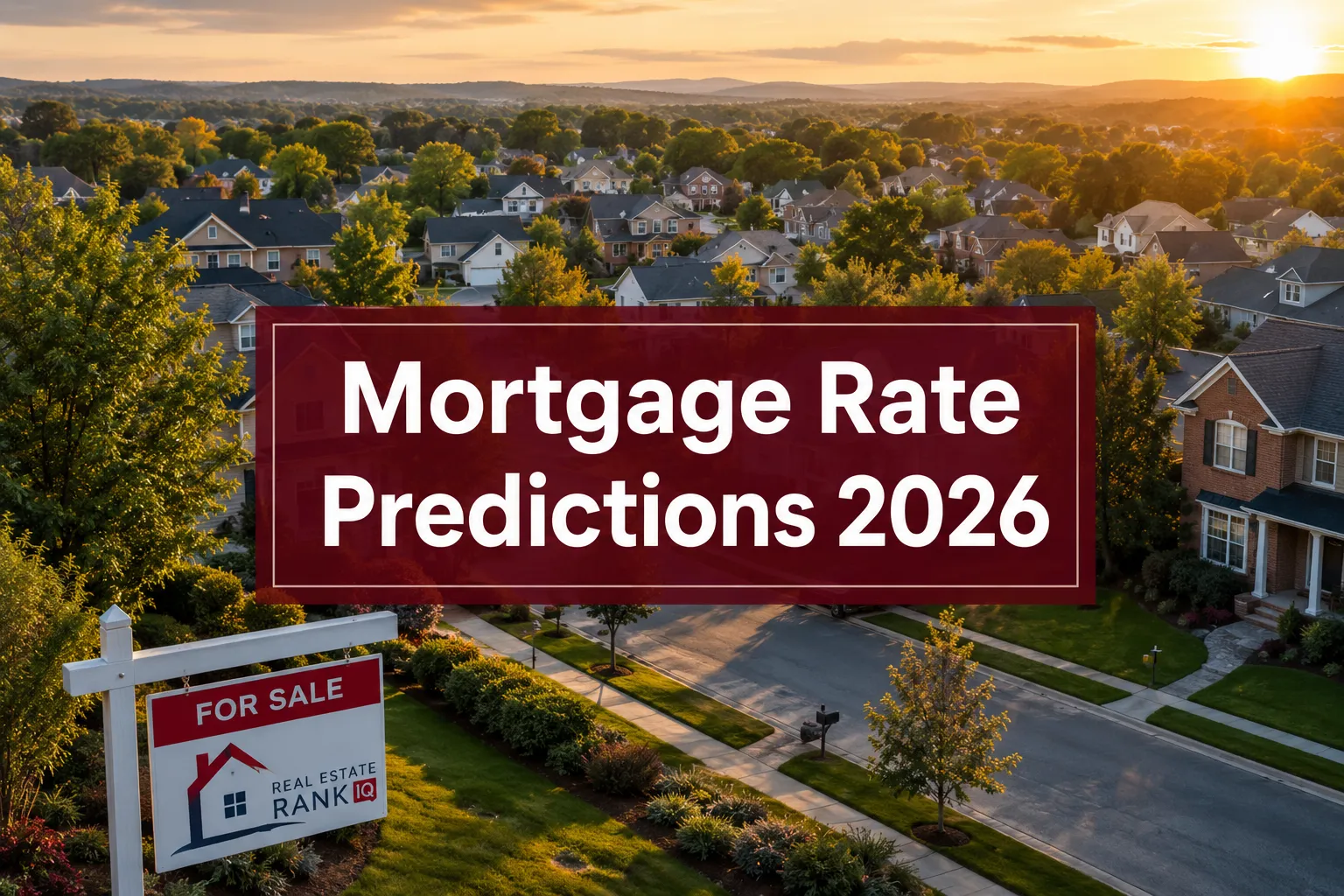
Quick Answer: Mortgage rates in fall 2026 are expected to ease modestly, with most expert forecasts placing the 30-year fixed rate in the 6.0%,6.5% range through Q3 and Q4. A dramatic drop is unlikely unless inflation falls faster than expected or the Federal Reserve accelerates its rate-cutting cycle. Buyers waiting for sub-5% rates may be waiting a long time.
Key Takeaways
- The 30-year fixed mortgage rate sat at approximately 6.11% in February 2026, according to Freddie Mac data cited by Real Estate Rank IQ.
- Fannie Mae's 2026 forecast projects the 30-year fixed rate averaging around 6.2% through the second half of 2026.
- The Federal Reserve held its federal funds rate steady in early 2026 after cutting rates three times in late 2024, per Federal Reserve meeting minutes.
- Mortgage rates track the 10-year U.S. Treasury yield more closely than the Fed funds rate, a distinction most buyers miss.
- The Mortgage Bankers Association (MBA) forecasts 30-year rates ending 2026 near 6.4%, reflecting a slow, gradual decline.
- Buyers who locked rates in early 2026 near 6.1% captured one of the better entry points seen since 2022.
- Refinancing activity is expected to pick up if rates dip below 6.0%, a threshold that triggers meaningful monthly savings for most borrowers.
What Factors Influence Mortgage Rates in 2026?
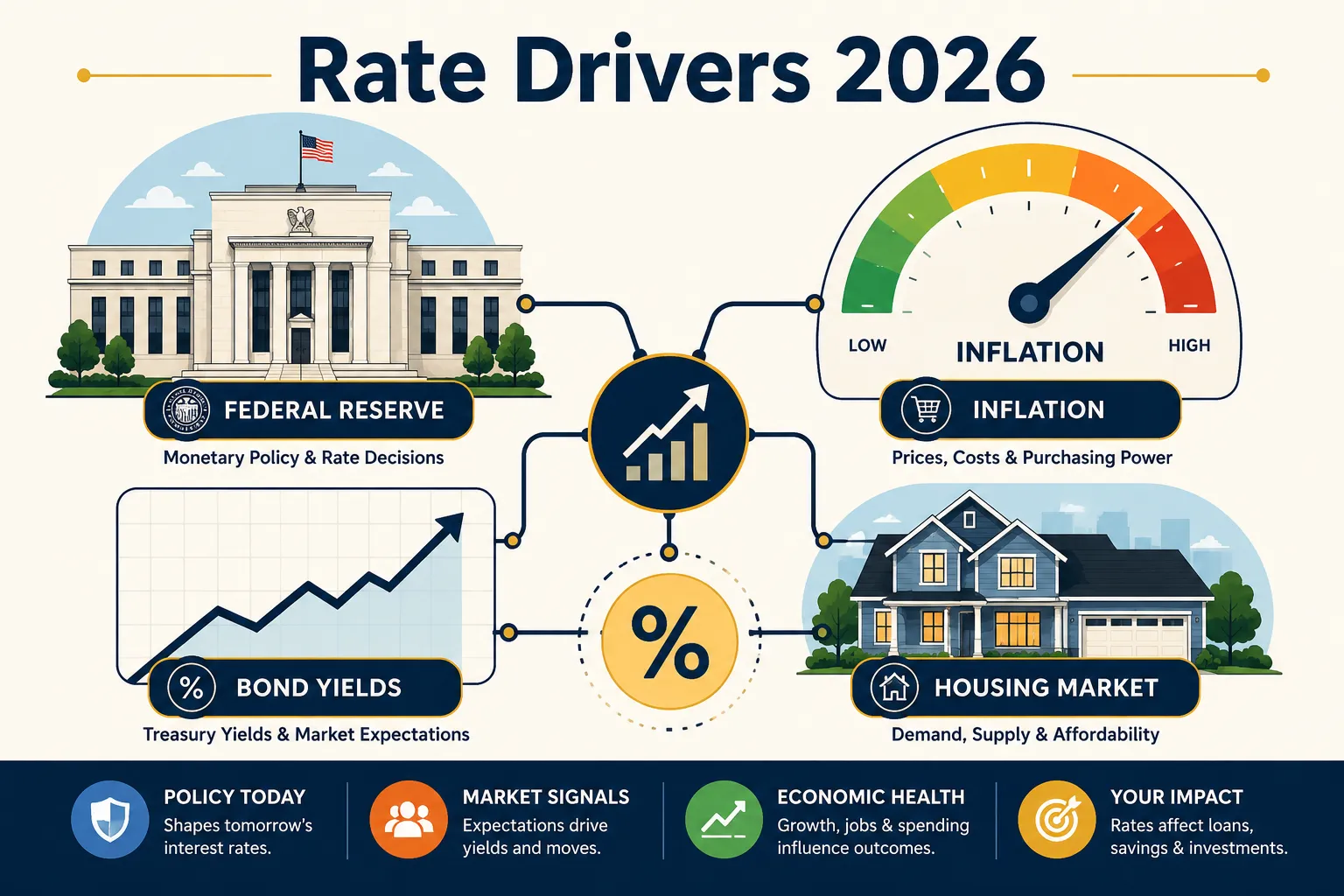
Mortgage rates in 2026 are shaped by a mix of inflation data, Federal Reserve policy, bond market activity, and global economic signals. No single factor controls the number you see on a lender's rate sheet, it's a combination that shifts daily.
Here's what's actually moving the needle this year:
- 10-Year Treasury Yield: This is the single biggest driver. When bond investors demand higher returns, mortgage rates follow. As of mid-2026, the 10-year Treasury has hovered between 4.2% and 4.6%, keeping mortgage rates elevated above 6%.
- Inflation (CPI): The Consumer Price Index directly influences Fed decisions. When CPI cools, the Fed has room to cut rates, which eventually filters into mortgage pricing.
- Federal Reserve Policy: The Fed doesn't set mortgage rates directly, but its federal funds rate signals borrowing costs across the economy. Three Fed cuts in late 2024 helped nudge rates down from their 2023 peak near 8%.
- Mortgage-Backed Securities (MBS) Demand: When investors buy MBS, lenders can offer lower rates. The federal government's $200 billion MBS purchase program in 2026 has been a quiet but real factor in keeping rates from spiking. Read more about how that program works in our breakdown of how the Federal Government's $200 billion MBS purchase is lowering mortgage rates in 2026.
- Unemployment Rate: A rising unemployment rate signals economic weakness, which typically pushes bond yields lower and can bring mortgage rates down with them.
- Global Capital Flows: When foreign investors park money in U.S. Treasuries (a safe-haven move), yields drop and mortgage rates can ease.
Common mistake: Many buyers assume the Fed cutting rates means their mortgage rate drops the next week. That's not how it works. The transmission takes months and depends heavily on bond market reaction.
Mortgage Rate Predictions 2026: What Are Experts Forecasting?
The consensus among major housing forecasters for Mortgage Rate Predictions 2026 points to a slow, grinding decline, not a dramatic fall. Think of it less like a cliff drop and more like a long, gradual slope.
Here's where the major institutions stand as of mid-2026:
| Forecaster | Q3 2026 Forecast | Q4 2026 Forecast | Key Assumption |
|---|---|---|---|
| Fannie Mae | ~6.2% | ~6.1% | Gradual Fed easing, stable inflation |
| Mortgage Bankers Association (MBA) | ~6.3% | ~6.4% | Modest Fed cuts, resilient economy |
| Freddie Mac | ~6.0%,6.3% | ~6.0%,6.2% | Inflation trending toward 2% Fed target |
| National Association of Realtors (NAR) | ~6.1% | ~5.9%,6.1% | Two additional Fed cuts in H2 2026 |
The most optimistic scenario, rates touching 5.9% by year-end, requires the Fed to cut twice more in the second half of 2026 AND for inflation data to cooperate. That's not impossible, but it's the best-case read, not the base case.
For a deeper look at how the spring market set the stage for these forecasts, check out our Spring 2026 Housing Market outlook on lower rates and rising inventory.
How Do Federal Reserve Decisions Affect Mortgage Rates?
The Fed influences mortgage rates indirectly, not directly. When the Fed raises or cuts the federal funds rate, it changes the cost of short-term borrowing between banks, but mortgage rates are long-term instruments priced off the bond market.
Here's the actual chain of events:
- The Fed cuts its benchmark rate.
- Bond investors reassess inflation expectations.
- The 10-year Treasury yield adjusts (up or down).
- Lenders reprice mortgage rates based on the new yield environment.
- The rate you see on Zillow or your lender's site reflects that repricing, sometimes days later, sometimes weeks.
The Fed cut rates three times in late 2024 (totaling 75 basis points), per Federal Reserve meeting records. Mortgage rates responded, but not proportionally, they dropped roughly 50 basis points over that same period because bond markets had already priced in some of those cuts in advance.
Decision rule: If the Fed signals more cuts are coming, mortgage rates often drop before the actual cut. Smart buyers watch Fed meeting language, not just the headline rate decision.

What's the Difference Between Mortgage Rates and the Prime Rate?
Mortgage rates and the prime rate are related but measure different things. The prime rate is what banks charge their most creditworthy business customers for short-term loans. Mortgage rates are long-term consumer loan rates tied to the bond market.
- Prime Rate: Moves directly with the Fed funds rate. As of mid-2026, the prime rate sits at approximately 7.5% (Fed funds rate + 3%).
- 30-Year Fixed Mortgage Rate: Tied to the 10-year Treasury yield plus a spread (typically 1.5%,2%). Currently near 6.1%,6.3%.
- 15-Year Fixed Mortgage Rate: Priced lower than the 30-year, typically 0.5%,0.75% less. If you're weighing the two, our 15 vs 30-year mortgage rates guide for 2026 breaks down the long-term savings math clearly.
The prime rate matters more for HELOCs, credit cards, and adjustable-rate products. If you're getting a 30-year fixed mortgage, watch the 10-year Treasury, not the prime rate.
How Do Inflation and Unemployment Affect Mortgage Rates?
Inflation and unemployment are the two economic signals the Fed watches most closely, and both feed directly into mortgage rate direction.
Inflation's role: When inflation runs hot, bond investors demand higher yields to protect their returns. Higher yields push mortgage rates up. The Fed's 2% inflation target is the goalpost. As of mid-2026, CPI has been running near 2.8%,3.1% (Bureau of Labor Statistics, 2026), which is why rates haven't fallen faster.
Unemployment's role: A rising unemployment rate signals the economy is slowing. That typically means the Fed will cut rates to stimulate growth, which eventually eases mortgage rates. The U.S. unemployment rate sat near 4.1% in early 2026 (Bureau of Labor Statistics, 2026), elevated enough to keep the Fed cautious but not alarming enough to trigger emergency cuts.
Think of it like a thermostat. Inflation too hot? Rates go up. Economy too cold? Rates come down. Right now, we're in a lukewarm middle zone, which is exactly why Mortgage Rate Predictions 2026 cluster in that 6%,6.5% band rather than swinging dramatically in either direction.
Should I Lock In My Mortgage Rate Now or Wait?
For most buyers in 2026, locking in a rate now makes more sense than waiting for a significant drop. Rates are unlikely to fall more than 0.25%,0.5% by year-end based on current forecasts, and waiting carries real costs.
Here's how to think about it:
Lock now if:
- You've found the right home at the right price.
- Your rate is at or below 6.3% on a 30-year fixed.
- You plan to stay in the home 5+ years (the break-even math favors locking).
- You can't absorb the financial risk of rates rising before closing.
Consider waiting if:
- You're 90+ days from closing and your lender offers a float-down option.
- You have strong evidence the Fed will cut rates at the next meeting.
- You're buying in a market with strong seller concessions that offset a slightly higher rate.
Common mistake: Buyers wait for the "perfect" rate and miss the right home. A 0.25% rate difference on a $400,000 loan changes your monthly payment by roughly $60, not nothing, but not worth losing a home over.
For buyers navigating the financing side from scratch, our real estate financing guide covering mortgages, credit, and down payments is an impeccable starting point.
What Happens to My Mortgage If Rates Drop After I Lock In?
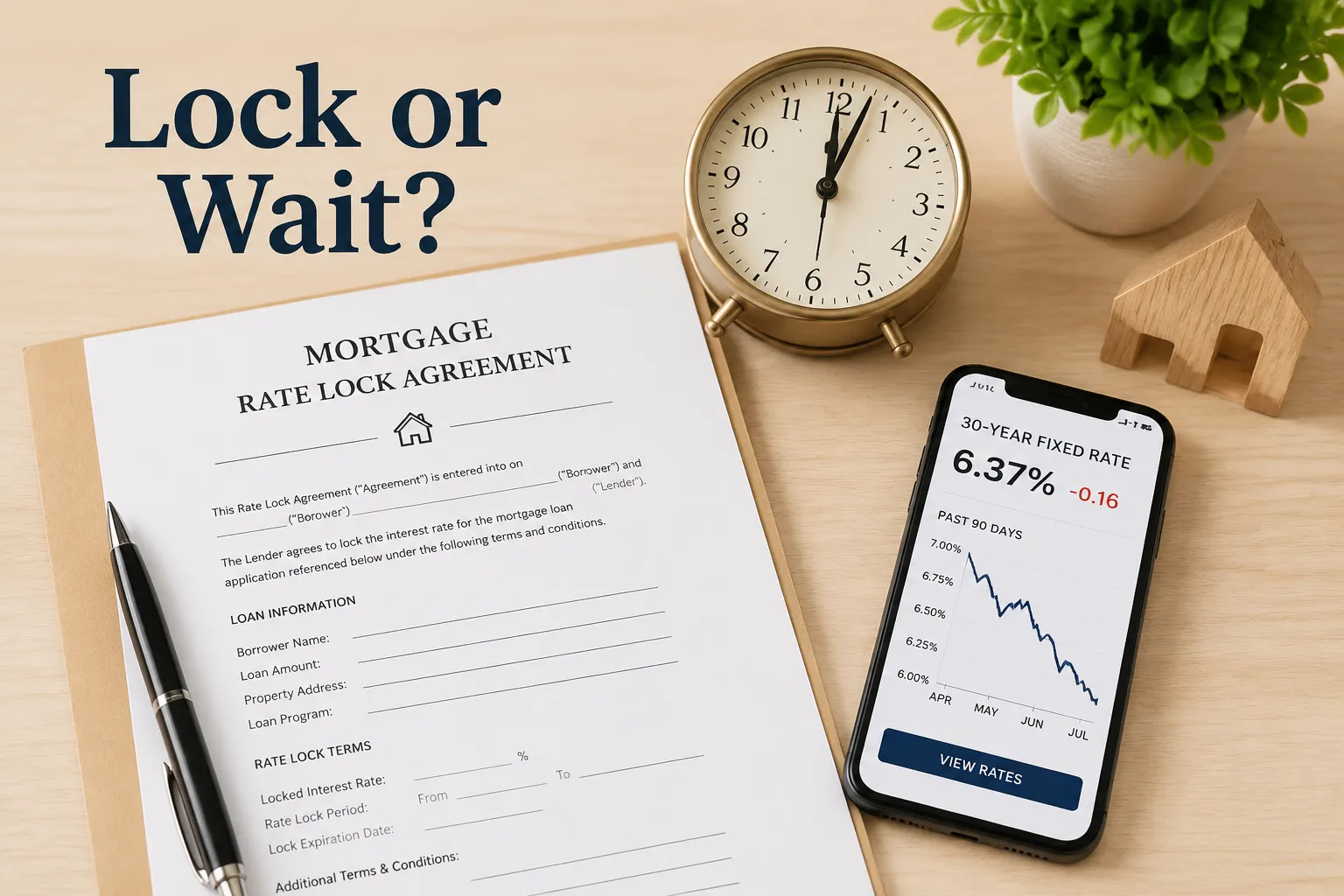
If rates drop after you lock, your locked rate stays in place, unless your lender offers a float-down option. A standard rate lock is a one-way commitment: you're protected if rates rise, but you don't automatically benefit if they fall.
Float-down option: Some lenders offer this for a fee (typically 0.1%,0.5% of the loan amount). It allows you to capture a lower rate if rates drop by a defined amount (usually 0.25% or more) before closing.
Renegotiating your lock: In rare cases, if rates drop significantly, you can ask your lender to renegotiate. Most won't do this without restarting the process, which costs time and potentially money.
The real play: If you lock at 6.2% and rates drop to 5.8% within a year of closing, you refinance. That's not a failure, that's the system working as designed.
Can I Refinance If Rates Go Down in 2026?
Yes, and refinancing in 2026 is a real strategy worth planning for now. If rates drop to the 5.75%,6.0% range by late 2026 or into 2027, millions of borrowers who locked in at 6.5%,7.5% over the past two years will have a clear refinancing opportunity.
The general rule of thumb: refinancing makes sense when you can lower your rate by at least 0.75%,1.0% AND you plan to stay in the home long enough to recoup closing costs (typically 2-3 years).
Refinancing costs to expect:
- Closing costs: 2%,5% of the loan amount
- Break-even period: 18-36 months on average
- Credit score requirement: Most lenders want 620+ for conventional; 740+ for the best rates
Fresh data from the Mortgage Bankers Association shows refinancing applications have already started climbing in mid-2026 as borrowers anticipate further rate relief. If you're a homeowner who bought in 2023 at 7%+, start tracking rates now and get pre-qualified so you can move fast when the window opens.
For investors specifically, our best HELOC lenders for investment property guide covers how to use equity strategically when rates shift.
How Accurate Are Mortgage Rate Predictions?
Straight answer: not very accurate beyond 6 months. Mortgage rate forecasting is more art than science, and even the best economists get it wrong regularly.
Consider: In early 2022, almost no major forecaster predicted the 30-year fixed rate would hit 7.08% by October of that year (Freddie Mac, 2022). The speed of the Fed's rate-hiking cycle caught nearly everyone off guard.
Why predictions miss:
- Geopolitical events (wars, trade policy shifts) move bond markets instantly.
- Inflation data surprises in either direction.
- Fed communication changes market expectations overnight.
- Global capital flows are unpredictable.
So based on the data we have: Mortgage Rate Predictions 2026 from major institutions are useful as a range, not a precise target. Treat the 6.0%,6.5% forecast band as a planning tool, not a promise.
The honest broker advice: don't gate keep your home purchase waiting for a number that may never arrive. Make decisions based on your financial situation, not a forecast.
Mortgage Rate Trends: Historical Comparison 2024 vs 2026
Rates have moved meaningfully over the past two years, and context matters for buyers trying to decide if now is a good time.
- October 2023: 30-year fixed peaked near 7.79% (Freddie Mac, 2023), the highest since 2000.
- Early 2024: Rates eased to the 6.6%,7.0% range as inflation cooled slightly.
- Late 2024: Three Fed cuts pushed rates toward 6.5%,6.8%.
- February 2026: 30-year fixed sat at 6.11% (Freddie Mac, as reported by Real Estate Rank IQ).
- Mid-2026: Rates range from 6.1%,6.4% depending on lender and loan type.
The trend is clear: rates are down roughly 150 basis points from their 2023 peak. That's real progress, and it's already reshaping buyer behavior. Our piece on 2026 real estate trends and how stable 6% rates are reshaping buyer and seller strategies goes deep on what this means for your next move.
How Far in Advance Should I Shop for Mortgage Rates?
Start shopping 60-90 days before your target closing date. That gives you enough time to compare lenders, get pre-approved, and lock in a rate without the clock pressure that leads to bad decisions.
The shopping playbook:
- Pull your credit report and fix any errors 90-120 days out.
- Get pre-approval quotes from at least 3 lenders simultaneously (multiple credit pulls within 14-45 days count as one inquiry under FICO scoring rules).
- Compare APR, not just the interest rate, APR includes fees.
- Ask each lender about rate lock periods (30, 45, 60 days) and float-down options.
- Lock when you have a signed purchase agreement and the rate fits your budget.
Common mistake: Waiting until you have a signed contract to start shopping. By then, you have 30-45 days to close and zero negotiating leverage with lenders.
For first-time buyers building their mortgage knowledge from the ground up, our first-time homebuyer guide is a fresh resource that walks through every step without the jargon wall.
What If Rates Don't Drop, Should I Still Buy or Refinance?
If rates stay in the 6%,6.5% range through the end of 2026, the answer for most buyers is still yes, with the right approach.
For buyers: The rent vs. buy math has shifted. Rents in many U.S. markets remain elevated, and home prices in most metros have held steady or risen modestly in 2026. Waiting for lower rates while paying rent is a real cost that doesn't build equity.
For refinancers: If your current rate is 7.5% or higher, a refinance to 6.2% still saves meaningful money. On a $350,000 loan balance, dropping from 7.5% to 6.2% saves approximately $285/month, that's real money even before rates hit the "perfect" level.
The so based take: Extraordinary opportunities don't always look like rock-bottom rates. Sometimes they look like a motivated seller, a well-priced home, and a rate you can refinance later. Let it cook before you see results, building equity at 6.2% beats sitting on the sidelines at 0%.
For sellers wondering how rate trends affect their pricing strategy, our 2026 home sellers pricing playbook is worth a read before you list.
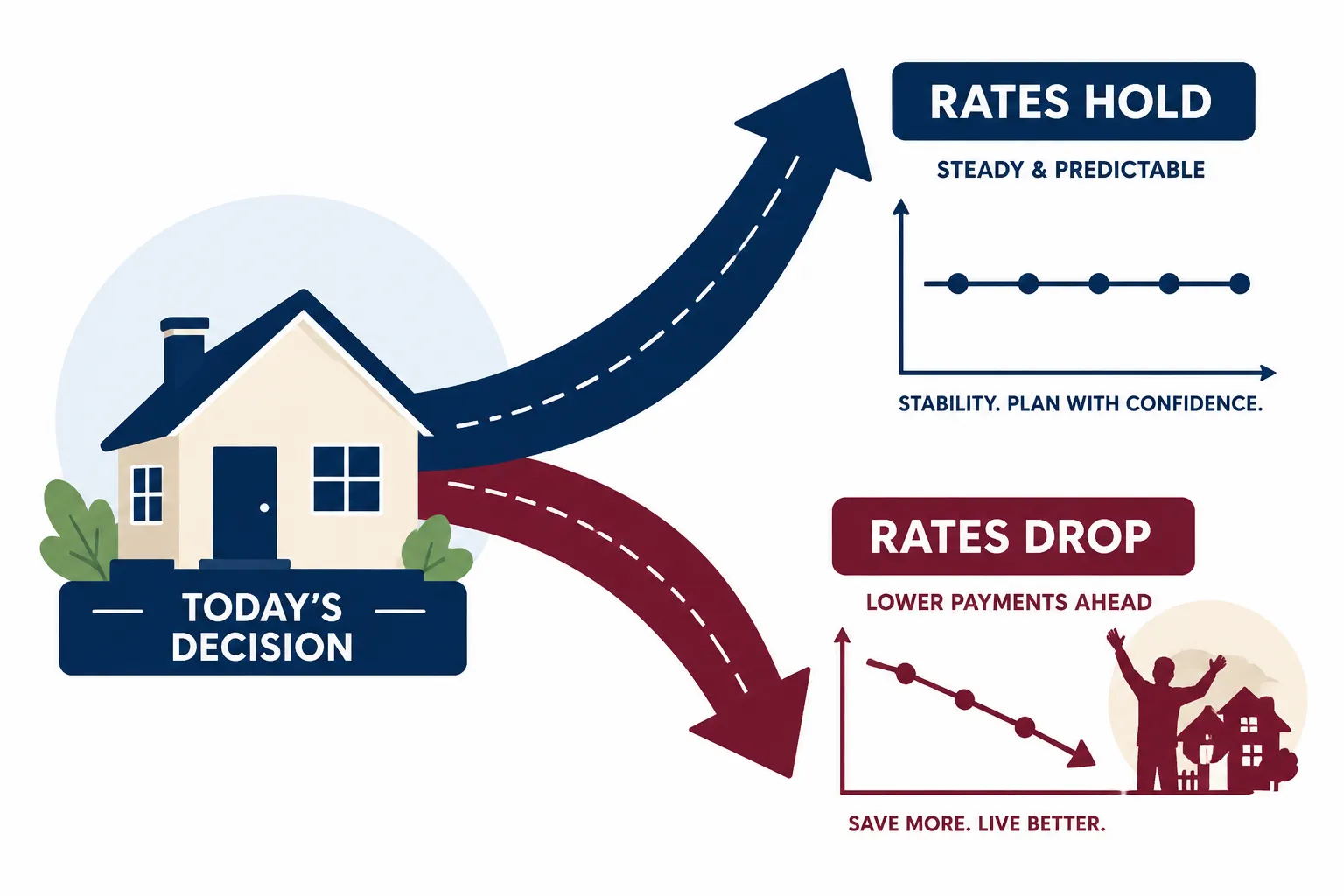
Frequently Asked Questions: Mortgage Rate Predictions 2026
Will mortgage rates drop below 6% in fall 2026?
Possibly, but it's not the base case. Most forecasters project rates staying in the 6.0%,6.3% range through Q3 and Q4 2026. A drop below 6% would require at least two additional Fed rate cuts and continued cooling of inflation data, both possible but not guaranteed.
What is the mortgage rate prediction for the end of 2026?
The Mortgage Bankers Association forecasts the 30-year fixed rate near 6.4% by year-end 2026. Fannie Mae projects closer to 6.1%. The realistic range is 5.9%,6.5% depending on how Fed policy and inflation data evolve in the second half of the year.
How does the Federal Reserve affect my mortgage rate?
The Fed doesn't set mortgage rates directly. It sets the federal funds rate, which influences bond yields. Mortgage rates track the 10-year U.S. Treasury yield, which responds to Fed policy but also to inflation expectations, economic data, and global capital flows. Fed cuts help, but the effect isn't immediate or one-to-one.
Is it better to get a 15-year or 30-year mortgage in 2026?
It depends on your cash flow and goals. A 15-year mortgage carries a lower rate (currently around 5.5%,5.7%) but a higher monthly payment. A 30-year offers lower monthly payments with flexibility to pay extra when you can. Our 15 vs 30-year mortgage comparison for 2026 breaks down the exact savings math.
What credit score do I need to get the best mortgage rate in 2026?
To qualify for the lowest rates on a conventional loan, lenders typically want a 740+ credit score. Scores between 680-739 will still qualify, but expect a rate 0.25%,0.75% higher. FHA loans accept scores as low as 580 with a 3.5% down payment.
Should I use a mortgage broker or go directly to a lender in 2026?
A mortgage broker shops multiple lenders on your behalf, which often results in better rates and terms, especially for borrowers with complex financial profiles. Direct lenders are faster but give you one quote. Our breakdown of mortgage broker vs direct lender for investors covers the tradeoffs clearly.
How many times can I refinance my mortgage?
There's no legal limit on how many times you can refinance. The practical limit is the break-even calculation, each refinance costs 2%,5% in closing costs, so you need to stay in the home long enough to recoup those costs through monthly savings before refinancing again.
Are adjustable-rate mortgages (ARMs) a good idea in 2026?
ARMs can make sense if you plan to sell or refinance within 5-7 years. A 5/1 ARM in 2026 typically starts 0.5%,1.0% below the 30-year fixed rate. The risk: if rates rise again after the initial fixed period, your payment increases. For buyers planning a long-term hold, a fixed rate offers more predictability.
What This All Means for Your Next Move
Mortgage Rate Predictions 2026 point to a market that's improving but not dramatically. Rates are down from their 2023 peak, the direction is gradually lower, and the housing market is adjusting in real time.
Here's the actionable summary:
- Buyers: Don't wait for a rate that may not arrive. Shop 3+ lenders, compare APR, and lock when the numbers work for your budget. A rate you can refinance later beats a home you never buy.
- Sellers: Buyers are rate-sensitive but active. Price your home correctly and consider offering rate buydowns as a concession, it's one of the most effective tools in a 6%+ rate environment.
- Investors: The gap between cap rates and mortgage rates is tightening. Model your deals at current rates, not hoped-for rates, and focus on markets with strong rent growth. Our best states to invest in real estate in 2026 gives you the data-backed starting point.
- Refinancers: If your rate is 7%+, start tracking now. Set a rate alert, get your financials in order, and be ready to move when the spread makes sense.
The market rewards preparation. Whether rates drop this fall or hold steady, the buyers and investors who did the work, got pre-approved, shopped lenders, understood the numbers, are the ones who close. So based on everything we're seeing in 2026, the best move is the one you're actually ready to make.
For ongoing market updates, rate news, and broker-backed analysis, visit us at realestaterankiq.com or subscribe to our newsletter at news@realestaterankiq.com.
References
- Freddie Mac Primary Mortgage Market Survey. (2022, 2023). Weekly mortgage rate data. https://www.freddiemac.com/pmms
- Fannie Mae Economic & Strategic Research Group. (2026). Housing Forecast. https://www.fanniemae.com/research-and-insights/forecast
- Mortgage Bankers Association. (2026). Mortgage Finance Forecast. https://www.mba.org/news-and-research/research-and-economics/single-family-research/mortgage-finance-forecast
- Bureau of Labor Statistics. (2026). Consumer Price Index and Employment Situation Summary. https://www.bls.gov
- National Association of Realtors. (2026). Housing Statistics and Real Estate Market Trends. https://www.nar.realtor/research-and-statistics
- Federal Reserve. (2024). FOMC Meeting Minutes and Press Releases. https://www.federalreserve.gov/monetarypolicy/fomccalendars.htm
- Real Estate Rank IQ. (2026). Current Mortgage Rates February 2026: 30-Year at 6.11%. https://realestaterankiq.com/current-mortgage-rates-february-2026-30-year-fixed-at-6-11-what-buyers-need-to-know/