
Last updated: July 20, 2026

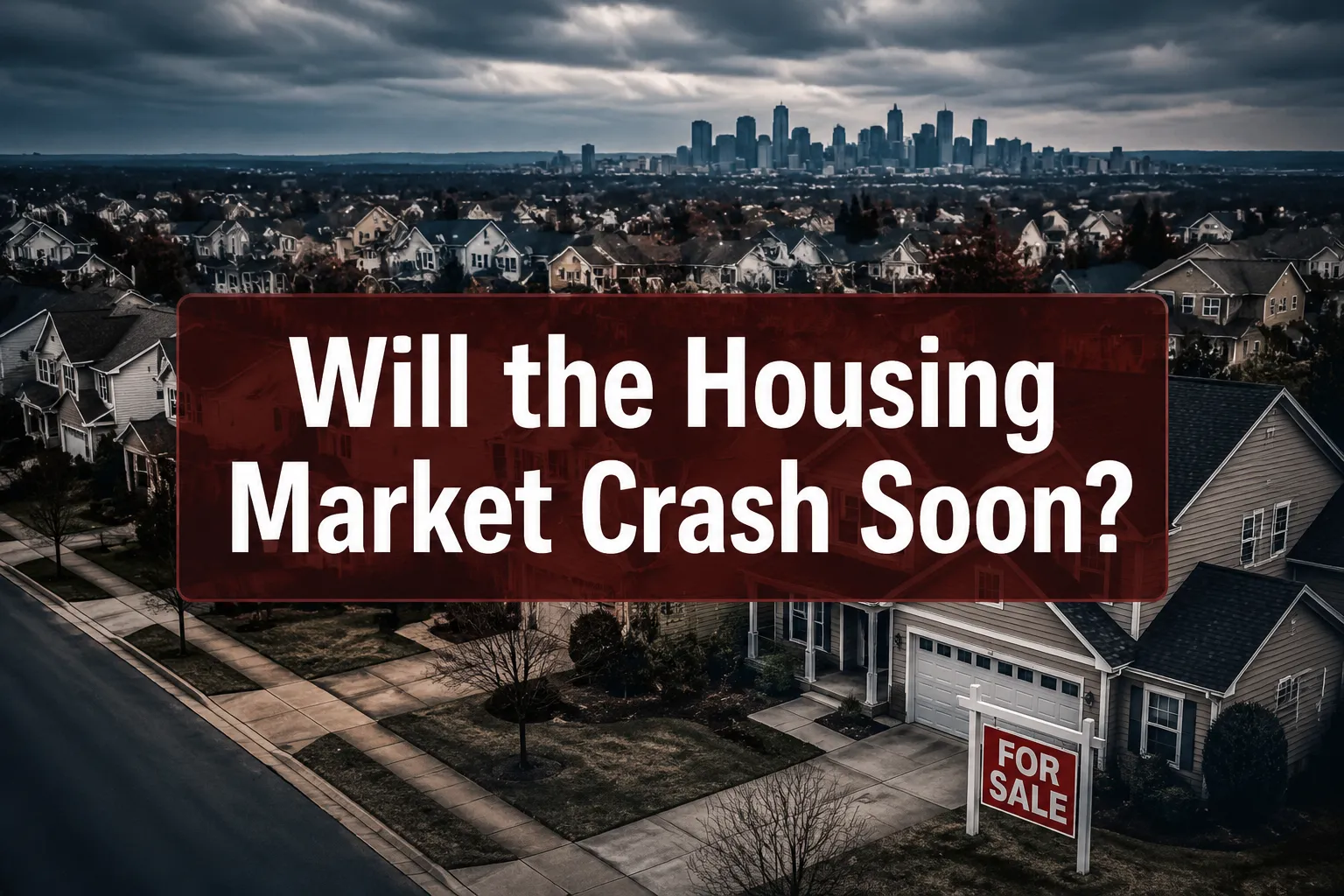
Quick Answer: The U.S. housing market in 2026 is not in a crash, but it is showing stress fractures worth watching. Prices in several metros have softened, inventory is rising, and affordability remains stretched. A full crash requires a specific combination of forced selling, credit collapse, and demand destruction that we are not seeing nationally right now, but five key signals tell you whether that changes.
Key Takeaways
- The National Association of Realtors (NAR) reported that existing home sales fell to a 30-year low in 2023, signaling deep affordability strain that carried into 2025 and 2026.
- The Federal Reserve held its benchmark rate at 5.25%,5.50% through much of 2024 before beginning gradual cuts; mortgage rates in mid-2026 remain near 6.5%,7% (Freddie Mac, 2026).
- A housing market correction is defined as a 10%,20% price decline; a crash is typically 20%+ with widespread foreclosures, the U.S. is not there nationally as of 2026.
- The 2008 crash was driven by subprime lending, loose underwriting, and mortgage-backed securities risk, today's lending standards are significantly tighter (Urban Institute, 2023).
- Inventory levels, foreclosure rates, days on market, debt-to-income ratios, and unemployment are the five core signals to track.
- First-time buyers and investors should watch local market data, not just national headlines, conditions in Phoenix, Austin, and Tampa differ sharply from New York and Chicago.
- Protecting home equity through fixed-rate mortgages, avoiding cash-out overextension, and building reserves are the best hedges if conditions worsen.
What Actually Causes a Housing Market Crash
A housing market crash does not happen because prices feel high. It happens when a specific set of conditions converge: forced selling at scale, credit markets seizing up, and demand collapsing faster than supply can adjust.
The three core drivers of a true crash are:
- Overleveraged borrowers who cannot make payments and must sell, or get foreclosed on, all at the same time
- Credit contraction where lenders stop issuing mortgages, cutting off the buyer pool
- Demand destruction caused by job losses, rising rates, or economic recession deep enough to sideline buyers for years
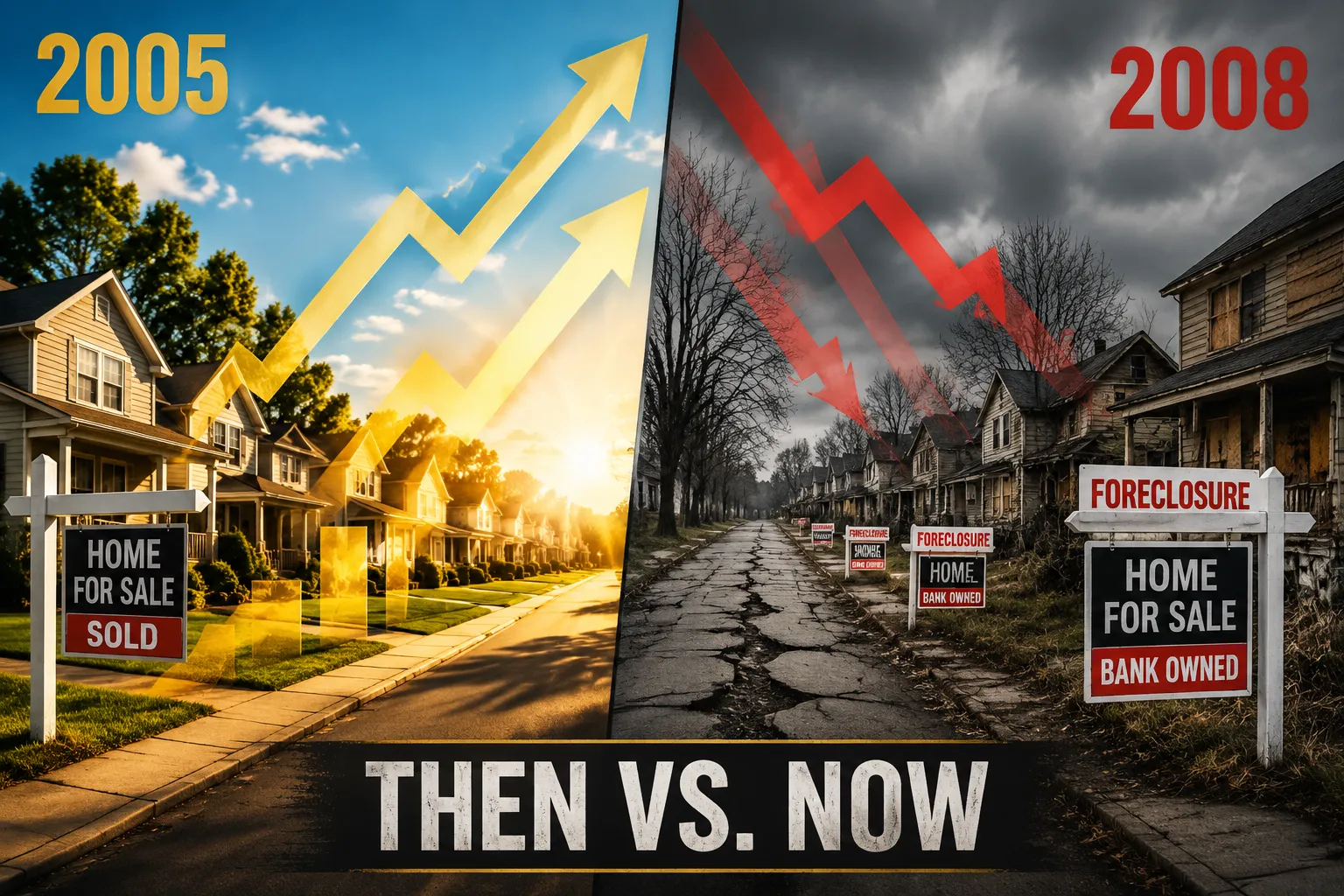
The 2008 crisis is the clearest modern example. Banks issued adjustable-rate and subprime loans to borrowers who could not sustain payments once rates reset. When those borrowers defaulted en masse, it triggered a foreclosure wave that flooded the market with distressed inventory and cratered prices by roughly 30% nationally (S&P Case-Shiller, 2012).
The 2026 market does not mirror 2008. Lending standards are tighter, most homeowners locked in 30-year fixed rates at 3%,4% during 2020-2022, and the share of adjustable-rate mortgages is far lower. That said, affordability stress is real, and certain local markets are more exposed than others.
"The difference between 2008 and now is equity. Most homeowners today have it. In 2008, millions didn't.", Urban Institute Housing Finance Policy Center, 2023
Will the Housing Market Crash Soon? The 5 Signs to Watch Right Now
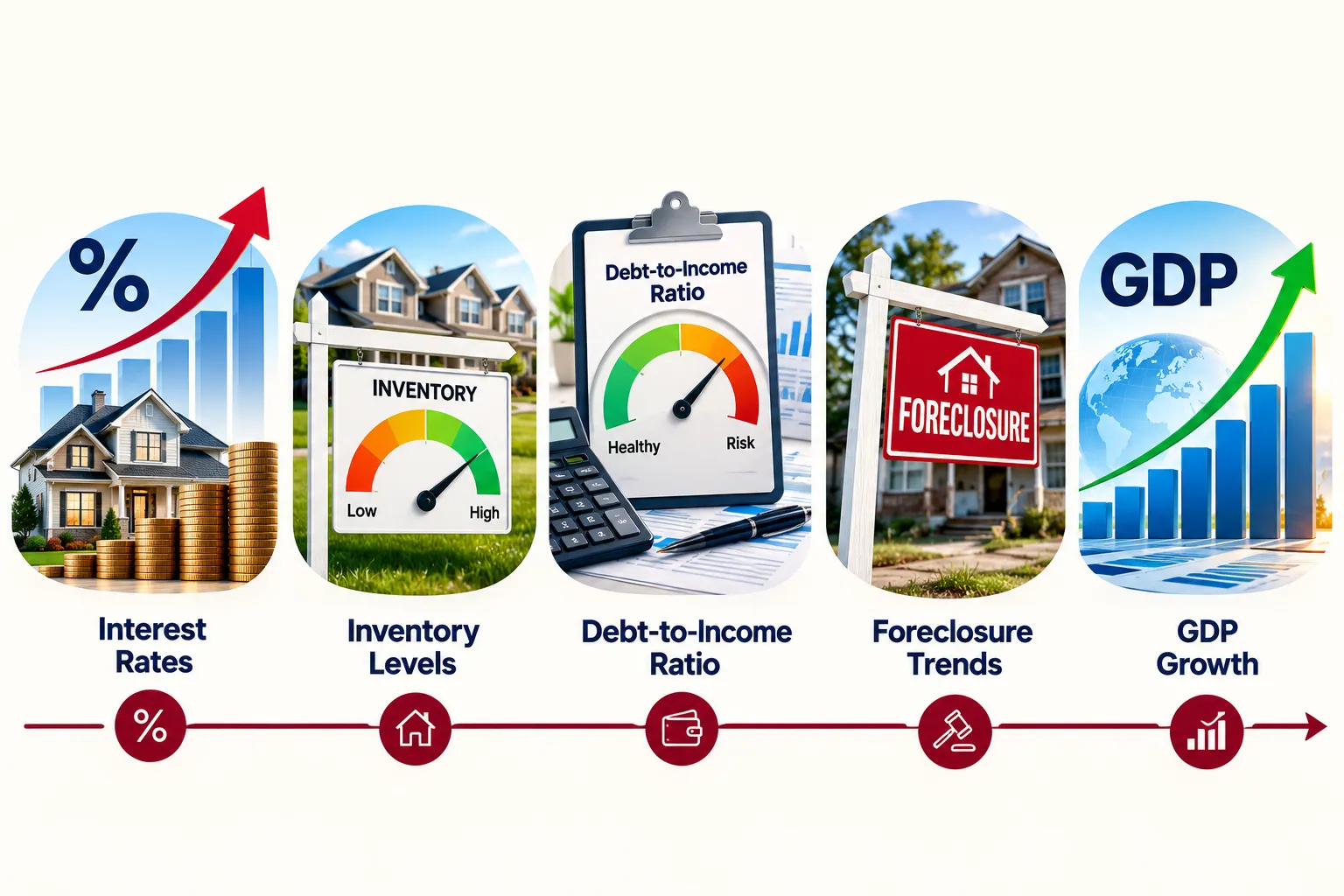
This is the real question, and the answer is not a simple yes or no. Here are the five signals that brokers and economists watch most closely. Think of them as a dashboard: one blinking light is not a crisis, but three or four lighting up at once is worth serious attention.
Sign 1: Rising Foreclosure Rates
Foreclosures are the canary in the coal mine. When homeowners start defaulting in volume, distressed inventory floods the market, prices drop, and panic selling follows.
As of early 2026, foreclosure filings remain historically low compared to 2008-2012 levels. ATTOM Data Solutions reported that U.S. foreclosure activity in 2024 was still roughly 60% below pre-pandemic 2019 levels. The reason: homeowners who locked in low fixed rates have little incentive to default unless they lose their jobs. Watch for any sustained month-over-month increase in foreclosure starts, that is the first real warning.
Sign 2: Inventory Surges Past 6 Months of Supply
A balanced market has about 4-6 months of housing supply. Below 4 months favors sellers; above 6 months favors buyers and puts downward pressure on prices.
NAR data showed national existing home inventory hovering around 3-4 months of supply in early 2026, still below balanced territory in most markets. However, certain Sun Belt metros like Austin, TX and Tampa, FL saw inventory climb above 5-6 months in late 2025, contributing to price softening in those areas. Check your local market's months of supply, it matters more than the national number.
Sign 3: Mortgage Rates Stay Elevated or Spike Again
High mortgage rates do not cause a crash on their own, but they destroy affordability and choke transaction volume. When buyers cannot qualify, demand falls, and sellers who must move are forced to cut prices.
Freddie Mac's weekly survey showed 30-year fixed rates averaging near 6.7%,7.0% through mid-2026. At that level, a $400,000 home purchase carries a monthly principal and interest payment roughly 60% higher than it would have at 2021's 3% rates. That math squeezes first-time buyers hardest. If rates spike back above 7.5% without a corresponding income increase, expect transaction volume to fall further and price cuts to accelerate in rate-sensitive markets.
Sign 4: Unemployment Rises Above 5%,6%
Jobs underpin everything. Employed homeowners make their mortgage payments. When unemployment rises sharply, think 2008's climb from 4.5% to 10%, forced selling begins.
The U.S. Bureau of Labor Statistics reported national unemployment at approximately 4.1%,4.3% in early 2026. That is not alarming, but it is worth watching given ongoing layoffs in tech, finance, and retail sectors. A sustained move above 5% nationally, especially paired with rising mortgage rates, would be a genuine red flag.
Sign 5: Price-to-Income Ratios Reach Unsustainable Levels
When home prices grow far faster than household incomes, the market becomes structurally fragile. Buyers stretch to qualify, savings get depleted, and any economic shock tips them over.
Harvard's Joint Center for Housing Studies reported in 2024 that housing cost burdens, defined as spending more than 30% of income on housing, reached record highs, with over 22 million renter households and a growing share of owner households cost-burdened. In metros like Los Angeles, Miami, and New York, price-to-income ratios are at or near historic peaks. That does not guarantee a crash, but it means the floor is thinner.
How Likely Is a Housing Market Crash in 2025-2026?
Most major forecasters do not predict a national crash in 2026, but they do expect continued price softening in overheated markets. A correction, yes. A crash on the scale of 2008, unlikely.
Redfin's 2026 housing outlook projected modest national price growth of 1%,3% for the year, with select metros seeing flat or slightly negative appreciation. Goldman Sachs and Moody's Analytics both maintained in late 2025 that the structural undersupply of housing, estimated at 3.8 million units nationally by Freddie Mac, acts as a price floor that 2008 simply did not have.
For a deeper read on where the market is heading, check out The Great Housing Reset: Redfin's 2026 Market Predictions and our full breakdown of the Spring 2026 Housing Market outlook.
The short version: the national market is not crashing, but it is not healthy either. Affordability is broken in many cities, and the recovery depends heavily on whether rates fall meaningfully and whether builders can close the supply gap.
What Is the Difference Between a Correction and a Crash?
A correction is a 10%,20% price decline from peak levels, typically concentrated in specific markets or property types. A crash is a 20%+ decline with widespread foreclosures, credit market disruption, and multi-year recovery timelines.
Corrections are relatively common and often healthy. The U.S. housing market experienced corrections in the early 1980s, early 1990s, and in select markets during 2022-2023 when rates spiked. A crash is rare and requires a systemic failure, not just high prices or rising rates.
| Scenario | Price Decline | Foreclosure Wave | Recovery Time |
|---|---|---|---|
| Soft Landing | 0%,5% nationally | No | 12-18 months |
| Correction | 10%,20% in affected markets | Minimal | 2-4 years |
| Crash (2008-style) | 20%,35%+ nationally | Yes, widespread | 5-10 years |
| 2026 Outlook | Flat to -5% in select metros | No, low rates locked in | Ongoing adjustment |
What Happened During the 2008 Housing Crisis, And Why 2026 Is Different
The 2008 crash was, in a word, extraordinary in its scope and speed. It was not just a real estate event, it was a financial system failure.
The chain of events: banks and mortgage companies issued millions of subprime loans with teaser rates that reset sharply upward. Those loans were bundled into mortgage-backed securities and sold globally. When borrowers defaulted en masse, the securities collapsed, banks stopped lending, and home prices fell 30%+ nationally over three years (S&P Case-Shiller, 2012). Unemployment hit 10% by October 2009 (BLS). The recovery took a decade in many markets.
The 2026 market differs in three structural ways:
- Lending standards are tighter. The Dodd-Frank Act (2010) introduced qualified mortgage rules requiring documented income, debt-to-income limits, and ability-to-repay standards. The share of loans with FICO scores below 620 is a fraction of 2006 levels (Urban Institute, 2023).
- Homeowners have equity. The average homeowner had over $300,000 in home equity as of 2024 (CoreLogic). That buffer means most distressed homeowners can sell rather than foreclose.
- Supply is structurally short. In 2008, overbuilding created excess supply. Today, the U.S. is short an estimated 3.8 million homes (Freddie Mac, 2021). That undersupply acts as a price floor.
None of this makes the market immune to pain. It just means the mechanism for a 2008-style crash is not in place right now.
How Do Interest Rates Affect Housing Prices?
Interest rates and home prices move in opposite directions, when rates rise, affordability falls, demand drops, and prices face downward pressure. When rates fall, buying power increases and prices tend to rise.
The relationship is not instant, and it is not perfectly linear. Between 2022 and 2023, the Fed raised rates from near zero to 5.25%,5.50%, the fastest hiking cycle in 40 years. Mortgage rates went from 3% to over 8% at the peak. Yet national home prices only fell modestly because inventory was so tight that sellers held firm.
That is the "lock-in effect", homeowners with 3% mortgages have no incentive to sell and take on a 7% rate for their next home. This kept supply constrained even as demand fell. For more on how this dynamic is playing out in 2026, read our 2026 Real Estate Trends breakdown.
The bottom line on rates: a sustained move above 7.5%,8% would likely trigger meaningful price corrections in high-cost markets. A drop toward 5.5%,6% would reignite demand and potentially push prices higher in supply-constrained cities.
Can You Predict When the Housing Market Will Crash?
No one can predict a crash with precision, and anyone who claims otherwise is gate keeping information they do not actually have. What you can do is track leading indicators and adjust your strategy based on probability, not certainty.
Economists, brokers, and analysts use a combination of:
- Months of supply (rising above 6 months signals softening)
- Foreclosure filing trends (ATTOM Data Solutions tracks this monthly)
- Mortgage delinquency rates (Mortgage Bankers Association tracks 30, 60, and 90-day delinquencies)
- Consumer confidence and unemployment (BLS and Conference Board)
- Real home price indexes (S&P Case-Shiller, FHFA)
The honest broker answer: you cannot time the housing market the way you might time a stock trade. What you can do is read the signals, understand your local market's specific exposure, and make decisions based on your personal financial position, not fear or hype.
Are Housing Prices Going Down in Specific Areas in 2026?
Yes, in certain markets, prices are already declining or flat. This is not a national story; it is a local one.
Markets that saw the sharpest price softening heading into 2026 include:
- Austin, TX, Prices fell roughly 15%,18% from their 2022 peak by late 2025 (Zillow, 2025), driven by overbuilding and remote work reversals
- Phoenix, AZ, Similar correction of 10%,12% from peak
- Tampa, FL, Rising insurance costs and inventory growth put downward pressure on prices
- Boise, ID, One of the sharpest pandemic-era run-ups, followed by a meaningful correction
Markets holding firm or still appreciating include New York City, Chicago's North Shore, and most of coastal California, constrained by zoning and limited supply.
Our regional market rankings for 2026 break down which metros are heating up and which are cooling in real time. Also worth reading: our piece on which states are seeing the most dramatic housing price shifts this spring.
Is It a Good Time to Buy a House Right Now?
The answer is impeccable in its simplicity: it depends on your personal financial position, your local market, and your timeline, not on whether a crash is coming.
Here is the decision framework brokers actually use:
Buy now if:
- You plan to stay in the home for at least 5-7 years
- Your debt-to-income ratio is below 43%
- You have 10%,20% down plus 3-6 months of reserves
- Your local market has rising inventory and motivated sellers
- You can afford the payment at today's rates without stretching
Wait if:
- You would be house-poor at current rates
- You are in a market with falling prices and rising inventory
- Your employment situation is uncertain
- You are relying on a crash to make the numbers work
Trying to time the bottom of a housing market is like waiting for the perfect moment to start a workout routine, you can let it cook before you see results, but only if you actually start. For first-time buyers, our complete first-time homebuyer guide walks through every step of the process.

Should I Sell My House Before the Market Crashes?
Selling out of fear is rarely a sound strategy, especially when you have no place to go and would be re-entering the market as a buyer.
If you are thinking about selling, ask these questions first:
- Do you need to sell? Life events, job relocation, divorce, upsizing, downsizing, are valid reasons. Fear of a crash that may not materialize is not.
- What is your local market doing? If inventory is rising and days on market are climbing, pricing aggressively and selling sooner makes sense. If your market is still tight, you have time.
- What are your proceeds going toward? If you sell and rent, you are exposed to rent inflation. If you sell and buy elsewhere, you are still in the market.
The fresh reality is this: sellers who panic-listed in 2022-2023 when rates spiked often left money on the table because they misjudged the floor. Markets with structural undersupply do not crater the way fear-driven sellers expect.
For a step-by-step selling plan, our 60-day home selling checklist is a solid starting point.
How Do I Protect My Home Equity If the Market Crashes?
Protecting equity is about avoiding overextension, not about predicting the future. Here are the moves that matter:
- Do not cash out equity aggressively. A HELOC or cash-out refinance at peak value leaves you underwater if prices fall. If you are considering a HELOC, read our guide on how soon you can do a HELOC after purchasing before pulling the trigger.
- Stay on a fixed-rate mortgage. Adjustable rates create payment shock risk if rates rise. Fixed rates give you predictability.
- Build cash reserves. Six months of mortgage payments in liquid savings means a job loss does not force a fire sale.
- Avoid over-improving for your neighborhood. Renovations that push your home value well above comparable sales are hard to recoup in a down market.
- Hold for the long term. Every housing market crash in U.S. history has been followed by a full recovery. Time is the most so based hedge you have.
Is Renting Better Than Buying If a Crash Is Coming?
Renting is not automatically better than buying during market uncertainty, it depends on the rent-vs-buy math in your specific market and your personal timeline.
In high-cost markets like San Francisco, Los Angeles, and New York, renting is often the financially rational choice even without a crash on the horizon, because price-to-rent ratios are so stretched that buying generates negative real returns in the short term. Our full breakdown of renting vs. buying in 2026 covers the numbers in detail.
The key variables:
- Price-to-rent ratio: If annual rents are less than 5% of the home's purchase price, buying is typically more expensive in the short run
- Your timeline: Buying and selling within 2-3 years rarely pencils out after transaction costs (typically 8%,10% of the sale price)
- Rent trajectory: In markets with rising rents, locking in a fixed mortgage payment has real value
Renting while waiting for a crash that never comes is also a real risk. The U.S. has been "about to crash" according to some analysts since 2013. Renters who waited have paid significantly more in cumulative rent than they would have in mortgage payments in most markets.
What Should First-Time Homebuyers Do If a Crash Seems Possible?
First-time buyers should focus on financial preparation, not market timing. The buyers who regret their purchases most are those who stretched beyond their means, not those who bought before a correction.
The so based checklist for first-time buyers in an uncertain market:
- Get pre-approved (not just pre-qualified) so you know your real buying power
- Target a payment no more than 28%,30% of gross monthly income
- Put down at least 10% to avoid being underwater in a modest correction
- Choose a fixed-rate mortgage, the 15 vs. 30-year mortgage comparison is worth reading before you decide
- Buy in a market with strong employment fundamentals, not just low prices
- Plan to stay at least 5 years
The extraordinary buyers are not the ones who called the market bottom. They are the ones who bought a home they could afford, in a place they wanted to live, with a payment they could sustain through a recession. That is the whole playbook.

How Long Do Housing Market Crashes Usually Last?
Historical data gives us a useful range. The 2008 crash took roughly 5-7 years for national prices to fully recover, though some markets like Las Vegas and Phoenix took closer to 10 years (S&P Case-Shiller, 2019). The early 1990s correction lasted about 3-4 years in affected markets. The early 1980s rate-shock correction resolved in 2-3 years once rates fell.
The recovery timeline depends on:
- Depth of the price decline, deeper drops take longer to recover
- Speed of credit market recovery, if lending freezes, recovery stalls
- Employment conditions, job growth drives demand back into the market
- New construction pace, overbuilt markets take longer to absorb excess supply
For buyers and long-term investors, the lesson from every cycle is the same: markets recover. The risk is not buying during a correction, it is buying with too much debt and not enough runway to wait it out.
Frequently Asked Questions
Q: Will the housing market crash in 2026?
A: Most major forecasters, including Redfin and Goldman Sachs, do not predict a national crash in 2026. Prices in some overheated metros like Austin and Phoenix are correcting, but a 2008-style national crash is not the base case given tight lending standards, low foreclosure rates, and structural housing undersupply.
Q: What are the biggest warning signs of a housing market crash right now?
A: The five signs to watch are rising foreclosure rates, inventory surging above 6 months of supply, mortgage rates spiking above 7.5%, unemployment climbing above 5%,6%, and price-to-income ratios reaching unsustainable levels. None of these are at crisis levels nationally as of mid-2026.
Q: How is 2026 different from 2008?
A: Three key differences: lending standards are far tighter today, most homeowners have substantial equity (CoreLogic reported average equity over $300,000 in 2024), and the U.S. has a structural housing shortage of roughly 3.8 million units (Freddie Mac). In 2008, the market was overbuilt and overleveraged, the opposite of today.
Q: Should I wait to buy a house until the market crashes?
A: Only if your personal finances are not ready. Trying to time a crash that may not come, or may not affect your local market, often costs more in rent and missed equity than a modest price correction would. Buy when your finances are solid and you plan to stay 5+ years.
Q: What is the difference between a housing market crash and a correction?
A: A correction is a 10%,20% price decline in specific markets, typically without widespread foreclosures. A crash is 20%+ nationally with credit market disruption and multi-year recovery. The U.S. is experiencing localized corrections in 2026, not a national crash.
Q: How do rising mortgage rates affect my home's value?
A: Higher rates reduce buyer purchasing power, which softens demand and puts downward pressure on prices. However, if supply stays constrained, prices can hold even as rates rise, as seen in 2022-2023. The impact varies significantly by local market conditions.
Q: Is it better to rent or buy if a crash is coming?
A: It depends on your local price-to-rent ratio and your timeline. In high-cost markets, renting can be financially rational regardless of crash risk. In moderately priced markets with strong employment, buying and holding through a correction typically outperforms renting over a 5-10 year horizon.
Q: How can I protect my home equity if prices fall?
A: Avoid over-leveraging with cash-out refinances, stay on a fixed-rate mortgage, maintain 6 months of cash reserves, and hold long-term. Homeowners with substantial equity and fixed payments are insulated from all but the most severe downturns.
The Bottom Line: Read the Signals, Not the Headlines
The question of "Will the Housing Market Crash Soon? 5 Signs to Watch" does not have a single national answer, it has a local one. The five signals covered here (foreclosure rates, inventory levels, mortgage rates, unemployment, and price-to-income ratios) are your real dashboard. Watch them in your specific market, not just on cable news.
The 2026 market is stressed but not broken. Affordability is a genuine crisis in many cities. Certain metros are correcting. But the structural conditions for a 2008-style national crash, overleveraged borrowers, loose credit, and excess supply, are not in place.
Your next steps:
- Pull your local market's months of supply data from Realtor.com or Redfin
- Check your area's foreclosure filing trends at ATTOM Data Solutions
- Run your own rent-vs-buy math for your specific market and timeline
- If you are buying, get pre-approved and stress-test your payment at 7.5% rates
- If you are selling, price based on current comparable sales, not 2022 peaks
For more market intelligence, visit the RERIQ Hub, free, unbiased, built by brokers. You can also reach the team directly at news@realestaterankiq.com.
References
- National Association of Realtors (NAR). (2023). Existing Home Sales Report. https://www.nar.realtor/research-and-statistics/housing-statistics/existing-home-sales
- Freddie Mac. (2021). Housing Supply: A Growing Deficit. https://www.freddiemac.com/research/insight/20210507-housing-supply
- Freddie Mac. (2026). Primary Mortgage Market Survey. https://www.freddiemac.com/pmms
- ATTOM Data Solutions. (2024). U.S. Foreclosure Market Report. https://www.attomdata.com/news/market-trends/foreclosures/
- Urban Institute Housing Finance Policy Center. (2023). Housing Finance at a Glance. https://www.urban.org/policy-centers/housing-finance-policy-center
- S&P Case-Shiller Home Price Index. (2012). National Home Price Index Historical Data. https://www.spglobal.com/spdji/en/indices/indicators/sp-corelogic-case-shiller-us-national-home-price-nsa-index/
- CoreLogic. (2024). Homeowner Equity Insights Report. https://www.corelogic.com/intelligence/homeowner-equity-insights/
- Harvard Joint Center for Housing Studies. (2024). The State of the Nation's Housing 2024. https://www.jchs.harvard.edu/state-nations-housing-2024
- Bureau of Labor Statistics (BLS). (2026). Current Employment Situation. https://www.bls.gov/news.release/empsit.toc.htm
- Mortgage Bankers Association. (2024). National Delinquency Survey. https://www.mba.org/news-and-research/research-and-economics/single-family-research/national-delinquency-survey
- Zillow Research. (2025). Austin, TX Home Value Index. https://www.zillow.com/research/data/