
Last updated: August 23, 2026

Quick Answer
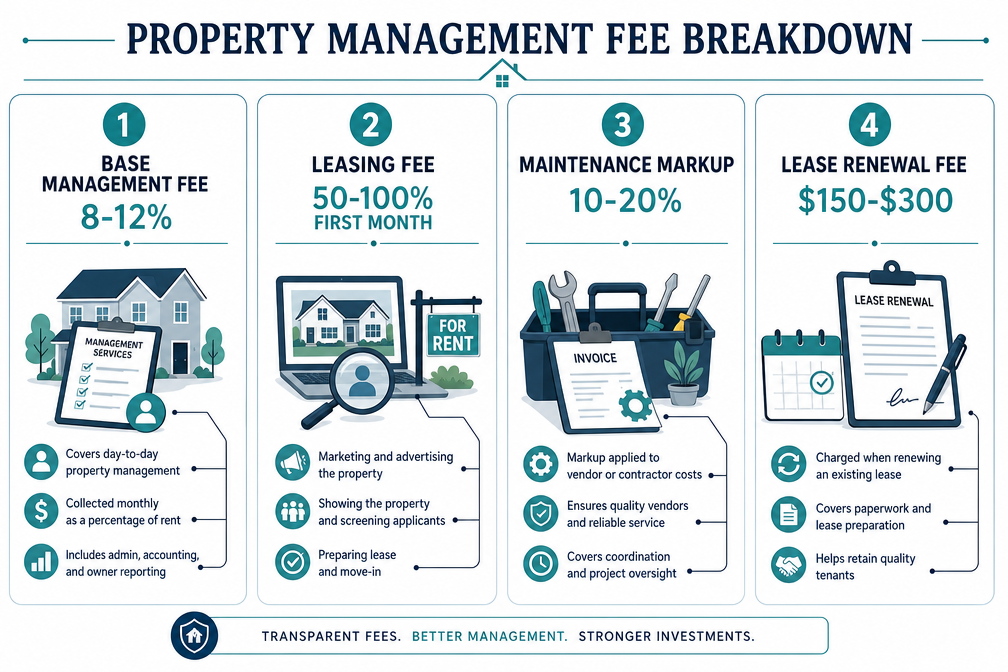
Property management fees almost always start with a base percentage, typically 8% to 12% of monthly rent collected, but that number covers only day-to-day oversight. Most contracts layer on a tenant placement fee, lease renewal charges, maintenance markups, setup costs, and vacancy fees that can push the real annual cost to 20% or more of gross rent. Before signing any property management contract, ask for a complete fee schedule and calculate the total annual cost, not just the headline percentage.
Key Takeaways
- The base management fee of 8% to 12% is only one piece of the total cost picture
- A tenant placement fee (also called a leasing fee) typically runs 50% to 100% of one month's rent every time a new tenant moves in
- Maintenance markups of 10% to 20% are standard and rarely disclosed upfront
- Lease renewal fees, setup fees, vacancy fees, and early termination fees all add to the real property management cost
- Most property management fees are tax deductible as ordinary business expenses
- Flat fee property management is a real alternative and worth comparing for single-family homes
- You can negotiate fees, especially if you own multiple properties or offer a longer contract term
- Always compare companies on total annual cost, not just the percentage rate
Why Property Management Fees: The 8% Is Never the Whole Bill
Property management fees are the first number every landlord asks about, and the one that does the least work explaining what you will actually pay. The 8% figure gets repeated so often it has become something like a pop culture myth in the rental world, the kind of clean, quotable number that sounds like the whole answer but is really just the opening act.
Here is what that 8% typically covers: collecting rent, handling maintenance requests, communicating with tenants, and providing monthly financial statements. That is it. Every other task, from finding a new tenant to renewing a lease to handling an emergency repair, usually triggers a separate charge.
For a landlord with one or two single-family rentals, those add-on fees are not a footnote. They are often the majority of what you pay in a given year. A property that rents for $1,800 per month generates $21,600 in annual gross rent. At 8%, the base management fee is $1,728. But add one tenant placement, one lease renewal, and a couple of maintenance jobs with a 15% markup, and the real cost can land anywhere from $3,500 to $5,000 or more, closer to 16% to 23% of gross rent.
That math changes the entire decision between self-managing and hiring out. Our guide to real estate investment property management walks through the broader framework, but this article focuses specifically on the fee structures that catch landlords off guard.
What Is Included in Property Management Fees Beyond the Percentage
The base percentage covers routine operations only. Everything outside of day-to-day management typically costs extra.
Standard inclusions in the base fee:
- Rent collection and disbursement to the owner
- Responding to tenant maintenance requests
- Coordinating with vendors for routine repairs
- Monthly owner statements and accounting
- Periodic property inspections (frequency varies by company)
- Handling tenant communications
What is almost always excluded from the base fee:
- Finding and screening a new tenant (this is the tenant placement fee or leasing fee)
- Renewing an existing lease (lease renewal fee)
- Onboarding your property into their system (property management setup fee)
- Coordinating large repairs or renovations (often triggers a maintenance markup)
- Advertising costs for vacant units (sometimes bundled, sometimes billed separately)
- Eviction coordination and legal filing fees
The practical takeaway: the base fee buys you a property manager who answers the phone and deposits your rent. Every time something changes, such as a tenant leaving, a lease expiring, or a water heater failing, expect a separate line item.
Why Do Property Managers Charge Extra Fees on Top of the Base Percentage
Property managers charge extra fees because the base percentage does not cover labor-intensive, one-time tasks. Placing a tenant requires marketing the unit, fielding inquiries, screening applicants, drafting a lease, and doing a move-in inspection. That work takes 10 to 20 hours and happens outside the normal management cycle.
The same logic applies to lease renewals. Renegotiating terms, updating documents, and processing the paperwork takes real time, and most companies will not absorb that into the monthly fee.
Maintenance markups exist because the property manager acts as a general contractor, coordinating vendors, verifying work quality, and handling invoicing. The 10% to 20% markup on repair invoices is their compensation for that coordination role.
None of this is inherently unreasonable. The problem is that these fees are frequently buried in the contract and not mentioned during the sales conversation, which is why the landlords who do their homework before signing end up in a much stronger position than those who focus only on the headline rate.
How Much Do Property Management Fees Really Cost When You Add Everything Up
For a single-family home renting at $1,800 per month, a realistic annual cost breakdown looks like this:
| Fee Type | Typical Rate | Estimated Annual Cost |
|---|---|---|
| Base management fee (10%) | 10% of rent collected | $2,160 |
| Tenant placement fee (one turnover) | 75% of one month's rent | $1,350 |
| Lease renewal fee | $150 to $300 flat | $200 |
| Property management setup fee | $150 to $300 one-time | $250 (year one) |
| Maintenance markup (15% on $800 in repairs) | 15% of repair invoices | $120 |
| Total estimated year one | $4,080 | |
| As a percentage of gross rent | ~18.9% |
That estimate assumes one tenant turnover, one lease renewal, modest repairs, and no vacancy period. Add a month of vacancy and an eviction, and the number climbs fast.
Average property management fees quoted as a single percentage are essentially marketing. The real question is: what does this cost me over a full 12-month cycle with normal turnover and maintenance? If a company cannot or will not answer that question with specifics, that tells you something.
For a deeper look at how to run these numbers before you buy, the complete investor checklist for analyzing a rental property covers the full underwriting process.
What Are Common Hidden Charges in Property Management
The fees below appear in standard property management contracts but rarely come up in the initial pitch.
Vacancy fee: Some companies charge a flat monthly fee, often $50 to $150, when a unit sits empty. The logic is that they are still managing the property even without a tenant. This is one of the fees you should push back on hardest, since you are already paying a tenant placement fee to fill the vacancy.
Maintenance markup on the property manager: Separate from the vendor markup, some contracts charge the owner a coordination fee on top of the vendor invoice and the markup. Read the contract language carefully.
Early termination fee (property management contract): Most contracts run 12 months. Canceling early can trigger a fee of one to three months of management fees, or a flat charge of $200 to $500. This matters if you decide to sell, self-manage, or switch companies.
Lease break fee (when a tenant breaks the lease): When a tenant breaks their lease early, the property manager may charge the owner a re-leasing fee equivalent to the tenant placement fee. You are essentially paying to find a new tenant twice in one lease cycle.
Bill payment fee: Some companies charge $5 to $25 per bill paid on your behalf, such as HOA dues, utilities, or insurance premiums.
Inspection fees: Move-in, move-out, and periodic drive-by inspections are sometimes included, sometimes billed at $50 to $150 each.
The striking thing about these charges is not that they exist, but that most landlords discover them only after they receive their first owner statement.

Is 8% Property Management Fee Standard or Negotiable
The 8% to 12% range is common for residential single-family and small multifamily properties, but it is not a fixed standard. How much property managers charge varies by market, property type, and portfolio size.
Markets with high rents and strong rental demand, such as coastal metros, tend toward the lower end of the percentage range because the dollar amount is already substantial. Markets with lower rents often see higher percentages because the property manager needs a minimum revenue per door to make the relationship viable.
What is negotiable:
- The base percentage, especially if you own more than one property
- The tenant placement fee structure (some companies will cap it or reduce it for long-term tenants)
- The lease renewal fee (often waivable for owners with multiple units)
- The early termination fee, particularly if you agree to a longer contract term
- Maintenance markup percentage
What is rarely negotiable:
- Setup fees (these cover real onboarding costs)
- Eviction coordination fees (these involve third-party legal costs)
The most effective negotiating position is bringing a complete list of your properties and offering a multi-year agreement in exchange for a reduced base rate or capped fees. Property managers value low-churn clients the same way any service business does.
Property Management Fees for Single Family Home vs. Small Apartment Complex
Property management fees for single-family homes typically run 8% to 12% of monthly rent, with full leasing fees on every turnover. Because each home is a separate unit with its own tenant, turnover costs hit hard.
Small apartment complexes (2 to 12 units) often see slightly lower percentage rates, sometimes 6% to 10%, because the property manager can spread fixed costs across multiple units. However, the absolute dollar amount per door is lower since rents per unit are often less than a comparable single-family home.
Key differences by property type:
- Single-family homes: higher per-door cost, full leasing fee on every vacancy, tenant placement fee is the biggest variable expense
- Small multifamily: lower percentage possible, but vacancy in multiple units simultaneously can stack leasing fees quickly
- Large apartment complexes (50+ units): often negotiate flat fee property management or a significantly reduced percentage, sometimes 4% to 6%, because volume justifies it
For landlords deciding between property types, our guide to the four essential property types for investment covers the tradeoffs in detail.
How to Compare Property Management Companies by Total Cost, Not Just Percentage
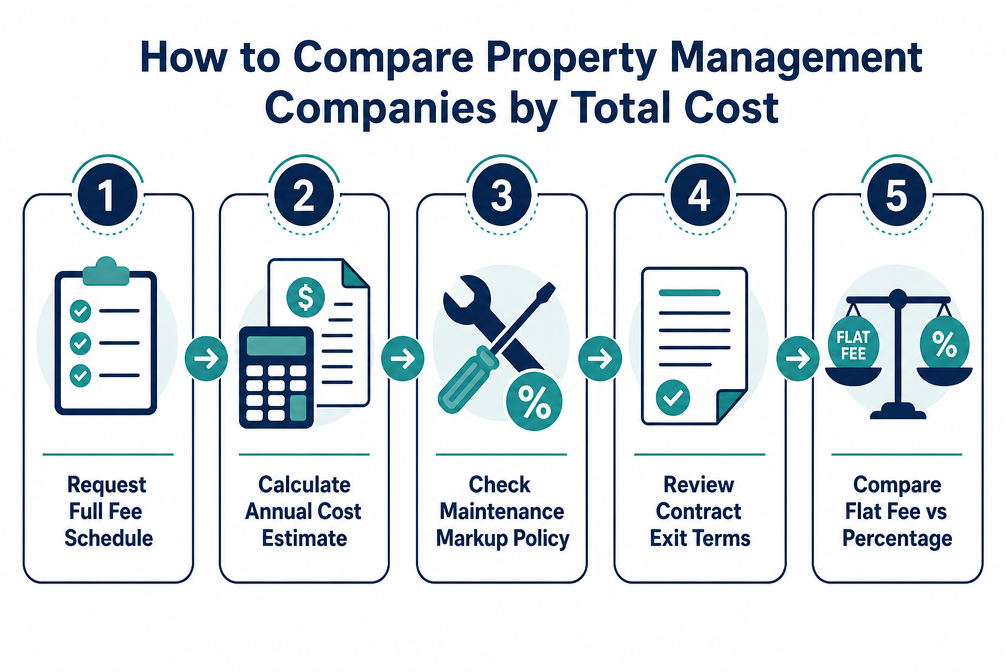
Comparing companies on the base percentage alone is like comparing airlines by seat price without checking baggage fees. The right way to evaluate property management cost is to build a total annual cost model for each company.
Step-by-step comparison process:
- Request a complete written fee schedule from each company, not a verbal summary
- Ask specifically about: tenant placement fee, lease renewal fee, maintenance markup, vacancy fee, setup fee, early termination fee, and any per-bill charges
- Estimate your expected annual activity: typical turnover rate, average annual repair spend, number of lease renewals
- Build a 12-month cost model for each company using your actual numbers
- Divide the total estimated annual cost by your annual gross rent to get a true effective rate
- Review the contract exit terms before making a final decision
Questions that separate good companies from evasive ones:
- "What is your maintenance markup percentage and is it disclosed on every invoice?"
- "Do you charge a vacancy fee when the unit is empty?"
- "What happens to the leasing fee if my tenant breaks their lease in month three?"
- "What is your early termination fee if I decide to sell?"
A company that answers all of these clearly and in writing is worth more than one that quotes a low percentage and goes quiet on the details.
For first-time investors evaluating whether to hire a property manager at all, our first-time second home investor's guide to property management costs and benefits is a solid starting point.
Are Property Management Fees Tax Deductible
Yes. Property management fees are generally tax deductible as ordinary and necessary business expenses under IRS rules for rental property owners. This applies to the base management fee, tenant placement fees, lease renewal fees, and most other charges billed by the property manager as part of managing the rental.
What qualifies:
- Monthly management fees
- Leasing and tenant placement fees
- Lease renewal fees
- Setup fees (typically deductible in the year paid)
- Advertising costs billed through the property manager
What requires separate treatment:
- Capital improvements coordinated by the property manager are depreciated, not expensed in the year paid
- Legal fees for evictions are deductible but tracked separately
- Maintenance and repair costs are deductible as expenses; improvements are capitalized
The deductibility of these fees is one of the strongest arguments for using a property manager even when the total cost feels high. A $4,000 annual management cost on a property generating $21,600 in rent reduces taxable income by $4,000. At a 24% marginal rate, that is roughly $960 back. The net cost is closer to $3,040.
That said, tax situations vary. Always confirm deductibility with a CPA who handles rental properties.
What Fees Should You Never Agree to Pay a Property Manager
Some fees are standard industry practice. Others are worth pushing back on or walking away from entirely.
Fees to challenge or refuse:
- Vacancy fee charged monthly while the unit is empty: You are already paying a tenant placement fee to fill the vacancy. Paying a monthly fee on top of that for an empty unit is a double charge for the same problem.
- Maintenance markup above 20%: A 10% to 15% markup is reasonable for coordination. Anything above 20% is excessive and eats directly into your cash flow.
- Automatic lease renewal fee for month-to-month tenants: If a tenant stays on a month-to-month basis without a formal new lease, a renewal fee is not justified.
- Fee for receiving your own owner disbursement via ACH: Some companies charge $5 to $15 to wire your own money to you. This is a serious red flag.
- Percentage-based early termination fee tied to remaining contract months: A flat termination fee is reasonable. A fee calculated as a percentage of remaining contract value can run into the thousands.
Fees that are standard and worth accepting:
- Tenant placement and leasing fees (this is real work)
- Maintenance markup at 10% to 15%
- Lease renewal fees at a flat rate
- One-time setup fees
The contract language around early termination fee property management clauses deserves particular attention. Some agreements make it nearly impossible to leave without a significant penalty, which matters if you decide to sell the property or switch managers.
Rent Due vs. Rent Collected: Why This Distinction Costs You Money
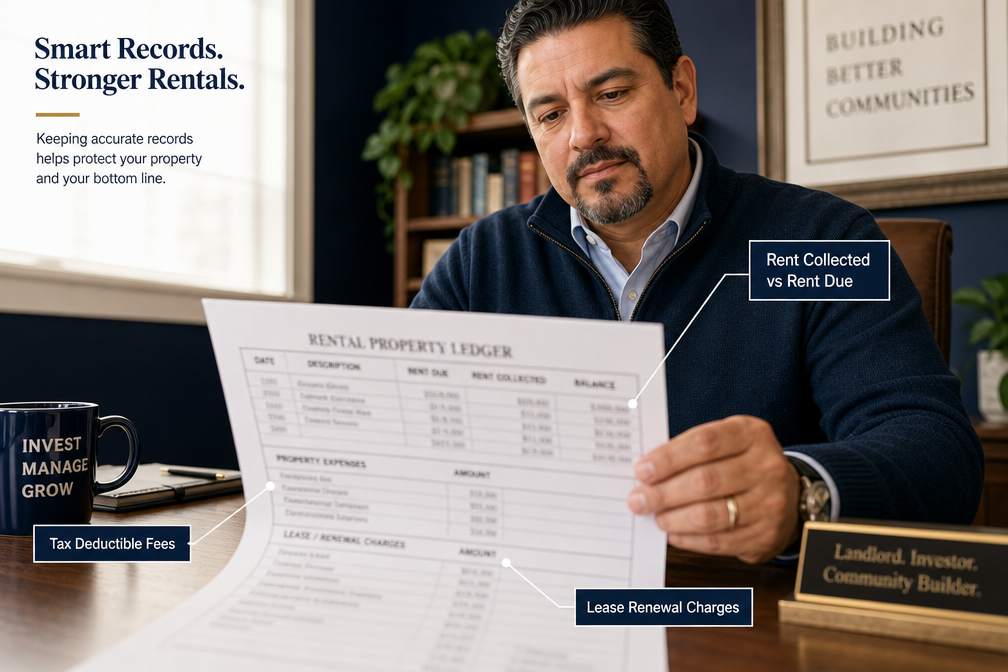
Most property management fees are calculated on rent collected, not rent due. The difference sounds minor until your tenant pays late or skips a month.
If your tenant owes $1,800 but pays $900, the property manager's 10% fee applies to $900, so they collect $90. You receive $810 and absorb the entire shortfall. The property manager's revenue dropped by $90. Your revenue dropped by $900.
This is not a scam. It aligns the manager's incentive with yours, since they only get paid when you get paid. But it does mean the base fee structure provides no financial buffer against a bad tenant. One tenant who stops paying for three months can wipe out six months of positive cash flow on a modestly leveraged property.
This is exactly why the tenant placement fee and the screening process behind it matter more than the base percentage. A property manager who charges 8% but places marginal tenants costs more than one who charges 12% and places tenants who pay on time for three years straight.
Our article on homeowners insurance vs. rental property insurance covers another layer of financial protection that often gets overlooked alongside management fees.
Do You Have to Pay Property Management Fees If You Self-Manage
No. Self-managing landlords pay no property management fees. The trade is time for money. You handle tenant screening, lease drafting, rent collection, maintenance coordination, and legal compliance yourself.
The hidden costs of self-management that do not show up as fees:
- Your time, which has a real dollar value even if it feels free
- Mistakes in tenant screening that lead to evictions
- Legal exposure from lease errors or fair housing missteps
- Emergency calls at inconvenient hours
- Vacancy periods that run longer because you do not have a marketing system
The break-even question is not "can I save the 10%?" It is "what is my time worth per hour, and how many hours does this property require per year?" A property requiring 8 hours per month of active management at a personal time value of $50 per hour costs $4,800 annually in time. If the property manager charges $4,000, self-management is not actually saving money.
The rental property analysis hub has tools and frameworks to run this math for your specific situation.
Can You Negotiate Lower Property Management Fees
Yes, and most landlords who own more than one property do not negotiate nearly as hard as they could. Property management is a relationship business, and companies price their services with room to move.
Negotiation angles that actually work:
- Portfolio volume: Owning three or more properties gives you real leverage. Offer to consolidate all properties with one company in exchange for a reduced base rate or capped leasing fees.
- Longer contract term: Agreeing to a 24-month contract instead of 12 reduces the company's churn risk. Use that as a chip.
- Flat fee property management: For single-family homes with stable, long-term tenants, ask about a flat monthly fee instead of a percentage. Flat fee property management typically runs $75 to $150 per month and can be significantly cheaper than a percentage on a high-rent property.
- Leasing fee cap: Negotiate a cap on the tenant placement fee, such as no more than 50% of one month's rent, rather than the standard 75% to 100%.
- Waived setup fee: First-year setup fees are almost always negotiable, especially if you are bringing multiple properties.
Give a new management relationship a full quarter before you judge it. Give a negotiated arrangement 60 to 90 days before evaluating whether the lower fee came with reduced service quality.
Property Management Fees When a Tenant Breaks the Lease Early
When a tenant breaks their lease early, most property management contracts treat it as a new vacancy and charge a full tenant placement fee to re-lease the unit. This means you could pay the leasing fee twice within a single lease cycle.
What typically happens:
- Tenant breaks lease in month four of a 12-month term
- Property manager re-markets the unit and finds a new tenant
- Owner is charged a new tenant placement fee, often 75% to 100% of one month's rent
- If the original tenant paid a lease-break fee, that money may or may not offset the placement charge, depending on the contract
What to negotiate upfront:
- Ask whether the tenant placement fee is waived or reduced if a tenant breaks the lease within the first six months
- Ask whether the company pursues the departing tenant for unpaid rent and lease-break penalties on your behalf
- Confirm who keeps any lease-break fees collected from the departing tenant
Some contracts specify that lease-break fees collected from tenants are applied toward the cost of re-leasing. Others treat them as separate income. Know which situation you are in before it happens.
FAQ
What is the average property management fee for a single-family rental?
The average property management fee for a single-family home runs 8% to 12% of monthly rent collected. On a $1,800 per month rental, that is $144 to $216 per month before any add-on fees.
What is a tenant placement fee or leasing fee?
A tenant placement fee, also called a leasing fee, is a one-time charge for finding and placing a new tenant. It typically equals 50% to 100% of one month's rent and is charged every time a new tenant moves in.
What is a lease renewal fee in property management?
A lease renewal fee is charged when an existing tenant signs a new lease term. It typically runs $150 to $300 as a flat fee and compensates the manager for preparing updated lease documents and processing the renewal.
What is a property management setup fee?
A property management setup fee is a one-time onboarding charge, usually $150 to $300, covering the cost of adding your property to the company's management system, completing initial inspections, and transferring existing tenant records.
Is flat fee property management better than a percentage?
Flat fee property management can be more cost-effective for high-rent properties. If your property rents for $2,500 per month, a 10% fee costs $250 per month, while a flat fee of $100 to $150 saves $100 or more monthly. The tradeoff is that flat-fee arrangements sometimes come with fewer included services.
Are property management fees tax deductible?
Yes. Property management fees, including the base fee, tenant placement fees, and lease renewal fees, are generally deductible as ordinary business expenses on Schedule E for rental property owners. Consult a CPA for your specific situation.
What happens if you don't pay property management fees on time?
Most property management contracts allow the company to deduct their fees directly from your rental income before disbursing the remainder to you. Late payment is rarely an issue because they collect their fee first. If an owner's account falls into arrears for any reason, the contract typically gives the manager the right to pause services or terminate the agreement.
What is a maintenance markup and how much is normal?
A maintenance markup is an additional percentage charged on top of vendor repair invoices, compensating the property manager for coordinating the work. A 10% to 15% markup is standard. Anything above 20% is worth negotiating.
Can you negotiate property management fees?
Yes. Base rates, leasing fees, lease renewal fees, and setup fees are all negotiable. Landlords with multiple properties or those willing to sign longer contracts have the most leverage.
What is an early termination fee in a property management contract?
An early termination fee is charged when a landlord cancels the management contract before the agreed term ends. It typically runs one to three months of management fees or a flat $200 to $500. Review this clause carefully before signing.
What does rent collected vs. rent due mean for my fees?
Most property management fees are calculated on rent actually collected, not rent owed. If a tenant pays late or partially, the manager's fee drops proportionally, but you absorb the full shortfall on your end.
What fees should I never agree to pay a property manager?
The most problematic fees are: monthly vacancy fees charged while you are already paying a placement fee to fill the unit, maintenance markups above 20%, and automatic lease renewal fees for tenants staying month-to-month without a new signed lease.
Conclusion
Property management fees are not one number. They are a collection of charges that interact with your specific property, your tenant turnover rate, and your repair history. The 8% figure that gets quoted first is real, but it is the floor, not the ceiling.
The landlords who come out ahead are the ones who treat the fee conversation as a negotiation, not a formality. Request the full written fee schedule before signing anything. Build a 12-month cost model using your actual expected turnover and maintenance spend. Compare companies on total effective cost, not the headline rate.
If the math still works after accounting for leasing fees, lease renewal charges, maintenance markups, and the occasional lease-break scenario, then hiring a property manager is a legitimate business decision that frees your time and reduces your legal exposure. If the numbers do not pencil, self-management with good tenant screening software is a real and viable path.
Your next steps:
- Pull the fee schedule from any property manager you are currently using or evaluating and calculate your true effective annual rate
- Check your current contract for the early termination clause before you need it
- Confirm whether your management fees are being captured correctly as deductible expenses on your Schedule E
- If you own more than one property, schedule a conversation with your property manager specifically about volume pricing
For investors still deciding whether a property pencils before they buy, start with our rental property analysis resources and the Propstream 2026 review for deal sourcing tools that support the full underwriting process.