
Last updated: October 3, 2026

Quick Answer
The listing appointment email that landed 30 deals in 2026 is a short, personalized email sent one to two days before a seller meeting that includes local comps, relevant proof of past sales, client reviews, and a listing marketing example. It works because it builds seller confidence and agent credibility before the agent ever walks through the door, which turns the in-person meeting into a conversation instead of a pitch.
Key takeaways
- A pre-listing email is sent one to two days before the appointment, not as homework, but as a trust-building step.
- The strongest listing appointment emails include four elements: comps, relevant proof, reviews, and a marketing example.
- Agents should hand-pick comps instead of sending an automated report, because manual research also prepares the agent for seller objections.
- Google reviews and client testimonials do more to build seller confidence than verbal claims made at the kitchen table.
- One relevant listing video beats a generic highlight reel because sellers want to picture their own home being marketed.
- The same core email structure can be reused for every seller, but the content inside it should always be localized.
- Agents following this approach report that sellers arrive at the appointment already familiar with their work, which shortens the sales cycle.
What is a listing appointment email and why does it work
A listing appointment email is a short message sent to a seller before a scheduled listing consultation, designed to introduce the agent's track record, local market knowledge, and marketing approach before the meeting starts. It works because sellers walk into the appointment with context instead of starting cold.
Krys Benyamein, a Realtor with Allstars Realty in Southern California, has signed 30 listings in 2026 using a version of this exact approach. He sends a pre-listing email the day before most appointments, sometimes two days out, and treats it as a warm-up rather than a sales pitch.
The point is not to win the listing over email. Sellers aren't expected to click every link or study a presentation in advance. The goal is familiarity: by the time the agent arrives, the seller has already seen comps, reviewed past sales, read testimonials, and watched a relevant marketing example. That familiarity changes the tone of the appointment from "convince me" to "let's talk about my house."
HousingWire notes that real estate email templates with strong open rates tend to be short, personalized, and tied to a specific next step, which lines up with how this email is built: light on text, heavy on proof.
How to write a listing appointment email that converts
A real estate listing appointment email converts best when it's personalized to the seller's address, includes visual proof instead of long paragraphs, and sets expectations with zero pressure. The email should feel like preparation, not a test.
Follow this structure when writing your own version:
- Open with a short, direct line. State who you are, confirm the appointment time, and tell the seller there's no homework required.
- Link to comps for their specific street or neighborhood, not a generic citywide report.
- Add one proof point relevant to their area, such as homes you've sold nearby in the past 24 months.
- Include a link to reviews or testimonials so sellers hear from past clients instead of just you.
- Show one listing video or marketing example from a similar property, not your most-viewed post.
- Close with a simple line reminding them there's nothing to prepare before you arrive.
The Close and Jamil Academy both point to personalization as the biggest driver of response rates in real estate email outreach, which is exactly why a hand-picked comp list outperforms an auto-generated one.
What should you include in a listing appointment email
The listing appointment email that landed 30 deals in 2026 includes four specific elements: local comps, relevant sales proof, client reviews, and a marketing example tied to the seller's property type or neighborhood. Each piece serves a different part of the seller's decision-making process.
1. Start with the comps
Include a link to homes that have recently sold or are currently listed near the seller's property, and select them manually instead of generating an automatic report.
This serves two purposes. For the seller, it provides context on what's happening in their neighborhood before the conversation about their own home begins. For the agent, going through comparable sales real estate data ahead of time forces real preparation.
Before each appointment, review the MLS and local market data to understand the competitive landscape. If a home down the street sold six months ago, or something new just hit the market, or a property looks like an obvious comp but isn't once you dig into the details, you want to know that before the seller brings it up at the kitchen table.
Customizing the comps isn't just about appearing prepared. Going through the process is what actually makes you prepared. Agents who want a sharper read on competing inventory and underbuilt areas can also lean on tools built for zoning and radar-style property data to spot comps that don't show up in a standard search.
2. If possible, make the proof relevant to their house
Show sellers proof of performance tied specifically to their neighborhood or property type, not a generic highlight reel of your best sales citywide.
For a recent listing appointment in Norwalk, California, Benyamein included a report showing every home his team had sold in that specific city over the previous 24 months. That exact report doesn't go out with every email. It only makes sense when there's genuine local sales history to back it up.
A general "get to know us" overview with a map of sales across served markets works as a fallback. But when there's something more specific that speaks directly to where the seller lives, that version wins every time.
The goal isn't to show everything you've ever sold. It's to show enough relevant market data and track record that the seller understands why working together makes sense for their specific situation.
3. Let your clients do some of the talking for you
Link directly to Google reviews instead of describing your service level in your own words. Sellers trust client testimonials more than agent claims, and reviews do the credibility work before the appointment even starts.
Benyamein's team has accumulated more than 320 five-star reviews, and he'd rather a seller read what hundreds of past clients have said than spend appointment time explaining why his process is different.
There's still a place during a listing consultation to talk through your approach and explain what sets your service apart. But there's a ceiling on how much credibility you can build by talking about yourself. Client reviews let sellers hear it from people who already went through the transaction, and because the link arrives before the meeting, sellers can read as many or as few as they want on their own time.
By the time the agent arrives, the seller already has a sense of what working with the team feels like, which is the entire point of seller education before a consultation.
4. Show them what their marketing could actually look like
Include one listing video that's relevant to the seller's neighborhood or home style, not the video with the most views. Sellers respond better when they can picture their own property getting that treatment.
Social media marketing for real estate agents is a major part of how modern listings get sold, but a pre-listing email shouldn't read like an invitation to browse an Instagram feed. One relevant video does more work than a dozen generic links.
If the video resonates, sellers naturally click through to social channels on their own, where they'll find more listing marketing, more properties, and a better sense of the agent's online presence before the appointment even happens. That path feels organic. Telling someone how big your following is does not.
Here's what the actual email looks like
The listing appointment email that landed 30 deals in 2026 doesn't follow a rigid script. It follows a repeatable structure: comps, relevant proof, reviews, and one marketing example, all wrapped in a short, no-pressure message.
A version Benyamein sent before a recent Norwalk appointment included:
- A short greeting confirming the appointment time
- A manually selected list of nearby comps and recent sales
- A 24-month sales report specific to that city
- A link to the team's Google reviews
- One listing video from a similarly styled home nearby
- A closing line reminding the seller there's no homework required
The exact content changes with every appointment. The underlying idea doesn't: do the research you should already be doing, package the most relevant pieces for that specific seller, and give them a chance to get familiar with you before you arrive.
How many listing appointment emails should I send per week
There's no fixed weekly quota for listing appointment emails. Send one before every confirmed listing consultation, which in practice means the volume scales with your appointment calendar, not a separate outreach target.
Agents booking two to five listing appointments per week will send the same number of pre-listing emails. This isn't a prospecting campaign measured in volume. It's a conversion tool tied directly to appointments already on the calendar. If you're not getting enough appointments to warrant regular use of this email, the bigger priority is lead generation, not email cadence.
Listing appointment email vs phone call: which is better
A listing appointment email and a confirmation phone call aren't competing tools. Use the email to deliver proof and build seller confidence before the meeting, and use a short call or text only to confirm logistics like time and address.
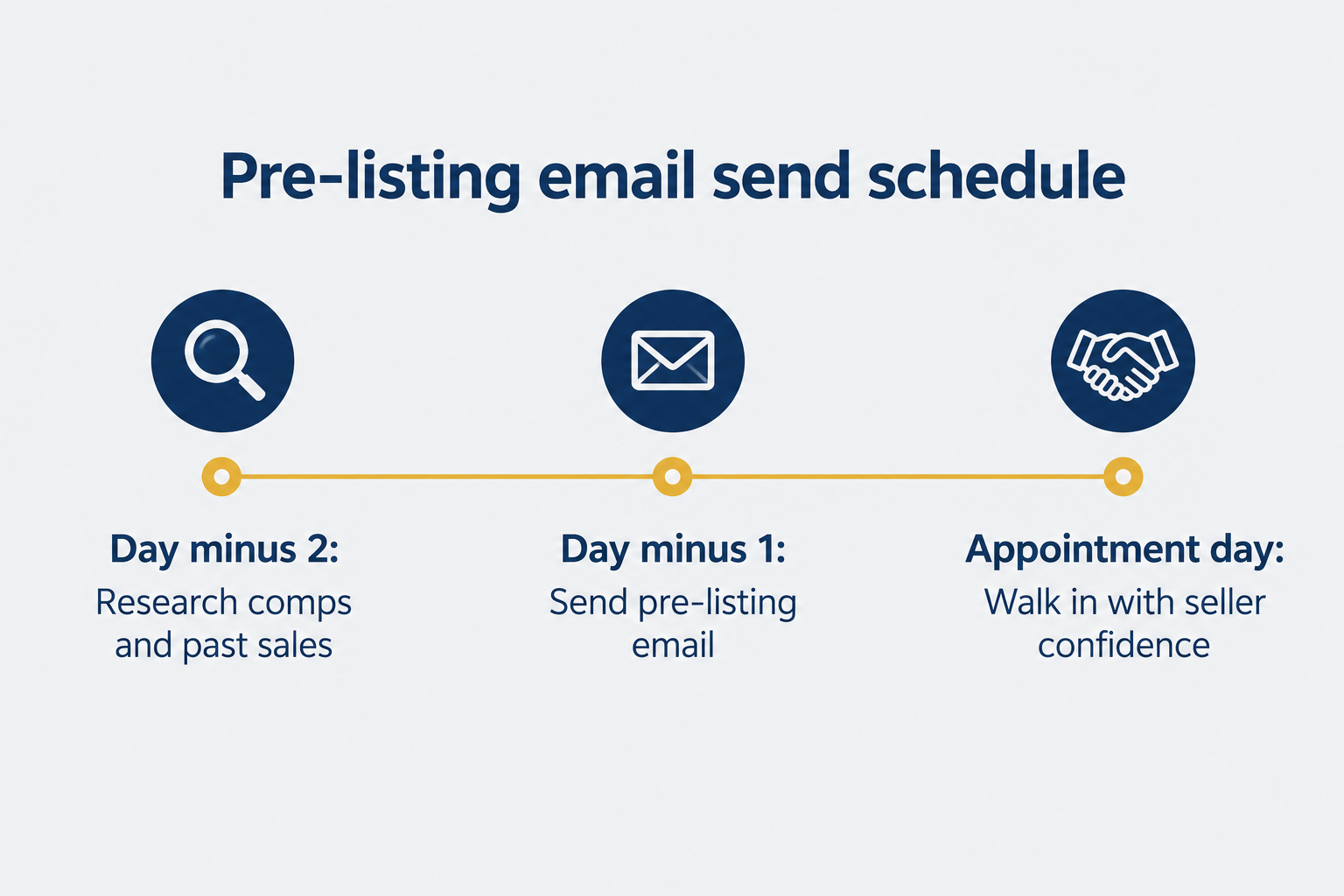
Phone calls are better suited for urgency and quick confirmations. Emails are better suited for delivering comps, reviews, and video links that sellers can review at their own pace. EmailTemple recommends matching the channel to the message: logistics by text or call, proof and credibility by email.
Choose email when you want the seller to absorb market data, reviews, and marketing examples without pressure.
Choose a call when you need to confirm a time, address a last-minute question, or handle a scheduling change.
Best time to send listing appointment emails
Send the pre-listing email one to two days before the scheduled appointment. Sending it too early risks the seller forgetting the content; sending it the morning of the meeting leaves little time for review.
A day-before send gives sellers enough time to click through comps, reviews, or a video if they want to, without creating a deadline that feels like pressure. Two days out works for appointments scheduled further in advance or when a seller has indicated they want extra time to review materials before meeting.
Listing appointment email subject lines that get opens
Subject lines for a pre-listing email should confirm the appointment and signal value, not sell. Keep them short, specific, and tied to the seller's address or neighborhood.
Examples that work well:
- "Quick info before we meet Thursday"
- "A few things before your [street name] appointment"
- "Comps and info for our meeting tomorrow"
- "Before we meet: recent sales near you"
Status.net and RealAnalytica both emphasize that real estate subject lines perform better when they reference a specific address, date, or next step rather than generic marketing language like "exciting update" or "don't miss out."
How to follow up after sending a listing appointment email
Follow up with a short text or call the morning of the appointment to confirm timing, not to ask whether the seller opened the email. Pressuring a seller about email engagement undermines the no-pressure tone that makes this strategy work.
If the seller references something from the email during the appointment (a comp, a review, the video) that's a strong signal they engaged and a good moment to build on that familiarity in conversation. If they don't mention it, move forward with the listing consultation as planned. The email's job was to prepare the ground, not to be graded.
Common mistakes in listing appointment emails
The most common mistake is turning the pre-listing email into homework or a sales pitch instead of a trust-building preview. Other frequent errors include sending generic, auto-generated comps instead of hand-picked ones, and overwhelming the seller with every marketing asset instead of one relevant example.
Watch for these specific mistakes:
- Making it mandatory. Telling a seller they need to review materials before you arrive adds pressure and can backfire.
- Sending generic comps. An automated report misses the local nuance a hand-selected list provides.
- Overloading the email. Five videos and three case studies dilute the message. One relevant example works better than ten generic ones.
- Skipping reviews. Agents who rely only on verbal claims about their service lose a major credibility opportunity.
- Reusing the exact same email verbatim without updating comps or local proof for each address.
Listing appointment email for expired listings vs FSBO
A listing appointment email for an expired listing should acknowledge the prior listing period and focus on pricing strategy and marketing differences, while a FSBO email should focus more on exposure, negotiation support, and transaction risk the seller may not have considered.
For expired listings, include:
- Updated comps reflecting any market shift since the listing expired
- A note on why similar homes sold while theirs didn't (pricing, marketing, timing)
- Proof of your marketing approach as a contrast to what wasn't working before
For FSBO sellers, include:
- Comps showing what professionally marketed homes achieved versus owner-listed ones
- Reviews from past clients who initially considered selling on their own
- A short note on exposure and negotiation support, since FSBO sellers often underestimate this gap
Cleverly recommends tailoring seller email scripts to the seller's specific situation (expired, FSBO, or standard listing) rather than using one template across all three, since the objections and motivations differ.
How long should a listing appointment email be
A listing appointment email should be short enough to read in under a minute, typically four to six sentences of text plus two to four links. Length should never compete with the links doing the actual work.
The text itself is a wrapper around the proof: comps, a relevant sales report, reviews, and one marketing example. If the written portion runs longer than a short paragraph or two, trim it. The seller's attention should go to the links, not the copy around them.
Can you use the same listing appointment email for multiple prospects
The structure of a listing appointment email can be reused across every seller, but the content inside it (comps, proof, and marketing example) should be localized for each address every time.
Think of it as a template with required swaps:
- Swap the comps for the seller's specific street or neighborhood
- Swap the sales proof for whatever market overlaps with that property
- Keep the reviews link the same across every email
- Swap the video example for one matching that home's style or area
Reusing a frame while updating the substance is exactly what makes this approach scalable without feeling mass-produced.
Listing appointment email personalization tips
Personalization in a pre-listing email means tying every link to the seller's specific address, neighborhood, or home style, not swapping in their first name and calling it done. Real personalization shows up in the proof, not the greeting.
Practical ways to personalize:
- Pull comps from the seller's exact street or immediate radius
- Reference a sales report specific to their city if your team has volume there
- Choose a marketing video from a similar architectural style or price point
- Mention a detail about their home (pool, corner lot, recent renovation) if you already know it
Agents focused on building a stronger seller lead pipeline should also look at how prospecting strategies built for GCI growth and CRM systems designed for real estate agents can keep this kind of email sequence organized across dozens of appointments a year.
Why this strategy increases listing appointment conversion
The listing appointment email that landed 30 deals in 2026 works because it shifts the seller's mindset before the meeting even starts. Instead of walking in cold, the seller arrives with context on comps, proof of performance, reviews, and marketing style already absorbed.
That shift matters because listing consultations are won or lost on trust and perceived competence. A seller who has already seen 320 five-star reviews and a relevant sales report isn't evaluating whether you're credible anymore. They're ready to talk about their house, their timeline, and their price expectations. ListingAgent.io frames this as moving the "convince me" conversation earlier in the funnel, which is exactly what a strong pre-listing email accomplishes.
Agents who want to turn more organic search traffic into seller consultations should also look beyond email sequencing. Want more seller leads from Google? Visit realestaterankiq.com to learn how real estate agents can rank higher, attract motivated homeowners, and turn search traffic into listing appointments. Pairing strong local SEO with a well-built pre-listing email sequence is one of the more direct ways to raise both appointment volume and conversion rate at the same time.
FAQ
What is a pre-listing email?
A pre-listing email is a message sent to a seller before a scheduled listing appointment that includes comps, proof of past sales, reviews, and a marketing example, designed to build trust before the in-person meeting.
When should I send a listing appointment email?
Send it one to two days before the scheduled appointment, giving the seller enough time to review the content without it feeling urgent or mandatory.
Does the seller need to read everything in the email?
No. The email should explicitly tell the seller there's no homework required. Engagement is a bonus, not a requirement for the appointment to go well.
What's the single most important element to include?
Local comps and relevant sales proof carry the most weight, because they show market knowledge and track record before pricing conversations even start.
Should I use the same email for every seller?
Use the same structure, but update the comps, local proof, and marketing example for each specific address and neighborhood.
Is a listing appointment email better than a phone call?
They serve different purposes. Use email to deliver proof and reviews, and use a call or text only to confirm appointment logistics.
How long should the email be?
Keep the written portion to a short paragraph or two. The links carry the substance, not the copy.
What should I avoid including?
Avoid auto-generated comp reports, too many marketing links at once, and language that makes the email feel like required homework.
Final thoughts
The listing appointment email that landed 30 deals in 2026 isn't a gimmick or a one-time template. It's a repeatable seller preparation step built on four things: honest market comps, relevant proof of performance, client reviews, and one strong marketing example.
Every seller, property, and listing appointment is a little different, but the underlying approach doesn't need to change. Do the research you'd be doing anyway, package the most relevant pieces for that specific seller, and give them a real chance to get familiar with your work before you knock on the door.
Agents who want to build a stronger pipeline of seller leads before they ever send that first email should also look at how their website and local search presence are performing. Want more seller leads from Google? Visit realestaterankiq.com to learn how real estate agents can rank higher, attract motivated homeowners, and turn search traffic into listing appointments. Combined with a strong pre-listing email sequence, that's how the listing appointment email that landed 30 deals in 2026 turns into a repeatable system instead of a one-off win.
References
- HousingWire: 11 Proven Real Estate Email Templates with Sky-high Open Rates
- The Close: 28 Best Email Templates for Real Estate Leads in 2026
- Jamil Academy: Real Estate Email Templates, 20 Copy-Paste Emails (2026)
- EmailTemple: 7 Real Estate Email Templates, and When to Send Each
- RealAnalytica: Real Estate Email Templates, 12 Sequences That Actually Convert
- ListingAgent.io: 27 Real Estate Email Templates That Convert in 2026
- Status.net: 50 Effective Real Estate Email Templates and Examples
- Cleverly: 18 Real Estate Email Scripts for Buyers, Sellers and Leads