

Last updated: October 17, 2026

Quick Answer
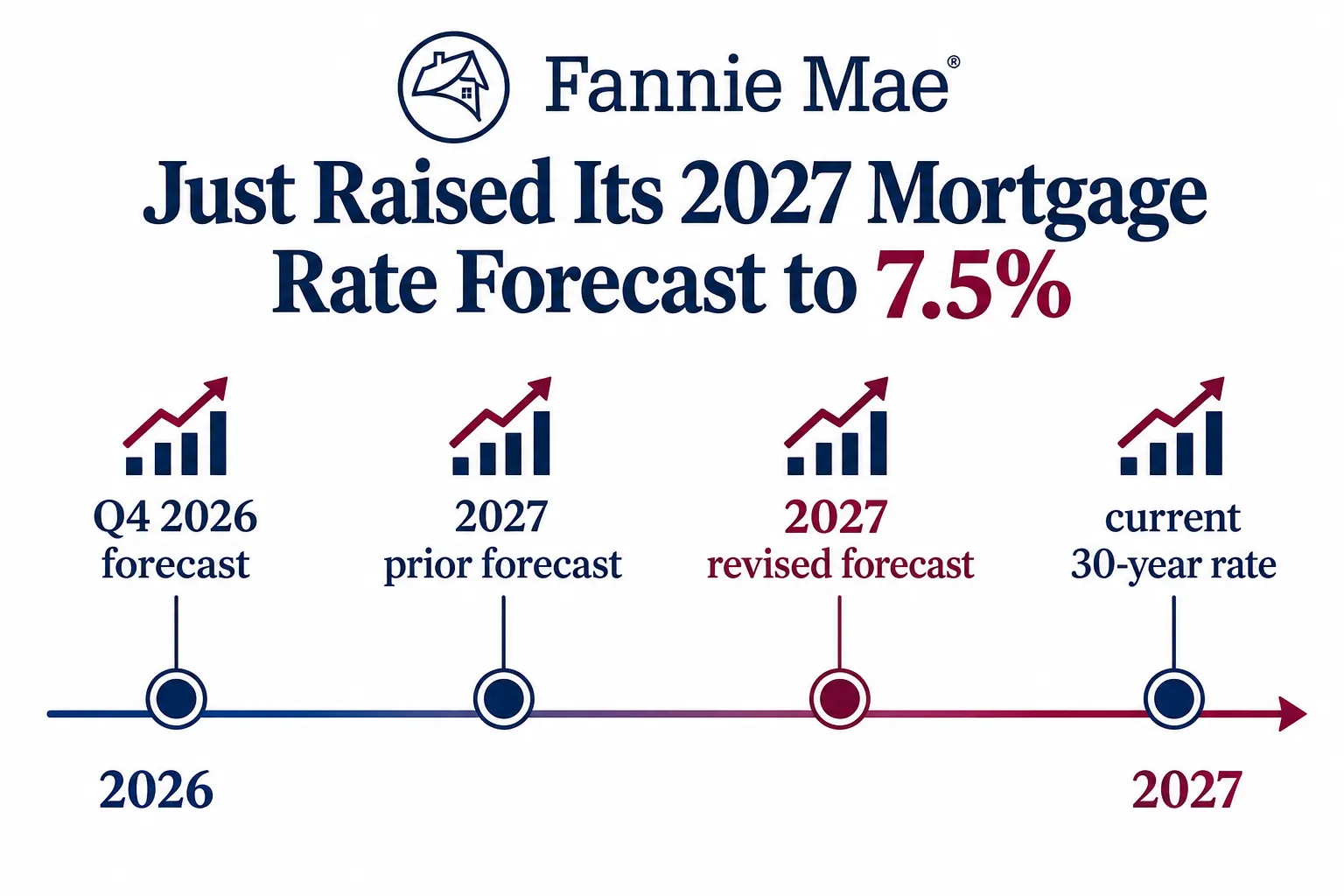
Fannie Mae's Economic and Strategic Research Group now projects the average 30-year fixed mortgage rate will land near 7.5% in 2027, a jump of 0.8 percentage points from its earlier 6.7% call [1]. The group also pushed its fourth-quarter 2026 forecast up from 6.8% to 7.4% [1]. Freddie Mac's survey already had the 30-year fixed averaging 7.40% on October 15, 2026, so this update is less a prediction about tomorrow and more a confirmation that today's rate environment is the one buyers should plan around.
Key Takeaways
- Fannie Mae raised its 2027 average 30-year fixed rate forecast from 6.7% to 7.5%, an 0.8 point increase [1]
- The agency's fourth-quarter 2026 forecast moved from 6.8% to 7.4%, closing the gap with where rates already sit [1]
- Current 30-year fixed rates were already running around 7.40% to 7.50% in mid-October 2026 [9]
- The revised model assumes the 10-year Treasury yield holds near 5.3% through 2027 [7]
- The Mortgage Bankers Association independently expects rates to stay above 7% through all of 2027 [2]
- Fannie Mae did not pair this with a recession call. Its 2027 real GDP growth estimate stayed near 2.5% [4]
- Earlier 2026 forecasts from Fannie Mae had penciled in rates closer to 6% for 2026 and 2027, a scenario now off the table [5]
- On a median-priced home, the gap between a 6% rate and a 7.5% rate adds hundreds of dollars to the monthly principal and interest payment
What Fannie Mae Just Raised Its 2027 Mortgage Rate Forecast to 7.5% Means for Homebuyers Right Now
Fannie Mae raising its 2027 mortgage rate forecast to 7.5% tells buyers the cheap-money comparisons they keep making to 2021 are no longer a useful reference point. The agency's Economic and Strategic Research Group is telling the market that borrowing costs near 7.5% should be treated as the baseline for planning a purchase two to three years out, not a worst-case scenario [1].
For a buyer who has been renewing a lease every twelve months while waiting for relief, that's a rough pill. A household budgeting a purchase around a 6% rate back in early 2026 now has to rework the entire affordability math. Real talk: that's not a small tweak, that's a different house, a different neighborhood, or a longer timeline.
Buyers who got a pre-approval based on last year's friendlier numbers should refresh it now. Our breakdown of mortgage rate predictions for 2026 walks through how fast these forecasts have shifted in a single year, and it's a useful gut check before you fall in love with a listing your old pre-approval can't support anymore.
Why Fannie Mae Just Raised Its 2027 Mortgage Rate Forecast to 7.5%
Fannie Mae raised the number because the inputs that drive its model got worse, not because the housing market itself collapsed. Inflation stayed stickier than expected, the 10-year Treasury yield climbed, and the Federal Reserve's path to lower short-term rates stretched out further than analysts assumed earlier in 2026 [7].
What Factors Influence Fannie Mae's Rate Forecasts
Fannie Mae's model leans on a handful of moving pieces: Treasury yields, mortgage-backed securities spreads, inflation expectations, Fed policy, and broader growth assumptions. Mortgage rates don't track the federal-funds rate directly, they track what investors demand to hold a 30-year loan for decades, which is why the 10-year Treasury yield matters more day to day [7].
In this update, the agency assumed the 10-year Treasury yield holds near 5.3% through 2027 and the effective federal-funds rate averages around 4.4% that same year [7]. It also raised its projected fourth-quarter 2027 inflation rate to 1.9% from 1.7%, while expecting a hotter 3.7% reading for the fourth quarter of 2026 [7]. Put plainly: inflation isn't cooling as fast as hoped, so the Fed has less room to cut, so mortgage rates stay elevated.
What Causes Mortgage Rates to Rise or Fall in General
Mortgage rates move with investor demand for mortgage-backed securities, inflation data, Treasury auctions, and how much debt the federal government needs to sell. When inflation runs hot or the government issues more debt than the market wants to absorb at current yields, rates climb to attract buyers. When growth slows and inflation cools, yields and mortgage rates tend to fall together.
What Was Fannie Mae's Previous 2027 Mortgage Rate Forecast
Before this October update, Fannie Mae's 2027 forecast sat at 6.7%, and earlier in 2026 the agency had floated numbers closer to 6% for both 2026 and 2027 [5]. The jump to 7.5% is a 0.8 point swing in a single revision, which is a large move for an institution that usually adjusts its forecasts in smaller steps [1].
That earlier 6% scenario assumed inflation would cool on schedule and the Fed would keep cutting through 2026 and 2027. Neither assumption held up. The gap between the old forecast and the new one is the clearest evidence that this isn't a minor tweak, it's a reset of expectations.
How a 7.5% Mortgage Rate Compares to Today's Rates
A 7.5% rate for 2027 is barely above where mortgage rates already sit in October 2026. Freddie Mac's survey showed the 30-year fixed averaging 7.40% on October 15, 2026, up from 6.27% a year earlier [9]. The new forecast isn't describing a future spike, it's describing more of the present.

| Rate figure | Value | Source |
|---|---|---|
| Fannie Mae 2027 forecast (new) | 7.5% | [1] |
| Fannie Mae 2027 forecast (previous) | 6.7% | [5] |
| Fannie Mae Q4 2026 forecast (new) | 7.4% | [1] |
| MBA 2027 outlook | Above 7% for the full year | [2] |
| Freddie Mac 30-year average, October 15, 2026 | 7.40% | [9] |
| 30-year average, one year earlier | 6.27% | [9] |
For a side-by-side on where rates sat earlier this year, our current mortgage rates roundup from February 2026 shows just how much ground has shifted in about eight months.
Is 7.5% a Good or Bad Mortgage Rate Compared to Historical Norms
A 7.5% mortgage rate feels brutal next to the sub-4% rates of 2020 and 2021, but it isn't an outlier by the longer sweep of mortgage history. Rates in the 7% to 8% range were common for extended stretches before the 2010s, which means the 2026 reader comparing everything to a pandemic-era refinance is measuring against the exception, not the rule.
That framing doesn't make the payment any easier to swallow today. A buyer locking a loan at 7.5% is still paying meaningfully more each month than someone who closed in 2021. The honest takeaway: 7.5% is high relative to the last fifteen years and unremarkable relative to the previous forty.
How Accurate Are Fannie Mae's Mortgage Rate Predictions, and Will Rates Actually Hit 7.5%
Fannie Mae's forecasts are directional guides built on current data, not guarantees, and the agency has revised this specific 2027 number twice in one year. That track record argues for treating 7.5% as a well-supported estimate rather than a locked-in fact.
The strongest evidence the 2027 number holds up is that it's barely a move from where rates sit right now. Reaching 7.5% in 2027 doesn't require a shock, it just requires today's environment to persist, and persistence is a far easier bet than a sharp reversal. The Mortgage Bankers Association reached a similar conclusion independently, projecting rates above 7% through all of 2027 [2].
How Fannie Mae's Forecast Differs From Other Lenders
Fannie Mae and the MBA use different models and land in slightly different places, but they're telling the same story. Fannie Mae's new call sits at 7.5% for 2027, while MBA's chief economist Mike Fratantoni has pointed to rates staying above 7% through the end of 2027, citing elevated Treasury yields, wider mortgage spreads, and the possibility of further Fed tightening [2]. When two separate research shops converge on "elevated and sticky," that's a signal worth taking seriously, not gate keeping behind one institution's spreadsheet.
Gagan Sharma, founder and CEO of BSI Financial, has described the current rate environment as one that moved past what most lenders expected just six months earlier, adding that both servicing costs and new originations have gotten harder even with the broader economy holding up [4].
Should You Buy a House Now or Wait for 2027 Mortgage Rates
Waiting for 2027 no longer makes sense as a rate-driven strategy, because Fannie Mae's own forecast shows rates staying roughly where they are today. If the plan was "hold out until rates drop to 6%," that plan just lost its supporting data.

Choose to buy now if your household budget already works at today's rate, you've found a home you'd want to stay in for seven-plus years, and you have a down payment ready. Choose to wait only if your income is about to change, your local inventory is genuinely thin, or you need more time to save regardless of what rates do. A common mistake right now: treating 2027 as a finish line when the forecast says the race doesn't end there. Our guide to down payment strategies is a solid next stop if the math is close but not quite there yet.
Sellers weighing the same calendar should read our take on whether it's a good time to sell or wait for 2027, since the buyer and seller side of this decision are tied to the same forecast.
Should You Lock In Your Mortgage Rate Now Before It Goes Higher
Lock your rate now if you're already under contract and today's number works for your budget, because the forecast points toward flat-to-higher rates, not relief. Floating a rate in hopes of a near-term drop is a bet against Fannie Mae's own data.
Rate locks typically run 30 to 60 days and some lenders offer float-down options for a fee if rates improve before closing. That's a reasonable hedge for a buyer nervous about locking too early. Shopping a few lenders before you lock matters more in a 7.5% environment than it did at 4%, since even a quarter-point difference compounds over a 30-year term. Our comparison of mortgage brokers versus direct lenders breaks down which route tends to save more on closing costs and rate flexibility.
How Mortgage Rate Forecasts Affect Refinancing Decisions
A forecast that keeps rates near 7.5% through 2027 means homeowners who locked in below 5% during 2020 and 2021 have little reason to refinance for years. Refinancing only makes sense when the new rate beats your current one by enough to offset closing costs within a timeframe you'll actually stay in the home.
Homeowners who bought in 2023 or 2024 at 7% or higher are in a different spot. If rates hold flat near 7.4% to 7.5% rather than falling, there's no refinance window coming on the horizon, so other payment-reduction tools matter more than waiting on a rate drop that this forecast doesn't support.
What Should Homeowners Do If Rates Hit 7.5%
Homeowners facing a 7.5% rate environment should focus on the payment levers they actually control: loan term, extra principal payments, and eliminating avoidable monthly costs like mortgage insurance. Waiting on the Fed isn't a strategy anymore, it's a hope.
Practical moves worth running the numbers on:
- Making biweekly payments instead of monthly to shave years off the loan
- Requesting a PMI removal review once home equity crosses 20%, which our guide on killing PMI early covers step by step
- Comparing an adjustable-rate option against a fixed rate if you plan to move or refinance within five to seven years
- Building a larger emergency fund before taking on new debt, since a 7.5% environment makes every other loan more expensive too
Let it cook before you see results is good advice here. A lot of these fixes take months to show up in your amortization schedule, not days.
Frequently Asked Questions
What does Fannie Mae's 2027 mortgage rate forecast mean for homebuyers?
It means buyers should plan around rates near 7.4% to 7.5% rather than waiting for a return to 5% or 6% borrowing costs, since Fannie Mae's updated model shows elevated rates persisting through 2027 [1].
Why did Fannie Mae raise its mortgage rate forecast to 7.5%?
Sticky inflation, a 10-year Treasury yield projected to hold near 5.3%, and a slower Fed rate-cutting path pushed the agency to revise its 2027 outlook up by 0.8 percentage points [1][7].
How accurate are Fannie Mae's mortgage rate predictions?
Fannie Mae's forecasts are data-driven estimates, not guarantees, and this specific 2027 number has already been revised twice in 2026, which shows the model adjusts as new inflation and Treasury data arrives [1][5].
What was Fannie Mae's previous 2027 mortgage rate forecast?
The agency's prior forecast for 2027 was 6.7%, down from an even earlier estimate near 6%, before the October 2026 revision pushed it to 7.5% [1][5].
Should you buy a house now or wait for 2027 mortgage rates?
Buy now if today's rate fits your budget and you plan to stay put for several years, since Fannie Mae's forecast shows little reason to expect materially lower rates by 2027 [1].
How does a 7.5% mortgage rate compare to current rates?
It's close to identical. Freddie Mac's survey showed the 30-year fixed averaging 7.40% on October 15, 2026, so the 2027 forecast mostly describes today's market continuing [9].
Will mortgage rates actually hit 7.5% in 2027?
It's plausible, since current rates already sit near that level and both Fannie Mae and the Mortgage Bankers Association expect rates to stay above 7% through 2027 [1][2].
Should you lock in your mortgage rate now before it goes higher?
If you're already under contract and the current rate works for your budget, locking it in makes more sense than floating, given the forecast shows flat-to-higher rates ahead [1].
How do mortgage rate forecasts affect refinancing decisions?
Homeowners with rates below 5% have little incentive to refinance while forecasts stay near 7.5%, while those who bought at 7% or higher should look at payment-reduction tools other than refinancing [1].
What should homeowners do if rates hit 7.5%?
Focus on controllable levers like extra principal payments, PMI removal once equity hits 20%, and comparing loan terms, since this forecast doesn't support waiting for a rate drop [1].
Conclusion
Fannie Mae just told the market, in plain numbers, that the cheap-rate era isn't returning on any near-term timeline. Raising the 2027 forecast from 6.7% to 7.5% closes the gap between hope and reality, since current rates already sit around 7.40% [1][9]. That's not a comfortable update for anyone who put off a purchase expecting relief, but it's a fresh and useful one, because planning around real numbers beats planning around wishful ones.
If you're buying, run your budget against 7.5%, not 6%, before you fall for a listing. If you're holding a rate below 5%, skip the refinance search and focus on principal paydown instead. If you're a seller or agent advising clients, treat this forecast as the planning baseline for the next two years, not a worst-case footnote. The next move is simple: pull your current pre-approval, rerun it at today's actual rate, and make your decision off that number instead of a forecast you're hoping changes.
References
[1] Fannie Mae Sharply Raises Mortgage Rate Forecast For 2027 – https://www.cnbc.com/2026/10/14/fannie-mae-sharply-raises-mortgage-rate-forecast-for-2027-.html
[2] Mba Forecast Mortgage Originations To Decrease 5 In 2027 As Mortgage Rates Remain Above 7 – https://newslink.mba.org/mba-newslinks/2026/october/mba-newslink-monday-oct-12-2026/mba-forecast-mortgage-originations-to-decrease-5-in-2027-as-mortgage-rates-remain-above-7/
[4] Fannie Mae Cuts 2027 Mortgage Forecast – https://www.housingwire.com/articles/fannie-mae-cuts-2027-mortgage-forecast/
[5] homes – https://www.homes.com/news/mortgage-rates-could-stay-well-above-7-through-2027-fannie-mae-says/1954095838/
[7] Fannie Mae Mortgage Rate Forecast 2027 101426 – https://qz.com/fannie-mae-mortgage-rate-forecast-2027-101426
[9] Mortgage Rates Remain Above 7 232348753 – https://finance.yahoo.com/real-estate/articles/mortgage-rates-remain-above-7-232348753.html