


Last updated: October 14, 2026

Quick Answer
Existing-home sales climbed 1.5% in September 2026 to a seasonally adjusted annual rate of 3.99 million units, up from August's revised 3.93 million pace, according to the National Association of REALTORS® [1]. The bump beat Reuters' forecast of roughly 3.95 million [3], but it happened while mortgage rates were already climbing past 7%, which is why nearly every economist attached to this report used the word "slow" instead of "strong."
Key Takeaways
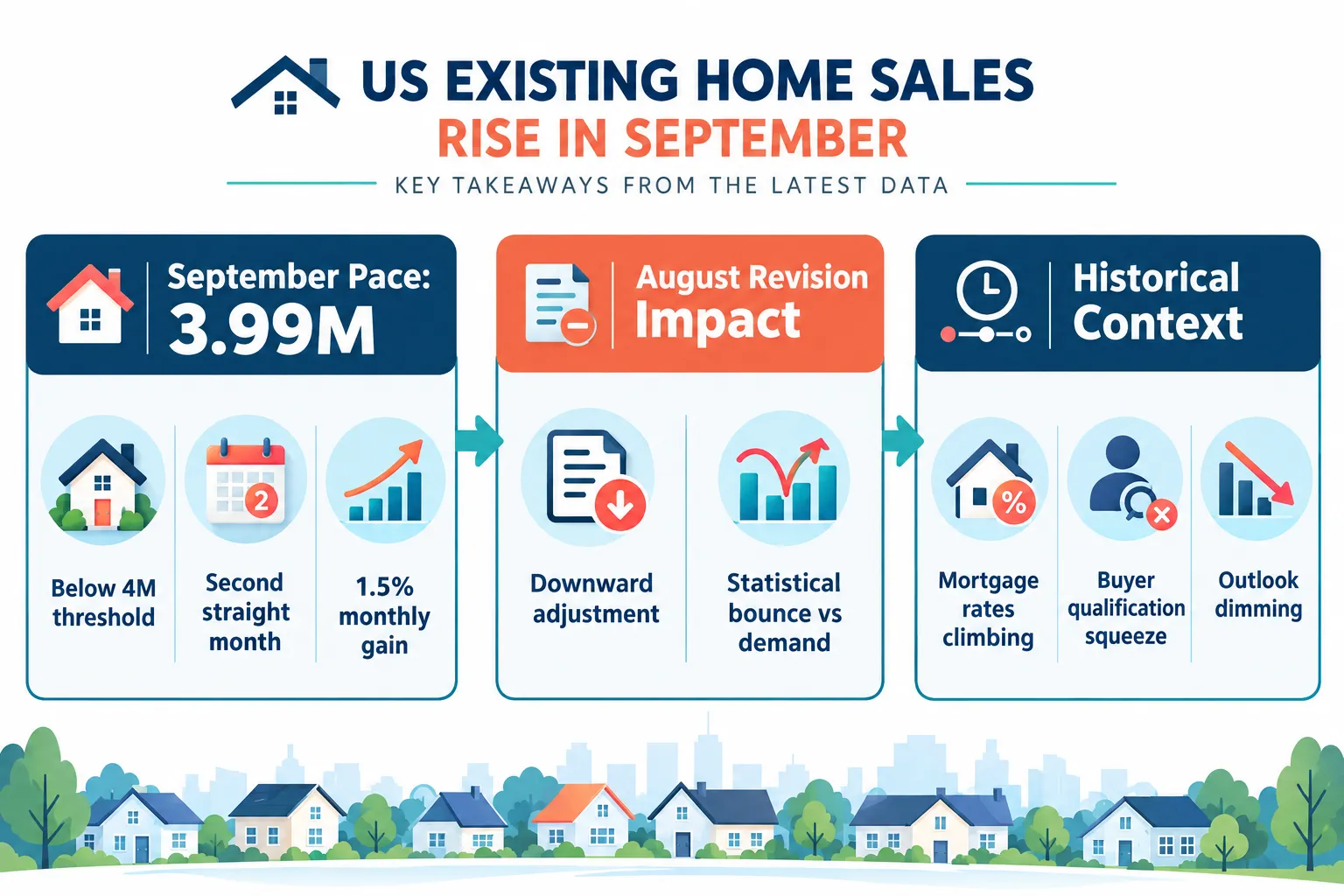
- September sales rose to a 3.99 million annualized pace, a 1.5% monthly gain, but stayed below the 4-million mark for the second straight month [1][2].
- August's number was revised down, so part of September's "increase" is a statistical bounce rather than fresh buyer demand [2].
- The historically normal annual pace is close to 5.2 million, meaning September's print is still a long way from a healthy baseline [2].
- Inventory hit 1.60 million unsold homes, the highest level since November 2019, up 4.6% from a year earlier [1][2].
- The 30-year fixed mortgage rate averaged 6.86% in September, then jumped to 7.40% for the week ending October 8, the highest since November 2023 [1][3][4].
- NAR chief economist Lawrence Yun called August and September the two slowest months of 2026 and expects rates near or above 7% to stick around [1][2].
- Realtor.com's Danielle Hale expects sales to stay subdued through the end of 2026 as rates remain elevated [6].
- Oxford Economics' Nancy Vanden Houten projects the annualized pace will likely stay under 4 million for several more quarters if rates hold above 7% [7].
- NAR's September Pending Home Sales report, due October 20, 2026, will be the next real signal of where closings head next [5].
US Existing Home Sales Rise In September: What The NAR Data Shows
Existing-home sales rose to a 3.99 million seasonally adjusted annual rate in September 2026, a 1.5% increase from August's revised 3.93 million pace, per NAR's October 13 release [1]. That outperformed the roughly 3.95 million economists polled by Reuters had penciled in [3].
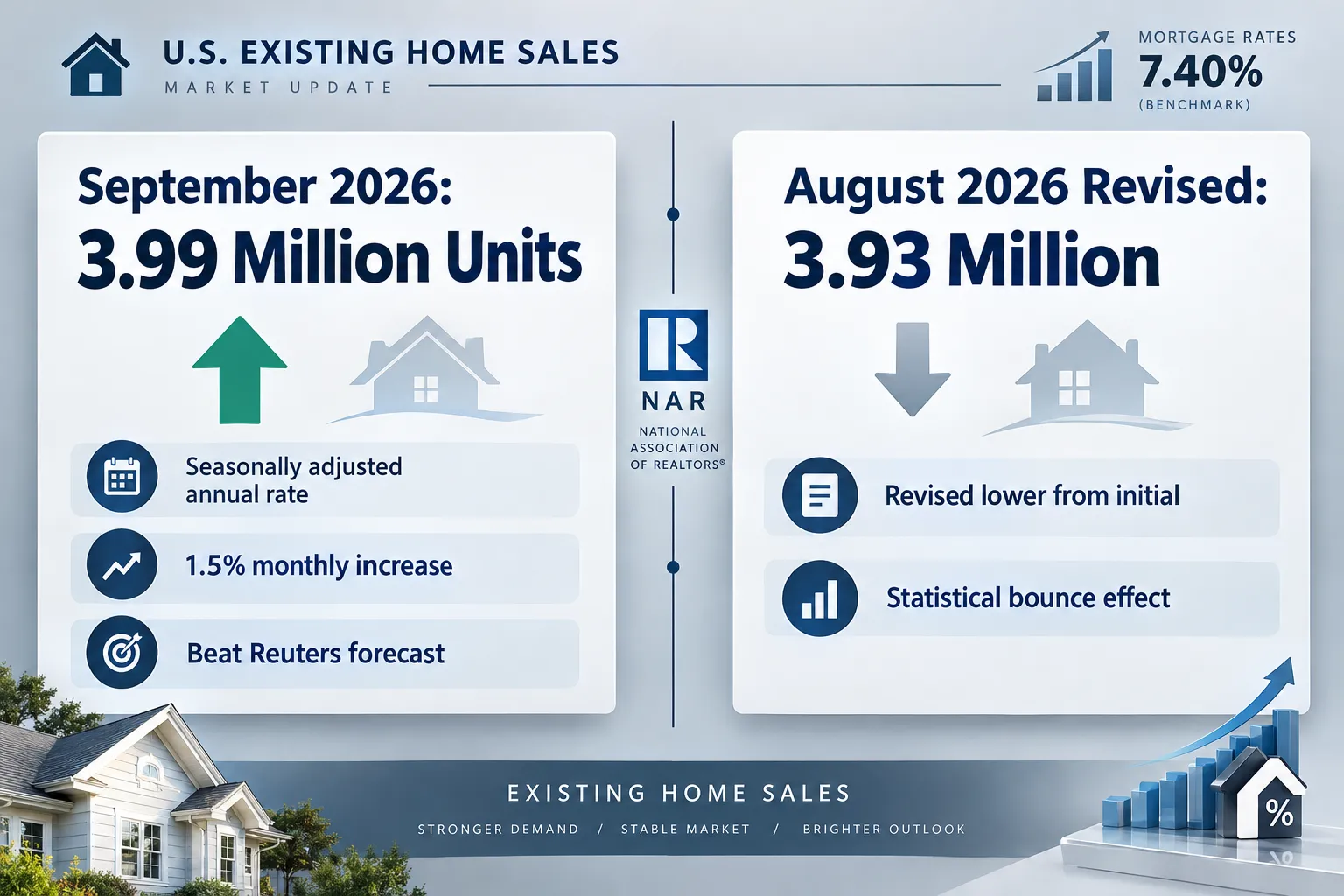
Here's the part that keeps this from being a celebration headline: August's original number got revised lower before September's comparison was even made [2]. So some of that "rise" is a mirror reflecting a weaker prior month, not a wave of new buyers rushing back into the market. Impeccable timing on the data revision, less impeccable underlying demand.
Why Did US Existing Home Sales Go Up In September
Sales rose mainly because August came in soft enough that any small uptick looked bigger by comparison, combined with buyers who locked in contracts before the worst of October's rate spike hit [1][2]. Closings reported in September typically reflect contracts signed 30 to 60 days earlier, back when rates sat closer to 6.5% to 6.8% instead of the 7.40% logged by early October [4].
That lag matters. September's "good news" was baked in before mortgage rates made their latest move higher, which is exactly why Yun flagged August and September together as the two slowest months of the year [1].
What Does A Rise In Home Sales Mean For The Economy
A small sales rise against a backdrop of rising rates signals a market running on momentum from older, cheaper financing rather than new economic strength. Existing-home sales still ran at less than 80% of the roughly 5.2 million pace considered historically normal [2], which keeps a drag on related spending: moving services, renovation work, furniture, and closing-related fees all stay compressed when transaction volume stays this thin.
Fewer closings also means less turnover-driven equity extraction and fewer new listings generated by move-up buyers, which keeps feeding the inventory story below.
What Does Existing Home Sales Mean Vs New Home Sales
"Existing-home sales" counts closings on previously owned properties already in the resale market, while "new home sales" counts transactions on homes built and sold by homebuilders, usually tracked by the U.S. Census Bureau rather than NAR. Existing homes represent roughly 85% to 90% of all residential transactions in a typical month, so the NAR report is the bigger lever on overall market sentiment.
The two series also behave differently because builders can adjust production, pricing, and incentives on the fly. Resale sellers generally cannot discount a 2005-built colonial the way a builder can discount a model home on a spec lot.
What's The Difference Between Existing And New Home Inventory
Existing-home inventory depends entirely on current owners deciding to list, which is why the 1.60 million unsold existing homes reported for September, the highest level since November 2019, took years to rebuild [1][2]. New-home inventory depends on builder construction pipelines and can move faster in either direction because builders control the supply spigot directly.
- Existing inventory, September 2026: 1.60 million units, 4.8 months of supply, up 1.9% month over month and 4.6% year over year [1][2]
- New-home inventory: tracked separately by Census, moves with builder start and completion rates rather than resale listing decisions
Choose existing-home data when you want a read on resale market health and seller psychology. Choose new-home data when you're specifically tracking builder behavior, incentive levels, or spec-home pricing.
How Do Mortgage Rates Affect Home Sales
Mortgage rates affect home sales by changing the monthly payment on the same loan amount, which directly shifts how much house a buyer can qualify for and how urgently they shop. A buyer who could afford a $400,000 loan at 6.3% a year ago qualifies for meaningfully less at 7.40%, even with identical income [4].
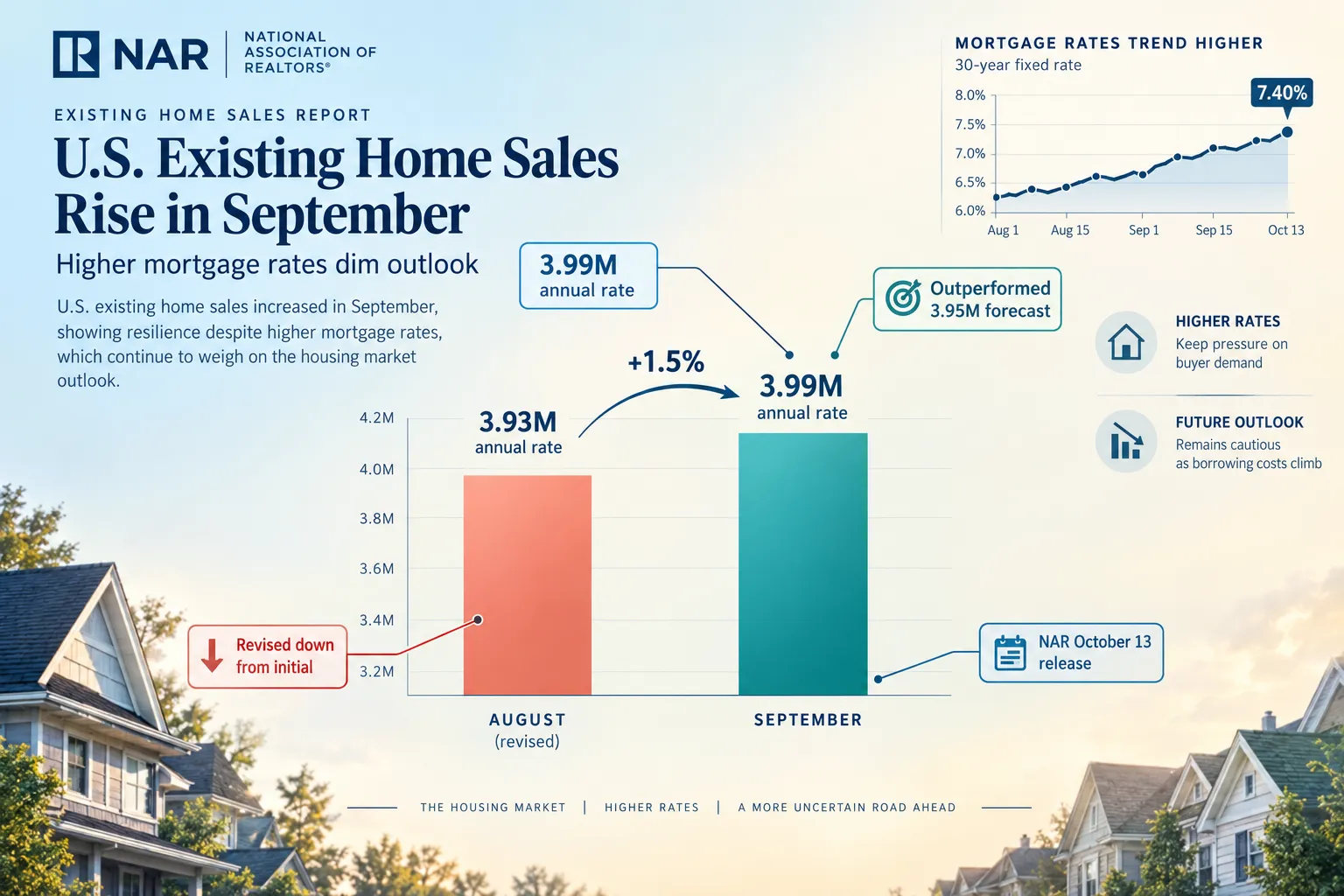
That's the entire mechanism behind September's weak backdrop. The 30-year fixed rate averaged 6.86% in September, already up from 6.67% in August and 6.35% in September 2025 [1][4]. Then it kept climbing into October, hitting 7.40% for the week ending October 8, up from 7.28% the prior week [4][10 is not used]. Reuters called that the highest level since November 2023 [3].
What Are Current Mortgage Rates Today
As of the week ending October 8, 2026, Freddie Mac reported the average 30-year fixed mortgage rate at 7.40%, up from 7.28% the previous week and from 6.30% a year earlier [4]. Rates move weekly, so always check the current Freddie Mac Primary Mortgage Market Survey before locking in a number for a specific deal, and compare at least three lenders since individual quotes vary based on credit score, down payment, and loan type. Readers weighing loan structure should also compare the adjustable rate mortgage pros and cons against a standard fixed-rate loan before assuming fixed is automatically the safer play in a 7%-plus environment.
Why Are Mortgage Rates Rising Right Now
Yun pointed to oil-price uncertainty, geopolitical tension, and elevated U.S. government debt as the forces keeping long-term borrowing costs stubborn into late 2026 [2]. Mortgage rates track the 10-year Treasury yield more closely than the Fed's short-term rate moves, so even when the Fed cuts, mortgage rates can stay fresh and painful if bond markets stay nervous about deficits and inflation risk.
When Will Mortgage Rates Come Down Again
Nobody credible is promising a near-term drop. Yun expects rates near or slightly above 7% to become the "new normal" rather than a temporary spike [2], and Vanden Houten's Oxford Economics outlook assumes rates stay above 7% for several more quarters [7]. Let it cook before you see results on this one. If you're waiting for a rate crash to re-enter the market, the data says you should plan your budget around 7%-ish financing, not around hope.
Higher Mortgage Rates Dim The Outlook For Existing Home Sales
Higher mortgage rates dim the outlook for existing-home sales because they directly shrink the pool of buyers who can qualify for a given price point, and that effect usually shows up in closings about 30 to 60 days after rates move. Yun's blunt framing: continued rate increases translate into fewer qualified buyers, full stop [1].
Hale's forecast backs that up. She expects sales to stay relatively low through the rest of 2026 as long as rates stay elevated [6]. Vanden Houten goes further, projecting the annualized pace stays under 4 million for several quarters if rates hold above 7% [7]. None of this is gatekeeping the market from people who want in. It's math.
Is Now A Good Time To Buy A House With Rates Going Up
Now can still be a reasonable time to buy if you find a priced-right home in a market with rising inventory, because buyers currently have more negotiating leverage than they've had in years. Choose to buy now if you plan to stay 7-plus years, can comfortably afford payments at today's 7%-ish rates, and can negotiate seller concessions given the 4.8-month supply level [1]. Hold off if you're stretching your budget assuming rates drop soon, since both Yun and Vanden Houten say that assumption is shaky [2][7].
First-time buyers specifically should also check how their age and income compare to current norms; the average age of first-time home buyers hitting record highs is a data point worth knowing before assuming you're behind schedule.
Should I Lock In My Mortgage Rate Now Or Wait
Lock your rate now if a lender offers float-down protection or if you're closing within 30 to 45 days, since rates have already moved from 6.86% in September to 7.40% by early October [1][4]. Waiting only pays off if you have strong evidence rates are about to drop, and right now the forecasting consensus points the other direction [2][7]. If your loan structure is non-traditional, review non-QM mortgage lenders before locking anything, and compare mortgage broker versus direct lender options since rate offers can vary meaningfully between the two paths.
How Do Rising Rates Affect Sellers Vs Buyers
Rising rates hand buyers more negotiating power while pressuring sellers to offer discounts or concessions to close deals. Yun said directly that higher inventory and longer time on market mean sellers may need to cut price or sweeten the deal to get a contract signed [1]. Buyers get more selection and slower urgency; sellers get a market that behaves less like 2021 and more like a buyer's market with teeth.
Sellers navigating this shift should look at current home selling strategies built for a slower market, since pricing and staging decisions carry more weight when days-on-market stretch out.
How Much Do Higher Rates Impact Home Prices
Higher rates slow price growth and extend time on market more than they cause outright price drops, at least so far in 2026. The median existing-home price rose to $434,100 in July 2026, still up year over year [per NAR data referenced earlier in 2026 market tracking], even as sales volume stayed soft. Rates hit affordability through the monthly payment, not necessarily through the sticker price, which is why inventory and days-on-market move faster than prices do.
Are Home Prices Expected To Drop With Higher Rates
Most forecasters expect price growth to slow or flatten rather than reverse into outright declines nationally, though some overbuilt or overpriced local markets could see corrections. For a deeper look at the national price debate, see the breakdown in will home prices drop in 2026, which walks through historical precedent for rate-driven slowdowns versus true price crashes.
What Comes Next: Pending Sales And The Rest Of 2026
NAR's September Pending Home Sales report, scheduled for October 20, 2026, is the next data point worth watching closely [5]. Pending contracts reflect signings, not closings, so they'll capture buyer behavior from the weeks when rates were already pushing past 7%, giving a more current read than the September existing-home sales print.
Buyers and sellers planning around this timeline should also factor in how location and amenities affect value retention in a slower market; the amenity proximity secrets guide is a useful companion read for anyone pricing a home or picking a neighborhood while rates stay elevated.
Frequently Asked Questions
Did existing-home sales really increase in September 2026?
Yes. NAR reported a 1.5% monthly rise to a 3.99 million seasonally adjusted annual rate, up from August's revised 3.93 million [1].
Why is the increase considered weak despite the rise?
Because August's figure was revised lower before the comparison, and the September pace still sits well below the roughly 5.2 million rate considered historically normal [2].
What was the average mortgage rate in September 2026?
The 30-year fixed rate averaged 6.86% in September, compared with 6.67% in August and 6.35% in September 2025 [1][4].
How high did mortgage rates climb after September?
Freddie Mac reported the 30-year fixed rate at 7.40% for the week ending October 8, 2026, the highest level since November 2023 [3][4].
How much housing inventory is currently available?
Unsold existing homes reached 1.60 million units in September, a 4.8-month supply and the highest level since November 2019 [1][2].
Who said rates near 7% could become the new normal?
NAR chief economist Lawrence Yun said this, citing oil-price uncertainty, geopolitical tension, and elevated government debt as reasons rates may stay elevated [2].
What does Realtor.com expect for the rest of 2026?
Chief economist Danielle Hale expects home sales to remain relatively low through year-end while mortgage rates stay elevated [6].
Will existing-home sales climb back above 4 million soon?
Oxford Economics' Nancy Vanden Houten projects the pace will likely stay below 4 million for several more quarters if rates remain above 7% [7].
When is the next major housing data release?
NAR's September Pending Home Sales report is scheduled for October 20, 2026 [5].
Is this market better for buyers or sellers right now?
Current conditions favor buyers on negotiating leverage, with rising inventory and longer time on market pushing some sellers toward price cuts or concessions [1].
Conclusion
September's headline looks like good news on the surface. A 1.5% rise to a 3.99 million annualized pace beat forecasts and gave the market something to point to after a rough stretch. The honest read, backed by Yun, Hale, and Vanden Houten, is that this bounce happened against a weaker revised August and ahead of mortgage rates jumping to 7.40% by early October [1][2][3][4][6][7].
If you're a buyer, use the current 4.8-month supply and softer seller leverage to negotiate price or concessions rather than waiting on a rate drop nobody credible is promising [1][2]. If you're a seller, price realistically for a market where days-on-market are stretching out, and consider concessions before your listing goes stale. If you're an agent or investor, watch the October 20 pending sales release closely, since it will show how buyers are actually responding to 7%-plus financing in real time rather than relying on a lagging closings report [5]. Track the next NAR and Freddie Mac releases directly, and revisit your rate-lock strategy before, not after, the next rate print lands.
References
[1] Existing Home Sales Increased 1 5 In September According To Nar Report – https://www.nar.realtor/newsroom/existing-home-sales-increased-1-5-in-september-according-to-nar-report
[2] Tag:reuters.com,2026:newsml Kbn3vt1va – http://rmb.reuters.com/rmd/rss/item/tag:reuters.com,2026:newsml_KBN3VT1VA?channel=FBi345
[3] Existing Home Sales Data Nar September 2026 – https://www.realtor.com/news/real-estate-news/existing-home-sales-data-nar-september-2026/
[4] Existing Home Sales – https://www.nar.realtor/research-and-statistics/housing-statistics/existing-home-sales
[5] Home Sales Eke Out Uptick But Mortgage Rate Threat Looms – https://www.nar.realtor/news/real-estate-news/economy/home-sales-eke-out-uptick-but-mortgage-rate-threat-looms
[6] Nar Existing Home Sales Report Shows 2 0 Decrease In August – https://www.nar.realtor/newsroom/nar-existing-home-sales-report-shows-2-0-decrease-in-august
[7] Existing Home Sales September 2026 – https://www.inman.com/2026/10/13/existing-home-sales-september-2026/