

Last updated: July 20, 2026

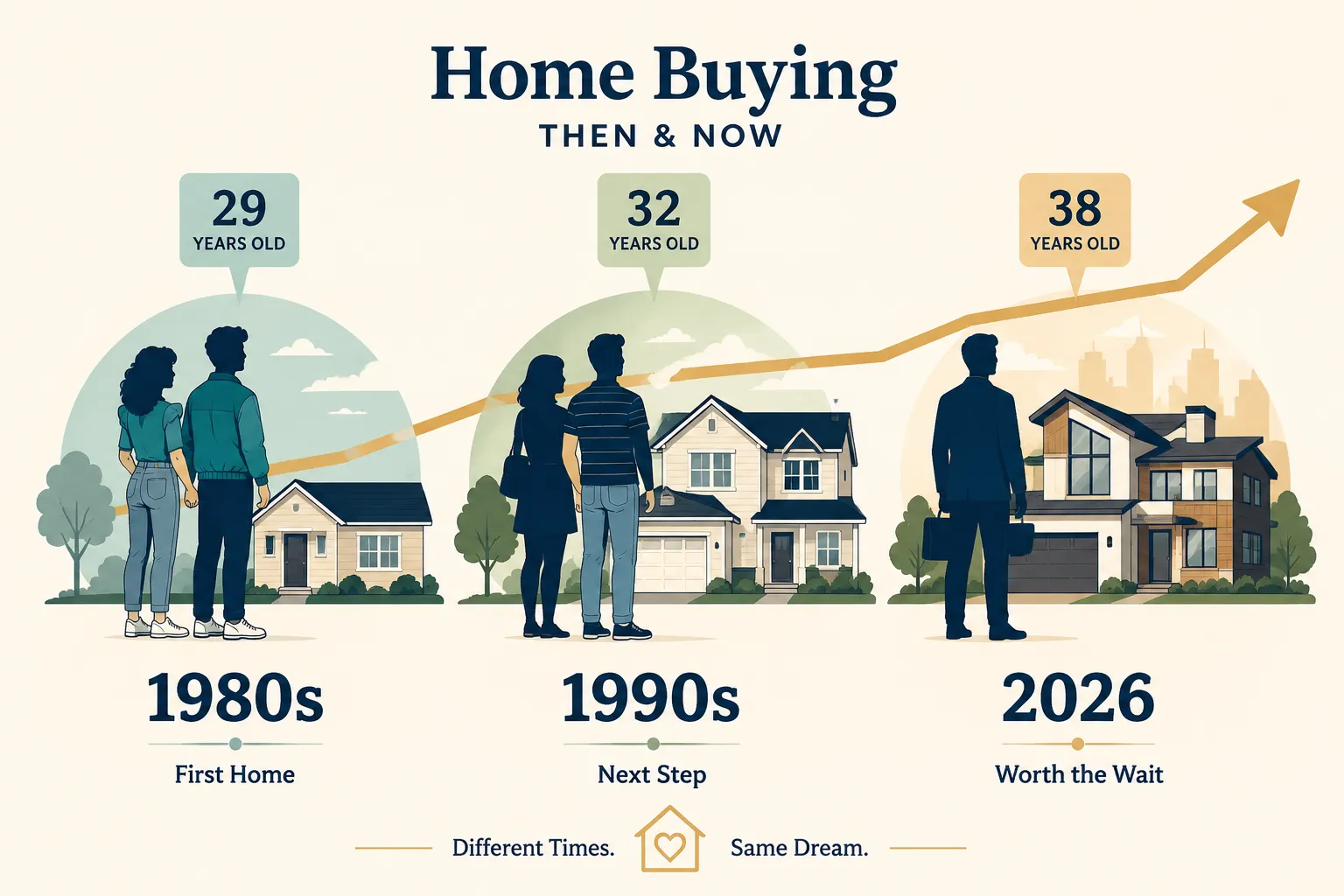
Quick Answer: The average age of first time home buyer in the U.S. hit a record high of 38 years old in 2024, according to the National Association of Realtors (NAR). That number has climbed steadily from 29 in 1981, driven by student debt, high home prices, and a housing supply shortage that has made it harder than ever for younger buyers to enter the market.
Key Takeaways
- The median age of first-time home buyers reached 38 in 2024, the highest ever recorded by NAR.
- In 1981, the average age of first-time home buyers was just 29 years old.
- Student loan debt, rising home prices, and tight inventory are the three biggest factors pushing the average age of first time home buyer higher every decade.
- First-time buyers now represent only about 24% of all home purchases, also a record low.
- The average age of first-time home buyers varies significantly by state, with high-cost coastal markets skewing older.
- Buying your first home at 25 is still possible, and buying at 40 is far from too late.
- Federal and state programs exist specifically to help first-time buyers overcome the savings and credit barriers that delay ownership.
- The average first-time buyer today needs roughly $60,000,$80,000 saved to cover a down payment and closing costs in most U.S. markets.
How the Average Age of First Time Home Buyer Has Changed Over the Years
The average age of first time home buyer just hit a record, and the data tells a story that goes back decades. In 1950, the post-war housing boom made homeownership accessible to buyers in their mid-to-late 20s. The GI Bill, low mortgage rates, and affordable new construction meant that a 27-year-old buying their first home was completely normal.
Here is how the median age of first-time home buyers has shifted over time:
First-Time Home Buyer Age Chart, Historical Trend
| Year | Average Age of First-Time Home Buyer |
|---|---|
| 1950 (est.) | ~27 |
| 1980 | ~29 |
| 1981 | 29 |
| 1990 | 30-31 |
| 2000 | 32 |
| 2010 | 30 |
| 2019 | 33 |
| 2022 | 36 |
| 2023 | 35 |
| 2024 | 38 |
Sources: NAR Profile of Home Buyers and Sellers (various years); 1950 figure is an estimate based on historical housing data.
The dip around 2010 reflects post-recession affordability in some markets, but the long-term trend is unmistakably upward. The average age of first time home buyer over time has essentially added nearly a decade since 1981. That is not a blip, that is a structural shift in how Americans access homeownership.
For a broader look at what is driving the 2026 market, check out our U.S. home buyers market trends in 2026 breakdown.
What Is the Average Age of First Time Home Buyer in 2024 and 2026?
The average age of first-time home buyer in 2024 officially hit 38, per NAR's 2024 Profile of Home Buyers and Sellers. That is the highest number in the survey's history. For context, the average age of first-time home buyer in 2025 held near that same range as affordability conditions remained tight heading into 2026.
As of 2026, early market data suggests the average age of first time home buyer in America has not meaningfully dropped. Mortgage rates stabilizing around 6% have helped some buyers re-enter the market, but home prices in most metros remain elevated. The result: the average age of first-time home buyer in 2026 is still tracking at or near that record 38-year mark.
What makes this extraordinary is the contrast with the repeat buyer side. The median age of repeat buyers hit 61 in 2024, meaning the gap between first-time and repeat buyers is wider than it has ever been. The housing market is essentially splitting into two very different demographics.
Why Are First-Time Home Buyers Getting Older?
Three forces are working together to push the average age of first time home buyer higher with every passing year. None of them are new, but they have compounded in ways that make 2026 uniquely difficult for younger buyers.
1. Student Loan Debt
The average student loan borrower carries roughly $37,000 in debt. For many buyers in their late 20s and early 30s, monthly loan payments eat directly into what could be a down payment fund. This is not gatekeeping, it is math. A $400/month student loan payment over five years is $24,000 that does not go toward a home.
2. Home Price Appreciation
From 2020 to 2024, U.S. median home prices rose by over 40% in many markets. Wages did not keep pace. A buyer who needed $40,000 for a down payment in 2019 now needs closer to $60,000,$80,000 for the same type of home in most markets.
3. Housing Supply Shortage
The U.S. is estimated to be short roughly 3-4 million housing units. Low supply keeps prices elevated and creates bidding wars that favor cash buyers and equity-rich move-up buyers over first-timers.
Bonus factor: The "Bank of Mom and Dad"
NAR data shows that first-time buyers who receive gift money from family are able to close deals faster. Those without that safety net wait longer, sometimes years, to save independently.

How Does Student Debt Affect First-Time Home Buying Age?
Student debt directly delays homeownership by reducing monthly cash flow available for saving and by increasing a buyer's debt-to-income (DTI) ratio, a key metric lenders use to approve mortgages.
Most conventional lenders want a DTI below 43%. If a buyer earns $6,000/month and pays $500/month in student loans, that $500 counts against them before the mortgage payment is even calculated. The result: they either qualify for less house or they do not qualify at all until the debt is paid down.
The delay caused by student debt is not uniform. Buyers with graduate degrees often earn more but also carry more debt, sometimes $100,000+. A medical school graduate or law school grad might not buy their first home until their late 30s despite a high income, simply because their DTI is too high during the early years of their career.
For Gen Z buyers specifically, our guide on first-time home buyers tips for Gen Z covers how to work around debt-to-income challenges at a younger age.
What Factors Are Delaying First-Time Home Purchases?
Beyond student debt, several other factors are pushing the average age of first time home buyer higher:
- Renting feels safer short-term. With home prices volatile in recent years, many younger buyers chose to rent and wait. That wait often stretches longer than planned.
- Marriage and family formation happening later. The median age of first marriage in the U.S. is now 30 for men and 28 for women, both higher than in previous generations. Many buyers wait until they have a partner to split costs.
- Remote work changed location decisions. Post-2020, many buyers relocated to new cities and needed time to understand local markets before committing.
- Credit score building takes time. First-time buyers without a credit history or with thin files need 12-24 months to build scores strong enough for competitive mortgage rates.
- Down payment requirements feel impossible. Even with 3% down programs available, buyers in high-cost markets face $15,000,$30,000 minimums before closing costs.
The combination of these factors is so based in economic reality that blaming younger buyers for "not trying hard enough" misses the point entirely.
Average Age of First-Time Home Buyers by State, Does Location Matter?
Yes, the average age of first-time home buyers by state varies significantly based on local home prices, job markets, and housing supply.
States with the oldest first-time buyers tend to be high-cost coastal markets:
- California, New York, Massachusetts, Washington, and Hawaii consistently see first-time buyers in their late 30s to early 40s.
States with younger first-time buyers tend to be more affordable interior markets:
- Iowa, Indiana, Ohio, Kansas, and Mississippi often see first-time buyers in their early-to-mid 30s.
The logic is straightforward: in a market where a starter home costs $650,000 (think San Jose or Seattle), it takes years longer to save a down payment than in a market where a starter home costs $180,000 (think Wichita or Columbus).
If you are flexible on location, our best states for first-time home buyers rankings for 2026 breaks down exactly where affordability still exists.

Can You Buy a House at 25 as a First-Time Buyer?
Absolutely, buying at 25 is possible and, in the right market with the right financial foundation, it is an impeccable move. The average age of first time home buyer being 38 does not mean 25 is too young. It means the average person is waiting longer. You do not have to be average.
To buy at 25, you typically need:
- A credit score of at least 620 (580 for FHA loans)
- A stable income with at least 2 years of employment history (or self-employment documentation)
- A down payment of 3%,20% depending on loan type
- A DTI below 43%
- Enough reserves to cover 2-3 months of mortgage payments
The honest reality: In most major metros, buying at 25 requires either a high income, family financial help, or choosing a more affordable market. In smaller cities and the Midwest, 25-year-old buyers close deals every day. The key is not waiting for the "perfect time", it is building the financial foundation and letting it cook before you see results.
Is It Too Late to Buy Your First Home at 40?
Not even close. Buying your first home at 40 is fresh, practical, and increasingly common given that the average age of first time home buyer in America just hit 38. At 40, you likely have a stronger income, better credit, and more savings than you did at 25.
The main concern buyers at 40 raise is the mortgage timeline. A 30-year mortgage taken at 40 runs until age 70. That feels long, but consider:
- You can always pay extra toward principal to shorten the timeline.
- A 15-year mortgage at 40 is paid off at 55, well before traditional retirement age.
- Home equity builds regardless of when you start.
- Renting at 40 and beyond means no equity accumulation and no fixed housing cost.
The real question is not whether 40 is "too late", it is whether your financial profile (income, credit, savings) supports a mortgage you can comfortably afford. If yes, there is no reason to wait.
How Much Do First-Time Home Buyers Need to Save?
The amount you need depends on the home price, loan type, and location, but here are the real numbers most buyers face in 2026:
Down Payment:
- FHA loan: 3.5% down (requires 580+ credit score)
- Conventional loan: 3%,5% down for first-time buyers
- Conventional with no PMI: 20% down
Closing Costs:
- Typically 2%,5% of the purchase price, paid at closing
- On a $350,000 home, that is $7,000,$17,500 in closing costs alone
Cash Reserves:
- Most lenders want to see 2-3 months of mortgage payments in savings after closing
Example, $350,000 home with 5% down:
- Down payment: $17,500
- Closing costs (3%): $10,500
- Reserves (2 months at $2,200/month): $4,400
- Total needed: ~$32,400
For buyers in high-cost markets (median home price $600,000+), that number easily doubles. This is why the average age of first time home buyer keeps climbing, saving $60,000,$80,000 while paying rent takes years.
Our financing and mortgage tips guide covers how to structure your savings strategy before applying.
What First-Time Home Buyer Programs and Grants Are Available?
First-time buyers have more help available than most realize. The challenge is that many buyers do not know these programs exist, classic gatekeeping by the industry that RERIQ is here to fix.
Federal Programs:
- FHA Loans, Lower credit score requirements, 3.5% down
- USDA Loans, Zero down payment for eligible rural and suburban areas
- VA Loans, Zero down for eligible veterans and active military
- Fannie Mae HomeReady / Freddie Mac Home Possible, 3% down for income-qualifying buyers
State and Local Programs:
Every state has a Housing Finance Agency (HFA) that offers down payment assistance, closing cost grants, and below-market mortgage rates for first-time buyers. These programs vary widely, some offer forgivable grants, others offer deferred loans.
How to Find Them:
- Search "[your state] housing finance agency first-time buyer"
- Ask your lender about HFA-approved loan products
- Check HUD's official directory of approved housing counselors
For buyers exploring mortgage options, our best mortgage options guide for Gen Z home buyers covers these programs in detail.
First-Time Home Buyer vs. Experienced Investor, Key Differences
First-time buyers and experienced investors approach the same transaction very differently, and understanding that gap can save a first-timer from making costly mistakes.
| Factor | First-Time Buyer | Experienced Investor |
|---|---|---|
| Motivation | Primary residence, stability | Cash flow, appreciation, tax benefits |
| Financing | FHA, conventional, state programs | Conventional, DSCR, portfolio loans |
| Emotional involvement | High | Low |
| Due diligence | Learning as they go | Systematic, data-driven |
| Negotiation | Often less confident | Strategic, numbers-based |
| Timeline | Flexible to urgent | Deal-dependent |
The biggest difference is emotional detachment. An investor walks away from a deal that does not pencil out. A first-time buyer sometimes falls in love with a home and overpays. Knowing this tendency going in is the first step to avoiding it.
Common Mistakes First-Time Home Buyers Make
These are the moves that cost buyers money, time, and sometimes the deal entirely:
- Not getting pre-approved before shopping. Sellers will not take you seriously without a pre-approval letter. In competitive markets, it is non-negotiable.
- Maxing out their budget. Just because a lender approves you for $450,000 does not mean you should spend $450,000. Leave room for repairs, furnishings, and life.
- Skipping the home inspection. In hot markets, some buyers waive inspections to compete. This is a gamble that can cost tens of thousands of dollars.
- Ignoring closing costs. Many first-timers budget for the down payment but forget closing costs can add $10,000,$20,000 to the total cash needed.
- Changing jobs or taking on new debt before closing. Lenders verify employment and credit right before closing. A new car loan or job change can kill the deal.
- Not shopping multiple lenders. Getting one mortgage quote is like buying the first car you test drive. Rate differences of even 0.5% can cost $30,000+ over a 30-year loan.
Our full first-time home buyer tips guide walks through each of these in detail with real broker perspective.
Are First-Time Home Buyers Approved for Mortgages More Easily?
Not necessarily, but there are programs designed to lower the barriers for first-time buyers specifically. FHA loans accept credit scores as low as 580 with 3.5% down. Fannie Mae's HomeReady program allows income from household members (not just the borrower) to count toward qualification.
That said, lenders still evaluate the same core factors for everyone:
- Credit score
- Debt-to-income ratio
- Employment history
- Down payment amount
- Cash reserves
First-time buyers without a mortgage history are not penalized for that gap, lenders simply look at rent payment history and other credit accounts instead. The key is showing stability and responsible financial behavior over 12-24 months before applying.
What Should You Do Before Buying Your First Home?
The buyers who close smoothly are the ones who prepared 12-24 months before they ever toured a house. Here is the playbook:
12-24 Months Out:
- Pull your credit reports and dispute any errors
- Start paying down high-interest debt to lower your DTI
- Open a dedicated savings account for your down payment
- Research first-time buyer programs in your target state
6-12 Months Out:
- Get a mortgage pre-qualification to understand your range
- Research neighborhoods and school districts
- Track local home prices to understand market timing
- Connect with a buyer's agent who specializes in first-time buyers
3-6 Months Out:
- Get formally pre-approved (not just pre-qualified)
- Finalize your must-haves vs. nice-to-haves list
- Avoid any major financial changes (new debt, job changes)
- Tour homes actively and make offers when the numbers work

The process rewards patience. Let it cook before you see results, buyers who rush the financial prep phase often end up with a higher rate, a smaller approval, or no approval at all. For a deeper dive, our complete first-time homebuyer guide covers every step from credit to closing.
Frequently Asked Questions
What is the average age of first-time home buyers in 2024?
The average age of first-time home buyers in 2024 was 38 years old, according to the National Association of Realtors. This is the highest median age of first-time home buyers ever recorded in NAR's annual survey.
What was the average age of first-time home buyers in 1981?
In 1981, the average age of first-time home buyers was 29 years old. The average age of first-time home buyer in 1980 was similar, hovering around 29-30.
What was the average age of a first-time home buyer in 1990?
The average age of first-time home buyer in 1990 was approximately 30-31 years old, reflecting a modest increase from the early 1980s baseline.
What is the average age of first-time home buyer in 2026?
Based on current market conditions, the average age of first-time home buyer in 2026 is tracking at or near 38, consistent with the 2024 record high, as affordability barriers have not significantly eased.
Why has the average age of first time home buyer in America increased so much?
The increase reflects a combination of rising home prices, student loan debt, delayed marriage, and a persistent housing supply shortage. These factors compound over time, pushing the average age of first time home buyer in the USA higher with each decade.
Is 38 the new normal for first-time buyers?
It may be the new average, but it is not inevitable for every buyer. With the right financial preparation, state assistance programs, and market selection, buyers in their late 20s and early 30s close deals regularly.
Does the average age of first-time home buyers vary by state?
Yes. High-cost states like California and New York see first-time buyers skewing older (late 30s to early 40s), while affordable Midwest and Southern states see buyers in their early-to-mid 30s.
Can student loans prevent you from getting a mortgage?
Student loans do not automatically disqualify you, but they increase your DTI ratio. If your total monthly debt payments (including the projected mortgage) exceed 43% of your gross monthly income, most lenders will not approve the loan.
What is the minimum credit score for a first-time home buyer?
FHA loans accept scores as low as 580 with 3.5% down. Conventional loans typically require 620+. The higher your score, the better your rate, a 760+ score gets you the best available terms.
Are there grants for first-time home buyers?
Yes. State Housing Finance Agencies offer down payment assistance grants and forgivable loans in most states. Some programs are income-based; others are geography-based. Search your state's HFA website or ask a HUD-approved housing counselor.
What percentage of home buyers are first-time buyers in 2024?
First-time buyers made up approximately 24% of all home purchases in 2024, per NAR, also a record low. The combination of record-high buyer age and record-low first-timer share tells the same story.
How long does it take to save for a first home?
At a savings rate of $1,000/month, it takes roughly 3-5 years to accumulate enough for a down payment and closing costs on a median-priced U.S. home. In high-cost markets, that timeline can stretch to 7-10 years without income growth or financial assistance.
Conclusion, What This Record Means for You
The average age of first time home buyer just hit a record, and the data is extraordinary in what it reveals about the American housing market. This is not a generational failure, it is a structural problem built over decades of underbuilding, rising costs, and wage stagnation.
But here is the straight answer: the record average age does not have to be your age.
If you are in your 20s or early 30s, the path to homeownership is harder than it was for your parents, but it is not closed. Start building your financial profile now, research state assistance programs, and be strategic about market selection. The buyers who close early are not lucky, they prepared early.
If you are approaching 40 or already there, the data is actually on your side. You are right at the national average, your income is likely stronger than it was a decade ago, and lenders see a 40-year-old with stable employment and solid credit as an impeccable borrower.
The real takeaway from this record is not discouragement, it is information. Use it to plan smarter, save more deliberately, and stop waiting for the "perfect" market. Markets do not get perfect. Buyers get prepared.
For current rate and market conditions shaping your buying timeline, see our 2026 real estate trends and buyer strategy guide.