
Last updated: August 23, 2026

Quick Answer: Should I hire a property manager? For most small landlords with one to three properties, the answer depends on one number almost nobody calculates: the true hourly cost of self managing rental property compared to what a property manager charges. When that math is done honestly, including your time, your vacancy risk, and the cost of one bad tenant, hiring a manager often breaks even faster than you expect.
Key Takeaways
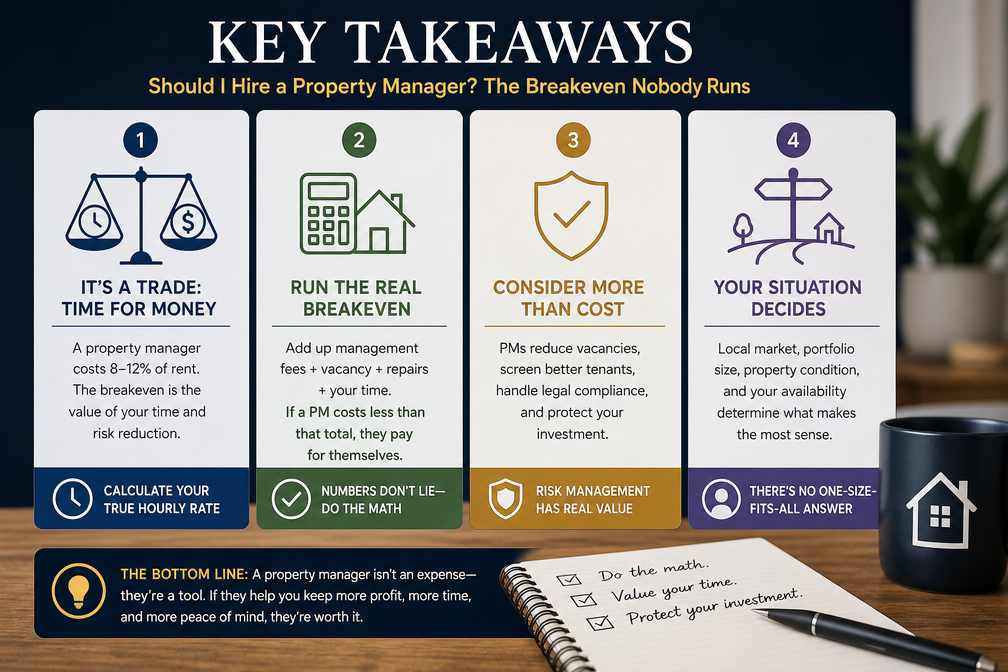
- Property managers typically charge 8% to 12% of monthly rent, plus a leasing fee of 50% to 100% of one month's rent when they place a new tenant.
- The breakeven on property manager fees vs. self-managing flips when your time is worth more than what the manager costs, or when a single tenant mistake wipes out a year of savings.
- Out of state landlords almost always benefit from professional management, since self-management from a distance is not a real option for emergencies.
- Most landlords who self-manage spend between 5 and 10 hours per month per property on average, but a single eviction can consume 40 to 80 hours and months of lost rent.
- Property management fees are generally tax deductible as an ordinary business expense on Schedule E.
- Hybrid property management, where a manager handles leasing and you handle day-to-day, can cut costs by 30% to 50% while reducing your workload.
- Red flags in a property management agreement include vague maintenance markups, no clear exit clause, and no owner portal access.
- Landlord software tools like TurboTenant, Avail, and Baselane can replace some property manager functions for landlords who want to stay self-managing but with better systems.
What Does a Property Manager Actually Do for Rental Properties
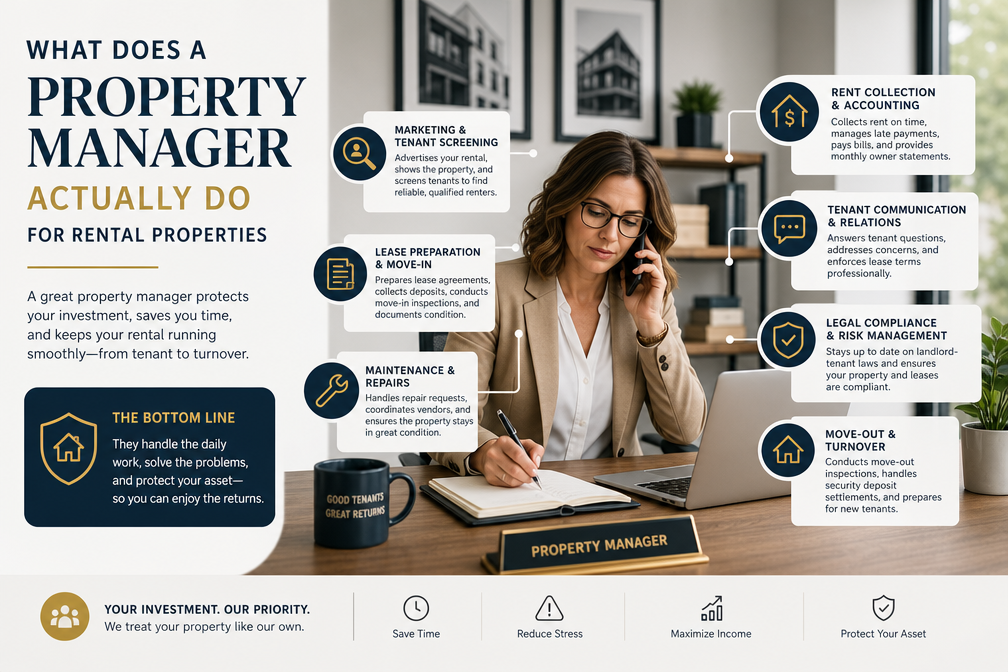
A property manager handles the operational side of owning a rental so the owner does not have to. The core services cover tenant placement, rent collection, maintenance coordination, and legal compliance.
Here is what that looks like in practice:
Tenant Placement and Screening
- Advertises the vacancy on major listing platforms
- Conducts background checks, credit pulls, and income verification
- Drafts and executes the lease agreement
- Handles move-in inspections and security deposit collection
Rent Collection and Financial Reporting
- Collects rent through an automated system
- Enforces late fees and sends notices
- Provides monthly owner statements and year-end reports for taxes
Maintenance and Repairs
- Manages a vendor network for repairs (plumbers, electricians, HVAC)
- Handles the 11pm emergency calls that most landlords dread
- Coordinates routine inspections and preventive maintenance
Legal Compliance and Evictions
- Keeps leases current with state and local landlord-tenant law
- Files eviction paperwork and represents the owner's interests through the process
- Manages move-out inspections and security deposit dispositions
For a deeper look at what separates a strong property management relationship from a costly one, our first-time second home investor's guide to property management costs, benefits, and how to pick the right company covers the full picture.
Should I Hire a Property Manager? The Breakeven Nobody Runs
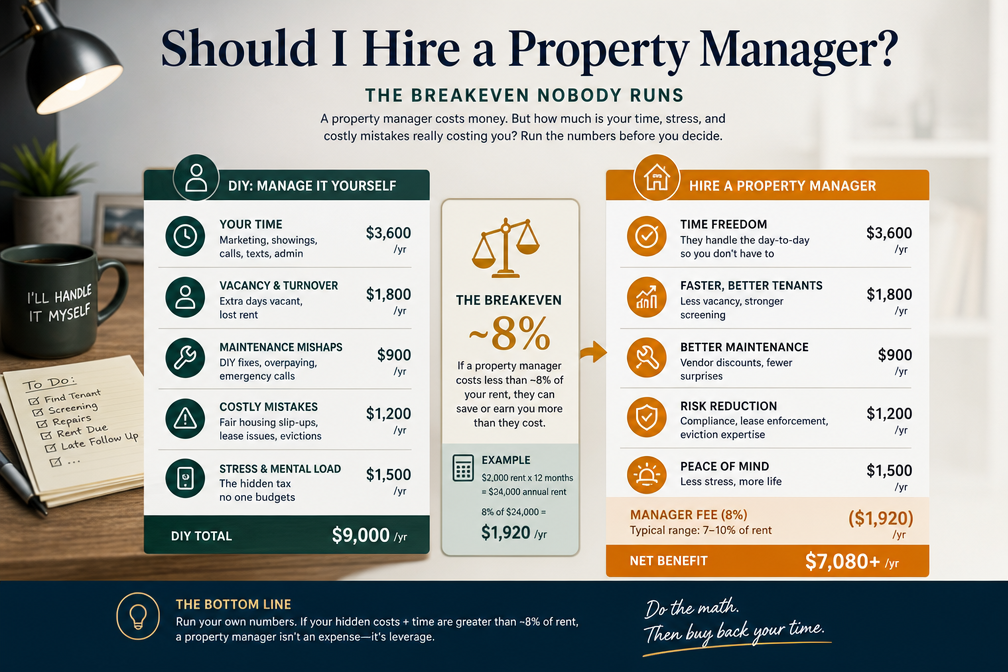
Most landlords ask whether a property manager is worth it by comparing the management fee to their monthly cash flow. That is the wrong calculation. The real breakeven question is: what does self managing rental property actually cost you, all in?
Run this math before you decide anything:
Step 1: Calculate your true time cost
Track how many hours per month you spend on your rental. Most small landlords underestimate this. A conservative estimate for a single-family home with a stable tenant runs 5 to 8 hours per month, covering communication, maintenance coordination, rent tracking, and inspections. At $50 per hour (a modest value for someone with a day job), that is $250 to $400 per month in time cost.
Step 2: Add the cost of one bad placement
This is the number that breaks the math wide open. A single eviction in most U.S. states costs between $3,500 and $7,000 when you factor in lost rent, filing fees, attorney costs, and turnover repairs. If a property manager's better screening process prevents one bad tenant every five years, that is $700 to $1,400 per year in avoided cost, before you count your own time going through the process.
Step 3: Compare to the actual management fee
On a $2,000/month rental at 10% management fee, the manager costs $200 per month, or $2,400 per year. Add a leasing fee of one month's rent ($2,000) when they place a tenant. If a tenant stays two years, the annualized leasing cost is $1,000 per year, bringing the total to roughly $3,400 per year.
The honest breakeven:
| Cost Category | Self-Managing | With Property Manager |
|---|---|---|
| Monthly time cost (8 hrs at $50/hr) | $400/month | $0 |
| Annual management fee (10% of $2,000) | $0 | $2,400 |
| Annualized leasing fee (2-yr tenant) | $0 | $1,000 |
| Bad tenant risk (1 in 5 years, avg $5,000) | $1,000/year | $300/year (reduced risk) |
| Annual total estimate | $5,800 | $3,700 |
That math is not perfect in its precision, but it is ruthless in its honesty. Most landlords never run it. The property manager wins on total cost once time is valued at anything above $25 per hour.
How Much Does Property Management Cost Per Month
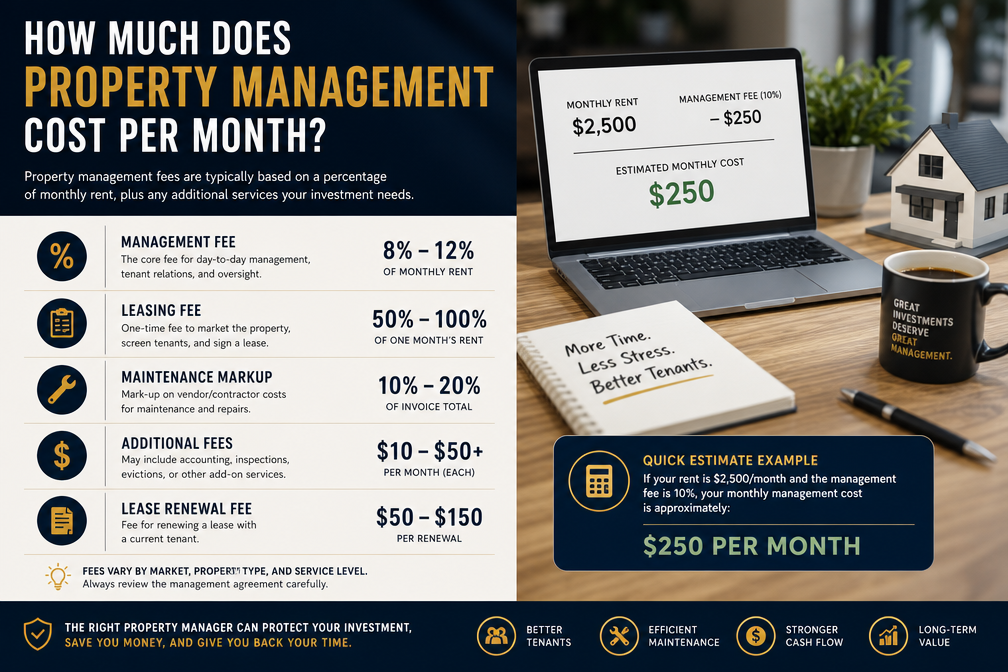
Property management fees typically run 8% to 12% of monthly collected rent for residential properties, with the national average sitting around 10%. On top of the monthly fee, expect additional charges that most fee summaries bury.
Standard fee structure breakdown:
- Monthly management fee: 8% to 12% of rent collected
- Leasing/placement fee: 50% to 100% of one month's rent (charged when a new tenant is placed)
- Lease renewal fee: $100 to $300 per renewal
- Maintenance markup: 10% to 20% above the vendor invoice (not all companies charge this, but many do)
- Vacancy fee: Some companies charge a flat fee or reduced percentage during vacancy
- Early termination fee: $200 to $500 if you exit the contract early
On a $1,800/month single-family rental, a 10% management fee costs $180/month. With a leasing fee every 18 months, the annualized total lands around $2,760 to $3,360 per year depending on turnover frequency.
For a full breakdown of how to analyze whether a rental deal pencils after management costs, the rental property analysis hub has the numbers-first approach we use at Real Estate Rank IQ.
What Percentage of Rent Do Property Managers Charge
Most residential property managers charge between 8% and 12% of monthly rent, with 10% being the most common rate for single-family homes and small multifamily properties. Rates vary by market, property type, and service level.
Factors that push fees higher:
- Properties under $1,200/month in rent (managers often set a minimum fee of $100 to $150 regardless of percentage)
- Short-term rentals and vacation properties (fees run 20% to 35%)
- Properties with frequent maintenance needs or older construction
- Smaller markets with fewer management companies competing for business
Factors that bring fees lower:
- Multiple properties with the same manager (volume discount)
- Higher-rent properties where 8% still produces a solid management fee
- Newer properties with lower maintenance demand
- Competitive urban markets with many management options
For comparison, vacation rental platforms like Airbnb and full-service companies like Vacasa operate on a very different fee model. Our Airbnb vs. Vacasa comparison for real estate investors breaks down how short-term rental management fees stack up.
Are Property Management Fees Tax Deductible
Yes. Property management fees are fully tax deductible as an ordinary and necessary business expense on Schedule E (Supplemental Income and Loss) of your federal tax return. This applies to the monthly management fee, leasing fees, and most other charges billed by the management company.
What you can deduct:
- Monthly management fees
- Tenant placement and leasing fees
- Lease renewal fees
- Advertising costs the manager bills to you
- Maintenance coordination fees
What to watch:
- Keep all invoices and monthly statements from your property manager
- If the manager bills a maintenance markup separately, that portion may be deductible as a repair expense rather than a management fee, but it is still deductible
- Consult a tax professional for your specific situation, especially if you have multiple properties or passive activity loss questions
The deductibility of management fees effectively reduces the real cost. At a 22% federal tax bracket, a $2,400 annual management fee costs you roughly $1,872 after the deduction. That changes the breakeven math in the manager's favor.
How Many Rental Properties Before You Need a Property Manager
There is no hard rule, but most landlords hit a real inflection point at three to four properties. At that scale, self managing rental property becomes a part-time job whether you planned for it or not.
The honest thresholds:
- 1 property, local, stable tenant: Self-management is reasonable if you have time and the tenant is low-maintenance. Landlord software handles most of the administrative work.
- 2 to 3 properties: You will spend 15 to 25 hours per month managing. A single vacancy or maintenance issue at any property can consume your weekends. This is where most landlords first ask, should I hire a property manager?
- 4 or more properties: At this scale, self-management competes directly with your day job and your personal time. The math almost always favors professional management or at minimum a hybrid model.
- Out of state landlord: Distance removes the option of self-management for anything beyond routine rent collection. If you cannot drive to the property in under 45 minutes, a property manager is not optional, it is infrastructure.
For landlords thinking about scaling into multifamily, the apartment investing numbers you should know before buying your first multifamily covers how management costs change at scale.
Property Manager vs. Self-Managing: Pros and Cons
Both paths work. The question is which one works for your specific situation, your time, and your risk tolerance.
Self-Managing Pros:
- Keep 8% to 12% of rent that would go to management fees
- Direct relationship with tenants
- Full control over vendor selection and repair costs
- Immediate access to property information
Self-Managing Cons:
- Your phone rings at 11pm when the water heater fails
- Tenant screening quality depends entirely on your experience
- One bad tenant, one eviction, and one year of cash flow can disappear
- Scales poorly beyond two or three properties
- Emotional difficulty enforcing late fees or starting eviction on someone you know
Property Manager Pros:
- Removes you from day-to-day operations
- Professional tenant screening reduces placement risk
- Established vendor relationships typically mean faster, cheaper repairs
- Legal compliance handled by someone who tracks local law changes
- Scales cleanly as your portfolio grows
Property Manager Cons:
- Costs 8% to 12% monthly plus leasing fees
- Variable quality, a bad manager creates more problems than they solve
- Less control over vendor selection and repair decisions
- Communication gaps can leave owners in the dark
Hybrid property management sits between the two. You hire a manager to handle leasing and tenant placement only, then self-manage the ongoing relationship. This cuts the annual cost by 30% to 50% while eliminating the highest-risk task: choosing the wrong tenant. Not every management company offers this structure, but it is worth asking about.
For landlords who want to stay self-managing but with better systems, tools like TurboTenant, Avail, RentRedi, and Baselane handle rent collection, tenant screening, maintenance requests, and basic accounting at a fraction of the cost of full management. These are legitimate landlord software alternatives, not workarounds.
Common Mistakes Landlords Make Without a Property Manager
The most expensive mistake is not the management fee you avoided. It is the one bad decision that a professional would have caught.
The most common and costly mistakes:
1. Weak tenant screening
Accepting a tenant because they seemed nice, paid the deposit fast, or had a compelling story. Professional managers run credit, criminal, eviction history, and income verification on every applicant without exception. Emotion does not enter the process.
2. Below-market rent
Self-managing landlords frequently underprice their rentals to avoid vacancy or keep a good tenant. A manager with market data sets rent accurately. Our comprehensive landlord pricing guide walks through how to price a rental without leaving money on the table.
3. Deferred maintenance
Skipping the $200 repair that becomes a $2,000 problem six months later. Managers with vendor networks catch and address maintenance issues faster because they have systems for it.
4. Lease language gaps
A lease drafted from a generic template that does not comply with your state's current landlord-tenant law. This creates liability exposure that can cost far more than a year of management fees.
5. Ignoring insurance requirements
Not requiring renters insurance or carrying the wrong landlord policy. The difference between homeowners insurance and rental property insurance is significant, and getting it wrong leaves you exposed. Our breakdown of homeowners insurance vs. rental property insurance covers what landlords actually need.
Property Management Agreement Red Flags and When to Fire Your Property Manager
A bad property manager is worse than no property manager. Knowing the red flags before you sign, and recognizing when to fire your property manager after you hire, protects your investment.
Red flags in a property management agreement:
- No clear exit clause: If you cannot leave the contract without paying a penalty of more than two months of fees, walk away.
- Vague maintenance markup language: The agreement should specify whether the manager marks up vendor invoices and by how much. "At cost" should mean at cost.
- No owner portal access: You should be able to see your property's financials, maintenance history, and lease documents at any time without asking.
- Guaranteed rent clauses: Some companies guarantee rent payment regardless of occupancy. Read the fine print. These programs often come with higher fees and restrictive terms.
- Automatic renewal with no notice period: Some agreements auto-renew for 12 months unless you give 60 to 90 days notice. Missing that window locks you in for another year.
Questions to ask a property manager before signing:
- What is your average days-to-lease for a vacancy?
- How do you screen tenants, and what is your eviction rate?
- Do you mark up maintenance invoices? By how much?
- What does the exit clause look like if we part ways?
- How do you communicate with owners, and how often?
- Do you have an owner portal I can access 24/7?
When to fire your property manager:
- Rent is consistently late to your account without explanation
- Maintenance requests go unresolved for more than two weeks
- You cannot get a straight answer about your property's status
- Vacancy sits unfilled for more than 30 to 45 days in a normal market
- You discover repairs were billed but not completed
- Financial statements are missing, late, or do not add up
Firing a manager mid-lease requires reviewing your contract carefully. Most agreements allow termination with 30 to 60 days notice. Document everything before you give notice, and make sure tenant relationships and security deposits transfer cleanly.
Can You Manage a Rental Property Yourself Instead
Yes, and millions of landlords do it successfully. Self managing rental property is a so-based choice for the right landlord in the right situation. The key is being honest about your time, your skills, and your risk tolerance before you decide.
Self-management works well when:
- You own one or two local properties
- You have a reliable tenant in place
- You are handy or have contractor relationships
- You have time to respond to issues within a few hours
- You enjoy the operational side of real estate
Self-management gets difficult when:
- You travel frequently or have an unpredictable schedule
- You are an out of state landlord
- You are scaling to three or more properties
- You have had a bad tenant experience and it shook your confidence in screening
- Your day job is demanding and you cannot afford to be distracted by property issues
Landlord software has made self-management far more manageable than it was five years ago. Tools like TurboTenant and Avail handle tenant applications, background checks, rent collection, and maintenance request tracking for under $50 per month. That is not the same as a property manager, but it removes the administrative friction that burns most self-managing landlords out.
If you are evaluating whether to bring on outside help for other parts of your real estate business, our guide on how to hire and find your next virtual assistant for your real estate business covers a lower-cost alternative for administrative tasks.
How Much Time Does Managing a Rental Actually Take
The honest answer: more than most landlords admit, and it spikes at the worst possible times.
Average monthly time for a stable, occupied rental:
- Rent collection and bookkeeping: 1 to 2 hours
- Tenant communication: 1 to 3 hours
- Maintenance coordination: 1 to 4 hours (higher for older properties)
- Inspections and compliance: 30 minutes to 1 hour amortized
Total for a stable property: 5 to 10 hours per month
Time spikes that break the average:
- Tenant turnover (marketing, showings, screening, lease): 15 to 25 hours
- Eviction from notice to possession: 40 to 80 hours over several months
- Major maintenance event (HVAC failure, roof leak, water damage): 5 to 20 hours
- Legal dispute or security deposit disagreement: 5 to 15 hours
A landlord with two properties and one turnover per year is looking at 180 to 240 hours annually. At $50 per hour, that is $9,000 to $12,000 in time cost. Run the self-management model for a full year and the math rarely improves the way landlords hope.
Conclusion
The question "should I hire a property manager?" does not have a universal answer, but it does have a personal one, and it comes from running the actual numbers rather than guessing. Most small landlords who self-manage are not saving as much as they think once time, risk, and the occasional catastrophic tenant are factored in.
Actionable next steps:
Run your personal breakeven. Use the table in this article as a starting point. Plug in your actual rent, your honest hourly rate, and your realistic time per month. The number will tell you more than any general advice.
Get at least two management quotes. Fee structures vary enough that shopping matters. Ask each company the six questions listed above before you sign anything.
Consider hybrid management if full-service feels like too much cost. Paying for leasing and screening only, then self-managing the ongoing relationship, cuts your cost while protecting you from the highest-risk part of the process.
If you stay self-managing, get the right tools. Landlord software like TurboTenant, Avail, or Baselane replaces the administrative work without replacing your judgment.
Review your insurance. Before any other decision, make sure you have the right landlord policy in place. One uninsured event makes every other calculation irrelevant.
The best landlords are not necessarily the ones who self-manage everything or the ones who outsource everything. They are the ones who know exactly what their time is worth and make the decision accordingly.
Frequently Asked Questions
Is a property manager worth it for a single rental property?
For a single local property with a stable tenant and an engaged owner, self-management is often viable. A manager becomes worth it when your time is constrained, you are out of state, or you have had a bad tenant experience that cost you more than a year of management fees.
What percentage do property managers take?
Most residential property managers charge 8% to 12% of monthly collected rent. The national average is around 10%. Short-term rental managers charge 20% to 35%.
Can I deduct property management fees on my taxes?
Yes. Property management fees are deductible as an ordinary business expense on Schedule E. This includes monthly fees, leasing fees, and lease renewal fees.
How do I know if my property manager is doing a bad job?
Key signs: rent arrives late to your account without explanation, vacancies sit unfilled for more than 45 days in a normal market, maintenance requests go unresolved for weeks, or financial statements are missing or inconsistent.
What is hybrid property management?
Hybrid property management means hiring a manager for tenant placement and leasing only, then handling the ongoing relationship yourself. It typically costs 30% to 50% less than full-service management while removing the highest-risk task from your plate.
How many properties do most landlords have before hiring a manager?
Most landlords hit the inflection point at three to four properties. At that scale, self-management starts competing seriously with a day job and personal time.
What should I look for in a property management agreement?
Look for a clear exit clause, transparent maintenance markup policy, owner portal access, and a defined communication schedule. Avoid agreements that auto-renew without notice or charge penalties for early termination above two months of fees.
Are there software tools that replace a property manager?
Landlord software tools like TurboTenant, Avail, RentRedi, and Baselane handle rent collection, tenant screening, maintenance tracking, and accounting at a fraction of the cost of full management. They do not replace human judgment on tenant selection or legal compliance, but they remove most of the administrative burden.
What does a property manager do during a vacancy?
A property manager handles advertising the unit, scheduling and conducting showings, screening applicants, executing the lease, collecting the security deposit, and completing the move-in inspection. The leasing fee covers this work.
How long does it take to evict a tenant without a property manager?
Eviction timelines vary by state from as few as 30 days to over six months. The process typically consumes 40 to 80 hours of a landlord's time and costs $3,500 to $7,000 in lost rent, filing fees, attorney costs, and turnover repairs.
Can an out of state landlord self-manage a rental property?
Technically yes, but practically it creates serious gaps in emergency response, maintenance oversight, and tenant relations. Most out of state landlords who try self-management end up hiring a manager after the first major maintenance event or tenant issue.
What questions should I ask a property manager before hiring them?
Ask about their average days-to-lease, tenant screening process, maintenance markup policy, exit clause terms, communication frequency, and whether they offer an owner portal with 24/7 access.