


Last updated: May 24, 2026

Quick Answer: Apartment investing means buying a property with two or more units to generate rental income and build long-term wealth. Before buying your first multifamily, you need to understand five core numbers: cap rate, net operating income (NOI), gross rent multiplier (GRM), cash-on-cash return, and vacancy rate. Get these right, and you’re making a data-backed decision. Skip them, and you’re gambling with six figures.
Key Takeaways
- Cap rates for small apartment buildings typically range from 4% to 8%, depending on market and asset class — know your local benchmark before making any offer.
- NOI (Net Operating Income) is the single most important number in any apartment deal — it drives valuation, financing, and cash flow projections.
- The 1% rule is a quick screening tool: monthly rent should equal at least 1% of the purchase price. It’s a starting point, not a final answer.
- You’ll need 15%–25% down for most conventional multifamily loans, but FHA loans on 2–4 unit owner-occupied properties allow as little as 3.5% down.
- Property management costs typically run 8%–12% of gross monthly rent for small apartment complexes.
- Apartment investing outperforms single-family rentals on cash flow per dollar invested — but comes with higher entry costs and more management complexity.
- The BRRRR strategy (Buy, Rehab, Rent, Refinance, Repeat) works well for small multifamily — if your rehab numbers are tight and your ARV is accurate.
- Red flags in a deal include inflated pro forma rents, deferred maintenance, below-market vacancy assumptions, and sellers who won’t share actual rent rolls.
- Markets matter — population growth, job diversity, and rent-to-price ratios are the three filters that separate strong apartment markets from average ones.
- Insurance for apartment buildings is different from standard homeowner’s coverage — you need commercial landlord insurance, and umbrella policies are strongly recommended.
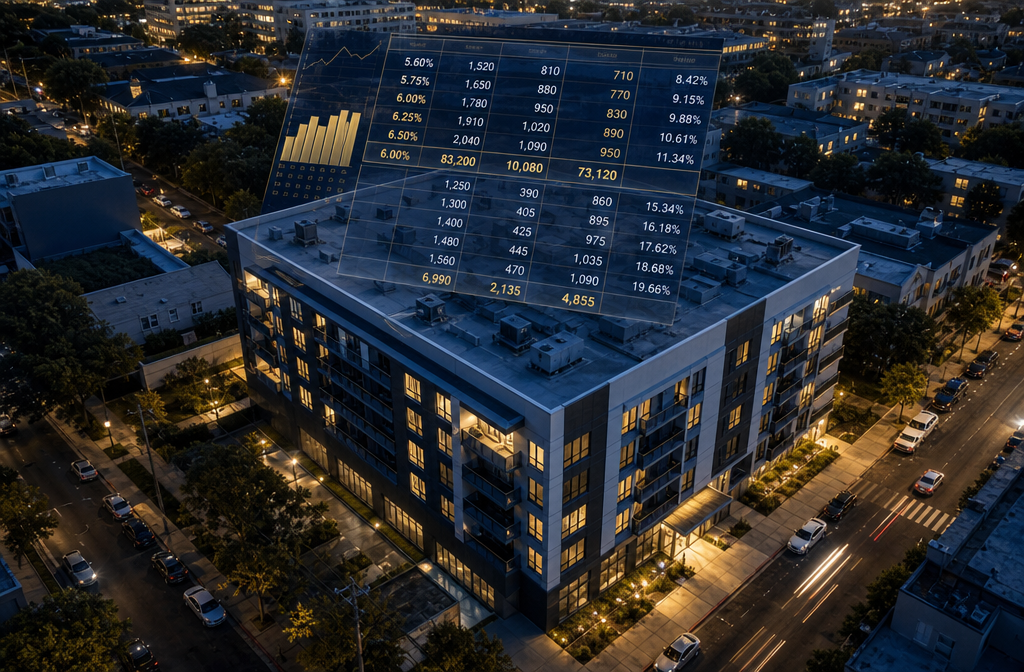
Apartment Investing: The Numbers You Should Know Before Buying Your First Multifamily
Every first-time multifamily investor eventually hits the same wall: the property looks great on paper, the seller’s pitch sounds solid, but the actual numbers — when you run them honestly — tell a completely different story. Apartment investing for beginners isn’t complicated, but it does require you to speak the language of the deal before you sign anything.
Here’s the core math you need to know.
Net Operating Income (NOI): The Foundation of Every Deal
NOI is the annual income a property generates after operating expenses, before debt service. It’s the number lenders, appraisers, and experienced investors use to value commercial and multifamily properties.
Formula:
NOI = Gross Rental Income − Vacancy Loss − Operating Expenses
Operating expenses include property taxes, insurance, maintenance, property management, utilities (if landlord-paid), and reserves for capital expenditures. They do NOT include mortgage payments.
Example:
- 6-unit building, each unit rents for $1,200/month
- Gross annual income: $86,400
- Vacancy (5%): −$4,320
- Operating expenses (40%): −$32,832
- NOI = $49,248
A common mistake: first-timers forget to include a capital expenditure (CapEx) reserve — typically 5%–10% of gross income — for roofs, HVAC systems, plumbing, and appliances. Leave that out and your NOI looks better than it actually is.
Cap Rate: How the Market Values Apartment Buildings
The cap rate (capitalization rate) tells you the rate of return a property would generate if purchased with all cash. It’s calculated by dividing NOI by the property’s current market value or purchase price.
Formula:
Cap Rate = NOI ÷ Purchase Price
Using the example above: $49,248 ÷ $650,000 = 7.6% cap rate
Cap rates vary by market and property size. In high-demand metros like New York City or Los Angeles, apartment building cap rates can compress to 3%–5%. In secondary and tertiary markets — think Memphis, Cleveland, or Kansas City — cap rates of 6%–9% are common for small multifamily properties.
Choose a market based on cap rate if: you’re prioritizing cash flow over appreciation.
Choose a market with lower cap rates if: you’re betting on long-term appreciation in high-growth metros.
Cash-on-Cash Return: What Your Down Payment Actually Earns
Cash-on-cash return measures the annual pre-tax cash flow relative to the actual cash you invested — meaning your down payment plus closing costs.
Formula:
Cash-on-Cash Return = Annual Pre-Tax Cash Flow ÷ Total Cash Invested
If you put $150,000 into a deal (down payment + closing costs) and the property generates $12,000 in annual cash flow after debt service, your cash-on-cash return is 8% — which is solid for most markets in 2026.
Most experienced investors target a minimum of 6%–10% cash-on-cash return for small multifamily properties.
Gross Rent Multiplier (GRM): The Quick Sanity Check
GRM = Purchase Price ÷ Annual Gross Rent
A GRM of 10 means you’re paying 10 times the annual rent. Lower is generally better. This is a fast screening tool — not a replacement for full underwriting. Use it to quickly compare similar properties in the same market.
What’s the Average Cap Rate for Apartment Buildings Right Now?
As of 2026, average cap rates for small apartment buildings (2–20 units) in the U.S. range from 4.5% to 8%, depending heavily on location, property condition, and unit count.
Here’s a general breakdown by market tier:
| Market Type | Typical Cap Rate Range |
|---|---|
| Major Gateway Cities (NYC, LA, SF) | 3.5% – 5.5% |
| Large Secondary Markets (Atlanta, Phoenix, Denver) | 5% – 7% |
| Tertiary/Midwest Markets (Memphis, Toledo, Dayton) | 6.5% – 9% |
| Rural or Small-Town Markets | 8% – 11% |
Important caveat: Cap rates are a snapshot. They don’t account for future rent growth, local economic shifts, or financing costs. A 7% cap rate in a declining market can be worse than a 5% cap rate in a growing one.
Always compare the cap rate to local market benchmarks — not national averages. A property with a cap rate significantly above the local average usually signals either a hidden opportunity or a problem the seller hasn’t disclosed.
How Much Money Do You Actually Need to Start Investing in Apartments?
The honest answer: plan for $50,000–$200,000+ in cash for a small apartment building, depending on property size, market, and financing strategy. Here’s how that breaks down.
Down Payment Requirements
- FHA Loan (2–4 units, owner-occupied): As low as 3.5% down — this is the most accessible entry point for apartment investing for beginners who are willing to live in one unit.
- Conventional Loan (2–4 units): 15%–25% down, depending on lender and property type.
- Commercial Loan (5+ units): Typically 20%–30% down, with stronger underwriting requirements.
Beyond the Down Payment
Don’t stop at the down payment. Budget for:
- Closing costs: 2%–5% of the purchase price
- Inspection fees: $500–$2,000+ for multifamily inspections
- Immediate repairs/rehab: Varies widely — always get contractor estimates before closing
- Operating reserves: 3–6 months of mortgage payments and expenses in liquid savings
- CapEx reserve: Start building this from day one
A realistic example for a $400,000 fourplex:
- 20% down payment: $80,000
- Closing costs (3%): $12,000
- Repairs/contingency: $15,000
- Operating reserves: $12,000
- Total cash needed: ~$119,000
For investors who want to start smaller, check out our guide on how to invest in real estate with $5,000 or less — there are legitimate entry points that don’t require six figures upfront.
What’s the 1% Rule and Why Does It Matter for Apartment Investments?
The 1% rule states that a rental property’s monthly gross rent should equal at least 1% of its purchase price. It’s a fast filter used in apartment property analysis to screen deals before running full numbers.
Example: A $300,000 triplex should generate at least $3,000/month in gross rent to pass the 1% rule.
When the 1% Rule Works
- Screening large numbers of deals quickly
- Comparing similar properties in the same market
- Setting a minimum threshold before deeper analysis
When the 1% Rule Falls Short
The 1% rule is increasingly hard to hit in high-cost markets. In cities like Seattle, Denver, or Austin, most properties come in at 0.5%–0.7% — and investors still make money because appreciation and rent growth compensate. So based is the investor who uses the 1% rule as a starting filter, not a final verdict.
The rule doesn’t account for:
- Property taxes (which vary wildly by state)
- Insurance costs
- Local vacancy rates
- Financing costs and interest rates
Use it to screen. Use NOI, cap rate, and cash-on-cash return to decide.
How Do Apartment Returns Compare to Single-Family Home Investing?
Apartment buildings — especially small multifamily (2–20 units) — generally produce stronger cash flow per dollar invested than single-family rentals, but require more capital and management. Here’s the real comparison.

Cash Flow
A single-family rental might generate $200–$500/month in net cash flow. A well-run 6-unit apartment building in a solid market can generate $2,000–$4,000/month. The math scales — that’s the power of multifamily real estate investments.
Vacancy Risk
With a single-family home, one vacancy = 100% income loss. With a 6-unit building, one vacancy = roughly 17% income loss. This is one of the most underrated advantages of small apartment building investing.
Appreciation
Single-family homes in strong markets can appreciate faster on a per-unit basis. But apartment buildings are valued on income (cap rate), not comparable sales — meaning you can force appreciation by increasing rents or cutting expenses. That’s a lever single-family investors don’t have.
Management Complexity
Single-family is simpler. Apartment investing demands more — more tenants, more maintenance calls, more compliance. That’s why property management becomes a real conversation at 4+ units.
For a deeper look at building your investment foundation, our beginner’s blueprint to real estate investing covers the full spectrum from single-family to commercial.
How Much Does Property Management Cost for a Small Apartment Complex?
Property management for small apartment complexes typically costs 8%–12% of gross monthly rent, plus additional fees for leasing, maintenance coordination, and evictions. For a 6-unit building generating $7,200/month, that’s $576–$864/month in management fees alone.

Full Breakdown of Common Property Management Fees
| Fee Type | Typical Cost |
|---|---|
| Monthly management fee | 8%–12% of gross rent |
| Leasing/placement fee | 50%–100% of one month’s rent |
| Lease renewal fee | $100–$300 per renewal |
| Maintenance markup | 10%–20% on contractor invoices |
| Eviction coordination | $200–$500+ per event |
| Vacancy fee | Some charge reduced fee during vacancies |
Self-managing saves money but costs time — and mistakes in tenant screening or lease compliance can cost far more than management fees. For most first-time apartment investors, professional management is worth the cost while you’re learning the business.
Our first-time second-home investor’s property management guide walks through exactly how to pick the right company and what questions to ask before signing a management agreement.
What Financing Options Exist If You Don’t Have 20% Down?
You don’t need 20% down to get started in apartment investing — especially on 2–4 unit properties. Here are the real options.
FHA Loans (2–4 Units, Owner-Occupied)
This is the most powerful tool for apartment investing for beginners. Live in one unit, rent the others. FHA allows as little as 3.5% down with a credit score of 580+. Rental income from the other units can offset your mortgage payment — sometimes dramatically.
Duplex investing and triplex investing become very accessible with FHA financing. A $350,000 triplex with 3.5% down requires only $12,250 — plus closing costs and reserves.
Conventional Loans (2–4 Units)
If you don’t want to owner-occupy, conventional loans require 15%–25% down. Fannie Mae and Freddie Mac back these loans up to 4 units. Above that, you’re in commercial lending territory.
Small Multifamily Financing Options Beyond Traditional Loans
- Portfolio loans: Local banks and credit unions hold these in-house, offering more flexibility on underwriting.
- DSCR loans (Debt Service Coverage Ratio loans): Qualify based on the property’s income, not your personal income. Popular with investors who have multiple properties.
- Seller financing: The seller acts as the lender. Rare but powerful — especially in off-market deals.
- BRRRR apartments: Buy a distressed multifamily below market, rehab it, rent it, refinance it at the new appraised value, and pull your capital back out to repeat. This strategy requires tight rehab budgets and a solid lender relationship.
For a full breakdown of financing mechanics, our real estate financing guide covering mortgages, credit, and down payments is required reading before you talk to any lender.
What Cities or Markets Have the Best Apartment Investment Potential in 2026?
The best apartment investment markets in 2026 share three traits: population growth, diversified job bases, and rent-to-price ratios that support positive cash flow. Here’s what’s worth watching.
Top Market Filters for Apartment Investors
- Population growth rate — Look for metros growing faster than the national average
- Job market diversity — Single-industry towns carry more risk
- Rent growth trends — Markets where rents are rising faster than expenses
- Landlord-friendly laws — Eviction timelines, rent control policies, and tenant protection laws vary dramatically by state
- Supply pipeline — Heavy new construction can suppress rents and cap rates
Markets Worth Watching in 2026
These aren’t recommendations — they’re starting points for your own research:
- Midwest metros (Columbus OH, Indianapolis IN, Kansas City MO): Strong rent-to-price ratios, lower entry costs, landlord-friendly laws
- Southeast markets (Huntsville AL, Greenville SC, Charlotte NC): Population growth, job diversification, improving infrastructure
- Sun Belt secondary cities (San Antonio TX, Tucson AZ, Oklahoma City OK): More affordable than primary Sun Belt markets with solid fundamentals
Avoid markets with heavy rent control, high property tax burdens, or shrinking populations — regardless of how attractive the cap rate looks on the surface. The spring housing market 2026 analysis covers current market signals worth monitoring before you commit to a location.
How Do You Calculate Potential Rental Income for a Multifamily Property — and What Expenses Should You Budget For?
Start with market rents, not asking rents or pro forma projections. Pull actual comparable rents from Zillow, Apartments.com, and local property managers before trusting any number the seller provides.

Step-by-Step Apartment Property Analysis
- Collect actual rent rolls — Request signed leases, not verbal summaries
- Research market rents — Compare unit-by-unit to current listings
- Apply a realistic vacancy rate — 5%–10% is standard; use local data
- List all operating expenses — Don’t let the seller’s pro forma do this for you
- Calculate NOI — Gross income minus vacancy minus expenses
- Divide NOI by purchase price — That’s your cap rate
- Subtract debt service — That’s your cash flow
- Divide cash flow by total cash invested — That’s your cash-on-cash return
Full Expense Checklist for Multifamily Properties
- Property taxes
- Insurance (landlord/commercial policy)
- Property management (8%–12%)
- Maintenance and repairs (estimate 5%–8% of gross rent annually)
- Landscaping and snow removal
- Trash removal
- Water/sewer (if landlord-paid)
- Common area utilities
- CapEx reserve (5%–10% of gross rent)
- Accounting/legal fees
- Vacancy allowance
Our complete rental property analysis checklist breaks down every line item so you’re not leaving anything out of your underwriting.
What Red Flags Should You Look for When Analyzing an Apartment Deal?
The biggest red flags in multifamily deals are inflated income assumptions, deferred maintenance, and sellers who resist transparency. Here’s what to watch for before you write a check.
Deal Red Flags — Don’t Ignore These
🚩 Pro forma rents that don’t match current leases — “Market rate” projections are not the same as actual income. Always request and verify current signed leases.
🚩 Deferred maintenance — A roof that “needs attention soon” or HVAC units that are 20 years old are capital expenses waiting to happen. Get a professional inspection on every unit.
🚩 Unrealistically low vacancy assumptions — A seller showing 0%–2% vacancy in a market that averages 7% is either cherry-picking a time period or being dishonest.
🚩 Missing or vague expense data — If the seller can’t provide 2 years of actual operating statements, that’s a problem.
🚩 Tenant issues — Month-to-month leases on every unit, high turnover history, or pending evictions all signal management problems that will land on your plate.
🚩 Environmental concerns — Older buildings (pre-1978) may have lead paint or asbestos. Phase I environmental assessments are worth the cost on larger properties.
🚩 Zoning issues — Verify the property is legally permitted for its current use. Unpermitted units are a liability, not a bonus.
The rule: If a seller is gatekeeping information — actual rent rolls, maintenance records, utility bills — treat that as a deal-killer until proven otherwise. Extraordinary deals don’t require you to skip due diligence.
Are Apartments Better for Beginners or Experienced Real Estate Investors?
Small multifamily properties (2–4 units) are genuinely beginner-friendly — especially with owner-occupied FHA financing. Larger apartment complexes (10+ units) are better suited for investors who already understand property management, financing, and tenant law.
Beginner-Friendly Entry Points
- Duplex investing: Two units, one mortgage. Live in one, rent the other. The most accessible form of apartment investing.
- Triplex investing: Three units. Owner-occupy with FHA, and two rents offset most or all of your payment.
- Small 4–6 unit buildings: Still residential financing territory in some cases, manageable with a good property manager.
When to Level Up
Once you’ve operated a small property for 12–24 months, you understand vacancy cycles, maintenance costs, and tenant management. That experience is worth more than any course. Let it cook before you see results — apartment investing rewards patience and operational discipline over time.
Platforms like Roofstock multifamily have made it easier for beginners to find vetted, tenant-occupied small apartment buildings with existing cash flow — reducing the guesswork on your first deal.
What Biggest Mistakes Do First-Time Multifamily Investors Make?
The most common mistake is underestimating expenses — specifically maintenance, CapEx, and vacancy. The second most common is overpaying because the seller’s pro forma looked impeccable on the surface.
Top 5 First-Timer Mistakes
- Trusting pro forma income over actual rent rolls — Always verify with real leases.
- Skipping the inspection — Multi-unit inspections catch issues that kill deals or give you negotiating power.
- Underestimating management complexity — Four tenants is not four times easier than one. It’s exponentially more involved.
- Ignoring financing costs — A deal that cash-flows at a 5% rate may bleed at 7.5%. Model multiple rate scenarios.
- Not building reserves — Fresh investors often spend every dollar on the purchase and have nothing left when the water heater goes out in unit 3 the first week.
For a broader look at avoiding costly investment mistakes, the 16 pro tips to maximize real estate investment returns covers strategies that experienced investors use to protect their portfolios.
Do You Need Special Insurance for Apartment Buildings?
Yes — standard homeowner’s insurance does not cover apartment buildings used as investment properties. You need a commercial landlord policy, and for most small multifamily investors, an umbrella policy is worth the added premium.
What You Need
- Commercial landlord insurance (also called “dwelling fire” or “landlord policy”): Covers the building structure, liability, and loss of rental income.
- General liability coverage: Protects you if a tenant or visitor is injured on the property.
- Umbrella policy: Adds an extra layer of liability coverage above your base policy — typically $1M–$5M in additional coverage for a few hundred dollars per year.
- Flood insurance: Required in flood zones; optional elsewhere but worth evaluating.
- Loss of rent coverage: Pays you if a covered event (fire, storm damage) makes units uninhabitable.
Cost estimate: Landlord insurance for a small apartment building typically runs $1,500–$5,000+ per year, depending on location, building age, and coverage limits. Always get multiple quotes and work with an agent who specializes in investment properties.
FAQ: Apartment Investing Numbers Every Beginner Should Know
Q: What’s a good cap rate for a first apartment building?
A 6%–8% cap rate is a solid target for most secondary and tertiary markets. In high-cost metros, 4%–5% is common. Compare to local market averages — not national benchmarks.
Q: What does NOI mean in apartment investing?
NOI stands for Net Operating Income. It’s the annual income a property generates after operating expenses, before mortgage payments. It’s the primary metric used to value multifamily properties.
Q: How do I know if an apartment deal will cash flow?
Subtract your annual debt service (mortgage payments) from the NOI. If the result is positive, the property cash flows. Divide that number by your total cash invested to get your cash-on-cash return.
Q: Is duplex investing a good starting point?
Yes. A duplex with owner-occupied FHA financing is one of the most accessible and financially intelligent first moves in real estate. You live in one unit, collect rent from the other, and build equity while learning the business.
Q: What is the BRRRR strategy for apartments?
BRRRR stands for Buy, Rehab, Rent, Refinance, Repeat. You buy a distressed multifamily below market value, renovate it, rent it up, then refinance at the new appraised value to pull out your invested capital and repeat the process with another property.
Q: What’s the difference between a cap rate and cash-on-cash return?
Cap rate ignores financing — it measures return as if you paid all cash. Cash-on-cash return accounts for your actual mortgage payment and measures return on the cash you personally invested. Both matter; neither tells the full story alone.
Q: How many units do I need before hiring a property manager?
Most investors find that 4+ units justifies professional management. At 2–3 units, self-management is manageable if you’re local and have time. Once you hit 6+ units, professional management becomes almost essential for maintaining your sanity.
Q: Can I use rental income to qualify for a multifamily mortgage?
Yes, in most cases. Lenders typically allow 75% of the projected rental income from non-owner-occupied units to count toward your qualifying income. DSCR loans qualify you entirely on the property’s income, not your personal income.
Q: What’s a realistic apartment investing ROI for beginners?
A realistic apartment investing ROI for a well-underwritten small multifamily is 6%–12% cash-on-cash return, with additional upside from appreciation and mortgage paydown. Deals promising 20%+ returns without strong data deserve extra scrutiny.
Q: What is Roofstock multifamily?
Roofstock is an online marketplace for buying tenant-occupied investment properties, including small multifamily buildings. It’s a useful starting point for investors who want to see vetted deals with existing cash flow history.
Conclusion: Run the Numbers, Then Run Them Again
Apartment investing isn’t a secret club — but it does have an entry exam, and that exam is the numbers. Cap rate, NOI, cash-on-cash return, vacancy rate, and expense ratios aren’t just finance jargon. They’re the difference between a deal that builds wealth and one that quietly drains it.
Here’s your action plan:
- Pick your entry point — duplex, triplex, or small apartment building based on your capital and risk tolerance.
- Get pre-approved — know your financing options before you fall in love with a property.
- Run every deal through the full underwriting process — NOI, cap rate, cash-on-cash, and expense analysis.
- Verify everything — actual rent rolls, real operating statements, physical inspections.
- Build your team — a real estate attorney, a CPA who understands investment property, and a property manager you trust.
- Start small and let it cook — your first deal teaches you more than any course ever will.
Multi family real estate investing rewards the prepared. The investors who take time to understand the numbers before they buy — not after — are the ones who build impeccable portfolios over time. That intel has been gatekept by the industry long enough. Now you have it.
For more fresh strategies on building your investment portfolio, explore our real estate investing hub and stay current with real estate news and market predictions from Real Estate Rank IQ.
Tags: apartment investing, multifamily real estate, cap rate, NOI apartment building, duplex investing, triplex investing, small multifamily financing, cash flow apartments, BRRRR strategy, apartment investing for beginners, real estate investing, rental property analysis
For more rental analysis and investing guides, visit the Investment Hub.











Comments 1