



Last updated: April 16, 2026

Quick Answer: Real estate financing determines whether a deal happens or falls apart before it starts. Your credit score, down payment size, debt-to-income ratio, and the mortgage type you choose directly control your interest rate, monthly payment, and long-term wealth. Understanding these numbers — not just the listing price — is what separates buyers who close from buyers who keep scrolling Zillow.
Key Takeaways
- A credit score of 620 is the minimum for most conventional loans, but 740+ is where the best rates live.
- The 20% down payment myth is real — many programs allow 3% to 3.5% down, though PMI applies below 20%.
- Your debt-to-income (DTI) ratio should stay at or below 43% to qualify for most mortgage products.
- In 2026, 30-year fixed mortgage rates are hovering around 6.1%–6.5% — higher than the pandemic lows but historically normal.
- Fed rate decisions don’t directly set mortgage rates, but they influence the bond market, which does.
- Inflation, GDP growth, unemployment data, and recession signals all move the housing market in measurable ways.
- Closing costs typically run 2%–5% of the loan amount — a number most first-time buyers forget to budget for.
- FHA, VA, USDA, and conventional loans each serve different buyer profiles. Picking the wrong one costs money.
- Rate locks, points, and ARM vs. fixed decisions can save or cost tens of thousands over a loan’s life.
- Economic indicators like the 10-year Treasury yield are more reliable predictors of mortgage rate movement than Fed announcements alone.

What Does Real Estate Financing Actually Cover?
Real estate financing is the system of loans, credit products, and capital structures that allow buyers, investors, and developers to purchase property without paying the full price upfront. It covers mortgage types, interest rate structures, credit qualification standards, down payment requirements, closing costs, and the economic forces that move all of those numbers.
Most people think real estate financing starts when they call a lender. It actually starts the moment you open your first credit card or take out your first car loan. Every financial decision you make before buying a home shapes the terms you’ll get offered.
The core components of real estate financing include:
- Mortgage products — conventional, FHA, VA, USDA, jumbo
- Credit evaluation — scores, history, utilization, derogatory marks
- Down payment — source, size, and impact on loan terms
- Debt-to-income ratio (DTI) — how lenders measure your payment capacity
- Closing costs — fees, taxes, and prepaid items due at settlement
- Rate structures — fixed vs. adjustable, points, rate locks
- Economic context — how inflation, Fed policy, and GDP growth affect what you pay
Real Estate Financing From the Ground Up: Mortgages, Credit, Down Payments, and the Numbers That Actually Matter
This is the section most people skip — and that’s exactly why they end up overpaying. Real estate financing from the ground up means understanding each layer of the process before you ever step into a showing.
The Mortgage Types You Need to Know
Not all mortgages are created equal. Picking the right product for your situation is the kind of move that saves you thousands over the life of the loan. Here’s how the main options stack up:
| Loan Type | Minimum Down | Credit Score Min | Best For |
|---|---|---|---|
| Conventional | 3% | 620 | Strong credit buyers |
| FHA | 3.5% | 580 | First-time buyers, lower credit |
| VA | 0% | No official min (lenders vary) | Veterans, active military |
| USDA | 0% | 640 recommended | Rural/suburban buyers |
| Jumbo | 10%–20% | 700+ | High-cost markets |
For Gen Z buyers navigating their first purchase, check out our guide to the best mortgage options for Gen Z home buyers — it breaks down which products actually work for younger buyers with shorter credit histories.
Fixed vs. Adjustable Rate: The Decision That Follows You for Decades
A 30-year fixed mortgage gives you predictability. Your rate doesn’t move. Your payment doesn’t change. You sleep well.
An adjustable-rate mortgage (ARM) — typically a 5/1 or 7/1 ARM — starts with a lower rate that adjusts after the initial period. It works if you plan to sell or refinance before the adjustment kicks in. It’s a problem if you don’t.
Choose a fixed rate if:
- You plan to stay in the home 7+ years
- You want payment stability regardless of market swings
- Current rates are already near historical averages
Choose an ARM if:
- You’re confident you’ll sell or refinance within 5–7 years
- The rate differential is at least 1%–1.5% below fixed
- You understand the adjustment caps and worst-case scenarios
Our detailed breakdown of 15-year vs. 30-year mortgage rates in 2026 covers the long-term savings math in full — so you can run the numbers for your specific situation.
The Credit Score Breakdown Lenders Actually Use
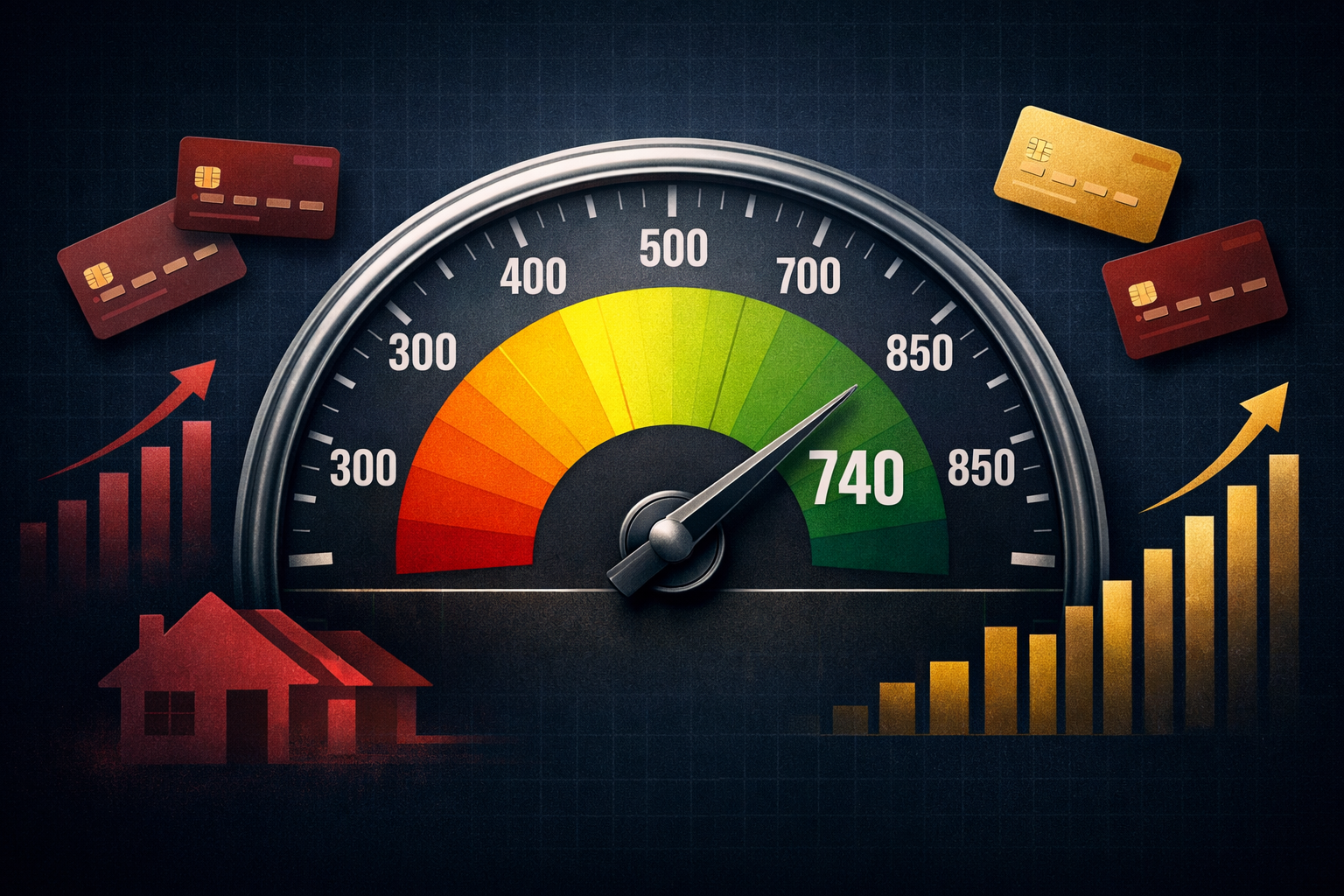
Lenders don’t just look at one number. They pull all three bureau scores (Equifax, Experian, TransUnion) and use the middle score for qualification. Here’s what different score ranges mean for your rate:
| Credit Score Range | Rate Impact (Estimate) | Loan Access |
|---|---|---|
| 760–850 | Best available rates | All products |
| 700–759 | Slightly above best | Most products |
| 660–699 | Moderate rate premium | Conventional, FHA |
| 620–659 | Higher rate, limited options | FHA, some conventional |
| Below 620 | Very limited / denied | FHA (580+), portfolio lenders |
A difference of 80 points on your credit score can mean a difference of 0.5%–1.0% on your interest rate. On a $400,000 loan, that’s roughly $100–$200 per month — or $36,000–$72,000 over 30 years. That’s not a small number. That’s a car.
What moves your credit score:
- Payment history (35% of FICO score)
- Credit utilization — keep it below 30%, ideally below 10%
- Length of credit history
- Credit mix (revolving + installment)
- New inquiries — avoid opening new accounts 6–12 months before applying
Down Payments: The 20% Myth and What’s Actually Required
The idea that you need 20% down to buy a home is gatekeeping from a different era. It’s not accurate for most buyers in 2026.
What’s actually required:
- FHA loans: 3.5% down (with 580+ credit score)
- Conventional loans: as low as 3% down (Fannie Mae HomeReady, Freddie Mac Home Possible)
- VA and USDA loans: 0% down for qualifying buyers
That said, putting less than 20% down on a conventional loan triggers Private Mortgage Insurance (PMI), which typically runs 0.5%–1.5% of the loan amount annually. On a $350,000 loan, that’s $1,750–$5,250 per year added to your cost until you hit 20% equity.
The real question isn’t “can I put 20% down?” — it’s “what’s the smartest use of my available capital?”
For investors especially, keeping cash liquid for the next deal often makes more sense than dumping everything into a down payment. Our real estate investment financing guide digs into this tradeoff for portfolio builders.
Debt-to-Income Ratio: The Number Lenders Care About Most
Your DTI is calculated as: total monthly debt payments ÷ gross monthly income.
Most conventional lenders cap DTI at 43%, though some programs allow up to 50% with compensating factors (strong reserves, high credit score).
Example:
- Gross monthly income: $7,000
- Monthly debts (car, student loans, credit cards): $800
- New mortgage payment (PITI): $1,800
- Total monthly debt: $2,600
- DTI: $2,600 ÷ $7,000 = 37.1% ✅
If that same buyer had $1,400 in existing debts, the DTI would jump to 46%+ — and the loan likely gets denied or requires a larger down payment.
Ways to improve DTI before applying:
- Pay down revolving balances
- Avoid taking on new debt (car loans, personal loans)
- Increase income through documented side work or a raise letter
- Consider a co-borrower with strong income
How Economic Forces Shape the Numbers in Real Estate Financing
The economic impact on real estate is not abstract — it shows up directly in your mortgage rate, your purchasing power, and the price of the home you’re trying to buy. Understanding how economic indicators affect real estate financing is what separates informed buyers from reactive ones.
How Interest Rates Affect Home Prices
The relationship between interest rates and home prices is inverse — when rates rise, purchasing power falls, which puts downward pressure on prices. When rates fall, buyers flood back in and prices climb.
Here’s the practical math: at a 3% rate, a buyer with a $2,000/month payment budget can afford roughly a $475,000 home. At 6.5%, that same budget gets them to about $315,000. That’s a $160,000 difference in purchasing power — from the same buyer, same income, same budget. That’s how interest rates affect home prices in real terms.
For a full picture of where rates stand right now, our current mortgage rates February 2026 breakdown covers the 30-year fixed at 6.11% and what that means for buyers this year.
Inflation and the Housing Market
Inflation and the housing market have a complicated relationship. On one hand, real estate is historically one of the best inflation hedges — home values and rents tend to rise with inflation. On the other hand, inflation pushes the Fed to raise rates, which raises mortgage costs, which cools demand.
In 2022–2023, the U.S. experienced this cycle firsthand. Inflation hit 40-year highs, the Fed raised the federal funds rate aggressively, and mortgage rates went from sub-3% to over 7% in under 18 months. Home prices softened in many markets but didn’t crash — largely because inventory stayed historically low.
The inflation-housing relationship in plain terms:
- High inflation → Fed raises rates → mortgage rates rise → buyer demand falls
- Low inflation → Fed holds or cuts → mortgage rates stabilize or fall → buyer demand returns
- Rental demand tends to stay strong in high-inflation periods as ownership becomes less affordable
Fed Rate Decisions and Real Estate
This is one of the most misunderstood dynamics in real estate financing. The Fed does not set mortgage rates. The Federal Reserve sets the federal funds rate — the overnight lending rate between banks. Mortgage rates are primarily driven by the 10-year U.S. Treasury yield and the secondary mortgage market.
That said, Fed rate decisions real estate implications are real and indirect:
- Fed hikes signal inflation concern → bond market reacts → Treasury yields rise → mortgage rates follow
- Fed cuts signal economic cooling → bond market eases → mortgage rates may drop
The key word is “may.” Mortgage rates don’t always move in lockstep with Fed decisions. In late 2024, the Fed cut rates three times — and mortgage rates actually ticked up because bond investors priced in persistent inflation expectations. So based on the data, watching the 10-year Treasury yield is more predictive than watching Fed press conferences.
GDP, Unemployment, and the Housing Market
GDP and housing market performance are closely linked. Strong GDP growth signals consumer confidence, employment growth, and wage increases — all of which support home buying demand. Weak GDP, especially two consecutive quarters of contraction (the technical definition of recession), tends to soften housing demand as buyers pull back.
Unemployment and home buying have a direct connection: employed buyers qualify for mortgages, unemployed buyers don’t. When unemployment rises above 5%–6%, mortgage delinquencies tend to follow, and lenders tighten underwriting standards across the board.
Economic indicators real estate professionals should track:
- 10-year Treasury yield (most direct mortgage rate signal)
- Core PCE inflation (the Fed’s preferred inflation measure)
- Monthly jobs report (unemployment rate + wage growth)
- GDP quarterly growth rate
- Consumer confidence index
- Housing starts and building permits (supply-side signal)
For a broader look at how 2026 rate stability is reshaping buyer and seller strategies, our 2026 real estate trends analysis is worth a read.
Recession and Real Estate Investing
Recession and real estate investing don’t always mean what people think. Not all recessions crush real estate. The 2001 recession barely touched home prices. The 2008 crisis was specifically a housing and credit crisis — a rare overlap. The 2020 COVID recession lasted two months and was followed by the hottest housing market in decades.
What recessions typically do to real estate:
- Reduce buyer demand temporarily
- Increase distressed inventory (foreclosures, short sales) — opportunity for investors
- Lower interest rates as the Fed stimulates the economy
- Create rent demand as ownership becomes less accessible
The mortgage rates economic outlook for 2026 suggests rates will remain in the 6%–6.75% range barring a significant economic shock. The housing market forecast points to modest price appreciation in supply-constrained markets and flat-to-slight corrections in overbuilt metros. Let it cook before you see results — buyers who enter now in the right markets are positioning for appreciation when rates eventually ease.

What Are the Real Costs of Buying a Home Beyond the Purchase Price?
The purchase price is just the starting point. The actual cost of buying a home includes closing costs, prepaid items, reserve requirements, and ongoing ownership expenses that many buyers don’t budget for until they’re sitting at the closing table.
Closing Costs: The Budget Line Everyone Forgets
Closing costs typically run 2%–5% of the loan amount, paid at settlement. On a $400,000 purchase with 10% down ($360,000 loan), that’s $7,200–$18,000 due at closing — on top of the down payment.
Common closing cost line items:
- Origination fee (lender): 0.5%–1% of loan amount
- Appraisal: $400–$700
- Title search and title insurance: $1,000–$2,500
- Attorney/settlement fee: $500–$1,500
- Prepaid homeowner’s insurance: 12 months upfront
- Prepaid property taxes: 2–6 months in escrow
- Recording fees: $100–$300
- Survey (if required): $400–$800
One smart move: ask the seller for a credit toward closing costs. In a buyer’s market, this is a legitimate negotiating tool. Our guide on how to get a home seller to pay closing costs walks through exactly how to structure that ask. Also, check out our breakdown of seller credits and closing cost assistance to understand what’s standard and what’s extraordinary to request.
Mortgage Points: Buying Down Your Rate
One mortgage point = 1% of the loan amount, paid upfront to reduce your interest rate. Typically, one point reduces your rate by 0.25%.
When buying points makes sense:
- You plan to stay in the home long enough to break even (usually 5–7 years)
- You have the cash available without depleting reserves
- The rate environment makes the math favorable
Break-even example:
- Loan: $350,000
- One point cost: $3,500
- Rate reduction: 0.25% (say, from 6.5% to 6.25%)
- Monthly savings: ~$58
- Break-even: $3,500 ÷ $58 = ~60 months (5 years)
If you’re staying 10+ years, buying points is an impeccable financial move. If you’re planning to sell in 3 years, skip it.
Rate Locks: Don’t Let Your Rate Float in a Volatile Market
A rate lock guarantees your interest rate for a set period — typically 30, 45, or 60 days — while your loan processes. In a rising rate environment, floating (not locking) can cost you.
Rate lock best practices:
- Lock as soon as you’re under contract if rates are rising
- Confirm the lock period covers your expected closing date with buffer
- Ask about float-down provisions (some lenders allow you to drop to a lower rate if rates fall before closing)
- Understand what happens if closing is delayed — extensions cost money
How Do Investors Approach Real Estate Financing Differently?
Real estate investors use financing as a tool to multiply returns, not just a means to purchase a home. The math, the products, and the strategy are fundamentally different from owner-occupied financing.
Investment Property Loan Requirements
Lenders treat investment properties as higher risk. Expect:
- Minimum 15%–25% down (no 3% options for non-owner-occupied)
- Credit score 680+ (720+ for best rates)
- Higher interest rates — typically 0.5%–0.75% above primary residence rates
- Reserve requirements — 6 months of PITI in liquid reserves, sometimes more for multiple properties
- Rental income documentation — lenders may count 75% of projected rent toward qualifying income
DSCR Loans: The Investor’s Fresh Alternative
Debt Service Coverage Ratio (DSCR) loans have become a genuinely fresh option for real estate investors who don’t want to document personal income. The loan qualifies based on the property’s rental income relative to its debt payment.
DSCR formula: Monthly rental income ÷ Monthly PITI
- DSCR of 1.0 = income exactly covers debt
- DSCR of 1.25+ = most lenders’ preferred minimum
- DSCR below 1.0 = property doesn’t cash flow enough to qualify on its own
For investors building a portfolio, understanding the full range of real estate investment types and financing structures is the foundation for scaling intelligently.
The BRRRR Strategy and Financing
Buy, Rehab, Rent, Refinance, Repeat — the BRRRR method is built entirely on financing strategy. The goal is to pull your initial capital back out through a cash-out refinance after forcing appreciation through renovation, then redeploy that capital into the next deal.
It requires:
- Hard money or private money for the acquisition and rehab
- A solid ARV (After Repair Value) estimate to confirm the refinance works
- A DSCR or conventional refinance lender lined up before you start
- Patience — you have to let it cook before you see results from the refi appraisal

What Are the Most Common Real Estate Financing Mistakes?
Even experienced buyers and investors make financing mistakes that are entirely avoidable. Here are the ones that show up most often.
Mistake 1: Getting Pre-Qualified Instead of Pre-Approved
Pre-qualification is a rough estimate based on self-reported information. Pre-approval means the lender has verified your income, assets, and credit. In a competitive market, sellers and agents treat pre-qualification letters as nearly meaningless. Get the full pre-approval.
Mistake 2: Making Large Purchases Before Closing
Buying a car, opening a new credit card, or making large cash withdrawals between pre-approval and closing can tank your loan. Lenders run a final credit check before funding. Any new debt or unexplained deposits can trigger a denial or delay.
Mistake 3: Underestimating the True Cost of Ownership
The mortgage payment is one piece. Add property taxes, homeowner’s insurance, HOA fees (if applicable), maintenance (budget 1%–2% of home value annually), and utilities. Buyers who only budget for the mortgage payment often find themselves stretched thin within 12 months.
Mistake 4: Ignoring the Mortgage Rates Economic Outlook
Timing the market perfectly is impossible, but ignoring the economic context entirely is also a mistake. Buyers who locked in 7.5% rates in late 2023 without understanding the economic cycle paid a premium they didn’t have to. Staying informed about the housing market forecast and economic indicators real estate professionals track helps you make smarter timing decisions.
Mistake 5: Not Shopping Multiple Lenders
The Consumer Financial Protection Bureau (CFPB) has consistently found that borrowers who get at least three loan quotes save meaningfully on both rates and fees. Getting one quote and accepting it is leaving money on the table. Multiple inquiries within a 14–45 day window for mortgage shopping are treated as a single inquiry by FICO — so there’s no credit score penalty for shopping around.
FAQ: Real Estate Financing Questions Answered Directly
Q: What credit score do I need to buy a house in 2026?
A: The minimum is 580 for FHA loans with 3.5% down, and 620 for most conventional loans. To get the best available rates, aim for 740 or higher.
Q: How much do I need for a down payment?
A: As little as 0% (VA/USDA) to 3%–3.5% (conventional/FHA) for owner-occupied homes. Investment properties require 15%–25%. More down means lower monthly payments and no PMI above 20%.
Q: Does the Fed rate directly control mortgage rates?
A: No. The Fed sets the federal funds rate, which influences but does not directly set mortgage rates. The 10-year Treasury yield is the more direct driver of 30-year fixed mortgage rates.
Q: What is a good debt-to-income ratio for a mortgage?
A: Below 36% is strong. Up to 43% is acceptable for most conventional loans. Some programs allow up to 50% with compensating factors like high credit scores or large reserves.
Q: How does inflation affect the housing market?
A: Inflation pushes the Fed to raise rates, which raises mortgage costs and reduces buyer purchasing power. Real estate itself is an inflation hedge — home values and rents tend to rise with inflation over time.
Q: What’s the difference between pre-qualification and pre-approval?
A: Pre-qualification is an informal estimate. Pre-approval involves verified documentation (pay stubs, tax returns, bank statements) and carries real weight with sellers. Always get pre-approved before making offers.
Q: Can I use gift funds for a down payment?
A: Yes, for most loan types — but the gift must be documented with a gift letter stating no repayment is required. Lenders will trace the source of funds.
Q: What is PMI and when does it go away?
A: Private Mortgage Insurance is required on conventional loans with less than 20% down. It cancels automatically when your loan balance reaches 78% of the original home value, or you can request removal at 80%.
Q: How do recessions affect real estate prices?
A: Recessions typically soften demand and can increase distressed inventory, but they don’t always crash prices. The 2008 crash was a credit crisis, not a typical recession. Most recessions cause modest price corrections, not collapses.
Q: What’s a DSCR loan?
A: A Debt Service Coverage Ratio loan qualifies based on the property’s rental income rather than the borrower’s personal income. It’s popular with real estate investors who have complex tax returns or multiple properties.
Q: How many lenders should I get quotes from?
A: At minimum three. Shopping multiple lenders within a 45-day window counts as one credit inquiry under FICO scoring rules, so there’s no penalty for comparing.
Q: What is a rate lock and should I use one?
A: A rate lock guarantees your interest rate for a set period (30–60 days) while your loan processes. In a rising rate environment, locking is almost always the right call.
Conclusion: Build the Foundation Before You Build the Portfolio
Real estate financing from the ground up isn’t glamorous content. Nobody’s posting their DTI ratio on Instagram. But the buyers and investors who take time to understand mortgages, credit, down payments, and the economic forces behind the numbers — those are the ones who close extraordinary deals while everyone else is still wondering why they keep getting outbid or denied.
The numbers that actually matter aren’t just your credit score or your down payment amount. They’re the economic indicators real estate professionals track, the rate structures that determine your long-term cost, and the financing products that match your actual situation — not the one your neighbor used.
Your actionable next steps:
- Pull your credit reports from all three bureaus at AnnualCreditReport.com — know your starting point.
- Calculate your DTI before talking to a lender — fix what you can first.
- Get pre-approved (not just pre-qualified) with at least three lenders.
- Research loan programs that match your profile — FHA, VA, USDA, and conventional all have different sweet spots.
- Track the 10-year Treasury yield weekly — it’s the most direct signal for where mortgage rates are heading.
- Budget for closing costs separately from your down payment — 2%–5% of the loan amount.
- Read the housing market forecast regularly — our 2026 rent or buy analysis is a solid starting point for current context.
The information is out there. Most people are gatekeeping their own success by skipping the fundamentals. Don’t be that person.
References
- Consumer Financial Protection Bureau (CFPB). Shop for a Mortgage. https://www.consumerfinance.gov/owning-a-home/explore-rates/ (2023)
- Federal Housing Finance Agency (FHFA). House Price Index. https://www.fhfa.gov/DataTools/Downloads/Pages/House-Price-Index.aspx (2024)
- Freddie Mac. Primary Mortgage Market Survey. http://www.freddiemac.com/pmms/ (2024)
- Fannie Mae. HomeReady Mortgage Guidelines. https://www.fanniemae.com/originating-underwriting/mortgage-products/homeready-mortgage (2023)
- U.S. Department of Housing and Urban Development (HUD). FHA Loan Requirements. https://www.hud.gov/buying/loans (2024)
- FICO. What’s in My FICO Score. https://www.myfico.com/credit-education/whats-in-your-credit-score (2023)
- Federal Reserve Bank of St. Louis (FRED). 30-Year Fixed Rate Mortgage Average. https://fred.stlouisfed.org/series/MORTGAGE30US (2024)
- National Association of Realtors (NAR). 2024 Profile of Home Buyers and Sellers. https://www.nar.realtor/research-and-statistics (2024)
- Mortgage Bankers Association (MBA). Mortgage Finance Forecast. https://www.mba.org/news-and-research/research-and-economics/single-family-research/mortgage-finance-forecast (2024)