



Last updated: April 16, 2026

Quick Answer: The economy directly controls real estate prices, buyer demand, and investment returns through interest rates, inflation, employment levels, and GDP growth. When the economy is strong, home prices rise and competition heats up. When it contracts, prices soften and opportunities shift. Understanding how the economy shapes real estate prices, demand, and your next move as a buyer or investor is the difference between timing the market well and getting caught off guard.
Key Takeaways
- Interest rates are the single biggest lever the economy pulls on housing — when the Fed raises rates, mortgage costs climb and buyer demand cools almost immediately.
- Inflation pushes home prices up in the short term, but it also erodes purchasing power and can stall the market when wages don’t keep pace.
- GDP growth signals confidence — a growing economy means more employed buyers, more investor activity, and tighter housing inventory.
- Unemployment is a leading indicator for housing demand — rising jobless rates historically precede drops in home sales and price corrections.
- The Fed’s rate decisions ripple through every corner of real estate, from 30-year fixed mortgages to commercial cap rates and rental yields.
- Recessions don’t always crash home prices — location, inventory levels, and local job markets determine how hard any market gets hit.
- Economic indicators like CPI, PCE, and the jobs report are data points every serious buyer and investor should be tracking monthly.
- Sun Belt markets and data center corridors are showing extraordinary resilience even as broader economic pressures squeeze coastal markets.
- Investors who understand economic cycles can position themselves ahead of price shifts rather than reacting after the fact.
- 2026 is a transition year — rates are stabilizing, inventory is slowly improving, and the buyers who move smart will win.
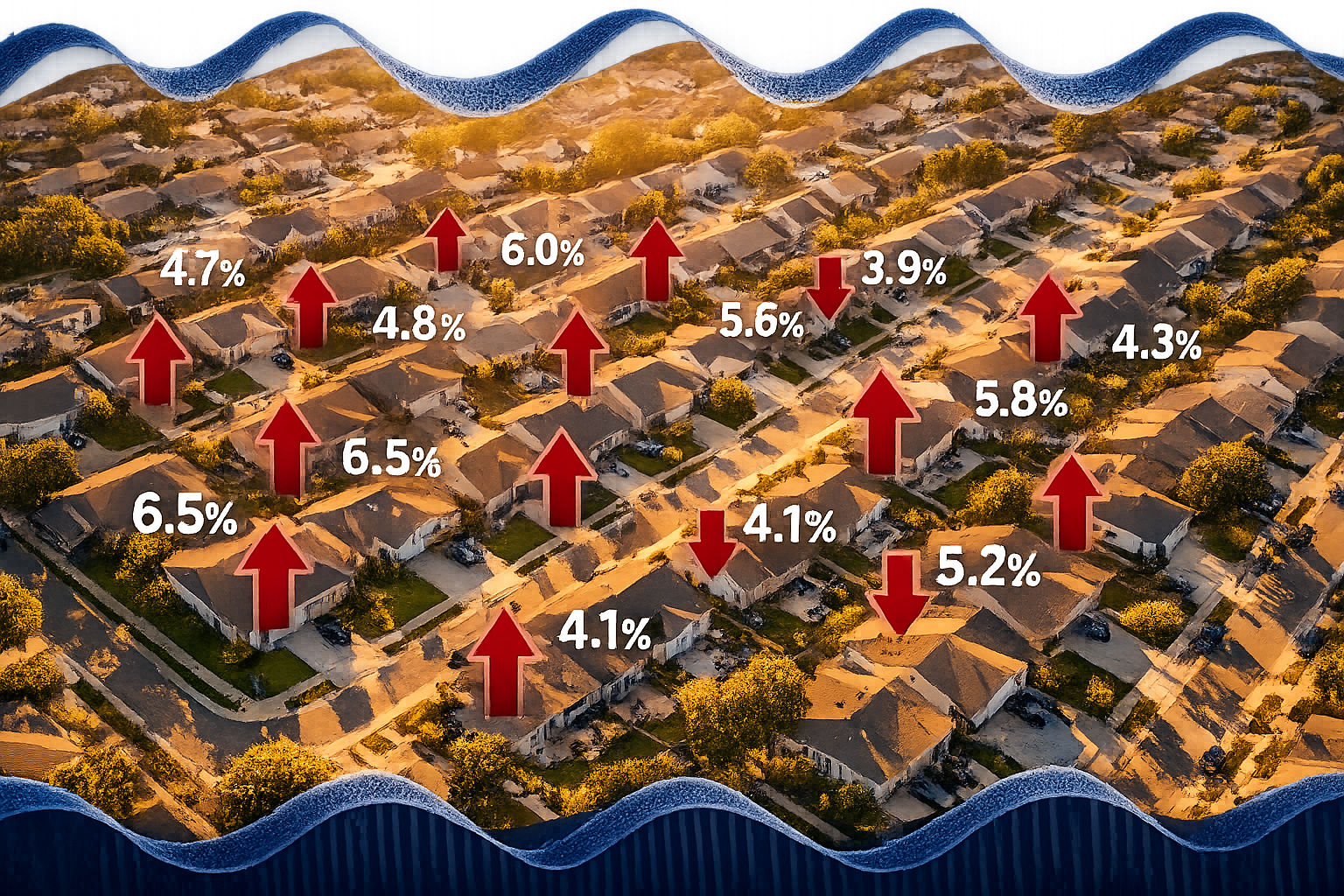
What Economic Forces Actually Drive Real Estate Markets?
The economy doesn’t whisper when it wants to move real estate — it shouts. Home prices, buyer demand, and investment returns are all downstream of broader economic conditions. The relationship isn’t always linear, but it’s always present.
Here’s the core framework: real estate markets respond to five primary economic forces.
| Economic Force | How It Hits Real Estate |
|---|---|
| Interest Rates | Higher rates = higher mortgage payments = fewer buyers |
| Inflation | Rising prices push up home values but also construction costs |
| Employment / Unemployment | More jobs = more buyers; job losses = demand drops |
| GDP Growth | Strong GDP = consumer confidence = active housing market |
| Consumer Confidence | Buyers only buy when they feel financially secure |
Each of these forces doesn’t operate in isolation. They interact. A low unemployment rate during a high-inflation period creates a market where buyers want to purchase but can’t afford to — which is exactly what the U.S. housing market looked like from 2022 through much of 2024.
The key insight for buyers and investors: economic indicators are your early warning system. By the time price changes show up on Zillow, the economic signal was already flashing weeks or months earlier.
How the Economy Shapes Real Estate Prices, Demand, and Your Next Move as a Buyer or Investor
This is the full picture — and it’s worth breaking down carefully because understanding this connection is what separates impeccable investors from reactive ones.
The Price Connection
Home prices don’t move randomly. They move because of supply, demand, and the cost of financing. All three are economic outputs.
When the economy is expanding:
- Wages rise, giving buyers more purchasing power
- Lenders loosen credit standards slightly
- Developers build more, but construction lags demand by 12-24 months
- Prices climb because demand outpaces supply
When the economy contracts:
- Layoffs reduce the pool of qualified buyers
- Lenders tighten underwriting standards
- Sellers who must sell accept lower offers
- Prices soften, sometimes sharply in over-leveraged markets
The National Association of Realtors (NAR) has consistently documented that median home prices track closely with employment conditions and wage growth over multi-year cycles. That’s not coincidence — that’s the economic impact on real estate playing out in real time.
The Demand Connection
Buyer demand is essentially consumer confidence with a mortgage attached. When people feel secure in their jobs and believe the economy is stable, they buy homes. When uncertainty spikes — think early pandemic, 2008-2009, or rapid rate hike cycles — demand evaporates fast.
In 2026, we’re watching a fresh dynamic: rates have stabilized around 6% on 30-year fixed mortgages (down from the 7-8% range that choked the 2023-2024 market), and demand is cautiously returning. Our breakdown of 2026 real estate trends and how stable 6% rates are reshaping buyer and seller strategies covers exactly how this rate stabilization is changing the game.
Your Next Move
So based on where the economy sits right now, what does that mean practically?
- Buyers: The window between “rates are still high” and “prices start climbing again” is narrow. Waiting for perfect conditions is a strategy that historically costs more than it saves.
- Investors: Economic transitions are where extraordinary returns get built. Distressed sellers, motivated landlords, and underpriced markets all emerge from economic stress cycles.
- Sellers: Pricing your home correctly in an economically uncertain market is non-negotiable. Overpricing in a softening economy doesn’t just delay a sale — it can cost you 5-10% more in final price than a well-priced listing from day one.
How Interest Rates Affect Home Prices and Buyer Behavior
Interest rates are the most immediate and measurable way the economy shapes real estate prices. When the Federal Reserve adjusts the federal funds rate, mortgage rates follow — and the ripple effect hits every buyer, seller, and investor in the market.
The math is straightforward: On a $400,000 home with 20% down:
- At 5% interest: monthly payment ≈ $1,718
- At 7% interest: monthly payment ≈ $2,129
- At 8% interest: monthly payment ≈ $2,348
That’s a $630/month difference between a 5% and 8% rate on the same home. That difference eliminates millions of buyers from the qualified pool overnight.
What the Fed’s Rate Decisions Mean for Real Estate
The Fed doesn’t set mortgage rates directly — but it sets the tone. When the Fed raises the federal funds rate to fight inflation, bond yields rise, and 30-year fixed mortgage rates follow. When the Fed cuts rates, mortgage rates typically ease within weeks.
The Fed’s rate decisions in real estate terms:
- Rate hikes: Buyers retreat, inventory builds, price growth slows or reverses
- Rate cuts: Buyers flood back, inventory tightens, prices accelerate
- Rate holds: Market finds equilibrium — often the best buying window for prepared buyers
The Federal Government’s $200 billion MBS purchase program is one of the more extraordinary interventions we’ve seen in 2026 specifically aimed at bringing mortgage rates down — worth understanding if you’re making a move this year.
Common mistake: Buyers who wait for rates to drop to 4-5% before buying are likely waiting for a scenario that requires a severe recession to materialize. Locking in at 6% and refinancing later is often the smarter play.
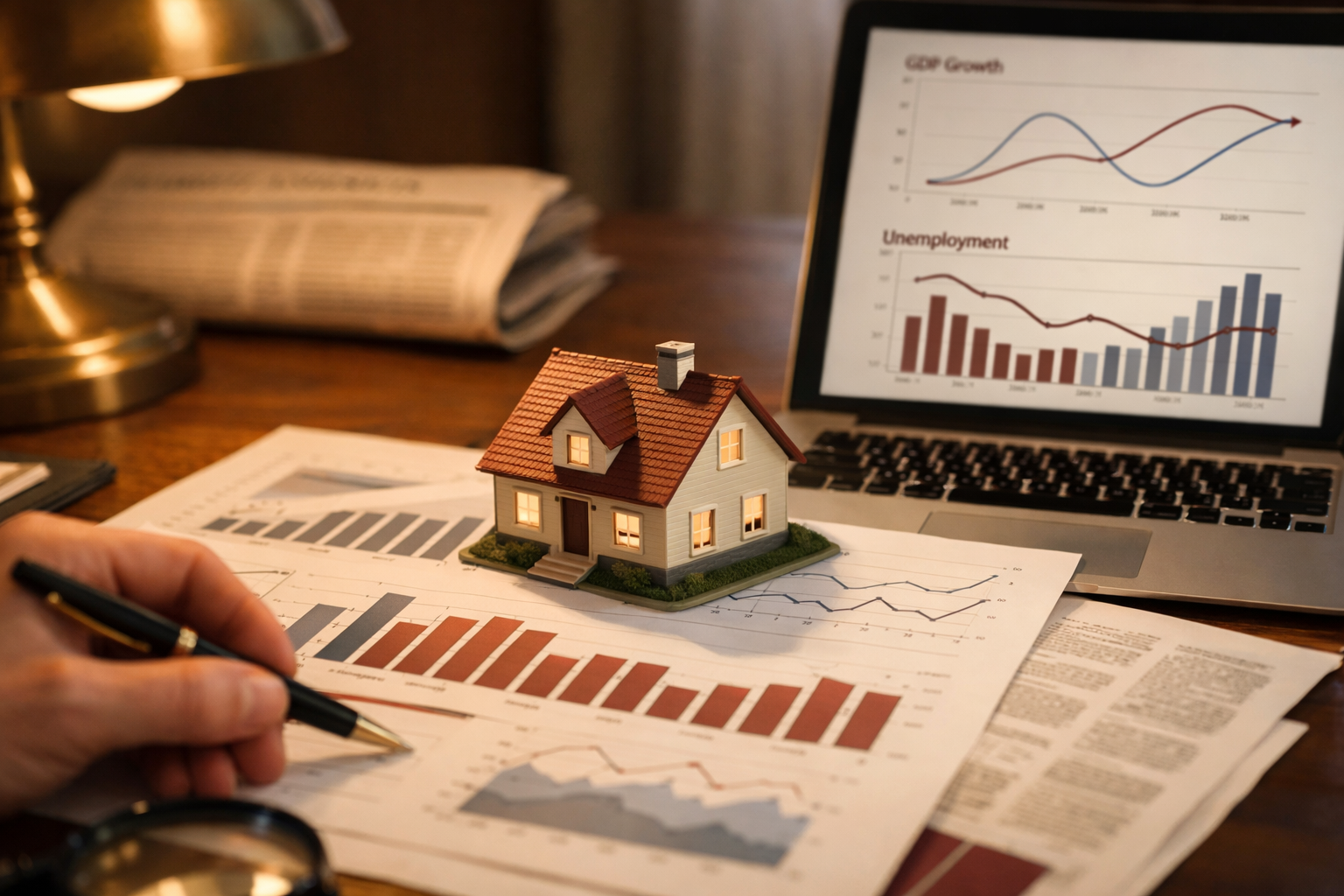
Inflation, GDP, and the Housing Market: What the Numbers Actually Tell You
Inflation and GDP are the two macro indicators that give the clearest read on where home prices are headed over a 12-36 month horizon.
Inflation and the Housing Market
Inflation affects real estate from two directions simultaneously — and they pull in opposite directions.
Inflation pushes prices UP because:
- Construction materials cost more (lumber, steel, concrete)
- Labor costs rise for contractors and builders
- Replacement cost of existing homes increases
- Real assets like real estate become attractive inflation hedges
Inflation creates pressure DOWN because:
- The Fed raises rates to fight inflation, increasing mortgage costs
- Consumer purchasing power erodes
- Buyers qualify for smaller loan amounts
- Investor cap rates get compressed
The net effect depends on which force is stronger in a given market. In high-demand, low-supply markets (think Austin, Nashville, Phoenix), inflation tends to push prices higher even as rates rise. In oversupplied or economically weaker markets, the rate pressure wins and prices soften.
GDP and the Housing Market
GDP growth is a confidence indicator. When the economy is growing at 2-3% annually, the housing market tends to be active and stable. When GDP contracts for two consecutive quarters (the technical definition of a recession), real estate demand typically follows within 3-6 months.
That said, the relationship between recession and real estate investing isn’t as simple as “recession = bad for real estate.” Some of the most impeccable real estate fortunes were built during or immediately after recessions — when prices corrected and motivated sellers created extraordinary buying opportunities.
Decision rule: If GDP growth is above 2% and unemployment is below 5%, you’re in a healthy buying environment. If GDP is contracting and unemployment is rising past 6%, expect price softening in most markets within 6-12 months.
Unemployment and Home Buying: The Indicator Most People Ignore
Unemployment data is the most underrated economic indicator in real estate. Most buyers and investors track mortgage rates obsessively but barely glance at the monthly jobs report — and that’s a mistake.
Here’s why unemployment matters so much:
Employment drives three things simultaneously:
- The number of qualified buyers in the market
- Consumer confidence and willingness to make large financial commitments
- Rental demand (unemployed people rent, not buy — which affects investor returns)
When unemployment rises, the first market to feel it is typically entry-level housing. First-time buyers are the most economically sensitive segment — they have less savings, less equity, and less job security on average. When they exit the market, the move-up buyer chain breaks down, and the entire market slows.
The unemployment threshold to watch: Historically, U.S. housing markets begin showing meaningful demand softening when unemployment crosses 5.5-6%. Below that range, housing demand tends to remain stable even if rates are elevated.
For investors specifically, rising unemployment can signal an opportunity in the rental market — displaced buyers become tenants. Our guide to investor plays for low-supply neighborhoods covers how to position for exactly this kind of market shift.
Recession and Real Estate Investing: Where the Opportunities Actually Hide
Not all recessions hit real estate equally — and the investors who know this are the ones who let it cook before you see results while everyone else panics.
What History Shows Us
The 2008-2009 recession was catastrophic for real estate because it originated in real estate — a mortgage crisis fueled by subprime lending, over-leveraging, and systemic fraud. That was a housing-specific collapse.
The 2020 COVID recession, by contrast, saw home prices rise during and after the downturn because:
- Historically low interest rates flooded the market with buyers
- Remote work created new demand in suburban and Sun Belt markets
- Supply was already constrained before the pandemic hit
The lesson: the cause of a recession matters as much as the recession itself.
Where Investors Find Extraordinary Deals in Downturns
- Distressed sellers — homeowners who bought at peak prices with adjustable-rate mortgages
- Motivated landlords — small portfolio owners who can’t weather vacancy periods
- New construction deals — builders who need to move inventory offer extraordinary concessions
- Undervalued markets — secondary cities that got overlooked during boom times
The data center boom driving Sun Belt real estate in 2026 is a fresh example of how economic infrastructure investment creates real estate demand that’s largely recession-resistant — because the jobs and infrastructure follow regardless of broader economic cycles.
So based on the current data: The investors who are gate-keeping their best deals right now are the ones who bought in Sun Belt secondary markets 18-24 months ago when everyone else was frozen by high rates.

Economic Indicators Every Buyer and Investor Should Track in 2026
You don’t need a finance degree to read economic indicators — you just need to know which ones to watch and what they’re telling you about real estate.
Here’s the impeccable short list:
Monthly Indicators (Check These Every Month)
| Indicator | Where to Find It | What to Watch For |
|---|---|---|
| CPI (Consumer Price Index) | Bureau of Labor Statistics | Inflation direction — affects Fed decisions |
| Jobs Report (Non-Farm Payrolls) | Bureau of Labor Statistics | Employment health — demand signal |
| Mortgage Rate Weekly Survey | Freddie Mac | Direct cost of buying |
| Existing Home Sales | NAR | Demand and inventory levels |
| Housing Starts | Census Bureau | Future supply pipeline |
Quarterly Indicators (Check These Every Quarter)
| Indicator | What It Tells You |
|---|---|
| GDP Growth Rate | Overall economic health and direction |
| Fed Meeting Minutes | Rate direction for next 6-12 months |
| Case-Shiller Home Price Index | National and metro-level price trends |
| Consumer Confidence Index | Buyer sentiment leading indicator |
The economic indicators real estate playbook: When CPI is falling, jobs are stable, and the Fed signals rate cuts — that’s the window. Buyers who move in that window consistently outperform those who wait for the headlines to confirm what the data already showed.
For buyers navigating the mortgage side of this, our 15-year vs. 30-year mortgage rate comparison for 2026 breaks down the long-term savings math in plain language.
What the 2026 Economic Outlook Means for Your Next Real Estate Move
The mortgage rates economic outlook for 2026 is cautiously optimistic — and that matters enormously for buyers, sellers, and investors making decisions right now.
Here’s the current picture:
- Rates: Stabilizing in the 6-6.5% range for 30-year fixed mortgages
- Inflation: Moderating but not fully tamed — PCE (the Fed’s preferred measure) is trending toward the 2% target
- Employment: Labor market remains relatively tight, supporting buyer demand
- Inventory: Slowly improving but still below historical norms in most markets
- Price growth: Decelerating from the 2021-2022 frenzy but not reversing in most markets
J.P. Morgan’s 2026 outlook — which we covered in detail in our analysis of stalling home prices and buyer tactics — suggests price growth in the 2-4% range nationally, with significant variation by market.
What This Means for Each Audience
Home Buyers in 2026:
- Stop waiting for rates to hit 4%. They won’t without a recession.
- Get pre-approved now so you can move fast when the right property appears.
- Use seller concessions and credits to offset rate costs — sellers are more flexible than they were in 2021.
Sellers in 2026:
- Pricing is everything. The market is no longer forgiving overpriced listings.
- Economic uncertainty means buyers are more cautious — your home needs to be priced right from day one.
- Consider offering rate buydowns as an incentive — it’s one of the most effective tools in a 6%+ rate environment.
Investors in 2026:
- The housing market forecast points to slow, steady appreciation — not explosive growth.
- Cash flow matters more than appreciation bets right now.
- Secondary Sun Belt markets, healthcare real estate, and senior housing are showing extraordinary fundamentals. Our senior housing boom 2026 investment guide is worth a read if you haven’t seen it.

FAQ: The Economy and Real Estate — Your Questions Answered
Q: Does a recession always cause home prices to drop?
No. Recessions cause home price drops only when the recession is severe, unemployment rises sharply, and credit tightens significantly. The 2020 recession actually saw home prices rise in most U.S. markets.
Q: How quickly do Fed rate decisions affect mortgage rates?
Mortgage rates typically respond within days to weeks of a Fed announcement. The 30-year fixed rate is more tied to 10-year Treasury yields than the federal funds rate directly, but both move in response to Fed signals.
Q: What’s the best economic environment for buying a home?
Stable employment, moderate inflation (2-3%), and a Fed in a rate-cutting or rate-holding cycle. That combination gives buyers purchasing power, lender confidence, and reasonable financing costs.
Q: How does inflation affect rental property investors?
Inflation is generally positive for rental investors — rents tend to rise with inflation, increasing cash flow. The challenge is that property acquisition costs and financing costs also rise, compressing returns on new purchases.
Q: What economic indicator is most predictive of home price changes?
The 30-year mortgage rate and existing home sales data together give the clearest short-term signal. For longer-term trends, wage growth relative to home price appreciation is the most reliable indicator of market sustainability.
Q: Should I buy real estate during a recession?
It depends on your financial position and local market. If you have stable income, strong credit, and cash reserves, recessions can offer extraordinary buying opportunities. If your job security is uncertain, wait.
Q: How does GDP growth affect real estate investment returns?
Strong GDP growth (above 2%) typically supports rising rents, lower vacancy rates, and property appreciation — all positive for investors. Contracting GDP signals potential rent softening and higher vacancy risk.
Q: What’s the relationship between unemployment and rental demand?
They move inversely in the short term. Rising unemployment increases rental demand as displaced buyers become renters. However, if unemployment stays high long enough, it eventually depresses rents too as renters double up or relocate.
Q: How do I know if a local real estate market is overvalued?
Compare median home prices to median household incomes. A price-to-income ratio above 5x in a market historically signals overvaluation. Also compare rent-to-price ratios — if gross yields fall below 5%, appreciation is doing most of the work, which is riskier.
Q: Are Sun Belt markets still strong in 2026 despite economic uncertainty?
Yes, for markets with strong job growth and infrastructure investment. Markets tied to data centers, healthcare expansion, and population migration from high-cost states are showing resilience that broader economic headwinds haven’t fully penetrated.
Conclusion: Let the Economy Work For You, Not Against You
Understanding how the economy shapes real estate prices, demand, and your next move as a buyer or investor isn’t just academic — it’s the difference between making a confident, well-timed decision and getting caught flat-footed when the market shifts.
The economic impact on real estate is real, measurable, and trackable. Interest rates, inflation, unemployment, GDP, and Fed decisions all leave fingerprints on home prices and buyer demand. The buyers and investors who read those fingerprints early are the ones who build impeccable portfolios and make extraordinary moves while everyone else is still debating whether to wait.
Your action steps right now:
- ✅ Track the monthly jobs report and CPI — set a calendar reminder. These two numbers tell you more about the next 6 months of real estate than any headline will.
- ✅ Get pre-approved if you’re buying — rate stability won’t last forever, and pre-approval costs you nothing but positions you to move fast.
- ✅ Run the numbers on your local market — use the AI tools for real estate investors we’ve covered to analyze local economic conditions, not just national headlines.
- ✅ If you’re an investor, identify your economic cycle play — cash flow markets, distressed opportunities, or emerging Sun Belt corridors each require a different strategy.
- ✅ If you’re selling, price it right from day one — the economic environment rewards well-priced homes and punishes overpriced ones more than ever.
The economy is always moving. The question is whether you’re moving with it — or reacting after it’s already moved on without you.
For more fresh market intelligence, head to the RERIQ Hub where our team of licensed brokers breaks down market trends, investment strategies, and economic shifts as they happen.
Questions? Reach us at news@realestaterankiq.com
Subscribe on YouTube: @Realestaterankiq
References
- National Association of Realtors (NAR). (2024). Existing Home Sales and Economic Conditions Report. https://www.nar.realtor/research-and-statistics
- Freddie Mac. (2024). Primary Mortgage Market Survey (PMMS). https://www.freddiemac.com/pmms
- U.S. Bureau of Labor Statistics. (2024). Consumer Price Index Summary. https://www.bls.gov/cpi/
- U.S. Bureau of Economic Analysis. (2024). Gross Domestic Product, Fourth Quarter 2024. https://www.bea.gov/data/gdp/gross-domestic-product
- Federal Reserve. (2024). Federal Open Market Committee Meeting Minutes. https://www.federalreserve.gov/monetarypolicy/fomccalendars.htm
- S&P CoreLogic Case-Shiller. (2024). Home Price Index. https://www.spglobal.com/spdji/en/indices/indicators/sp-corelogic-case-shiller-us-national-home-price-nsa-index/
- U.S. Census Bureau. (2024). New Residential Construction (Housing Starts). https://www.census.gov/construction/nrc/
- J.P. Morgan Asset Management. (2025). 2026 U.S. Real Estate Outlook. https://www.jpmorgan.com/insights/real-estate