


Last updated: April 23, 2026

Quick Answer: To analyze a rental property before buying, calculate the property’s net operating income (NOI), cap rate, cash-on-cash return, and gross rent multiplier — then stress-test those numbers against realistic vacancy rates, operating expenses, and local rental comps. A deal that looks good on paper can fall apart fast if you skip even one of these steps.
Key Takeaways
- The 1% rule and 50% rule are fast screening tools — not final decisions. Always run full numbers before making an offer.
- Cap rate tells you the property’s return independent of financing. Cash-on-cash return tells you how your actual cash investment is performing.
- Pull rental comps from at least three sources (Rentometer, Zillow Rental Manager, Redfin) before trusting any rent estimate.
- Vacancy rates vary wildly by market. Use local data — not national averages — when calculating NOI.
- Tools like DealCheck, Mashvisor, PropStream, and the BiggerPockets Rental Property Calculator can cut your analysis time significantly.
- A good cap rate for residential rental property typically falls between 4% and 10%, depending on the market and asset class.
- A good cash-on-cash return is generally considered 8% or higher, though many investors accept 6%+ in strong appreciation markets.
- Never skip a property inspection — hidden repair costs are the fastest way to destroy a deal’s ROI.
- The best investors don’t just analyze one property — they analyze dozens to build a baseline for what “good” looks like in their target market.

Why Most Investors Buy the Wrong Rental Property (And How to Stop)
Most investors who lose money on rental properties don’t lose it because the market crashed. They lose it because they skipped the math. They fell in love with a property, convinced themselves the numbers were “close enough,” and signed the papers before doing a real investment property analysis.
Knowing how to analyze a rental property before you buy is the single most important skill in a rental investor’s toolkit. It doesn’t matter if you’re buying your first duplex or your fifteenth single-family home — the checklist stays the same.
This guide walks through every metric, every tool, and every red flag so you can run an impeccable analysis before a single dollar changes hands.
How to Analyze a Rental Property Before You Buy: The Complete Investor Checklist
This is the full, step-by-step process used by experienced investors to evaluate any rental property deal. Work through each section in order — skipping steps is how bad deals get funded.
Step 1: Define Your Investment Criteria First
Before analyzing any specific property, know what you’re looking for. Ask yourself:
- What’s my target market? (Class A, B, or C neighborhoods?)
- What’s my minimum acceptable cash-on-cash return?
- Am I prioritizing cash flow or appreciation?
- What’s my maximum all-in budget, including repairs?
Investors who skip this step end up chasing deals instead of filtering them. Get your criteria locked in writing before you run a single number. For a broader look at investment types and strategies, our complete guide to the 4 essential property types for investments is a solid starting point.
Step 2: Run the Quick Screening Rules
Two rules help you filter properties in under two minutes. They’re not perfect, but they eliminate the obvious losers fast.
The 1% Rule
A property passes the 1% rule if the monthly rent is at least 1% of the purchase price.
Example: A $200,000 property should rent for at least $2,000/month.
The 50% Rule
Expect operating expenses (excluding mortgage) to equal roughly 50% of gross rents. So if a property brings in $2,000/month, budget $1,000 for expenses.
| Rule | Formula | Use Case |
|---|---|---|
| 1% Rule | Monthly Rent ÷ Purchase Price ≥ 1% | Fast cash flow screening |
| 50% Rule | Operating Expenses ≈ 50% of Gross Rent | Quick NOI estimate |
| 70% Rule | ARV × 70% − Repairs = Max Offer | Fix-and-flip screening |
⚠️ Common Mistake: Treating these rules as final answers. In high-cost markets like San Francisco or New York, almost nothing passes the 1% rule — but deals can still make sense based on appreciation. Use these as filters, not verdicts.
Step 3: Pull Accurate Rental Comps
Your rent estimate is the foundation of every number that follows. Get it wrong, and your entire analysis is fiction.
How to pull rental comps:
- Search active rentals within 0.5–1 mile of the subject property on Zillow Rental Manager, Redfin, and Apartments.com
- Filter for similar bed/bath count, square footage, and condition
- Use Rentometer to get a quick median rent estimate with percentile breakdowns
- Cross-reference with Mashvisor for neighborhood-level rental data
- Call local property managers — they know what’s actually renting and at what price
Rent estimate red flags:
- Only one comp available in the area
- Comps are 6+ months old
- The seller’s rent estimate is significantly higher than market comps
- High vacancy rates in the neighborhood (more than 8–10%)
For a deeper breakdown on pricing rental units, check out our comprehensive landlord’s pricing guide.
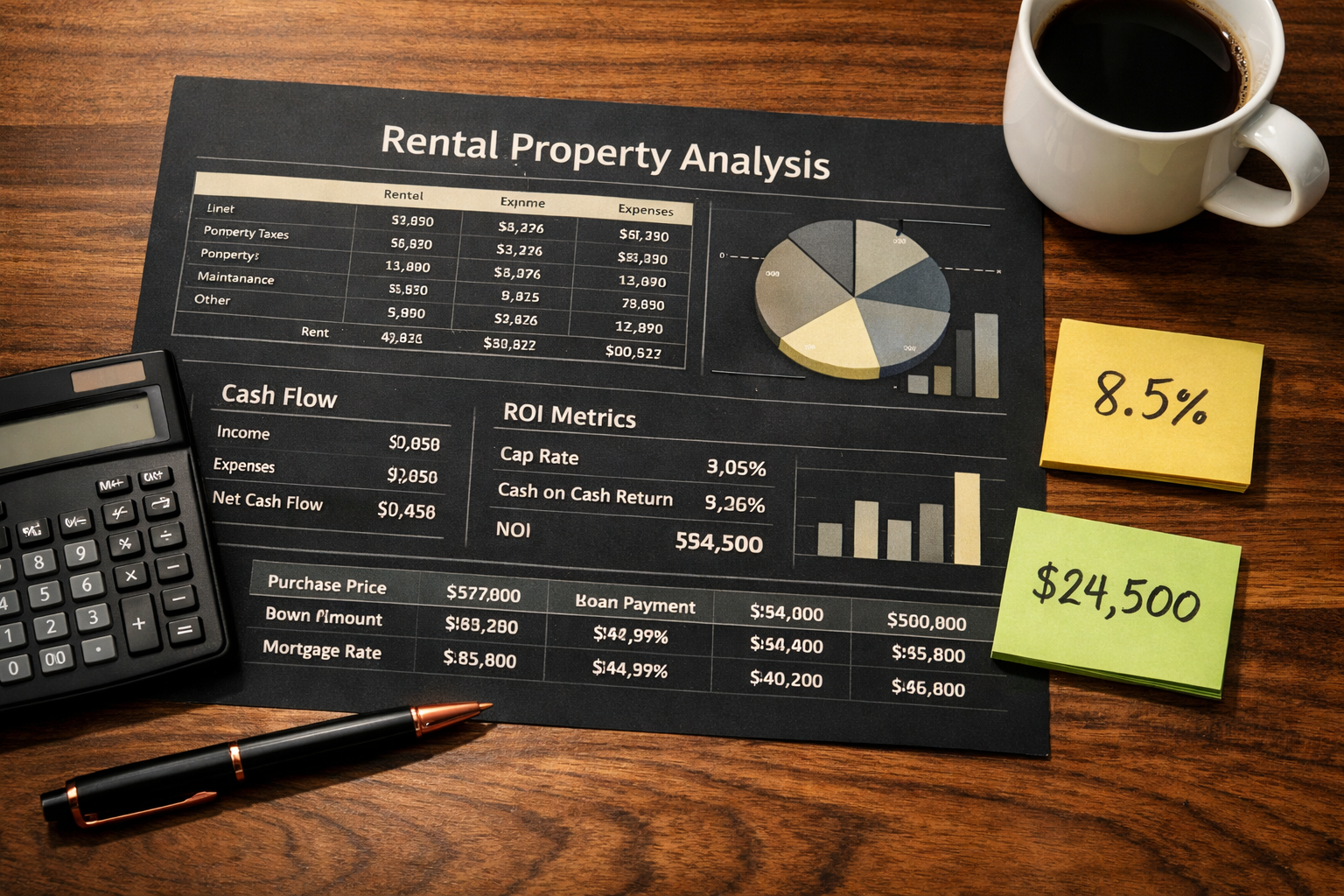
Step 4: Calculate Net Operating Income (NOI)
NOI = Gross Rental Income − Operating Expenses (before debt service)
This is the most important number in rental property analysis. It tells you what the property earns before any mortgage payments.
Gross Rental Income:
- Annual rent (use your verified comp estimate, not the seller’s claim)
- Subtract vacancy allowance (typically 5–10% depending on local market)
- Add any other income (laundry, parking, storage fees)
Operating Expenses to include:
- Property taxes
- Insurance (see our 2026 cost guide on homeowners vs. rental property insurance)
- Property management fees (typically 8–12% of collected rent)
- Maintenance and repairs (budget 1% of property value annually as a baseline)
- Capital expenditures (roof, HVAC, appliances — budget 5–10% of rent)
- Utilities paid by owner
- HOA fees (if applicable)
Example NOI Calculation:
| Item | Monthly | Annual |
|---|---|---|
| Gross Rent | $2,000 | $24,000 |
| Vacancy (7%) | −$140 | −$1,680 |
| Effective Gross Income | $1,860 | $22,320 |
| Property Taxes | −$200 | −$2,400 |
| Insurance | −$100 | −$1,200 |
| Property Management (10%) | −$186 | −$2,232 |
| Maintenance/CapEx | −$250 | −$3,000 |
| NOI | $1,124 | $13,488 |
Step 5: Calculate Cap Rate
Cap Rate = NOI ÷ Property Value (or Purchase Price)
The cap rate is how investors compare properties regardless of financing. It’s a pure measure of the property’s income-generating ability relative to its price.
Using the example above:
$13,488 ÷ $200,000 = 6.74% cap rate
What is a good cap rate for rental property?
| Market Type | Typical Cap Rate Range |
|---|---|
| Major metros (NYC, LA, SF) | 3–5% |
| Mid-size cities | 5–8% |
| Smaller markets / rural | 7–12%+ |
| Class C / higher-risk areas | 9–12%+ |
Decision rule: Choose a higher cap rate if you need cash flow now. Accept a lower cap rate if you’re buying in a high-appreciation market for long-term wealth building.
For a deeper look at how to figure cap rate in different market conditions, our neighborhood market data and investment strategies guide breaks it down by location type.
Step 6: Calculate Cash-on-Cash Return
Cash-on-Cash Return = Annual Pre-Tax Cash Flow ÷ Total Cash Invested
This is the metric that actually tells you how your real money is performing — because it accounts for your mortgage payment, unlike cap rate.
Annual Pre-Tax Cash Flow = NOI − Annual Debt Service
Continuing the example with a $160,000 loan at 7% interest, 30-year term (approximate monthly payment: $1,065):
| Item | Annual |
|---|---|
| NOI | $13,488 |
| Annual Debt Service | −$12,780 |
| Annual Cash Flow | $708 |
Total Cash Invested:
- Down payment: $40,000
- Closing costs: $4,000
- Initial repairs: $5,000
- Total: $49,000
$708 ÷ $49,000 = 1.44% cash-on-cash return
That’s a weak deal. A good cash-on-cash return is generally 8% or higher. This example shows why running real numbers matters — the 1% rule said it might work, but the full analysis says otherwise.
If you’re financing through a DSCR loan, understanding the qualification requirements changes your analysis. Our DSCR loan requirements guide for 2026 covers exactly what lenders look for.
Step 7: Calculate Gross Rent Multiplier (GRM)
GRM = Property Price ÷ Annual Gross Rent
GRM is a fast valuation tool — lower is generally better.
$200,000 ÷ $24,000 = GRM of 8.33
A GRM below 10 is often considered solid for residential rentals, though this varies by market. Use GRM to quickly compare multiple properties in the same area — it’s not a standalone metric, but it’s a great filter.
Step 8: Estimate Vacancy Rate Accurately
Vacancy is one of the most underestimated expenses in real estate cash flow analysis. New investors often plug in 0% vacancy because the current tenant is in place. That’s a mistake.
How to estimate vacancy rate:
- Check local apartment association data for your city
- Ask local property managers what their average vacancy looks like
- Review Census Bureau rental vacancy data by metro area
- Factor in turnover time (cleaning, repairs, re-listing between tenants)
A 5% vacancy rate equals about 18 days vacant per year. A 10% rate equals about 36 days. In a soft rental market, 10–15% is realistic.
The Best Real Estate Deal Analyzer Tools in 2026
Running this analysis manually is possible, but the right tools make it faster, more accurate, and honestly — a lot less painful. Here’s a straight comparison of the top real estate investment tools available right now.
| Tool | Best For | Cost | Key Feature |
|---|---|---|---|
| DealCheck | Full property analysis | Free / $14–$29/mo | Rental, flip, BRRRR analysis |
| Mashvisor | Airbnb + rental comps | ~$17–$74/mo | Neighborhood heatmaps |
| PropStream | Off-market deal finding | ~$99/mo | Skip tracing + comps |
| BiggerPockets Calculator | Beginners | Free (account required) | Simple, clean UI |
| Rentometer | Rent comps only | Free / Pro plan | Fast rent estimates |
| Roofstock | Turnkey rental buying | Free to browse | Pre-analyzed deals |
| CoStar | Commercial / institutional | Enterprise pricing | Deep market data |
| Zillow Rental Manager | Basic rent estimates | Free | Zestimate rent data |
| Redfin | Comps + sales history | Free | Transparent data |
So based on what most independent investors actually need day-to-day, DealCheck and the BiggerPockets Rental Property Calculator cover 90% of use cases without a massive subscription cost. PropStream is extraordinary for finding off-market deals before they hit the MLS.
Our comparison of HouseCanary vs. Skyline AI for real estate investment analysis is worth reading if you want to go deeper on AI-powered real estate analytics.
How to Build a Rental Property Spreadsheet (What to Track)
A solid rental property spreadsheet doesn’t need to be fancy — it needs to be accurate and consistent. Here’s what every column should include:
Purchase Analysis Tab:
- Purchase price
- Down payment %
- Loan amount, rate, and term
- Closing costs
- Estimated repairs
- Total cash invested
Income Tab:
- Gross monthly rent
- Vacancy allowance
- Other income
- Effective gross income
Expense Tab:
- Property taxes
- Insurance
- Management fees
- Maintenance
- CapEx reserves
- Utilities
- HOA
Returns Tab:
- NOI
- Annual debt service
- Annual cash flow
- Cash-on-cash return
- Cap rate
- GRM
- Total ROI (including appreciation estimate)
Tools like DealCheck and the BiggerPockets calculator auto-populate most of this — but building your own spreadsheet once is a fresh exercise that forces you to understand every line item.
What Is a Good ROI on a Rental Property?
A good ROI on rental property depends on your strategy, market, and financing — but most experienced investors target a minimum 8–12% total return annually.
Here’s how to think about it by strategy:
Cash Flow Investors:
- Target cash-on-cash return: 8–12%+
- Target cap rate: 6–10%
- Priority: Monthly income over appreciation
Appreciation Investors:
- Accept lower cash-on-cash (sometimes 2–4%)
- Target markets with strong job growth, population growth, and limited housing supply
- Priority: Long-term equity building
BRRRR Investors (Buy, Rehab, Rent, Refinance, Repeat):
- Target infinite returns (getting all cash back out via refinance)
- Focus on forced appreciation through value-add renovation
What is a good rate of return on rental property?
A property generating 8% cash-on-cash with a 6% cap rate in a stable market with 3–4% annual appreciation is delivering a total return in the 10–14% range — that’s an extraordinary result by most investment standards.
For investors weighing whether to rent out a property they already own, our 2026 decision guide for homeowners sitting on big equity covers the full rent vs. sell analysis.
Red Flags That Kill a Rental Property Deal
Stop gatekeeping this information — every investor needs to know these warning signs before they write a check.
🚩 Red Flag #1: The seller’s rent estimate is above market comps
Run your own comps. Always. Sellers have every incentive to inflate projected rents.
🚩 Red Flag #2: Deferred maintenance everywhere
A property that hasn’t been maintained is hiding repair costs. Budget conservatively and get a full inspection before closing.
🚩 Red Flag #3: High crime or declining neighborhood
Check local crime data and look at 5-year population and employment trends. A cheap property in a shrinking market is not a deal.
🚩 Red Flag #4: Tenant already in place with below-market rent
Inherited tenants with long-term leases at below-market rates can lock you into negative cash flow for years. Know your local landlord-tenant laws before assuming you can raise rent.
🚩 Red Flag #5: Flood zone or environmental issues
Check FEMA flood maps. Flood insurance adds significant cost and can make an otherwise solid deal unprofitable.
🚩 Red Flag #6: The numbers only work at 0% vacancy
If your cash flow disappears the moment a tenant leaves, the deal is too thin. Build in a real vacancy buffer.
The Complete Rental Property Analysis Checklist (Printable)
Use this as your go-to reference for how to analyze a rental property before you buy. This is the complete investor checklist — work through every item before making an offer.
📋 Pre-Analysis Setup
- Define investment criteria (return targets, budget, market)
- Identify target neighborhood and property class
- Confirm financing terms and total cash available
📋 Market Research
- Pull rental comps from 3+ sources
- Verify local vacancy rates
- Check neighborhood employment and population trends
- Review recent sales comps (real estate comps free via Redfin, Zillow)
📋 Quick Screening
- Apply 1% rule
- Apply 50% rule
- Calculate GRM
📋 Full Financial Analysis
- Verify gross rent with market comps
- Calculate effective gross income (with vacancy)
- List all operating expenses line by line
- Calculate NOI
- Calculate cap rate
- Calculate cash-on-cash return
- Stress test: What happens at 15% vacancy? At 20% higher expenses?
📋 Property Due Diligence
- Order full property inspection
- Get repair cost estimates from licensed contractors
- Review title report for liens or encumbrances
- Confirm zoning allows intended use
- Check flood zone status
- Review HOA rules and financials (if applicable)
📋 Legal and Management
- Research local landlord-tenant laws
- Decide: self-manage or hire a property manager?
- Get insurance quotes (rental property policy, not homeowners)
- Review existing leases if tenant-occupied

Frequently Asked Questions
Q: What is the first step in analyzing a rental property?
A: Define your investment criteria before looking at any specific property. Know your minimum acceptable return, total budget, and target market. Without this baseline, you’ll waste time analyzing deals that never fit your goals.
Q: What is a good cap rate for rental property in 2026?
A: For most residential rental properties, a cap rate between 5% and 8% is considered solid in 2026. In major metros, 4–5% is common. In smaller markets, 8–12% is achievable. Lower cap rates are acceptable in high-appreciation markets.
Q: How do I estimate rental income before buying?
A: Pull active rental listings within 0.5–1 mile for comparable units using Zillow Rental Manager, Rentometer, and Redfin. Cross-reference with Mashvisor for neighborhood-level data. Call two or three local property managers for a real-world sanity check.
Q: What is a good cash-on-cash return on a rental property?
A: Most experienced investors target 8% or higher. In strong appreciation markets, 5–6% cash-on-cash is sometimes accepted when long-term equity gains are expected to compensate.
Q: What does the 50% rule mean in real estate?
A: The 50% rule estimates that operating expenses (excluding mortgage) will equal about 50% of gross rental income. It’s a quick screening tool — not a replacement for a detailed expense analysis.
Q: How do I calculate NOI on a rental property?
A: NOI = Effective Gross Income (rent minus vacancy) minus all operating expenses (taxes, insurance, management, maintenance, CapEx). Do not include mortgage payments in this calculation.
Q: What tools do investors use for rental property analysis?
A: The most widely used tools include DealCheck, Mashvisor, PropStream, BiggerPockets Rental Property Calculator, Rentometer, Roofstock, and Zillow Rental Manager. CoStar is the industry standard for commercial properties.
Q: What is the 1% rule in rental property investing?
A: The 1% rule says a property’s monthly rent should equal at least 1% of its purchase price. A $250,000 property should rent for at least $2,500/month. It’s a fast filter — not a final decision.
Q: How do I pull free real estate comps?
A: Redfin and Zillow both offer free sales and rental comps. Rentometer provides free basic rent estimates. BiggerPockets has free calculators. For deeper data, PropStream and CoStar require paid subscriptions.
Q: How do vacancy rates affect rental property ROI?
A: Every percentage point of vacancy directly reduces your effective gross income. A 10% vacancy rate on a $2,000/month rental costs $2,400 per year — and that’s before accounting for turnover costs like cleaning, repairs, and re-leasing fees.
Q: Should I use a property manager or self-manage?
A: If you’re investing out of state or own multiple properties, a property manager (typically 8–12% of collected rent) is usually worth the cost. If you’re local and have time, self-managing improves cash flow but adds responsibility. Our first-time investor’s guide to property management breaks down both sides.
Q: What is a gross rent multiplier and how is it used?
A: GRM = Purchase Price ÷ Annual Gross Rent. It’s a fast valuation comparison tool. A GRM of 8 means you’re paying 8 times the annual rent for the property. Lower GRM generally means better value, though it must be used alongside cap rate and cash-on-cash analysis.
Conclusion: Let It Cook Before You See Results
Running a thorough rental property analysis isn’t glamorous. It doesn’t go viral. Nobody’s posting their NOI spreadsheet on Instagram. But this is exactly where the real money is made — before the deal closes, not after.
The investors who consistently build impeccable portfolios are the ones who analyze 20 properties to buy one. They know their numbers cold. They don’t fall in love with a house — they fall in love with the math.
Use the checklist above on every deal. Run your numbers through DealCheck or the BiggerPockets calculator. Pull your rental comps from at least three sources. Calculate your cap rate, your cash-on-cash return, and your NOI before you ever schedule a showing. And when a deal doesn’t hit your targets? Walk away. The next one will.
Actionable Next Steps:
- Download or bookmark this checklist and use it on your next property analysis
- Set up a free account on DealCheck or BiggerPockets to run your first digital analysis
- Pull rental comps for your target market using Rentometer and Zillow Rental Manager today
- Define your personal investment criteria in writing before looking at another deal
- Read our beginner’s blueprint for how to invest in real estate if you’re still building your foundation
The data is out there. The tools are free or cheap. The only thing stopping most investors is skipping the work. Don’t be that investor.
References
- BiggerPockets. (2023). Rental Property Calculator. https://www.biggerpockets.com/rental-property-calculator
- Mashvisor. (2024). Real Estate Investment Analysis Tools. https://www.mashvisor.com
- Rentometer. (2024). Rental Price Analysis. https://www.rentometer.com
- PropStream. (2024). Real Estate Data and Analytics Platform. https://www.propstream.com
- DealCheck. (2024). Real Estate Investment Analysis Software. https://www.dealcheck.io
- Roofstock. (2024). Single-Family Rental Marketplace. https://www.roofstock.com
- U.S. Census Bureau. (2024). Rental Vacancy Rates by Metropolitan Area. https://www.census.gov/housing/hvs/
- National Association of Realtors. (2024). Investment and Vacation Home Buyers Survey. https://www.nar.realtor
- CoStar Group. (2024). Commercial Real Estate Data and Analytics. https://www.costar.com
- Redfin. (2024). Real Estate Market Data. https://www.redfin.com
Tags: rental property analysis, how to analyze a rental property, cap rate calculation, cash-on-cash return, rental property ROI, real estate cash flow, investment property analysis, NOI calculation, rental comps, real estate deal analyzer, rental property spreadsheet, real estate investment tools
For more rental analysis and investing guides, visit the Investment Hub.











Comments 3