

{“cover”:”Professional landscape format (1536×1024) hero image showing a sleek modern home office desk with dual monitors displaying accounting dashboard software with commission charts, colorful bar graphs, and transaction logs. A crumpled Excel spreadsheet sits discarded in the foreground next to a coffee mug. Color scheme: deep burgundy red, rich black, cream white accents. Clean editorial aesthetic, magazine cover quality, no text overlays, high contrast lighting from left side window casting warm glow on workspace.”,”content”:[“Wide-angle shot of a frustrated real estate agent at a cluttered desk surrounded by printed Excel spreadsheets with red error marks, sticky notes everywhere, and a calculator. Contrast with a glowing laptop screen showing a clean modern accounting dashboard with commission tracking widgets. Color palette: muted grays and reds, overhead office lighting, editorial documentary style, landscape format 1536×1024.”,”Flat-lay overhead composition showing five distinct software interface mockups arranged in a grid on a dark navy surface — QuickBooks, FreshBooks, Wave, Xero, and Realtyzam logos visible on tablet screens. Small house icons and dollar sign tokens scattered between devices. Warm cream and burgundy accent colors, product photography style, landscape format 1536×1024.”,”Split-screen infographic-style illustration showing two real estate agents side by side — left agent buried in paper receipts and a broken spreadsheet on screen, right agent using a sleek AI-powered accounting app with automated commission splits and mileage tracking displayed. Clean vector art style, burgundy and navy color scheme, landscape format 1536×1024.”,”Close-up of a laptop screen displaying a real estate commission tracking dashboard with automated split calculations, 1099 income summaries, mileage logs, and expense categories. A realtor’s hand holds a stylus pointing at the screen. Shallow depth of field, warm office background blur, financial data visualization focus, editorial quality, landscape format 1536×1024.”,”Conceptual illustration of a smooth transition path — a winding road starting from a crumpled Excel grid on the left transforming into a clean digital accounting interface on the right, with milestone markers showing ‘import data,’ ‘connect bank,’ ‘categorize expenses,’ ‘run report.’ Isometric 3D style, burgundy red and cream color palette, minimal background, landscape format 1536×1024.”]

Last updated: May 24, 2026
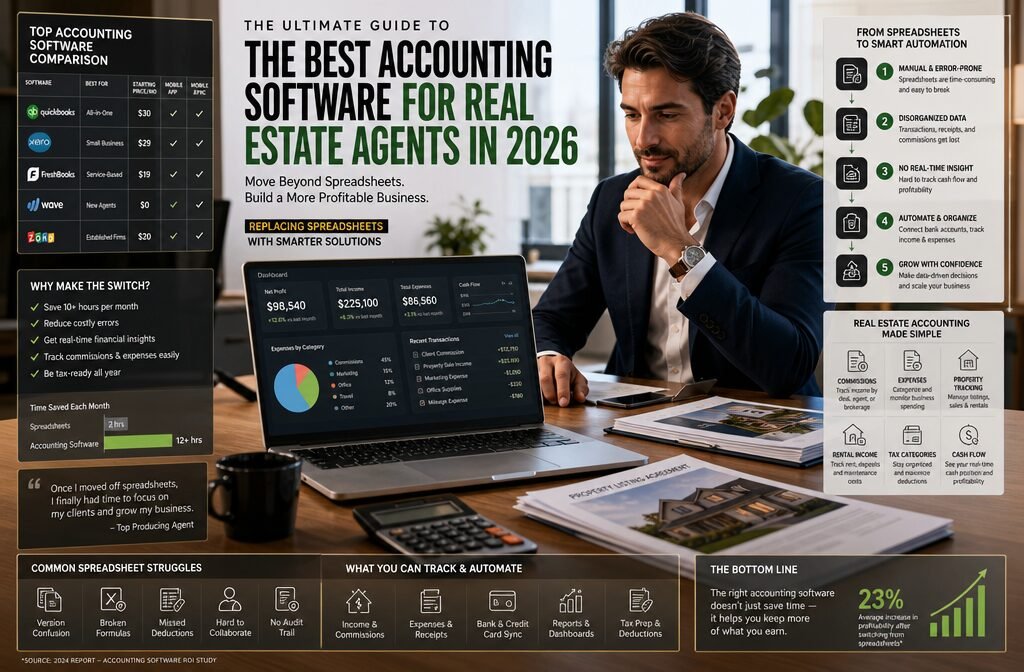
Quick Answer: The best accounting software for real estate agents in 2026 includes QuickBooks Self-Employed, FreshBooks, Wave Accounting, Xero, and Realtyzam — each offering commission tracking, expense categorization, and tax prep features that Excel simply cannot match. For independent agents closing fewer than 20 deals a year, Wave (free) or Realtyzam (real estate-specific) are the strongest starting points. Larger teams and brokerages will get more out of QuickBooks or Xero.
Key Takeaways
- Excel is not accounting software — it has no automation, no bank sync, no tax calculations, and no audit trail.
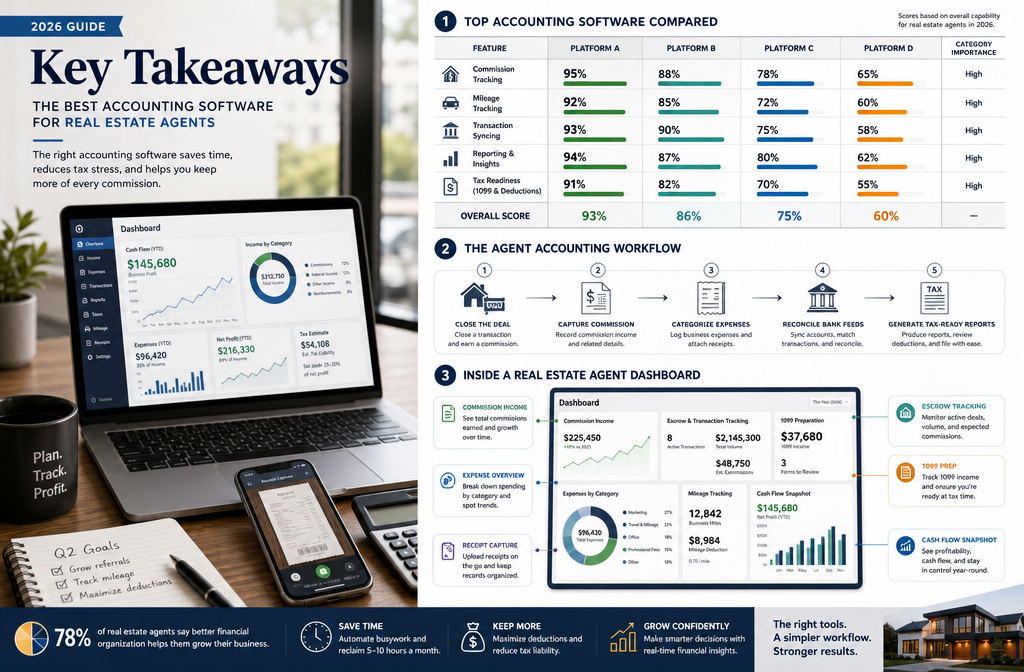
- The best accounting software for real estate agents automates commission tracking, mileage logs, expense categorization, and 1099 preparation.
- Top picks for 2026: QuickBooks Self-Employed, FreshBooks, Wave Accounting (free), Xero, Realtyzam, and Baselane (for agents who also invest).
- Most real estate agent accounting tools cost between $0 and $50/month — a fraction of what disorganized books cost at tax time.
- AI bookkeeping features are now standard in 2026 — tools like QuickBooks and Xero auto-categorize transactions with machine learning.
- Even agents closing fewer than 10 deals a year benefit from dedicated software — the IRS doesn’t grade on a curve.
- Switching from spreadsheets to accounting software takes most agents less than a full weekend to set up.
- Commission splits, referral fees, and Schedule C deductions are all trackable automatically with the right tool.
Why Excel Is Quietly Killing Your Real Estate Business Finances
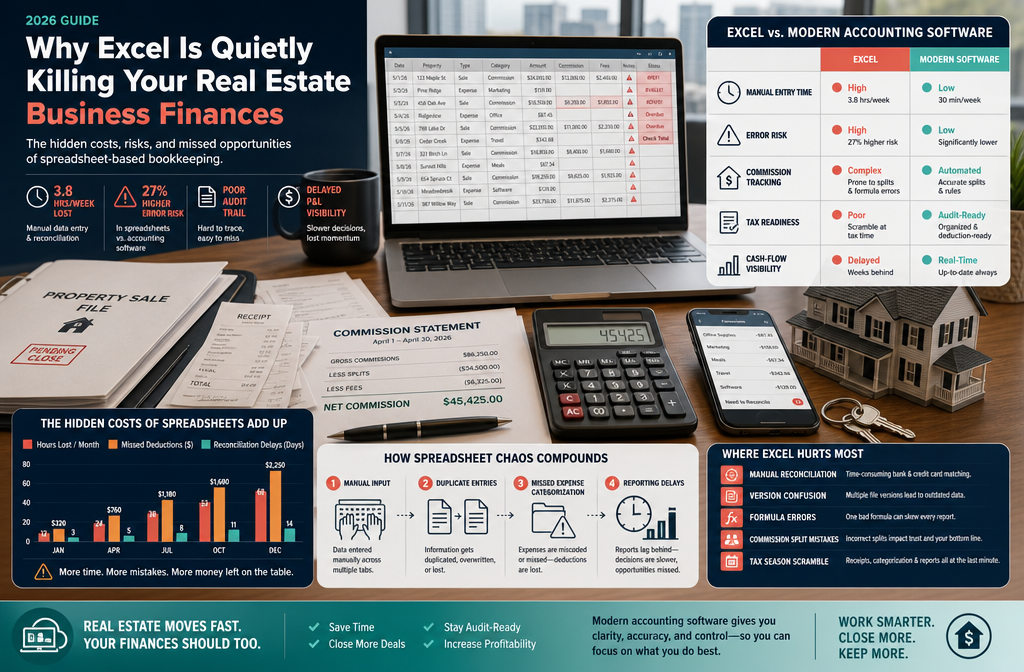
Excel is a spreadsheet tool. It is not accounting software, and treating it like one is one of the most common — and costly — mistakes in real estate agent bookkeeping.
Here’s what Excel cannot do for you:
- Sync with your bank account to automatically pull in transactions
- Calculate self-employment tax or estimate quarterly payments
- Track mileage with GPS or auto-log
- Generate a Schedule C for your CPA at tax time
- Flag deductible expenses in real time
- Create an audit trail if the IRS comes knocking
Most agents don’t realize how exposed they are until they’re sitting across from their accountant in March, handing over a spreadsheet with 11 months of half-entered data and a prayer. That’s not a plan — that’s a liability.
The IRS treats real estate agents as self-employed independent contractors. That means you’re responsible for tracking every commission, every split, every referral fee, and every deductible business expense on your own. Excel gives you a blank grid. The best accounting software for real estate agents gives you a system.
Real talk: The agents who build impeccable financial systems early are the ones who scale without chaos. The ones who wing it with spreadsheets are the ones calling their CPA in a panic every April.
Best Accounting Software for Real Estate Agents: Ditch Excel and Use These Instead
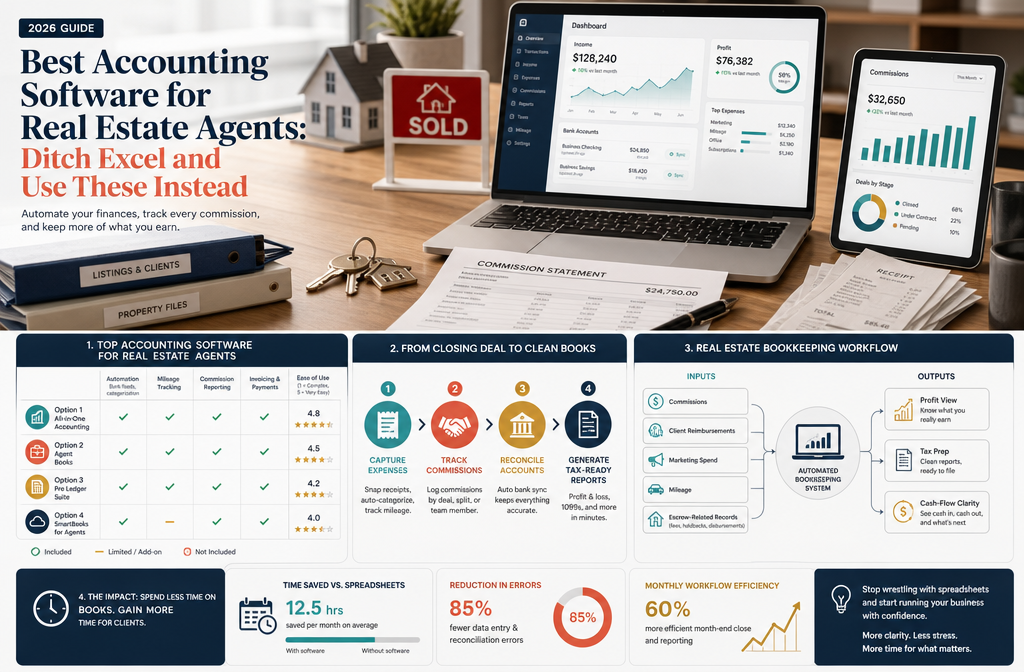
The best accounting software for real estate agents in 2026 falls into a few clear categories based on business size, budget, and whether you also manage investment properties.
Here’s the full breakdown:
🏆 Top Picks at a Glance
| Software | Best For | Starting Price | Real Estate-Specific? |
|---|---|---|---|
| QuickBooks Self-Employed | Independent agents, 1099 tracking | ~$15/month | No (but highly adaptable) |
| FreshBooks | Agents who invoice clients & teams | ~$19/month | No (but agent-friendly) |
| Wave Accounting | Budget-conscious solo agents | Free | No |
| Xero | Growing teams, multi-user access | ~$15/month | No (strong integrations) |
| Realtyzam | Real estate-specific bookkeeping | ~$9.95/month | Yes |
| Baselane | Agents who also own rentals | Free (core) | Yes (investor-focused) |
| AgentBooks | Commission-heavy agent workflows | Varies | Yes |
QuickBooks for Real Estate Agents
QuickBooks Self-Employed is the most widely used real estate agent accounting tool in the U.S., and for good reason. It connects directly to your bank and credit card accounts, auto-categorizes transactions, tracks mileage via the mobile app, and generates Schedule C reports your CPA will actually appreciate.
Where it shines:
- Automatic 1099 tracking for real estate agent income
- Mileage tracking built into the mobile app (huge for agents driving to showings)
- Estimated quarterly tax calculations so you’re not blindsided
- Separates personal vs. business expenses with a simple swipe
Where it falls short: QuickBooks Self-Employed doesn’t have deep commission split tracking out of the box. You’ll need to set up custom income categories manually.
Choose QuickBooks if: You’re an independent agent or solo realtor who wants the most trusted name in self-employed accounting with solid IRS-ready reporting.
FreshBooks
FreshBooks is a strong choice for real estate agents who work with teams, send invoices to clients or referral partners, and want a cleaner user experience than QuickBooks. It’s particularly useful if you’re managing transaction coordinator fees, referral invoices, or team billing.
Where it shines:
- Impeccable invoice and payment tracking
- Time tracking (useful for agents billing consulting hours)
- Expense receipt scanning via mobile
- Strong client communication tools built in
Choose FreshBooks if: You invoice clients, manage a small team, or want a more polished interface than QuickBooks.
Wave Accounting (Free)
Wave is 100% free for core accounting features — and it’s genuinely good. Bank syncing, income and expense tracking, and basic financial reports are all included at no cost. For a new agent or someone closing fewer than 10 deals a year, Wave is a fresh starting point that costs nothing.
The catch: Wave’s payroll and payment processing features cost extra, and it lacks real estate-specific commission tracking. But for basic real estate agent bookkeeping? It handles the job.
Choose Wave if: You’re just starting out, budget is tight, and you need something better than Excel without a monthly bill.
Xero
Xero is the accounting platform that scales. It’s used by growing real estate teams, small brokerages, and agents who have multiple income streams. The multi-user access, strong third-party integrations, and AI-powered transaction categorization make it a serious contender in 2026.
Where it shines:
- Connects with hundreds of apps including CRMs and property management tools
- Multi-user access for teams (great for brokerages)
- Strong reporting and cash flow dashboards
- AI bookkeeping features that auto-learn your expense patterns
Choose Xero if: You’re running a team, managing a brokerage, or want accounting software that grows with your business.
Realtyzam
Realtyzam is built specifically for real estate agents — and that specificity matters. It tracks commissions by transaction, logs expenses per deal, and generates reports formatted for real estate agent tax prep. It’s not the flashiest tool, but it’s so based for what agents actually need day to day.
Where it shines:
- Commission tracking per transaction (not just total income)
- Expense tracking tied to specific deals
- Real estate-specific expense categories pre-loaded
- Simple, clean interface designed for non-accountants
Choose Realtyzam if: You want purpose-built real estate agent accounting without the learning curve of a general platform.
Baselane and Stessa (For Agents Who Also Invest)
If you’re an agent who also owns rental properties, Baselane and Stessa are extraordinary tools. Both are built for real estate investors and offer free core features including rent collection, expense tracking, and property-level financial reporting.
For a deeper look at how these tools serve the investor side of your business, check out our guide to best accounting software for real estate investors.
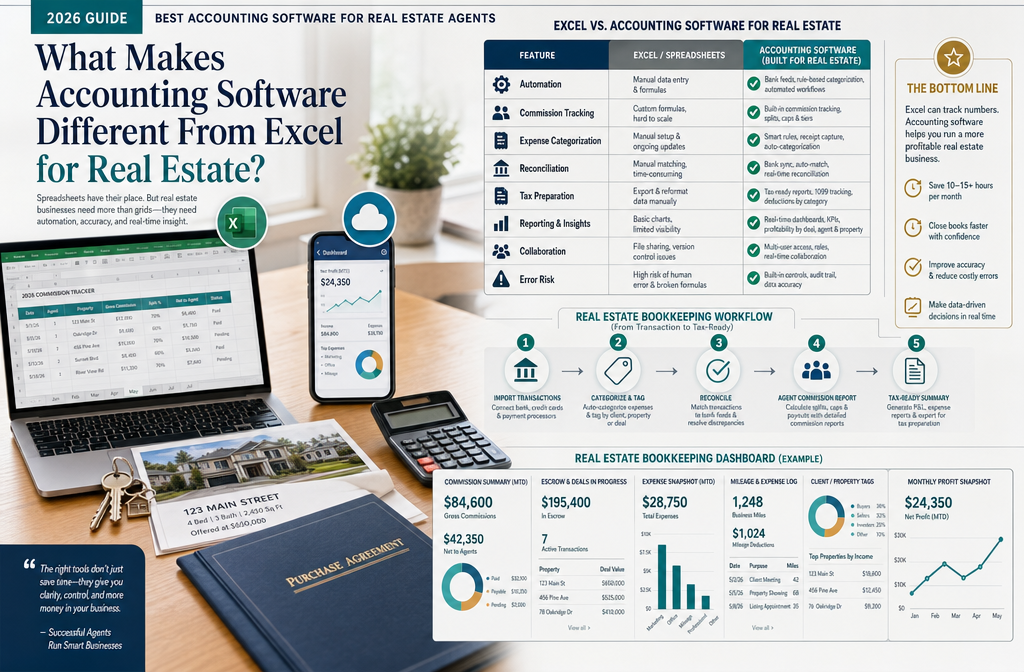
What Makes Accounting Software Different From Excel for Real Estate?
Accounting software is fundamentally different from Excel because it’s built to automate, verify, and report — not just store data.
Here’s the honest comparison:
| Feature | Excel | Accounting Software |
|---|---|---|
| Bank account sync | ❌ Manual entry | ✅ Automatic |
| Commission tracking | ❌ Manual formulas | ✅ Auto-categorized |
| Mileage tracking | ❌ You log it yourself | ✅ GPS-tracked via app |
| Tax calculations | ❌ You build the formulas | ✅ Automated |
| Schedule C prep | ❌ You do it manually | ✅ One-click reports |
| Audit trail | ❌ None | ✅ Built-in |
| Error detection | ❌ None | ✅ Flags inconsistencies |
| 1099 tracking | ❌ Manual | ✅ Automatic |
The difference isn’t just convenience — it’s accuracy. Real estate agent expense tracking in Excel relies entirely on human discipline. One missed entry, one wrong formula, and your tax return is wrong. Accounting software builds the guardrails in.
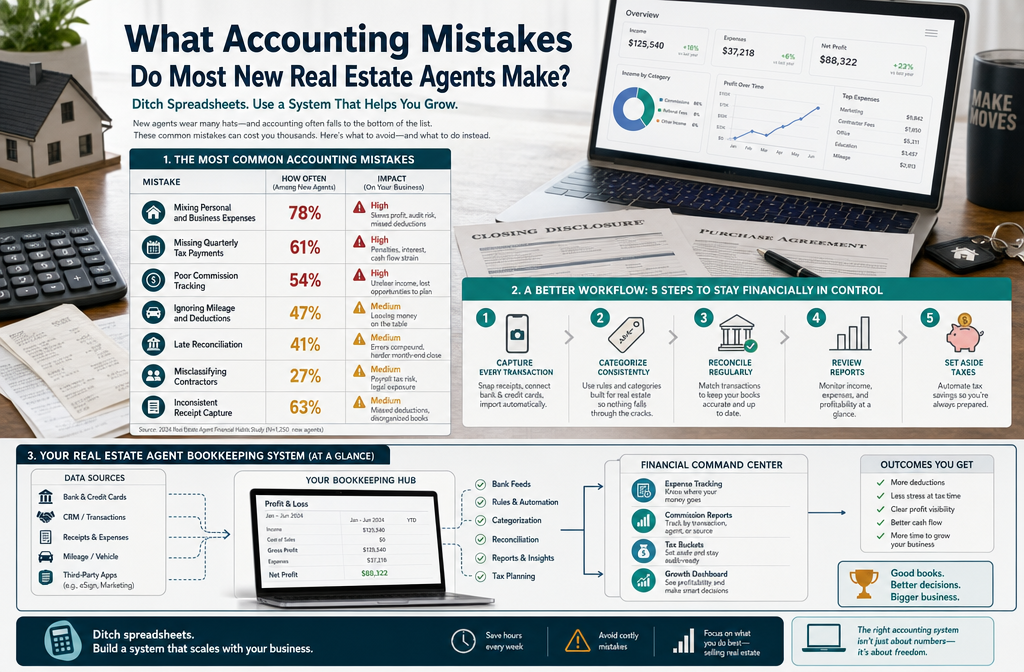
What Accounting Mistakes Do Most New Real Estate Agents Make?
The most common real estate agent accounting mistakes are mixing personal and business finances, missing deductible expenses, and failing to track mileage. These three errors alone can cost agents thousands of dollars every tax season.
The biggest offenders:
- No separate business bank account — mixing personal and business spending makes bookkeeping a nightmare and raises red flags with the IRS.
- Missing mileage deductions — the IRS standard mileage rate is one of the most valuable deductions for agents, and most agents underreport it because they’re not tracking in real time.
- Forgetting commission splits as income — your gross commission is your income, even if your broker takes a cut. The split is an expense. Many new agents get this wrong on their Schedule C.
- Not tracking referral fees paid — referral fees paid to other agents are deductible business expenses. Most agents don’t log them.
- Waiting until tax season to organize — doing 12 months of bookkeeping in February is how errors happen. Real estate accounting software runs in the background all year.
- Not setting aside self-employment tax — agents are responsible for both the employee and employer portions of Social Security and Medicare. That’s 15.3% on top of income tax. Not budgeting for it is a brutal surprise.
If you’re building your agent tech stack and want to avoid the tools that waste your time, our roundup of best real estate AI tools for agents covers the full picture.
Can I Track Commissions and Splits Automatically With These Tools?
Yes — several of the best accounting software options for real estate agents include automatic commission and split tracking, though the depth varies by platform.
Realtyzam is the strongest here. It’s built transaction-by-transaction, so you log each deal, record the gross commission, and enter the broker split as an expense. Reports show your net income per deal automatically.
QuickBooks Self-Employed handles commission tracking through custom income categories. You’ll set up “Gross Commission Income” as a category and “Broker Split” as an expense. It’s not automatic out of the box, but once configured, it runs smoothly.
AgentBooks is another real estate-specific platform designed around commission workflows, including split tracking, referral fee logging, and transaction-level reporting.
AI commission tracking is also emerging in 2026 — tools like QuickBooks and Xero now use machine learning to recognize recurring commission deposits and auto-categorize them without manual input. Let it cook before you see results with AI categorization — it takes 30 to 60 days of transaction history before the AI gets accurate.
Which Accounting Tools Integrate Best With Real Estate CRM Systems?
QuickBooks and Xero have the strongest CRM integration ecosystems for real estate agents in 2026. Both connect with major platforms through Zapier, direct API integrations, or native connectors.
If you’re using a CRM like Follow Up Boss or kvCORE, you can push deal data into your accounting software automatically when a transaction closes. That means no double-entry — the commission hits your CRM, and your accounting software picks it up.
For a full breakdown of which CRMs are worth connecting to, see our best CRM for real estate agents guide.
Integration quick reference:
- QuickBooks + Zapier → connects to 5,000+ apps including most real estate CRMs
- Xero + Zapier / API → strong multi-app ecosystem, works with transaction management tools
- FreshBooks → native integrations with Stripe, PayPal, and project tools; Zapier for CRM connections
- Wave → limited native integrations; Zapier available for workarounds
- Realtyzam → standalone platform, limited integrations (best used independently)
Is QuickBooks or FreshBooks Better for Real Estate Professionals?
QuickBooks is better for most real estate agents because of its self-employment tax tools, mileage tracking, and 1099 income reporting. FreshBooks is better if you frequently invoice clients, manage a team, or want a cleaner interface.
Choose QuickBooks if:
- You’re a solo agent or independent contractor
- You need quarterly estimated tax calculations
- Mileage tracking is a priority
- You want the most CPA-compatible reports
Choose FreshBooks if:
- You invoice referral partners, clients, or team members
- You manage a small team with multiple users
- You want time tracking alongside expense tracking
- You prefer a more modern, visual interface
Both are solid. Neither is a wrong answer. The real question is whether you need invoicing (FreshBooks wins) or self-employment tax automation (QuickBooks wins).
Do I Really Need Special Accounting Software If I Have Fewer Than 10 Deals a Year?
Yes — even agents closing fewer than 10 deals a year need proper accounting software. The IRS doesn’t have a “low volume” exemption, and the deductions available to real estate agents are significant regardless of deal count.
An agent closing 8 deals a year might still drive 8,000 to 12,000 miles for showings, open houses, and client meetings. At the 2026 IRS standard mileage rate, that’s a meaningful deduction — but only if it’s tracked and documented.
The math is simple:
- 10,000 miles × $0.67/mile (2024 IRS rate, verify current rate for 2026) = $6,700 in deductions
- Missing that deduction because you weren’t tracking = real money lost
Wave Accounting is free. Realtyzam is under $10/month. There’s no financial argument for staying in Excel when the cost of proper software is this low.
For agents who are also exploring investment properties alongside their agent income, our guide on how to invest in real estate with $5,000 or less shows how tracking income and expenses from both sides of the business becomes critical fast.
Which Accounting Software Works Best for Independent Agents Versus Large Brokerages?
Independent agents and solo realtors are best served by QuickBooks Self-Employed, Wave, or Realtyzam. Large brokerages and growing teams need multi-user platforms like Xero or QuickBooks Online (the full version, not Self-Employed).
For independent agents:
- Simple setup, low cost, minimal features needed
- Self-employment tax tools are the priority
- Mileage and expense tracking matter most
- Best picks: Realtyzam, Wave, QuickBooks Self-Employed
For teams and brokerages:
- Multi-user access is non-negotiable
- Payroll integration may be needed for W-2 staff
- Commission split reporting across multiple agents
- Integration with transaction management software
- Best picks: Xero, QuickBooks Online (Advanced), FreshBooks (Teams)
Brokerage owners managing agent rosters should also look at how their accounting software connects to their broader tech stack. Our breakdown of best real estate marketing automation platforms covers how these systems can work together.
What Features Should I Look for in Accounting Software as a Real Estate Agent?
The non-negotiable features for real estate agent accounting software are bank syncing, commission income tracking, expense categorization, mileage logging, and Schedule C or self-employment tax reporting.
Must-have features:
- ✅ Bank and credit card sync — automatic transaction import, no manual entry
- ✅ Commission income tracking — log gross commissions, net commissions, and splits
- ✅ Mileage tracking — GPS-based or manual log with IRS-compliant records
- ✅ Expense categorization — auto-sort expenses into IRS-recognized categories
- ✅ 1099 tracking — log all 1099-MISC income from brokerages and referral partners
- ✅ Schedule C reporting — generate the form your CPA needs at tax time
- ✅ Receipt capture — scan and attach receipts to transactions via mobile
Nice-to-have features:
- Quarterly estimated tax reminders
- Profit and loss reports by deal or time period
- CRM integration
- AI-powered transaction categorization
- Multi-user access for assistants or transaction coordinators
If you’re building out your full agent tech stack, pairing your accounting software with the right lead generation and marketing tools makes a real difference. See our picks for best real estate lead generation software to round out your setup.
Are There Accounting Tools Specifically Designed for Real Estate Transactions?
Yes — Realtyzam, AgentBooks, and Baselane are purpose-built for real estate professionals. These platforms understand the difference between gross commission income and net commission, how broker splits work, and how to categorize real estate-specific expenses.
Realtyzam is the most widely known real estate-specific accounting tool for agents. It organizes your books by transaction, tracks income and expenses per deal, and generates reports formatted for real estate agent tax prep.
AgentBooks is designed around commission workflows and is a strong option for agents who want transaction-level financial tracking without the learning curve of adapting a general platform.
Baselane and Stessa serve agents who also own investment properties — they’re built for real estate investors but work well for agents managing rental income alongside commission income.
The gatekeeping around “you need a CPA to handle this” is real, but so is the reality that having organized books going into that CPA meeting saves you money. Software does the organizing — your CPA does the strategy.
How Complicated Is It to Switch From Spreadsheets to Real Estate Accounting Software?
Switching from Excel to accounting software is easier than most agents expect. The setup process for most platforms takes between two and four hours, and the ongoing time investment drops significantly once automation kicks in.
Step-by-step transition process:
- Choose your platform — pick from the options above based on your deal volume and budget
- Open a dedicated business bank account (if you haven’t already) — this is step zero
- Connect your bank and credit card accounts — most platforms sync in minutes
- Set your fiscal year start date — use January 1 or your license date
- Import or manually enter year-to-date transactions — most platforms let you import CSV files from your bank
- Set up income categories — create categories for gross commissions, referral income, and other revenue
- Set up expense categories — MLS fees, E&O insurance, marketing, mileage, office supplies, continuing education
- Run your first report — a basic P&L to confirm everything imported correctly
- Set up mileage tracking on the mobile app
- Schedule a monthly 30-minute bookkeeping session — this is how you stay current
The learning curve is real but short. Most agents feel comfortable within two weeks. The AI categorization features in QuickBooks and Xero get smarter over time — let it cook before you see results, because the first 30 days are the roughest.
What’s the Learning Curve Like for Real Estate Accounting Software?
The learning curve for real estate accounting software ranges from minimal (Wave, Realtyzam) to moderate (QuickBooks, Xero). None of these platforms require accounting knowledge to use effectively.
By platform:
- Wave — easiest. Designed for non-accountants. Most agents are functional within an hour.
- Realtyzam — easy. Real estate-specific layout means less setup and fewer confusing options.
- FreshBooks — easy to moderate. Clean interface, but invoicing features add some complexity.
- QuickBooks Self-Employed — moderate. More features means more to configure, but the mobile app is intuitive.
- Xero — moderate to advanced. Most powerful, but also the steepest curve. Best for agents with a bookkeeper or tech-savvy transaction coordinator.
Pro tip: Every platform on this list has free tutorial libraries and YouTube walkthroughs. Before paying for onboarding help, spend 90 minutes watching the official tutorials. Most agents find they don’t need more than that.
How Much Does Professional Accounting Software Cost for Realtors?
Real estate agent accounting software costs between $0 and $50 per month for most agents in 2026. Here’s the realistic pricing breakdown:
| Platform | Monthly Cost (2026 estimate) | Free Trial |
|---|---|---|
| Wave | Free (core features) | N/A |
| Realtyzam | ~$9.95/month | 30-day free trial |
| QuickBooks Self-Employed | ~$15/month | 30-day free trial |
| Xero (Starter) | ~$15/month | 30-day free trial |
| FreshBooks (Lite) | ~$19/month | 30-day free trial |
| QuickBooks Online | ~$35–$90/month | 30-day free trial |
| Baselane | Free (core) | N/A |
Prices are estimates based on publicly available 2026 pricing. Always verify current pricing directly with the provider.
For context: a CPA charging to clean up a year of disorganized books typically bills $150 to $300+ per hour. One month of disorganization can cost more than a full year of accounting software.
AI Bookkeeping for Real Estate Agents in 2026: What’s Actually Useful
AI bookkeeping tools are no longer a novelty — they’re now standard features inside the platforms agents already use. In 2026, AI commission tracking, AI mileage tracking, and AI tax deduction identification are built into QuickBooks, Xero, and FreshBooks.
What AI actually does in these tools:
- Auto-categorizes transactions — machine learning recognizes your MLS fee, your E&O insurance, your marketing spend, and sorts them without input
- Flags potential deductions — surfaces expenses that might qualify as business deductions you didn’t tag
- Predicts cash flow — some platforms (Xero, QuickBooks Online) now forecast your next 30 to 90 days based on historical patterns
- AI mileage tracking — apps like MileIQ (which integrates with QuickBooks) use AI to detect when you’re driving for business vs. personal trips
- Receipt matching — AI matches uploaded receipts to existing transactions automatically
What AI still can’t do: Replace your CPA for tax strategy, handle complex commission structures without setup, or catch errors if your bank sync is broken.
The AI bookkeeping real estate tools of 2026 are extraordinary at reducing the manual work — but they’re a starting point, not a finish line. You still need to review your books monthly.
For a broader look at how AI is changing the agent workflow, our guide to best AI tools for real estate agents breaks down what’s worth paying for and what’s just noise.
FAQ: Best Accounting Software for Real Estate Agents
Q: What is the best free accounting software for real estate agents?
Wave Accounting is the best free option for real estate agents in 2026. It includes bank syncing, income and expense tracking, and basic reporting at no cost. Baselane is also free for agents who own rental properties.
Q: Do real estate agents need to file a Schedule C?
Yes. Most real estate agents are classified as self-employed independent contractors and file Schedule C (Profit or Loss from Business) with their personal tax return. Accounting software like QuickBooks Self-Employed generates Schedule C-ready reports automatically.
Q: Can accounting software track my broker commission splits?
Yes. Realtyzam and AgentBooks handle this natively. QuickBooks and Xero can track splits through custom income and expense categories. You log the gross commission as income and the broker split as a business expense.
Q: Is mileage tracking included in real estate accounting software?
Most platforms include mileage tracking via their mobile app. QuickBooks Self-Employed has one of the best built-in mileage trackers — it uses your phone’s GPS to log trips and lets you swipe to classify each one as business or personal.
Q: How do I track 1099 income as a real estate agent?
Log each commission payment as income in your accounting software, tagged with the paying brokerage or company. QuickBooks Self-Employed automatically totals your 1099 income and compares it against what you’ve logged. Discrepancies are flagged before tax time.
Q: What’s the difference between QuickBooks Self-Employed and QuickBooks Online for agents?
QuickBooks Self-Employed is designed for solo independent contractors — simpler, cheaper, and focused on Schedule C prep and mileage. QuickBooks Online is for businesses with employees, multiple income streams, or teams. Most solo agents start with Self-Employed and upgrade to Online as they grow.
Q: Can my transaction coordinator use the same accounting software?
Yes — Xero, FreshBooks, and QuickBooks Online all support multi-user access. You can give your transaction coordinator view or edit access without sharing your full account credentials.
Q: Is Realtyzam worth it compared to QuickBooks?
Realtyzam is worth it if you want a real estate-specific tool with zero learning curve. QuickBooks is worth it if you want broader features, stronger integrations, and more CPA-friendly reporting. Many agents start with Realtyzam and migrate to QuickBooks as their business grows.
Q: How do I handle real estate agent accounting if I work in multiple states?
Use a platform like Xero or QuickBooks Online that supports multi-state income tracking and allows you to tag transactions by state. Consult a CPA familiar with multi-state self-employment tax rules — software handles the tracking, but the tax strategy needs a human.
Q: What expenses can real estate agents deduct on their taxes?
Common deductible expenses include MLS fees, E&O insurance, marketing and advertising, mileage, continuing education, office supplies, home office (if applicable), professional memberships, and referral fees paid. Accounting software with real estate-specific categories pre-loads most of these for you.
Q: Can I use accounting software to manage both my agent income and rental property income?
Yes — Baselane and Stessa are built for exactly this. For a deeper breakdown, see our guide on best accounting software for real estate investors.
Q: How long does it take to set up real estate accounting software?
Most agents complete the initial setup — bank connections, income categories, expense categories, and opening balances — in two to four hours. The AI categorization improves over the first 30 to 60 days as it learns your transaction patterns.
Conclusion: Stop Gatekeeping Yourself From Better Tools
The best accounting software for real estate agents isn’t a luxury — it’s the foundation of a sustainable business. Excel was never built for this. It doesn’t know what a commission split is, it can’t track your mileage to that 7 AM showing, and it definitely won’t remind you to set aside self-employment tax before you spend it.
The tools covered in this guide — QuickBooks, FreshBooks, Wave, Xero, Realtyzam, and Baselane — are accessible, affordable, and genuinely built for how agents earn money. Most cost less per month than a tank of gas.
Your next steps:
- Open a dedicated business checking account if you don’t have one — this is the foundation of clean books.
- Pick one platform from this guide based on your deal volume and budget. Don’t overthink it — Wave if you’re cost-sensitive, Realtyzam if you want real estate-specific, QuickBooks if you want the most complete self-employment toolkit.
- Connect your bank account and let the software import your last 90 days of transactions.
- Set up your income and expense categories — commissions in, broker splits and MLS fees out.
- Download the mobile app and turn on mileage tracking today.
- Block 30 minutes per month for a bookkeeping review — that’s all it takes to stay current.
The agents running impeccable financial systems aren’t spending more time on accounting — they’re spending less, because the software does the work. That’s the whole point.
For more tools to build your agent business, explore our full real estate software and tools resource hub — it’s updated regularly with fresh picks and honest reviews.
Tags: best accounting software for real estate agents, real estate agent bookkeeping, commission tracking software, QuickBooks for real estate agents, FreshBooks, Wave Accounting, Realtyzam, real estate tax software, mileage tracking for agents, 1099 tracking real estate, self-employed agent accounting, realtor accounting tools