


Last updated: May 24, 2026

Quick Answer: Real estate drip email templates are pre-written, automated email sequences sent to leads over days, weeks, or months to maintain contact and build trust until they're ready to buy or sell. The best templates are personalized, value-driven, and timed strategically — not blasted out like a mass newsletter. When done right, a well-built drip sequence is one of the most cost-effective tools an agent has for converting cold leads into closings.
Key Takeaways
- Most real estate leads need 6–18 months of nurturing before they're ready to transact — drip emails keep you top of mind without requiring daily manual effort.
- Buyer, seller, and past client drip sequences each require different messaging, timing, and content angles.
- Platforms like Follow Up Boss, kvCORE, ActiveCampaign, Lofty, and Wise Agent offer built-in real estate email automation — some free, some paid.
- AI email writing tools in 2026 are making personalization faster and more impactful — agentic AI can now write and send context-aware follow-ups automatically.
- The biggest mistake agents make is sending too many promotional emails and not enough value-first content.
- Email cadence matters: 1–2 emails per week is the sweet spot for most lead types. More than that and you risk unsubscribes.
- Drip email templates for luxury markets need a different tone and content strategy than those targeting first-time buyers.
- CAN-SPAM and CASL compliance is non-negotiable — always include an unsubscribe link and your physical business address.
- Free tools like Mailchimp and ConvertKit can run solid drip campaigns for agents just starting out.
- The agents who win with email aren't the ones sending the most — they're the ones sending the right message at the right time.
What Are Real Estate Drip Email Templates That Keep Leads Warm?
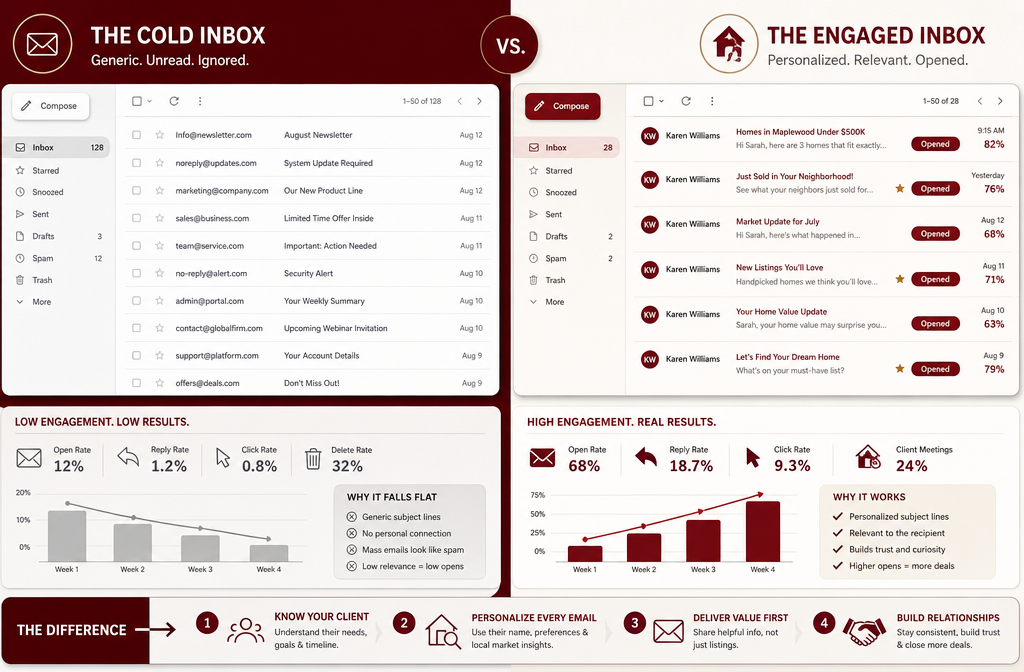
Real estate drip email templates are a series of pre-written emails sent automatically to leads on a set schedule, designed to maintain a relationship and move prospects closer to a transaction. Think of it as the email version of staying in someone's orbit — you're not chasing them, you're just consistently showing up with something useful.
The term "drip" comes from the idea of slowly dripping water — consistent, measured, and patient. That patience is exactly what separates agents who close leads from agents who lose them to a competitor who simply followed up better.
Here's why this matters in 2026: According to the National Association of Realtors (NAR), one of the top pain points agents report is inconsistent lead follow-up. Most leads don't convert in the first week. They convert months later — and whoever stayed in touch is the one who gets the call.
A solid real estate drip email template system covers:
- Initial response emails (within the first 5 minutes of a lead coming in)
- Nurture sequences (weeks 1–8 of ongoing contact)
- Long-term follow-up emails (months 3–18 for leads not yet ready)
- Re-engagement emails (for cold leads that went quiet)
- Post-closing sequences (to turn clients into referral machines)
This isn't gatekeeping — this is the exact system top-producing agents use while newer agents wonder why their leads go cold. Let it cook, and the results will come.
Best Real Estate Drip Email Templates for First-Time Homebuyers
First-time homebuyer drip sequences work best when they lead with education, not sales pressure. These leads are often overwhelmed, unsure about financing, and nervous about making a mistake — so your job is to be the calm, knowledgeable guide they didn't know they needed.
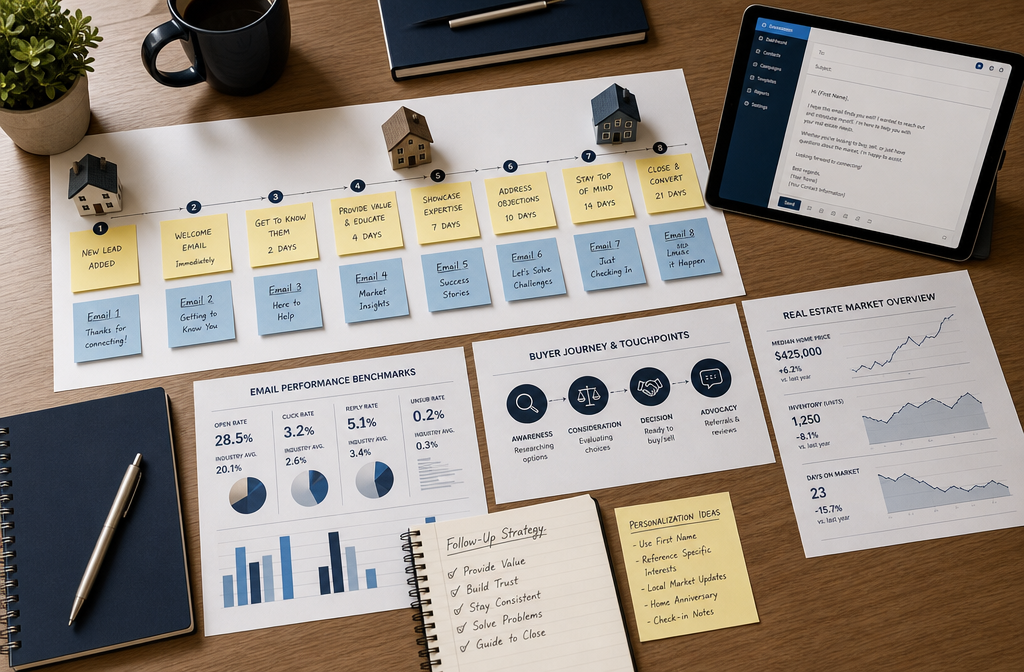
Here's a proven 6-email buyer drip sequence structure:
| Email # | Timing | Subject Focus |
|---|---|---|
| 1 | Immediately | Welcome + what to expect from you |
| 2 | Day 3 | How to get pre-approved (link to a lender you trust) |
| 3 | Day 7 | What to look for in a neighborhood |
| 4 | Day 14 | Common first-time buyer mistakes to avoid |
| 5 | Day 21 | Current market snapshot for their target area |
| 6 | Day 30 | Soft check-in: "Where are you in your search?" |
Sample Email #1 — Welcome Template:
Subject: You asked about [City] homes — here's what's next
Hey [First Name],
Thanks for reaching out! I work with a lot of first-time buyers in [City], and I know the process can feel like a lot at first.
Here's the short version: I'm going to send you a few quick emails over the next few weeks with tips that actually help — no fluff, no pressure.
When you're ready to talk, I'm one reply away. Until then, here's a quick look at what homes are doing in [Neighborhood] right now: [Market Update Link]
Talk soon,
[Your Name]
For more on how to pair this with the right platform, check out our breakdown of email marketing for real estate agents and top platforms compared.
Pro tip: Include a link to a first-time home buyer guide in your early emails. It positions you as a resource, not just a salesperson.
How Much Do Professional Real Estate Email Marketing Templates Cost?
Professional real estate email templates range from completely free to several hundred dollars per month, depending on the platform and level of customization. Here's the honest breakdown:
Free options:
- Mailchimp — Free up to 500 contacts, includes basic automation
- ConvertKit — Free plan includes limited sequences and landing pages
- Constant Contact — Offers a free trial; paid plans start around $12/month
CRM-included templates (paid):
- Wise Agent — Around $49/month, includes pre-built real estate drip campaigns
- kvCORE — Brokerage pricing varies; includes a full library of real estate email templates
- Follow Up Boss — Starts around $69/month per user; strong drip campaign builder
- Lofty (formerly Chime) — Mid-to-high tier pricing; AI-powered nurture sequences included
- ActiveCampaign — Starts around $15/month; highly customizable automation
Done-for-you template packs:
Marketplaces like Etsy and real estate coaching sites sell pre-written drip sequence packs for $25–$200. Quality varies wildly — some are extraordinary, some are recycled junk from 2015.
The real cost isn't the template — it's the platform. Most agents underestimate the value of a CRM that integrates email automation directly with their lead sources. If you're serious about scaling, investing in a real CRM is worth it.
See our full comparison of the best email marketing software for real estate agents to find the right fit for your budget and volume.
Why Aren't My Real Estate Drip Emails Converting Leads?
If your drip emails aren't converting, the problem is almost always one of three things: the wrong message, the wrong timing, or a lack of personalization. Generic emails that could have been sent by any agent in any city are the #1 conversion killer.
Here's what's likely going wrong:
❌ You're leading with "I" instead of "You"
Emails that open with "I wanted to reach out…" or "I've been in real estate for 15 years…" immediately signal that the email is about you, not the lead. Flip it. Start with their situation.
❌ Your subject lines are boring
"Checking in" and "Following up" are the two most ignored subject lines in real estate email history. Try something specific: "3 homes under $400K just listed in [Neighborhood]" performs significantly better.
❌ You're sending too much too fast
Blasting five emails in the first week feels like a car dealership, not a trusted advisor. Slow down. Let it cook before you see results.
❌ You're not segmenting your list
Buyers and sellers need completely different email content. Sending a seller-focused email to a buyer lead (or vice versa) signals that you're not paying attention.
❌ Your call-to-action is too aggressive
"Are you ready to buy?" in email #2 is too much. Build trust first. The CTA in early emails should be low-commitment: "Reply with any questions," or "Click here to see what's sold recently."
✅ What actually works:
- Hyper-local content (neighborhood stats, school ratings, local business openings)
- Value-first structure (give before you ask)
- Consistent cadence (same day and time each week builds habit)
- A real human voice — not corporate copy
Are Email Templates Different for Luxury vs. Starter Home Markets?
Yes — and the difference is more significant than most agents realize. Luxury buyers and sellers expect a completely different tone, pace, and content style compared to first-time or move-up buyers.
Luxury market email templates:
- Tone: Sophisticated, understated, exclusive
- Content: Off-market opportunities, architectural highlights, lifestyle-focused storytelling
- Cadence: Less frequent (bi-weekly or monthly is often better)
- Personalization: Extremely high — generic templates are a red flag at this price point
- Subject lines: "A rare opportunity in [Prestigious Neighborhood]" vs. "New listings this week"
Starter/first-time buyer email templates:
- Tone: Warm, approachable, educational
- Content: Financing tips, neighborhood guides, step-by-step process breakdowns
- Cadence: More frequent early on (weekly during active search phase)
- Personalization: Name + location-specific data is enough to feel personal
- Subject lines: "How much home can you afford in [City]?" — direct and practical
The core rule: Match the energy of the buyer. A luxury client receiving a template that looks like it was built for a first-time buyer will lose confidence in you immediately. That's not just a missed email — that's a missed commission.
For agents working across both segments, build two separate drip sequences and tag leads accordingly in your CRM. Platforms like Follow Up Boss and kvCORE make this straightforward with tagging and smart lists.
Can I Use Drip Email Templates for Commercial Real Estate Leads Too?
Drip email templates absolutely work for commercial real estate leads — but the sequences need to be rebuilt from scratch, not recycled from residential campaigns. Commercial leads operate on longer decision timelines, have different motivations, and respond to different content entirely.
Key differences for commercial real estate drip sequences:
- Timeline: Commercial deals can take 12–36 months from first contact to closing. Your sequence needs to reflect that patience.
- Content: Cap rates, NOI analysis, zoning updates, market vacancy rates, and investment return data — not neighborhood school ratings.
- Decision-makers: You may be emailing multiple stakeholders (investors, CFOs, business owners). Segment accordingly.
- Tone: More formal and data-driven than residential. These leads want numbers, not lifestyle copy.
Sample commercial drip sequence structure:
- Day 1: Introduction + your commercial market expertise
- Day 5: Recent commercial sale comparable in their target area
- Day 14: Market vacancy rate update for their asset class
- Day 30: Case study or success story (anonymized)
- Monthly: Market report with cap rate trends
For a broader look at building your commercial pipeline, our guide on top ways to generate commercial real estate leads pairs well with any drip strategy you're building.

What Mistakes Do Realtors Make With Automated Email Campaigns?
The most common mistake realtors make with automated email campaigns is "set it and forget it" thinking — building a sequence once, never updating it, and wondering why engagement tanks after six months. Automation is a tool, not a replacement for strategy.
Here are the mistakes we see most often — and they're so based on avoidable patterns it's almost painful:
1. Not personalizing beyond the first name
Merge tags for first name are table stakes. The agents winning with email automation in 2026 are pulling in neighborhood-specific data, recent search behavior, and price range preferences into their templates.
2. Skipping the seller drip sequence entirely
Most agents build a buyer drip sequence and stop there. Seller leads need their own real estate nurture sequence — focused on home value trends, market timing, and what your listing process looks like.
3. Ignoring past client sequences
The past client drip sequence is the most underused tool in real estate email marketing. A simple quarterly check-in with a home value update keeps you top of mind for referrals and repeat business. This is not gatekeeping — this is just good business.
4. No re-engagement strategy
Leads go quiet. That's normal. But most agents just let them die in the CRM. A well-timed re-engagement email ("Hey, I know it's been a while — the market in [City] has shifted a lot since we last talked. Want an update?") can revive leads that went cold months ago.
5. Violating email compliance rules
More on this below — but skipping unsubscribe links or sending from a personal Gmail without proper setup is a compliance risk that can get your domain flagged.
For a deeper look at automation strategy, our real estate marketing automation guide covers the full picture.
Which Email Template Works Best for Cold Real Estate Leads?
For cold real estate leads — people who signed up for a home search but haven't responded to any outreach — the best-performing template is a short, low-pressure, curiosity-driven email that asks one simple question.
Cold leads are not ready to buy or sell yet. They're browsing. Your job is to stay in their peripheral vision without being annoying about it.
The "One Question" template for cold leads:
Subject: Quick question about your [City] search
Hey [First Name],
I noticed you've been looking at homes in [Neighborhood]. Just one question — are you thinking about moving in the next 6 months, or more like 12+?
No pressure either way. Just helps me send you the right info.
[Your Name]
This works because:
- It's short (cold leads don't read long emails)
- It asks for minimal commitment
- It signals that you're paying attention
- The response tells you exactly how to follow up
What doesn't work on cold leads:
- Long emails with multiple CTAs
- Market reports with heavy data (save those for warm leads)
- "Just checking in" subject lines
- Anything that sounds like a mass blast
The real estate email cadence for cold leads should be light: one email every 2–3 weeks for the first 90 days, then monthly after that. Patience is the strategy here.
How Often Should I Send Drip Emails Without Annoying Potential Clients?
The right email cadence for real estate leads is 1–2 emails per week during active search phases, dropping to bi-weekly or monthly for long-term nurture. Sending more than twice a week to someone who hasn't responded is the fastest way to earn an unsubscribe.
Here's a practical real estate email cadence guide by lead type:
| Lead Type | First 30 Days | Days 31–90 | 90+ Days |
|---|---|---|---|
| Hot buyer (pre-approved, active search) | 2x/week | 1x/week | Bi-weekly |
| Warm buyer (interested, not pre-approved) | 1x/week | Bi-weekly | Monthly |
| Cold buyer (early research phase) | 1x/week | Every 2–3 weeks | Monthly |
| Seller lead | 1x/week | Bi-weekly | Monthly |
| Past client | Quarterly | Quarterly | Quarterly |
| Commercial lead | 1x/week | Bi-weekly | Monthly |
The golden rule: Every email should earn the next one. If you're not giving the reader something useful — a market update, a tip, a relevant listing — you're just burning goodwill.
Also worth noting: day and time matter. Tuesday through Thursday mornings (8–10 AM local time) consistently outperform Friday afternoons and Monday mornings for open rates in most email marketing studies.
Do Email Templates Work Differently for Buyers Versus Sellers?
Buyer and seller drip sequences are fundamentally different in content, tone, and timing — and mixing them up is one of the most common (and costly) mistakes in real estate email marketing.
Buyer drip sequence focus:
- Property alerts and new listings
- Financing education (mortgage types, down payment options)
- Neighborhood guides and school data
- Inspection and offer process walkthroughs
- Market timing advice ("Is now a good time to buy in [City]?")
Seller drip sequence focus:
- Home value trends in their specific zip code
- What's selling and at what price per square foot
- How to prepare a home for sale (staging, repairs, curb appeal)
- Your listing process and what makes it different
- Tax implications of selling (capital gains basics)
The key difference in tone:
Buyers are in "learning mode" — they want education and reassurance. Sellers are in "decision mode" — they want data and confidence. Your email copy needs to match that energy.
A seller who receives a "first-time buyer tips" email from you will immediately sense that you're not paying attention. That's not impeccable service — that's a missed opportunity.
For agents building out a full seller strategy, our resource on 15 real estate prospecting ideas to boost your GCI complements a seller drip sequence well.
What Free Real Estate Email Marketing Tools Can I Use?
Several free tools can run effective real estate drip email templates without costing anything upfront. The tradeoff is usually contact limits, branding restrictions, or limited automation depth.
Best free options in 2026:
Mailchimp (Free tier)
- Up to 500 contacts, 1,000 emails/month
- Basic automation included
- Good template builder
- Limitation: Mailchimp branding on emails; limited segmentation
ConvertKit (Free plan)
- Up to 1,000 subscribers
- Visual automation builder
- Clean, minimal email design (great for a personal brand)
- Limitation: No advanced segmentation on free plan
Constant Contact (Free trial)
- 60-day free trial
- Strong template library
- Good for agents who want a polished look fast
- Limitation: Reverts to paid after trial
HubSpot CRM (Free tier)
- Includes basic email sequences
- Integrates with their free CRM
- Good for agents building a contact database from scratch
What free tools can't do:
- Deep CRM integration with your MLS or lead sources
- Automated property alerts tied to email sequences
- AI-powered personalization at scale
Once you're managing more than 200–300 active leads, a paid platform becomes worth the investment. Check out our full guide to the best real estate lead generation software for a complete comparison.
Are Drip Email Templates Legal and Compliant With Real Estate Regulations?
Yes, drip email templates are legal — but they must comply with CAN-SPAM (U.S.), CASL (Canada), and GDPR (EU) regulations, depending on where your leads are located. Non-compliance can result in fines and domain blacklisting.
CAN-SPAM compliance checklist for real estate agents:
- ✅ Include your physical business address in every email
- ✅ Use a clear, non-deceptive subject line
- ✅ Identify the email as commercial (no deceptive "from" names)
- ✅ Include a visible, functional unsubscribe link
- ✅ Honor unsubscribe requests within 10 business days
- ✅ Don't use harvested or purchased email lists without consent
Additional real estate-specific considerations:
- NAR's Code of Ethics applies to digital communications — misleading market claims in emails can be an ethics violation
- Some states have additional disclosure requirements for agent emails (check your state's real estate commission guidelines)
- If you're emailing leads from a third-party lead gen source, confirm that those leads have opted in to receive communications
CASL (Canada): Requires explicit consent before sending commercial emails. If you work with Canadian buyers or sellers, you need documented opt-in records.
The compliance piece isn't complicated — it's mostly about having the right infrastructure in your email platform. Every major platform (Mailchimp, ActiveCampaign, Constant Contact, Follow Up Boss) handles the technical compliance pieces automatically when set up correctly.

How Do Top Real Estate Agents Personalize Their Email Automation in 2026?
Top agents in 2026 are using AI email writing tools and agentic AI systems to personalize drip emails at a scale that would have been impossible manually just two years ago. The days of "Dear [First Name]" being enough personalization are over.
What AI-powered personalization looks like now:
Dynamic content blocks — Platforms like ActiveCampaign and Lofty can swap out entire sections of an email based on lead behavior. A lead who clicked on a condo listing gets condo-focused content. A lead who downloaded a seller guide gets seller-focused follow-ups.
AI email writing for real estate in 2026 — Tools like ChatGPT, Claude, and built-in AI writers in platforms like Follow Up Boss are being used to generate fresh, hyper-local email copy on demand. An agent can prompt: "Write a 150-word email for a first-time buyer lead in Phoenix who's been searching for 3 months and hasn't responded in 6 weeks" — and get a usable draft in seconds.
Agentic AI real estate emails — This is the fresh frontier. Agentic AI systems (like those being built into Lofty and kvCORE) can monitor lead behavior, decide when to send an email, write a context-aware message, and send it — all without the agent touching anything. It's extraordinary what these systems are starting to do.
AI nurture sequences — Instead of static pre-written sequences, AI can now generate personalized email content based on real-time market data, the lead's search history, and their engagement patterns.
For agents who want to stay ahead of this curve, our guide to AI tools real estate agents are sleeping on is a must-read.
What Email Content Keeps Real Estate Leads Engaged Without Being Pushy?
The email content that keeps real estate leads engaged long-term is hyper-local, genuinely useful, and asks for nothing in return. The moment your emails start feeling like ads, engagement drops.
Content that consistently performs well:
- "Just sold" updates in their target neighborhood (social proof + market data in one)
- Monthly market snapshots — median price, days on market, inventory levels for their zip code
- Neighborhood spotlights — new restaurants, school rating changes, development news
- Seasonal home tips — relevant, practical, non-salesy
- Client success stories (brief, anonymized) — shows you get results without bragging
- Rate update emails — when mortgage rates shift meaningfully, a short email noting the change and what it means for their buying power is genuinely valuable
- "You might have missed this" listing alerts — curated, not automated spam
What to avoid:
- "I have buyers looking in your area!" (overused, feels manipulative)
- Listing presentations sent to cold leads (way too early)
- Anything that leads with your awards, years in business, or production numbers
- Emojis in every subject line (a few is fine; every email looks desperate)
The agents with impeccable email engagement treat their list like a community, not a sales funnel. That mindset shift changes everything about how you write.

FAQ: Real Estate Drip Email Templates
Q: How many emails should be in a real estate drip sequence?
A buyer drip sequence typically runs 8–12 emails over 90 days for active leads, then transitions to a long-term monthly sequence. Seller sequences are usually 6–10 emails. Past client sequences are quarterly — 4 emails per year is enough to stay relevant.
Q: What's the best subject line for a real estate drip email?
Specific, curiosity-driven subject lines outperform generic ones. "3 homes under $350K just listed in [Neighborhood]" beats "Monthly Update" every time. Keep subject lines under 50 characters for mobile readability.
Q: Can I use the same drip templates as another agent at my brokerage?
Technically yes, but you shouldn't. Templates shared across a brokerage quickly become recognizable and lose their personal feel. Customize at minimum the tone, local references, and your specific value proposition.
Q: How do I know if my drip emails are working?
Track open rate, click rate, and reply rate — not just unsubscribes. A healthy real estate email open rate is around 20–30%. Click rates above 3–5% indicate strong content relevance. Reply rates, even at 1–2%, signal genuine engagement.
Q: Should I send drip emails from my personal email or a platform?
Always use a dedicated email marketing platform. Sending bulk emails from Gmail or Outlook risks your domain being flagged as spam, which can affect all your business emails. Platforms like Mailchimp, ActiveCampaign, and Follow Up Boss handle deliverability properly.
Q: What's the difference between a drip campaign and a nurture sequence?
They're often used interchangeably, but technically: a drip campaign is time-based (emails go out on a fixed schedule regardless of behavior), while a nurture sequence is behavior-triggered (emails respond to what the lead does — clicks, opens, visits). The best systems combine both.
Q: Do real estate drip emails work for rental leads?
Yes, but the content needs to shift. Rental leads want neighborhood info, pet policies, and move-in cost breakdowns — not mortgage tips. If your business includes property management or rental referrals, build a separate sequence for this segment.
Q: How do I build a drip sequence if I'm brand new and have no content?
Start with three emails: a welcome, a market update, and a soft check-in. That's enough to begin. Build from there as you learn what your leads respond to. Don't wait for a perfect 12-email sequence before you start — done beats perfect every time.
Q: Is it worth hiring someone to write my real estate drip emails?
For agents closing 20+ transactions per year, yes — the ROI is clear. For newer agents, use AI tools to draft templates, then edit them in your own voice. The combination of AI speed and human authenticity is the sweet spot in 2026.
Q: What CRM is best for running real estate drip email campaigns?
Follow Up Boss and kvCORE are the most popular among high-volume agents. For smaller teams or solo agents, Wise Agent offers solid drip functionality at a lower price point. See our kvCORE vs Follow Up Boss comparison for a detailed breakdown.
Conclusion: Build the Sequence, Then Let It Cook
Real estate drip email templates that keep leads warm aren't magic — they're a system. And like any good system, they require the right tools, the right content, and enough patience to let the results build over time.
Here's your action plan:
- Segment your leads — buyers, sellers, past clients, cold leads, and commercial prospects each need their own sequence.
- Choose the right platform — match your budget and volume to the right tool (free options work for under 300 contacts; invest in a CRM as you scale).
- Build your core sequences first — start with a buyer drip and a seller drip. Add past client and re-engagement sequences next.
- Personalize beyond the first name — use neighborhood data, price range, and lead behavior to make emails feel 1:1.
- Test your subject lines — run A/B tests on at least 20% of your list to find what resonates.
- Stay compliant — unsubscribe links, physical address, and honest subject lines are non-negotiable.
- Layer in AI — use AI email writing tools to speed up content creation and start exploring agentic AI platforms as they mature.
The agents who dominate their markets in 2026 aren't the ones with the biggest ad budgets. They're the ones with the most consistent, impeccable follow-up systems. Real estate drip email templates are how you build that consistency — one well-timed email at a time.
For more on building a complete agent tech stack that supports your email strategy, explore our guide to marketing automation for real estate agents and see exactly where drip email fits into the bigger picture.
Have questions about building your drip sequence? Reach us at news@realestaterankiq.com or follow us @realestaterankiq for fresh real estate agent resources every week.
Tags: real estate drip email templates, email marketing for real estate agents, buyer drip sequence, seller drip sequence, real estate nurture sequence, real estate email automation, Follow Up Boss, ActiveCampaign, kvCORE, real estate lead follow-up, AI email writing real estate, real estate email cadence










Comments 1