


Last updated: April 23, 2026

Quick Answer: The best email marketing software for real estate agents in 2026 depends on your workflow. ActiveCampaign wins for automation depth, Mailchimp for budget-conscious solo agents, Constant Contact for ease of use, and CRM-native tools like Wise Agent or kvCORE for agents who want everything under one roof. Every agent on this list can build drip sequences, send listing alerts, and nurture cold leads — the difference is how much setup time and budget you're willing to invest.
Key Takeaways
- Email marketing for real estate agents consistently delivers higher ROI than social media for lead nurturing — because you own the list [10]
- The right platform depends on three things: database size, automation needs, and whether you already use a CRM
- Behavioral automation (triggered by link clicks, property views, or form fills) produces 5–10X higher engagement than standard email blasts [source: Boldtrail, April 2026]
- Real estate drip sequences should be structured separately for buyers, sellers, and past clients — one-size-fits-all sequences kill conversions
- Free tiers from Brevo and MailerLite work well for new agents; paid CRM-integrated tools pay off as your database grows [7]
- Commercial real estate email marketing requires a completely different tone, cadence, and content strategy than residential
- Subject lines under 50 characters with a local hook consistently outperform generic subject lines in real estate campaigns [8]
- Hyperlocal newsletters targeting specific neighborhoods can hit 50–60% open rates when the content is genuinely useful [8]
- At Real Estate Rank IQ, we've analyzed which email marketing platforms actually fit the way real estate agents work — and which ones are built for ecommerce sellers who happen to offer a real estate tier
- Cold email prospecting for real estate requires compliance with CAN-SPAM and a clear value proposition in the first two lines
Email Marketing for Real Estate Agents: Why It Still Outperforms Every Other Channel
Email marketing for real estate agents is not a backup strategy — it's the channel that closes deals while you sleep. Unlike Instagram posts that disappear in 48 hours or Zillow leads you're renting from a third party, an email list is an asset you own outright.
Reddit's r/Emailmarketing community put it plainly in April 2026: when someone tells you to "just use LinkedIn," they're missing the point. Owned channels — especially email — give agents control that no social algorithm can take away [10]. And with AI-enhanced send-time prediction and behavioral triggers now baked into most platforms, the gap between email and every other channel is only getting wider.
Here's what the data actually shows:
- Hyperlocal newsletters targeting specific ZIP codes or neighborhoods can hit 50–60% open rates when the content is genuinely useful — think market updates, days-on-market stats, and local event roundups [8]
- Behavioral drip sequences (triggered by a lead clicking a listing link or downloading a buyer's guide) generate 5–10X more engagement than standard blast emails [Boldtrail, April 2026]
- Real estate email CTR goals sit at 2–5%, with single-CTA emails pushing toward the higher end [8]
- Delivery rates above 95% are achievable on verified, permission-based lists [8]
The agents who are gatekeeping this information — quietly building lists while everyone else chases TikTok followers — are the ones with full pipelines. So based on what the top producers are doing, email is the foundation, not an afterthought.
For a broader look at how automation fits into your overall marketing stack, check out our real estate marketing automation guide — it pairs directly with everything covered here.
Best Email Marketing Software at a Glance (Full Comparison Table)
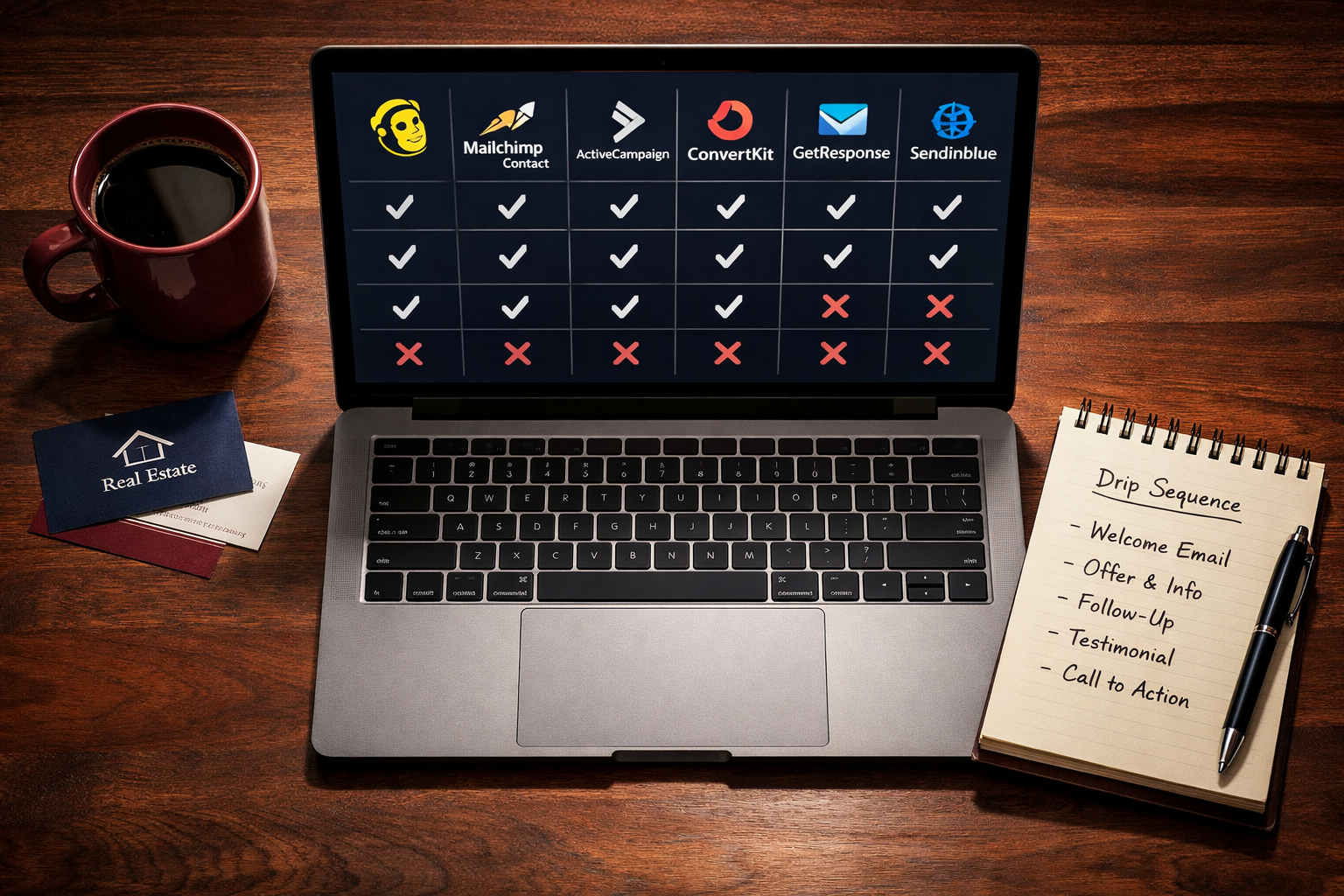
| Platform | Starting Price | Best For | CRM Integration | Automation Depth | Real Estate Templates | Free Tier |
|---|---|---|---|---|---|---|
| ActiveCampaign | $15/mo | Automation-first agents | Native + 870+ integrations | ⭐⭐⭐⭐⭐ | Yes (via marketplace) | No |
| Mailchimp | $0–$20/mo | Budget solo agents | Zapier, native integrations | ⭐⭐⭐ | Limited | Yes (500 contacts) |
| Constant Contact | $12/mo | Ease of use | Salesforce, HubSpot, Zapier | ⭐⭐⭐ | Yes | 60-day trial |
| Wise Agent | $49/mo | CRM-native email | Built-in CRM | ⭐⭐⭐⭐ | Yes (RE-specific) | 14-day trial |
| kvCORE | $499+/mo (team) | Teams and brokerages | Built-in IDX + CRM | ⭐⭐⭐⭐⭐ | Yes (RE-specific) | No |
| Brevo (formerly Sendinblue) | $0/mo | New agents, free tier | Zapier, native | ⭐⭐⭐⭐ | Limited | Yes (unlimited contacts) |
| Follow Up Boss | $58/user/mo | Lead routing + email | Built-in CRM | ⭐⭐⭐⭐ | Yes (RE-specific) | No |
Decision rule: If you're a solo agent just starting out, Brevo or Mailchimp free tiers get you going without spending a dollar. If you're closing 20+ deals a year and running a database of 1,000+ contacts, ActiveCampaign or a CRM-native tool like Wise Agent will pay for itself fast.
Best Overall: ActiveCampaign for Real Estate
ActiveCampaign is the strongest all-around pick for email marketing for real estate agents who are serious about automation. It combines deep behavioral triggers, a visual automation builder, and over 870 integrations — meaning it connects to virtually any CRM or IDX tool you're already using.
Pricing and Plans
- Starter: $15/month (up to 1,000 contacts)
- Plus: $49/month — adds CRM, landing pages, and SMS
- Professional: $79/month — adds predictive sending and split automation
- Enterprise: Custom pricing for large brokerages
Pricing scales with contact count, so a 5,000-contact database will cost more than the base rate. Still, compared to full CRM-integrated platforms that start at $499/month for teams, ActiveCampaign delivers extraordinary value for solo agents and small teams [7].
Automation and Drip Sequence Features
This is where ActiveCampaign earns its reputation. The visual automation builder lets you map out entire buyer or seller journeys — triggered by email opens, link clicks, form fills, or even website visits. You can build:
- New lead welcome sequences (triggered immediately when a lead opts in)
- Property alert drips (automated based on saved search criteria)
- Seller nurture sequences (timed around listing anniversaries or market updates)
- Past client re-engagement (triggered by inactivity after 90 days)
Predictive send-time optimization (on the Professional plan) analyzes when each individual contact is most likely to open — which is a fresh approach that most agents aren't using yet [7].
Real Estate Templates Available
ActiveCampaign's native template library isn't real-estate-specific out of the box, but its marketplace includes pre-built real estate email marketing templates and automation recipes. Agents can also import HTML templates or use the drag-and-drop builder to create impeccable branded emails that match their listing aesthetic.
Verdict
Best for: Agents and small teams who want serious automation without paying for a full CRM platform. If you're running buyer and seller drip campaigns simultaneously and want behavioral triggers that actually respond to what leads do — not just when you scheduled an email — ActiveCampaign is the move. Let it cook before you see results; most agents see meaningful engagement lifts within 60–90 days of setting up proper sequences.
Best Budget Option: Mailchimp for Real Estate Agents
Mailchimp is the most recognizable name in email marketing, and for good reason — it's genuinely solid for agents who are price-sensitive and want a clean, reliable platform. It won't out-automate ActiveCampaign, but it gets the job done for agents building their first email list [3].
Pricing and Plans
- Free: Up to 500 contacts, 1,000 emails/month
- Essentials: $13/month — removes Mailchimp branding, adds A/B testing
- Standard: $20/month — adds behavioral targeting and send-time optimization
- Premium: $350/month — advanced segmentation and multivariate testing
The Standard plan at $20/month is the sweet spot for most solo agents. It includes behavioral targeting — meaning you can trigger emails based on whether a contact opened your last message or clicked a specific link [7].
What Works and What Doesn't for Agents
What works:
- Impeccable A/B testing tools — test subject lines, send times, and content variations easily
- Clean drag-and-drop builder with solid mobile preview
- Strong deliverability reputation across major inbox providers [3]
- Integrates with Zapier, allowing connection to most real estate CRMs
What doesn't:
- Automation is more limited than ActiveCampaign — no true behavioral branching on lower tiers
- No native real estate email marketing templates (you'll build your own or use third-party designs)
- Contact limits on the free tier are tight for agents with existing databases
- Manual design work required — there's no done-for-you real estate content [5]
Verdict
Best for: New agents building their first list, or established agents who want a reliable platform for monthly newsletters and listing announcements without a steep learning curve. If your email strategy is "send a market update once a month and follow up with new leads," Mailchimp handles that cleanly at a price that won't hurt.
Best for Ease of Use: Constant Contact
Constant Contact is the go-to pick for agents who want to get up and running fast without a technical background. Constant Contact published a detailed comparison of real estate email marketing software in April 2026, emphasizing that its time-saving drip campaign features are especially relevant as AI integration becomes standard across the industry [source: Constant Contact, April 2026].
Pricing and Plans
- Lite: $12/month — basic email, 1GB storage
- Standard: $35/month — adds automation, A/B testing, scheduled posts
- Premium: $80/month — adds SEO tools, advanced reporting, and Google Ads integration
A 60-day free trial is available — one of the longest in the industry, giving agents real time to test the platform before committing.
Real Estate Specific Features
Constant Contact offers a library of pre-built templates that work well for real estate email campaigns, including:
- Open house announcement templates
- Just listed / just sold email designs
- Monthly market update newsletter layouts
- Client referral request emails
The event management feature is a genuine differentiator — agents can promote open houses, broker tours, and client appreciation events directly through the platform, with RSVP tracking built in. Integration with Salesforce, HubSpot, and Zapier means it connects to most real estate CRMs without custom development [5].
Verdict
Best for: Agents who want professional-looking emails without spending hours designing them. If you've been putting off email marketing because the setup felt overwhelming, Constant Contact removes that excuse. The template library and event tools make it especially strong for agents who do a lot of open houses and community events.
Best CRM-Integrated Option: Wise Agent Email Tools
Wise Agent is built specifically for real estate agents, and its email tools are native to its CRM — meaning your contacts, drip sequences, and follow-up tasks all live in one place. Starting at $49/month, it's one of the most cost-effective all-in-one platforms available for individual agents [1].
What makes Wise Agent stand out for email marketing for real estate agents:
- Pre-built real estate drip email templates for buyers, sellers, FSBOs, expired listings, and past clients — ready to activate immediately
- Transaction management integration — email sequences can be triggered by deal milestones (under contract, inspection scheduled, closing date set)
- Text and email combined sequences — critical for lead response speed in 2026's competitive market
- AI-assisted email writing — helps agents draft follow-up emails and market update content faster
- Referral tracking — built-in tools to monitor which past clients are sending you new business
The platform's deliverability is solid, and because contacts are already in the CRM, there's no import/export friction. Agents using Wise Agent report that the pre-loaded real estate email marketing templates alone save hours of setup time [5].
Verdict: Best for solo agents and small teams who want CRM and email marketing under one roof without paying enterprise prices. If you're currently managing contacts in a spreadsheet and emailing from Gmail, switching to Wise Agent is an extraordinary upgrade for the price.
Best for Teams and Brokerages
kvCORE is the dominant platform for real estate teams and brokerages that need email marketing, IDX search, CRM, and lead generation all integrated. It's not cheap — pricing starts around $499/month for small teams and scales up — but for a brokerage running 10+ agents, the per-agent cost becomes reasonable fast.
Key email marketing features inside kvCORE:
- Smart CRM behavioral triggers — the system detects when a lead is searching specific price ranges or neighborhoods and fires relevant email sequences automatically
- AI-driven lead nurturing — kvCORE's "Smart Campaigns" send personalized property alerts and market updates without manual scheduling
- Branded team email templates — brokerages can maintain consistent branding across all agent communications
- Mass email (real estate email blast) tools — compliant bulk sending for database-wide announcements
- IDX integration — listing alerts pull directly from MLS data, keeping property emails accurate and current
For context on how platforms like kvCORE fit into a full agent tech stack, our guide on AI tools that actually close deals covers the broader picture.
Verdict: Best for teams of 5+ agents and brokerages that want a single platform handling everything from lead capture to closing follow-up. The price is steep for solo agents, but for teams, the productivity gain is real.
Best Free Option for New Agents
Brevo (formerly Sendinblue) offers the most generous free tier for agents starting from zero — unlimited contacts on the free plan, with up to 300 emails per day. That's a meaningful advantage over Mailchimp's 500-contact cap [7].
Why Brevo works for new agents:
- Unlimited contacts on the free tier — you can import your entire sphere of influence without hitting a wall
- Automation on free plan — basic drip sequences are available without paying, which is rare
- Transactional email support — useful for agents who want to send automated listing alerts or appointment confirmations
- Per-email pricing model — as your database grows, Brevo's pricing structure can be more cost-effective than per-contact models used by competitors [4]
- SMS integration — add text messaging to your sequences when you're ready to upgrade
The tradeoff: Brevo's real estate-specific templates are limited, and the 300 emails/day cap on the free plan means a large email blast to your full database requires a paid upgrade. The Starter plan at $25/month removes the daily limit.
Verdict: Best for brand-new agents building their first database. Start free, learn the platform, and upgrade when your list justifies it. There's no reason to pay for email marketing until you have the contacts to make it worth it.

Commercial Real Estate Email Marketing: A Different Approach
Commercial real estate email marketing operates on a completely different playbook than residential. The audience — investors, business owners, developers, asset managers — expects data-heavy, low-frequency, high-value communication. They don't want weekly newsletters about neighborhood coffee shops.
Key differences in commercial real estate email campaigns:
Content focus:
- Cap rate analysis and market absorption data
- Vacancy rate trends by submarket
- New development pipeline updates
- Investment opportunity summaries with pro forma attachments
- 1031 exchange deadline reminders for investor contacts
Cadence: Monthly or bi-monthly is the norm. Sending weekly in commercial real estate will get you unsubscribed fast. These are busy professionals who filter aggressively.
Tone: More formal than residential. Data-forward. Get to the point in the first two sentences.
List segmentation is non-negotiable in commercial. An office investor doesn't want industrial listings. A retail tenant rep doesn't need multifamily cap rate updates. Segment by property type, deal size, and investor profile before you send anything.
Platform recommendation for commercial: ActiveCampaign or a CRM like Follow Up Boss with heavy segmentation. For large commercial brokerages, a dedicated platform like Buildout (which includes email marketing tools) may be worth evaluating.
For agents working both sides, our guide on generating commercial real estate leads covers prospecting strategies that pair directly with a strong email follow-up system.
Cold email in commercial real estate: This is where cold email strategies for real estate shine most. A well-researched cold email to a property owner — referencing their specific asset, its current occupancy, and a relevant market comp — will outperform any generic blast. Keep it under 150 words, lead with insight, and end with one clear ask.
How to Build a Real Estate Email List From Scratch
Building a real estate email list from scratch means collecting permission-based contacts through every touchpoint in your business — not buying lists. Purchased lists have poor deliverability, high spam complaint rates, and violate most platform terms of service.
Here's how to build a list that actually converts:
Add an opt-in to your website — a home valuation tool, buyer's guide download, or neighborhood market report in exchange for an email address. Our guide on real estate farming covers hyperlocal content that makes great lead magnets.
Import your sphere of influence — past clients, family, friends, colleagues, and anyone who's given you their contact info with implied permission. This is your warmest list.
Open house sign-in sheets — digital sign-in tools (like Open Home Pro or Spacio) capture emails at showings and can sync directly to your email platform.
Social media lead ads — Facebook and Instagram lead ads collect email addresses natively. Connect them to your email platform via Zapier for automatic list building.
Referral partner co-marketing — co-host a first-time buyer webinar with a mortgage lender and split the opt-in list.
QR codes on print marketing — business cards, flyers, and yard signs with a QR code linking to a landing page with an email opt-in.
Networking events and community involvement — always follow up with a permission-based email within 24 hours of meeting someone new.
List hygiene matters: Clean your list every 90 days. Remove hard bounces immediately and re-engage or remove contacts who haven't opened in 6+ months. A smaller, engaged list outperforms a massive, cold one every time [8].
The Ideal Drip Sequence Structure for Real Estate
A real estate drip email sequence is a pre-written series of emails sent automatically over time to nurture leads toward a transaction. The structure should differ based on where the contact is in their journey.
Buyer Drip Sequence
Goal: Move a cold or warm buyer lead toward a consultation and then toward an offer.
| Email # | Timing | Content |
|---|---|---|
| 1 | Immediately | Welcome + what to expect from you |
| 2 | Day 2 | Buyer's guide or neighborhood overview |
| 3 | Day 5 | Current market conditions (local stats) |
| 4 | Day 10 | First-time buyer tips or financing basics |
| 5 | Day 21 | Case study or recent buyer success story |
| 6 | Day 30 | Soft CTA — "Ready to start your search?" |
| 7+ | Monthly | Market updates, new listings, rate news |
Real estate follow-up email templates for buyers should always include a local angle — generic national market data feels impersonal and gets ignored.
Seller Drip Sequence
Goal: Stay top of mind with potential sellers until they're ready to list.
| Email # | Timing | Content |
|---|---|---|
| 1 | Immediately | Home valuation confirmation + what's next |
| 2 | Day 3 | Recent comparable sales in their neighborhood |
| 3 | Day 10 | Seller's market timing guide |
| 4 | Day 21 | What buyers are looking for right now |
| 5 | Day 45 | Updated market stats for their ZIP code |
| 6+ | Monthly | Neighborhood market report |
Past Client Nurture Sequence
Goal: Generate referrals and repeat business from people who already trust you.
- Monthly: Neighborhood market update with their home's estimated current value
- Quarterly: Local real estate news digest
- Annually: Home anniversary email ("It's been one year since you closed!")
- Ad hoc: Relevant articles on home improvement, tax tips for homeowners, or refinancing opportunities
Past clients are the highest-ROI segment on any agent's list. They already trust you — the email just needs to remind them you exist [5].
Real Estate Email Templates That Get Responses
The best real estate email templates are short, specific, and written like a human — not a marketing department. Here's what actually works in 2026.
Cold Email Templates for Prospecting
FSBO prospecting email (under 100 words):
Subject: Quick question about [Address]
Hi [Name], I noticed your home at [Address] is listed for sale by owner. I work with buyers actively searching in [Neighborhood] right now and wanted to reach out in case there's a fit. No pressure — just wanted to introduce myself. If you'd ever like a second opinion on pricing or a look at recent comps, I'm happy to share what I'm seeing in the market. [Your name], [Phone]
Expired listing email:
Subject: Your listing at [Address] — what happened?
Hi [Name], I saw your home came off the market recently. That's frustrating, especially when you had plans around the sale. I've helped several sellers in [Neighborhood] get relisted and closed after a previous listing expired — usually with a few key adjustments. Would a 15-minute call be worth your time? [Your name]
Follow-Up Email Templates
The real estate follow-up email template that gets the most responses is the one that adds value instead of just checking in. Replace "Just following up!" with something specific:
- "I pulled the latest comps for your street — want me to send them over?"
- "A home two blocks from yours just went under contract at [price]. Thought you'd want to know."
- "Rates moved this week — here's what it means for your buying power."
Newsletter Ideas for Real Estate Agents
Fresh newsletter content ideas that agents aren't oversaturating yet:
- "What sold this week in [Neighborhood]" — simple, local, and highly clickable
- "Rate watch" — weekly or bi-weekly mortgage rate update with a local angle
- "Renovation ROI" — which upgrades are adding value in your market right now
- "Buyer vs. Seller market tracker" — a simple visual showing where your market sits
- "Local business spotlight" — builds community goodwill and gets local businesses sharing your newsletter
For agents looking to pair email content with AI tools, our roundup of AI marketing tools for real estate agents covers platforms that can generate first drafts of newsletter content in minutes.
Email Flyers for Realtors: How to Do Them Right
Email flyers for realtors are HTML-designed emails that look like a property flyer — visual-first, with a featured listing photo, key details, and a single call to action. Done right, they're one of the highest-engagement email formats in real estate. Done wrong, they look like spam.
Rules for real estate email flyers that convert:
- One listing per flyer — don't cram three properties into one email. Each gets its own send.
- Hero image above the fold — the property photo should be the first thing visible, no scrolling required
- Key stats in scannable format — price, beds/baths, square footage, and one standout feature in a clean layout
- Single CTA — "Schedule a showing" or "View full listing" — not both. One ask per email [8]
- Mobile optimization is non-negotiable — over 60% of emails are opened on mobile devices; a flyer that breaks on a phone is a wasted send
- Personalized subject line — "[Name], new listing in [Neighborhood] just hit the market" outperforms generic "New Listing Alert" every time
Tools for building real estate email flyers: Canva (export as HTML or image), Mailchimp's drag-and-drop builder, Constant Contact's template library, or dedicated real estate flyer tools like Coffee & Contracts.
Subject Lines That Increase Open Rates
The subject line is the single most important element of any real estate email campaign — it determines whether the email gets opened or deleted. Here's what the data and experience say about what works [8]:
Formulas that consistently perform:
- Local specificity: "3 homes sold on [Street Name] this week — here's what they went for"
- Urgency with context: "Rate drop today — here's what it means for [Neighborhood] buyers"
- Curiosity gap: "The one thing keeping your home from selling faster"
- Personalization: "[Name], your home's value just changed"
- Question format: "Is now a good time to sell in [City]?"
What kills open rates:
- ALL CAPS subject lines
- Excessive punctuation ("AMAZING DEAL!!!")
- Spam trigger words: "free," "guaranteed," "act now," "limited time"
- Vague subject lines: "Newsletter — March 2026" tells the reader nothing
Length: Keep subject lines under 50 characters for mobile. Preview text (the line after the subject) should complete the thought — treat it as a second subject line.
A/B test everything. Even a small list of 500 contacts gives you enough data to learn what resonates with your specific audience. Most platforms covered in this article include A/B testing — use it.
How Often Should Real Estate Agents Send Emails?
Most real estate agents should email their list 2–4 times per month. More than that and you risk unsubscribes; less than that and leads forget who you are.
Here's a practical cadence by list segment:
| Segment | Recommended Frequency |
|---|---|
| Active buyer leads | Weekly (market updates + new listings) |
| Active seller leads | Weekly (comps + market conditions) |
| Warm leads (6–12 month timeline) | Bi-weekly |
| Past clients | Monthly |
| Cold database (12+ months inactive) | Monthly, then re-engagement campaign |
| Commercial prospects | Monthly or bi-monthly |
Common mistake: Sending the same email to every segment at the same frequency. A past client who closed 3 years ago doesn't need weekly listing alerts — that's a fast path to an unsubscribe.
Re-engagement campaigns: Before removing cold contacts, send a 2–3 email re-engagement sequence. Something like: "We haven't heard from you in a while — still interested in [City] real estate? Click here to stay on our list." Anyone who doesn't engage after that sequence gets removed. Your deliverability will thank you [8].
For agents who want to automate this entire process, our marketing automation for real estate guide covers how to set up hands-off systems that manage cadence automatically.

Frequently Asked Questions
Q: What is the best email marketing software for real estate agents in 2026?
ActiveCampaign is the best overall pick for automation depth and integrations. Wise Agent is the top choice for agents who want CRM and email in one tool. Brevo is the best free option for agents just starting out. The right answer depends on your database size, budget, and whether you already use a CRM.
Q: How much does email marketing cost for real estate agents?
Costs range from $0 (Brevo free tier) to $499+/month for team platforms like kvCORE. Solo agents typically spend $15–$49/month on a solid platform. CRM-integrated tools like Wise Agent at $49/month or Follow Up Boss at $58/user/month bundle email with contact management, which often makes them more cost-effective than paying for separate tools [7].
Q: What should real estate agents include in their email newsletters?
The highest-performing newsletters include hyperlocal market data (recent sales, days on market, price trends), mortgage rate updates, local event coverage, and one personal story or client win per issue. Keep it scannable, keep it local, and always include one clear call to action [8].
Q: How do I build a real estate email list legally?
Collect emails through opt-in forms, open house sign-in sheets, social media lead ads, and direct networking — always with explicit permission. Never purchase email lists. Follow CAN-SPAM requirements: include your physical address, a clear unsubscribe link, and an accurate subject line in every email.
Q: What open rate should real estate agents expect from email campaigns?
Average real estate email open rates sit around 20–25% for general campaigns. Hyperlocal neighborhood newsletters targeting engaged subscribers can reach 50–60% open rates. Behavioral drip sequences triggered by lead activity consistently outperform scheduled blasts [8].
Q: Are there free email marketing tools for real estate agents?
Yes. Brevo offers unlimited contacts and basic automation on its free plan. Mailchimp's free tier covers up to 500 contacts. HubSpot's free CRM includes basic email marketing for up to 1 million contacts. Free tiers work well for new agents but have limitations on automation depth and daily send volume [7].
Q: What's the difference between a drip campaign and a newsletter for real estate?
A drip campaign is a pre-written automated sequence triggered by a specific action (a lead signing up, clicking a link, or reaching a certain date). A newsletter is a regularly scheduled broadcast sent to your full list or a segment. Most agents should run both: drip sequences for lead nurturing and newsletters for database-wide relationship building [5].
Q: How do cold email strategies work for real estate prospecting?
Effective cold email for real estate leads with a specific, researched hook — referencing the recipient's property, neighborhood, or a relevant market event. Keep it under 150 words, make one clear ask, and follow up 2–3 times if there's no response. Personalization is the difference between a reply and a spam report.
Q: What are the best real estate email templates for following up with leads?
The best follow-up templates add value instead of just checking in. Reference something specific: a new comparable sale, a rate change, or a relevant market stat. Templates that start with "I noticed" or "I saw" and reference something specific to the lead's situation consistently outperform generic "just following up" emails [5].
Q: Is commercial real estate email marketing different from residential?
Significantly. Commercial real estate email marketing uses a lower frequency (monthly or bi-monthly), more formal tone, data-heavy content (cap rates, vacancy rates, absorption data), and strict segmentation by property type and investor profile. The audience is professional and filters aggressively — every email needs to earn its place in their inbox.
Q: Can I use AI to write real estate email campaigns?
Yes, and it's one of the highest-ROI uses of AI for agents. Tools like ChatGPT, Claude, and platform-native AI writers can draft subject lines, email body copy, and full drip sequences in minutes. Always review and personalize AI-generated content before sending. For a full breakdown of AI tools worth using, see our guide on AI tools real estate agents are sleeping on.
Q: How do I improve email deliverability for real estate campaigns?
Use a verified sending domain (set up SPF, DKIM, and DMARC records), clean your list every 90 days, remove hard bounces immediately, avoid spam trigger words in subject lines, and maintain a consistent sending schedule. Delivery rates above 95% are achievable on clean, permission-based lists [8].
Conclusion
Email marketing for real estate agents isn't going anywhere — and in 2026, it's more powerful than ever because the tools have caught up with the strategy. Behavioral automation, AI-assisted content, hyperlocal personalization, and seamless CRM integration mean agents who build and nurture an email list have a genuine competitive advantage over those who don't.
Here's the short version of everything covered:
- Start with the right platform for your current stage — free tools for new agents, CRM-integrated platforms as you scale
- Build your list with permission — open houses, opt-in forms, social ads, and your sphere
- Segment your sequences — buyers, sellers, and past clients need different content and different cadences
- Make every email earn its place — local data, specific value, one clear ask
- Test subject lines constantly — small improvements in open rates compound over time
- Don't sleep on commercial if that's your market — the approach is different but the ROI is real
At Real Estate Rank IQ, we believe the agents who win long-term are the ones who own their audience. Social platforms change algorithms. Portals raise lead prices. Your email list stays yours.
For agents ready to go deeper on building a full marketing system, our real estate marketing automation beginners guide is the natural next step — it covers how to connect your email platform to your CRM, IDX, and lead sources into one automated pipeline.
And if you want to stay current on the tools, strategies, and market intelligence that top agents are actually using, bookmark the RERIQ Hub and follow us at @RealEstateRankiQ. Ranked by brokers. Read by everyone.
References
[1] Best Email Marketing Software For Real Estate Agents – https://leadoom.com/best-email-marketing-software-for-real-estate-agents/
[2] The Best Real Estate Email Marketing Platforms In 2018 You Can Hop On Now – https://newoldstamp.com/blog/the-best-real-estate-email-marketing-platforms-in-2018-you-can-hop-on-now/
[3] The Best Email Marketing Software – https://www.pcmag.com/picks/the-best-email-marketing-software
[4] Real Estate Agents – https://www.sequenzy.com/email-marketing-for/real-estate-agents
[5] Best Real Estate Email Marketing Tools – https://www.tryagentreach.com/guides/best-real-estate-email-marketing-tools
[6] Real Estate Marketing Tools – https://www.housingwire.com/articles/real-estate-marketing-tools/
[7] Email Marketing Tools Real Estate – https://www.luxurypresence.com/blogs/email-marketing-tools-real-estate/
[8] Best Email Marketing Tools For Real Estate 2025 – https://www.propphy.com/blog/best-email-marketing-tools-for-real-estate-2025
[9] Real Estate Marketing Tools – https://www.xara.com/blog/real-estate-marketing-tools/
[10] Does Email Marketing Really Works In April 2026 – https://www.reddit.com/r/Emailmarketing/comments/1ssr615/does_email_marketing_really_works_in_april_2026/
For more agent tools, tutorials, and resources, visit the Agent Resources Hub.












Comments 1