


Last updated: May 24, 2026

Quick Answer: A newsletter for real estate agents works when it delivers genuinely useful, locally relevant content on a consistent schedule — not just listings and bragging rights. The agents who see real results combine a clean email platform, a simple content structure, and a subject line strategy that earns the open before the content ever loads. Start simple, stay consistent, and let it cook before you see results.
Key Takeaways
- Real estate email marketing has one of the highest ROI of any digital channel — but only when the content is worth reading
- Send frequency sweet spot for most agents: twice a month (bi-weekly), with a local market update as the anchor
- Platforms like beehiiv, Mailchimp, ActiveCampaign, ConvertKit, and Substack all work — the right one depends on your budget and how technical you want to get
- The biggest mistake agents make is turning their newsletter into a listings dump — readers unsubscribe fast when there's nothing in it for them
- Subject lines are the single biggest lever for open rates — AI subject line tools in 2026 are making this easier than ever
- New agents absolutely should start a newsletter — it builds credibility and a warm audience before you even have a big track record
- Track open rate, click-through rate, and unsubscribe rate as your core three metrics
- Growing your email list as a real estate agent starts with your existing sphere — not cold traffic
- A well-built realtor newsletter can directly generate listing appointments and referrals
What Makes a Real Estate Newsletter Actually Work?
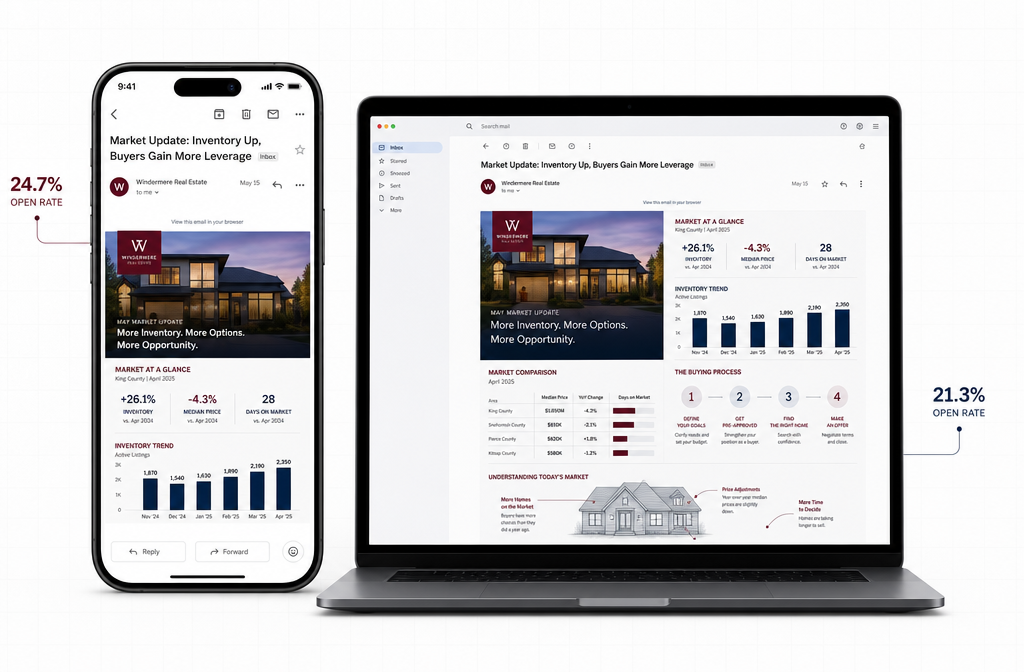
A real estate newsletter works when it gives the reader something they can't easily Google themselves — hyper-local insight, honest market takes, and practical advice that feels like it came from a trusted neighbor who happens to sell houses. Generic content gets deleted. Specific, relevant content gets saved, forwarded, and remembered.
The agents who build newsletters people open share a few things in common:
- They write like a human, not a press release. The tone is conversational, direct, and occasionally funny.
- They lead with local data. "Homes in [Your Neighborhood] sold 11 days faster this month" beats "The market is heating up!" every single time.
- They make it about the reader. What does this market shift mean for someone thinking about selling in the next six months? Answer that question, and you've earned the next open.
- They're consistent. The agents who quit after three sends never see the compounding effect. Real estate email marketing rewards patience — you have to let it cook before you see results.
- They nail the subject line. If the subject line doesn't earn the click, nothing else matters.
Think of your newsletter the way Taylor Swift thinks about album rollouts — every touchpoint builds anticipation and trust. Your email list is your audience. Treat it like one.
Newsletter for Real Estate Agents: Build One People Open — The Full Framework
Building a newsletter for real estate agents that people actually open isn't complicated, but it does require a clear structure from day one. Here's the full framework broken into phases.
Phase 1: Define Your Audience and Angle
Before you write a single word, answer this: Who is this newsletter for, and what problem does it solve for them?
Most agents try to serve everyone — buyers, sellers, investors, renters — in one newsletter. That's a fast track to a forgettable email. Pick a lane:
- Homeowners in a specific neighborhood (great for real estate farming)
- First-time buyers in your market (positions you as the educator)
- Local investors (data-heavy, ROI-focused content)
- Your general sphere (relationship-based, mix of market news and personal updates)
Narrower focus = higher relevance = better open rates. So based.
Phase 2: Choose Your Platform
More on this below, but pick one platform and commit. Don't let platform paralysis stop you from sending your first issue.
Phase 3: Build a Repeatable Content Template
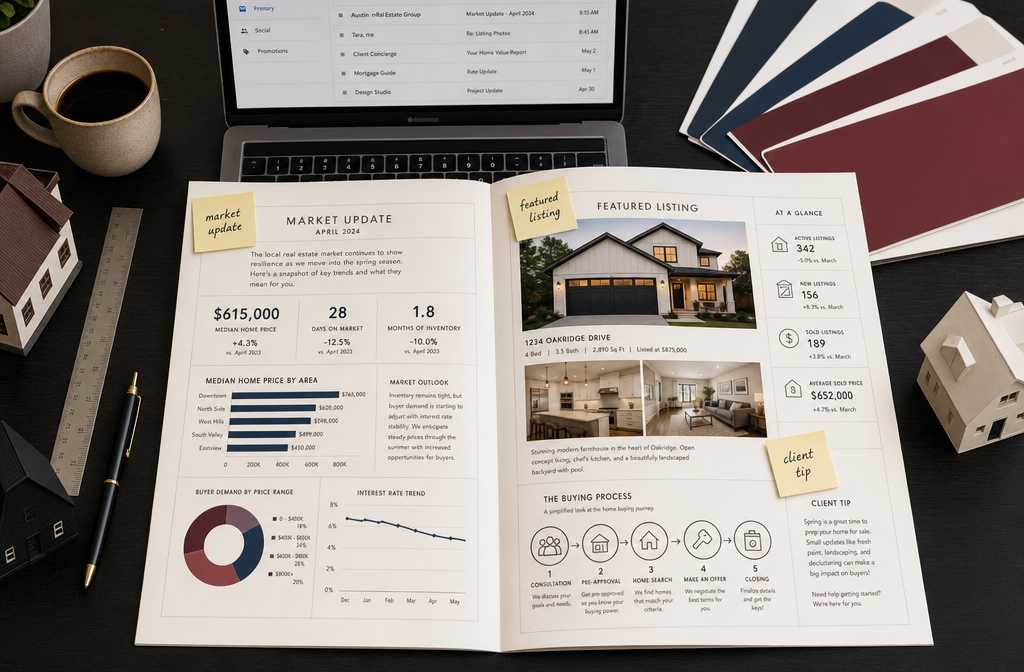
The best realtor newsletters use a consistent structure so readers know what to expect. A solid template might look like:
- Opening note — 2-3 sentences, personal and timely (60 words max)
- Local market snapshot — 3-4 data points from your MLS
- Main feature — one topic explored in depth (see content ideas below)
- Quick tips or resources — 2-3 bullets your reader can use today
- Featured listing or recent sale — one property, not five
- Call to action — one clear ask (book a call, reply with a question, share with a friend)
Phase 4: Send, Measure, Adjust
Track your numbers (open rate, clicks, unsubscribes), make small adjustments, and keep going. The agents who treat their newsletter like a business asset — not a chore — are the ones who see it pay off.
How Often Should You Send Your Real Estate Newsletter?
Twice a month is the sweet spot for most real estate agents. Weekly is ambitious and often leads to burnout or thin content. Monthly is too infrequent to stay top of mind. Bi-weekly hits the balance between consistent presence and manageable production.
Here's a simple framework:
| Frequency | Best For | Risk |
|---|---|---|
| Weekly | High-volume agents with a content team | Burnout, thin content |
| Bi-weekly | Most agents — best balance | Requires planning ahead |
| Monthly | Part-time agents or those just starting | Slower list growth, lower recall |
| Quarterly | Better than nothing, barely | Readers forget who you are |
One important note: consistency beats frequency. An agent who sends a great bi-weekly newsletter for two years will outperform one who sends weekly for three months and then disappears. Pick a cadence you can actually maintain.
If you're running a real estate weekly newsletter during a hot market cycle (like spring selling season), consider bumping to weekly temporarily — then returning to bi-weekly. Readers will appreciate the extra intel when the market is moving fast.
Best Email Platforms for Real Estate Agent Newsletters
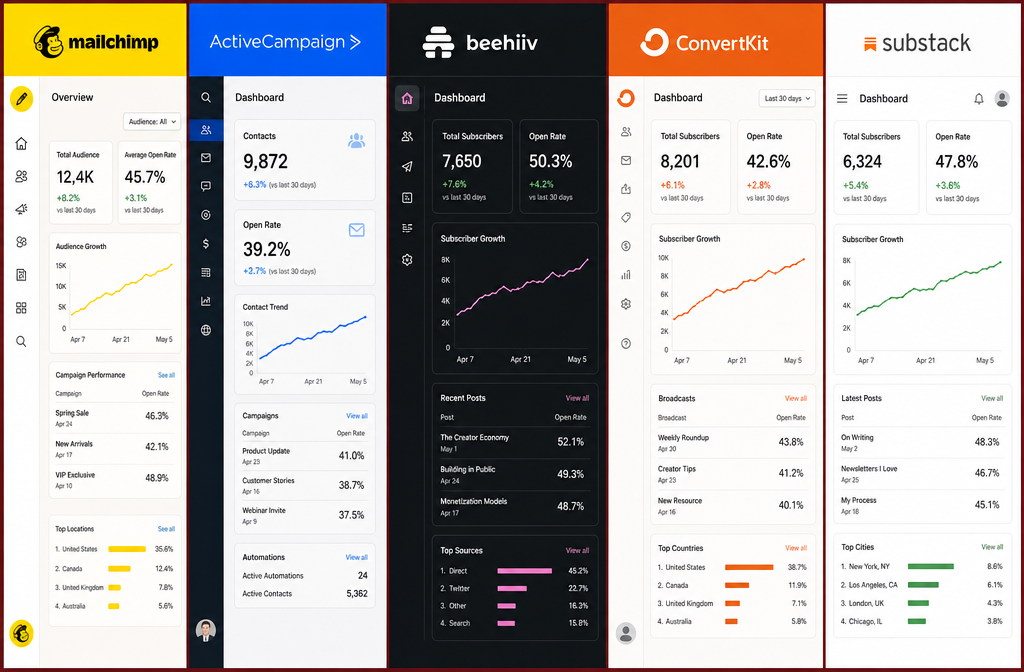
The best platform is the one you'll actually use. That said, some platforms are genuinely better suited for real estate agents than others, depending on your goals, budget, and tech comfort level.
Here's an honest breakdown:
Mailchimp
The most recognizable name in email marketing. Free up to 500 contacts, easy drag-and-drop editor, solid analytics. Great for agents just starting out. The free plan has limitations on automation, but for a basic bi-weekly newsletter, it works fine.
ActiveCampaign
The power tool. Best-in-class automation, CRM features built in, and serious segmentation options. If you want to send different content to buyers vs. sellers vs. investors on the same list, ActiveCampaign handles it cleanly. Starts around $15/month. Check out our email marketing for real estate agents platform comparison for a deeper look.
beehiiv
The fresh new player that's become a favorite among newsletter-first creators. Built specifically for newsletters, not retrofitted from a general marketing tool. Clean interface, built-in growth tools, and a generous free tier. If you want your newsletter to eventually become a revenue channel (sponsor slots, paid tiers), beehiiv is worth serious consideration.
ConvertKit (now Kit)
Popular with content creators and educators. Simple, clean, and excellent for tagging subscribers based on behavior. Good middle ground between Mailchimp's simplicity and ActiveCampaign's complexity.
Substack
Free to use, built-in audience discovery features, and incredibly easy to set up. The catch: Substack takes a cut if you ever charge for subscriptions. For a free newsletter, it's a solid option — especially if you want a public-facing archive of your issues.
Constant Contact
A solid, dependable choice that's been around forever. Better customer support than most. Good for agents who want phone support when something breaks.
Wise Agent and kvCORE
These are real estate-specific CRMs with built-in email marketing. If you're already using kvCORE or a similar real estate CRM, the email tools inside may be enough to run your newsletter without adding another subscription.
Decision rule: Choose beehiiv or ConvertKit if you're newsletter-first. Choose ActiveCampaign if automation and CRM features matter. Choose Mailchimp if you want free and simple. Choose Wise Agent or kvCORE if you want everything in one real estate-specific platform.
For a full side-by-side breakdown, our best email marketing software for real estate agents guide covers pricing, features, and what each platform actually does well.
What Content Do Real Estate Clients Actually Want to Read?
Clients want content that helps them make better decisions about the biggest financial transaction of their lives. They don't want a listing dump. They don't want a humble brag about your latest sale. They want to feel smarter after reading your email.
The highest-performing real estate newsletter content in 2026 falls into these categories:
Local Market Data (Always Wins)
- Days on market trends for specific neighborhoods
- Median sale price vs. list price ratios
- Inventory levels ("We currently have X weeks of supply in [City]")
- Year-over-year price changes
Practical Buyer and Seller Guides
- "What to do if your home appraises low"
- "How to read a seller's disclosure like an agent"
- "5 things that actually hurt your home's value at inspection"
These work because they position you as the expert without being salesy. Our first-time home buyer guide is a great example of the kind of depth clients respond to — link to resources like this in your newsletter.
Neighborhood Spotlights
Pick one neighborhood per issue. New restaurant opening, school rating update, infrastructure project, recent sales data. Hyper-local content is the one thing Zillow can't replicate.
Interest Rate and Mortgage Updates
Rates affect every buyer and seller decision. A quick, plain-English update on where rates are and what it means for affordability is consistently one of the most-clicked sections in any real estate weekly newsletter.
Real Estate News Digest
Curate 2-3 national or regional real estate stories with a one-sentence take from you. This is where you can link to resources like 2026 real estate trends and market strategies to add depth without writing it all yourself.
What Sections Should You Include in Your Real Estate Newsletter?
A great realtor newsletter has six sections max — and most issues don't need all six. Longer isn't better. Readable is better.
Here's the impeccable structure that top-producing agents use:
The Hook — One punchy opening line or stat that earns the read. Example: "Sellers in [City] are leaving an average of $14,000 on the table by pricing wrong in the first week."
Market Pulse — 3-5 local data points, presented visually if possible (a simple table works great in email).
Feature Article or Tip — The meat of the issue. One topic, explored well. 200-400 words max.
Quick Wins — 2-3 bullet points: a tool, a tip, a resource. Fast to read, high value.
Listing Spotlight — One property. Tell a story about it, don't just paste the MLS description.
CTA — One ask. "Reply and tell me what neighborhood you're watching." "Book a free 15-minute market call." One ask, not five.
Common mistake: Agents stuff their newsletter with five listings, three testimonials, and a request to follow them on four social platforms. That's not a newsletter — that's a brochure. Nobody reads brochures.
How to Grow Your Email List as a Real Estate Agent
Start with the people who already know you. The fastest way to build an email list as a real estate agent isn't paid ads or landing pages — it's importing your existing contacts and asking permission to send them something valuable.
Step-by-Step List Building for Agents
Import your sphere. Past clients, friends, family, referral partners, former colleagues. Anyone who knows your name and wouldn't be surprised to hear from you. Get explicit permission — a quick text or DM works fine.
Create a lead magnet. A one-page PDF like "2026 [City] Neighborhood Pricing Guide" or "Home Seller Checklist: 30 Days Before You List" gives people a reason to subscribe. This is not gatekeeping — this is smart marketing.
Add a signup form to your website. Put it above the fold on your homepage, in your blog posts, and on your contact page.
Promote it on social media. Share a snippet of your newsletter content on Instagram or LinkedIn with a "subscribe link in bio" CTA. Let your content do the selling.
Mention it at every closing and open house. "I send a bi-weekly market update — want me to add you?" is a natural, non-pushy ask.
Partner with local businesses. A mortgage broker, home inspector, or interior designer who shares your audience can cross-promote your newsletter to their list.
For more lead generation strategies that complement your newsletter, check out our best real estate lead generation companies guide and 15 real estate prospecting ideas to boost your GCI.
Edge case: Don't buy email lists. Ever. Purchased lists destroy deliverability, violate CAN-SPAM, and will get your sending domain flagged faster than you can say "unsubscribe." Build organic, always.
Biggest Mistakes Real Estate Agents Make With Email Marketing
The #1 mistake is treating the newsletter as a marketing channel instead of a relationship channel. When every email is a pitch, readers stop opening. When every email delivers value, readers start forwarding.
Here are the mistakes worth knowing before you make them:
- Inconsistent sending. Disappearing for two months and then sending three emails in a week destroys trust and spikes unsubscribes.
- No clear subject line strategy. "March Newsletter" is not a subject line. It's a filing label.
- Writing for yourself, not your reader. "I'm so proud to announce I just closed my 50th deal" — nobody cares. Translate it: "Here's what I learned closing 50 deals that most agents won't tell you."
- Ignoring mobile optimization. Over 60% of emails are opened on mobile. If your newsletter looks broken on a phone, it gets deleted.
- Skipping the CTA. If you don't ask for anything, you get nothing. One clear call to action per issue.
- Sending from a generic Gmail. Use a professional domain email. It improves deliverability and looks impeccable.
- Never testing subject lines. A/B test your subject lines. Most platforms support this natively.
How Much Does It Cost to Start a Real Estate Newsletter?
Starting a real estate newsletter costs $0 if you use a free platform tier. Realistically, a professional setup costs between $0 and $50/month depending on list size and platform.
| Setup Level | Platform | Monthly Cost | What You Get |
|---|---|---|---|
| Free starter | Mailchimp or beehiiv | $0 | Up to 500 contacts, basic templates |
| Growing agent | ConvertKit or beehiiv | $9–$25/month | Automation, landing pages, growth tools |
| Power user | ActiveCampaign | $15–$49/month | CRM + email + advanced segmentation |
| All-in-one RE | Wise Agent or kvCORE | $29–$99/month | CRM + email + real estate-specific tools |
The only other real cost is your time. A well-structured bi-weekly newsletter takes 1-2 hours to produce once you have a template. Use AI tools to cut that in half.
AI Tools and Newsletter Automation for Real Estate Agents in 2026
AI newsletter writing in 2026 has made it genuinely easier to produce a consistent, high-quality newsletter without a copywriting background. Tools like ChatGPT, Claude, and Jasper can draft your feature article, generate five subject line options, and write your market summary from raw MLS data — in minutes.

Here's where AI is most useful for your real estate email marketing workflow:
- AI subject lines for real estate: Tools like Mailchimp's AI subject line assistant or standalone tools can generate and predict open rates for multiple subject line options. Use them every single issue.
- AI personalization: Platforms like ActiveCampaign use AI to personalize send times and content blocks based on subscriber behavior. An investor on your list sees different content than a first-time buyer — automatically.
- Agentic AI newsletter automation: In 2026, agentic AI workflows (tools that take multi-step actions autonomously) can pull your MLS data, draft your market update section, and schedule your send — with minimal human input. This is the frontier, and early adopters are not gatekeeping this advantage.
- Content repurposing: Drop your newsletter content into an AI tool and get a social media caption, a YouTube script, and a blog post out of it. One piece of content, multiple channels.
For a full breakdown of the AI tools worth your time, check out our top AI tools real estate agents are sleeping on and our best real estate AI tools expert guide.
One honest note on AI: it's a drafting tool, not a replacement for your local expertise. The market data, the neighborhood insight, the personal tone — that still has to come from you. AI gets you 70% there. You bring the other 30%.
What Metrics Should You Track for Your Real Estate Newsletter?
Track three core metrics: open rate, click-through rate, and unsubscribe rate. Everything else is secondary until your list hits a few hundred subscribers.
| Metric | What It Tells You | Benchmark (2026 estimate) |
|---|---|---|
| Open Rate | Are your subject lines working? | 35–45% for engaged real estate lists |
| Click-Through Rate (CTR) | Is your content driving action? | 2–5% is solid for real estate |
| Unsubscribe Rate | Are you sending too often or off-topic? | Under 0.5% per send is healthy |
| List Growth Rate | Is your acquisition working? | 5–10% monthly growth is strong |
| Reply Rate | Are readers engaging personally? | Any replies are a good sign |
Common mistake: Obsessing over open rates while ignoring click-through. A 45% open rate with 0.2% CTR means your subject lines are great but your content isn't converting. Fix the content.
If your open rate drops below 20%, check three things: your subject lines, your send frequency, and your list hygiene (remove subscribers who haven't opened in 6+ months).
Is a Newsletter Worth It for New Real Estate Agents?
Yes — and arguably more valuable for new agents than experienced ones. A newsletter builds credibility and keeps you top of mind during the period when you have the fewest transactions to prove your worth.
Here's the logic: a new agent with 50 contacts and a consistent, well-written bi-weekly newsletter is building a warm audience. By month six, those 50 people have read 12 issues. They know your market takes, they've seen your expertise, and when someone in their network mentions real estate, your name comes up first.
That's not a small thing. That's a referral pipeline being built in the background while you're busy with everything else a new agent has to manage.
The NAR 2026 data on content creation pain points consistently shows that agents struggle most with consistency and knowing what to write — not with the technical setup. That's the real barrier. Solve the content problem (templates + AI tools), and the newsletter becomes one of the most extraordinary lead-nurturing tools in your entire business.
For agents building their full tech stack, our real estate agent tech stack guide shows how a newsletter fits into a broader automation system.
Can a Newsletter Help You Get More Real Estate Listings?
Yes, directly. A newsletter for real estate agents is one of the most underrated listing generation tools available — because it keeps you in front of homeowners who are thinking about selling but haven't raised their hand yet.

Here's how it works in practice:
- A homeowner on your list reads your neighborhood market update for six months.
- They see that homes in their area are selling fast and above asking.
- They reply to your email: "We've been thinking about selling — can we talk?"
That's a warm listing appointment generated by a newsletter. No cold calls. No door knocking. No ad spend.
To make this work intentionally:
- Include a "Thinking About Selling?" CTA in every issue. Even one line at the bottom: "Curious what your home is worth in today's market? Reply and I'll run a free CMA."
- Feature sold homes in your newsletter. Real numbers from real sales in their neighborhood are the most compelling listing pitch you can make.
- Use your newsletter for real estate farming. A neighborhood-specific newsletter is an extraordinary farming tool. Pair it with our real estate farming guide for a complete system.
The agents who combine consistent newsletter sends with a clear listing-focused CTA are the ones who stop chasing leads and start receiving them.
How Top-Producing Agents Design Their Newsletters
Top producers keep their newsletters simple, branded, and scannable. They don't use every design feature the platform offers — they use a clean, consistent template that readers recognize immediately.
Design principles that work:
- One column layout. Two-column layouts often break on mobile. One column, always.
- Brand colors. Use your brand colors consistently. Readers should recognize your email before they read a word.
- Short paragraphs. Three sentences max per paragraph. White space is your friend.
- One image per section, max. A hero image at the top, then text. Heavy image emails trigger spam filters and load slowly on mobile.
- Bold the key takeaways. Readers scan before they read. Make the important stuff impossible to miss.
- Consistent from-name. "Sarah Chen, Compass Chicago" every time — not "Sarah" one week and "Sarah Chen Real Estate" the next.
Top producers also test relentlessly. They A/B test subject lines, send times (Tuesday and Thursday mornings tend to perform well, though this varies by audience), and CTA placement. They treat their newsletter like a business asset with measurable ROI — because it is one.
Frequently Asked Questions
Q: What's a good open rate for a real estate newsletter?
A 35–45% open rate is strong for a real estate agent newsletter with an engaged, permission-based list. Industry averages across all email marketing hover lower, but real estate lists with local, relevant content consistently outperform generic benchmarks.
Q: How do I write a real estate newsletter subject line that gets opened?
Lead with specificity and local relevance. "Homes in Riverside sold 9 days faster this month" outperforms "March Market Update" every time. Use numbers, ask questions, or create mild urgency. AI subject line tools in 2026 can generate and rank options in seconds.
Q: Should I use a personal email or a business email for my newsletter?
Always use a professional domain email (yourname@yourdomain.com). Sending from Gmail or Yahoo hurts deliverability and looks unprofessional. Most email platforms let you connect your domain email easily.
Q: How many subscribers do I need before my newsletter is worth sending?
Send it at 10 subscribers. Seriously. The habit and the template matter more than the list size early on. A newsletter to 50 engaged contacts outperforms a newsletter to 5,000 cold ones.
Q: Can I repurpose my newsletter content for social media?
Absolutely — and you should. Your newsletter feature article becomes a LinkedIn post. Your market snapshot becomes an Instagram carousel. Your quick tips become a TikTok script. One piece of content, multiple channels.
Q: How do I avoid my real estate newsletter going to spam?
Use a reputable platform (Mailchimp, beehiiv, ActiveCampaign), send only to people who opted in, avoid spam trigger words in subject lines ("FREE!!!", "ACT NOW"), and clean your list regularly by removing subscribers who haven't opened in 6+ months.
Q: What's the difference between a newsletter and a drip campaign?
A newsletter is broadcast content sent to your whole list on a regular schedule. A drip campaign is automated, sequential content triggered by a subscriber action (like signing up or downloading a lead magnet). Both are valuable — they serve different purposes.
Q: How long should a real estate newsletter be?
300–600 words of body content is the sweet spot. Long enough to deliver value, short enough to read in under three minutes. Readers who want more will click through to your blog or reply to ask questions.
Q: Do I need a CRM to run a newsletter?
No — a standalone email platform like Mailchimp or beehiiv is enough to start. A CRM becomes valuable when you want to segment your list, track subscriber behavior alongside deal pipeline, or automate follow-up sequences. Check out our best CRM for real estate agents guide when you're ready to level up.
Q: What's the best newsletter template for real estate agents?
The best template is the one you'll actually use consistently. Start with: opening hook → local market data → one feature tip → one listing spotlight → one CTA. That's it. Master the basics before adding complexity.
Q: How do I get my first 100 email subscribers as a real estate agent?
Import your existing contacts (with permission), create one lead magnet (a local pricing guide or seller checklist), add a signup form to your website, and mention your newsletter at every open house and closing. Most agents can hit 100 subscribers within 30 days without spending a dollar.
Q: Is email marketing still effective for real estate agents in 2026?
Yes — and the data backs it up. Email consistently delivers higher ROI than social media for relationship-based businesses like real estate. The key difference in 2026 is that AI tools make personalization and subject line optimization accessible to every agent, not just those with marketing teams.
Conclusion: Build the Newsletter. Then Let It Cook.
A newsletter for real estate agents isn't a magic lead machine that produces results overnight. It's a long game — one of the best long games in the business. The agents who commit to it, build a clean template, show up consistently, and treat their subscribers like real people are the ones who find themselves fielding warm listing calls from people who've been reading their emails for a year.
Here's your action plan to get started:
- Pick your platform this week. beehiiv or Mailchimp if you're starting free. ActiveCampaign if you want automation from day one.
- Import your existing contacts and get permission to add them to your list.
- Build your template. Six sections, clean design, one column.
- Write your first issue. Lead with a local market stat. Keep it under 500 words.
- Send it. Don't wait for a perfect list or a perfect design.
- Track your open rate and CTR after each send and make one small improvement each time.
- Use AI tools to cut your production time in half and sharpen your subject lines.
The agents who are winning with email marketing in 2026 aren't doing anything extraordinary — they're just doing the basics extraordinarily well, consistently. Your newsletter is one of the few marketing assets you own completely, independent of algorithm changes, platform shutdowns, or brokerage politics.
Build it. Protect it. Let it cook.
For more tools and strategies to build your real estate business, explore our real estate marketing automation guide and stay current with real estate news and market predictions at Real Estate Rank IQ.
Have questions about building your newsletter? Reach us at news@realestaterankiq.com or follow along at @real_estate_rankiq.
Tags: newsletter for real estate agents, real estate email marketing, email marketing for realtors, real estate newsletter ideas, realtor newsletter, email list building real estate, beehiiv real estate, Mailchimp real estate, AI newsletter tools 2026, real estate lead generation, real estate marketing automation, email open rates real estate










Comments 1