
Last updated: July 20, 2026

Quick Answer: An adjustable rate mortgage starts with a lower interest rate than a fixed loan, then adjusts periodically based on a market index. The initial savings are real, but so is the risk of significantly higher payments down the road. Whether an ARM works for you depends entirely on how long you plan to stay in the home and where rates are headed.
Key Takeaways
- ARM loans offer lower starting rates than fixed mortgages, often saving hundreds of dollars per month in the early years
- After the fixed period ends, your rate adjusts annually based on a benchmark index plus a margin set by your lender
- Rate caps limit how much your rate can increase per adjustment and over the life of the loan, but those caps still allow for substantial payment increases
- A 5/1 ARM and a 7/1 ARM differ only in how long the initial fixed period lasts, five years versus seven
- ARM loans make the most sense for buyers who plan to sell or refinance before the first adjustment kicks in
- Payment shock is real: a rate jump from 5% to 8% on a $400,000 loan can add $700+ to your monthly payment
- Refinancing out of an ARM before adjustment is possible but not guaranteed, it depends on your credit, equity, and the rate environment at that time
- In a rising rate environment, ARMs carry more risk than in a falling or stable rate environment
- The adjustable rate mortgage pros and cons conversation is not one-size-fits-all, your timeline is everything
What Is an Adjustable Rate Mortgage and How Does It Work
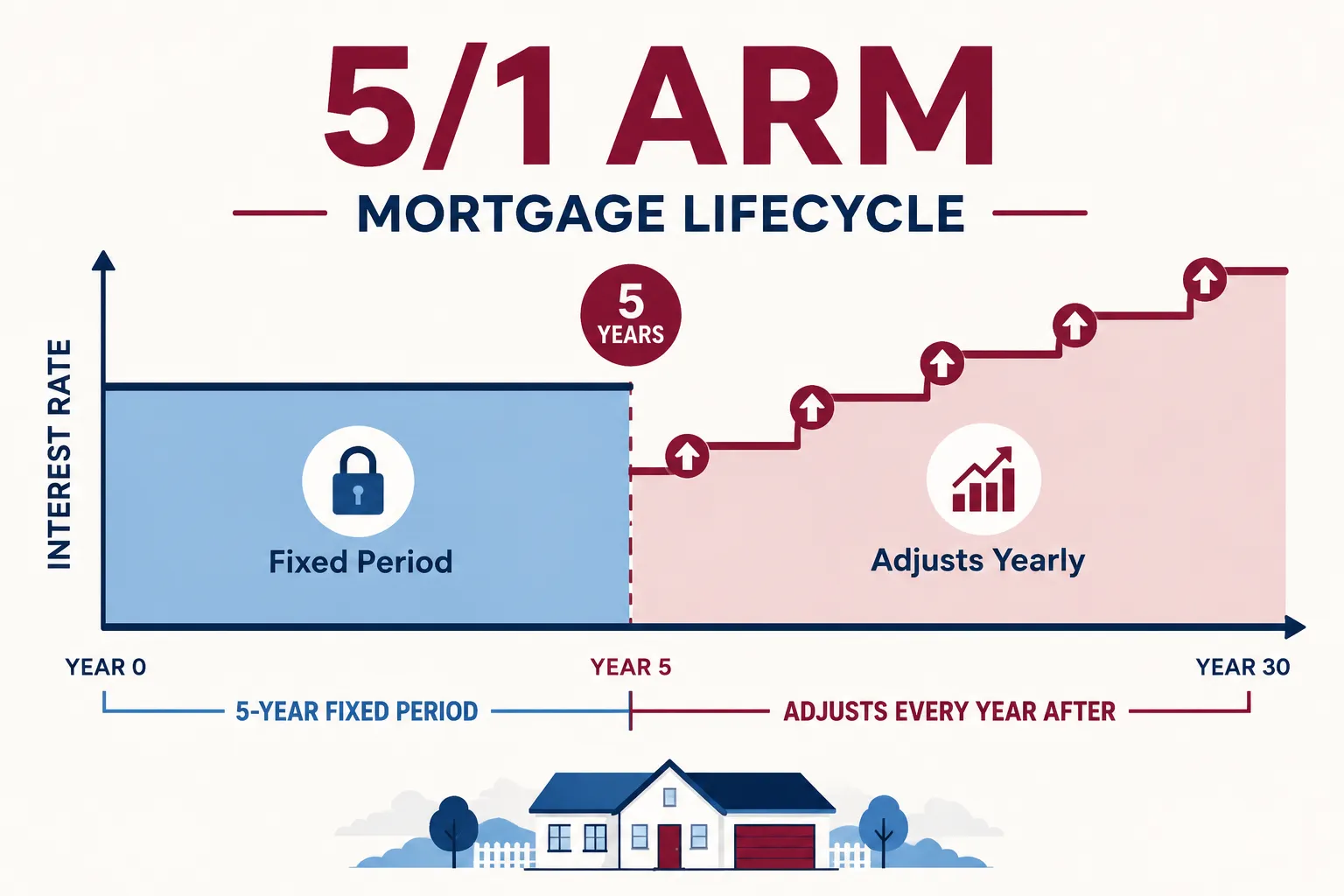
An adjustable rate mortgage (ARM) is a home loan with an interest rate that stays fixed for an initial period, then resets periodically based on a financial index. The adjustable rate mortgage definition is straightforward: part fixed, part variable, and entirely dependent on market conditions after the intro period ends.
Here is how does an adjustable-rate mortgage work in plain terms:
- Index: A benchmark rate like SOFR (Secured Overnight Financing Rate), which replaced LIBOR as the standard ARM index. Your rate moves with this index.
- Margin: A fixed percentage your lender adds on top of the index. If the index is 4% and your margin is 2.5%, your new rate is 6.5%.
- Adjustment period: How often the rate resets after the fixed period, typically once per year on most modern ARMs.
- Caps: Limits on how much the rate can change per adjustment and over the loan's lifetime (more on this below).
A classic adjustable-rate mortgage example: a 5/1 ARM at 5.75% means your rate is locked at 5.75% for five years. In year six, it adjusts based on the current index plus your margin. If the index has risen, your rate goes up. If it has dropped, your rate may go down.
For a deeper look at how today's mortgage types stack up, check out our real estate financing guide covering mortgages, credit, and down payments.
Adjustable Rate Mortgage Pros and Cons, No Sugarcoat, The Full Breakdown
This is the section most lenders gloss over. The adjustable rate mortgage pros and cons deserve a straight read, not a sales pitch.
The Real Pros of Adjustable Rate Mortgages
Lower starting rate. This is the headline benefit. ARM mortgage rates today consistently run lower than 30-year fixed rates. In 2026, the spread between a 5/1 ARM and a 30-year fixed has ranged between 0.5% and 1.25% depending on the lender and borrower profile. On a $450,000 loan, that spread can translate to $150,$400 in monthly savings during the fixed period.
You pay less interest early. Because your rate starts lower, more of your early payments go toward principal. That is genuinely useful if you plan to sell before the rate adjusts.
Makes sense for short-term ownership. If you are buying a starter home, a relocation property, or a flip, and you know you are out in four to six years, the pros of adjustable rate mortgage structures are hard to argue with. You get the savings and exit before the risk materializes.
Potential to benefit from falling rates. If rates drop after your fixed period, your ARM adjusts down automatically. No refinancing costs required.
The Real Disadvantages of Adjustable Rate Mortgage Loans
Payment unpredictability. After the fixed period, your payment can change every year. Budgeting becomes harder, especially for households on tight margins.
Payment shock. This is the big one. If rates spike during your adjustment period, your monthly payment can jump dramatically in a short window. This is not hypothetical, it happened to millions of homeowners during the 2004-2008 ARM era.
Refinancing is not guaranteed. Many buyers plan to refinance before the rate adjusts. That plan depends on having sufficient equity, a strong credit score, and a favorable rate environment at that exact moment. None of those are guaranteed.
Complexity. ARM loan terms are more complex than fixed loans. Caps, indexes, margins, and adjustment schedules require careful reading. Buyers who skip that homework often get surprised.
Psychological stress. Knowing your rate can increase every year is a real burden for many homeowners. The financial risk is manageable for some; the mental weight is underestimated by most.
ARM vs Fixed Rate Mortgage: Which Is Better
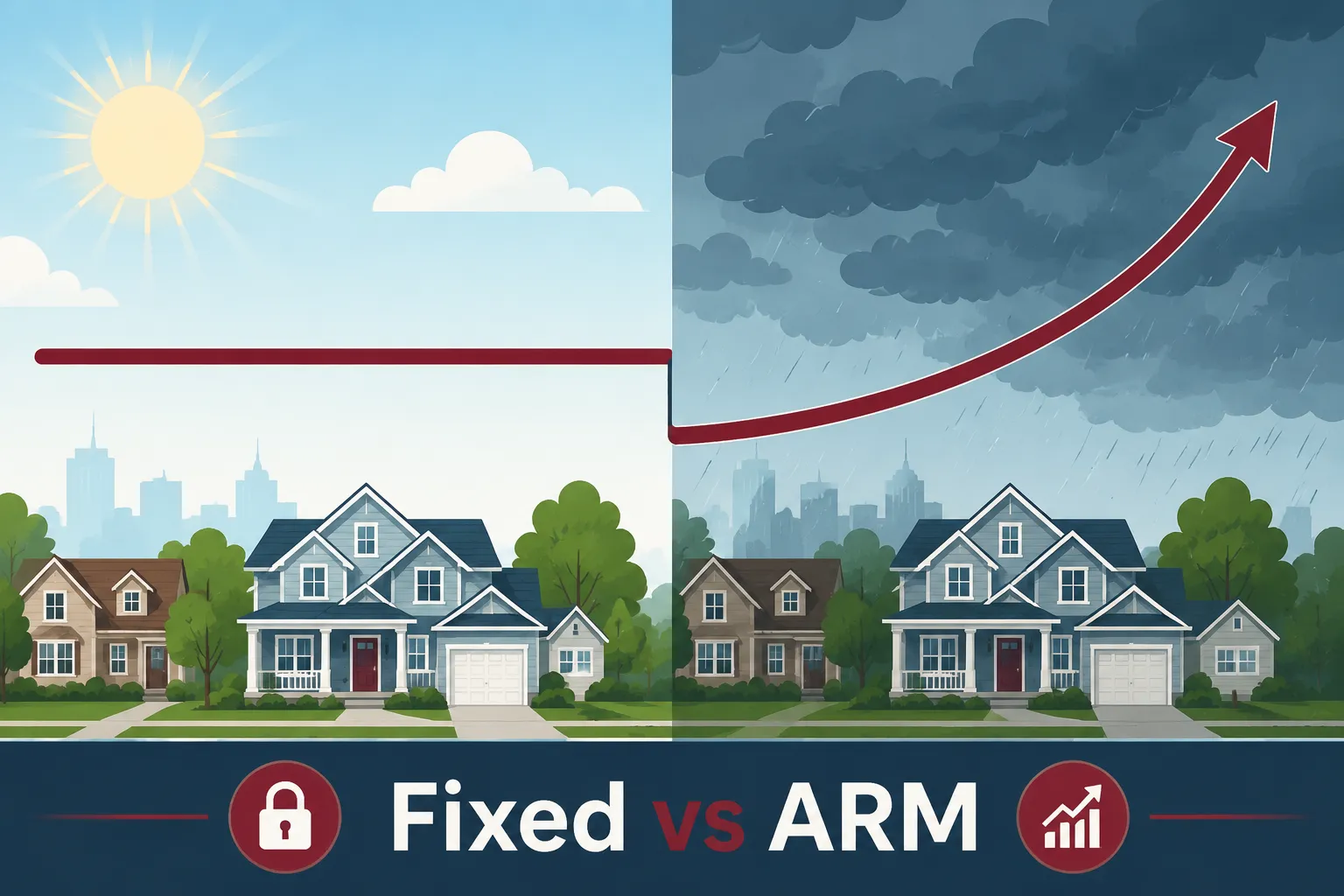
Neither is universally better. The adjustable rate mortgage vs fixed decision comes down to your timeline, risk tolerance, and rate environment.
Choose a fixed-rate mortgage if:
- You plan to stay in the home for more than seven years
- Your budget has little room for payment increases
- You want predictability above all else
- Rates are relatively low and likely to rise
Choose an ARM if:
- You plan to sell or refinance within five to seven years
- You want the lowest possible payment during the early ownership period
- You have strong financial reserves to absorb a rate increase if plans change
- Current ARM mortgage rates vs fixed show a meaningful spread worth capturing
Our breakdown of 15-year vs 30-year mortgage rates in 2026 is worth reading alongside this comparison, the fixed-rate landscape shapes how attractive ARM spreads actually are at any given moment.
What Is an ARM Rate Cap and Why Does It Matter
An ARM rate cap is a contractual limit on how much your interest rate can increase. Caps are the single most important protective feature in any ARM loan, and most buyers do not read them carefully enough.
There are three types of caps to know:
| Cap Type | What It Limits |
|---|---|
| Initial adjustment cap | How much the rate can jump at the first adjustment (commonly 2%) |
| Periodic adjustment cap | How much the rate can change at each subsequent adjustment (commonly 2%) |
| Lifetime cap | The maximum total increase over the life of the loan (commonly 5-6%) |
Adjustable-rate mortgage example with caps: You close on a 5/1 ARM at 5.5% with a 2/2/5 cap structure. At year six, the rate can jump no more than 2%, to 7.5%. Each year after that, it can move no more than 2%. Over the life of the loan, it can never exceed 10.5%.
That 10.5% ceiling sounds extreme, but it is contractually real. Use an adjustable rate mortgage calculator to run those numbers before you sign. The payment difference between 5.5% and 10.5% on a $400,000 loan is roughly $1,100 per month.

When Does an ARM Interest Rate Adjust and How Much Can It Increase
An ARM rate adjusts at the end of the initial fixed period, then annually after that. For a 5/1 ARM, the first adjustment happens at the start of year six. For a 7/1 ARM, it is year eight.
How much can an adjustable rate mortgage increase? That depends entirely on the cap structure in your loan documents. Using a common 2/2/5 structure:
- Year 1 of adjustment: up to 2% above your start rate
- Each year after: up to 2% per adjustment
- Maximum over loan life: 5% above your start rate
So if you started at 6%, the worst-case scenario under a 2/2/5 cap is 11%. That is not a hypothetical scare tactic, that is the contractual maximum your lender can charge.
What is the difference between a 5/1 ARM and a 7/1 ARM? The only difference is the length of the fixed period. A 5/1 ARM locks your rate for five years; a 7/1 ARM locks it for seven. The 7/1 typically carries a slightly higher starting rate than the 5/1, because the lender is taking on more fixed-rate risk. If you are confident you will sell or refinance within five years, the 5/1 ARM often wins on savings. If you need two more years of certainty, the 7/1 is worth the small rate premium.
What Type of Buyer Should Consider an Adjustable Rate Mortgage
The adjustable rate mortgage is it a good idea question has a clear answer: it depends on the buyer's situation. Here is who it genuinely fits, and who it does not.
Strong candidates for an ARM:
- Short-term buyers: Military families, corporate relocators, or anyone with a known move date within five to seven years
- High-income buyers in expensive markets: Buyers who can absorb a rate jump but want to maximize cash flow during the fixed period
- Real estate investors: Investors using short-term holds, fix-and-flip strategies, or bridge scenarios where the property will be sold or refinanced before adjustment
- Buyers expecting income growth: A 25-year-old professional buying their first home who expects significantly higher income by year six has more cushion to absorb a rate adjustment
Poor candidates for an ARM:
- Buyers on fixed or limited incomes with no payment flexibility
- Anyone who plans to stay in the home long-term (10+ years)
- Buyers who are already stretching to qualify, a rate increase could make the payment unmanageable
- Anyone who cannot clearly answer the question: "What is my exit plan before the rate adjusts?"
For first-time buyers still sorting out financing options, our guide on best mortgage options for Gen Z home buyers in 2026 covers ARM alternatives worth comparing.
What Happens to Your Payment When ARM Rates Go Up, Real Payment Shock Examples
Payment shock is what happens when your ARM adjusts upward and your monthly payment jumps significantly. This is one of the most underestimated disadvantages of adjustable rate mortgage products.
Adjustable rate mortgage examples of payment shock:
Assume a $400,000 loan balance at the time of first adjustment:
- Rate goes from 5.5% to 7.5% (2% initial cap): monthly payment increases from approximately $2,271 to $2,797, a jump of $526/month
- Rate goes from 5.5% to 9.5% (two consecutive 2% adjustments): monthly payment climbs to approximately $3,361, a jump of $1,090/month
- Rate hits lifetime cap of 10.5%: monthly payment reaches approximately $3,670, a jump of $1,399/month
These are not edge cases. These are the contractual possibilities built into a standard ARM with a 2/2/5 cap structure. Buyers who enter an ARM without running these numbers are not making an informed decision.
The current rate environment matters here. Our coverage of 2026 real estate trends and how stable 6% rates are reshaping buyer strategies gives useful context for where ARM adjustments could realistically land.
Can You Refinance an ARM Before the Rate Adjusts
Yes, you can refinance an ARM before the rate adjusts, but it is not automatic, and the window is not always open.
What you need to refinance successfully:
- Sufficient equity: Most lenders require at least 20% equity to refinance without PMI. If home values have dropped, you may not have enough.
- Strong credit: Your credit score at refinance time determines your new rate. A score drop since origination can hurt your options.
- Favorable rate environment: If rates have risen significantly, refinancing into a fixed loan may cost more than just riding the ARM adjustment.
- No prepayment penalty: Some ARMs include a prepayment penalty during the fixed period. Read your loan documents.
The honest reality: Refinancing as a backup plan is not a guaranteed escape hatch. Buyers who treat "I'll just refinance before it adjusts" as a certainty are taking on more risk than they realize. Life changes, job loss, divorce, medical expenses, or a market downturn can close that window fast.
For buyers comparing lender options, our breakdown of mortgage broker vs direct lender and which saves investors more is worth reading before you lock in any loan.
How ARM Teaser Rates Work and What the Catch Is
A teaser rate is the below-market introductory rate that makes ARMs look so attractive at origination. It is not a trick exactly, but it is designed to be compelling, and it works.
How teaser rates are structured:
Lenders price 5/1 ARM rates today lower than 30-year fixed rates because they are only committed to that rate for five years. After that, the risk transfers to you. The teaser rate is real savings, during the fixed period, you genuinely pay less. The catch is what comes after.
The actual catch:
- The teaser rate creates a payment you may budget around permanently
- When the rate adjusts, the psychological shock of a higher payment hits harder because you have been anchored to the lower number
- Some buyers stretch their purchase price because the ARM payment makes a more expensive home feel affordable, then face payment shock when the rate adjusts on a larger balance
So based financial planning means running the worst-case ARM scenario before you run the best-case one. If the worst-case payment breaks your budget, the teaser rate is not worth it.
Are ARMs a Good Idea in a Rising Interest Rate Environment
In a rising rate environment, ARMs carry meaningfully more risk than in a stable or falling rate environment. This is the most direct answer to the question.
Why rising rates hurt ARM borrowers:
- Your index (SOFR or equivalent) rises with broader rate increases
- At adjustment, your new rate is index + margin, both components are working against you
- Refinancing into a fixed rate becomes more expensive, potentially eliminating the escape option
- Home values may soften in rising rate environments, reducing your equity cushion
When ARMs still make sense despite rising rates:
- If you are absolutely certain you will sell before the first adjustment
- If the ARM spread over fixed is still wide enough to justify the risk for your specific hold period
- If you have strong financial reserves and can absorb worst-case payment scenarios
The federal government's $200 billion MBS purchase program and its effect on mortgage rates in 2026 is directly relevant here, policy interventions like this affect both fixed and ARM rate spreads in real time.

Common Mistakes People Make With Adjustable Rate Mortgages
The adjustable rate mortgage pros and cons conversation is incomplete without naming the mistakes that turn a smart financial tool into a financial problem.
Mistake 1: No exit plan. Buying an ARM without a clear, realistic plan to sell or refinance before adjustment is the most common and most costly error.
Mistake 2: Not reading the cap structure. Many buyers know their starting rate but cannot tell you their initial cap, periodic cap, or lifetime cap. Those numbers define your worst-case scenario.
Mistake 3: Stretching purchase price. Using the lower ARM payment to justify buying more home than you could afford on a fixed rate is gate keeping your own financial stability, and not in a good way.
Mistake 4: Assuming refinancing will always be available. Market conditions, credit changes, and equity fluctuations can all close the refinancing window at the worst possible time.
Mistake 5: Ignoring the index. Not all ARM indexes move the same way. Understanding what benchmark your loan is tied to and how it has historically behaved is basic due diligence that most buyers skip.
Mistake 6: Underestimating payment shock psychologically. Even buyers who can technically afford the higher payment often find the stress of annual uncertainty affects their quality of life in ways they did not anticipate.
How Much Can You Save With an ARM Compared to a Fixed Rate
The savings during the fixed period are real and meaningful, but they require context to evaluate fairly.
Estimated monthly savings (2026 rate environment, approximate):
Assume a $400,000 loan. Based on current ARM mortgage rates today vs 30-year fixed:
- 30-year fixed at 6.75%: approximately $2,594/month (principal + interest)
- 5/1 ARM at 5.75%: approximately $2,334/month
- Monthly savings: approximately $260/month
- 5-year savings: approximately $15,600
That $15,600 is real money. The question is whether it justifies the risk of a rate adjustment in year six. For a buyer who is 95% certain they will sell in four years, that math is extraordinary. For a buyer who might stay longer, the calculus shifts.
Use an adjustable rate mortgage calculator to run your specific numbers. Plug in your loan amount, the current ARM rate, the fixed rate you qualify for, and your expected hold period. Let it cook before you see results, the five-year picture looks very different from the ten-year picture.
For current rate benchmarks, our current mortgage rates page for 2026 has updated figures worth checking before you run your calculations.
Frequently Asked Questions
What is the adjustable rate mortgage definition in simple terms?
An adjustable rate mortgage is a home loan where the interest rate is fixed for an initial period (typically 3, 5, 7, or 10 years), then adjusts annually based on a market index plus a lender margin. The rate can go up or down at each adjustment, subject to contractual caps.
What are 5/1 ARM rates today in 2026?
5/1 ARM rates today in 2026 are generally running between 5.5% and 6.5% depending on the lender, borrower credit profile, and loan size. Always compare at least three lenders before locking, as ARM pricing varies more than fixed-rate pricing across institutions.
How does an adjustable-rate mortgage work after the fixed period ends?
After the fixed period, the lender recalculates your rate using the current index plus your margin. If the index has risen, your rate and payment increase. If it has fallen, they decrease. This recalculation happens annually on most modern ARMs.
Is an adjustable rate mortgage a good idea for first-time buyers?
It can be, but only if the buyer has a clear exit plan, strong financial reserves, and a realistic understanding of the worst-case payment scenario. First-time buyers with tight budgets and long-term ownership plans are generally better served by a fixed-rate loan.
What is the difference between ARM mortgage rates vs fixed rates?
ARM mortgage rates vs fixed rates: ARMs start lower because the lender only commits to that rate for the fixed period. The spread in 2026 typically ranges from 0.5% to 1.25%. Fixed rates offer certainty for the full loan term; ARMs offer savings upfront and uncertainty afterward.
Can my ARM rate ever go down after it adjusts?
Yes. If the benchmark index drops, your rate adjusts downward at the next adjustment date. This is one of the genuine pros of adjustable rate mortgage structures that gets less attention than the upside risk.
What is payment shock and how do I avoid it?
Payment shock is the sudden increase in your monthly payment when an ARM adjusts upward. Avoid it by running worst-case cap scenarios before you close, maintaining financial reserves, and having a concrete exit plan (sale or refinance) before the first adjustment date.
How much can an adjustable rate mortgage increase per year?
Under a standard 2/2/5 cap structure, your rate can increase no more than 2% at the first adjustment, 2% per year after that, and 5% total over the life of the loan. Always confirm your specific cap structure in your loan estimate documents.
What is the catch with ARM teaser rates?
The teaser rate is genuine, you really do pay less during the fixed period. The catch is that it anchors your budget to a payment that will not last, and some buyers use it to justify purchasing more home than they could sustain at a higher rate.
Should real estate investors use ARMs?
ARMs can be a fresh and impeccable tool for investors with short hold periods, fix-and-flip operators, short-term rental investors, or buyers planning to refinance into a DSCR loan after stabilization. For long-term buy-and-hold investors, the payment unpredictability is a liability.
What happens if I cannot refinance before my ARM adjusts?
You ride the adjustment. Your rate resets based on the index plus margin, subject to your caps. If the new payment is unaffordable, you may face financial hardship. This is why having a backup plan, and genuine reserves, is non-negotiable before taking an ARM.
Is an ARM better than a fixed mortgage in 2026?
Neither is universally better. In 2026's rate environment, ARMs offer a real savings spread over fixed loans during the fixed period. Whether that spread justifies the post-adjustment risk depends on your specific hold period, financial cushion, and confidence in your exit strategy.
Conclusion: What to Do With This Information
The adjustable rate mortgage pros and cons, no sugarcoat version comes down to this: ARMs are not inherently dangerous, and they are not inherently smart. They are a tool, and like any tool, the outcome depends on how well you understand it before you use it.
Actionable next steps:
Run your numbers. Use an adjustable rate mortgage calculator with your actual loan amount, the current ARM rate you qualify for, and the 30-year fixed rate. Calculate both the savings during the fixed period and the worst-case payment at the lifetime cap.
Define your exit plan. Write down exactly how you plan to exit the ARM before the rate adjusts, sale date, refinance trigger, or income milestone. If you cannot write it down clearly, you are not ready for an ARM.
Read your cap structure. Before signing any ARM loan, locate the initial adjustment cap, periodic cap, and lifetime cap in your loan estimate. Calculate the worst-case payment at the lifetime cap. Make sure your budget can handle it.
Compare at least three lenders. ARM pricing varies more than fixed pricing. A broker can often find better ARM terms than a single direct lender. Our guide on comparing mortgage options is a solid starting point.
Check the current rate environment. ARM decisions are rate-environment-sensitive. Stay current on where rates are headed using resources like our spring 2026 housing market outlook.
The adjustable rate mortgage pros and cons are real on both sides. The buyers who win with ARMs are the ones who go in with eyes open, numbers run, and a plan that does not rely on hope. That is not gatekeeping, that is just how impeccable financial decisions get made.