
Last updated: August 23, 2026

Quick Answer
Multigenerational living is how 25% of Boomers buy now, according to NAR's 2026 Generational Trends Report, making it the fastest-growing home purchase motivation among buyers aged 61 to 79. These buyers are specifically seeking homes with in-law suites, separate entrances, ADUs, or next-gen floor plans that allow multiple adult generations to share a property while maintaining independent living spaces. The trend is driven by aging parent care needs, shared housing costs in a high-price market, and a desire to stay close to grandchildren.
Key Takeaways
- NAR's 2026 Generational Trends Report shows Baby Boomers represent 42% of all buyers and 55% of all sellers, with 25% citing multigenerational needs as a primary purchase motivator.
- The most common reasons families pursue multigenerational home buying are caring for aging parents, cost-sharing on a mortgage, and housing adult children who cannot yet afford to buy independently.
- Fannie Mae's HomeReady loan and FHA loans both allow non-occupant co-borrowers, making a mortgage with a co-borrower parent a legitimate financing path.
- A gift of equity family purchase allows a relative to sell a home below market value, with the equity difference counting toward the buyer's down payment.
- Joint tenancy vs tenants in common are the two primary ways to title a home with multiple owners, and the choice has significant estate planning consequences.
- ADUs for aging parents are legal in most U.S. states following a wave of state-level ADU reform laws passed between 2020 and 2025.
- Multigenerational house plans differ from duplexes in that they share a primary structure but include legally connected private living zones, while duplexes are typically two fully separate units on one lot.
- Selling a multigenerational home later requires attention to how the property was titled, whether any ADU permits were pulled, and how capital gains are allocated between owners.
What Is Multigenerational Living and Why Are Boomers Choosing It
Multigenerational living means two or more adult generations sharing a single property, whether that's parents and adult children, grandparents and grandchildren, or a combination of all three. It is not a new concept, but the scale at which Boomers are pursuing it in 2026 is striking.
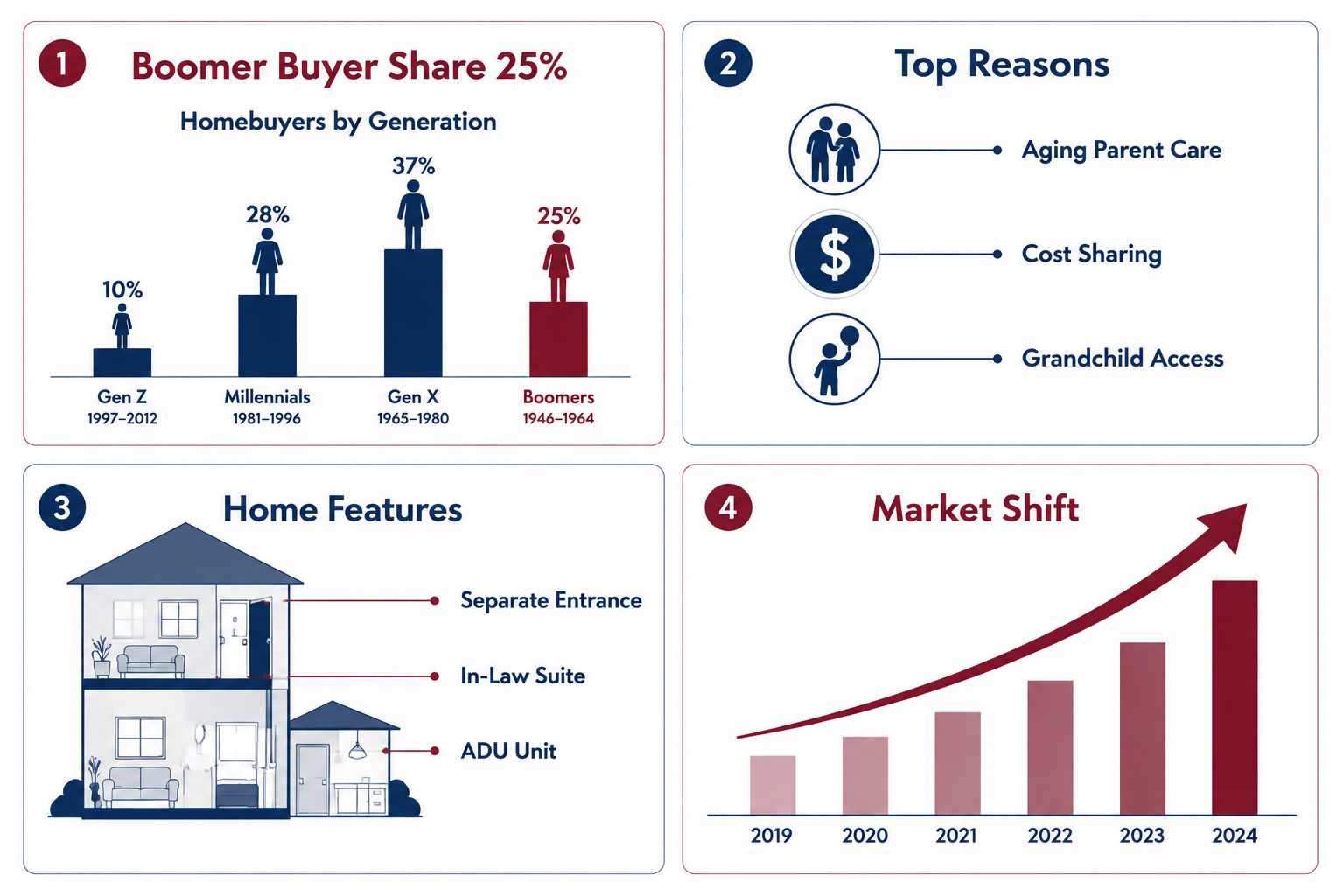
NAR's 2026 Generational Trends Report found that Baby Boomers (ages 61 to 79) make up 42% of all buyers and 55% of all sellers in the current market. Of those Boomer buyers, 25% are purchasing specifically for multigenerational reasons. That is not a rounding error. One in four Boomer purchases is structured around housing multiple generations under one roof.
The reasons break down clearly:
- Caring for aging parents, 41% of multigenerational buyers cite this as the primary driver
- Cost savings, shared mortgage, utilities, and maintenance costs across two incomes
- Housing adult children, adult children who cannot afford to buy independently in a market where the median home price sits at $434,100 (NAR, July 2026)
- Proximity to grandchildren, especially relevant for Boomers relocating after retirement
There is also a cultural shift at play. The pandemic years normalized the idea of extended family living together, and a generation that watched their own parents age in assisted living facilities is choosing a different path. That choice is now showing up in purchase contracts, floor plan requests, and mortgage applications across the country.
For agents, this is new territory that the standard buyer consultation script was not built for. The buyer is not just picking a neighborhood. They are picking a property that works for three generations simultaneously, which changes everything from the showing checklist to the financing conversation.
Multigenerational Living Is How 25% of Boomers Buy Now: The Full Picture
The 25% figure deserves more context because it tells a bigger story about where the housing market is heading.
Boomers are the dominant force in real estate right now. They are the largest buyer cohort at 42% of purchases and the largest seller cohort at 55% of listings. When one in four of those buyers is specifically seeking a multigenerational setup, that creates real demand pressure on a specific type of inventory: homes with in-law suites, next-gen home floor plans, detached ADUs, and properties with separate living quarters.
That demand is not being met by existing inventory. Most U.S. housing stock was built for nuclear families, not multigenerational ones. The typical American home was built in 1994 (NAR, 2025 Profile of Home Buyers and Sellers). It has one kitchen, one living area, and no secondary entrance. Buyers looking for multigenerational house plans are often forced to either build new, buy and renovate, or specifically hunt for the small percentage of existing homes that already have a secondary suite.
This supply gap is why multigenerational home buying has become a specialized search, not a casual preference. Buyers in this category search longer, make more specific requests, and are often willing to pay a premium for the right layout.
The new listings boom in March 2026 added inventory across many markets, but the share of that inventory with true multigenerational configurations remains thin. That gap is both a challenge for buyers and an opportunity for sellers who own properties with secondary suites.
How Much Does It Cost to Buy a Multigenerational Home
Multigenerational homes carry a price premium over standard single-family homes, and the size of that premium depends on what type of setup you are buying.
Existing homes with in-law suites: Expect to pay 10% to 20% above comparable homes without a secondary suite, based on current market patterns. In high-cost metros like San Jose, Seattle, or Denver, that premium can exceed $100,000 on an absolute basis.
New construction next-gen home floor plans: Major builders including Lennar (with their "NextGen" product line) and others have developed purpose-built multigenerational floor plans. These typically run $50,000 to $150,000 above a comparable standard floor plan from the same builder, depending on the size of the attached suite.
Adding an ADU for aging parents to an existing property: The cost to build a detached ADU ranges from $150,000 to $350,000 depending on size, local labor costs, and permit requirements. Attached ADU conversions (converting a garage or basement) run lower, typically $80,000 to $150,000.
Renovation to create a secondary suite: Converting existing space into a proper in-law suite home with a kitchenette, private bath, and separate entrance runs $40,000 to $120,000 depending on scope.
Beyond the purchase price, buyers need to account for:
- Higher property taxes on a larger or improved property
- Separate utility metering costs if desired
- Permit fees for any ADU or suite construction
- Accessibility features for aging in place (grab bars, wider doorways, zero-step entries) which add $5,000 to $30,000 depending on scope
For buyers watching the senior housing market, the Senior Housing Boom 2026 report provides useful context on what purpose-built senior communities cost as an alternative benchmark.
Multigenerational Home Mortgage Options and Financing
Most standard mortgage products work for multigenerational purchases, but a few specific programs are designed with this buyer in mind.
Fannie Mae HomeReady: This conventional loan program explicitly allows income from a non-borrower household member (like a parent living in the home) to be used as a compensating factor. It also permits non-occupant co-borrowers, making a mortgage with a co-borrower parent a clean path for families where the parent's income or assets strengthen the application.
FHA loans: FHA allows non-occupant co-borrowers as well, which is useful when an adult child is buying and a parent wants to co-sign without living in the property full-time. The FHA co-borrower must still meet credit and income standards.
Gift of equity family purchase: If a family member is selling their home to a relative below market value, the difference between the sale price and the appraised value counts as a "gift of equity." This can be applied toward the buyer's down payment, sometimes eliminating the need for any cash down. Lenders require a gift letter and the transaction must be arm's-length in documentation.
VA loans: For the 18% of buyers who are veterans or have a veteran in the household, VA loans allow a spouse co-borrower but are more restrictive on non-spouse co-borrowers. Veterans pursuing multigenerational purchases should confirm co-borrower eligibility with their lender before structuring the deal.
HELOC on existing equity: For Boomer buyers who already own a home with substantial equity, a home equity line of credit can fund an ADU construction project without refinancing the primary mortgage.
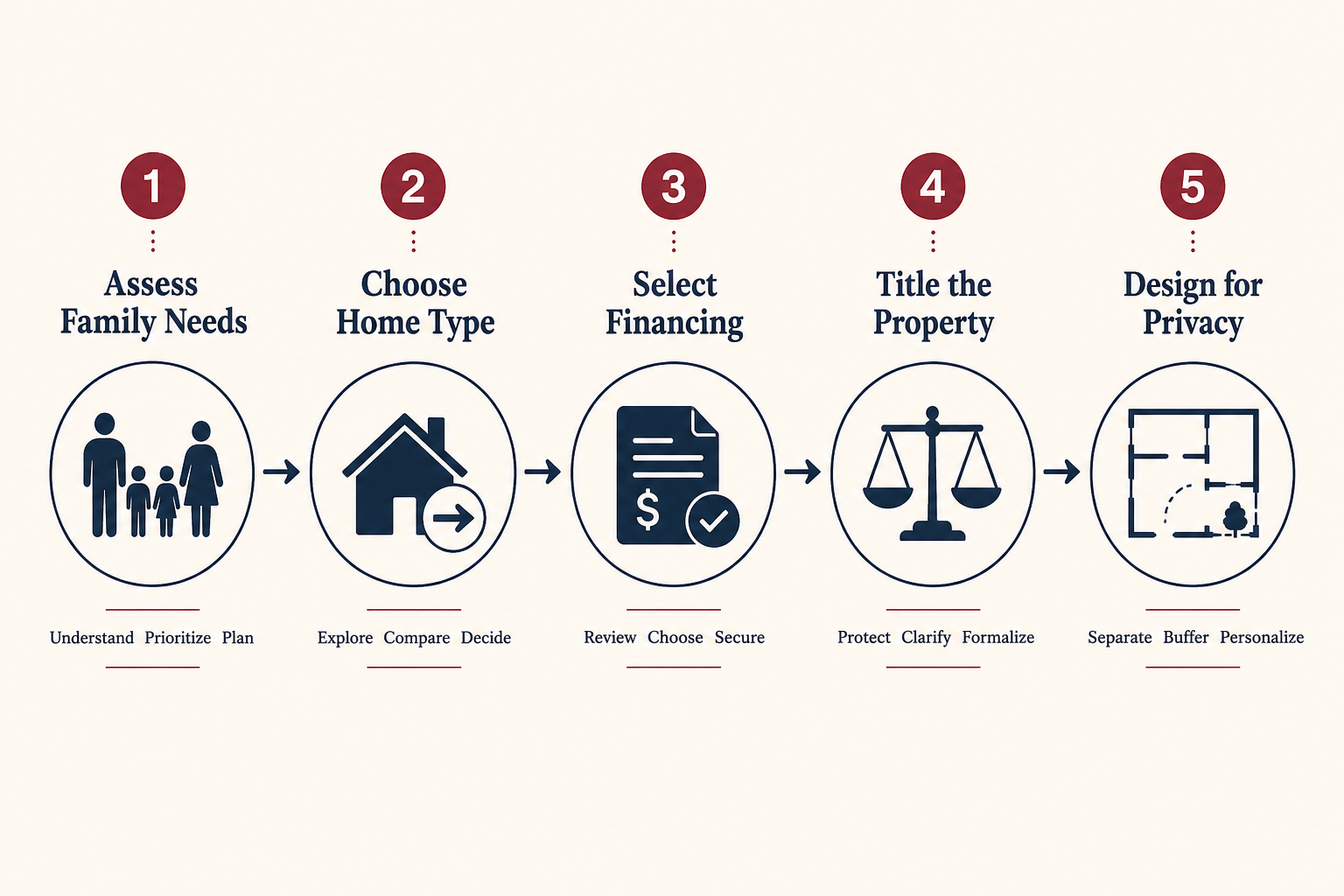
One financing mistake families make frequently: they apply for the mortgage before deciding how to title the property. The ownership structure affects who can be on the loan, how income is counted, and what happens to the property if one owner dies or wants to sell their share. Get the title conversation done first.
How to Title a Home With Multiple Owners: Joint Tenancy vs Tenants in Common
How you title a multigenerational property is one of the most consequential decisions in the entire purchase, and most families make it at the closing table without fully understanding the difference.
Joint tenancy means all owners hold equal shares and have the right of survivorship. If one owner dies, their share automatically passes to the surviving owners without going through probate. This sounds clean, but it creates problems when the owners do not hold equal financial stakes. If a parent contributes 40% of the down payment and an adult child contributes 60%, joint tenancy still gives each party 50% ownership.
Tenants in common allows owners to hold unequal shares and pass their share to heirs of their choosing through a will. A parent can own 30% and a child can own 70%, and each can leave their share to whoever they designate. There is no right of survivorship.
Which to choose:
- Choose joint tenancy if all owners contribute equally and want the simplest possible estate transfer
- Choose tenants in common if contributions are unequal, if owners want to protect their share for specific heirs, or if there is any possibility one party may want to sell their share independently
Tenancy by the entirety is a third option available only to married couples in some states. It provides strong creditor protection and automatic survivorship rights.
For any multigenerational purchase involving parents and adult children, tenants in common with a clearly documented ownership percentage is typically the more protective structure. A real estate attorney should draft or review the deed before closing. This is not the place to rely on a title company's boilerplate.
What Is the Difference Between a Multigenerational Home and a Duplex
A multigenerational home and a duplex are not the same thing, and the distinction matters for zoning, financing, and how you sell later.
Multigenerational home: A single-family residence with an attached or detached secondary living space. The primary structure is one legal unit. The secondary space (in-law suite, ADU, next-gen suite) may have its own entrance, kitchen, and bathroom, but the property is typically zoned and taxed as a single-family home. Financing follows standard single-family mortgage guidelines.
Duplex: Two fully separate dwelling units on one lot, each with its own address, utilities, and legal status. A duplex is classified as a two-unit residential property. Financing follows different guidelines (often requiring 15% to 25% down), and lenders may count rental income from the second unit toward qualification.
The practical differences:
| Feature | Multigenerational Home | Duplex |
|---|---|---|
| Zoning | Single-family | Multi-family or two-unit |
| Separate addresses | Usually no | Yes |
| Financing | Conventional/FHA single-family | Two-unit mortgage guidelines |
| Rental income counted | Generally no | Yes, with documentation |
| Privacy level | Shared walls common | Fully separate units |
| Resale pool | Broader (single-family buyers) | Narrower (investor-focused) |
For families who want to house a parent or adult child, a multigenerational home is usually the cleaner path. For families who also want the option to rent one unit to a non-family tenant, a duplex or a property with a separately permitted ADU may offer more flexibility. Our guide to multi-family real estate investments covers the duplex path in detail for anyone considering that route.
Best States for Multigenerational Living in 2026
The best states for multigenerational living combine permissive ADU laws, reasonable housing costs, and strong healthcare infrastructure for aging family members.
Top states based on ADU permissiveness, housing costs, and quality of life:
California, ADU laws are among the most permissive in the country following state-level reforms in 2020 through 2023. Homeowners can build ADUs by right in most jurisdictions with minimal local interference. The tradeoff is high base housing costs.
Texas, No state income tax, relatively affordable land in secondary metros like San Antonio and El Paso, and minimal ADU restrictions in most municipalities. Strong multigenerational housing culture in Hispanic communities.
Florida, High retiree population, strong healthcare infrastructure, and a growing number of new-construction communities with multigenerational floor plans. No state income tax is a draw for Boomer sellers relocating from high-tax states.
Arizona, Phoenix and Tucson have seen significant multigenerational development activity, with builders offering next-gen home floor plans specifically. Warm climate supports aging in place year-round.
Georgia, Atlanta suburbs offer affordable land, strong school systems for grandchildren, and a cost of living that allows families to stretch a combined income further. ADU regulations vary by county.
Virginia and North Carolina, Both states have strong healthcare systems, moderate housing costs outside major metros, and growing populations of Boomer retirees relocating from the Northeast.
For a broader look at where families can find affordable, livable markets, the top safest affordable cities in the U.S. ranking covers livability data across multiple metrics.
Tax Benefits of Multigenerational Living Arrangements
Multigenerational living can generate real tax advantages, but they require intentional structuring.
Mortgage interest deduction: If the property is owned jointly and both owners are on the mortgage, each owner can deduct mortgage interest proportional to their ownership share on their individual tax returns. This is particularly valuable when a high-income adult child and a retired parent share ownership.
ADU rental income: If the ADU or secondary suite is rented to a non-family tenant (rather than occupied by a family member), the rental income is taxable but the owner can deduct ADU-related expenses including depreciation, repairs, insurance, and a proportional share of mortgage interest and property taxes.
Capital gains exclusion on sale: The primary residence capital gains exclusion ($250,000 per individual, $500,000 for married couples filing jointly) applies to the primary home. If the property is titled with multiple owners, each owner may be eligible for their own exclusion on their proportional share of the gain, depending on how long they have lived in the home as their primary residence. This is a significant benefit for families who have held the property for 10 or more years.
Accessibility improvements: The IRS allows a medical expense deduction for home modifications made for medical reasons, such as installing grab bars, widening doorways, or adding a wheelchair ramp for an aging parent. The deductible amount is the cost that exceeds any increase in the property's fair market value.
Dependent care: If a parent living in the home qualifies as a dependent, the adult child who provides more than half of their support may be able to claim them as a dependent on their federal return.
Tax situations in multigenerational households get complicated fast. A CPA who specializes in real estate and estate planning is worth the consultation fee before the purchase closes.
Common Problems With Multigenerational Homes and How to Avoid Them
Families who go into multigenerational home buying without a clear plan tend to hit the same walls. Here are the ones that show up most often, and what to do about each.
Privacy conflicts: The most common complaint in multigenerational households is insufficient privacy. A door between the main house and the in-law suite that stays open becomes a source of daily friction. Solve this at the design stage, not after move-in. Separate entrances, soundproofing between shared walls, and clearly defined "knock first" norms prevent most of these conflicts.
Unclear financial agreements: Who pays which utilities? Who handles the mortgage if one party loses income? Who pays for a major repair? These conversations feel awkward before the purchase and become explosive after it. A written family financial agreement, reviewed by an attorney, is not overkill. It is basic protection.
Accessibility features aging in place ignored until crisis: Families often buy for a parent who is currently mobile and healthy, then face a renovation scramble when mobility declines. Building accessibility features in at purchase or during initial renovation costs far less than retrofitting later. Zero-step entries, wider doorways (36 inches minimum), curbless showers, and blocking in walls for future grab bars are the four features worth doing upfront.
Permit problems on the secondary suite: Unpermitted in-law suites are common in older housing stock. Buying a home with an unpermitted suite means inheriting potential code violations, which can complicate insurance, financing, and the eventual sale. Always verify permit history before closing.
Exit strategy not discussed: What happens when the arrangement no longer works? If a parent passes away, does their share of the property go to the other owner or to other heirs? If an adult child wants to sell their share, does the other owner have right of first refusal? These scenarios need to be addressed in the ownership agreement before they become emergencies.
For design ideas that help smaller shared spaces feel larger and more functional, the 10 interior design ideas that make your small living room look expensive guide has practical applications for multigenerational common areas.
How to Design a Multigenerational Home for Privacy and Independence
Good multigenerational home design is based on one principle: shared when chosen, private when needed.
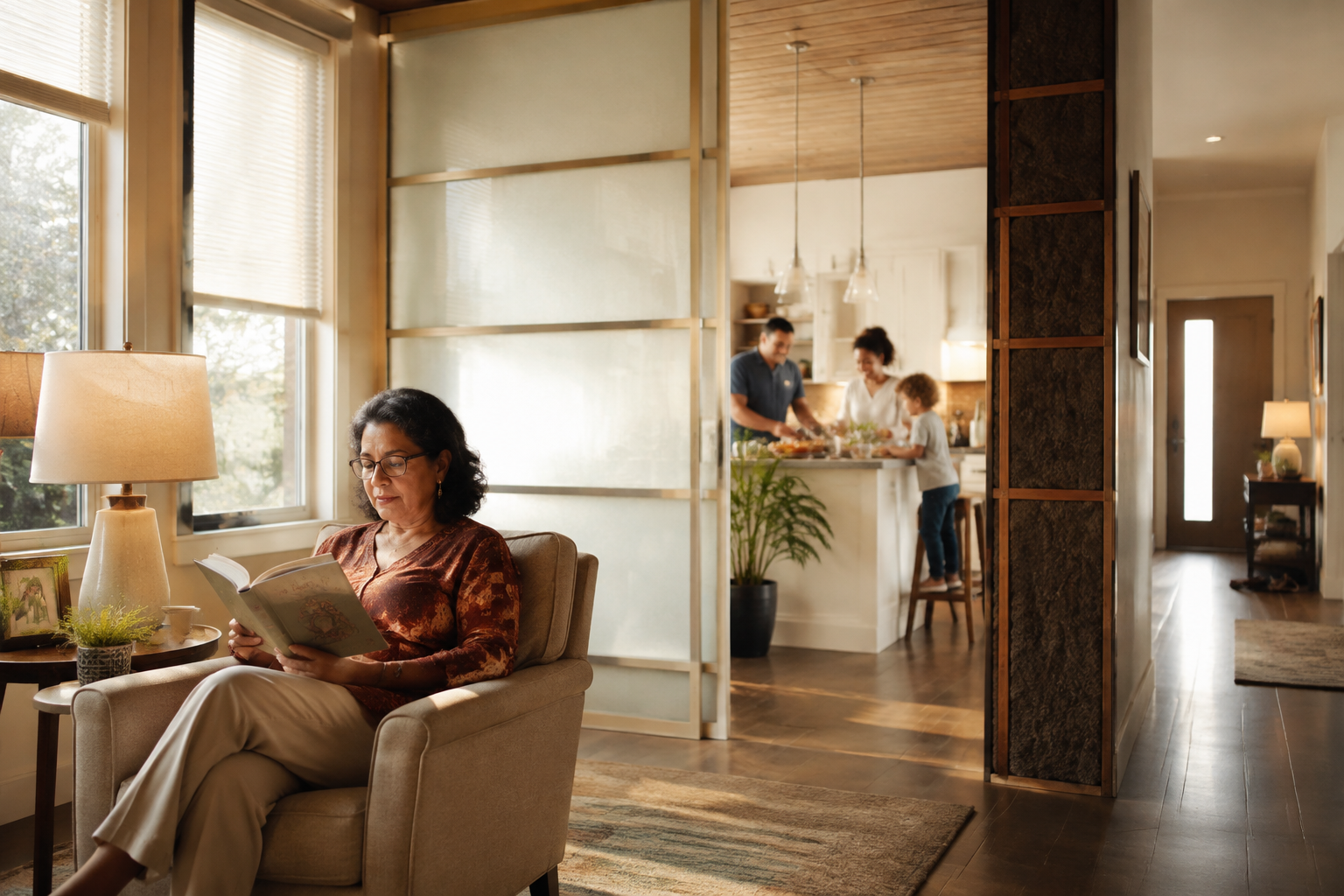
The most successful multigenerational house plans share these features:
Separate entrances: Each living zone should have its own exterior door. This is the single most important design element. It allows family members to come and go independently without passing through each other's space.
Sound separation: Shared walls between living zones should include acoustic insulation. Bedrooms should not share walls with the other unit's common areas. This is inexpensive to build in during construction and expensive to retrofit.
Independent utilities or sub-metering: Even if utilities are paid from a shared account, sub-metering allows each household to track their own usage. This prevents resentment over unequal consumption.
Accessible design in the parent suite: The parent or grandparent suite should be designed for aging in place from day one. Single-floor living, no-step shower entry, grab bar blocking in bathroom walls, lever door handles instead of knobs, and adequate lighting throughout.
Shared spaces that are optional: A shared outdoor space, garden, or covered patio that both households can use but neither is required to use creates connection without obligation.
Laundry: Each unit should ideally have its own washer and dryer hookups. Shared laundry is a consistent source of friction in multigenerational households.
For next-gen home floor plan buyers shopping new construction, ask builders specifically about: the thickness of the shared wall, whether the secondary suite has its own HVAC zone, and whether the suite's kitchen has full-size appliances or a kitchenette. Those three questions separate a true multigenerational design from a marketing label on a standard floor plan.
Legal Considerations for Multigenerational Property Ownership
Beyond the title structure covered earlier, multigenerational property ownership involves several legal considerations that families frequently overlook.
Estate planning alignment: The way the property is titled must align with each owner's will and estate plan. A parent who titles a property as joint tenants with an adult child may inadvertently disinherit other children who expected to share in the estate. Get an estate attorney involved before the deed is recorded.
Power of attorney for property decisions: If a parent co-owner becomes incapacitated, who has legal authority to make decisions about the property? A durable power of attorney naming a specific agent prevents the property from becoming frozen in a guardianship proceeding.
Cohabitation or co-ownership agreement: This is a private contract between the owners that covers financial contributions, decision-making authority, maintenance responsibilities, and exit procedures. It is not a standard closing document. Families have to create it intentionally, ideally with an attorney.
Zoning compliance for the secondary suite: Before purchasing a home with an in-law suite home or ADU, verify that the suite is legally permitted for occupancy under local zoning. Some jurisdictions restrict occupancy of secondary suites to family members only, which affects resale flexibility.
Insurance: Standard homeowner's insurance policies may not cover a secondary suite used as a separate dwelling. Notify your insurer of the property's configuration and confirm coverage. Some insurers require a separate landlord policy for an ADU, even when occupied by family.
Multigenerational Living vs Assisted Living for Aging Parents
For families deciding between multigenerational home buying and placing a parent in assisted living, the financial comparison is stark.
Assisted living in the U.S. costs a national median of approximately $4,500 to $6,000 per month in 2026, based on Genworth's annual Cost of Care survey data. Memory care facilities run $5,500 to $8,000 per month. Over five years, that is $270,000 to $480,000 in care costs, none of which builds equity.
A multigenerational purchase or ADU build typically costs $80,000 to $350,000 in additional investment above a standard home purchase, and that investment stays in the property's value.
Choose multigenerational living when:
- The parent is mobile and cognitively independent
- The family can provide daily support without professional medical care
- The parent values independence and does not want an institutional setting
- The financial math favors ownership over monthly care fees
Consider assisted living when:
- The parent requires skilled nursing or memory care that family members cannot provide
- The parent prefers a community setting with peers
- The family's home cannot be modified for the parent's medical needs
- Geographic distance makes daily family support impractical
Many families find a middle path: multigenerational living in the early years of a parent's aging, with a transition to assisted living if and when medical needs increase. Designing the ADU or suite with resale flexibility in mind (so it can be rented or used differently later) preserves options.
Selling a Multigenerational Home Later
Selling a multigenerational home is more complex than a standard sale, and families who plan for it from the start have a much easier exit.
Title clarity is everything: Before listing, all owners need to be aligned on the sale. If the property is held as tenants in common and one owner does not want to sell, the other owner may need to pursue a partition action through the courts. This is expensive and slow. A co-ownership agreement with a clear buyout or sale trigger prevents this.
Permit documentation: Buyers and their lenders will scrutinize any secondary suite. Have permit documentation for the ADU or in-law suite ready. An unpermitted suite either needs to be permitted before listing or disclosed as unpermitted, which limits the buyer pool.
Marketing to the right buyer: A multigenerational home sells best when marketed to multigenerational buyers. This is a growing but still specific pool. Agents should list the secondary suite's features explicitly: square footage, separate entrance, kitchen configuration, and accessibility features. Photos of the secondary suite are as important as photos of the main home.
Capital gains allocation: If multiple owners are on the title, each owner's capital gains are calculated based on their ownership percentage and their own cost basis. Owners who have not lived in the home as a primary residence for two of the last five years do not qualify for the primary residence exclusion on their share. This matters when a parent co-owns but has been in assisted living for the past three years.
Pricing: Multigenerational homes with well-designed secondary suites command a premium in most markets. The key is finding a buyer who values the configuration. Pricing to the multigenerational buyer pool rather than the standard single-family comparable pool typically produces a better outcome.
Is Multigenerational Living Right for My Family
Multigenerational living works well for families who go in with clear agreements, realistic expectations, and a property designed for the arrangement. It fails for families who treat it as a temporary fix without addressing the structural and relational requirements.
Strong candidates for multigenerational home buying:
- Families where a parent needs daily support but not skilled nursing care
- Adult children who cannot afford to buy independently in their target market
- Families with strong communication norms and a history of managing shared decisions
- Buyers in markets where ADU laws are permissive and construction costs are manageable
- Families where the financial math clearly favors ownership over assisted living costs
Situations where it may not work:
- Families with significant existing conflict between the generations involved
- Situations where the parent requires medical care beyond what family members can provide
- Markets where multigenerational homes are so scarce that the search becomes impractical
- Buyers who cannot afford the premium for a properly configured multigenerational property
The so-based truth about this trend is that it is not just a lifestyle choice. For many Boomer buyers, multigenerational living is a financial strategy, a caregiving solution, and an estate planning move all in one purchase. That is why 25% of Boomers are buying this way now, and that number is not going down.
FAQ
What percentage of Boomers buy multigenerational homes?
According to NAR's 2026 Generational Trends Report, 25% of Baby Boomer buyers (ages 61 to 79) purchase homes for multigenerational reasons, making it the most common multigenerational buyer cohort by share.
Can I get a mortgage for a multigenerational home with my parent as a co-borrower?
Yes. Fannie Mae's HomeReady loan and FHA loans both allow non-occupant co-borrowers. Your parent can co-sign the mortgage without living in the home full-time, and their income or assets can strengthen the application.
What is the difference between an in-law suite and an ADU?
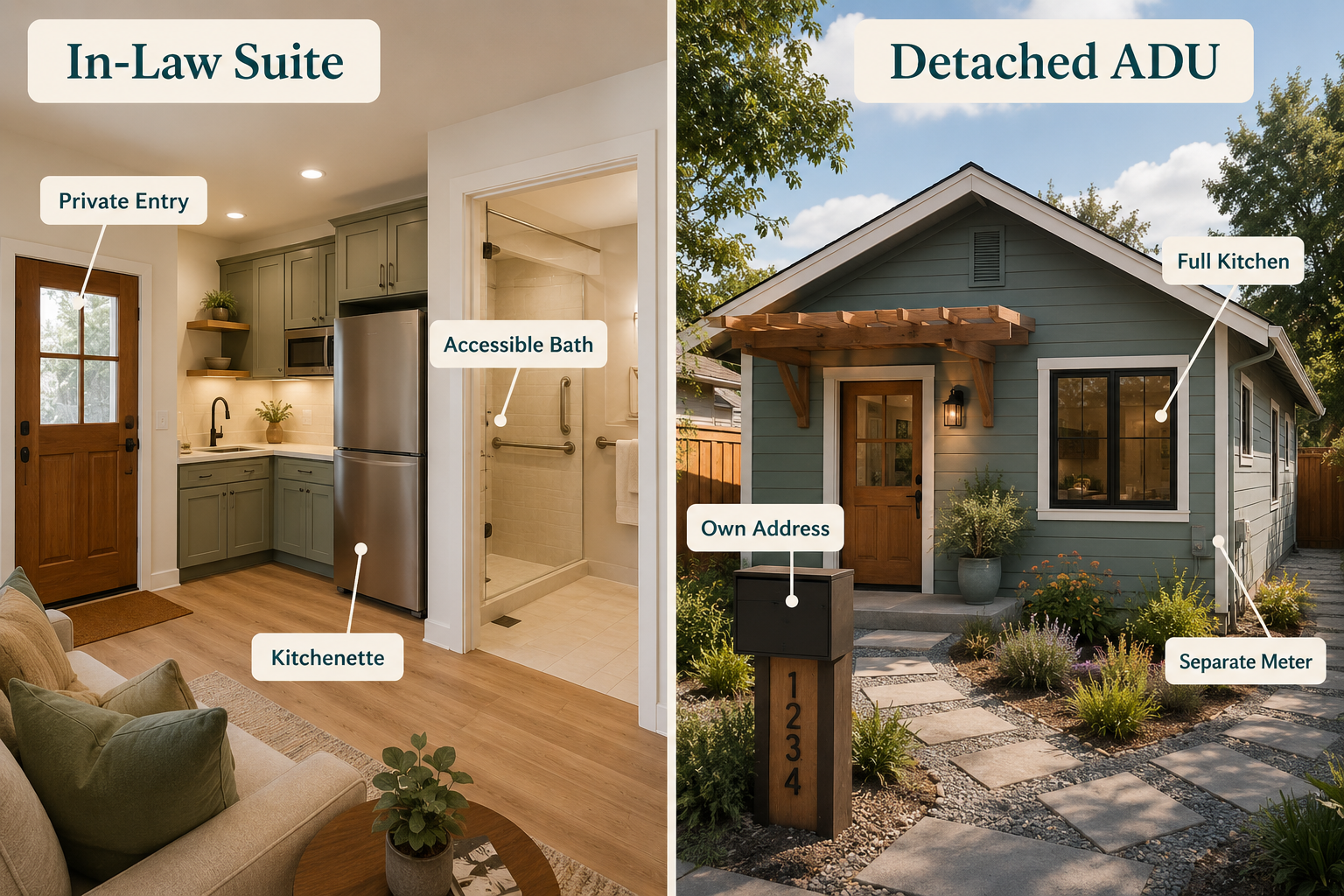
An in-law suite is typically an attached secondary living space within the main home structure, sharing at least one wall. An ADU (accessory dwelling unit) can be attached or detached and is a more formally permitted separate dwelling unit, often with its own address and utilities.
Is joint tenancy or tenants in common better for a multigenerational purchase?
Tenants in common is generally better for multigenerational purchases because it allows unequal ownership shares and lets each owner pass their share to their chosen heirs. Joint tenancy forces equal shares and automatic survivorship, which can create estate planning problems.
Do multigenerational homes cost more than standard homes?
Yes, typically 10% to 20% more than comparable homes without secondary suites in the same market. New construction next-gen floor plans from major builders add $50,000 to $150,000 above a standard floor plan.
What accessibility features should I build into a multigenerational home for aging parents?
The four most important features are: zero-step exterior entry, curbless shower with blocking for grab bars, 36-inch-wide doorways, and single-floor living for the parent suite. These are far cheaper to build in during construction or initial renovation than to add later.
Can I rent out the ADU or secondary suite to a non-family tenant?
In most cases, yes, but check local zoning. Some jurisdictions restrict secondary suite occupancy to family members. If you rent to a non-family tenant, you will need to report rental income and may need a separate landlord insurance policy.
What happens to a multigenerational home when a co-owner dies?
This depends on how the property is titled. In joint tenancy, the deceased owner's share passes automatically to the surviving owners. In tenants in common, the deceased owner's share passes according to their will or state intestacy laws. This is why title structure and estate planning must be aligned before closing.
Is a gift of equity valid for a multigenerational home purchase?
Yes. A gift of equity occurs when a family member sells a home to a relative below appraised value, and the difference counts toward the buyer's down payment. Lenders require a gift letter, and the transaction must be properly documented.
How do I find houses with separate living spaces for multigenerational families?
Search MLS listings using terms like "in-law suite," "ADU," "guest house," "secondary suite," "separate entrance," or "multigenerational." Filter for homes with two kitchens. Ask your agent to set up automated searches for these terms specifically. New construction communities from builders with next-gen floor plans are another reliable source.
What are the tax benefits of multigenerational living?
Key benefits include: mortgage interest deductions split proportionally between co-owners, potential rental income deductions if the ADU is rented to a non-family tenant, medical expense deductions for accessibility modifications, and the primary residence capital gains exclusion applied to each owner's proportional share upon sale.
Can a VA loan be used for a multigenerational home purchase?
Yes, but VA loans are more restrictive on co-borrowers than FHA or conventional loans. A veteran can use their VA entitlement for a multigenerational home, but non-spouse co-borrowers face additional requirements. Confirm co-borrower eligibility with a VA-approved lender before structuring the deal.
Conclusion
Multigenerational living is how 25% of Boomers buy now, and that figure reflects a real shift in how American families approach housing, caregiving, and wealth transfer simultaneously. This is not a trend that is going to reverse. The median home buyer is 59 years old, aging parents need care, and housing costs have made independent buying harder for younger generations. The multigenerational home is the answer a growing number of families are landing on.
For buyers, the action steps are clear: decide on your ownership structure before you apply for a mortgage, verify permits on any secondary suite before closing, build accessibility features into the design from day one, and put your financial agreement in writing before anyone moves in.
For sellers, a properly permitted and well-designed multigenerational property is a premium asset in 2026. Market it to the right buyer pool, have your permit documentation ready, and price it against the multigenerational buyer's willingness to pay, not just the standard comparable.
For agents, this buyer needs a different consultation. The showing checklist, the financing conversation, and the title discussion all require knowledge that the standard buyer intake form was not built to capture. Agents who get ahead of this demographic and build genuine expertise in multigenerational home buying will own a client segment that the rest of the market is still catching up to. Results take time, but the pipeline this builds is worth the wait.