
Last updated: August 23, 2026

Quick Answer
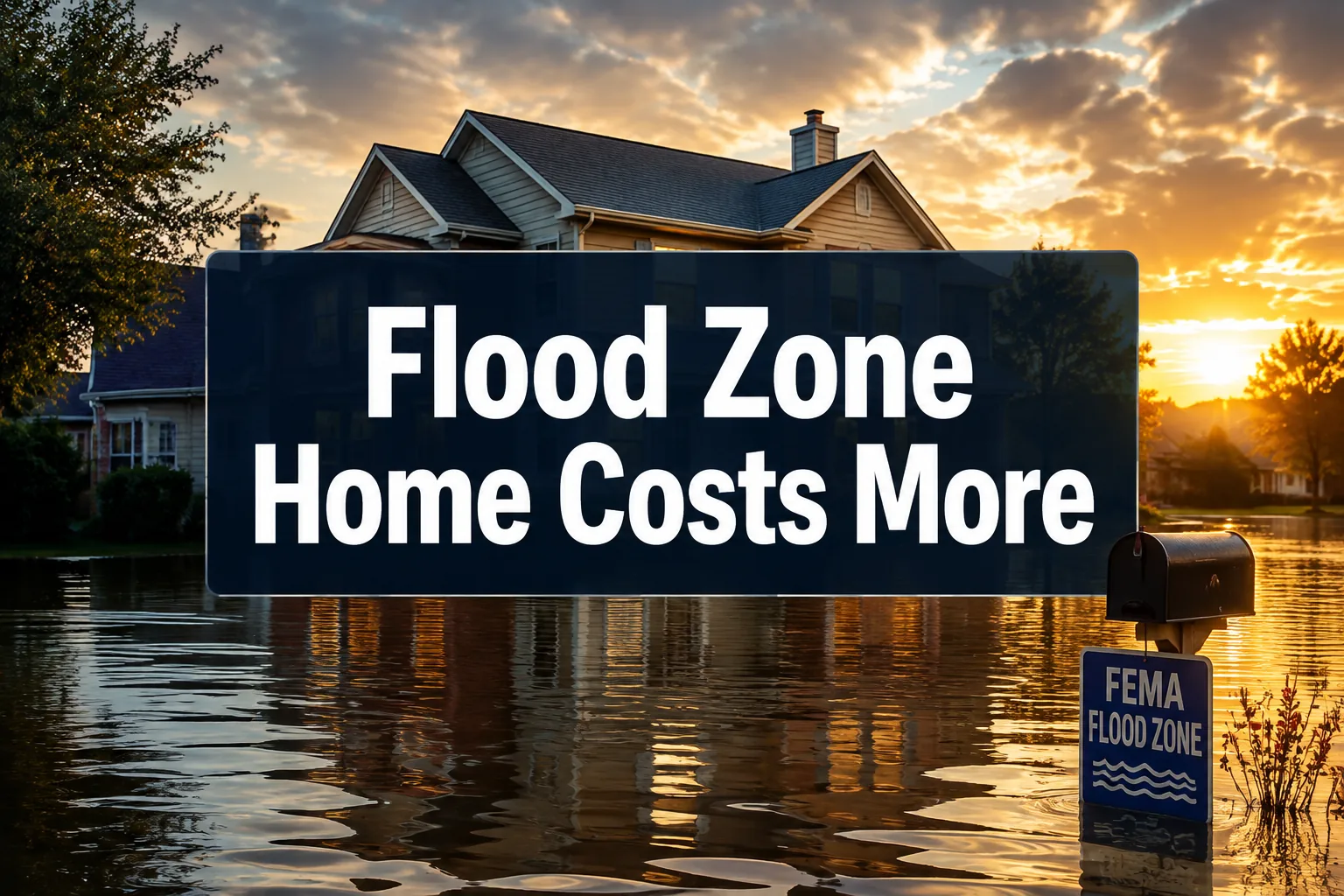
Buying a house in a flood zone costs more than the house when you add mandatory flood insurance, elevated property taxes, reduced resale demand, and ongoing mitigation expenses over a 15-to-30-year ownership window. A home priced at $350,000 in a high-risk flood zone can carry $3,000 to $10,000 or more in annual flood insurance alone, plus thousands in elevation certificates, potential retrofits, and insurance rate increases driven by FEMA's Risk Rating 2.0 methodology. Before signing anything, buyers need the full cost picture, not just the purchase price.
Key Takeaways
- FEMA designates flood zones from high-risk (Zone AE, VE) to minimal-risk (Zone X). High-risk zones require flood insurance if a federally backed mortgage is involved.
- Average flood insurance cost through the National Flood Insurance Program (NFIP) runs roughly $700 to $1,000 per year nationally, but high-risk properties routinely see $3,000 to $10,000+ annually under Risk Rating 2.0.
- Risk Rating 2.0, FEMA's updated pricing methodology launched in 2021, eliminated grandfathered flood insurance rates for most policyholders and tied premiums directly to individual property risk.
- An elevation certificate, which typically costs $500 to $2,000, is the single most useful document a flood zone buyer can obtain before closing.
- Private flood insurance now competes with NFIP and can offer lower premiums for some properties, but coverage terms vary widely.
- FEMA's Flood Map Service Center (msc.fema.gov) lets anyone check a property's flood zone designation for free using the address.
- Flood zone homes can and do lose their high-risk designation through a Letter of Map Amendment (LOMA) or Letter of Map Revision (LOMR), but the process takes time and money.
- Flood history disclosure requirements vary by state. Some states require sellers to disclose past flooding; others do not.
- Buying a house that has flooded before carries hidden repair costs, mold liability, and insurance complications that a standard inspection may not catch.
- Climate change is accelerating flood zone boundary expansions, meaning homes currently in Zone X may be remapped into Zone AE within a decade.
What Is a Flood Zone and How Does It Affect Home Prices
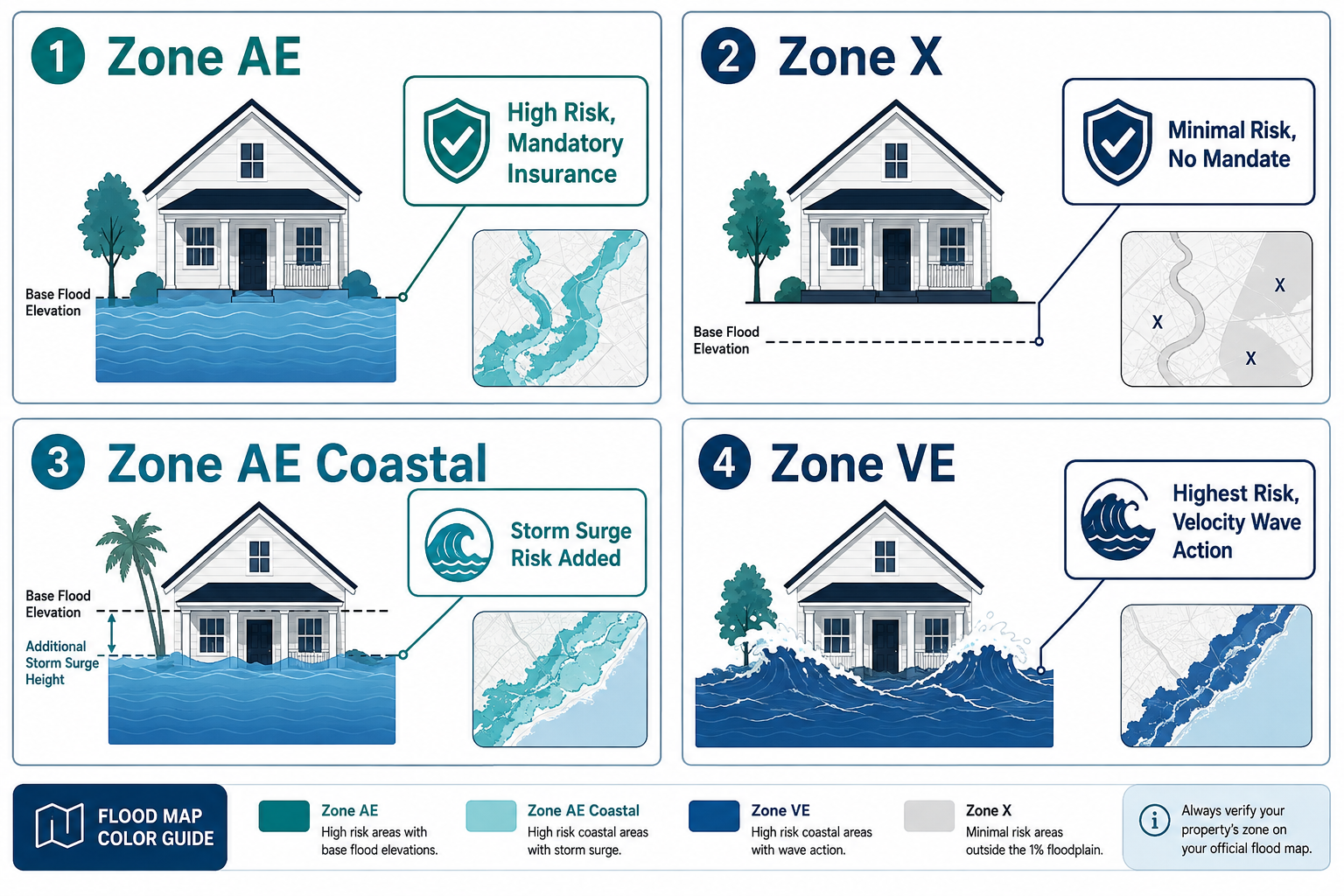
A flood zone is a geographic area FEMA has classified by its statistical probability of flooding in any given year. Zone AE, the most common high-risk designation, carries at least a 1% annual flood probability, which sounds small until you realize that over a 30-year mortgage that translates to roughly a 26% chance of flooding at least once. Zone VE applies to coastal areas with additional wave-action risk. Zone X covers areas with minimal flood risk, either 0.2% annual chance (shaded X) or lower (unshaded X).
Home prices in high-risk flood zones are measurably affected. Research published by the First Street Foundation found that flood-prone properties in the U.S. are overvalued by a collective $121 billion to $237 billion because buyers historically underpriced flood risk. That gap is closing. A 2023 study in the journal Nature Climate Change found that properties in 100-year floodplains sold at a discount of roughly 3% to 5% compared to similar homes outside flood zones, with larger discounts in markets where buyers are more informed about risk. The discount grows when insurance costs are factored into monthly payment comparisons.
The practical effect on price: a flood zone designation does not automatically mean a lower purchase price, especially in coastal or waterfront markets where buyers accept the risk for lifestyle reasons. What it does mean is that the true cost of ownership is substantially higher than the sticker price suggests.
Buying a House in a Flood Zone Costs More Than the House: The Full Number Breakdown
The total cost of buying a house in a flood zone exceeds the purchase price in ways most buyers do not calculate until they are already under contract. Here is where the money actually goes.
Annual flood insurance (NFIP): The national average NFIP premium is roughly $700 to $1,000 per year for lower-risk properties. For Zone AE homes, especially those built before modern floodplain standards, annual premiums under Risk Rating 2.0 range from $2,000 to over $10,000. A $5,000 annual premium over 30 years is $150,000, not counting rate increases.
Elevation certificate: Expect to pay $500 to $2,000 for a licensed surveyor to produce one. Without it, your insurer uses the worst-case assumption for your property's elevation, which almost always means a higher premium.
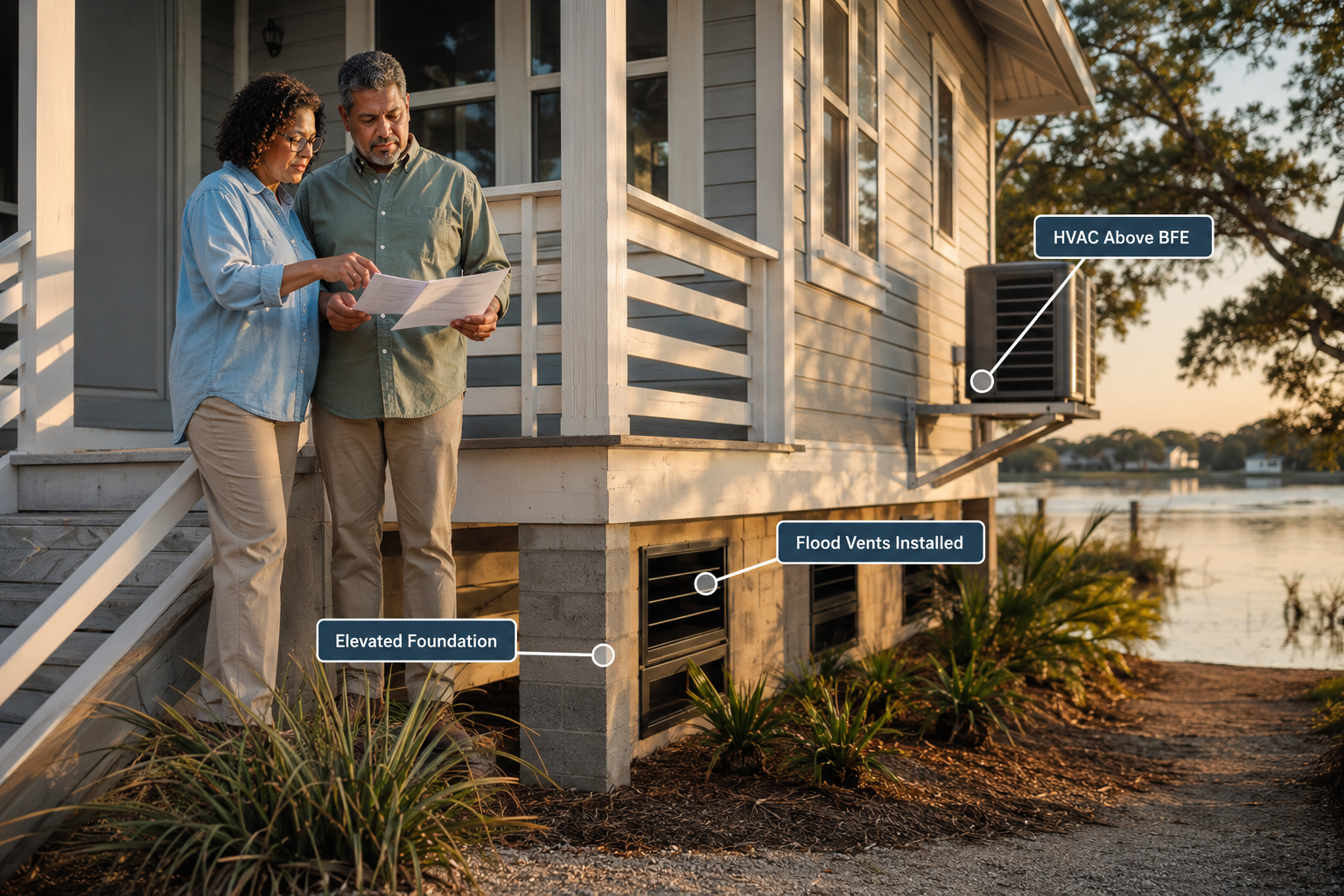
Flood mitigation retrofits: Elevating a home's utilities, installing flood vents, or raising the structure itself can cost $30,000 to $100,000 or more depending on the home's construction and how far it sits below the base flood elevation (BFE).
Reduced resale pool: Fewer buyers will qualify or choose to purchase a flood zone home, which compresses future sale prices and extends time on market.
For a deeper look at how to calculate all the costs before you close, the home buyer closing cost calculator using ChatGPT or Gemini AI walks through exactly how to build a full cost model in minutes.
How to Check If a House Is in a Flood Zone Before Buying
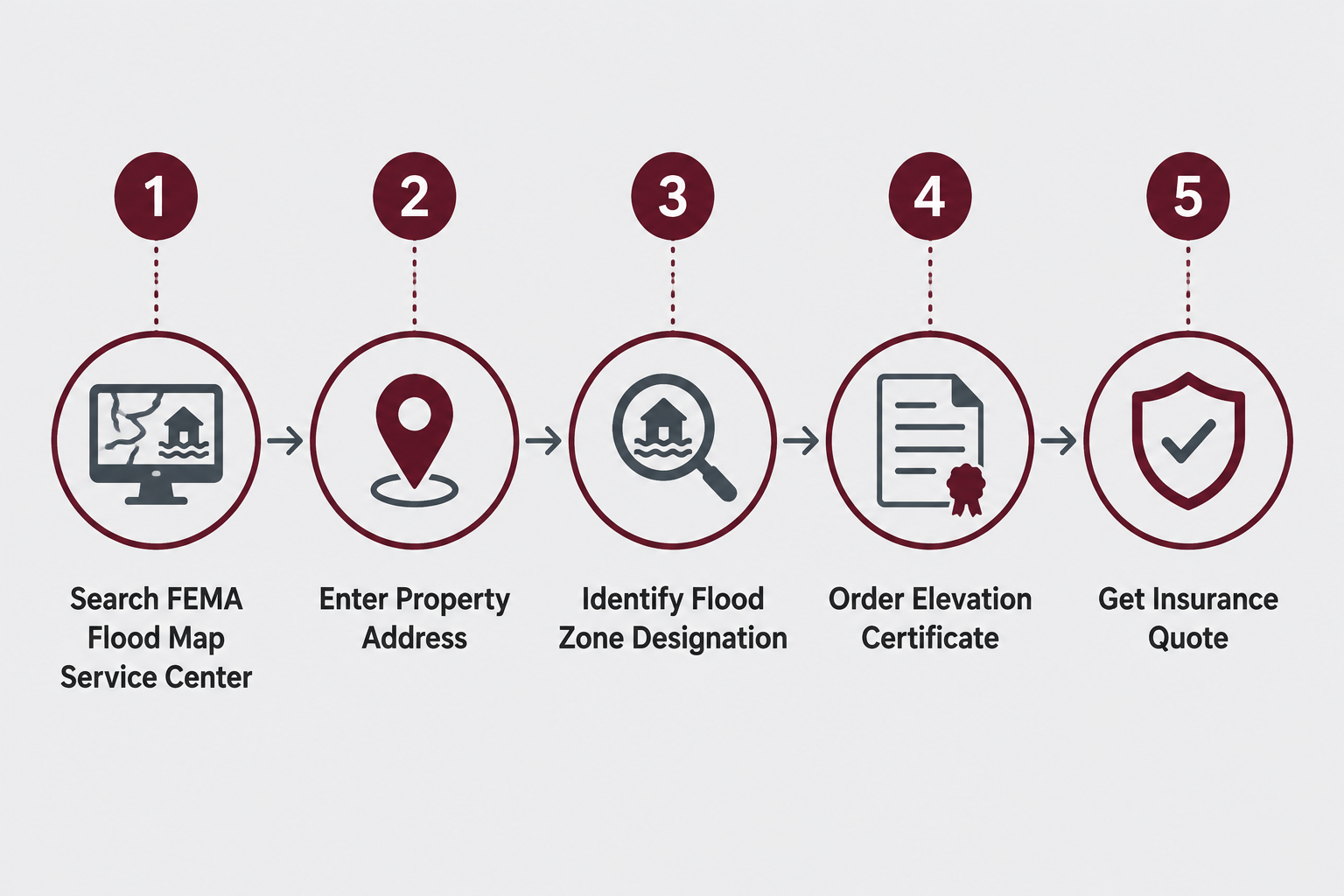
Checking a property's flood zone status takes about five minutes and costs nothing. Go to FEMA's Flood Map Service Center at msc.fema.gov and enter the property address. The tool returns the current Flood Insurance Rate Map (FIRM) panel for that location and the zone designation.
Step-by-step FEMA flood map lookup:
- Go to msc.fema.gov
- Enter the full property address in the search bar
- Click the property pin on the returned map
- Read the flood zone label (AE, X, VE, etc.)
- Note the FIRM panel number and effective date, since older maps may not reflect recent remapping
- Cross-reference with the seller's flood history disclosure if your state requires one
Beyond the FEMA map: FEMA maps are updated on a rolling basis and are not always current. Private flood risk tools like First Street Foundation's Flood Factor (floodfactor.com) provide a more granular, forward-looking risk score that accounts for climate projections. Some buyers use both.
Flood history disclosure requirements vary significantly by state. Florida, Texas, New York, and California have relatively strong disclosure laws requiring sellers to reveal past flood damage or insurance claims. States like Alabama and Georgia have weaker requirements. Always ask the seller's agent directly and request any NFIP claims history through the property's address via FEMA's flood insurance policy lookup.
Flood Zone AE vs X: What the Difference Actually Costs You
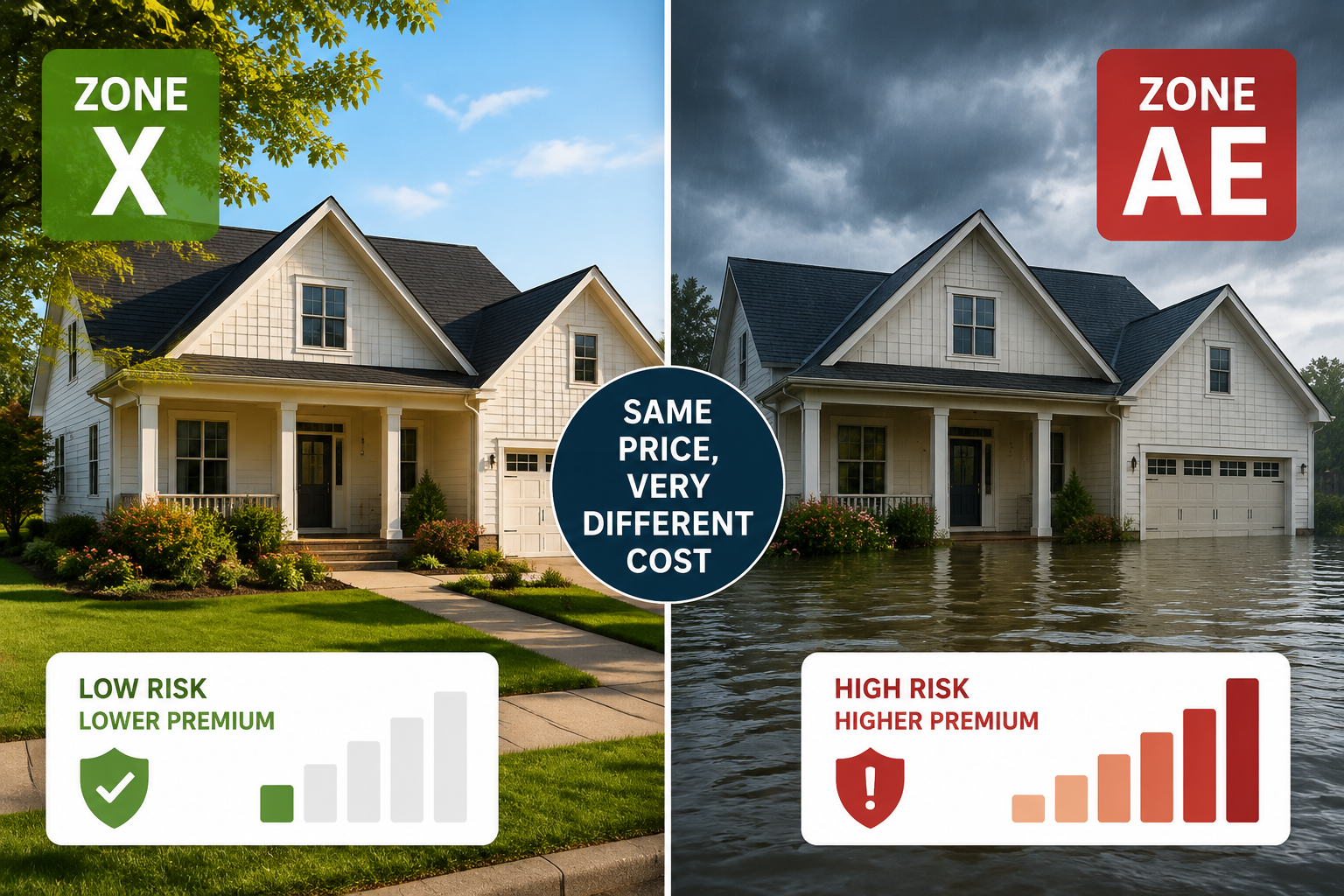
Zone AE and Zone X are not just different labels. They represent a potential difference of thousands of dollars per year in insurance premiums and a fundamental difference in lender requirements.
| Feature | Zone AE (High Risk) | Zone X (Minimal Risk) |
|---|---|---|
| Annual flood probability | 1% or greater | Less than 0.2% |
| Flood insurance required by lenders | Yes, if federally backed mortgage | No mandate |
| Typical NFIP annual premium | $2,000 to $10,000+ | $400 to $700 (voluntary) |
| Elevation certificate needed | Usually yes | Rarely |
| Resale impact | Measurable discount in many markets | Minimal |
| Climate remapping risk | Already in high-risk zone | Growing risk of reclassification |
Zone X properties are not immune to flooding. FEMA data shows that roughly 25% of NFIP flood claims come from properties outside high-risk flood zones. The difference is that Zone X buyers are not required to carry insurance, so many do not, and then a flood event wipes out equity they assumed was safe.
Is Flood Insurance Required If You Have a Mortgage in a Flood Zone
Yes, flood insurance is required by lenders for any federally backed mortgage on a property in a Special Flood Hazard Area (SFHA), which includes Zone AE, Zone VE, and several other high-risk designations. Federally backed means Fannie Mae, Freddie Mac, FHA, VA, and USDA loans. If your lender sells to those agencies, they must enforce the mandate.
What "required" means in practice:
- The lender will verify flood zone status during the loan origination process using a flood zone determination service
- If the property is in an SFHA, flood insurance must be in place before closing and maintained for the life of the loan
- If a borrower drops coverage after closing, the lender can force-place insurance, which is almost always more expensive than a policy the buyer chose themselves
- The coverage amount must be at least equal to the outstanding loan balance or the maximum available under NFIP ($250,000 for the structure), whichever is less
VA loan buyers: A VA loan on a flood zone property still triggers the federal flood insurance mandate. The VA entitlement does not exempt the property from lender requirements tied to flood zone status. For a broader look at VA and other loan types in challenging purchase situations, the FHA loan vs conventional loan comparison covers how different loan structures handle risk overlays.
How Much Does Flood Insurance Cost Per Year: NFIP vs Private Flood Insurance
The average NFIP flood insurance cost nationally is approximately $700 to $1,000 per year, but that average is misleading. It includes millions of lower-risk properties that pull the number down. For Zone AE properties, especially older homes with finished basements or ground-floor living space below the BFE, annual premiums under Risk Rating 2.0 routinely run $3,000 to $10,000 or more.
Risk Rating 2.0 is FEMA's updated pricing methodology, implemented in October 2021 for new policies and April 2022 for renewals. It replaced the old system that priced policies primarily based on flood zone and elevation, and instead uses property-specific variables including:
- Distance to the nearest water source
- Type of flooding (riverine, coastal, pluvial)
- Cost to rebuild the structure
- Foundation type
- First-floor height above ground
The result: some properties saw premium decreases, but the majority of high-risk properties saw increases. Grandfathered flood insurance rates, which previously allowed policyholders to keep lower premiums when maps were updated, were largely eliminated under Risk Rating 2.0. FEMA caps annual increases at 18% per year for existing policies, but that cap means a policy going from $2,000 to its actuarially correct $8,000 rate will get there in roughly nine years.
Private flood insurance entered the market aggressively after 2012 and now offers a real alternative to NFIP for many properties. Private carriers can offer higher coverage limits (above NFIP's $250,000 structure cap), shorter waiting periods (NFIP has a standard 30-day waiting period), and sometimes lower premiums for properties with favorable elevation or construction. The trade-off is that private policies are not guaranteed to be renewed, and claims handling varies by carrier.
Does flood insurance cover the basement? NFIP flood insurance has specific basement limitations. It covers cleanup and certain systems (electrical panels, HVAC, water heaters) in basements, but does not cover finished basement walls, flooring, personal property stored below ground, or most appliances in a basement space. This is a significant gap for buyers who plan to use a basement as living space.
What Happens to Flood Insurance Costs Over Time
Flood insurance costs under Risk Rating 2.0 are moving in one direction for most high-risk properties: up. FEMA's actuarial data shows that the majority of NFIP policyholders in Zone AE are paying below the risk-based rate, and the 18% annual cap means those gaps close over years, not decades.
The climate change factor compounds this. NOAA and independent climate research consistently show that 100-year flood events are occurring more frequently, storm intensity is increasing, and sea levels are rising along U.S. coastlines. FEMA is actively remapping flood zones to reflect updated hydrology, and properties currently in Zone X are being reclassified into Zone AE at an accelerating rate in states including Florida, Louisiana, Texas, North Carolina, and New Jersey.
A 2022 analysis by the First Street Foundation projected that the number of U.S. properties facing significant flood risk will grow by roughly 11% over the next 30 years as climate patterns shift. That means the insurance market for flood-prone properties will tighten further, private carriers may exit certain coastal markets (as has already happened with homeowners insurance in Florida and California), and buyers purchasing today are absorbing future risk that is not priced into the current sale.
The honest projection for a 2026 buyer: if you buy a Zone AE property today with a $4,000 annual flood insurance premium, budget for that number to reach $6,000 to $8,000 within a decade, even if you make no changes to the property.
Are There Ways to Reduce Flood Zone Insurance Premiums
Yes, flood mitigation to lower premiums is real and can produce meaningful savings, but the upfront costs are substantial. Here are the approaches that actually work.
1. Get an elevation certificate. An elevation certificate documents your property's lowest floor elevation relative to the BFE. If your home sits higher than FEMA's worst-case assumption, the certificate can lower your premium significantly. Cost: $500 to $2,000. This is the first thing to do before accepting any flood insurance quote.
2. Elevate the structure. Raising a home's first floor above the BFE through foundation work reduces premiums because it reduces risk. Each foot of elevation above BFE typically produces a measurable premium reduction. Cost: $30,000 to $100,000+. This makes sense for long-term owners, not buyers planning to sell in five years.
3. Install flood vents. Flood vents in the foundation allow water to flow through rather than build pressure against walls. FEMA recognizes properly installed flood vents as a mitigation measure. Cost: $1,000 to $5,000 depending on the number of vents needed.
4. Elevate mechanical systems. Moving HVAC, water heaters, and electrical panels above the BFE reduces the insurer's expected claim amount, which can lower premiums under Risk Rating 2.0's cost-to-rebuild variable.
5. Apply for a LOMA or LOMR. If a property was incorrectly included in a flood zone or if fill was added to raise the land elevation, a Letter of Map Amendment (LOMA) or Letter of Map Revision (LOMR) can remove the property from the SFHA entirely. If approved, flood insurance is no longer required by the lender. Cost: $500 to $3,000 in surveying and filing fees, plus several months of processing time.
6. Shop private flood insurance. For properties with favorable elevation and construction, private carriers sometimes offer lower premiums than NFIP. Get at least three quotes. The homeowners insurance vs rental property insurance comparison covers how insurance structures differ by property type, which is useful context for investors evaluating flood zone rentals.
Can You Negotiate a Lower Price on a Flood Zone House
Yes, and the flood zone designation is one of the most legitimate negotiation levers a buyer has. The key is quantifying the cost gap before making an offer, not after.
How to build the negotiation case:
- Get a flood insurance quote before submitting an offer. Call two or three carriers and get actual premium numbers for that specific property. This is your hard cost evidence.
- Request the elevation certificate from the seller. If they do not have one, factor the $500 to $2,000 cost into your offer.
- Ask for the property's NFIP claims history. FEMA tracks claims by address. A history of multiple claims is both a negotiation point and a red flag about the property's actual flood exposure.
- Research flood mitigation costs for the specific property. If the home needs $40,000 in elevation work to bring premiums to a manageable level, that is a direct reduction argument.
- Compare the true monthly cost (mortgage + flood insurance + property tax) against comparable homes outside the flood zone. Present that math.
Buying a house that has flooded before requires extra due diligence beyond the price negotiation. Flood damage that was not properly remediated leads to mold, structural deterioration, and compromised electrical systems. A standard home inspection may not catch all of this. Hire an inspector with specific flood damage experience and request any prior remediation documentation. For a broader pre-offer checklist, the property inspections hub covers what to look for before committing.
The negotiation leverage is real. Flood zone homes sit on market longer in most areas, and sellers know the buyer pool is smaller. Use that. For more on how to structure offers in situations where you have leverage, the negotiation strategies hub has specific frameworks worth reviewing.
Should I Buy a House in a Flood Zone or Keep Renting
This is genuinely a math problem, not a lifestyle preference question. The answer depends on three variables: the premium-adjusted monthly cost of ownership, the realistic appreciation trajectory of the specific property, and your personal risk tolerance for a flood event.
Buy if:
- The flood-adjusted monthly cost (mortgage + insurance + taxes + maintenance) is within 15% to 20% of comparable rents in the same area
- The property has a clear path to lower premiums through an elevation certificate or mitigation work
- You plan to own for 15+ years and can absorb the insurance cost trajectory
- The location has genuine lifestyle or income value (waterfront rental income, proximity to family, etc.)
- You can afford the property without stretching, because a flood event year is expensive even with insurance
Keep renting if:
- The flood-adjusted monthly cost is materially higher than renting a comparable home outside the flood zone
- You plan to move within five to seven years, since resale to a smaller buyer pool is a real exit risk
- The property's insurance is approaching or above $8,000 per year with no clear mitigation path
- Private insurers are exiting the market in that specific geography, which signals systemic risk
The broader rent vs buy in 2026 analysis covers the general math framework in detail. For flood zone properties, run that same analysis with the insurance premium added to the ownership cost column. The numbers often tell a clear story.
What Other Costs Come With Owning a Flood Zone Property
Beyond flood insurance, owning a flood zone property carries several ongoing costs that buyers rarely budget for upfront.
Property tax: In some jurisdictions, flood zone designation affects assessed value and therefore property taxes. In others, waterfront or coastal premiums in the tax assessment offset any flood discount.
Homeowners insurance complications: Standard homeowners insurance does not cover flood damage. But flood zone properties also face higher homeowners insurance premiums because carriers price in the elevated risk of wind, storm surge, and related perils. In Florida and Louisiana, finding homeowners coverage at any price has become difficult in coastal flood zones as private carriers have withdrawn from the market.
Maintenance and repair: Flood zone homes require more vigilant maintenance of drainage systems, sump pumps, foundation waterproofing, and landscaping that directs water away from the structure. Budget an additional $500 to $2,000 per year above the standard maintenance reserve.
Resale costs: When you eventually sell, flood zone disclosure requirements, a smaller buyer pool, and longer days on market translate to either a lower price or higher carrying costs during the listing period. For sellers planning ahead, the 60-day home selling checklist covers how to prepare a property for maximum appeal even in challenging market conditions.
Worst-case scenario: NFIP non-renewal. Congress periodically debates the financial solvency of NFIP, which carries over $20 billion in debt. If NFIP were restructured or coverage limits changed, flood zone homeowners could face sharp premium increases or coverage gaps with little warning. This is a low-probability but high-impact risk worth understanding before buying.
Do Flood Zone Homes Ever Leave the Flood Zone Designation
Yes, properties can be removed from high-risk flood zone designations, but it requires documentation, surveying, and FEMA approval. The two main mechanisms are a Letter of Map Amendment (LOMA) and a Letter of Map Revision (LOMR).
LOMA: Used when a property was incorrectly included in the SFHA based on the map, typically because the land elevation is actually above the BFE. A licensed surveyor documents the elevation, and FEMA reviews the submission. If approved, the property is officially removed from the SFHA and the lender can no longer require flood insurance. Processing time: typically 60 to 90 days. Cost: $500 to $2,000 in surveying fees plus FEMA's free administrative review.
LOMR: Used when physical changes to the property or surrounding area have altered flood risk, such as when fill was added to raise the land elevation or when a local flood control project was completed. More complex and expensive than a LOMA.
Important caveat: removal from the SFHA does not mean the property cannot flood. It means FEMA's model no longer classifies it as high-risk. Voluntarily maintaining a flood insurance policy after a LOMA is often still a reasonable decision, especially given climate remapping trends.
Frequently Asked Questions
What is the difference between NFIP and private flood insurance?
NFIP is the federal program administered by FEMA, with a $250,000 maximum structure coverage and a standard 30-day waiting period. Private flood insurance is offered by independent carriers, can provide higher coverage limits and shorter waiting periods, and sometimes offers lower premiums for well-elevated properties. Private policies are not federally guaranteed and can be non-renewed.
How do I know if a house is in a flood zone before making an offer?
Use FEMA's free Flood Map Service Center at msc.fema.gov. Enter the property address to pull the current Flood Insurance Rate Map and zone designation. Also check First Street Foundation's Flood Factor tool for a forward-looking climate-adjusted risk score.
What is an elevation certificate and why does it matter?
An elevation certificate is a document prepared by a licensed surveyor that records the elevation of a property's lowest floor relative to the base flood elevation. It is the primary tool for determining accurate flood insurance premiums and is required for most LOMA applications. Cost is typically $500 to $2,000.
Does flood zone designation lower home value?
Research suggests a measurable discount of 3% to 5% in markets where buyers are well-informed about flood risk, with larger discounts in areas where insurance costs are high. In waterfront or coastal lifestyle markets, the discount can be smaller because buyers are accepting risk for location value.
Can I get a VA loan on a flood zone property?
Yes. VA loans are available for flood zone properties. However, because VA loans are federally backed, the mandatory flood insurance requirement applies if the property is in a Special Flood Hazard Area. The VA entitlement does not waive this requirement.
What does Risk Rating 2.0 mean for my flood insurance premium?
Risk Rating 2.0 is FEMA's updated pricing system that replaced the old zone-and-elevation model with property-specific variables including distance to water, flood type, and rebuild cost. Most high-risk properties saw premium increases. Grandfathered rates were eliminated for new policies and are being phased out for existing ones, with increases capped at 18% per year.
Is flood insurance required for a cash purchase in a flood zone?
No. Federal flood insurance mandates only apply when a federally backed mortgage is involved. Cash buyers are not legally required to carry flood insurance, though not carrying it on a high-risk property is a significant financial gamble.
What happens if I stop paying flood insurance after closing?
If you have a federally backed mortgage and drop flood insurance, your lender will force-place coverage on your behalf and charge you for it. Force-placed insurance is typically more expensive than a policy you chose and may offer less coverage.
How long does the NFIP flood insurance waiting period last?
The standard NFIP waiting period is 30 days from the date of purchase. Exceptions apply when the policy is purchased in connection with a loan closing or when a property is newly mapped into a flood zone.
Are there states with stronger flood history disclosure requirements?
Yes. Florida, Texas, New York, New Jersey, and California have relatively strict flood disclosure laws. Many other states have minimal or no requirements. Always ask the seller directly and request any available NFIP claims history for the property address.
Can climate change move my Zone X property into Zone AE?
Yes. FEMA remaps flood zones on a rolling basis as hydrology data is updated. Properties in coastal, riverine, and low-lying areas that are currently in Zone X face a growing probability of reclassification as climate-driven flood patterns intensify. First Street Foundation's projections show flood risk expanding to millions of additional U.S. properties over the next 30 years.
What does flood insurance actually cover?
NFIP covers the building structure up to $250,000 and personal property up to $100,000 under a separate contents policy. It does not cover temporary housing, business losses, or most basement contents. Private flood insurance policies vary and may offer broader coverage.
Conclusion
Buying a house in a flood zone costs more than the house is not a scare tactic. It is arithmetic. A $350,000 home with $6,000 in annual flood insurance, $1,500 in extra maintenance, and a compressed resale pool costs materially more over 15 years than a $380,000 home in Zone X with a $500 annual flood policy. The gap is real, and it widens as Risk Rating 2.0 continues pushing premiums toward actuarially correct levels.
Actionable steps before you buy:
- Run a FEMA flood map lookup at msc.fema.gov on any property you are seriously considering.
- Get an actual flood insurance quote from two NFIP-authorized agents and one private carrier before submitting an offer.
- Ask the seller for the elevation certificate. If they do not have one, negotiate the cost into the offer or get one yourself.
- Request the property's NFIP claims history and any flood damage disclosure required by your state.
- Build a 30-year cost model that includes insurance at an 18% annual increase rate, not today's premium.
- If the numbers still work, negotiate the purchase price using the documented insurance cost gap as your primary lever.
Flood zone properties are not automatically bad investments or bad homes. Some of the most desirable real estate in the country sits in flood zones. The buyers who win in those markets are the ones who go in with full cost clarity, not just a purchase price. That homework belongs before the offer, not after the inspection.
For more on structuring your overall home purchase strategy, the Home Buying Hub covers financing, inspections, location selection, and negotiation in one place.