
Last updated: August 23, 2026

Quick Answer
The modular vs manufactured home confusion is not just a terminology problem, it is a financial trap. Modular homes are built in a factory and placed on a permanent foundation, then titled and financed exactly like a site-built house. Manufactured homes are also factory-built, but they ride on a permanent steel chassis, fall under federal HUD code (not local building codes), and can be titled as personal property, which means conventional mortgage financing may be off the table entirely. That single distinction controls your resale value, your loan options, and whether your home appreciates or depreciates over time.
Key Takeaways
- Modular homes follow the same International Residential Code (IRC) as site-built homes and are treated as real property from day one.
- Manufactured homes built after June 15, 1976 fall under HUD code, anything built before that date is legally called a mobile home.
- A manufactured home on a chattel loan is financed like a car, not a house, with higher interest rates and no land equity attached.
- Placing a manufactured home on a permanent foundation and retiring the title can convert it to real property, but the process varies by state and lenders still scrutinize the appraisal.
- Modular homes generally appreciate alongside comparable site-built homes. Manufactured homes in land-lease parks have historically depreciated.
- FHA, VA, and conventional loans are available for manufactured homes, but only under strict conditions including permanent foundation requirements and HUD tag verification.
- Manufactured home park rules can restrict your ability to sell, sublease, or modify your home, a risk many buyers never read before signing.
- The biggest financial mistake buyers make is assuming "factory-built" means the same thing across all home types. It does not.
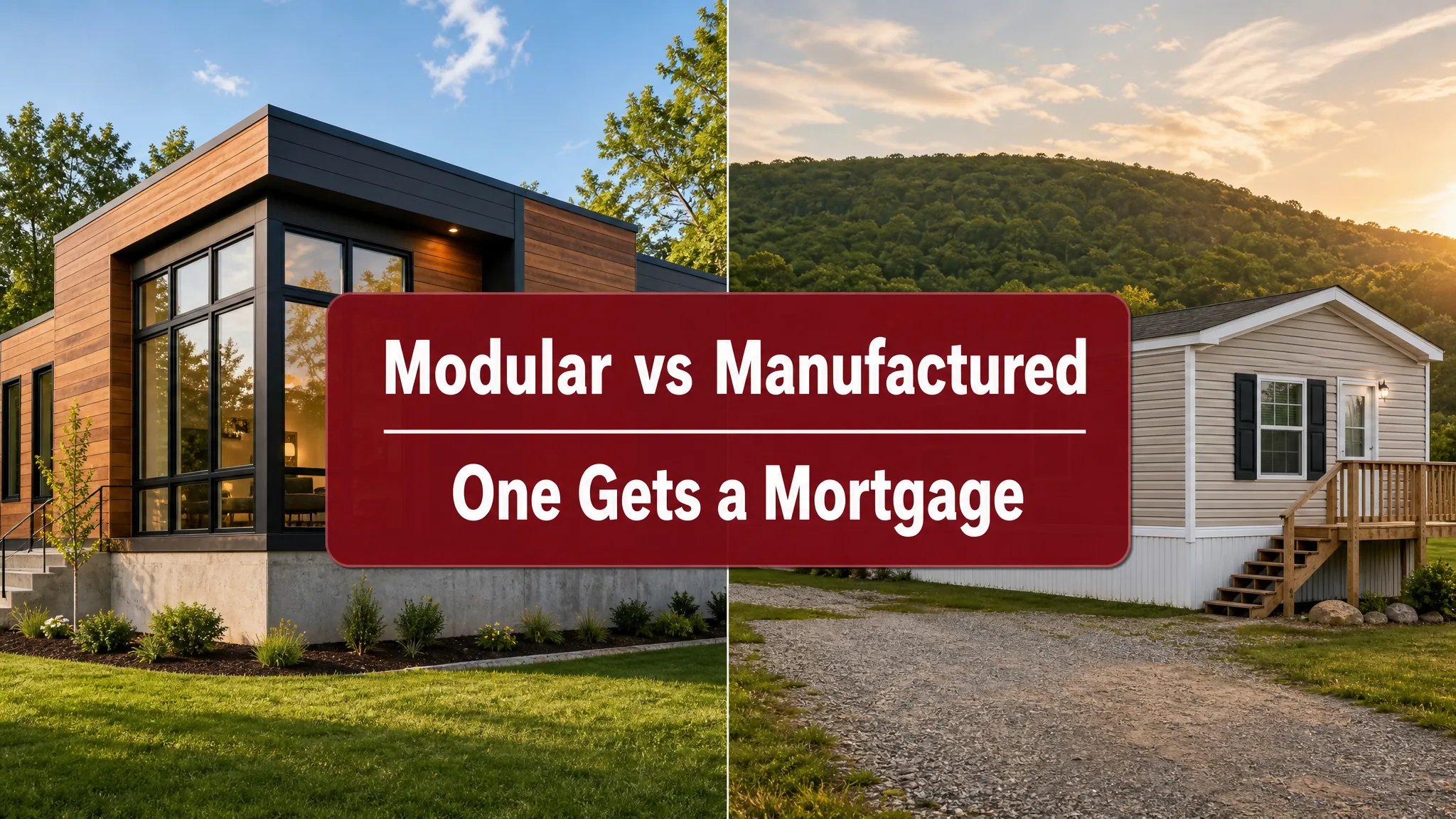
Modular vs Manufactured Home: One Gets a Mortgage
Forty-three percent of Americans say they cannot afford a site-built home at current prices, and the alternatives, barndominiums, ADUs, tiny homes, modular and manufactured housing, are getting serious attention. The problem is that most people researching the modular vs manufactured home question walk into a dealership or a builder's office without knowing that these two home types operate in completely different legal, financial, and regulatory universes.
The mistake nobody warns you about is this: you can buy what looks like the same house, on the same rural lot, for roughly the same price, and end up with either a home that builds equity like a conventional purchase or a depreciating asset that a bank will only finance with a glorified car loan. The difference is not the square footage or the floor plan. It is the chassis, the code stamp, and the title.
Here is the full breakdown, starting with the definitions that actually matter.
What Is the Actual Difference Between Modular and Manufactured Homes
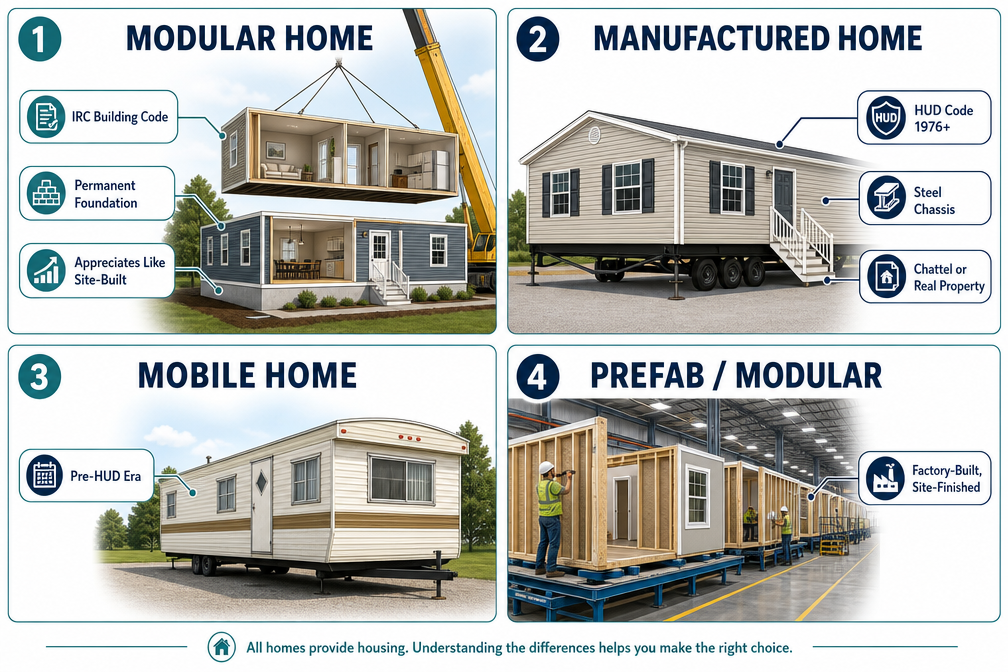
Modular homes and manufactured homes are both built in a factory, but that is where the similarity ends. A modular home is assembled in sections at a factory, transported to the site, and permanently attached to a foundation. Once it is set, it is legally and structurally indistinguishable from a site-built home. It follows the same IRC building code as every other house on your block and is titled as real property.
A manufactured home is also factory-built, but it is constructed on a permanent steel chassis with wheels and axles attached during production. That chassis stays with the home. The home is regulated under the federal HUD Manufactured Home Construction and Safety Standards, commonly called HUD code, not local building codes. Depending on how the title is handled after placement, a manufactured home can be classified as either real property or personal property.
The three-way breakdown buyers need:
| Home Type | Built To | Foundation | Title Default |
|---|---|---|---|
| Modular | IRC (local building code) | Permanent, required | Real property |
| Manufactured (post-1976) | HUD Code | Optional (can be permanent) | Personal property unless converted |
| Mobile Home (pre-1976) | No federal standard | Varies | Personal property |
The term "mobile home" is legally reserved for factory-built homes produced before June 15, 1976, the date HUD code took effect. Calling a modern manufactured home a mobile home is technically inaccurate, though the terms get used interchangeably in casual conversation. For financing and appraisal purposes, the distinction matters.
Why Do People Confuse Modular and Manufactured Homes
The confusion is common enough that it is almost understandable. Both home types are built in a factory, both arrive on a truck, and both can look nearly identical from the street. Real estate listings, dealerships, and even some lenders use the terms loosely, sometimes calling manufactured homes "modular" because it sounds more marketable.
The vagueness the industry keeps around this terminology is not accidental. "Modular" carries a cleaner reputation. "Manufactured" still carries the stigma of trailer parks, even though modern manufactured homes can be extraordinarily well-built with open floor plans, high-end finishes, and energy-efficient systems. Sellers and builders know which label moves product faster.
For buyers, the confusion becomes expensive when they get to the financing stage and discover their "modular" home is actually a HUD-code manufactured home, and the lender they pre-qualified with does not finance chattel loans or has stricter requirements for manufactured housing.
The short rule: ask for the HUD data plate and the HUD certification label before you sign anything. A modular home will not have one. A manufactured home built after 1976 is required to have both.
Modular Home vs Manufactured Home: Resale Value and Appreciation
Modular homes appreciate at rates comparable to site-built homes in the same market. Manufactured homes have a more complicated story, and this is the core of the modular vs manufactured home financial gap nobody mentions.
Modular home resale value tracks local market conditions because the home is titled as real property, appraised under the same standards as site-built homes, and subject to the same supply-and-demand dynamics. A modular home in a market where home values rose 2% year-over-year will generally rise with that market.
Manufactured home depreciation depends heavily on three factors:
- Whether the home is on owned land or a leased lot
- Whether it is titled as real property or personal property
- The age and condition of the home relative to local comps
Manufactured homes in land-lease communities, where you own the home but pay monthly lot rent to a park, have historically depreciated, functioning more like a vehicle than a house. The lot rent is an ongoing liability, and if the park closes or raises rents aggressively, your exit options shrink fast.
Manufactured homes on owned land with a permanent foundation, where the title has been converted to real property, behave much closer to site-built homes in terms of appreciation. The appraisal process is still more restrictive (more on that below), but the equity-building potential is real.
Does a modular home appreciate in value? Yes, generally at rates consistent with comparable site-built homes in the same area, assuming the home is well-maintained and the market supports it.
Financing a Manufactured Home vs a Modular Home
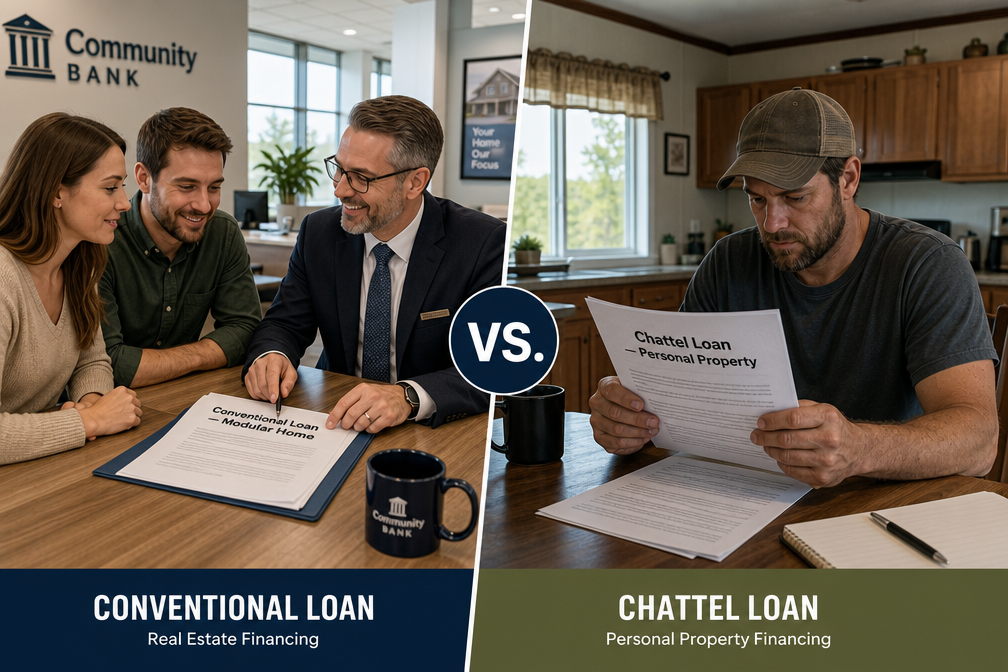
This is where the modular vs manufactured home gap becomes a serious financial divide. Financing a modular home follows the exact same path as a conventional home purchase. You get a standard mortgage, the home is appraised as real property, and your loan options include conventional, FHA, VA, and USDA programs.
Financing a manufactured home is a different conversation entirely.
Chattel loan vs conventional mortgage:
A chattel loan treats the manufactured home as personal property, the same legal category as a car or a boat. Chattel loans typically carry interest rates 1.5% to 3% higher than conventional mortgages, shorter loan terms (often 15 to 20 years versus 30), and no land equity attached. If the home is in a park and you default, the lender repossesses the home, not land.
For buyers researching home financing options and mortgage types, the chattel loan structure is a significant long-term cost difference.
Can you get an FHA loan on a manufactured home? Yes, under FHA Title I and Title II programs, but with conditions:
- The home must have been built after June 15, 1976 (post-HUD code)
- It must be on a permanent foundation meeting FHA guidelines
- It must be classified as real property, not personal property
- The HUD certification label and data plate must be present or verified
Can you get a conventional loan for a manufactured home? Fannie Mae and Freddie Mac both have programs for manufactured housing, including Fannie's MH Advantage program for homes that meet specific design standards. Conventional financing requires permanent foundation documentation (typically an engineer's certification), real property title, and the home must meet HUD code standards. Freddie Mac's CHOICEHome program extends conventional terms to manufactured homes that meet site-built construction standards.
VA loans are available for manufactured homes on permanent foundations with real property title. The home must be the veteran's primary residence.
The top down payment strategies for home buyers look very different when you are working with a chattel loan versus a conventional mortgage, the equity math and total cost of ownership change substantially.
Modular Home Foundation Requirements and Real Property Status
A modular home is always placed on a permanent foundation, that is a baseline requirement of the building process. The foundation type (basement, crawl space, slab) varies by region and builder, but the permanent attachment is non-negotiable.
For manufactured homes, the foundation question is where buyers make expensive mistakes.
Are modular homes considered real property or personal property? Modular homes are real property from the moment they are titled. There is no conversion process required.
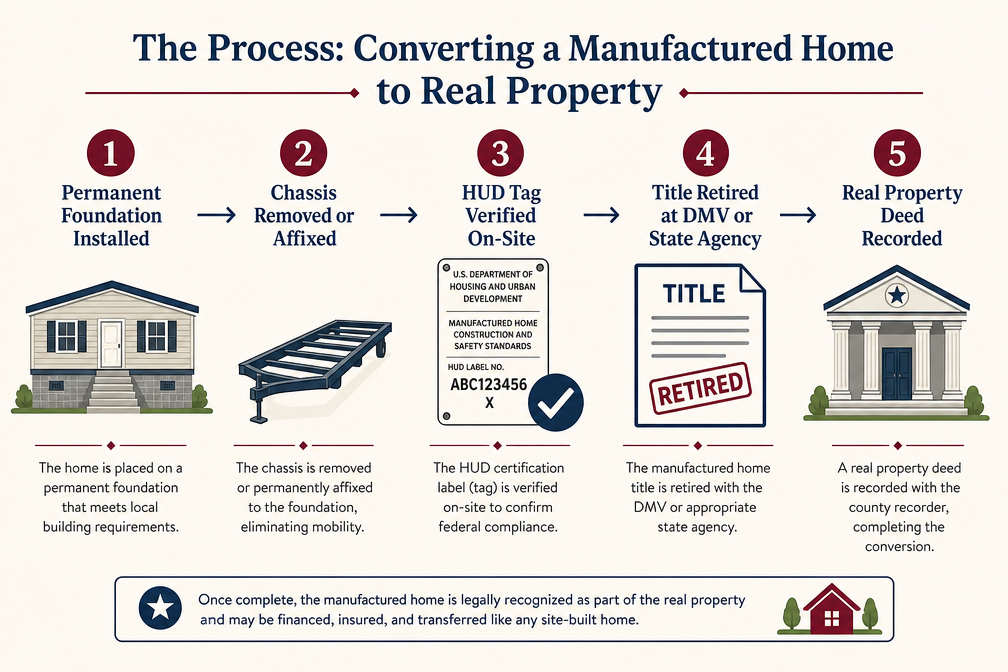
Manufactured homes as real property: A manufactured home defaults to personal property status in most states because it is titled like a vehicle through the DMV or equivalent state agency. Converting it to real property requires:
- Installing a permanent foundation that meets HUD's Permanent Foundations Guide for Manufactured Housing (a specific HUD publication, not just any foundation)
- Removing or permanently affixing the steel chassis (requirements vary by state)
- Verifying the HUD certification label is present on the home
- Retiring the vehicle title at the state agency
- Recording a real property deed with the county
This process is called "title elimination" or "title retirement" and it is state-specific. Some states make it straightforward. Others have bureaucratic processes that can take months. Without completing this conversion, most conventional lenders will not touch the loan, and the home will not appraise as real property.
What Lenders Won't Finance and Why Manufactured Home Appraisal Rules Are Different
Several lender categories avoid manufactured housing entirely or impose restrictions that effectively close off financing for many buyers. Understanding this before you make an offer saves you from a deal that falls apart at the financing stage.
What lenders typically will not finance:
- Manufactured homes in land-lease parks where the buyer does not own the land (most conventional lenders pass; FHA Title I is one of the few options)
- Homes without a verifiable HUD certification label (the label can sometimes be replaced through a HUD Label Verification Letter, but it adds time and cost)
- Homes with structural modifications that do not comply with HUD code
- Homes where the title has not been converted to real property (for conventional and most government-backed loans)
- Homes in parks with lease terms shorter than the loan term
Manufactured home appraisal rules differ from site-built appraisals in one critical way: appraisers must use comparable sales of other manufactured homes, not site-built homes. In rural or low-density markets where manufactured home comps are scarce, appraisals come in low or get flagged as unreliable. This is a known friction point for buyers trying to use conventional financing in markets where manufactured housing is common but sales volume is thin.
For buyers weighing a manufactured home purchase against other alternatives, the first-time home buyer tips guide covers the broader financing picture worth understanding before you commit to any home type.
Manufactured Home Park Rules That Affect Your Ownership
Buying a manufactured home in a land-lease community means you own the structure but not the ground under it. The park owner sets the rules, and those rules can directly affect your ability to sell, modify, or stay in your home.
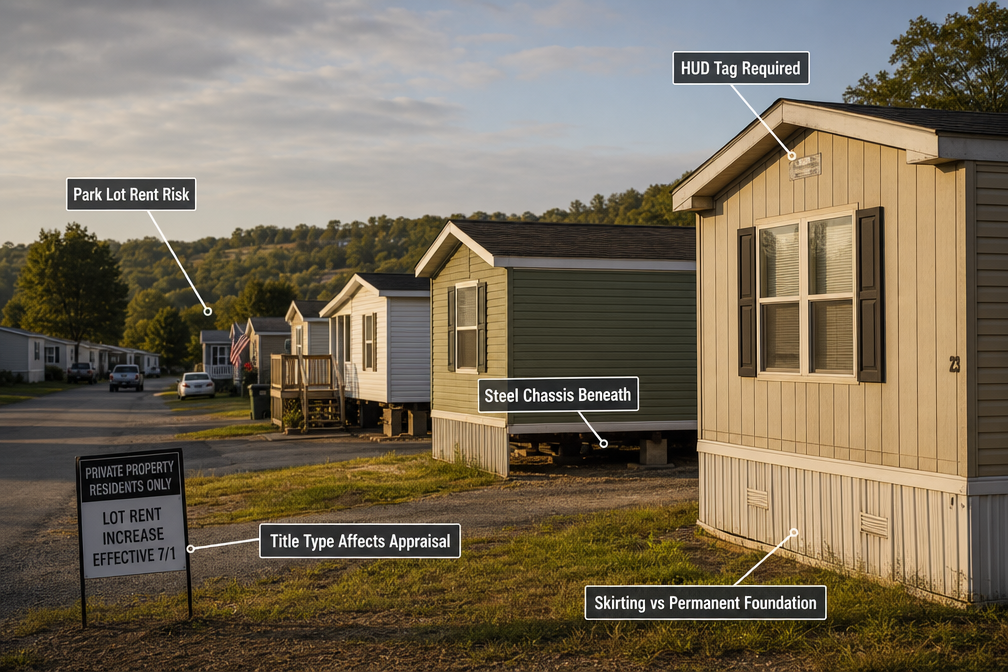
Common park rules that catch buyers off guard:
- Park approval of buyers: Many parks require the park owner to approve any buyer before you can sell your home. This limits your buyer pool and can slow a sale significantly.
- Lot rent increases: Lot rent is typically month-to-month or on a short-term lease. Significant rent increases can make the home unaffordable without warning.
- Age restrictions on homes: Some parks prohibit homes older than a certain year from being moved in, and some restrict resale of homes that fall below a condition threshold.
- No subletting: Many parks prohibit renting out your home, which eliminates any investment strategy beyond owner-occupancy.
- Park closure risk: If the park is sold for redevelopment, residents may receive relocation assistance, but the disruption and moving costs are real. Moving a manufactured home costs between $5,000 and $15,000 depending on distance and home size (estimate based on industry averages; costs vary significantly by market).
Can you move a modular home after it is built? No, modular homes are permanently attached to their foundations and cannot be relocated without demolition. This is actually a feature, not a limitation, because it means the home is treated as a permanent structure for all legal and financial purposes.
Can you move a manufactured home? Technically yes, since the steel chassis remains part of the structure. But moving a manufactured home is expensive, requires permits, and can damage the home. Most manufactured homes are never moved after initial placement.
HUD Code vs IRC: The Regulatory Split That Drives Everything
The HUD code started on June 15, 1976, when the federal government enacted the National Manufactured Housing Construction and Safety Standards Act. Before that date, factory-built homes had no federal standard, they were built to whatever the manufacturer chose, which is why pre-1976 homes are called mobile homes and are treated differently by lenders and insurers.
HUD code vs IRC building code, the practical differences:
The IRC (International Residential Code) is adopted and enforced at the state or local level. It covers everything from structural loads to electrical systems to energy efficiency. Modular homes are built to IRC and inspected by state or local building officials.
HUD code is a federal standard enforced by third-party inspection agencies called Production Inspection Primary Inspection Agencies (IPIAs). The code covers structural, fire safety, energy efficiency, and transportation loads, because the home must survive being trucked down a highway. HUD code is generally considered a solid standard, but it is not identical to IRC, and local building departments do not have jurisdiction over the HUD-regulated portions of a manufactured home.
This regulatory split is why a manufactured home cannot simply be re-permitted as a site-built home after the fact. The code it was built to is federal and permanent.
Modular home quality standards and certifications: Modular homes carry a state certification label (not a HUD label) confirming they were built to IRC. Third-party inspection agencies like the Modular Building Institute certify manufacturers. Some states have their own modular home approval programs. The quality of a modular home is directly comparable to a site-built home built to the same code.
For buyers interested in how structural and design choices affect long-term value, the piece on architectural styles that control your home's value is worth reading alongside this one.
Common Mistakes People Make Buying Modular or Manufactured Homes
The modular vs manufactured home mistake nobody mentions is not one mistake, it is a cluster of them, and they tend to compound.
Mistake 1: Assuming "modular" and "manufactured" mean the same thing.
They do not. The legal, financial, and regulatory differences are substantial. Always ask for the HUD data plate or the state modular certification label before proceeding.
Mistake 2: Signing a park lease before securing financing.
Many buyers fall in love with a manufactured home in a park, sign a lot lease, and then discover their preferred lender does not finance homes on leased land. Get lender pre-approval for the specific home type and land situation before committing.
Mistake 3: Skipping the title conversion on a manufactured home.
Buying a manufactured home as personal property and never converting it to real property locks you into chattel loan rates and limits your future financing options. If you plan to own the land, complete the title retirement process.
Mistake 4: Not reading the park rules before buying.
Park rules are a legal document. Read them. Pay specific attention to buyer approval clauses, subletting restrictions, and lot rent escalation terms.
Mistake 5: Underestimating insurance costs.
Manufactured home insurance is a separate product from standard homeowner's insurance. Rates vary significantly based on home age, foundation type, location, and whether the home is in a park. For buyers comparing total cost of ownership, the top home warranty companies guide covers protection options worth factoring into your budget.
Mistake 6: Ignoring the appraisal gap risk.
In markets with few manufactured home comps, appraisals can come in below the agreed purchase price. Build an appraisal contingency into any manufactured home purchase contract.
For sellers of manufactured homes, the pricing challenges are real, the home sellers pricing strategies playbook addresses how to position a property correctly when comps are limited.
Modular Home Insurance Costs Compared to Site-Built
Modular home insurance is priced essentially the same as site-built homeowner's insurance because the home is built to the same code, sits on the same type of foundation, and carries the same real property designation. Your insurer will look at the same factors: replacement cost, location, claims history, and coverage limits.
Manufactured home insurance is a distinct product. Insurers price it differently because:
- Manufactured homes built to HUD code have different structural characteristics than IRC-built homes
- Homes in parks face additional risks including park closure and proximity to neighboring units
- Older manufactured homes (pre-1990s) may have materials that are more expensive to replace or that insurers view as higher risk
- Homes on chattel titles (personal property) may require a different policy type than homes on real property
Specialty insurers like American Modern, Foremost, and National General focus on manufactured home coverage. Rates vary widely by state, home age, and foundation type. A newer manufactured home on a permanent foundation with a real property title will generally get better rates than an older home in a land-lease park.
The sustainable home design trends that boost resale value also applies to manufactured and modular homes, energy-efficient upgrades can reduce both insurance costs and operating expenses over time.
FAQ
What is the difference between modular and manufactured homes?
A modular home is factory-built, placed on a permanent foundation, and follows IRC building code, it is treated as real property. A manufactured home is also factory-built but sits on a steel chassis, follows federal HUD code, and can be titled as personal property. The legal and financial treatment of these two home types is fundamentally different.
What year did HUD code start?
HUD code took effect on June 15, 1976. Homes built before that date are legally called mobile homes and are not subject to HUD standards. Any manufactured home built after that date is required to carry a HUD certification label and a data plate.
Can you get a conventional loan for a manufactured home?
Yes, but only under specific conditions. The home must be on a permanent foundation, titled as real property, and built after June 15, 1976 with a verifiable HUD label. Fannie Mae's MH Advantage and Freddie Mac's CHOICEHome programs offer conventional financing for qualifying manufactured homes.
Does a modular home appreciate in value?
Generally yes. Modular homes appreciate at rates comparable to site-built homes in the same market because they are titled as real property and appraised under the same standards. Location and maintenance are the primary drivers, just as with any site-built home.
What is a chattel loan and why does it matter?
A chattel loan finances a manufactured home as personal property, similar to a vehicle loan. Interest rates are typically 1.5% to 3% higher than conventional mortgages, terms are shorter, and no land equity is attached. It is a significantly more expensive financing structure over the life of the loan.
Can you move a modular home after it is built?
No. Modular homes are permanently attached to their foundations during installation. Moving one would require demolition. This is by design, the permanent attachment is what qualifies the home as real property.
What is the mobile home vs manufactured home distinction?
"Mobile home" is the legal term for factory-built homes constructed before June 15, 1976. "Manufactured home" refers to factory-built homes built to HUD code after that date. The terms are often used interchangeably in conversation, but they have different legal, financing, and insurance implications.
What is the difference between modular homes vs mobile homes?
Modular homes are built to IRC, placed on permanent foundations, and titled as real property. Mobile homes are pre-1976 factory-built homes with no federal construction standard, typically titled as personal property, and very difficult to finance through conventional lenders.
How does manufactured vs prefab homes terminology work?
"Prefab" is an umbrella term covering any home with factory-built components, including modular homes, manufactured homes, panelized homes, and kit homes. Not all prefab homes are manufactured homes. Modular homes are a type of prefab home, but they follow IRC code and are not subject to HUD regulations.
What manufactured home appraisal rules should buyers know?
Appraisers must use comparable sales of other manufactured homes, not site-built homes. In markets with few manufactured home comps, appraisals can be unreliable or come in below purchase price. Homes on permanent foundations with real property titles appraise more favorably than homes on chattel titles.
Can you get an FHA loan on a manufactured home?
Yes, through FHA Title I (for homes in parks or on leased land) and Title II (for homes on owned land with permanent foundations). Title II loans require real property title, permanent foundation certification, and a verifiable HUD label.
What happens if a manufactured home park closes?
If a park closes, residents typically receive notice and may be entitled to relocation assistance under state law (requirements vary). Moving a manufactured home costs roughly $5,000 to $15,000 depending on distance and home size. Homes that cannot be economically moved may be lost entirely, a risk that is rarely discussed at the point of sale.
Conclusion
The modular vs manufactured home gap is not a minor technicality, it is the difference between building equity and watching it erode, between qualifying for a 30-year fixed mortgage and paying car-loan interest rates on your home for two decades. Both home types can be strong value compared to a site-built purchase at today's prices. But they are not the same product, and treating them as interchangeable is the error nobody catches until after the papers are signed.
Actionable next steps before you buy:
- Ask for the HUD data plate and certification label on any factory-built home. If it has one, it is a manufactured home. If it does not, confirm the state modular certification.
- Get lender pre-approval for the specific home type and land situation, not just a general pre-qualification.
- If buying a manufactured home on owned land, budget for the title retirement process and permanent foundation certification before closing.
- Read the park rules in full before signing a lot lease. Focus on buyer approval clauses, rent escalation terms, and subletting restrictions.
- Build an appraisal contingency into any manufactured home purchase contract.
For buyers comparing all their options in the current market, the U.S. home buyers market trends for 2026 and the best states for first-time home buyers are worth reading before you commit to a home type or a location. The buyers who do the research upfront are the ones who do not end up calling a broker six months later asking why their home will not appraise.