
Last updated: August 23, 2026

Quick Answer
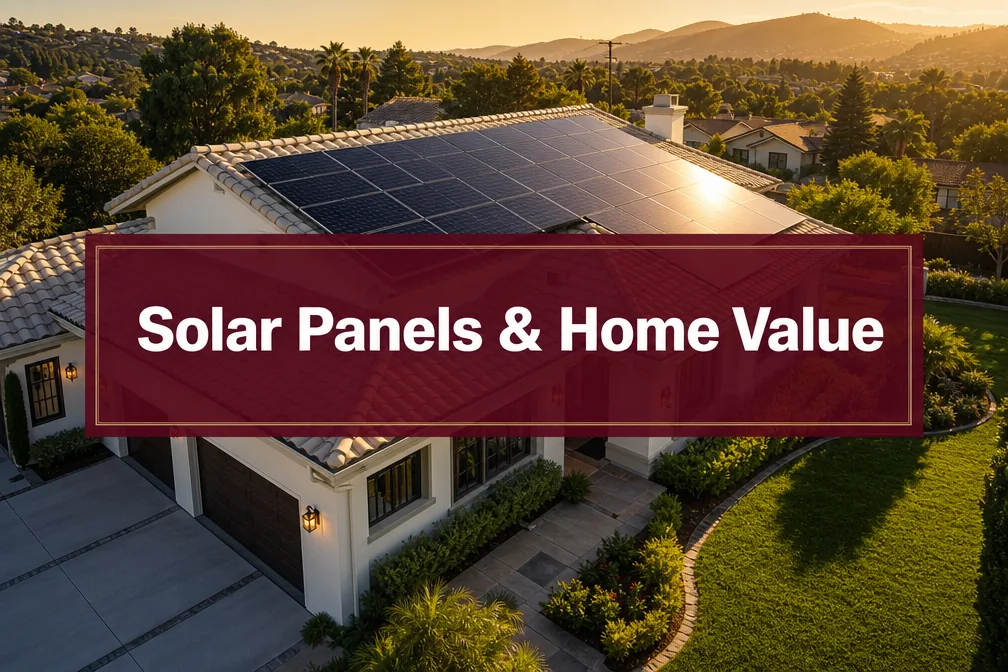
Do solar panels increase home value? Yes, for most homeowners with owned systems, solar panels add measurable value, with a widely cited Lawrence Berkeley National Laboratory study finding an average premium of roughly $15,000 on a typical U.S. home. The costly exception nobody talks about is leased solar panels, which can actively complicate or even derail a home sale, create lien issues, and reduce buyer interest, depending on how the system was financed and where the home is located.
Key Takeaways
- Owned solar panels add an average of 3% to 4.1% to home value, according to the Berkeley Lab solar premium study, but that figure varies sharply by state and local market.
- Leased solar panels are the costly exception nobody talks about. A solar lease transfer to buyer requires buyer approval and lender sign-off, and many buyers walk away rather than assume a lease obligation.
- A solar loan with a UCC-1 lien filed against the property must be paid off or transferred before closing, or the sale can stall entirely.
- Appraisers now use UAD solar addendum appraisal guidelines to value solar systems, but comparable sales with solar are still scarce in many markets, which can leave the premium unrecognized.
- Solar panels and home insurance interact in ways most sellers never check: some insurers require updated coverage when panels are added, and an undisclosed system can create liability.
- In high-electricity-cost states like California, Massachusetts, and New York, the solar premium is strongest. In low-cost-electricity states, buyers may see less financial motivation to pay more for solar.
- Owned vs leased solar panels home sale outcomes are dramatically different. Owned panels help. Leased panels require careful management.
- Homes with solar do tend to sell faster in markets where buyers understand the energy savings, but "faster" is not guaranteed everywhere.
Do Solar Panels Increase Home Value?
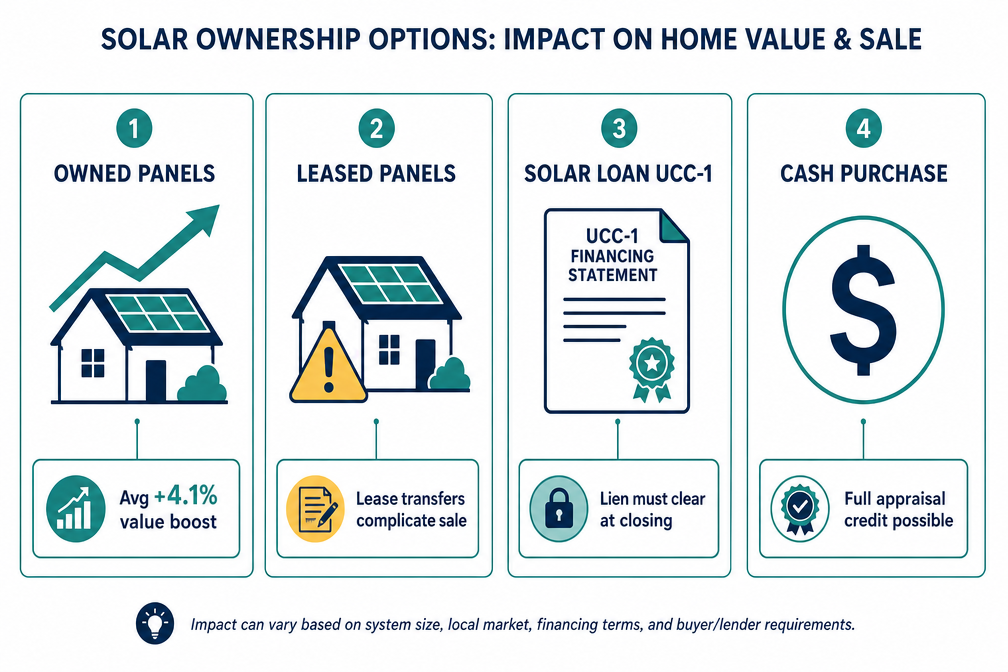
Owned solar panels increase home value in most U.S. markets. The most frequently cited data point comes from the Berkeley Lab solar premium study, which analyzed over 22,000 home sales across eight states and found that buyers paid a premium of roughly $4 per watt for solar systems, translating to approximately $15,000 on a typical 3.6 kW system. That works out to a value boost in the 3% to 4.1% range on a median-priced home.
So yes, the answer to "do solar panels increase home value" is generally yes, but the range is wide and the conditions matter enormously.
What drives the premium:
- Local electricity rates: the higher the utility cost, the more buyers value a system that cuts the bill
- System ownership: owned systems appraise; leased systems complicate
- System age and condition: a 15-year-old system with degraded output adds less value than a new one
- Local buyer awareness: in solar-saturated markets like California, buyers expect and price in solar; in markets where solar is rare, appraisers may struggle to find comps
The question "does solar increase home value" does not have one universal answer. It has a conditional one, and the conditions are what most sellers never read before they sign a lease or take out a solar loan.
Do Solar Panels Increase Home Value? $15,000 If Owned
This is where the conversation gets real. The costly exception nobody talks about is not a fringe scenario. It affects a significant share of solar homeowners because roughly one-third of residential solar installations in the U.S. are financed through leases or power purchase agreements (PPAs) rather than outright purchase or a personal loan.
The lease problem in plain terms:
A solar lease means a third-party company owns the panels on your roof. You agreed to pay them a monthly fee for 20 to 25 years in exchange for the electricity the panels produce. When you sell the house, that lease does not disappear. It either transfers to the buyer or gets bought out, and neither option is free or simple.
Selling a house with leased solar panels requires:
- The buyer to qualify for and agree to assume the lease
- The buyer's lender to approve the lease assumption (many lenders, especially FHA and VA, have strict rules here)
- The solar company to process the transfer, which can take weeks
- Full disclosure to the buyer upfront, or the deal can unravel at closing
Many buyers, especially first-time buyers already stretched thin on a 10% down payment, simply do not want to inherit a 15-year monthly obligation to a solar company they have never heard of. The result: sellers with leased panels often face a smaller buyer pool, longer days on market, and price negotiations that eat into whatever energy savings the lease provided.
The solar lease transfer to buyer is the single most common solar-related deal killer in residential real estate right now, and it barely gets mentioned in the marketing materials when the lease is signed.
The solar loan UCC-1 lien problem:
Solar loans are the other hidden trap. When a homeowner finances panels through a solar-specific loan, the lender often files a UCC-1 financing statement, which is a lien against the property. This lien shows up in a title search and must be resolved before closing. If the seller does not have enough equity to pay off the solar loan at closing, the deal can stall or fall apart.
A solar loan UCC-1 lien home sale complication is not theoretical. Title companies flag these regularly, and sellers who did not know the lien existed find out at the worst possible time.
For more on how liens and encumbrances affect what buyers and sellers owe at closing, see our guide on how to get a home seller to pay closing costs.
How Much Value Do Solar Panels Add to a House?
How much value solar adds depends on ownership status, system size, local electricity rates, and whether an appraiser can find comparable sales with solar. On average, owned solar panels add between 3% and 4.1% to a home's sale price, based on the Berkeley Lab solar premium study data. On a $434,000 home (the July 2026 national median), that range translates to roughly $13,000 to $17,800.
The appraisal gap problem:
Even when the value is real, it does not always show up in the appraisal. Appraisers follow UAD solar addendum appraisal guidelines, which require them to document the system, its ownership status, its estimated remaining useful life, and comparable sales that also include solar. In markets where solar is still uncommon, those comps may not exist. When an appraiser cannot find solar comps, the system may receive little to no additional value in the formal appraisal, which matters enormously if the buyer is financing the purchase.
How much does solar increase home value by state:
| State | Estimated Solar Premium | Key Driver |
|---|---|---|
| California | 4% to 6%+ | High electricity rates, strong buyer demand |
| Massachusetts | 3% to 5% | High rates, strong solar incentive history |
| New York | 3% to 4.5% | High rates, urban buyer awareness |
| Texas | 2% to 3.5% | Growing market, moderate rates |
| Florida | 2% to 3% | Growing adoption, rate sensitivity |
| Midwest states | 1% to 2% | Lower rates, fewer comps, lower buyer premium |
These are estimates based on available research and market patterns, not guaranteed figures. Local conditions, system age, and buyer pool all shift the outcome.
Solar Panels Home Resale Value Studies: What the Research Actually Shows
The Berkeley Lab solar premium study, formally titled "Selling into the Sun," remains the most cited piece of research on this topic. Researchers analyzed sales data across California, Connecticut, Florida, Maryland, Massachusetts, New York, North Carolina, and Pennsylvania. The core finding: buyers paid a consistent premium for homes with owned solar systems, averaging about $4 per watt of installed capacity.
A follow-up Zillow analysis found that homes with solar sold for 4.1% more than comparable homes without solar. A separate study from the National Renewable Energy Laboratory (NREL) found that solar homes sold 20% faster than non-solar homes in markets with high solar penetration.
What the research does not show:
- These studies focused almost entirely on owned systems. Leased systems were excluded or flagged separately.
- The data skews toward California and the Northeast, where electricity rates and buyer awareness are highest.
- Studies from the early 2020s may not fully reflect 2026 market conditions, where solar is far more common and the novelty premium may be compressing in saturated markets.
The honest read: the research supports a real premium for owned solar in the right markets. It does not support the blanket claim that "solar always adds value," and it says almost nothing useful about leased systems.
Will Solar Panels Hurt My Home Value? The Cases Where They Do
Will solar panels hurt home value? In specific situations, yes. The owned vs leased solar panels home sale dynamic is the most common problem, but it is not the only one.
Situations where solar can reduce or complicate value:
- Leased systems with above-market rates: If the lease was signed when electricity rates were lower and the monthly payment now exceeds what the buyer would pay the utility, the lease is a financial liability, not an asset.
- Aging or damaged systems: Panels degrade over time, typically losing 0.5% to 0.8% of output per year. A 20-year-old system may be near end-of-life. Buyers may discount the home or request removal.
- Roof damage from improper installation: Panels installed without proper flashing or on an aging roof can cause water intrusion. Buyers who discover this during inspection often request repairs or price reductions that exceed the solar premium.
- HOA restrictions: Some HOAs have rules about solar panel placement or aesthetics. Panels installed in violation of HOA guidelines can create legal complications for a sale. For a deeper look at how HOA rules affect home transactions, see The Truth About HOAs: Benefits and Challenges Every Buyer Should Know.
- Low-electricity-cost markets: In states where electricity is cheap, buyers have less financial incentive to pay a premium for solar. The value proposition weakens significantly.
Owned vs Leased Solar Panels: The Home Sale Difference
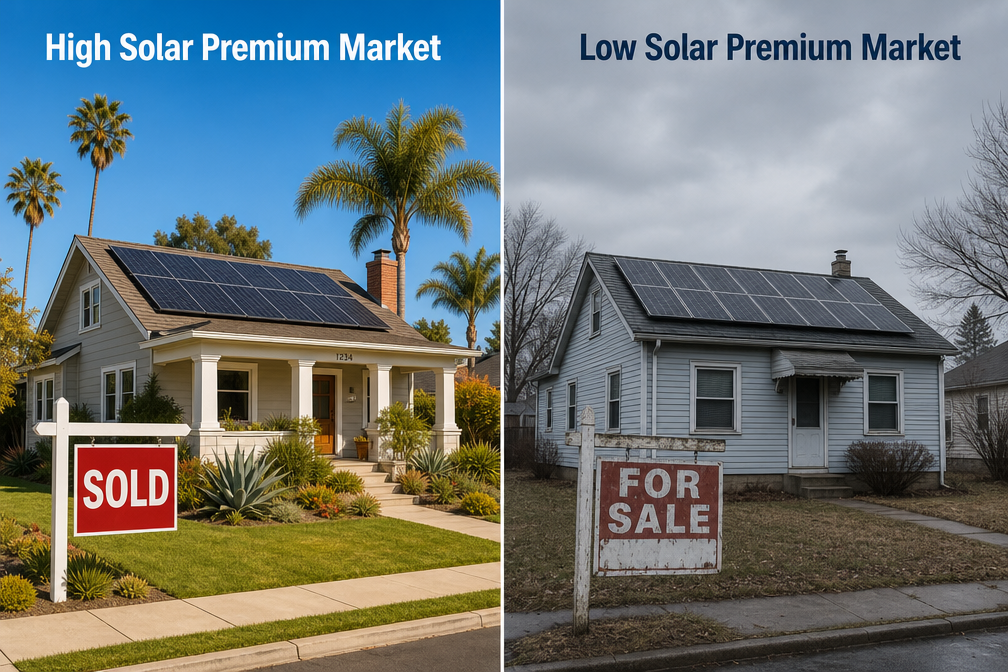
Owned vs leased solar panels home sale outcomes are not even close to equivalent. This is the single most important distinction any solar homeowner needs to understand before listing.
Owned solar (purchased outright or through a paid-off loan):
- Appraised as part of the property
- No third-party approval needed for transfer
- Full solar premium applies in most markets
- Buyer's lender treats it like any other home improvement
Leased solar or PPA:
- Third-party company retains ownership of the panels
- Buyer must qualify for and assume the lease
- Many conventional, FHA, and VA lenders require specific documentation or may decline to lend on homes with certain lease structures
- Solar lease transfer to buyer can take 30 to 60 days, potentially delaying closing
- If the buyer declines the lease, the seller may need to buy out the lease, which can cost $10,000 to $30,000 or more depending on remaining term
Solar loan with active UCC-1 lien:
- Title search will reveal the lien
- Must be paid off at closing or the buyer's title insurance will not clear
- Sellers who are underwater on the solar loan relative to the premium it adds face a net loss at closing
The honest advice here is simple: if you are considering solar and plan to sell within 10 years, buy the system outright or use a home equity product rather than a third-party lease. The math on resale is dramatically different.
For homeowners weighing how equity products interact with home improvements, our HELOC after purchasing a home guide covers the timing and mechanics in detail.
Do Solar Panels Increase Property Taxes?
In many states, solar panels do not increase property taxes because of specific solar energy exemptions. However, this is not universal, and the rules vary by state and sometimes by county.
States with full solar property tax exemptions (as of 2026): California, New York, New Jersey, Massachusetts, Texas, Florida, Arizona, and most other major solar markets have adopted exemptions that prevent the added value from solar from increasing the property tax assessment.
States without full exemptions: Some states treat solar as a standard home improvement and assess it accordingly. If you are in a state without an exemption, the added appraised value from solar will flow through to your property tax bill.
For a clear breakdown of how assessed value and market value interact, see our guide on home tax assessed value vs. market value.
The practical check: before assuming your solar installation is tax-exempt, verify your state's current exemption status with your county assessor. Laws change, and some exemptions have sunset provisions.
Do Buyers Want Solar Panels on Homes?
Buyer demand for solar is real but conditional. A 2023 survey by the National Association of Home Builders found that energy efficiency features, including solar, consistently rank among the top features buyers want. In markets with high electricity costs, solar is increasingly expected rather than just desired.
What buyers actually respond to:
- Lower monthly utility bills: this is the primary driver, not environmental preference
- Owned systems with transferable warranties
- Systems that are 10 years old or newer with documented output data
- Clear disclosure of ownership status upfront
What makes buyers hesitate:
- Any mention of a lease or PPA
- Panels that look visually dated or are mounted in a way that affects curb appeal
- Lack of documentation on system performance
- Uncertainty about who handles repairs if something breaks
Does solar help a house sell faster? In high-solar markets like California, Arizona, and parts of the Northeast, yes. Homes with owned solar systems in these markets do tend to move faster than comparable non-solar homes, consistent with the NREL finding of roughly 20% faster sales. In markets where solar is uncommon, the effect is neutral to slightly positive, and in markets with buyer skepticism about leases, it can slow a sale.
How to Maximize Home Value With Solar Panels
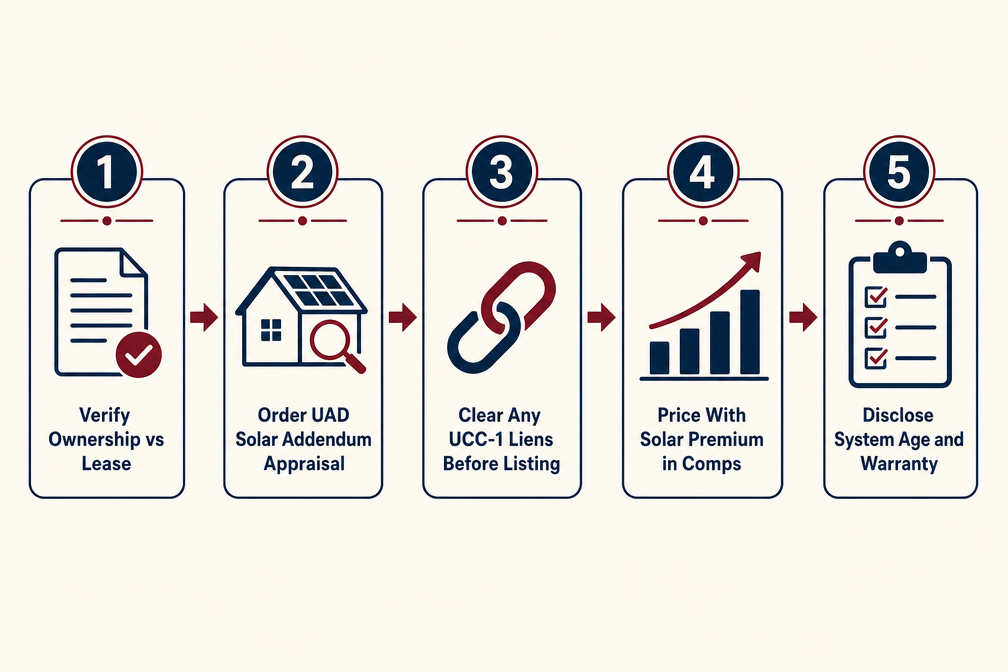
Getting the most value from solar at resale requires planning before the panels go on the roof, not after.
Step 1: Own the system outright
Buy with cash or a home equity product. Avoid third-party leases and PPAs if resale is a priority within 15 years.
Step 2: Size the system appropriately
Oversized systems do not always command proportionally higher premiums. A system sized to your actual usage is more defensible in an appraisal than one that produces far more than the home consumes.
Step 3: Document everything
Keep all installation permits, warranty documents, production data, and utility bills showing pre- and post-solar costs. Appraisers and buyers will ask for this.
Step 4: Request a UAD solar addendum appraisal
When listing, ask your listing agent to ensure the appraiser uses the UAD solar addendum appraisal form. This standardized addendum helps appraisers properly document and value the system rather than ignoring it.
Step 5: Address roof condition first
Panels on a roof that needs replacement within five years are a liability. Buyers will either request a price reduction or walk. If the roof is aging, replace it before adding solar or before listing.
Step 6: Disclose proactively
Full disclosure of ownership status, system age, and any financing liens is not just ethical, it is legally required in most states. Sellers who disclose early avoid the deal-killing surprises that come out in inspection or title search.
For more on which home improvements actually pay off at resale, see our breakdown of best home improvements before selling, ranked by ROI.
Solar Panels and Home Insurance: The Coverage Gap Nobody Checks
Solar panels and home insurance interact in ways that most homeowners never verify. Most standard homeowners insurance policies cover rooftop solar panels as part of the dwelling structure, but coverage limits and exclusions vary.
Common insurance issues with solar:
- Coverage limits: If your panels add $20,000 to $30,000 in value and your policy has a dwelling coverage cap that does not account for this, you may be underinsured.
- Liability for panel-related damage: If a panel falls or causes a fire, coverage depends on whether the installation was permitted and whether the insurer was notified.
- Leased panels: Some insurers treat leased panels differently because you do not own them. The solar company's insurance may cover the panels themselves, but damage they cause to your roof or home may fall into a coverage gap.
- Roof warranty interaction: Many roofing manufacturers void their warranty if solar panels are installed by a third party. This can affect both insurance claims and home sale disclosures.
The so-based move here is to call your insurer before installation, not after, and get the coverage confirmation in writing. This is one of those details that only matters when something goes wrong, and by then it is too late to fix.
What Happens to Home Value if Solar Panels Break or Fail?
A non-functioning solar system is not a neutral feature. It is an active liability. Buyers who discover broken or underperforming panels during inspection will either request a price reduction, ask the seller to repair or remove the system, or walk away.
Solar panel removal costs if selling house:
If a buyer wants the panels removed before closing, removal typically costs $1,500 to $3,000 for a standard residential system, plus any roof repair needed after removal. If the panels were installed with penetrating mounts, roof repair can add another $1,000 to $5,000 depending on the roof type and age.
What to check before listing:
- Pull production data from the monitoring app or inverter dashboard. If output has dropped more than 20% from the system's rated capacity, have it inspected.
- Verify the inverter is functioning. Inverters typically last 10 to 15 years and cost $1,000 to $2,500 to replace.
- Check that all panels are physically intact with no cracked cells or delamination.
- Confirm the system is still under manufacturer warranty and that the warranty is transferable to a new owner.
A fresh inspection report showing a fully functional system with documented output is a powerful selling tool. It removes buyer uncertainty and gives the appraiser concrete data to support the premium.
Are Solar Panels Worth It Financially for Resale?
For owned systems in high-electricity-cost markets, the financial case for solar at resale is solid. The average installation cost for a residential solar system in 2026 runs between $15,000 and $25,000 before the federal Investment Tax Credit (ITC), which currently sits at 30%. After the ITC, net cost is roughly $10,500 to $17,500.
If the Berkeley Lab premium of approximately $15,000 holds in your market, an owned system can return close to its net cost at resale, while also delivering years of reduced utility bills before you sell. That is a reasonable financial outcome.
The math breaks down when:
- The system is leased (no premium, plus transfer complications)
- The market has low electricity rates (premium compresses)
- The system is old and near end-of-life (buyers discount or request removal)
- Appraisers cannot find solar comps (premium goes unrecognized in the appraisal)
The honest answer to "are solar panels worth it financially for resale" is: owned system, right market, right age, yes. Leased system, or wrong market, the math gets murky fast. Expect a slow payoff, because the full financial benefit of solar, including both the utility savings and the resale premium, plays out over years, not months.
For context on how energy-efficient features are shaping buyer preferences in 2026, see our coverage of sustainable home design trends and energy-efficient features boosting resale value.
Solar Panel Financing Options and Their Impact on Home Equity
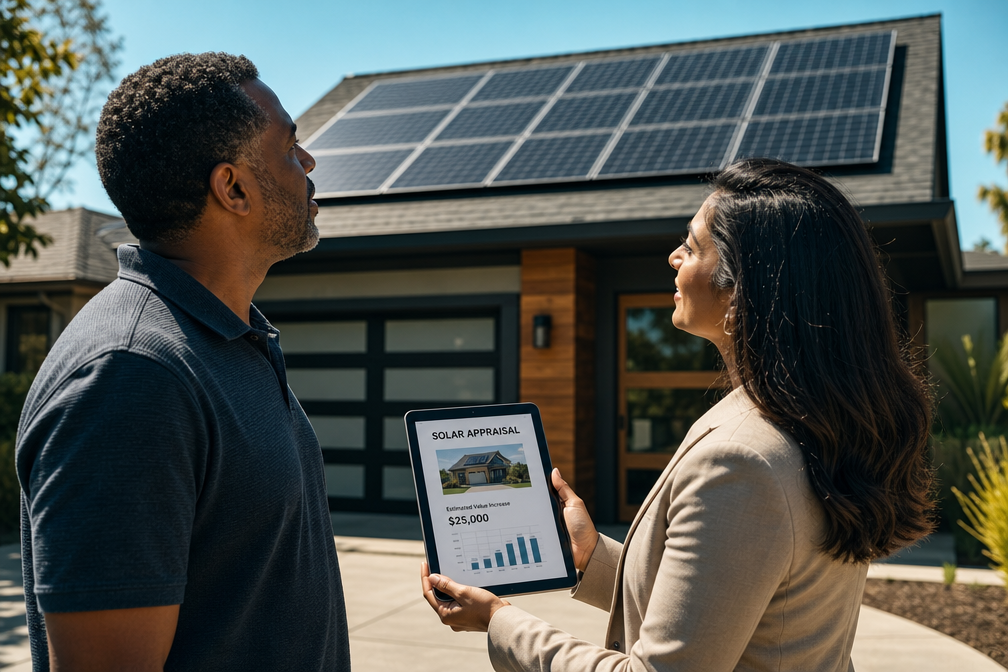
How you finance solar directly determines how it interacts with your home equity and your eventual sale.
Cash purchase: Full equity benefit. No lien, no lease complication, full appraisal credit possible. Best option for resale.
Home equity loan or HELOC: Panels are financed through your mortgage equity, so no separate UCC-1 lien is filed against the property. The system becomes part of the home's equity structure cleanly.
Solar-specific loan (PACE or unsecured): PACE (Property Assessed Clean Energy) loans are attached to the property tax bill and transfer with the home. They are not a standard mortgage, and many conventional lenders will not lend on homes with active PACE assessments. Unsecured solar loans may file a UCC-1 lien. Both require careful disclosure and resolution before closing.
Third-party lease or PPA: No equity benefit. Panels are not yours. Transfer complications are significant. Buyout costs can be substantial.
For sellers who are already in a lease and want to understand their options, the key questions are: what is the buyout cost, how many years remain on the lease, and does the buyer's lender allow lease assumptions? Get those answers before listing, not during.
For a broader look at how home improvements interact with property value and pricing strategy, our guide to avoiding pricing pitfalls when valuing your home is worth reading before you set your list price.
Conclusion: What Solar Homeowners and Buyers Should Do Right Now
Do solar panels increase home value? For most homeowners with owned systems in the right markets, yes, meaningfully. The Berkeley Lab data, the Zillow analysis, and the NREL speed-of-sale research all point in the same direction: owned solar adds real, measurable value when the market supports it.
The costly exception nobody talks about is the leased system, the solar loan with an active UCC-1 lien, and the aging system in a low-electricity-cost market. Those scenarios do not just fail to add value. They can actively complicate or reduce the value of a sale.
Actionable next steps:
- If you own solar outright: document the system thoroughly, request a UAD solar addendum appraisal when listing, and disclose everything upfront.
- If you have a solar lease: get the buyout cost from your solar company now, before you list. Know whether your buyer pool will qualify to assume the lease under current lender guidelines.
- If you have a solar loan: pull your title history or ask a title company to check for a UCC-1 lien. Know the payoff amount and factor it into your net proceeds calculation.
- If you are buying a home with solar: ask immediately whether the system is owned or leased, request production data for the last 12 months, and have your lender confirm they will lend on the property with the current financing structure.
- If you are considering installing solar before selling: buy the system outright, get the roof inspected first, and gather at least one to two years of documented production data before listing.
Solar is a strong feature when it is set up correctly. Keeping this quiet does no one any favors. The sellers who understand the owned vs. leased distinction, the lien implications, and the appraisal process walk away with more money and fewer surprises. The ones who do not find out at closing.
For more on preparing your home for a successful sale, visit our Preparing Your Home for Sale hub.
Frequently Asked Questions
Do solar panels increase home value for all homeowners?
No. Owned solar panels increase value in most markets, particularly those with high electricity rates. Leased systems typically do not add appraised value and can complicate a sale. The ownership structure is the deciding factor.
How much value does solar add to a home on average?
The Berkeley Lab solar premium study found an average premium of roughly $15,000, or about $4 per watt of installed capacity. Zillow's analysis found a 4.1% average price premium for solar homes. Both figures apply to owned systems in markets with sufficient comparable sales data.
What is the costly exception with solar panels and home value?
The costly exception is a leased solar system or a solar loan with an active UCC-1 lien. Leased panels require buyer qualification and lender approval for transfer, often shrink the buyer pool, and add no appraised value. Solar loans with liens must be paid off at closing or the title will not clear.
Does solar help a house sell faster?
In high-solar markets like California and Massachusetts, yes. Research from NREL found solar homes sold roughly 20% faster in markets with high solar penetration. In markets where solar is uncommon, the effect on days on market is minimal.
What is a UAD solar addendum appraisal?
It is a standardized appraisal form used to document and value a solar system as part of a home appraisal. It captures system ownership, size, age, estimated remaining useful life, and comparable sales data. Without it, appraisers in some markets may assign little to no value to the system.
Will solar panels increase my property taxes?
In most major solar markets, no. Most states have adopted property tax exemptions for solar installations. However, not all states have these exemptions, and some have sunset provisions. Verify your state's current rules with your county assessor before assuming you are exempt.
What does a solar lease transfer to a buyer involve?
The buyer must qualify for and agree to assume the lease, the buyer's lender must approve it, and the solar company must process the transfer. This can take 30 to 60 days and requires full disclosure upfront. Many buyers decline to assume leases, which reduces the seller's buyer pool.
How much does solar panel removal cost if selling a house?
Removal typically costs $1,500 to $3,000 for a standard system, plus any roof repair needed after removal. Roof repair can add $1,000 to $5,000 depending on the mounting method and roof condition.
Do solar panels and home insurance require any updates?
Yes, in most cases. Homeowners should notify their insurer when solar is installed to ensure dwelling coverage limits account for the added value. Leased systems may have coverage gaps between the homeowner's policy and the solar company's policy.
What is the difference between owned vs leased solar panels in a home sale?
Owned panels are appraised as part of the property, transfer cleanly to the buyer, and typically command a price premium. Leased panels are owned by a third party, require buyer and lender approval to transfer, add no appraised value, and can complicate or delay closing.
Are solar panels worth it financially for resale?
For owned systems in high-electricity-cost markets, the resale math is generally positive. Net installation cost after the 30% federal ITC runs roughly $10,500 to $17,500 for a typical system, and the average premium in favorable markets is approximately $15,000. In low-rate markets or with leased systems, the financial case for resale value weakens significantly.
How does a solar loan UCC-1 lien affect a home sale?
A UCC-1 lien filed by a solar lender shows up in a title search and must be resolved before closing. If the seller cannot pay off the solar loan from sale proceeds, the closing can stall. Sellers should check for this lien before listing and factor the payoff into their net proceeds calculation.