
Last updated: August 23, 2026

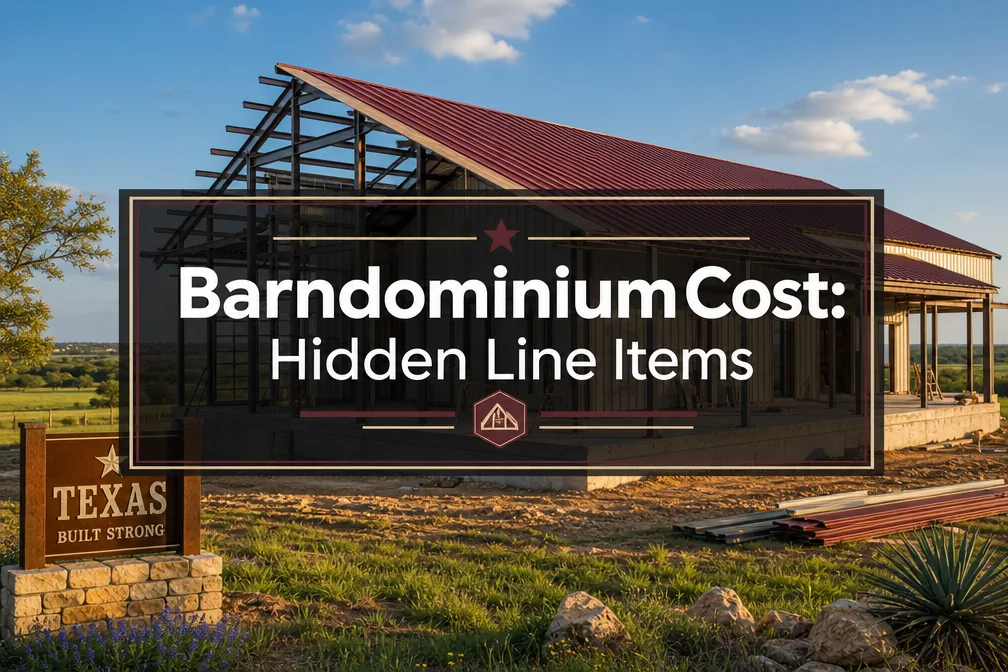
Quick Answer: Barndominium cost lands somewhere between the shell price a builder quotes you and the finished number you actually write checks for, and the gap is where most budgets break. The average barndominium cost per square foot runs $100 to $160 for a basic build and $160 to $250 or more for a fully finished, turnkey home, putting a 2,000 square foot barndominium cost between $200,000 and $500,000 depending on location, finishes, and the line items your builder quietly left off the quote. Those omissions, not the steel frame itself, are what sink barndominium budgets.
Key Takeaways
- The shell-only quote from most barndominium kit companies covers the steel frame and roof panels, nothing else. Interior finishing, site prep, utilities, and permits are separate costs that routinely add 40% to 80% on top of the kit price.
- A 1,500 sq ft barndominium cost typically runs $150,000 to $300,000 finished. A 3,000 sq ft barndominium cost can reach $450,000 to $750,000 or more in high-cost states.
- Site prep, including land clearing, grading, a well, and a septic system, often adds $30,000 to $80,000 before a single steel beam goes up.
- Barndominium insurance costs run 10% to 25% higher than a comparable stick-built home in many markets because most carriers classify metal buildings differently.
- Financing a barndominium is harder than financing a conventional home. Many lenders require a construction-to-permanent loan, and some rural markets have appraisal gaps that kill deals.
- Barndominium kits with prices starting under $50,000 are real, but they cover the shell only. Budget-conscious buyers chasing a barndominium under 100k finished will need to do significant owner-builder work.
- Zoning and permitting vary wildly by county. Some rural counties welcome barndominiums; others have minimum square footage rules or residential appearance requirements that add cost.
- Converting an existing barn into a barndominium (renovation path) is rarely cheaper than new construction once structural upgrades, insulation, and code compliance are factored in.
What Is a Barndominium and How Much Does It Cost to Build
A barndominium is a metal building, typically steel-framed, that functions as a residential home, often combining living quarters with a workshop, garage, or open-span storage area. The barndominium construction cost varies more than almost any other housing type because the structure itself is just the starting point.
The base cost to build a barndominium breaks down into two very different categories:
Shell only (kit or contractor-erected frame):
- Basic steel barndominium kits with prices range from $20 to $35 per square foot
- A 2,000 sq ft shell kit might cost $40,000 to $70,000 delivered
- This covers the frame, roof panels, exterior walls, and sometimes windows and doors
Turnkey finished (move-in ready):
- Barndominium cost per square foot for a fully finished build: $130 to $250+
- A 2,000 square foot barndominium cost finished: $260,000 to $500,000
- A 3,000 sq ft barndominium cost finished: $390,000 to $750,000
The spread between shell and turnkey is where most buyers get blindsided. Barndominium plans and prices shown in builder marketing almost always feature the shell or a lightly finished version. The polished-looking Instagram barndominiums with shiplap walls, quartz countertops, and soaking tubs? Those are landing closer to $200 per square foot.
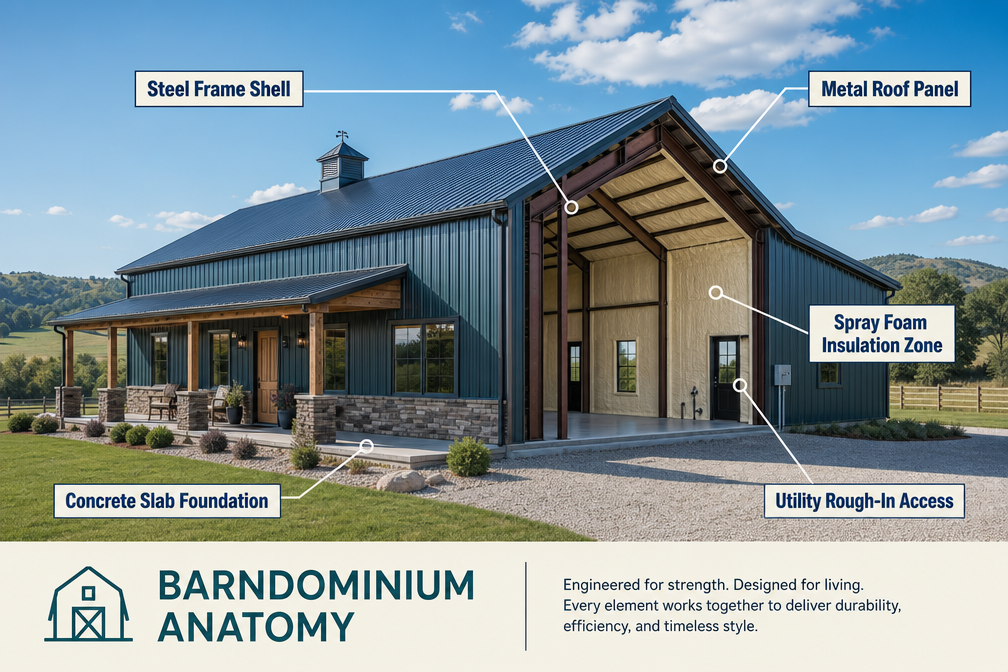
Barndominium Cost: $200K Basic, $500K Turnkey
This is the section most builder quotes skip entirely, and it's where budgets quietly collapse. The barndominium cost breakdown below covers the line items that rarely appear in a contractor's initial proposal.
The hidden cost categories, with realistic ranges:
| Line Item | Typical Cost Range | Notes |
|---|---|---|
| Land clearing and grading | $3,000 to $15,000 | Heavily wooded lots cost more |
| Soil testing and survey | $1,500 to $5,000 | Required by most lenders |
| Barndominium site prep cost (total) | $10,000 to $40,000 | Includes above plus access road |
| Concrete slab foundation | $6 to $12 per sq ft | $12,000 to $24,000 for 2,000 sq ft |
| Spray foam insulation | $3 to $7 per sq ft | Metal buildings require more than wood |
| HVAC system | $10,000 to $30,000 | Larger open spans cost more to condition |
| Plumbing rough-in and fixtures | $8,000 to $25,000 | Varies by bathroom count |
| Electrical panel and wiring | $8,000 to $20,000 | Long rural runs add cost |
| Drywall, framing interior walls | $5,000 to $20,000 | Open-concept plans still need some walls |
| Septic system | $8,000 to $25,000 | Required if no municipal sewer |
| Well drilling | $5,000 to $20,000 | Depth-dependent |
| Permits and inspections | $2,000 to $10,000 | County-dependent |
| Utility connection fees | $3,000 to $15,000 | Electric co-op hookup fees vary widely |
Add those up on the conservative end and you're looking at $80,000 to $100,000 in costs that never appear on the barndominium kit price page. That's the gap between barndominium prices in marketing materials and what buyers actually spend.
Three hidden costs that catch buyers off guard most often:
Spray foam insulation on metal. Wood-framed homes can use batt insulation. Metal buildings condensate. Spray foam is nearly mandatory, and it costs 3 to 5 times more than batt per square foot.
HVAC for open spans. A barndominium with a 30-foot open ceiling is striking to look at. It's also expensive to heat and cool. Builders quote the unit; they rarely quote the ductwork, zoning, or the operating cost.
Long utility runs. Rural lots often sit far from the electric grid, water main, or both. A 500-foot electric service run can add $5,000 to $15,000 that no kit company mentions.
Barndominium Cost Per Square Foot vs. Traditional Home
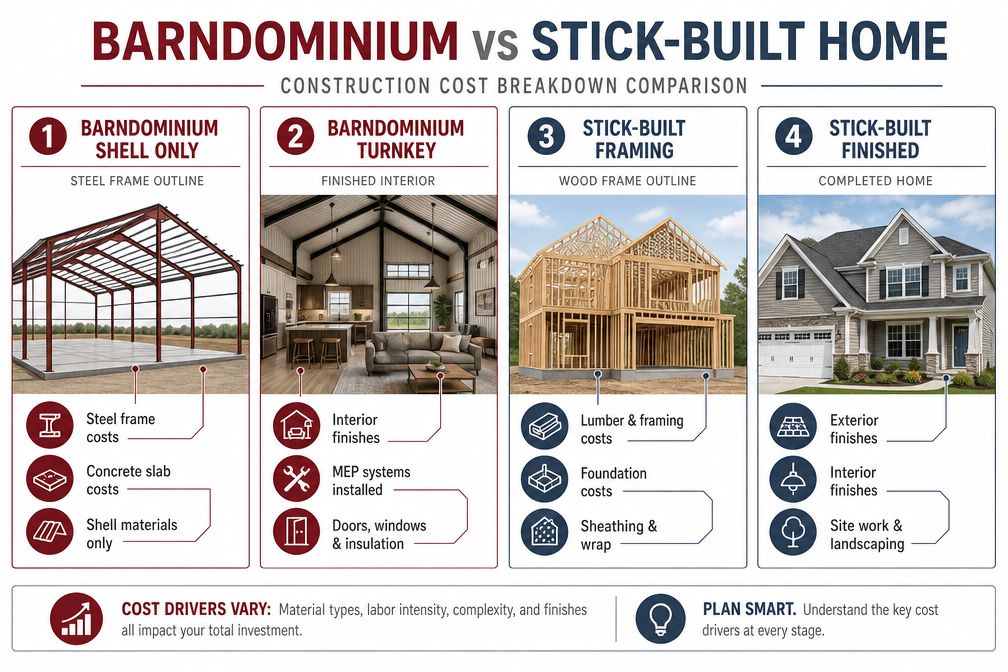
A barndominium is cheaper to build than a comparable stick-built home in most markets, but the gap is smaller than most people expect, and it closes fast once interior finishes are included.
Side-by-side comparison (2026 estimates):
| Build Type | Cost Per Sq Ft (Basic) | Cost Per Sq Ft (Mid-Grade) | Cost Per Sq Ft (High-End) |
|---|---|---|---|
| Barndominium | $100 to $130 | $140 to $180 | $200 to $260+ |
| Stick-built home | $130 to $160 | $170 to $220 | $250 to $350+ |
| Modular home | $90 to $130 | $130 to $180 | $180 to $250 |
The barndominium advantage is most pronounced at the basic and mid-grade level. At high-end finishes, the cost difference shrinks to 10% to 15% in many markets, and in some high-labor states like California or New York, it disappears entirely.
Where barndominiums genuinely save money:
- Faster construction timeline (30 to 50% faster than stick-built in many cases)
- Lower long-term maintenance on the exterior shell
- Larger usable square footage per dollar on the structural shell
- Combined living and workspace under one roof (no separate shop build needed)
Where the savings evaporate:
- High-end interior finishes cost the same regardless of what's holding the roof up
- Insulation and HVAC costs are higher in metal buildings
- Resale and appraisal challenges can reduce effective value
For buyers researching the new home construction surge in 2026, barndominiums represent a real alternative, but only if the full cost picture is on the table from day one.
Do You Need Special Permits and Zoning for a Barndominium
Yes, and this is one of the most underestimated costs in the entire barndominium budget. Zoning and permitting requirements vary by county, and some jurisdictions make barndominium construction genuinely difficult.
What to check before buying land for a barndominium:
- Zoning classification. Land must be zoned for residential use or agricultural residential. Some agricultural zones prohibit permanent dwellings or require a minimum acreage.
- Minimum square footage rules. Many counties require residential structures to meet a minimum finished square footage, often 1,000 to 1,200 sq ft.
- Residential appearance ordinances. Some counties require homes to have a certain percentage of non-metal exterior cladding, which adds cost.
- HOA restrictions. Subdivisions with HOAs almost universally prohibit metal buildings as primary residences.
- Building codes. Barndominiums must meet the same residential building codes as any other home, including energy codes, which is where spray foam insulation becomes non-negotiable in many states.
Permit costs range from $2,000 in a rural Texas county to $10,000 or more in a regulated suburban jurisdiction. Budget $3,000 to $7,000 as a reasonable middle estimate, and add $1,500 to $3,000 for inspections across the build timeline.
The mistake that costs the most: buying rural land before confirming it can be permitted for residential use. A $50,000 land purchase becomes a problem if the county won't issue a residential building permit for a metal structure.
Barndominium Foundation Costs and Site Prep Expenses
Site prep and foundation are the two line items most often missing from barndominium quotes, and together they represent the single largest hidden cost category.
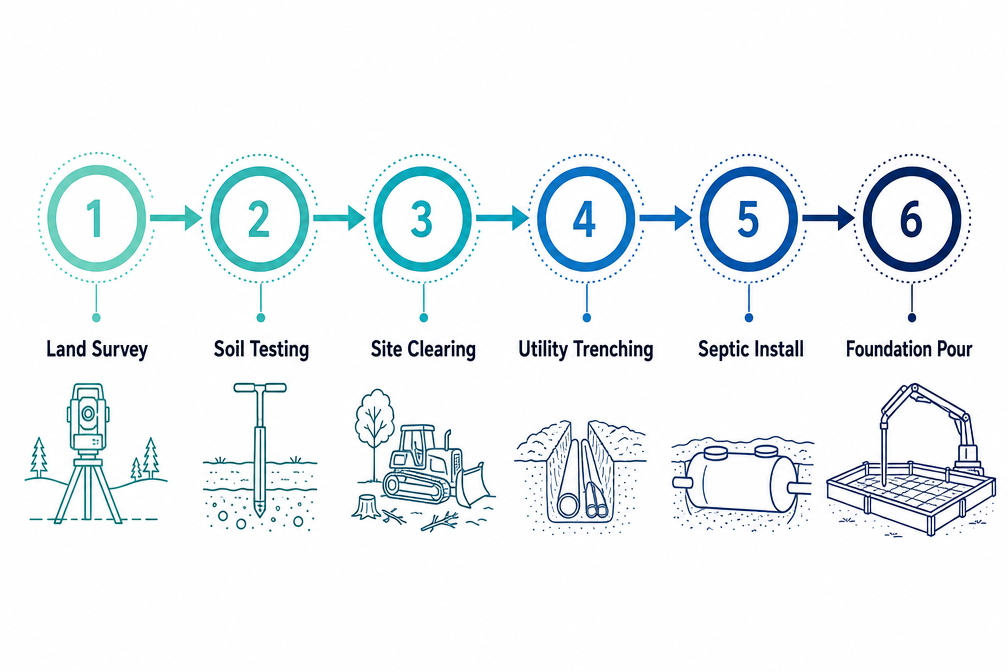
The barndominium site prep cost covers everything that happens before the steel frame arrives. On a raw rural lot, that list is long.
Site prep cost breakdown:
- Land clearing (light brush): $1,500 to $5,000
- Land clearing (heavy timber): $5,000 to $20,000
- Grading and leveling: $2,000 to $10,000
- Soil boring and geotechnical report: $1,000 to $3,500
- Driveway/access road (gravel, 200 feet): $3,000 to $8,000
- Erosion control and drainage: $1,000 to $5,000
Foundation options and costs:
Most barndominiums use a concrete slab, which is the most cost-effective option for flat to gently sloping sites.
- Monolithic slab: $6 to $10 per sq ft. A 2,000 sq ft slab runs $12,000 to $20,000.
- Pier and beam: $8 to $15 per sq ft. Better for sloped lots or expansive clay soils.
- Engineered slab (poor soil): $12 to $20 per sq ft. Required when soil tests show poor bearing capacity.
Rocky terrain, high water tables, or expansive clay soil (common in Texas and Oklahoma, two of the most popular barndominium states) can push foundation costs well above these ranges. Never skip the soil test. A $1,500 soil report can save $20,000 in foundation re-engineering.
How Much Do Utilities and Septic System Installation Add to Barndominium Cost
On a rural lot, utilities and septic can add $25,000 to $65,000 to the total barndominium cost before a single interior wall goes up. This is the category most often missing from barndominium plans and prices shown online.
Utility cost breakdown for a rural barndominium:
- Septic system (conventional): $8,000 to $15,000. Mound systems or aerobic systems in challenging soils: $15,000 to $25,000.
- Well drilling: $5,000 to $15,000 for most depths. Deep wells in arid regions: $15,000 to $25,000.
- Electric service installation: $3,000 to $10,000 for a standard run. Long rural runs (500+ feet): $10,000 to $20,000.
- Propane tank and line (if no natural gas): $1,500 to $5,000.
- Internet/cable conduit installation: $500 to $3,000.
For buyers comparing a barndominium under 100k to a conventional home purchase, this is the math that breaks the dream. A $45,000 barndominium kit plus $60,000 in site prep and utilities is already $105,000 before interior finishing begins. That's not a criticism of barndominiums, it's just the honest number.
Buyers interested in how property costs stack up across different markets might also find value in reviewing top affordable cities with low cost of living, since location affects every one of these utility cost ranges.
Can You Finance a Barndominium and What Are the Loan Requirements
Financing a barndominium is possible but more complicated than a conventional home loan. Most traditional mortgage lenders won't finance a barndominium under a standard 30-year mortgage because the property type doesn't fit their underwriting guidelines.
Barndominium financing options:
- Construction-to-permanent loan: The most common path. Covers the build, then converts to a permanent mortgage at completion. Requires detailed plans, a licensed contractor, and a qualified appraiser familiar with barndominiums.
- USDA loans: Available for rural properties that meet USDA guidelines. Barndominiums can qualify if the property is in an eligible rural area and meets residential standards.
- FHA loans: Rarely used for barndominiums. FHA has strict property standards that metal buildings often struggle to meet.
- Farm Credit System lenders: Agricultural lenders like Farm Credit Services and AgTexas are often more familiar with metal building homes and may offer more flexible terms.
- Portfolio lenders and local banks: Community banks and credit unions that hold loans in-house (rather than selling to Fannie Mae or Freddie Mac) have more flexibility. These are often the best path for barndominium buyers.
- Owner-builder loans: Available if you're acting as your own general contractor. Harder to qualify for and typically require significant construction experience.
Does a barndominium appraise well?
This is the question that determines whether financing works at all. Barndominiums often appraise below construction cost because appraisers struggle to find comparable sales ("comps") in rural markets. A barndominium that costs $350,000 to build may appraise at $280,000 if there are no similar sales within 10 to 15 miles.
The appraisal gap is a real risk. Lenders won't loan above appraised value, which means buyers may need to cover the difference in cash. Work with an appraiser who has specific barndominium experience before committing to a build budget.
For buyers weighing financing costs more broadly, the HELOAN vs HELOC guide covers how equity-based borrowing works if you're converting an existing property. And if you're considering hard money as a bridge during construction, the hard money lenders for beginners breakdown is worth reviewing before signing anything.
Barndominium Insurance Costs and Why They're Higher
Barndominium insurance costs run higher than a comparable stick-built home in most markets. The reason is simple: most insurance carriers classify metal buildings differently from wood-frame residential construction, and that classification affects both availability and premium.
Why barndominium insurance costs more:
- Metal buildings are classified as "non-standard" residential construction by many carriers
- Fewer insurers offer coverage, which reduces competition and raises prices
- Replacement cost calculations for metal structures vary more than for wood-frame homes
- Combined living and workshop spaces create mixed-use classification issues
- Rural locations often carry higher fire risk ratings due to limited fire department response
Estimated premium difference:
A comparable stick-built home insured at $250,000 might cost $1,200 to $1,800 per year in a rural Midwest market. A barndominium at the same insured value often runs $1,500 to $2,500 per year, a 15% to 40% premium increase.
How to manage barndominium insurance costs:
- Get quotes from at least 5 carriers, including specialty farm and ranch insurers
- Separate the workshop/garage space from the living area in your policy structure
- Install a monitored alarm system and fire suppression where possible
- Work with an independent agent who has placed barndominium policies before
For a deeper look at how property type affects insurance costs, the homeowners insurance vs rental property insurance comparison covers the structural differences in how carriers price non-standard properties.
Shell Only vs. Turnkey Barndominium: What's Actually Included in the Quote
The shell only vs turnkey barndominium distinction is the single most important thing to clarify before signing any builder contract. Most barndominium kit companies and many contractors quote shell only by default.
What "shell only" typically includes:
- Steel frame and columns
- Roof panels and ridge cap
- Exterior wall panels
- Trim and flashing
- Sometimes: windows, walk doors, and roll-up doors
What shell only does NOT include:
- Concrete slab foundation
- Insulation
- Interior framing (partition walls)
- Plumbing
- Electrical
- HVAC
- Drywall
- Flooring
- Cabinets and fixtures
- Painting
- Permits
A shell-only barndominium kit for 2,000 sq ft might run $45,000 to $80,000. The same building finished to a livable standard adds another $100,000 to $200,000 in labor and materials.
What "turnkey" should mean (verify this in writing):
A turnkey barndominium builder should deliver a move-in ready home including foundation, all mechanical systems, insulation, interior finishing, and appliances. Get a written scope of work that lists every item. "Turnkey" means different things to different contractors, and the ones who leave items off the list aren't necessarily being dishonest. They're just letting you assume.
The wide variation in what builders include is why two quotes for the "same" barndominium can differ by $80,000. They're not quoting the same building.
Common Mistakes People Make When Budgeting for Barndominiums
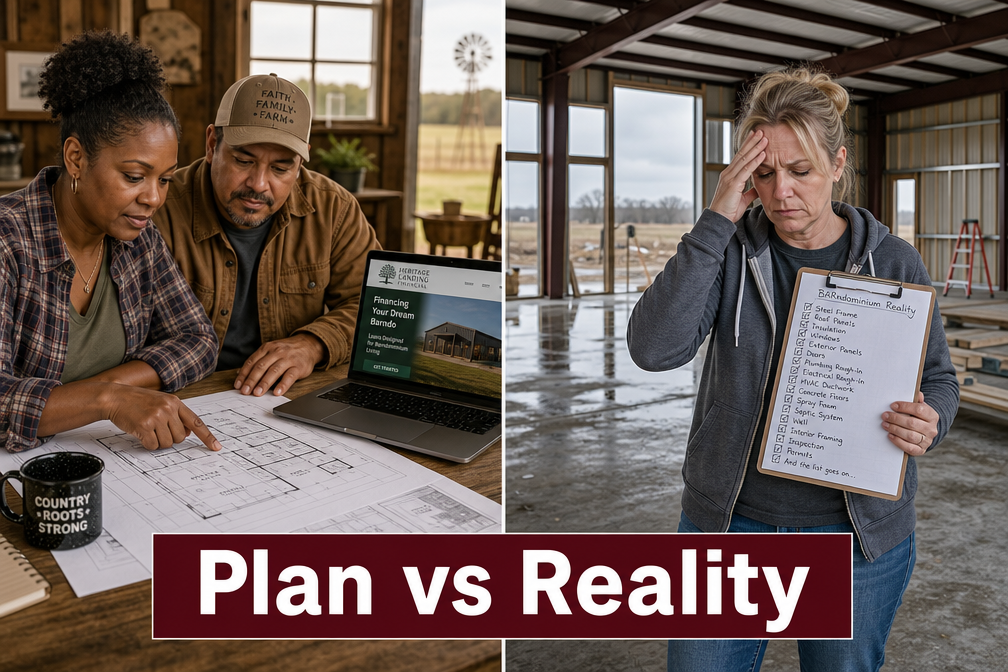
The most common barndominium budgeting mistake is treating the kit price as the project cost. It's not even close.
The seven mistakes that blow barndominium budgets:
Using the kit price as the total budget. A $50,000 kit becomes a $250,000 project. Plan for it.
Skipping the soil test. Poor soil conditions can add $20,000 to $40,000 in foundation costs. A $1,500 test is cheap insurance.
Underestimating insulation. Metal buildings require spray foam in most climates. Budget $3 to $7 per square foot, not the $0.50 batt insulation rate.
Ignoring utility run distance. Check where the nearest electric transformer, water main, and sewer connection are. Every 100 feet of distance adds cost.
Not confirming zoning before buying land. Buying land without verifying residential building permits are available for metal structures is a $30,000 to $100,000 mistake waiting to happen.
Choosing a builder based on the lowest quote. The lowest quote is almost always the most incomplete scope of work. Ask every bidder to itemize what's included and what isn't.
Not budgeting a contingency. A 15% to 20% contingency on total project cost is standard for any custom build. Barndominiums, with their rural sites and non-standard construction, deserve the full 20%.
For buyers who've already made some of these calls on an existing property, the design vs renovation framework is a solid resource for thinking through what to fix and what to leave alone before spending more money.
Is a Barndominium Cheaper Than Building a House
Yes, in most cases, a barndominium is cheaper than a comparable stick-built home, but the margin is smaller than the marketing suggests and depends heavily on location, finishes, and site conditions.
Where barndominiums win on cost:
- Structural shell: 15% to 30% cheaper than wood framing
- Construction timeline: faster builds mean lower carrying costs and labor hours
- Durability: metal roofs and frames have lower long-term maintenance costs
- Combined use: one structure for home and workshop vs. two separate buildings
Where the cost advantage shrinks or disappears:
- High-finish interiors cost the same regardless of what's holding the roof up
- Insulation and HVAC costs are higher in metal buildings
- Rural site prep and utility costs apply equally to both build types
- Insurance premiums run higher for metal buildings
- Appraisal gaps can reduce effective value at resale
The honest answer for a 2,000 square foot barndominium cost vs. a comparable stick-built home:
A mid-grade stick-built home in a suburban market: $340,000 to $440,000.
A mid-grade barndominium on a rural lot with site prep: $280,000 to $400,000.
The barndominium saves $40,000 to $80,000 in many scenarios, but that savings assumes rural land prices, not suburban lot prices. If you're comparing land costs too, the picture shifts again.
Buyers comparing these options against a conventional purchase should also factor in seller closing costs on their current home and the full transaction cost picture before committing to a build.
Barndominium Renovation Costs If Converting From an Existing Barn
Converting an existing barn into a barndominium is rarely cheaper than new construction once the real scope of work is on paper. Most existing barns were not built to residential code, and bringing them up to standard is expensive.
What a barn-to-barndominium conversion typically requires:
- Structural assessment and engineering report: $2,000 to $5,000
- Foundation upgrades or new slab pour: $10,000 to $40,000
- Roof replacement or reinforcement: $8,000 to $25,000
- Full insulation installation (spray foam): $15,000 to $35,000 for a 2,000 sq ft structure
- Complete electrical system (barns have agricultural wiring, not residential): $10,000 to $20,000
- Plumbing installation from scratch: $10,000 to $25,000
- Interior framing, drywall, and finishing: $30,000 to $80,000
- HVAC: $10,000 to $25,000
- Windows and doors (residential grade): $8,000 to $20,000
Total conversion cost for a 2,000 sq ft existing barn: $100,000 to $250,000, and that's before cosmetic finishes. A new barndominium kit on a cleared lot often comes in at a similar or lower number with a better structural result.
When conversion makes sense:
- The existing barn has exceptional structural integrity (post-frame or heavy timber)
- The property has historic or sentimental value
- Local zoning restricts new construction but allows renovation
- The owner has significant owner-builder skills to reduce labor costs
When to walk away from a conversion:
- The barn has a dirt floor or no foundation
- The roof framing is undersized for residential loads
- The building is more than 40 years old without documented maintenance history
Who Should and Shouldn't Build a Barndominium
A barndominium is a real option for the right buyer, but it's so based on specific lifestyle and location factors that it's a poor fit for a large portion of the people who get excited about it online.
Who barndominiums are a strong fit for:
- Rural landowners who already own acreage and want to build a primary residence
- Buyers who need combined living and working space (workshop, equipment storage, small business)
- Owner-builders with construction skills who can manage subcontractors and reduce labor costs
- Buyers prioritizing square footage and durability over resale liquidity
- Agricultural families building on farm property where metal buildings are culturally and practically normal
Who should think twice:
- Suburban buyers who want a barndominium aesthetic but live in an HOA or zoned subdivision (the zoning almost certainly won't allow it)
- First-time buyers without a cash reserve for the site prep and utility costs that won't show up in the initial quote
- Buyers in high-cost states where labor rates eliminate the cost advantage
- Anyone who needs to sell within 5 years (appraisal and comp challenges make resale harder)
- Buyers financing through conventional lenders without a local bank or Farm Credit relationship already in place
The barndominium market has grown impeccably fast over the past decade, and the lifestyle appeal is real. But the buyers who thrive are the ones who slow down first, spending real time on the full cost picture, the financing path, and the local zoning reality before committing to land or a kit.
For buyers weighing whether to build or buy in the current market, buyers skipping big houses for smaller homes is worth reading alongside this guide for broader context on what buyers are prioritizing in 2026.
FAQ
What is the average cost of a barndominium in 2026?
The average cost of a barndominium ranges from $130,000 to $400,000 for a finished 1,500 to 2,500 sq ft home on a rural lot, including site prep and utilities. High-end builds with premium finishes exceed $500,000.
Can you build a barndominium for under $100,000?
A barndominium under 100k finished is extremely difficult in 2026 without significant owner-builder labor. A shell kit can be purchased for $30,000 to $60,000, but site prep, utilities, foundation, and interior finishing add $80,000 to $150,000 on top of that.
What is the cost per square foot for a barndominium?
Barndominium cost per square foot runs $100 to $130 for a basic build, $140 to $180 for mid-grade, and $200 to $260+ for high-end finishes. Shell-only kits run $20 to $35 per square foot.
How much does a 1,500 sq ft barndominium cost?
A 1,500 sq ft barndominium cost for a finished home typically runs $150,000 to $280,000, depending on location, site conditions, and finish level.
How much does a 3,000 sq ft barndominium cost?
A 3,000 sq ft barndominium cost for a fully finished home runs $390,000 to $700,000 in most markets, with high-end builds in expensive states exceeding $750,000.
Do barndominiums hold their value?
Barndominiums can hold their value well in rural markets where metal building homes are common and comparable sales exist. In markets with few comps, resale can be challenging and appraisals may come in below replacement cost.
What financing options exist for barndominiums?
Barndominium financing options include construction-to-permanent loans, USDA rural housing loans, Farm Credit System lenders, and portfolio loans from local community banks. Conventional Fannie Mae/Freddie Mac loans are rarely available for barndominiums.
How long does it take to build a barndominium?
A barndominium typically takes 4 to 9 months to complete from permit approval to move-in, compared to 9 to 14 months for a comparable stick-built home. The steel frame erection phase is significantly faster than wood framing.
Are barndominium kits worth buying?
Barndominium kits with prices starting around $20 to $35 per square foot are worth buying if you have a contractor or owner-builder experience to manage the finish work. Buying a kit without a clear plan for the remaining $100,000 to $200,000 in finish costs is where buyers get into trouble.
What is barndominium site prep cost?
Barndominium site prep cost on a raw rural lot typically runs $10,000 to $40,000, covering land clearing, grading, access road, soil testing, and survey. Heavily wooded or rocky lots can push this to $50,000 or more.
Is barndominium construction cost lower than stick-built?
Barndominium construction cost is typically 10% to 25% lower than a comparable stick-built home at the structural level. That advantage narrows significantly once insulation, HVAC, and interior finishes are included.
What should I watch for in barndominium plans and prices?
Always verify whether barndominium plans and prices include foundation, insulation, mechanical systems, and interior finishing. Most kit prices and many contractor quotes cover the shell only. Get a written itemized scope before signing any contract.
Conclusion
The barndominium cost conversation starts with a steel frame and ends with a number most buyers didn't see coming. The shell is just the beginning. Site prep, utilities, insulation, foundation, permits, and interior finishing are where the real barndominium construction cost lives, and they're the line items builders skip in their initial quotes, not because they're hiding them, but because buyers don't always ask.
Actionable next steps before you commit to a build:
- Get three contractor quotes and ask each one to itemize every line item, including what's excluded.
- Pull the zoning and building permit requirements for your specific county before buying land.
- Order a soil test on any lot you're seriously considering. It's $1,500 that can save $30,000.
- Call a local community bank or Farm Credit lender before assuming you can finance the build.
- Get an insurance quote from at least three carriers, including a specialty farm and ranch insurer.
- Build a 20% contingency into your total budget from day one.
- Ask your appraiser to identify at least three comparable barndominium sales within 15 miles before finalizing your build budget.
The buyers who end up with a barndominium they love are the ones who ran the full cost picture before they broke ground, not after. Withholding that information is exactly what some builders count on. Now you have it.