
Last updated: August 23, 2026

Quick Answer: ADU construction cost is the number most contractors quote low and pad later. A basic detached ADU runs $150 to $350 per square foot for construction alone, but the real all-in cost, once permits, impact fees, utility hookups, design fees, and landscaping are added, routinely lands 30% to 60% above the original bid. Knowing what gets left off the estimate is the only way to protect your budget.
Key Takeaways
- The average detached ADU costs $150,000 to $350,000 all-in for a 500 to 800 sq ft unit, depending on location, site conditions, and finish level.
- Contractors frequently omit permit fees, impact fees, utility connection charges, soil testing, and temporary housing costs from initial quotes.
- Impact fees alone can range from $5,000 to $30,000+ depending on the city, and some municipalities have waived them for ADUs under 750 sq ft.
- A garage conversion ADU typically costs $80,000 to $150,000, making it the most budget-friendly path, but structural upgrades often surprise owners.
- Prefab ADUs cost 15% to 30% less than stick-built on average, but site prep, foundation, and utility work still apply to both.
- ADUs increase home value by an estimated 20% to 35% in high-demand markets, according to general appraisal industry estimates, though local comps vary widely.
- Timeline matters: a 12-month build at $2,000 per month in temporary housing adds $24,000 to your real cost.
- Always ask for an itemized bid that separates hard construction costs from soft costs, fees, and site work.
What Is an ADU and How Much Does It Cost to Build
An accessory dwelling unit (ADU) is a secondary housing unit on a single-family residential lot. It can be detached, attached to the main home, a garage conversion, or built above a garage. The cost to build an ADU ranges from roughly $80,000 for a simple garage conversion to $400,000 or more for a large detached unit in a high-cost market like California or the Pacific Northwest.
The wide range exists because ADU cost is driven by four variables: size, structure type, location, and finish level. A 500 sq ft ADU cost in Austin, Texas sits in a different universe than the same footprint in San Jose, California. Before any contractor quote means anything, those four variables need to be locked.
ADU cost by type (estimated all-in ranges for 2026):
| ADU Type | Typical Size | Estimated All-In Cost |
|---|---|---|
| Garage conversion ADU | 400-600 sq ft | $80,000 – $150,000 |
| Attached ADU (addition) | 500-800 sq ft | $120,000 – $250,000 |
| Detached ADU (backyard) | 500-1,200 sq ft | $150,000 – $400,000 |
| ADU above garage | 600-900 sq ft | $175,000 – $350,000 |
| Prefab ADU (installed) | 400-800 sq ft | $100,000 – $220,000 |
A 500 sq ft ADU cost typically lands between $100,000 and $175,000 all-in for a detached stick-built unit in a mid-cost market. A 1,200 sq ft ADU cost can easily reach $300,000 to $450,000 once every line item is counted.
ADU Construction Cost: Why Bids Run 60% Under Final
This is where most homeowners get burned. The ADU construction cost on a contractor's initial bid covers one thing: the physical structure. Everything else is your problem until you know to ask about it.
Here is what routinely disappears from the first quote:
Soft costs that rarely appear in contractor bids:
- Architectural and engineering drawings: $5,000 to $20,000
- Permit application fees: $2,000 to $15,000 depending on jurisdiction
- Plan check fees (separate from permit fees in many cities): $1,500 to $8,000
- Structural engineering review if soil conditions require it: $2,000 to $6,000
- Title 24 energy compliance report (California): $500 to $2,000
- Survey and boundary staking: $1,500 to $4,000
Site work that gets quoted separately or not at all:
- Grading and excavation: $3,000 to $15,000
- Soil testing and geotechnical report: $1,500 to $5,000
- Tree removal or root protection: $1,000 to $8,000
- Demolition of existing structure (shed, old garage): $2,000 to $10,000
Utility connection costs (among the biggest surprises):
- New electrical panel or service upgrade: $3,000 to $12,000
- Separate utility meter installation: $2,000 to $6,000
- Water and sewer lateral extension: $5,000 to $25,000
- Gas line extension: $1,500 to $6,000
A homeowner who gets a $180,000 contractor bid for a detached backyard ADU can easily find themselves writing checks for $240,000 to $260,000 by the time the certificate of occupancy lands. That gap is not a scam. It is omission by design, and it happens constantly.
For more on how contractor quotes hide real costs, our guide on how to hire the right contractors for renovations and what red flags to notice covers the warning signs in detail.
ADU Permits and Fees That Get Hidden in Quotes
Permit and impact fees are the single most underrepresented line item in ADU cost breakdowns. Most contractors quote the construction. Almost none quote the government fees, because those are technically the owner's responsibility and vary by city.
ADU permit fees by category:
- Building permit fee: Calculated as a percentage of project valuation in most cities, typically 1% to 3% of construction cost. On a $200,000 project, that is $2,000 to $6,000.
- Impact fees: One-time charges cities collect to offset the cost of new residents on infrastructure. ADU impact fees by city range from waived (many California cities under SB 9 rules) to $30,000+ in high-growth Texas and Florida metros.
- School fees: Several California counties charge school impact fees on ADUs over 500 sq ft, currently around $4.00 to $5.50 per square foot.
- Fire sprinkler requirement: Some jurisdictions require sprinklers in new ADUs, adding $8,000 to $15,000.
Where impact fees are commonly waived or reduced:
California's ADU law limits impact fees for ADUs under 750 sq ft. Oregon waived ADU system development charges in Portland. Some Texas cities have no impact fees at all. Others, particularly fast-growing suburbs of Austin and Dallas, charge $15,000 to $25,000 per unit.
Always call the local planning department before signing a contractor agreement. Ask specifically: "What are the total permit, plan check, and impact fees for a [size] ADU at this address?" Get that number in writing from the city, not from the contractor.
ADU Construction Cost Breakdown by Component
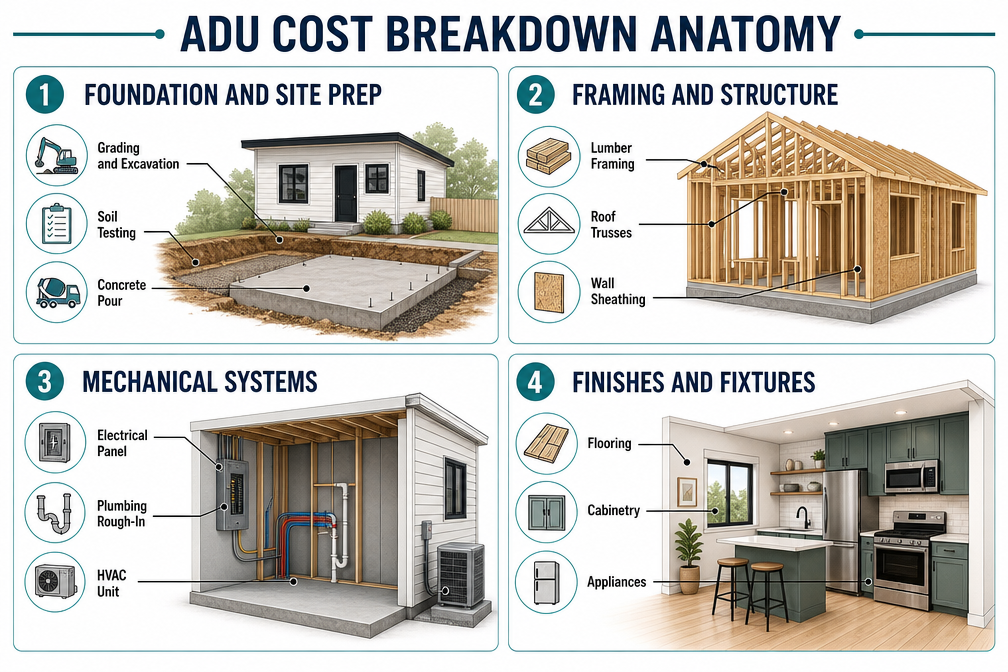
A fully itemized ADU cost breakdown separates hard costs from soft costs and site work. Here is a realistic breakdown for a 600 sq ft detached ADU in a mid-cost U.S. market in 2026:
Hard construction costs (what most bids cover):
| Component | Estimated Cost |
|---|---|
| Foundation (slab or crawlspace) | $8,000 – $20,000 |
| Framing and structural | $25,000 – $50,000 |
| Roofing | $8,000 – $18,000 |
| Exterior siding and windows | $12,000 – $25,000 |
| Insulation | $4,000 – $8,000 |
| Drywall and interior finishes | $10,000 – $20,000 |
| Flooring | $5,000 – $12,000 |
| Kitchen and bath fixtures | $15,000 – $35,000 |
| Electrical (rough and finish) | $10,000 – $20,000 |
| Plumbing (rough and finish) | $10,000 – $22,000 |
| HVAC | $8,000 – $18,000 |
| Subtotal (hard costs) | $115,000 – $248,000 |
Add soft costs, fees, and site work as outlined above, and the realistic all-in ADU build cost for a 600 sq ft detached unit runs $155,000 to $320,000 depending on market.
ADU construction cost per square foot for stick-built detached units currently averages $200 to $350 per square foot in most U.S. markets, with California, Hawaii, and the Pacific Northwest running $300 to $500+ per square foot.
ADU Permits and Fees: What the Quote Leaves Out

Most homeowners discover the permit and fee gap after they have already signed a contract. The contractor is not lying, exactly. They are quoting what they build. The city fees, the utility district charges, and the school fees are separate billing relationships the owner manages directly.
The fees that appear after contract signing:
- Utility capacity charges: Water and sewer districts often charge "capacity fees" or "connection fees" separate from the physical pipe work. These range from $3,000 to $20,000 and are paid directly to the utility district.
- Soils report requirement: If the city's plan checker flags soil conditions, a geotechnical report becomes mandatory. Budget $2,000 to $5,000.
- Change orders during construction: Industry data suggests the average residential construction project generates 10% to 15% in change orders. On a $200,000 ADU, that is $20,000 to $30,000 in additions.
- Temporary power and water during construction: $500 to $2,000, often billed separately.
- Landscaping and fencing restoration: After crews have worked the backyard for months, restoration runs $3,000 to $12,000.
The cleanest protection is a contract that lists every exclusion explicitly. If a contractor's bid does not have an exclusions section, ask for one before signing.
How Much Does It Cost to Build an ADU vs a Regular Addition
A conventional home addition costs $100 to $200 per square foot for basic work, which looks cheaper than ADU construction cost at first glance. The difference is function and permitting complexity.
An addition is part of the main house. It shares utilities, does not need a separate kitchen or bathroom, and does not trigger the same impact fees. An ADU is a self-contained dwelling unit, which means separate systems, separate permitting track, and in many cities, separate utility meters.
Side-by-side comparison:
| Factor | Home Addition | Detached ADU |
|---|---|---|
| Cost per sq ft | $100 – $200 | $200 – $350 |
| Separate kitchen required | No | Yes |
| Separate bathroom required | No | Yes |
| Impact fees | Rarely | Often |
| Separate utility meter | No | Often required |
| Rental income potential | No | Yes |
| Adds separate living unit | No | Yes |
The ADU costs more per square foot, but it generates rental income. A backyard ADU cost of $200,000 that rents for $1,800 per month produces a gross return of 10.8% annually before expenses. A home addition generates zero rental income.
For investors comparing build cost against other strategies, our article on private real estate investing deals the public never sees is worth reading alongside this analysis.
Prefab ADU vs Stick-Built ADU: Which Costs Less
Prefab ADUs (also called modular or manufactured ADUs) cost 15% to 30% less than comparable stick-built units on average, but the savings are almost entirely in the factory-built structure itself. Site work, foundation, utility connections, and permits cost the same regardless of how the unit was built.
Prefab ADU cost reality check:
- Factory-built unit (delivered): $60,000 to $130,000 for 400-800 sq ft
- Foundation and site prep: $15,000 to $40,000
- Utility connections: $10,000 to $35,000
- Permits and fees: $5,000 to $25,000
- Crane and installation: $3,000 to $8,000
- All-in prefab ADU cost: $93,000 to $238,000
Compare that to a stick-built detached ADU at $115,000 to $280,000 all-in for the same size range, and the prefab savings are real but narrower than the factory price tag suggests.
Choose prefab if: the lot has straightforward access, you want a faster timeline (8 to 16 weeks versus 6 to 12 months for stick-built), and the local jurisdiction approves prefab units without additional plan check hurdles.
Choose stick-built if: the lot has unusual dimensions, the design needs to match the main home's architecture closely, or local zoning requires site-specific engineering.
ADU Construction Timeline and How It Affects Your Total Cost
The average ADU takes 6 to 18 months from permit application to certificate of occupancy. Timeline is a cost multiplier that almost no contractor mentions in the initial conversation.
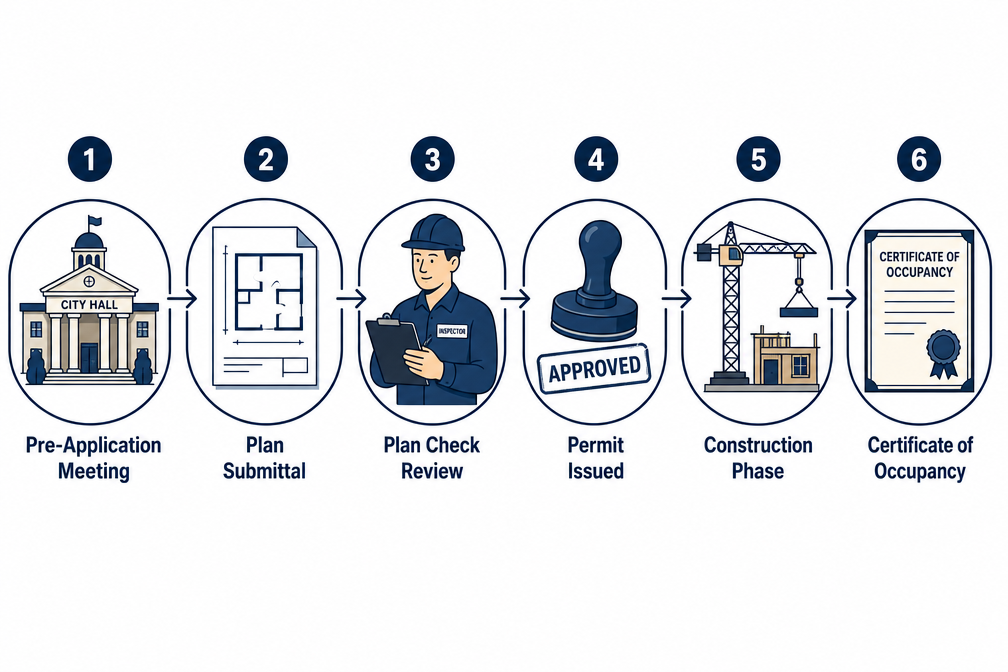
Timeline phases and their cost implications:
- Pre-application and design: 4 to 12 weeks. Architect and engineering fees are front-loaded here.
- Plan submittal and plan check: 4 to 16 weeks depending on the city's backlog. Some California cities have same-day ADU plan check for pre-approved plans.
- Permit issuance: 1 to 4 weeks after plan check approval.
- Construction: 3 to 9 months for stick-built, 6 to 16 weeks for prefab installation.
- Inspections and certificate of occupancy: 2 to 6 weeks.
The hidden cost of timeline: if you are displaced from your home during construction, or if you are paying a mortgage on the main house while also renting elsewhere, every extra month costs real money. At $2,000 per month in temporary housing, a 12-month build adds $24,000 to the real ADU cost. A 16-month build adds $32,000.
Construction delays also trigger contractor escalation clauses. Material cost increases mid-project are the contractor's most common justification for change orders. Locking in material pricing at contract signing is worth negotiating for.
ADU Construction Cost With Utilities and Infrastructure Hookups
Utility and infrastructure costs are the most consistently underestimated component of ADU build cost. They are also the most variable, because they depend entirely on what already exists at the property.
What drives utility cost up:
- The main home's electrical panel is already at capacity, requiring a new 200-amp service upgrade: $4,000 to $12,000
- The sewer lateral is undersized or deteriorated, requiring replacement: $8,000 to $20,000
- The lot is on a septic system, and a new or expanded septic field is required: $10,000 to $40,000
- The water main pressure is insufficient, requiring a booster pump: $2,000 to $6,000
- The ADU is on a separate lot or flag lot, requiring a longer utility run: add $2,000 to $5,000 per 100 linear feet
ADU construction cost with utilities, realistic range:
For a property where the main home's systems are in good shape and the ADU is within 50 feet of existing connections, utility hookups typically add $15,000 to $35,000 to the total. For a property with aging infrastructure or a long utility run, that number can reach $50,000 to $70,000.
This is the line item that most frequently causes budget overruns. Get a licensed electrician and a licensed plumber to assess the existing infrastructure before signing any contractor agreement. Their assessment fee ($300 to $800 combined) is the cheapest insurance available.
For investors who plan to rent the ADU, understanding insurance implications is equally important. Our comparison of homeowners insurance versus rental property insurance costs and coverage walks through what changes when a structure becomes a rental unit.
Does an ADU Increase Home Value and What Is the Return on Investment
ADUs increase home value, but the amount depends heavily on local market conditions and how appraisers in that market treat income-producing structures. In high-demand rental markets, a well-built ADU can add 20% to 35% to the main home's value. In rural markets with weak rental demand, the value add is smaller.
ADU return on investment factors:
- Rental income: A 600 sq ft ADU renting for $1,500 per month generates $18,000 per year gross. On a $200,000 all-in build cost, that is a 9% gross yield before vacancy, maintenance, and insurance.
- Appreciation: The ADU increases the property's total square footage and income potential, both of which appraisers factor into value.
- Financing benefit: Lenders increasingly allow projected ADU rental income to count toward mortgage qualification. This is a real advantage for buyers who want to house-hack a property.
When ADU ROI underperforms:
- The build cost exceeds $400,000 in a market where comparable rentals go for $1,200 per month
- The ADU design does not provide genuine privacy from the main house
- Local zoning caps short-term rentals, limiting income flexibility
For homeowners considering an ADU as a short-term rental strategy, our breakdown of Airbnb vs Vacasa property management services and costs covers the operational side of that decision.
Common ADU Construction Mistakes That Increase Costs
The most expensive ADU mistakes are not made during construction. They are made before the first permit is filed.
Mistake 1: Designing before checking zoning. Some lots have setback requirements, height limits, or lot coverage maximums that shrink the buildable footprint significantly. An architect who designs a 900 sq ft ADU on a lot that only allows 600 sq ft has wasted $8,000 to $15,000 in design fees.
Mistake 2: Choosing a contractor based on the lowest bid. The lowest bid is almost always the one with the most exclusions. A $160,000 bid that excludes permits, utility connections, and site work is not cheaper than a $210,000 bid that includes them.
Mistake 3: Not budgeting a contingency. A 15% to 20% contingency on total project cost is standard for residential construction. On a $200,000 ADU, that is $30,000 to $40,000 held in reserve. Skipping the contingency and then hitting a surprise sewer line replacement is how projects stall.
Mistake 4: Ignoring the neighbor notification requirement. Many cities require notifying adjacent property owners before ADU permits are issued. Objections can delay the permit timeline by 30 to 90 days, adding holding costs.
Mistake 5: Underestimating the design phase. Rushing the plans to save time usually means plan check corrections, which add 4 to 8 weeks to the timeline. Good plans that are thorough and code-compliant from submission move faster.
ADU Construction Financing Options
ADU construction financing is more accessible in 2026 than it was five years ago, but the options carry different cost structures that affect total ADU build cost.
Primary financing options:
- Home equity line of credit (HELOC): Best for owners with 30%+ equity. Variable rate, interest-only during construction. Current HELOC rates run 7% to 9% in 2026. Our guide on no-appraisal HELOC lenders and the real cost covers current options.
- Cash-out refinance: Replaces the existing mortgage with a larger one. Works when the current rate is close to market. Less attractive when the original mortgage is at 3% and current rates are near 6.6%.
- Construction-to-permanent loan: One loan that covers the build and converts to a mortgage at completion. Requires detailed plans and a licensed contractor. Typically 1% to 2% higher rate than a standard mortgage during construction.
- ADU-specific lender programs: Several California lenders and national programs offer ADU-specific loans up to $250,000 with simplified qualification. Fannie Mae's ADU financing guidelines allow rental income to offset the loan payment.
- HELOAN (home equity loan): Fixed rate, lump sum. Better than a HELOC if rates are expected to rise. See our breakdown of HELOAN vs HELOC and the difference that costs borrowers thousands.
Choose construction-to-permanent if: you do not have significant equity, the build cost exceeds $200,000, and you want one closing.
Choose HELOC if: you have strong equity, want flexibility in draw timing, and can tolerate a variable rate.
What Questions to Ask Contractors About ADU Costs
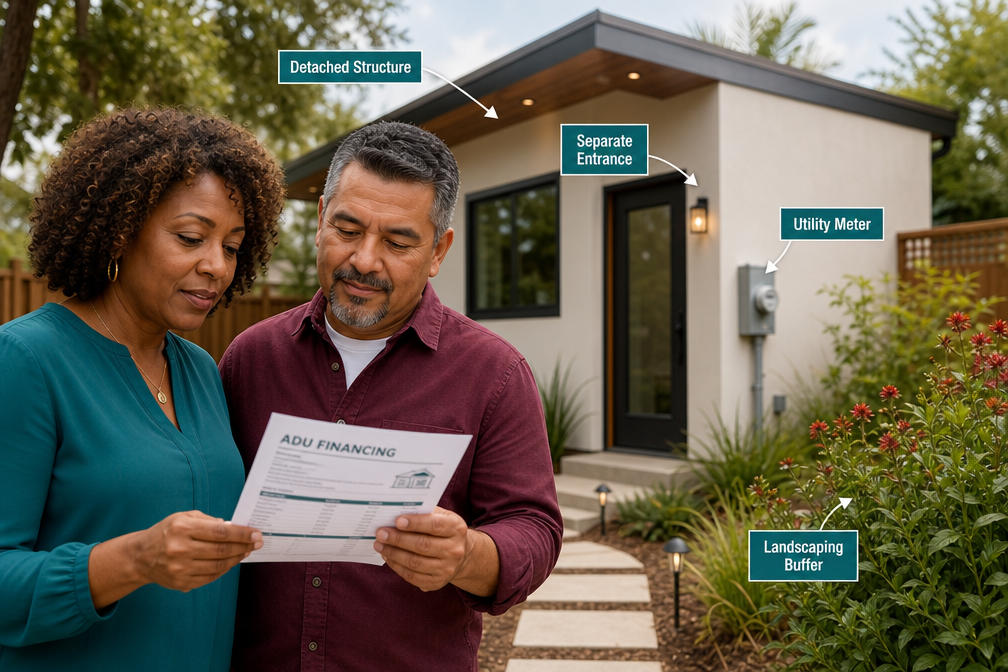
Getting an honest ADU cost breakdown requires asking the right questions before a contract is signed. Most contractors will answer honestly when asked directly. The problem is that most homeowners do not know what to ask.
The right question list to bring to every contractor meeting:
- "Does this bid include permit fees, plan check fees, and impact fees, or are those separate?"
- "What site work is included, and what triggers additional charges?"
- "Does this bid include utility connection costs, including any panel upgrade or sewer lateral work?"
- "What is your change order policy, and what percentage of projects generate change orders?"
- "Is there an escalation clause for material costs, and how is it calculated?"
- "Who pulls the permits, and who is responsible for failed inspections?"
- "What is the payment schedule, and what percentage is held until certificate of occupancy?"
- "Have you built ADUs in this city before, and are you familiar with their specific plan check requirements?"
- "What is not included in this bid?" (Ask this explicitly. The exclusions list is more valuable than the inclusions list.)
- "Can you provide references from ADU projects where the final cost was within 10% of the original bid?"
A contractor who cannot answer questions 1, 2, 3, and 9 clearly is not ready to build your ADU. Slow down before you commit to a signature, and get at least three itemized bids.
For a broader look at renovation contractor red flags, our guide on how to hire the right contractors for renovations is required reading before any construction agreement is signed.
ADU Construction Insurance and Liability Costs
Insurance costs during and after ADU construction are unfamiliar territory for most homeowners and get almost no attention in contractor conversations.
During construction:
- Your standard homeowners policy may not cover a structure under construction on your property. Notify your insurer before breaking ground.
- Builder's risk insurance covers the structure during construction against fire, theft, and weather damage. Cost: $500 to $2,500 for a 6-12 month policy on a $200,000 ADU.
- Verify that your contractor carries general liability ($1 million minimum) and workers' compensation. If they do not, and a worker is injured on your property, you may be liable.
After construction:
- Adding a rental ADU changes your insurance classification. A standard homeowners policy does not cover rental activity.
- A landlord or dwelling fire policy for the ADU unit typically costs $800 to $2,000 per year depending on location and coverage limits.
- Umbrella liability coverage is worth adding when a separate dwelling is rented. A $1 million umbrella policy runs $200 to $400 per year.
Total insurance add-on cost: budget $1,500 to $5,000 for the construction period and $1,000 to $2,500 annually ongoing. These numbers rarely appear in ADU cost discussions and almost never appear in contractor bids.
Do I Need a Contractor for ADU Construction or Can I DIY
Owner-builder permits are legal in most U.S. states, but the practical answer for most homeowners is: hire a general contractor for structural and systems work, and self-perform only finish work if you have the skills.
What an owner-builder can legally do in most states:
- Act as their own general contractor and hire subcontractors directly
- Perform their own finish carpentry, painting, and landscaping
- Manage the permit process and inspection scheduling
What creates real risk when DIY:
- Structural framing without engineering review
- Electrical work without a licensed electrician (most jurisdictions require licensed work for permit)
- Plumbing rough-in and gas line work
- Foundation work on unstable or expansive soils
The honest cost comparison: an owner-builder who manages subcontractors directly can save 15% to 25% on general contractor markup. On a $200,000 ADU, that is $30,000 to $50,000. The trade-off is 6 to 12 months of active project management, subcontractor coordination, and personal liability for any defect.
For most homeowners building their first ADU, the general contractor markup is worth paying for the first project. The savings from self-managing are real, but so is the risk of a single bad subcontractor or a failed inspection that delays the certificate of occupancy by three months.
FAQ
What is the average ADU construction cost in 2026?
The average all-in ADU construction cost in 2026 runs $150,000 to $350,000 for a detached 500 to 800 sq ft unit in a mid-cost U.S. market. High-cost states like California average $250,000 to $500,000 for the same size.
How much does a 500 sq ft ADU cost?
A 500 sq ft ADU costs approximately $100,000 to $175,000 all-in for a detached stick-built unit in a mid-cost market, including permits, site work, and utility connections. Prefab options start around $90,000 all-in for the same footprint.
How much does a 1,200 sq ft ADU cost?
A 1,200 sq ft ADU typically costs $240,000 to $450,000 all-in depending on location, structure type, and finish level. At $200 to $350 per square foot for construction alone, plus soft costs and fees, the upper range is common in California and coastal markets.
What is the cheapest type of ADU to build?
A garage conversion ADU is the least expensive option, typically running $80,000 to $150,000 all-in. The structure already exists, which eliminates foundation and framing costs. Electrical, plumbing, insulation, and interior finishes are the primary expenses.
Do ADU impact fees get waived?
Some jurisdictions waive or reduce impact fees for ADUs under 750 sq ft. California state law limits impact fees for ADUs below that threshold. Oregon, Washington, and several Texas cities have also reduced fees to encourage ADU construction. Always verify with the local planning department.
How long does it take to build an ADU?
From permit application to certificate of occupancy, a typical ADU takes 6 to 18 months. Prefab ADUs can be installed in 6 to 16 weeks once permits are issued, but the permit process itself takes 2 to 6 months in most cities.
Does an ADU increase property taxes?
Yes. Adding an ADU increases the assessed value of the property, which raises property taxes. The increase is based on the added value, not the full property value, in most states. Expect an annual property tax increase of $1,500 to $4,000 depending on local tax rates and the ADU's appraised value.
What financing is available for ADU construction?
The main options are HELOC, HELOAN, cash-out refinance, and construction-to-permanent loans. Several states also have ADU-specific loan programs. Fannie Mae allows projected ADU rental income to count toward mortgage qualification on new purchases.
Can I rent out my ADU on Airbnb?
Short-term rental rules for ADUs vary by city. Many California cities restrict or prohibit short-term ADU rentals. Check local zoning before designing an ADU around short-term rental income.
What is the ROI on an ADU?
A well-built ADU in a strong rental market typically generates a 7% to 12% gross annual return on the all-in build cost. The ADU also adds 20% to 35% to the main home's value in high-demand markets, though local appraisal practices vary.
What does ADU cost per square foot look like nationally?
ADU construction cost per square foot ranges from $150 to $200 in low-cost markets (parts of the Midwest and South) to $300 to $500+ in California, Hawaii, and the Pacific Northwest. These figures cover construction only; soft costs, fees, and site work add $30,000 to $80,000 on top.
Is a prefab ADU cheaper than stick-built?
The factory-built unit itself is 15% to 30% cheaper, but foundation, site prep, utility connections, and permits cost the same. Total all-in savings for prefab versus stick-built typically run 10% to 20% on comparable projects.
Conclusion: Build with Your Eyes Open
ADU construction cost is a real opportunity to add income, value, and flexibility to a property, but only when the full cost picture is on the table before the first shovel breaks ground. The contractor quote is the starting point, not the finish line.
The better approach is this: treat the contractor bid as covering roughly 65% to 75% of your real cost. Budget the remaining 25% to 35% for permits, fees, utility connections, soft costs, and contingency before you agree to anything.
Actionable next steps:
- Call your city's planning department before hiring anyone. Ask for the full fee schedule for ADUs at your address, including impact fees and school fees.
- Get three itemized bids, and ask each contractor to provide a written exclusions list alongside the bid.
- Hire a licensed electrician and plumber to assess your existing infrastructure before signing a construction contract. Their assessment costs $300 to $800 and can save $20,000 in surprises.
- Add a 15% to 20% contingency to the all-in budget before committing to financing.
- Verify your homeowners insurance covers the construction period, and get a landlord policy quote for after occupancy.
- If financing through a HELOC or HELOAN, review our HELOAN vs HELOC comparison to choose the right structure for your build timeline.
The homeowners who get the best ADU outcomes are not the ones with the biggest budgets. They are the ones who asked every question on this page before signing anything.