
Last updated: October 22, 2026

Quick Answer
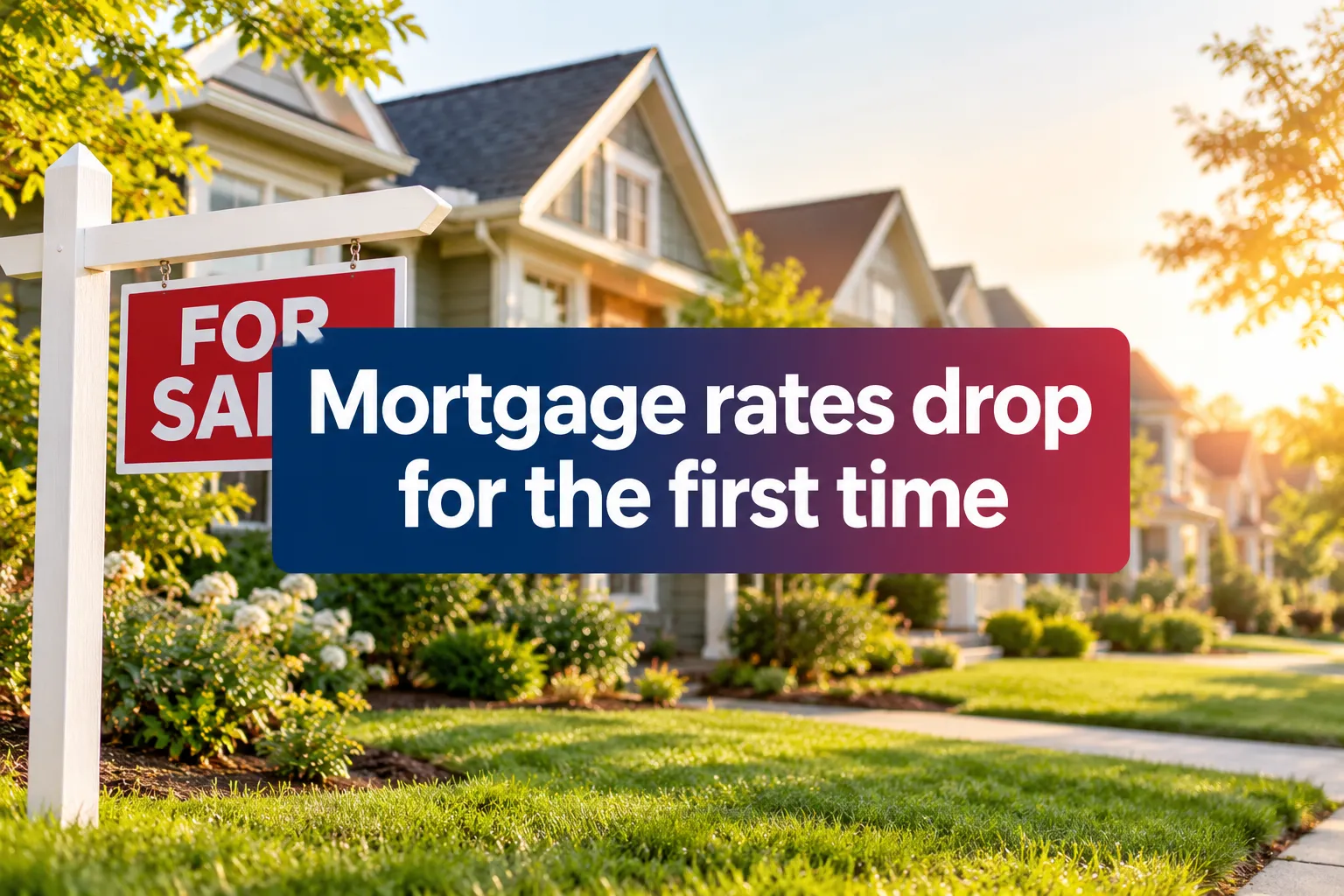
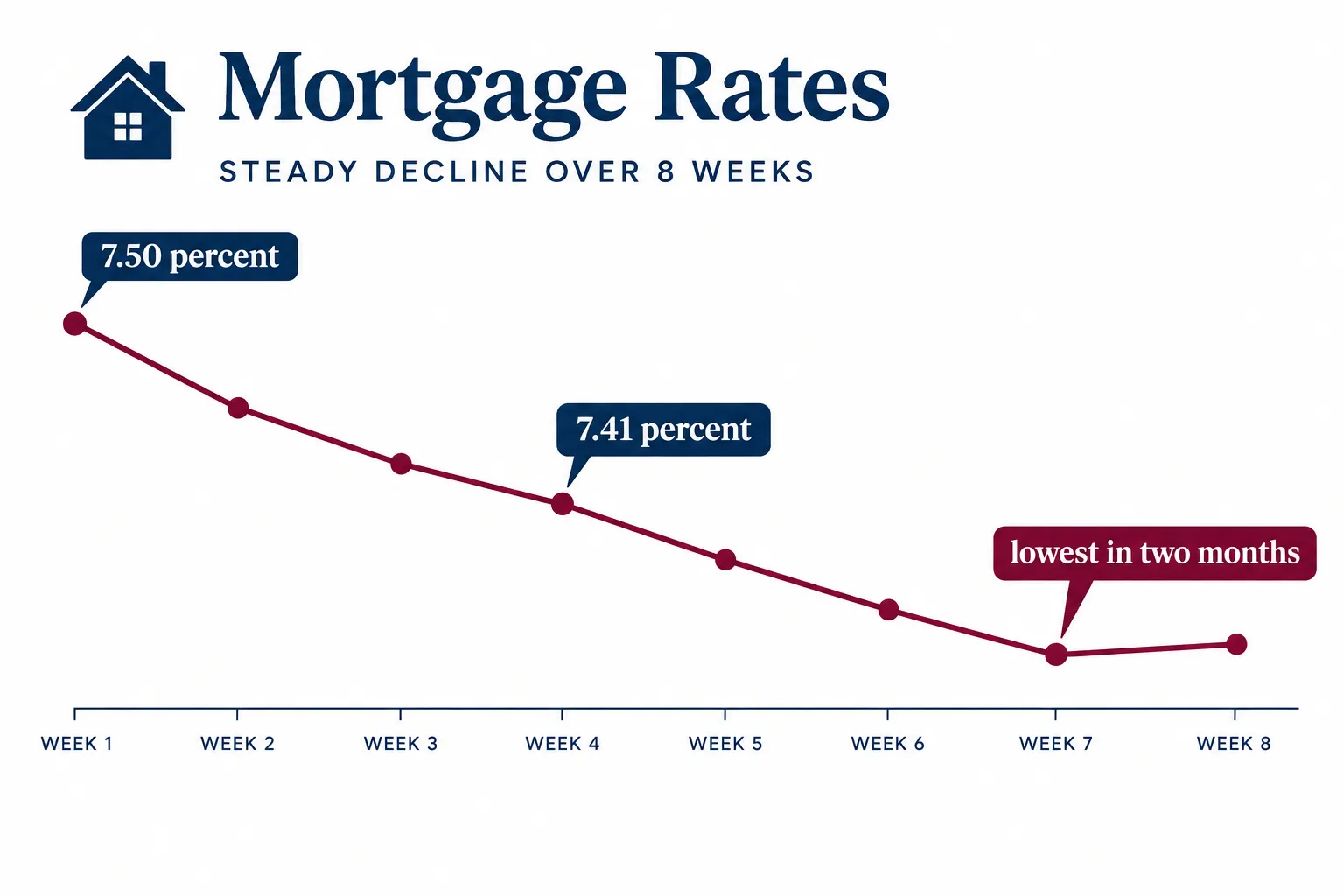
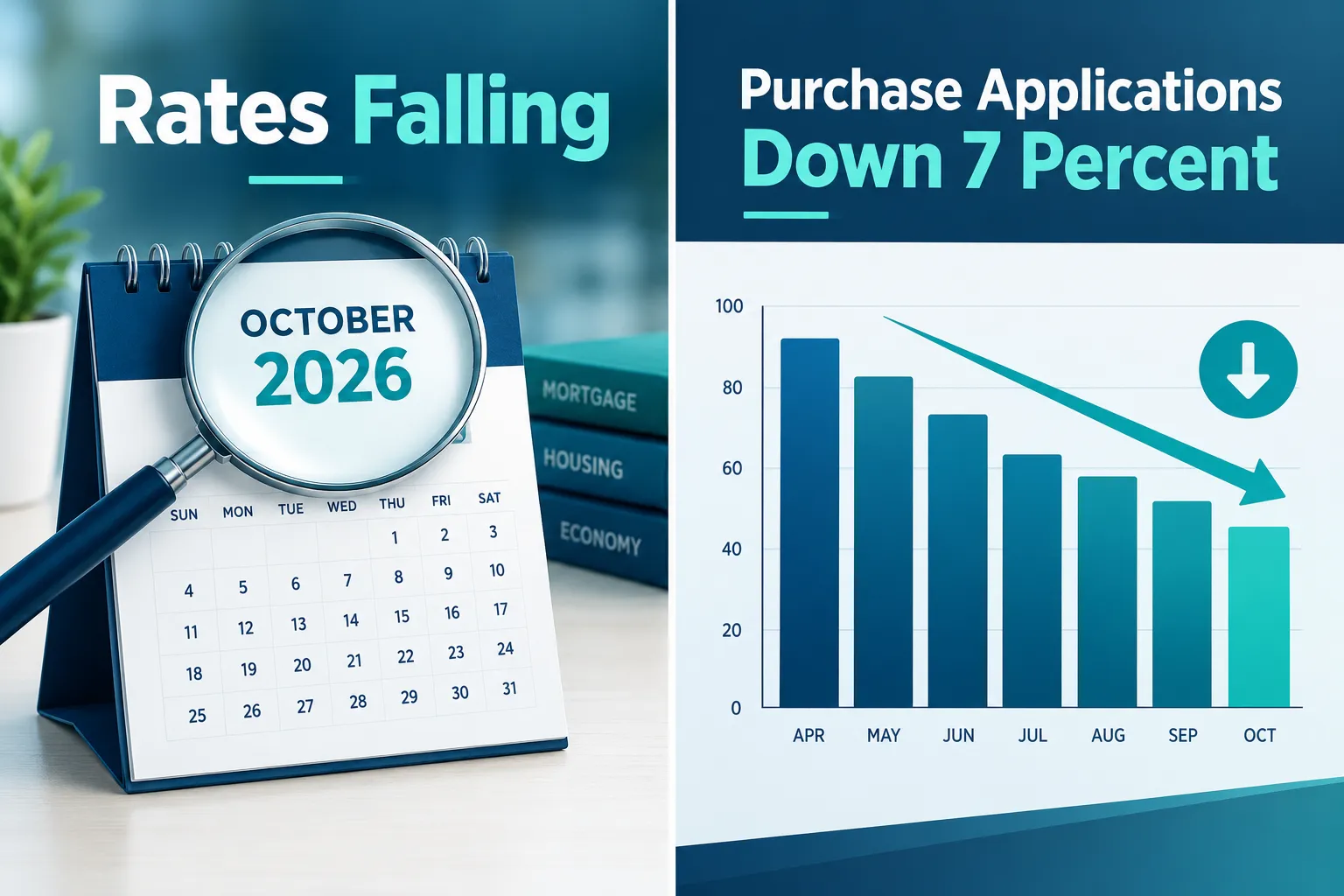
Mortgage rates dropped for the first time in two months during the week ending October 16, 2026, with the average 30-year fixed rate falling 9 basis points to 7.41% [1]. Despite that relief, overall mortgage application demand fell 5.3%, purchase applications dropped 7% week over week, and refinance activity slipped another 2% [1]. The pattern shows mortgage rates drop for the first time in 2 months, but demand still falls further, a sign that affordability pressure runs deeper than rate movement alone.
Key Takeaways
- The 30-year fixed mortgage rate fell to 7.41% from 7.50%, its first weekly decline in two months [1].
- The Mortgage Bankers Association's Market Composite Index dropped 5.3% for the week ending October 16, 2026 [1].
- Purchase applications fell 7% week over week and sat 18% below the same week in 2025 [1].
- Refinance applications dropped 2% weekly and were 59% below year-ago levels [1].
- Rates remain 104 basis points higher than a year earlier, according to CME Group's reading of MBA data [2].
- Jumbo, FHA, 15-year, and 5/1 ARM rates all declined alongside the 30-year average [1].
- Freddie Mac's own weekly survey showed 30-year rates at 7.28%, up from 7.03% the prior week, a reminder that weekly benchmarks can diverge [3].
- Xactus' Mortgage Intent Index fell 5.65% week over week and sat roughly 25% below the same week in 2025 [1].
- The Federal Reserve's October 27-28 meeting was a live factor investors were watching closely [4].
- MBA deputy chief economist Joel Kan said the modest rate dip "was not enough to boost application activity" [1].
Why Are Mortgage Rates Dropping If Demand Is Falling
Mortgage rates eased because broader market pressures, including bond yields and expectations around Federal Reserve policy, shifted downward independent of buyer behavior. Demand fell anyway because the rate drop was small and borrowers remain priced out at the affordability level that actually matters: monthly payment versus income.
A single nine-basis-point move doesn't change a buyer's math in any meaningful way. Someone who couldn't afford a home at 7.50% generally still can't afford it at 7.41%. Investors were tracking the Federal Reserve's October 27-28 meeting along with inflation data and Treasury yields, all of which continue to push and pull mortgage pricing week to week [4]. Rates and demand don't move in lockstep. They're reacting to different inputs on different timelines, and that gap is exactly why this story matters.
Decision rule: if a rate drop is under 15 basis points, treat it as noise, not a buying signal. Anything that small rarely changes a monthly payment enough to shift a decision.
What Are Current Mortgage Rates Right Now
The average 30-year fixed-rate conforming mortgage sat at 7.41% for the week ending October 16, 2026, down from 7.50% [1]. Other loan products moved in the same direction, but by different margins.
| Loan type | Previous rate | New rate |
|---|---|---|
| 30-year fixed (conforming) | 7.50% | 7.41% |
| 30-year jumbo | 7.49% | 7.33% |
| 30-year FHA | 7.19% | 7.13% |
| 15-year fixed | 6.87% | 6.73% |
| 5/1 ARM | 6.54% | 6.46% |
Source: MBA data reported by HousingWire [1]
Freddie Mac's separate weekly survey, which uses different methodology and timing, actually showed the 30-year rate rising to 7.28% from 7.03% the week before [3]. Different surveys, different snapshots, different answers. That's normal and it's worth checking more than one source before making a decision based on a single headline rate.
Should I Refinance My Mortgage With Rates Going Down
Refinancing rarely makes sense from a rate drop this small unless an existing mortgage is above roughly 7.8% to 8%, factoring in closing costs that typically run 2% to 5% of the loan balance. The data backs this up directly: refinance applications fell 2% during the same week rates dropped, and sat 59% below year-ago levels [1].
Run a breakeven calculation before applying:
- Add up closing costs (title fees, appraisal, origination).
- Calculate the monthly payment savings from the new rate.
- Divide closing costs by monthly savings to get a breakeven month count.
- Compare that number against how long the home will be owned.
If the breakeven point lands past the expected ownership window, refinancing loses money. Borrowers locked in under 6% during 2020-2021 have no reason to touch their loan right now regardless of the headlines. Anyone reviewing loan type options as part of a broader strategy can compare structures in 15-year vs 30-year mortgage rates in 2026.
Is Now A Good Time To Buy A House With Falling Demand
Falling demand can work in a buyer's favor through less competition and more negotiating leverage, but it does not automatically mean better prices or easier financing. Purchase applications were 18% below the same week in 2025, which tells a story about fewer competing offers on listings, not a price collapse [1].
Choose to buy now if:
- Monthly payment fits comfortably within income at today's rate, with no expectation of a near-term rate rescue
- The home meets long-term needs, since timing the market perfectly rarely works
- Local inventory has grown enough to allow for real negotiation on price or concessions
Wait if:
- The budget only works assuming rates drop another full point
- Job stability or relocation plans are uncertain over the next two years
Buyers weighing current conditions against broader market signals can review the Spring 2026 housing market outlook for a fuller inventory and pricing picture.
How Much Lower Will Mortgage Rates Go
No one can forecast mortgage rates with precision, and any number offered as a guarantee should be treated skeptically. Rates depend on Federal Reserve policy decisions, inflation trends, and Treasury yield movement, all of which shift week to week [4].
What's known: the 30-year rate sat 104 basis points above its year-earlier level even after the recent decline, according to CME Group's reading of MBA figures [2]. That gap shows how far rates would need to fall just to return to where they were twelve months ago, let alone drop into the 5% range some buyers are holding out for. The safer approach is planning around today's actual rate rather than a hoped-for future one.
What Counts As A Good Mortgage Rate In 2026
A good mortgage rate in 2026 is one at or below the current market average for a borrower's credit profile and loan type, since the 7% range has become the baseline rather than the exception. As of the week ending October 16, 2026, that average sat at 7.41% for a 30-year fixed conforming loan [1].
Quick benchmark table:
| Credit profile | Typical rate position |
|---|---|
| Excellent credit (740+), 20% down | At or slightly below market average |
| Good credit (680-739) | Near market average |
| Fair credit (620-679) | Above market average, often by 0.5% or more |
A "good" rate is relative to the borrower, not a fixed number. Shopping at least three lenders remains the single most reliable way to confirm whether an offer is actually competitive.
Does Lower Demand Mean Home Prices Will Drop
Lower mortgage demand doesn't translate directly into falling home prices, because prices respond mostly to inventory levels, not application volume alone. A market can see fewer buyers applying for loans while prices hold steady if the number of homes for sale also stays tight.
That said, sustained demand weakness, especially an 18% year-over-year drop in purchase applications [1], tends to slow price growth over time and gives sellers less leverage in negotiations. The effect shows up gradually in days-on-market and price reductions before it shows up in headline price indexes.
Should I Lock In My Mortgage Rate Or Wait
Lock in a rate once it meets the monthly payment target for the home being purchased, rather than trying to time the absolute bottom. Rate locks typically run 30 to 60 days and protect against increases during that window, but most come with a cost if the lock expires before closing.
Lock if:
- Closing is expected within the lock period
- The current rate already makes the payment affordable
- Rate volatility has been noticeable in recent weeks (it has: rates moved from 7.50% to 7.41% in a single week) [1]
Consider waiting (with a float-down option if available) if:
- Closing is more than 60 days out
- The lender offers a float-down clause allowing a rate reduction if rates drop further before closing
Why Aren't More People Buying Homes Even With Cheaper Rates
Buyers aren't responding to a nine-basis-point rate improvement because affordability math hasn't meaningfully changed, and rates remain more than a full percentage point above where they sat a year ago [2]. MBA deputy chief economist Joel Kan said directly that the lower rates "were not enough to boost application activity," noting both purchase and refinance applications declined in the same week [1].

Kan tied the purchase-side weakness specifically to affordability, with higher rates continuing to price prospective buyers out of the market even as the headline rate ticked down [1]. Separately, Xactus' Mortgage Intent Index, tracked by Thomas Lloyd, fell 5.65% week over week to 96.9, sitting roughly 25% below the same week in 2025 [1]. Lloyd noted the October 12 federal holiday contributed to that particular week's drop, but pointed out the index had already run about 20% below year-ago levels for two straight weeks before that [1]. This isn't a one-week blip. It's a pattern.
What's The Difference Between Mortgage Rates And APR
The mortgage rate is the interest charged on the loan balance, while the APR (annual percentage rate) includes that interest plus lender fees, discount points, and certain closing costs expressed as a yearly percentage. APR is almost always higher than the quoted rate because it bundles in the cost of getting the loan, not just the cost of borrowing the money.
When comparing lenders, APR gives a more complete picture since one lender might quote a lower rate but charge more in fees, making the APR higher than a competitor's slightly higher rate with fewer fees. Always compare both numbers side by side, never just the headline rate.
Do I Need To Refinance If Rates Drop
No, a rate drop alone doesn't create an obligation to refinance, and for most current homeowners it doesn't even create a financial incentive. Refinance applications actually fell 2% during the same week rates declined, sitting 59% below year-ago levels, which suggests most existing borrowers already recognize the math doesn't favor a refinance right now [1].
Common mistake: refinancing based on rate direction alone without calculating the breakeven point against closing costs. A rate drop of less than half a point almost never justifies the fees involved unless the loan balance is unusually large.
How Does Falling Housing Demand Affect Sellers
Falling demand typically means longer time on market, more price reductions, and reduced leverage for sellers who previously could expect multiple offers. Purchase applications sitting 18% below last year's pace signals meaningfully fewer active buyers shopping right now [1].
Sellers should expect to negotiate more on repair requests, closing cost credits, and timeline flexibility than they might have during a tighter market. Pricing competitively from the first listing day matters more in a lower-demand environment, since overpricing now carries a real risk of sitting unsold while buyer activity stays thin.
What Happens To My Existing Mortgage When Rates Drop
Nothing changes automatically on an existing fixed-rate mortgage when market rates drop. The loan keeps the rate locked in at origination regardless of where new rates move afterward, and the only way to benefit from a lower market rate is to actively refinance.
Borrowers with adjustable-rate mortgages (ARMs) may see some benefit at their next scheduled adjustment, since 5/1 ARM rates fell from 6.54% to 6.46% in the latest data [1], but that adjustment only applies on the loan's reset schedule, not immediately. Anyone unsure which loan structure fits their situation going forward can review PMI removal and loan cost strategies in what is PMI on a mortgage and how to kill it early.
Is It A Buyer's Market Right Now With Low Demand
Falling demand creates buyer-market conditions in some local areas, particularly where inventory has grown alongside the demand pullback, but it's not a uniform national buyer's market. Purchase applications down 18% year over year is a national average, and local conditions vary significantly by metro and price tier [1].
Buyers should check local days-on-market trends and price reduction rates in their specific target area rather than assuming national softness applies evenly everywhere. First-time buyers stretching for a down payment can also check down payment assistance programs for first-time buyers in 2026 before assuming a soft market alone solves an affordability gap.
Conclusion
The headline sounds like good news: mortgage rates drop for the first time in 2 months, but demand still falls further, and that gap is the real story here. A 9-basis-point improvement to 7.41% [1] wasn't enough to pull buyers off the sidelines, purchase applications fell 7% for the week and sat 18% below last year [1], and refinance activity kept sliding even with cheaper money on the table [1]. Rates sitting 104 basis points above year-ago levels explain why [2].
Next steps: check current rates across at least three lenders before assuming any single headline number applies, run a real breakeven calculation before refinancing, and focus home-buying decisions on what the monthly payment supports today rather than betting on a rate rescue that hasn't shown up yet. Watch the October 27-28 Federal Reserve meeting for the next real signal on where rates head from here [4].
FAQ
Did mortgage rates actually go down this week?
Yes. The 30-year fixed rate fell to 7.41% from 7.50% for the week ending October 16, 2026, the first decline in two months [1].
Why did mortgage applications drop if rates fell?
Rates fell by less than a tenth of a percentage point, too small to change affordability for most buyers, while rates overall remain more than a point above last year's levels [1][2].
Is 7.41% a good mortgage rate?
It's close to the national average as of October 2026, making it reasonable but not exceptional. Borrowers with strong credit may find offers below this average by shopping multiple lenders.
Should I wait for rates to drop more before buying?
Waiting only makes sense if the current rate truly doesn't fit the budget. Rates have moved in small increments for months, and affordability gaps rarely close through rate movement alone.
How much did refinance applications fall?
Refinance applications dropped 2% week over week and sat 59% below the same week in 2025 [1].
What is the Mortgage Intent Index?
It's a tracking metric from Xactus measuring borrower intent to apply for a mortgage. It fell 5.65% week over week to 96.9, about 25% below the same week last year [1].
Are FHA rates also dropping?
Yes, FHA-backed 30-year rates fell from 7.19% to 7.13% in the same reporting week [1].
Does a falling Purchase Index mean home prices are falling too?
Not directly. The Purchase Index measures loan application volume, not price. Prices respond more to inventory levels than to application activity alone.
References
- Mba Applications Drop 53. housingwire.com.
- Econoday. cmegroup.com.
- Mortgage Rates Average 728. freddiemac.gcs-web.com.
- Mortgage Applications Drop as Rate Relief Fails to Revive Demand. mpamag.com.