
Last updated: July 20, 2026

Quick Answer: Down payment assistance programs for first time buyers in 2026 are government-backed and nonprofit grants, forgivable loans, and deferred-payment programs that cover part or all of a home's down payment and closing costs. Eligibility typically depends on income limits, credit score, and whether you qualify as a first-time buyer. Hundreds of these programs exist at the federal, state, and local level, and many buyers leave thousands of dollars on the table simply because they don't know to ask.
Key Takeaways
- Down payment assistance programs for first time buyers in 2026 include grants, forgivable loans, deferred loans, and matched savings programs, each with different repayment rules.
- The most common assistance amounts range from $5,000 to $25,000, though some state programs offer more depending on income and location.
- Most programs require a minimum credit score between 580 and 640, though FHA down payment assistance grants can work with scores as low as 580.
- Income limits vary by county and household size, most programs target buyers earning 80% to 120% of the Area Median Income (AMI).
- Grants do not need to be repaid; forgivable loans are forgiven after a set period (typically 5 to 10 years) if you stay in the home.
- You can stack multiple assistance programs in many states, combining a federal program with a state or local grant is a legitimate and common strategy.
- Applying early matters, many programs run out of funding before the year ends.
- Low credit score buyers are not automatically disqualified; FHA-backed programs and certain nonprofit programs have more flexible requirements.
What Is Down Payment Assistance and How Does It Work
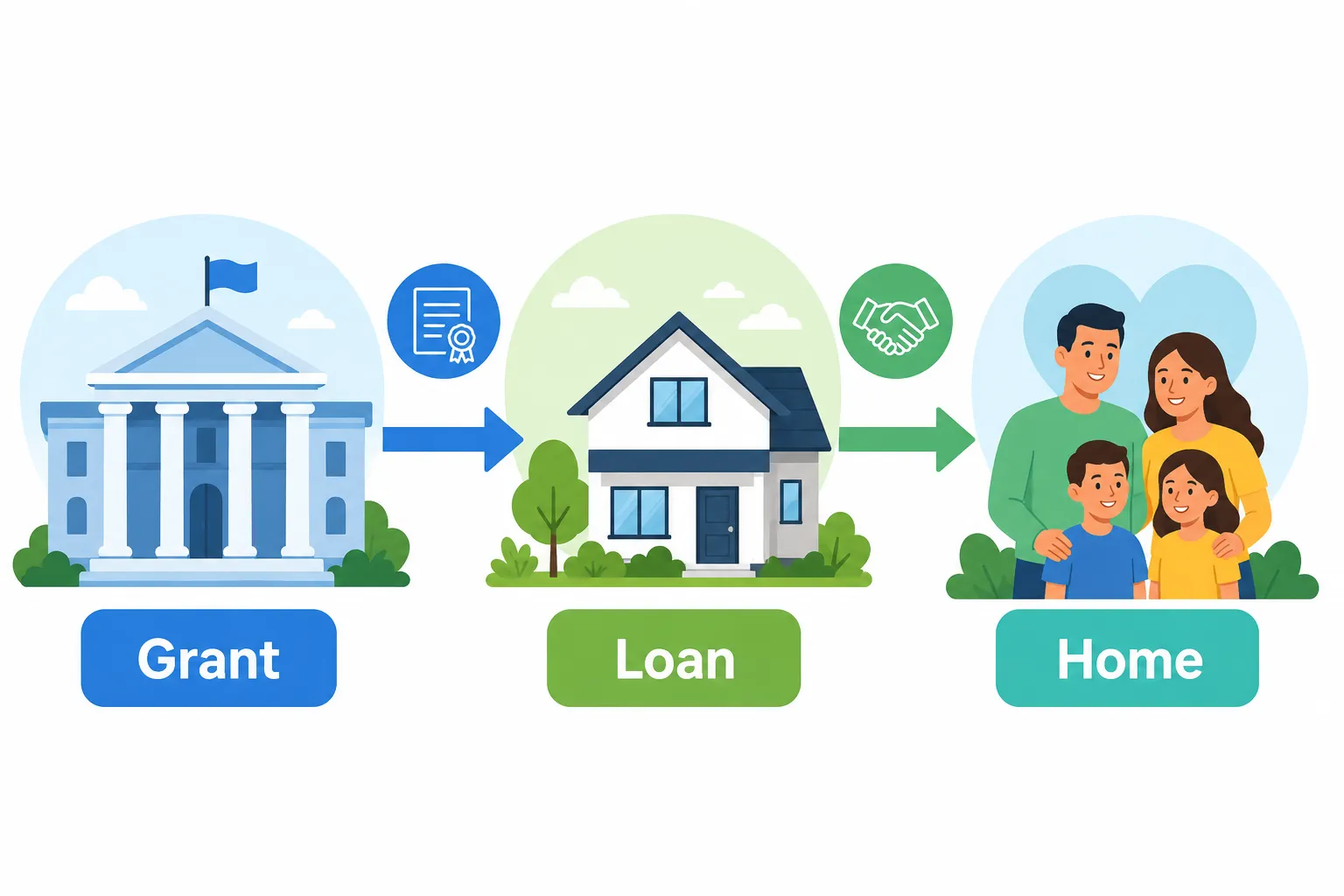
Down payment assistance (DPA) is financial help, from a government agency, nonprofit, or employer, that reduces or eliminates the cash a buyer needs to bring to closing. Instead of saving up the full 3% to 20% down payment on their own, a first-time buyer can receive funds that cover that gap, sometimes completely.
Here's how the mechanics work in practice:
- Grants: Free money. No repayment required. These are the most desirable form of assistance and are typically funded by state housing finance agencies or the federal government.
- Forgivable loans: Structured as a second mortgage but forgiven after you live in the home for a set number of years (usually 5 to 15). If you sell or refinance early, you may owe a prorated portion back.
- Deferred-payment loans: A second mortgage with no monthly payments. The balance is due when you sell, refinance, or pay off the first mortgage.
- Matched savings programs: Also called Individual Development Accounts (IDAs), these programs match your savings contributions at a set ratio, for example, $2 matched for every $1 you save.
The assistance is almost always layered on top of a primary mortgage. You still need to qualify for a first mortgage through a lender, and the DPA funds are applied at closing to reduce your out-of-pocket costs.
For a full breakdown of how financing layers work together, check out our Real Estate Financing Guide: Mortgages, Credit & Down Payments 2026.
Down Payment Assistance Programs for First Time Buyers 2026: The Full Landscape
The range of down payment assistance programs for first time buyers in 2026 is genuinely extraordinary. Federal programs set the floor, state housing finance agencies build on top of that, and local governments and nonprofits add even more layers. Here's a structured look at what's available right now.
Federal-Level Programs
FHA Down Payment Assistance Grants
The Federal Housing Administration (FHA) does not directly issue down payment grants, but it backs loans that are commonly paired with state-run DPA programs. The FHA minimum down payment is 3.5% for buyers with a 580+ credit score. Many state programs cover that 3.5% entirely, making the FHA loan effectively zero down for qualifying buyers.
HUD-Approved Programs
The U.S. Department of Housing and Urban Development (HUD) funds a network of approved housing counseling agencies and community development programs. Their website maintains a searchable database of local DPA programs by zip code.
USDA and VA Loans
These are technically zero-down mortgage programs rather than standalone DPA, but they function the same way for eligible buyers. USDA loans serve rural and suburban buyers within income limits. VA loans serve active military, veterans, and surviving spouses with no down payment and no private mortgage insurance (PMI).
The $25,000 First-Time Home Buyer Grant Application
The Downpayment Toward Equity Act, a federal proposal that would provide up to $25,000 in down payment assistance for first-generation buyers, has been in legislative discussion. As of 2026, this bill has not been signed into law nationally, but several states have created their own versions of this concept. Check your state housing finance agency for current status. Do not apply for a "$25,000 first-time home buyer grant application" through unofficial websites, scams targeting first-time buyers around this topic are active.
The $7,500 Government Grant
Some HUD-affiliated programs and state-level initiatives offer assistance in the $7,500 range, particularly for buyers in targeted census tracts or low-to-moderate income brackets. The specific amount varies by program and funding availability.
State-Level Programs
Every U.S. state operates at least one housing finance agency that administers DPA programs. Some standouts in 2026:
Down Payment Assistance Programs for First Time Buyers in California
California's CalHFA (California Housing Finance Agency) offers several programs including the MyHome Assistance Program, which provides a deferred-payment junior loan up to 3.5% of the purchase price for FHA loans or 3% for conventional. CalHFA also offers the Dream For All Shared Appreciation Loan, a first-generation buyer program providing up to 20% of the purchase price. Funding for Dream For All has been highly competitive and sells out quickly each year.
Down Payment Assistance Programs for First Time Buyers in Texas
The Texas State Affordable Housing Corporation (TSAHC) and the Texas Department of Housing and Community Affairs (TDHCA) both run active programs. TSAHC's Homes for Texas Heroes program targets teachers, firefighters, law enforcement, and healthcare workers. TDHCA's My First Texas Home program offers down payment assistance of up to 5% of the loan amount paired with a 30-year fixed mortgage.
Other states with strong programs include Florida (Florida Housing Finance Corporation), Georgia (Georgia Dream), Colorado (CHFA), and New York (State of New York Mortgage Agency).
How Much Down Payment Help Can You Get as a First-Time Buyer
The amount varies widely, but most buyers in 2026 can realistically access between $5,000 and $25,000 in down payment assistance depending on their state, income, and the program they qualify for.
Here's a general range by program type:
| Program Type | Typical Assistance Amount |
|---|---|
| Local government grants | $2,500, $10,000 |
| State DPA programs | $5,000, $25,000 |
| FHA-paired state programs | 3%, 5% of purchase price |
| First-generation buyer programs | Up to 20% of purchase price (select states) |
| Employer-assisted housing | $1,000, $15,000 |
| USDA / VA (zero down) | Full down payment covered |
The $20,000 down payment assistance tier is real and available in several states, particularly for buyers in high-cost areas or those who qualify as first-generation homeowners. The key is knowing which programs your state offers and whether you meet the income and purchase price caps.
Down Payment Assistance Grants vs. Loans: What's the Difference
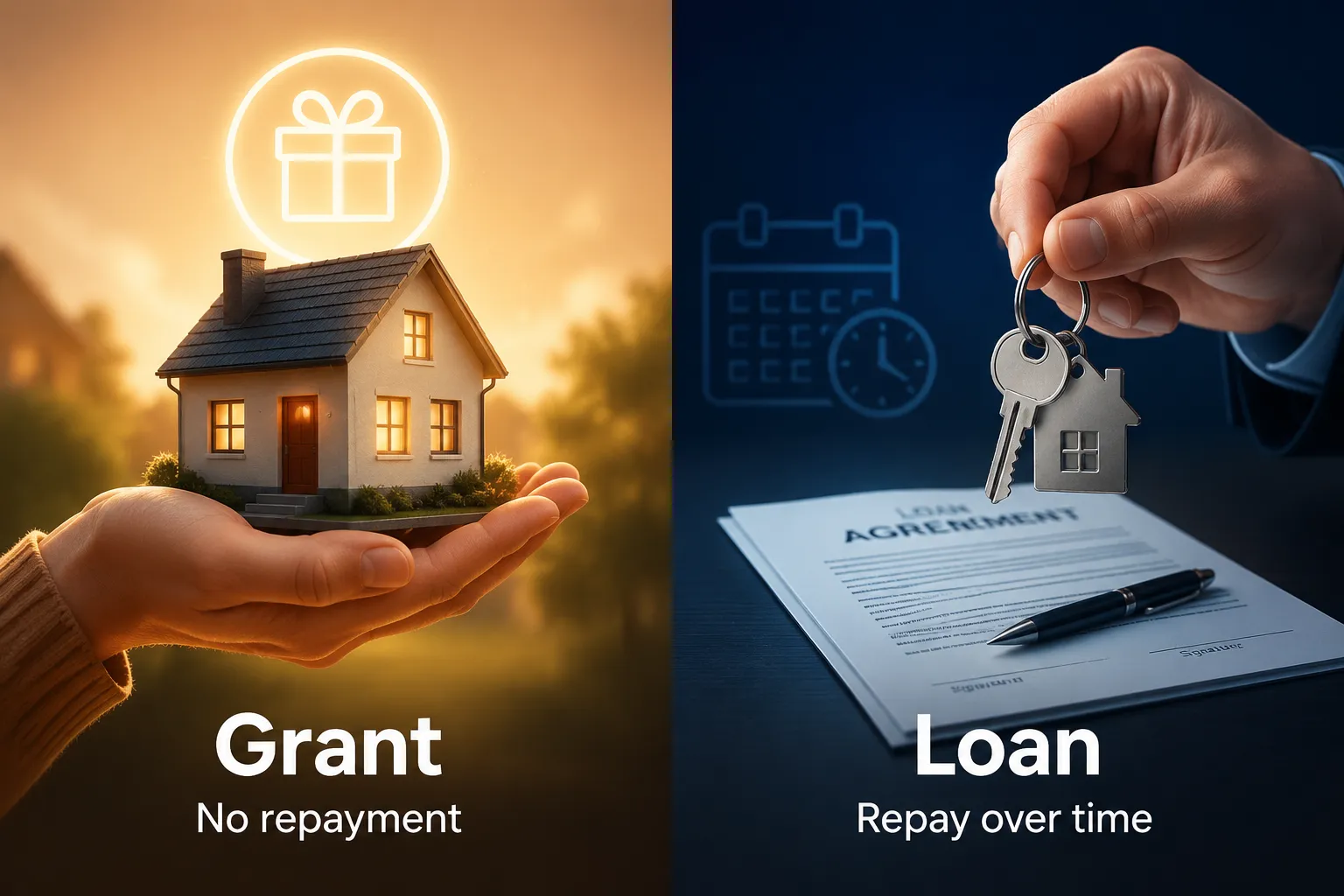
Down payment assistance grants do not need to be repaid under any circumstances. Down payment loans, even forgivable ones, come with conditions attached. This is the single most important distinction to understand before you apply.
Grants: True free money. Funded by government agencies or nonprofits. No repayment, no lien on your property. The catch: they're often limited in funding and competitive.
Forgivable loans: Recorded as a lien on your title. If you sell or refinance before the forgiveness period ends, you typically owe a prorated amount back. After the forgiveness period (often 5 to 10 years), the debt disappears.
Deferred loans: Also a lien on your property. No monthly payments, but the full balance is due when you sell, refinance, or pay off your first mortgage. These are not free money, they're interest-free loans that get paid back at the back end.
The Homebuyer Dream Program, offered through the Federal Home Loan Bank of New York and similar regional banks, is one of the few true grant programs, up to $9,500 in assistance that never needs to be repaid, provided you stay in the home for 5 years.

Am I Eligible for Down Payment Assistance Programs
Most first-time buyers are surprised to find they qualify. Eligibility for down payment assistance programs for first time buyers in 2026 generally requires:
Standard Requirements:
- First-time buyer status (defined as not having owned a primary residence in the past 3 years, not necessarily someone who has never owned)
- Minimum credit score of 580 to 640 depending on the program
- Income at or below the program's limit (typically 80% to 120% of Area Median Income)
- The property must be your primary residence, investment properties do not qualify
- Completion of a HUD-approved homebuyer education course (required by most programs)
- The purchase price must fall within the program's maximum limit
Who Does NOT Qualify:
- Buyers purchasing investment or vacation properties
- Buyers whose income exceeds the program's AMI cap
- Buyers with active bankruptcies in some cases (though some programs allow post-discharge buyers)
- Buyers purchasing above the program's maximum purchase price
If you're a repeat buyer, you may still qualify if you haven't owned a home in the past 3 years, that's the federal definition of "first-time buyer" used by most programs. So based on this definition, a divorced person who hasn't owned property in 3 years can qualify. Don't gate keep this information from people in your circle who might benefit.
Down Payment Assistance Income Limits 2026
Income limits for down payment assistance are tied to the Area Median Income (AMI) for your specific county, not a flat national number. This is where a lot of buyers get confused.
How AMI Works:
The U.S. Department of HUD publishes AMI figures annually for every county and metropolitan area. A program capping eligibility at "80% AMI" in San Francisco will have a much higher dollar limit than the same cap in rural Mississippi, because the median incomes are different.
General 2026 Income Limit Ranges:
- Low-income programs (80% AMI): Roughly $50,000, $85,000 for a household of 1-2 people in most mid-size metros
- Moderate-income programs (120% AMI): Roughly $75,000, $130,000 depending on location
- Some state programs (like California Dream For All) have higher income caps for high-cost areas
Practical step: Look up your county's AMI on the HUD website, then compare it to the program's cap percentage. If your household income is under the cap, you likely pass the income test.
Household size matters too. A 4-person household has a higher income limit than a 1-person household under the same program. Always check the limit for your specific household size.
Best Down Payment Assistance Programs Compared
No single program is the best for everyone, the right choice depends on your state, income, credit score, and whether you need grant money versus a loan. Here's how the major program types stack up.
For buyers who want money they never repay:
The Homebuyer Dream Program and true state grants (where available) are the top pick. California's MyHome and Texas TSAHC grants both have strong track records.
For buyers with lower credit scores:
FHA-paired DPA programs are the most accessible. The FHA's 580 minimum credit score threshold is the most forgiving of any major mortgage program, and most state DPA programs that pair with FHA loans honor that same floor.
For rural buyers:
USDA loans eliminate the down payment entirely. No DPA needed if you qualify for USDA, and the income limits are more generous than many people assume.
For veterans:
VA loans are still the most impeccable zero-down option available. No PMI, no down payment, and competitive rates. Pair with state DPA programs for closing cost coverage.
For first-generation buyers:
Programs modeled after the $25,000 first-time home buyer grant concept, including California Dream For All and similar state initiatives, offer the highest assistance amounts. These are worth pursuing even if they're competitive.
For context on where mortgage rates stand right now and how they affect your total payment, read our breakdown of 2026 Real Estate Trends: How Stable 6% Rates Are Reshaping Buyer and Seller Strategies.
How to Apply for Down Payment Assistance
Applying for down payment assistance programs for first time buyers is a process that runs parallel to your mortgage application, not after it. Here's the step-by-step breakdown:
Step 1: Check Your Eligibility First
Before anything else, verify your income against your county's AMI, confirm your credit score, and confirm you meet the first-time buyer definition.
Step 2: Find Programs in Your Area
- Visit your state's housing finance agency website
- Use HUD's searchable database at hud.gov
- Ask your lender, many participating lenders have direct relationships with DPA programs
Step 3: Complete a Homebuyer Education Course
Most programs require this before you can receive funds. HUD-approved courses are available online through agencies like Framework or eHome America, typically for $75 to $100.
Step 4: Get Pre-Approved with a Participating Lender
Not all lenders participate in DPA programs. You need a lender approved by the specific program you're applying for. This is a critical step many buyers miss.
Step 5: Submit Your DPA Application
This is typically handled through your lender or directly through the housing agency. You'll need income documentation, tax returns, bank statements, and purchase contract details.
Step 6: Let It Cook Before You See Results
DPA approvals take time, sometimes 2 to 4 weeks on top of your regular mortgage timeline. Start early. Don't wait until you have a signed contract to begin the process.
For more guidance on the full home buying process, our First-Time Home Buyer Tips for Gen Z covers the financial prep side in detail.
Down Payment Assistance Common Mistakes to Avoid
Even fresh, motivated buyers trip up on the same issues. Here are the most common mistakes, and how to sidestep them.
Mistake 1: Waiting Until You're Under Contract
DPA programs have limited funding and specific approval timelines. Starting the process after you've found a home is too late for many programs. Begin researching and pre-qualifying before you start house hunting.
Mistake 2: Using an Ineligible Lender
DPA programs require participating lenders. Going to a lender who isn't approved by the program means you can't access those funds, even if you're otherwise eligible.
Mistake 3: Assuming Your Income Is Too High
Many buyers self-disqualify without checking. AMI limits are higher than most people expect, especially in high-cost metros. Always verify before assuming you don't qualify.
Mistake 4: Ignoring Closing Costs
Some buyers focus entirely on the down payment and forget that closing costs (typically 2% to 5% of the loan amount) are a separate expense. Many DPA programs cover closing costs too, ask specifically about this.
Mistake 5: Not Stacking Programs
Multiple assistance sources can often be combined. A state grant plus a local employer assistance program plus a federal program is a legitimate strategy. Not asking about stacking is leaving money on the table.
Mistake 6: Applying Through Unofficial Websites
Scams around "$25,000 first-time home buyer grant applications" and "free grants for first-time home buyers" are common. Always go directly to official .gov or .org housing agency websites.
Can You Use Multiple Down Payment Assistance Programs Together
Yes, stacking multiple down payment assistance programs is allowed in many cases and is a smart strategy for buyers who qualify. The key is that each program must be compatible with the others and with your primary mortgage.
Common stacking combinations:
- A state DPA grant + a local government grant
- An FHA loan + a state DPA program covering the 3.5% down payment + a local program covering closing costs
- An employer-assisted housing benefit + a state program
Rules for stacking:
- The combined assistance cannot exceed your total down payment and closing costs
- Each program must approve the use alongside other assistance, most do, but confirm in writing
- Your primary lender must be approved for all programs you're combining
- Some programs have a "subordination" requirement, meaning their lien position must be agreed upon
This is one of the most underused strategies in real estate. It's not gate keeping to say that most buyers and even some real estate agents don't know this is possible. Now you do.
Down Payment Assistance for Low Credit Score Buyers
A low credit score does not automatically disqualify you from down payment assistance. FHA down payment assistance grants and FHA-paired DPA programs are specifically designed to work with credit scores as low as 580.
Options for buyers with credit scores below 640:
- FHA-paired DPA programs: Most state DPA programs that pair with FHA loans accept the FHA minimum of 580. Some go as low as 560 for specific programs.
- USDA loans: No set minimum credit score by rule, though most USDA-approved lenders prefer 640+. Some manual underwriting options exist for lower scores.
- Nonprofit DPA programs: Organizations like NeighborWorks America and local Community Development Financial Institutions (CDFIs) often have more flexible credit requirements than government programs.
- Credit repair first: If your score is below 580, a 6 to 12-month credit repair plan may be the most efficient path. Paying down revolving debt and disputing errors can move a score significantly in that window.
Edge case: If you have a low score due to medical debt (which was removed from credit reports under updated CFPB guidelines), your actual creditworthiness may be stronger than your score reflects. Mention this to your lender.
For more on how credit impacts your mortgage options, see our Real Estate Financing Guide: Mortgages, Credit & Down Payments 2026.
State and Local Down Payment Assistance Programs Near You
Beyond the major state programs, cities, counties, and employers run their own DPA initiatives, and these are often the most overlooked.
Where to find local programs:
- Your city or county's housing department website
- HUD's local housing counseling agency locator at hud.gov/findacounselor
- Your state's housing finance agency program directory
- The National Council of State Housing Agencies (ncsha.org)
- Your employer's HR department, many large employers offer housing assistance benefits
Examples of local programs in 2026:
- Many major cities offer down payment assistance grants for buyers purchasing within city limits, often targeting neighborhoods the city wants to revitalize
- Some counties offer programs specifically for teachers, first responders, or healthcare workers
- Certain employers, particularly hospitals, universities, and large corporations, offer forgivable loans to employees buying near their workplace
The best states for first-time buyers in terms of program availability and affordability are worth researching before you commit to a location. Our Best States for First-Time Home Buyers: 2026 Rankings breaks this down with current data.
Does Down Payment Assistance Affect Your Mortgage Rate
Down payment assistance can affect your mortgage rate, but the impact depends on the program type and how it's structured. This is a real concern worth understanding before you commit.
When DPA does NOT affect your rate:
- True grants with no repayment obligation typically have no impact on your mortgage rate
- Some state DPA programs are structured specifically to avoid rate adjustments
When DPA can increase your rate:
- Some DPA programs are funded by a slight rate premium, the lender charges a marginally higher rate and uses the yield spread to fund the assistance
- Second mortgage DPA programs (deferred or forgivable loans) may require a lender to add a small rate adjustment to account for the combined loan-to-value ratio
The practical math:
Even if a DPA program adds 0.25% to your mortgage rate, the upfront cash benefit of $10,000 to $20,000 in assistance almost always outweighs the rate cost over the first several years of homeownership. Run the numbers with your lender before declining DPA solely because of a rate concern.
For current rate context, our Spring 2026 Housing Market: Lower Rates and Rising Inventory covers where rates are trending and what it means for buyers this year.
How to Qualify for First-Time Home Buyer Grants: The Checklist
To qualify for most first-time home buyer government programs and grants in 2026, you'll need to meet these criteria:
Financial Requirements:
- Credit score of 580 or higher (640+ preferred for conventional DPA programs)
- Debt-to-income ratio (DTI) below 45% to 50%
- Household income within the program's AMI cap
- Sufficient reserves (some programs require 1 to 2 months of mortgage payments in savings after closing)
Property Requirements:
- Primary residence only
- Purchase price within the program's maximum (varies by county)
- Property must pass an appraisal and any required inspection
Buyer Requirements:
- First-time buyer status (no primary residence ownership in past 3 years)
- Completion of an approved homebuyer education course
- U.S. citizenship or eligible non-citizen status (varies by program)
Documentation You'll Need:
- Last 2 years of federal tax returns
- Last 2 to 3 months of pay stubs
- Last 2 to 3 months of bank statements
- Government-issued ID
- Social Security number
Our down payment strategies guide covers additional ways to build your down payment alongside assistance programs.

Frequently Asked Questions
What counts as a first-time home buyer for down payment assistance purposes?
Most programs define a first-time buyer as someone who has not owned a primary residence in the past 3 years. This means previous homeowners can qualify again after a 3-year gap.
Do I have to repay down payment assistance grants?
No. True grants are free money with no repayment obligation. Forgivable loans and deferred loans are different, they must be repaid under certain conditions. Always confirm which type you're receiving before closing.
Can I use down payment assistance with an FHA loan?
Yes. FHA loans are one of the most common primary mortgages paired with DPA programs. Most state housing finance agencies have FHA-compatible DPA options specifically designed to cover the 3.5% FHA minimum down payment.
What is the Homebuyer Dream Program?
The Homebuyer Dream Program is a grant program offered through the Federal Home Loan Bank system (primarily in the Northeast) that provides up to $9,500 in assistance for first-time buyers. It is a true grant, no repayment required, as long as the buyer remains in the home for 5 years.
Are there down payment assistance programs for first-time buyers with bad credit?
Yes. FHA-paired DPA programs accept credit scores as low as 580. Some nonprofit and CDFI programs work with scores below that. A score below 580 typically requires credit repair before qualifying.
Is the $25,000 first-time home buyer grant available in 2026?
The federal Downpayment Toward Equity Act has not been enacted as national law as of 2026. Some states have created their own first-generation buyer programs with similar amounts. Check your state's housing finance agency for current offerings.
How long does it take to get approved for down payment assistance?
Approval timelines vary by program, but most DPA approvals take 2 to 4 weeks on top of the standard mortgage approval process. Start the application before you're under contract whenever possible.
Can I use down payment assistance on a new construction home?
Many programs allow new construction, but some have restrictions. Confirm with the specific program whether newly built homes qualify and whether there are any builder approval requirements.
What happens to my down payment assistance if I sell the home early?
For forgivable loans, you typically owe a prorated portion back if you sell before the forgiveness period ends. For deferred loans, the full balance is due at sale. True grants have no repayment requirement regardless of when you sell.
Does down payment assistance affect my debt-to-income ratio?
If the DPA is structured as a second mortgage with monthly payments, yes, it adds to your DTI. Most DPA programs are structured as deferred or forgivable loans with no monthly payment specifically to avoid impacting DTI.
Can renters who have never owned a home qualify for first-time buyer programs?
Yes. Long-term renters are the primary target audience for most first-time home buyer government programs. Never having owned a home puts you in the strongest eligibility position.
Where is the best place to find down payment assistance programs near me?
Start with your state's housing finance agency website, then check HUD's housing counseling agency locator at hud.gov. Your mortgage lender, if they participate in DPA programs, is also a direct resource.
Conclusion: Your Next Steps to Access Down Payment Assistance in 2026
Down payment assistance programs for first time buyers in 2026 represent one of the most underused financial tools in real estate. The money is real, the programs are active, and thousands of buyers qualify without ever knowing it. That's the definition of gate keeping, and this article exists to change that.
Here's what to do right now:
- Check your state's housing finance agency website, search "[your state] housing finance agency" and look for first-time buyer programs.
- Verify your income against your county's AMI using HUD's published data at hud.gov.
- Pull your credit score and confirm it meets the minimum for the programs you're targeting.
- Find a participating lender, not all lenders work with DPA programs. Ask specifically whether they are approved for your state's programs.
- Complete a HUD-approved homebuyer education course, this is required by most programs and takes about 6 to 8 hours online.
- Ask about stacking, find out whether you can combine a state grant with a local program or employer assistance.
- Apply before funding runs out, many programs exhaust their annual budgets mid-year. Don't wait.
The housing market in 2026 is moving. Rates have stabilized, inventory is rising in many markets, and down payment assistance programs for first time buyers are more accessible than they've been in years. Let it cook, do the prep work now, and the path to homeownership gets a lot shorter.
For more on what the market looks like right now, read our U.S. Home Buyers Market Trends in 2026 and explore our full First-Time Home Buyers resource hub for step-by-step guidance on every part of the process.
Meta Title: Down Payment Assistance Programs for First Time Buyers 2026
Meta Description: Discover the best down payment assistance programs for first time buyers in 2026, grants, forgivable loans, income limits, and how to apply step by step.