

Last updated: July 20, 2026

Quick Answer: PMI, private mortgage insurance, is a monthly fee lenders charge when your down payment is less than 20% of the home's purchase price. It protects the lender, not you, if you default. The good news: understanding what is PMI on a mortgage and how to kill it early can save you hundreds of dollars a month once you know the rules.
Key Takeaways
- PMI stands for Private Mortgage Insurance and is required on most conventional loans with less than 20% down.
- The average PMI cost runs between 0.5% and 1.5% of the original loan amount per year, paid monthly.
- Federal law (the Homeowners Protection Act) requires lenders to automatically cancel PMI when your loan balance reaches 78% of the original purchase price.
- You can request PMI cancellation earlier, at 80% loan-to-value, by submitting a written request to your lender.
- FHA loans have their own version of mortgage insurance (MIP) with different rules, and it's harder to remove.
- Refinancing is one of the fastest ways to eliminate PMI if your home value has increased significantly.
- You can avoid PMI altogether with a 20% down payment, a piggyback loan, or select lender programs.
- PMI is not currently tax deductible for most borrowers (the deduction expired and has not been made permanent as of 2026).
What Is PMI on a Mortgage, and Why Does It Exist?
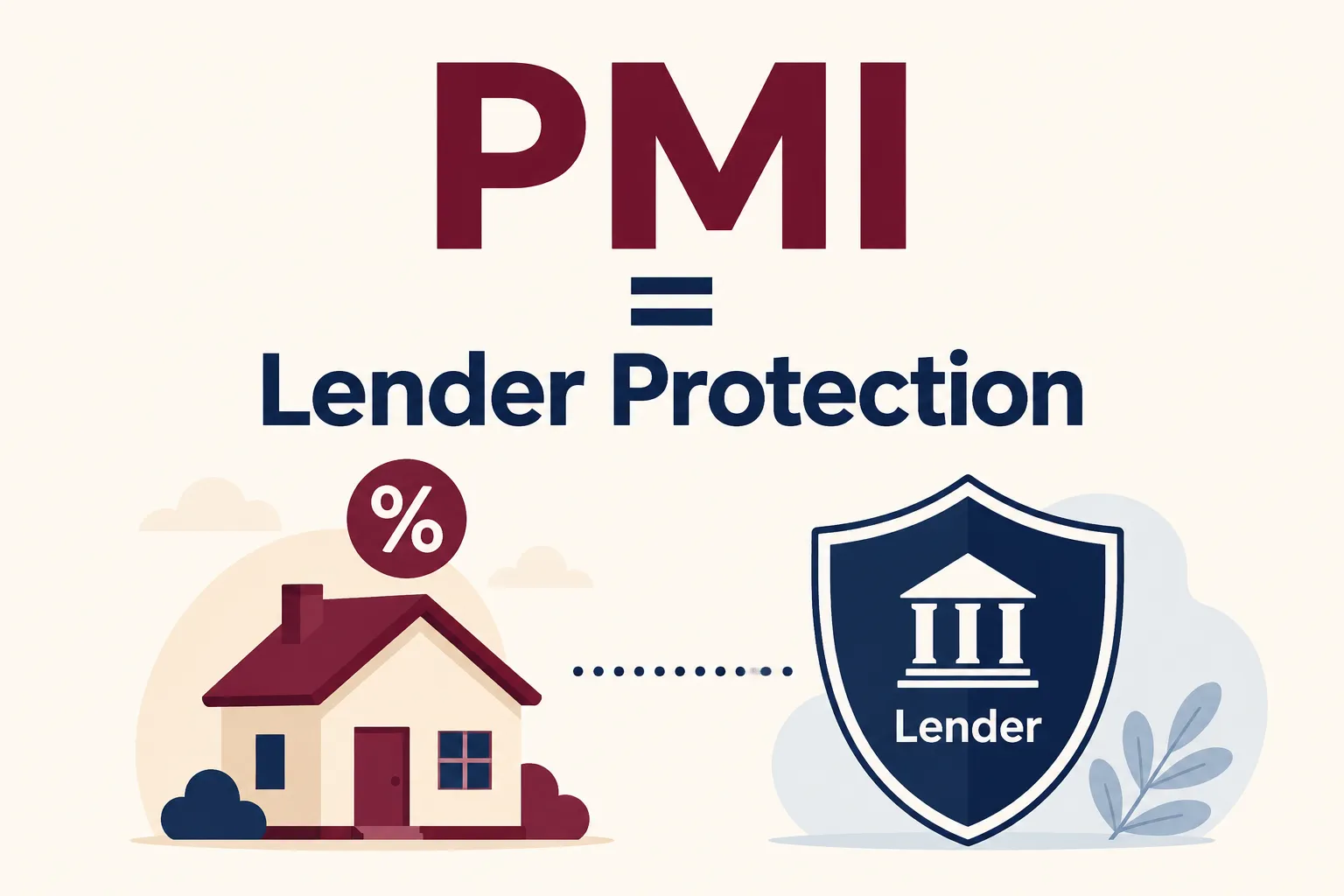
PMI on a mortgage is a type of insurance policy that protects your lender, not you, if you stop making payments and the loan goes into default. Lenders require it when a borrower puts down less than 20% because a smaller down payment means higher risk for the bank.
Here's the straight answer: you pay for coverage that benefits someone else. So based as that sounds, it's the cost of getting into a home with less cash upfront.
What PMI stands for: Private Mortgage Insurance. It's "private" because it's issued by private insurance companies, not a government agency. Don't confuse it with MIP (Mortgage Insurance Premium), which is the FHA version, more on that difference below.
Why lenders require it:
- A borrower with less than 20% equity has more statistical likelihood of default, according to historical lending data.
- PMI offsets that risk by reimbursing the lender a portion of the loan if foreclosure occurs.
- Once you build enough equity, the risk drops, and the insurance requirement goes away.
Think of it like a security deposit on a rental. The landlord (lender) wants protection before they hand over the keys. Once you've proven yourself and built equity, you get that money back in the form of a cancelled monthly charge.
For a broader look at how mortgage costs stack up, check out our Real Estate Financing Guide: Mortgages, Credit & Down Payments 2026.
What Does PMI Stand For on a Mortgage Loan?
PMI stands for Private Mortgage Insurance. On a conventional mortgage, it's a monthly premium added to your payment when your loan-to-value ratio (LTV) exceeds 80%, meaning you own less than 20% of the home's value.
Key terms to know:
- Loan-to-Value (LTV): Your loan balance divided by the home's appraised value. An LTV above 80% triggers PMI on conventional loans.
- Private Mortgage Insurance (PMI): Coverage for the lender on conventional loans.
- Mortgage Insurance Premium (MIP): The FHA equivalent of PMI, different rules, different removal process.
- LPMI (Lender-Paid PMI): The lender pays the PMI but rolls the cost into a higher interest rate. You don't see a separate line item, but you pay it through the life of the loan.
"PMI is not punishment for a small down payment. It's the price of entry when you don't have 20%, and it's fully removable once you do."
How Much Does PMI Cost Per Month?
PMI typically costs between 0.5% and 1.5% of your original loan amount per year, broken into monthly payments. On a $350,000 loan, that's roughly $145 to $437 per month.
What percentage is PMI on a mortgage? The exact rate depends on:
- Your credit score (higher score = lower PMI rate)
- Your down payment percentage (more down = lower PMI)
- Loan type and term
- The PMI insurer your lender uses
Sample monthly PMI estimates (conventional loan):
| Loan Amount | PMI Rate | Monthly PMI Cost |
|---|---|---|
| $250,000 | 0.5% | ~$104/month |
| $350,000 | 0.8% | ~$233/month |
| $450,000 | 1.0% | ~$375/month |
| $500,000 | 1.2% | ~$500/month |
These are estimates. Your actual rate will vary based on credit profile and lender. Use a PMI removal calculator to model your specific scenario and track when you'll hit the 80% LTV threshold.
Does PMI Go Away Automatically, and When Does PMI Go Away?
Yes, PMI does go away automatically under federal law, but only under specific conditions. The Homeowners Protection Act (HPA) of 1998 requires lenders to automatically cancel PMI when your loan balance reaches 78% of the original purchase price, based on your scheduled payment history.
Two key thresholds to know:
80% LTV, You can request cancellation. At this point, you have the right to submit a written request to your lender asking them to remove PMI. You'll likely need a current appraisal showing the home's value supports the 80% threshold.
78% LTV, Automatic cancellation kicks in. The lender must cancel PMI automatically based on your original amortization schedule, as long as you're current on payments.
Does PMI go away after 20 percent automatically? Not quite. The automatic cancellation happens at 78% LTV (22% equity), not exactly 20%. To cancel at 20% equity, you need to request it in writing.
Edge case: If your home's value has dropped, the lender may deny an early cancellation request even if your payments suggest you've hit 80% LTV. The math is based on the original purchase price for automatic cancellation, but an appraisal matters for early requests.
How to Kill PMI Early, The Real Strategies That Work
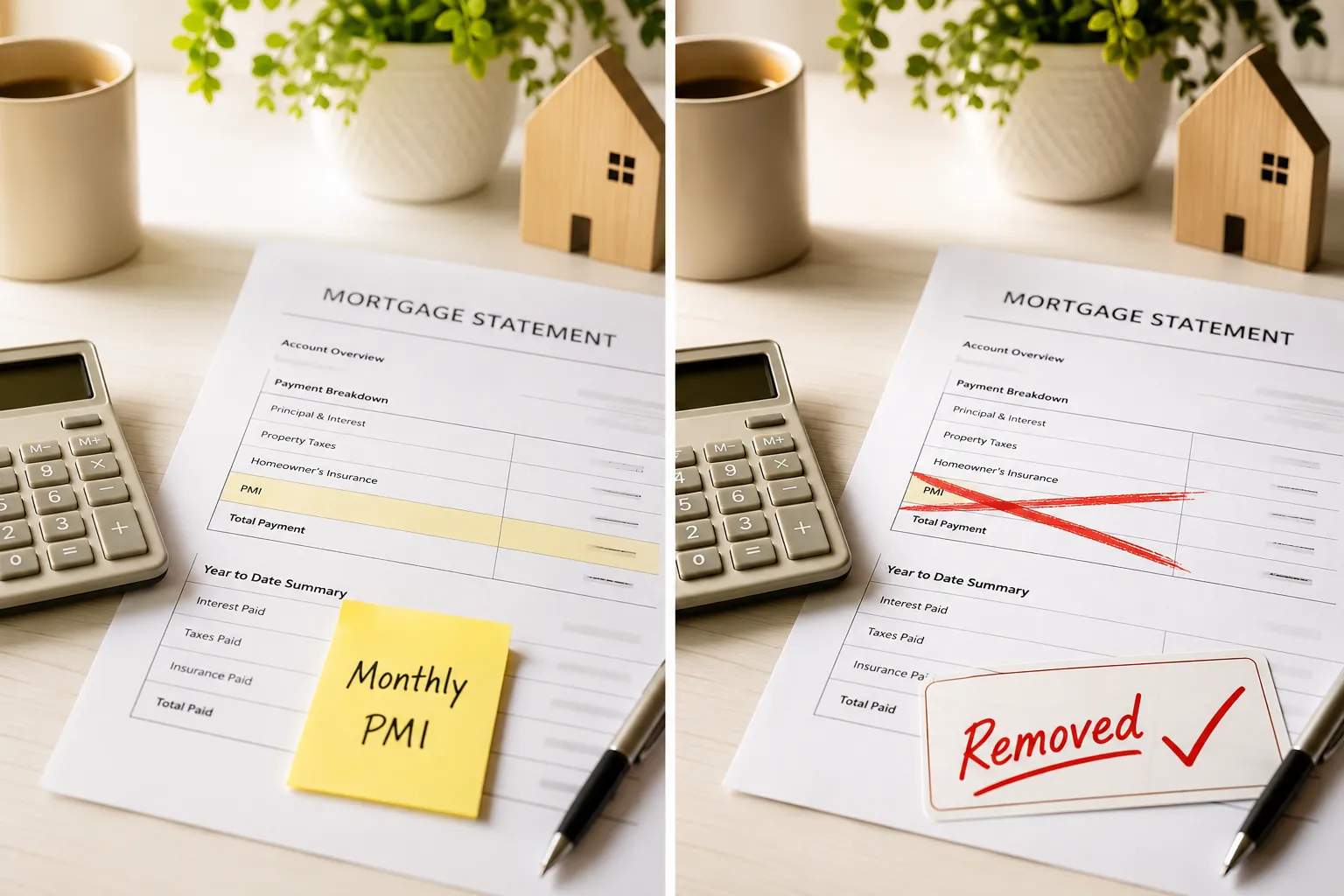
Killing PMI early is absolutely possible, and the savings are extraordinary once you understand the playbook. Here are the most effective methods ranked by speed and practicality.
1. Make Extra Principal Payments
Every extra dollar you pay toward principal reduces your loan balance faster, which moves you toward that 80% LTV threshold sooner. Even an extra $100,$200 per month can shave years off your PMI timeline.
Use a PMI removal calculator to see exactly how many months you'd save with different extra payment amounts.
2. Request Cancellation at 80% LTV
Once your loan balance hits 80% of the original purchase price, submit a written cancellation request to your servicer. You'll typically need:
- A written request (some lenders have a form)
- Proof you've made payments on time (usually 12-24 months of clean history)
- Possibly a new appraisal (at your expense, usually $300,$600)
- No second liens on the property
This is how to cancel PMI on a mortgage without waiting for the automatic 78% threshold.
3. Get a New Appraisal If Your Home Value Has Increased
If your home's market value has risen significantly since purchase, a new appraisal could show your current LTV is already below 80%, even if your payments haven't gotten you there yet. This is one of the freshest moves in the PMI-killing playbook.
For example: You bought at $300,000 with 10% down ($270,000 loan). Your home is now worth $380,000. Your current LTV is $265,000 / $380,000 = 69.7%. That's well below 80%, and grounds for PMI removal.
4. Refinance to Remove PMI
Refinancing into a new loan eliminates the old PMI policy entirely. If your home has appreciated and you now have 20%+ equity, a refinance resets the loan without PMI. This is especially worth considering if current rates are favorable.
Check out our coverage of current mortgage rates to evaluate whether refinancing makes financial sense for your situation.
Heads up: Refinancing comes with closing costs (typically 2-5% of the loan amount). Run the numbers on break-even time before committing.
How to Get Rid of PMI Without Refinancing
If refinancing isn't the move right now, you still have options:
- Extra principal payments to reach 80% LTV faster
- Requesting cancellation based on improved home value (appraisal route)
- Waiting for automatic cancellation at 78% LTV
These three paths answer the question of how to get rid of PMI without refinancing, and they're all legitimate under federal law.
FHA Loan vs. Conventional Loan PMI Differences
This is where a lot of buyers get blindsided. FHA loans and conventional loans handle mortgage insurance very differently, and the FHA version is significantly harder to remove.
Conventional PMI:
- Cancellable at 80% LTV (by request) or 78% LTV (automatic)
- Rate depends on credit score and down payment
- Removed once equity threshold is met
FHA MIP (Mortgage Insurance Premium):
- Required regardless of down payment size
- Includes an upfront MIP (1.75% of the loan amount, rolled into the loan)
- Monthly MIP continues for the life of the loan if you put down less than 10%
- If you put down 10% or more on an FHA loan, MIP cancels after 11 years
What is PMI on an FHA loan? Technically, FHA loans don't have PMI, they have MIP. But the effect is the same: you pay monthly mortgage insurance. The critical difference is that FHA MIP is much harder to remove.
How to get rid of PMI on an FHA loan without refinancing: For most FHA borrowers (those who put down less than 10%), the only way to eliminate MIP is to refinance into a conventional loan once you have enough equity. There is no cancellation-by-request option for FHA MIP if your down payment was under 10%.
This is why many buyers who start with FHA loans eventually refinance to conventional, it's the exit strategy built into the FHA playbook.
For a full breakdown of loan types and what they cost long-term, see our guide on 15 vs 30-Year Mortgage Rates 2026.

Can You Refinance to Remove PMI?
Yes, refinancing is one of the most direct ways to eliminate PMI, especially if your home value has increased. When you refinance, you're taking out a new loan. If the new loan is at or below 80% LTV based on the current appraised value, no PMI is required.
When refinancing to remove PMI makes sense:
- Your home has appreciated significantly since purchase
- You've paid down enough principal to be near or below 80% LTV
- Current interest rates are lower than your existing rate (double win)
- You plan to stay in the home long enough to recoup closing costs
When it doesn't make sense:
- Rates are significantly higher than your current rate (you'd be trading PMI savings for a higher rate)
- You're close to hitting 78% LTV through normal payments anyway
- You can't cover closing costs
Choose refinancing if: Your home value has jumped 15%+ since purchase AND current rates are within 0.5-1% of your existing rate. That combination makes the math work.
For investors and buyers exploring alternative financing structures, our piece on Non-QM Mortgage Lenders covers situations where standard PMI rules may not apply.
What's the Best Way to Avoid PMI Altogether?
The best way to avoid PMI is to put 20% down. No PMI is required on conventional loans when your down payment hits that threshold. But that's not the only path, and for many buyers in 2026, it's not realistic.
Strategies to avoid PMI without 20% down:
Piggyback Loan (80-10-10): You take a first mortgage for 80% of the purchase price, a second mortgage (HELOC or home equity loan) for 10%, and put 10% down. The first loan never exceeds 80% LTV, so no PMI is triggered. This is the classic answer to how to avoid PMI without 20% down.
Lender-Paid PMI (LPMI): The lender covers the PMI cost in exchange for a slightly higher interest rate. No monthly PMI line item, but you pay through the rate for the life of the loan. Best if you plan to sell or refinance within a few years.
VA Loans: Veterans and active-duty service members can qualify for VA loans with zero down and no PMI, ever. This is one of the most impeccable benefits in the mortgage world.
Physician Loans: Certain lenders offer doctor mortgage programs with low or no down payment and no PMI. See our breakdown of Physician Mortgage Lenders for details on who qualifies.
Credit Union and Portfolio Lender Programs: Some local credit unions and portfolio lenders offer low-down-payment loans without PMI as a competitive differentiator. Worth shopping around.
What Happens If You Don't Pay PMI?
If PMI is required on your loan and you don't pay it, you're not actually the one who stops paying, it's built into your monthly mortgage payment. You can't opt out of PMI mid-loan once it's been established as a condition of your mortgage.
What actually happens if you try to avoid it:
- PMI is collected by your mortgage servicer as part of your monthly payment. You don't write a separate check.
- If you fall behind on your mortgage payment (which includes PMI), you risk delinquency, late fees, and eventual foreclosure, not just a PMI issue.
- You cannot legally refuse to pay PMI if it's a condition of your loan agreement.
Is PMI required? Yes, on conventional loans with less than 20% down, it's a lender requirement, not optional. The only way to avoid it is through the strategies listed above (20% down, piggyback loan, VA loan, etc.).
Is PMI Tax Deductible in 2026?
No, PMI is not currently tax deductible for most borrowers in 2026. The mortgage insurance premium deduction expired, and as of the current tax year, it has not been made permanent by Congress.
Important note: Tax law changes frequently. Always consult a licensed CPA or tax professional for advice specific to your situation. What's true for 2026 may change with new legislation.
Historically, when the deduction was active:
- It applied to PMI paid on loans for a primary or secondary residence
- It phased out at higher income levels (above roughly $100,000 AGI for married filers)
- It was an itemized deduction, so it only helped if you itemized rather than taking the standard deduction
Don't make your PMI removal strategy dependent on a tax deduction that may or may not be available. Focus on eliminating the cost entirely, that's the real win.
How Long Do You Have to Pay PMI?
How long you pay PMI depends on your loan type, down payment, and how aggressively you build equity. On a conventional loan with 5% down and no extra payments, PMI typically stays on for 7-11 years before the automatic cancellation at 78% LTV kicks in.
Factors that shorten PMI duration:
- Larger initial down payment (closer to 20%)
- Extra principal payments each month
- Home value appreciation (supports early cancellation request)
- Refinancing into a new loan at lower LTV
Factors that extend PMI duration:
- Minimum monthly payments only
- Flat or declining home values
- FHA loan (MIP may last the full loan term)
The fastest path is a combination of extra payments plus a favorable appraisal. Let it cook before you see results, but the payoff is real. Eliminating $250,$400/month in PMI is the equivalent of a significant raise.
For first-time buyers building their full financial picture, our First-Time Homebuyer Guide covers this and much more.
FAQ: What Is PMI on a Mortgage and How to Kill It Early
Q: What is monthly PMI on a mortgage?
Monthly PMI is the portion of your mortgage payment that covers private mortgage insurance. It's typically 0.5%,1.5% of your original loan amount divided by 12. On a $300,000 loan at 0.8%, that's $200/month added to your payment.
Q: What is PMI insurance on a mortgage vs. homeowners insurance?
PMI protects the lender if you default. Homeowners insurance protects you and your property from damage, theft, and liability. They're completely separate policies, both are typically required by lenders, but they serve different purposes.
Q: Can I remove PMI before paying off the loan?
Yes. You can request PMI cancellation once your loan balance reaches 80% of the original purchase price, provided you have a good payment history and your home's value hasn't declined. You don't need to pay off the loan to eliminate PMI.
Q: Does PMI go away after 20 percent automatically?
Not exactly. Automatic cancellation under federal law happens at 78% LTV (22% equity), not 20%. At 20% equity (80% LTV), you have the right to request cancellation, but you must submit that request in writing.
Q: How to get rid of PMI on an FHA loan without refinancing?
For most FHA borrowers who put down less than 10%, you can't remove MIP without refinancing into a conventional loan. If you put down 10% or more, MIP cancels after 11 years.
Q: What percentage is PMI on a mortgage?
PMI rates typically range from 0.5% to 1.5% of the original loan amount per year. Your exact rate depends on your credit score, down payment size, and the PMI insurer.
Q: How to avoid PMI without 20% down?
The main options are a piggyback loan (80-10-10 structure), lender-paid PMI (LPMI), a VA loan (for eligible veterans), or select physician/portfolio lender programs that waive PMI requirements.
Q: What is the difference between PMI and mortgage insurance?
PMI is the conventional loan version. MIP (Mortgage Insurance Premium) is the FHA version. Both protect the lender, but FHA MIP is harder to remove and includes an upfront premium. The term "mortgage insurance" is an umbrella term that covers both.
Q: Is PMI required on all mortgages?
No. PMI is required on conventional loans with less than 20% down. VA and USDA loans have no PMI. FHA loans have MIP instead. Jumbo loans vary by lender.
Q: Can I use a PMI removal calculator to plan my strategy?
Yes, a PMI removal calculator lets you input your loan balance, home value, and extra payment amounts to see exactly when you'll hit 80% LTV. Most mortgage servicer websites offer one, or you can find free versions through financial planning sites.
Q: What happens to my PMI payment if I refinance?
When you refinance, the original loan (and its PMI policy) is paid off. The new loan is underwritten fresh. If your new LTV is below 80%, no PMI is required on the new loan.
Q: How do I request PMI cancellation from my lender?
Contact your mortgage servicer in writing. Request their PMI cancellation form or submit a written letter stating your request. You'll need to show your loan balance is at or below 80% LTV, confirm you have a good payment history, and potentially provide a new appraisal.
Conclusion: Stop Gate Keeping This Information, Share It
Understanding what is PMI on a mortgage and how to kill it early is one of the most actionable pieces of financial knowledge a homeowner can have. Too many buyers spend years paying for insurance that protects someone else, simply because no one explained the rules clearly.
Here's your action plan:
- Check your current LTV. Call your servicer or log into your account. Find your current loan balance and compare it to your original purchase price.
- Request a home value estimate. If your market has appreciated, a new appraisal could show you're already below 80% LTV.
- Run the PMI removal calculator. Model how much faster you'd hit 80% with extra monthly payments.
- Submit a written cancellation request if you're at or below 80% LTV with a clean payment history.
- Evaluate refinancing if rates and your equity position make it a net win.
- If you're on an FHA loan, plan your conventional refinance timeline as soon as you have 20% equity.
The money you free up by eliminating PMI can go toward building more equity, investing, or simply breathing easier every month. That's an extraordinary outcome for a few hours of paperwork.
For more on mortgage strategy and financing options, explore our full Financing & Mortgages hub, built by brokers, free for everyone.