

Last updated: August 23, 2026

Quick Answer: The VA loan first time home buyer rules most vets never use include zero down payment with no private mortgage insurance, a reusable entitlement that works across multiple purchases, seller concessions up to 4% of the purchase price, and a funding fee exemption for veterans with a service-connected disability. You do not have to be a first-time buyer to use a VA loan, and the benefit does not expire.
Key Takeaways
- VA loans require no down payment and no PMI, which saves most buyers thousands per year compared to conventional financing
- The VA funding fee for a first-time user with zero down is 2.15% of the loan amount as of 2026, but veterans with a service-connected disability rating pay nothing
- Your VA entitlement can be used more than once, and in most cases it can be fully restored after you sell or pay off a prior VA loan
- The Certificate of Eligibility (COE) is the document that proves your VA loan eligibility to a lender, and you can request it online through the VA's eBenefits portal
- Sellers can pay up to 4% of the purchase price in concessions on a VA loan, covering the funding fee and closing costs
- VA loans can be used to purchase a duplex, triplex, or fourplex as long as the veteran occupies one unit
- The VA Interest Rate Reduction Refinance Loan (IRRRL), also called the streamline refinance, lets you lower your rate with minimal paperwork
- Second tier VA entitlement allows you to carry two VA loans at the same time under specific conditions
- VA minimum property requirements (MPRs) protect the buyer, not just the lender, and can actually work in your favor during negotiation
- 18% of home buyers in the most recent NAR survey were veterans or had a veteran in the household, yet a large share never fully used the benefits available to them
VA Loan First Time Home Buyer Rules Most Vets Never Use
Only about 8% of first-time home buyers used a VA loan in the most recent NAR survey of buyer financing, despite veterans and active-duty service members making up 18% of the buying pool. The VA loan first time home buyer rules most vets never use are not buried in fine print. They are just rarely explained by anyone who has actually closed a VA deal.
The VA home loan benefit was established by the Servicemen's Readjustment Act of 1944, and it has been expanded several times since. The core promise has not changed: eligible veterans, active-duty service members, National Guard members, reservists, and certain surviving spouses can buy a home with no down payment, no private mortgage insurance, and competitive interest rates backed by the U.S. Department of Veterans Affairs.
What has changed is how complex the rules around entitlement, funding fees, and reuse have become. Most veterans walk into a lender's office knowing only that the loan exists. This guide covers the mechanics that actually matter.
For a broader look at how VA financing fits into the current market, see our mortgage options and real estate market trends for new buyers.
What Are VA Loan Requirements and Who Qualifies
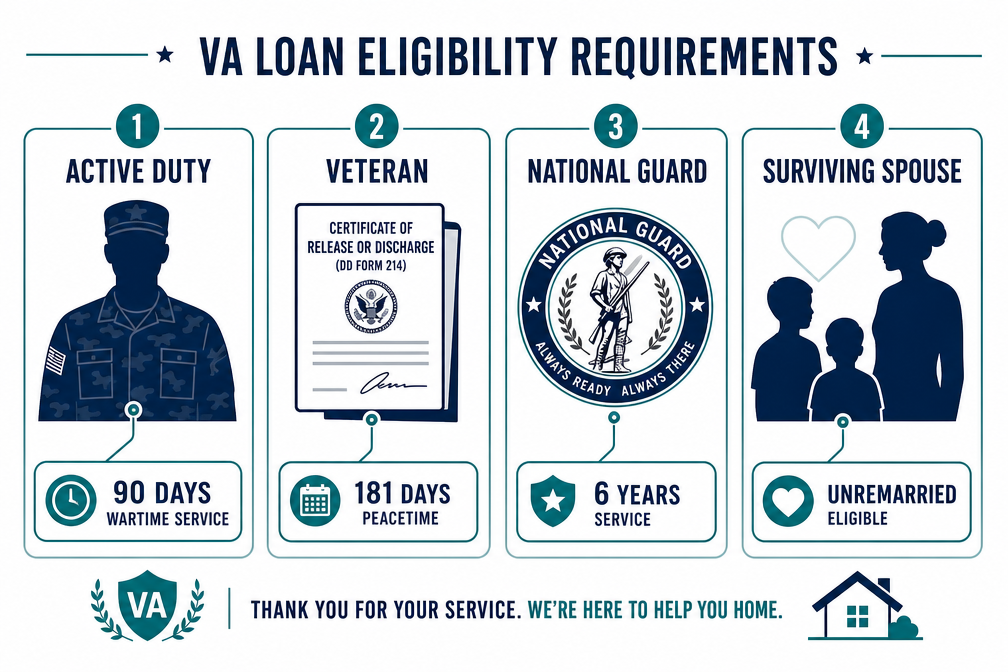
VA loan eligibility is based on military service, not income or first-time buyer status. The VA does not set a minimum credit score or income floor, though individual lenders add their own overlays (most require at least a 580 to 620 score in practice).
Service requirements by category:
- Active duty: 90 consecutive days during wartime, or 181 days during peacetime
- Veterans: Same thresholds as above, with an honorable or other-than-dishonorable discharge
- National Guard and Reserves: 6 years of service, or 90 days of active-duty service under Title 10 orders
- Surviving spouses: Unremarried spouses of veterans who died in service or from a service-connected disability, or spouses of veterans listed as missing in action or prisoners of war
The VA also requires that the property be your primary residence. You cannot use a VA loan to buy a vacation home or a pure investment property. That said, the va loan occupancy requirement allows you to buy a multi-unit property (up to four units) and rent out the other units as long as you live in one.
Common mistake: Many veterans assume they need a 20% down payment or perfect credit because a recruiter or bank told them so years ago. VA loans have no down payment requirement and no PMI, period.
Do You Have to Be a First-Time Home Buyer to Get a VA Loan
No. The VA loan is not restricted to first-time buyers. Any eligible veteran or service member can use it regardless of how many homes they have owned before. The confusion comes from how the benefit interacts with entitlement, which is covered in the next section.
A veteran who bought a home conventionally ten years ago and never used a VA loan still has full entitlement available. A veteran who used a VA loan, sold that home, and had their entitlement restored can use the benefit again. The VA loan is not a one-time reward. It is a recurring benefit tied to service.
How VA Loan Entitlement Works for First-Time and Repeat Buyers
VA loan entitlement is the dollar amount the VA guarantees to the lender if you default. There are two tiers.
Basic entitlement is $36,000. Bonus entitlement (also called second tier or additional entitlement) brings the total guarantee to 25% of the conforming loan limit in your county. In 2026, the baseline conforming loan limit is $806,500, making the standard bonus entitlement $201,625.
For most buyers in most counties, this means you can borrow up to the conforming loan limit with zero down and full VA backing. In high-cost counties, the limit is higher.
What happens when you use your entitlement:
When you buy a home with a VA loan, a portion of your entitlement is tied to that property. It stays tied until one of these happens:
- You sell the home and the VA loan is paid off, which allows a full entitlement restoration
- You pay off the loan without selling (you can request a one-time restoration in this case)
- Another eligible veteran assumes your loan and substitutes their entitlement for yours
Second tier va entitlement is what makes it possible to carry two VA loans at the same time. If you have remaining entitlement after your first purchase and you need to relocate, you may be able to use the leftover entitlement on a second property without selling the first. The math depends on your county's loan limit and how much entitlement is already in use.
This is one of the va loan first time home buyer rules most vets never use because most buyers never ask about it. A VA-experienced lender can run the numbers in about ten minutes.
VA Loan No Down Payment and No PMI: What That Actually Saves
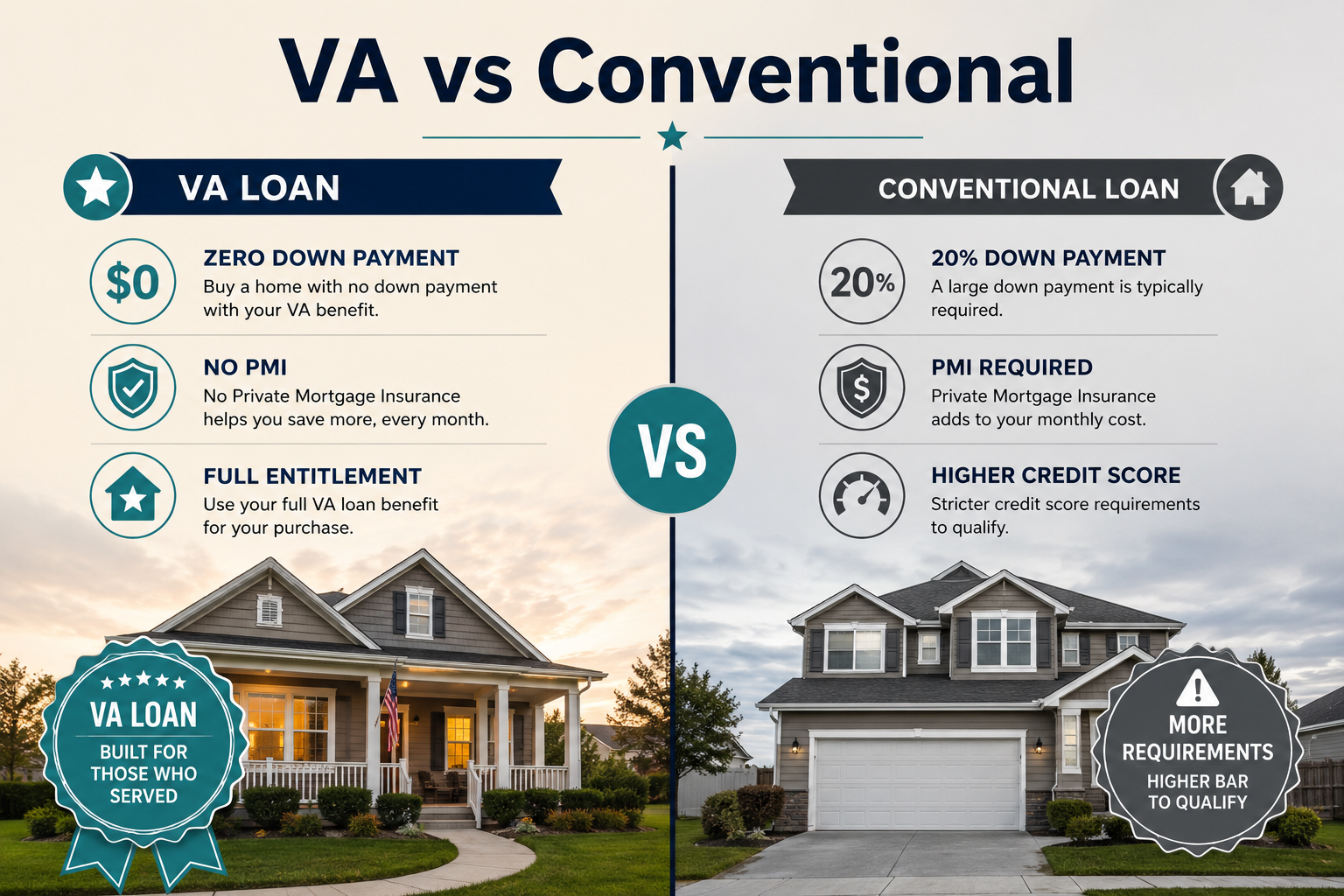
On a $434,100 home (the July 2026 national median), a conventional loan at 10% down requires $43,410 upfront. FHA requires 3.5% down ($15,194) plus an upfront mortgage insurance premium of 1.75% ($7,597) and an annual MIP of roughly 0.55% of the loan balance. A VA loan requires zero down.
The no-PMI advantage compounds over time. On a $390,000 loan balance, conventional PMI at 0.85% annually costs about $275 per month until you reach 20% equity. That is $3,300 per year, or $16,500 over five years, that VA borrowers simply do not pay.
VA loan vs conventional loan for first-time buyers at a glance:
| Feature | VA Loan | Conventional (10% down) | FHA (3.5% down) |
|---|---|---|---|
| Down payment | 0% | 10% | 3.5% |
| PMI / MIP | None | Required until 20% equity | Required for life of loan (if under 10% down) |
| Funding fee (first use) | 2.15% | None | 1.75% upfront MIP |
| Minimum credit score (lender overlay) | 580-620 | 620+ | 580+ |
| Seller concessions allowed | Up to 4% | Up to 3% | Up to 6% |
| Multi-unit eligible | Yes (up to 4 units) | Yes | Yes |
For a detailed side-by-side breakdown of FHA and conventional costs, see our FHA loan vs conventional loan comparison.
VA Loan Funding Fee: What First-Time Buyers Pay and Who Gets Exempted
The VA funding fee is a one-time charge paid at closing (or rolled into the loan) that helps fund the VA loan program. It is not paid to the lender. It goes to the VA.
2026 funding fee rates for purchase loans:
- First-time use, 0% down: 2.15%
- First-time use, 5% to 9.99% down: 1.50%
- First-time use, 10% or more down: 1.25%
- Subsequent use, 0% down: 3.30%
- Subsequent use, 5% or more down: 1.50%
VA funding fee exemption: Veterans with a service-connected disability rating of 10% or higher pay zero funding fee. Surviving spouses of veterans who died in service or from a service-connected disability are also exempt. Purple Heart recipients on active duty are exempt.
This exemption is one of the most under-claimed benefits in the VA loan system. If you have a disability rating and your lender does not ask about it, bring it up yourself. On a $400,000 loan, the 2.15% fee is $8,600. Exemption means that money stays in your pocket.
The fee can be financed into the loan, which means it does not have to come out of pocket at closing. However, rolling it in does increase your loan balance and your monthly payment slightly.
How Much Can You Borrow with a VA Loan as a First-Time Buyer
There is no VA-set maximum loan amount for borrowers with full entitlement. The VA removed its loan limits for full-entitlement borrowers in 2020. If you have never used a VA loan before, or if you have had your entitlement fully restored, you can borrow as much as a lender will approve based on your income, credit, and debt-to-income ratio.
The practical ceiling is what the lender will approve. Most VA lenders use a maximum debt-to-income ratio of 41%, though exceptions are made for strong residual income. The VA uses a residual income test (minimum cash left over after all monthly obligations) as an additional safety check, which actually benefits borrowers by catching deals that look fine on paper but leave no breathing room.
For borrowers with partial entitlement (because they have an existing VA loan), the lender will calculate the remaining guarantee and may require a down payment to cover the gap.
Can You Use a VA Loan If You Already Own a Home
Yes, with conditions. The va loan occupancy requirement means the new property must become your primary residence within 60 days of closing (extensions are available for active-duty deployments). You cannot use a VA loan to buy a second vacation property while keeping your current home as your primary residence.
However, two scenarios make it work:
- Relocation: If you are moving for work or military orders and have remaining entitlement, you may be able to use a second VA loan on the new home while renting out the old one, as long as the math on remaining entitlement supports it.
- Entitlement restoration: Sell the first home, pay off the VA loan, and request a restoration of entitlement. Then use the full benefit on your next purchase.
This is directly tied to second tier va entitlement. A VA-approved lender can pull your Certificate of Eligibility and show you exactly how much entitlement is available.
What Is the Certificate of Eligibility and How Do You Get It
The va loan eligibility certificate, formally called the Certificate of Eligibility (COE), is the document that proves to a lender that you meet VA service requirements. Without it, a lender cannot process a VA loan.
Three ways to get your COE:
- Online through VA.gov or eBenefits: Fastest option. Many veterans can get an automated COE in minutes.
- Through your lender: Most VA-approved lenders can pull your COE electronically through the VA's WebLGY system during the application process.
- By mail: Submit VA Form 26-1880 with supporting service documents. This takes several weeks.
The COE also shows your entitlement amount and any existing entitlement in use. If your lender never mentions the COE or does not ask about your disability rating, that is a red flag. Work with a lender who closes VA loans regularly, not one who does one or two a year.
What Are VA Loan Seller Concessions and How Do They Work
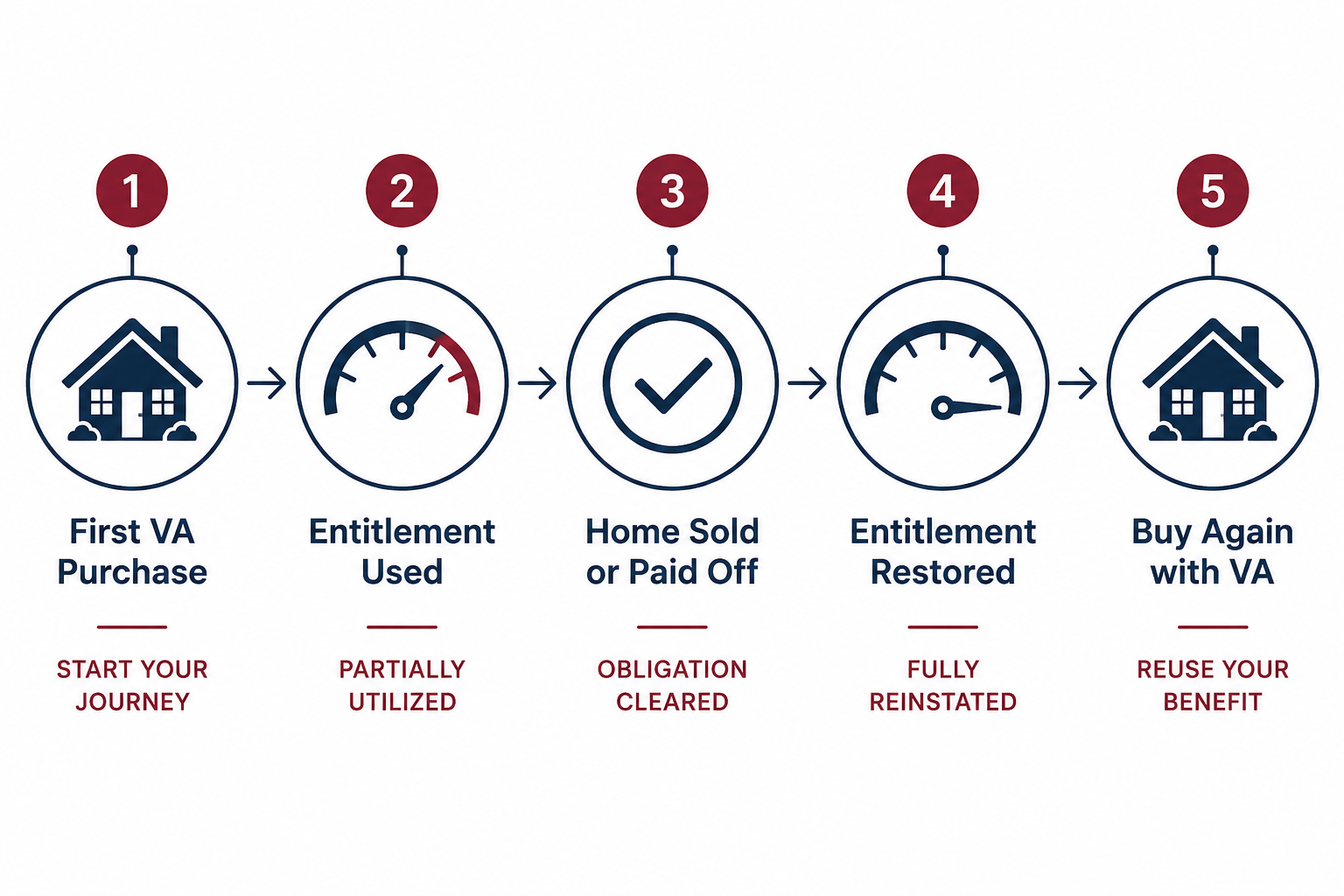
VA loan seller concessions allow the seller to pay up to 4% of the purchase price toward the buyer's costs. This is separate from normal closing cost credits, which are negotiated independently.
The 4% cap covers:
- The VA funding fee (which can be paid entirely by the seller)
- Prepaid taxes and insurance
- Paying off the buyer's debts to lower their DTI
- Discount points to buy down the interest rate
This is a major edge compared to conventional loans, which cap seller concessions at 3% for buyers putting less than 10% down. On a $400,000 purchase, 4% equals $16,000 in potential seller-paid costs. Combined with zero down payment, a veteran buyer can close on a home with very little cash out of pocket.
How to use this in negotiation: In a market where sellers are offering credits to move properties, ask specifically for the VA funding fee to be covered. Most sellers and listing agents do not know this is allowed. For tips on how to structure that ask, see our guide on [how to get a home seller to pay closing costs](https://realestaterankiq.com/how-to-get-a-home-seller-to-pay-closing costs/).
For a full breakdown of what closing costs look like, our guide to calculating home buyers closing costs with AI walks through the math step by step.
VA Loan Closing Costs: Who Pays What
VA loans limit what the buyer can be charged in closing costs. The VA's non-allowable fees rule prohibits lenders from charging veterans certain fees, including attorney fees for the lender's attorney, settlement or closing fees charged by the lender, and document preparation fees.
Costs the veteran can pay:
- VA appraisal fee (typically $500 to $800)
- Credit report fee
- Title insurance and title search
- Recording fees
- Origination fee (capped at 1% of the loan amount)
- Prepaid items (homeowners insurance, property taxes, interest)
Costs the veteran cannot be charged: Lender attorney fees, escrow fees charged by the lender, and any fee labeled as a "junk fee" under VA guidelines.
The seller, lender (via lender credits), or both can cover remaining costs. A well-structured VA offer can result in a veteran closing with as little as $500 to $2,000 out of pocket on a median-priced home.
What Disqualifies You from a VA Loan
Several conditions can disqualify a borrower or a property.
Borrower disqualifiers:
- Dishonorable discharge (other-than-honorable discharges are reviewed case by case)
- Foreclosure on a prior VA loan without repaying the VA (this reduces or eliminates available entitlement)
- Insufficient service length for your category
- Debt-to-income ratio above lender thresholds without compensating factors
- Active bankruptcy (most lenders require 2 years post-discharge)
Property disqualifiers (VA appraisal and MPRs):
The VA requires a VA-assigned appraiser to assess both value and condition. The VA's Minimum Property Requirements (MPRs) ensure the home is safe, structurally sound, and sanitary. Common MPR failures include:
- Roof with less than 2 years of remaining life
- Exposed electrical wiring
- Active pest infestation (in termite-prone states)
- Peeling lead-based paint (in homes built before 1978)
- Non-functioning HVAC or plumbing
MPR issues are not automatic deal-killers. The seller can make repairs, or the buyer can request a repair escrow in some cases. The VA appraisal and MPRs actually protect the buyer from overpaying for a deteriorating property, which is a feature, not a bug.
Can You Use a VA Loan for a Duplex or Multi-Unit Property
Yes. VA loans can be used to purchase a property with up to four units, as long as the veteran occupies one unit as their primary residence. This is one of the va loan first time home buyer rules most vets never use, and it is a genuine advantage.
A veteran buying a duplex with a VA loan pays zero down, no PMI, and then collects rent from the other unit. That rental income can offset a significant portion of the mortgage payment. The VA will count 75% of the expected rental income from the non-owner-occupied units when calculating the borrower's qualifying income, which helps with DTI.
What to know before going this route:
- The property must pass VA MPRs for all units, not just the one you occupy
- You must move in within 60 days of closing
- Managing tenants while living next door is a real operational consideration
For more on managing rental income from a property like this, our first-time second home investor guide to property management covers the cost and logistics in detail.
VA IRRRL Streamline Refinance: The Refinance Most VA Borrowers Skip
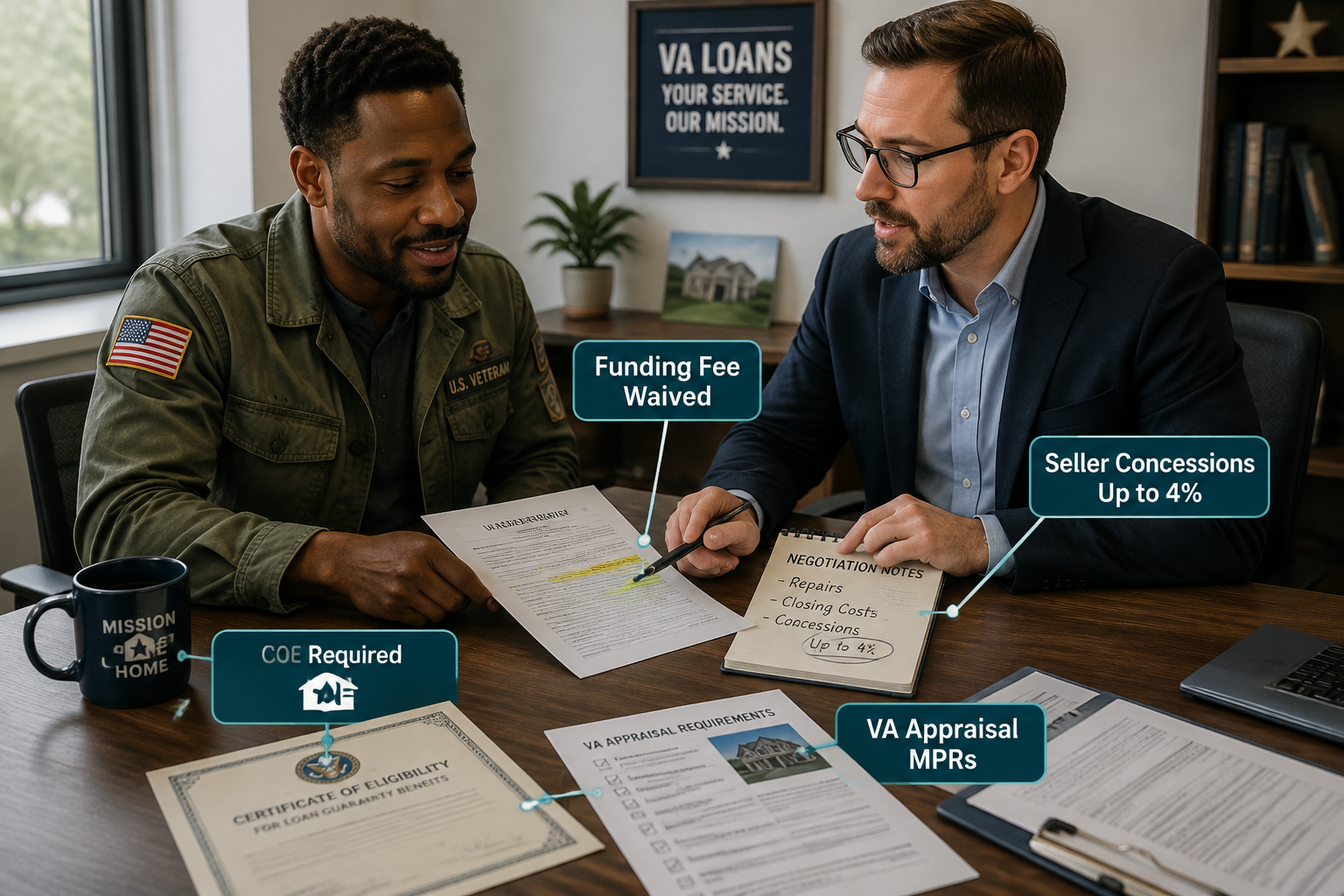
The VA Interest Rate Reduction Refinance Loan, known as the VA IRRRL or streamline refinance, lets existing VA loan holders refinance to a lower interest rate with minimal documentation. No new appraisal is required in most cases. No income verification. No new COE.
Requirements:
- You must already have a VA loan on the property
- The new rate must be lower than the existing rate (with exceptions for ARM-to-fixed conversions)
- You must certify that you previously occupied the home as your primary residence (you do not have to be living there now)
- The funding fee for an IRRRL is 0.50%, much lower than a purchase loan
The IRRRL is valuable enough that it almost feels unfair that more veterans do not know about it. If you bought with a VA loan when rates were higher and have not refinanced, this is worth a ten-minute phone call to a VA lender. The break-even on closing costs is often under 18 months.
Common Mistakes Veterans Make with VA Loans
1. Not shopping lenders. The VA sets the rules, but lenders set the rate. A half-point difference on a $400,000 loan is roughly $100 per month. Get at least three quotes.
2. Assuming the VA appraisal is a home inspection. The VA appraisal checks MPRs and value. It does not check the HVAC filter, the water heater age, or the foundation drainage. Always pay for an independent home inspection.
3. Not claiming the funding fee exemption. If you have a disability rating, bring documentation to your lender on day one. Do not wait for them to ask.
4. Walking away from a deal over MPR repairs. Most MPR issues are minor and negotiable. A good buyer's agent who knows VA transactions will push the seller to make repairs rather than kill the deal.
5. Thinking the benefit expires. It does not. A veteran who has never used their VA loan benefit can use it at age 70 on their first home purchase.
6. Not asking about second tier entitlement before buying a second home. Many veterans who need to relocate assume they have to sell first. Sometimes they do not.
For a full playbook on working through the buying process as a first-time buyer, our first time home buyer tips guide from a real estate agent covers the full sequence from pre-approval to closing.
FAQ
Is a VA loan only for first-time home buyers?
No. VA loans are available to any eligible veteran, active-duty service member, or qualifying surviving spouse regardless of how many homes they have owned. There is no first-time buyer requirement.
How many times can you use a VA loan?
As many times as you have available entitlement. After selling a home and paying off the VA loan, you can request a full entitlement restoration and use the benefit again. There is no lifetime cap on uses.
What is the VA funding fee for a first-time buyer in 2026?
2.15% of the loan amount for a first-time use with zero down payment. Veterans with a service-connected disability rating of 10% or higher are fully exempt from this fee.
Can you use a VA loan with bad credit?
The VA does not set a minimum credit score, but most lenders require at least 580 to 620. A lower score may still qualify with strong residual income and compensating factors.
What are VA loan minimum property requirements?
MPRs are the VA's standards for property condition. The home must be safe, structurally sound, and sanitary. Common issues include roof condition, electrical hazards, plumbing function, and lead paint in pre-1978 homes.
Can a veteran buy a rental property with a VA loan?
Not a pure rental. The veteran must occupy the property as a primary residence. However, a multi-unit property (up to 4 units) qualifies as long as the veteran lives in one unit.
How do I get my Certificate of Eligibility?
Apply online at VA.gov, through your lender's VA portal, or by mailing VA Form 26-1880. Most VA-approved lenders can pull it electronically within minutes during the application process.
What is second tier VA entitlement?
It is the additional entitlement beyond the basic $36,000 that allows veterans to borrow up to 25% of the county conforming loan limit with VA backing. It also makes it possible, in some cases, to hold two VA loans simultaneously.
Can the seller pay the VA funding fee?
Yes. Under VA seller concession rules, the seller can pay up to 4% of the purchase price toward the buyer's costs, and the funding fee qualifies as an eligible concession.
What happens to my VA entitlement if I foreclosed on a prior VA loan?
The VA pays the lender's claim, and that amount is deducted from your available entitlement. You may still have remaining entitlement, but you would need to repay the VA's loss to fully restore it.
Does the VA IRRRL require a new appraisal?
In most cases, no. The VA IRRRL streamline refinance is designed to be fast and low-documentation, with no appraisal required and no income verification in standard cases.
Can a surviving spouse use a VA loan?
Yes. Unremarried surviving spouses of veterans who died in service or from a service-connected disability are eligible for VA loan benefits, including the no-down-payment and no-PMI features.
Conclusion
The VA loan first time home buyer rules most vets never use are not complicated once someone explains them plainly. Zero down payment, no PMI, a funding fee exemption for disabled veterans, seller concessions up to 4%, multi-unit eligibility, and a reusable entitlement that does not expire. These are substantial benefits that most veterans either underuse or never use at all.
Your next steps:
- Pull your Certificate of Eligibility through VA.gov or ask a VA-approved lender to pull it for you. Know your entitlement amount before you start shopping.
- Check your VA disability rating. If you have a service-connected rating of 10% or higher, confirm the funding fee exemption with your lender in writing before closing.
- Get quotes from at least three VA-approved lenders. Rates and lender overlays vary. The VA sets the rules, not the rate.
- If you are buying a multi-unit property, ask your lender specifically about using rental income from non-owner units to qualify.
- If you already have a VA loan and rates have moved since you closed, call a VA lender about the IRRRL. The paperwork is minimal and the break-even is often under two years.
For a broader look at where the housing market stands right now and how buyers are positioning themselves, see our U.S. home buyers market trends in 2026 and our spring 2026 housing market outlook.
Give the process time before you judge the results. The VA benefit took decades to build. Using it well takes a few weeks of preparation and the right lender in your corner.