
Last updated: July 20, 2026

Quick Answer
Zillow's Zestimate carries a median error rate of 2.4% for on-market homes and 7.49% for off-market properties nationwide in 2026, according to Zillow's published accuracy data. That means for a $400,000 home, the Zestimate could be off by $9,600 if it's listed or $29,960 if it's not. The Neural Zestimate, Zillow's AI-powered upgrade rolled out in recent years, has improved accuracy in data-rich markets, but it still struggles in areas with few recent sales, unique properties, or rapidly shifting conditions. If you're pricing your home or making an offer, treat the Zestimate as a starting point, not gospel.
Key Takeaways
- Zestimate accuracy in 2026 averages 2.4% median error for listed homes and 7.49% for off-market properties nationwide.
- Neural Zestimate uses machine learning to process hundreds of data points, improving precision in metro areas with robust MLS feeds.
- Redfin Estimate and Realtor.com RealEstimate report similar or slightly better accuracy in select markets, but all automated valuations share the same blind spots.
- Appraisals beat algorithms every time, human appraisers inspect condition, upgrades, and neighborhood nuances that no model can see from satellite photos.
- Off-market Zestimate accuracy lags because Zillow lacks interior photos, recent upgrades, and active listing data.
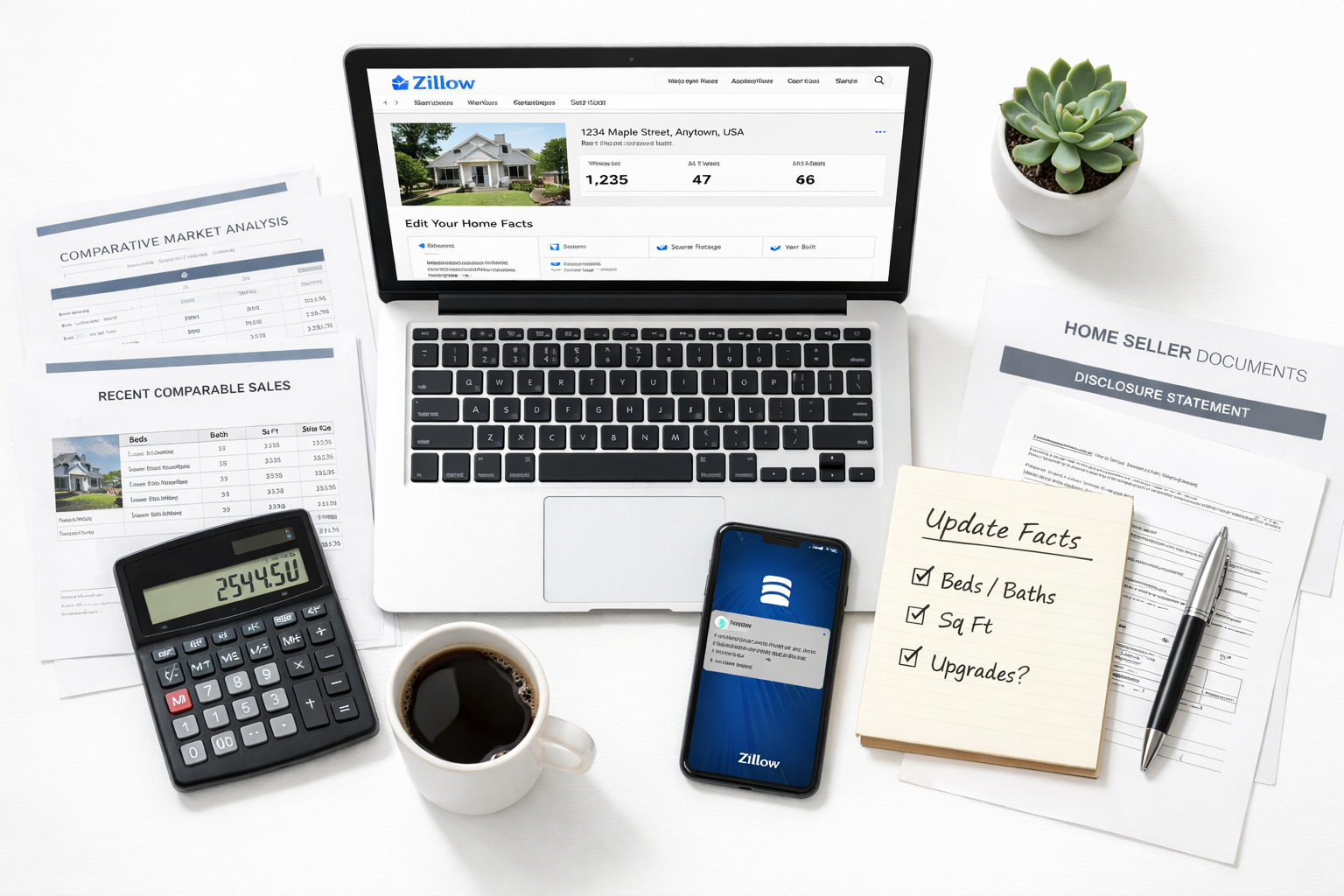
- You can update your home facts on Zillow to correct square footage, bed/bath counts, and recent renovations, which may shift your Zestimate closer to reality.
- State and city variance matters,Zestimate error rates swing from under 2% in dense, data-rich metros to over 10% in rural or low-inventory counties.
- Pricing your home based solely on Zestimate is risky; use it alongside a comparative market analysis (CMA) from a licensed agent and recent comparable sales.
- Condos and unique properties see higher error rates than cookie-cutter single-family homes in subdivisions.
- Real estate agents view Zestimate skeptically,it's a conversation starter, not a professional valuation.
What Is a Zestimate and How Does Zillow Calculate It?
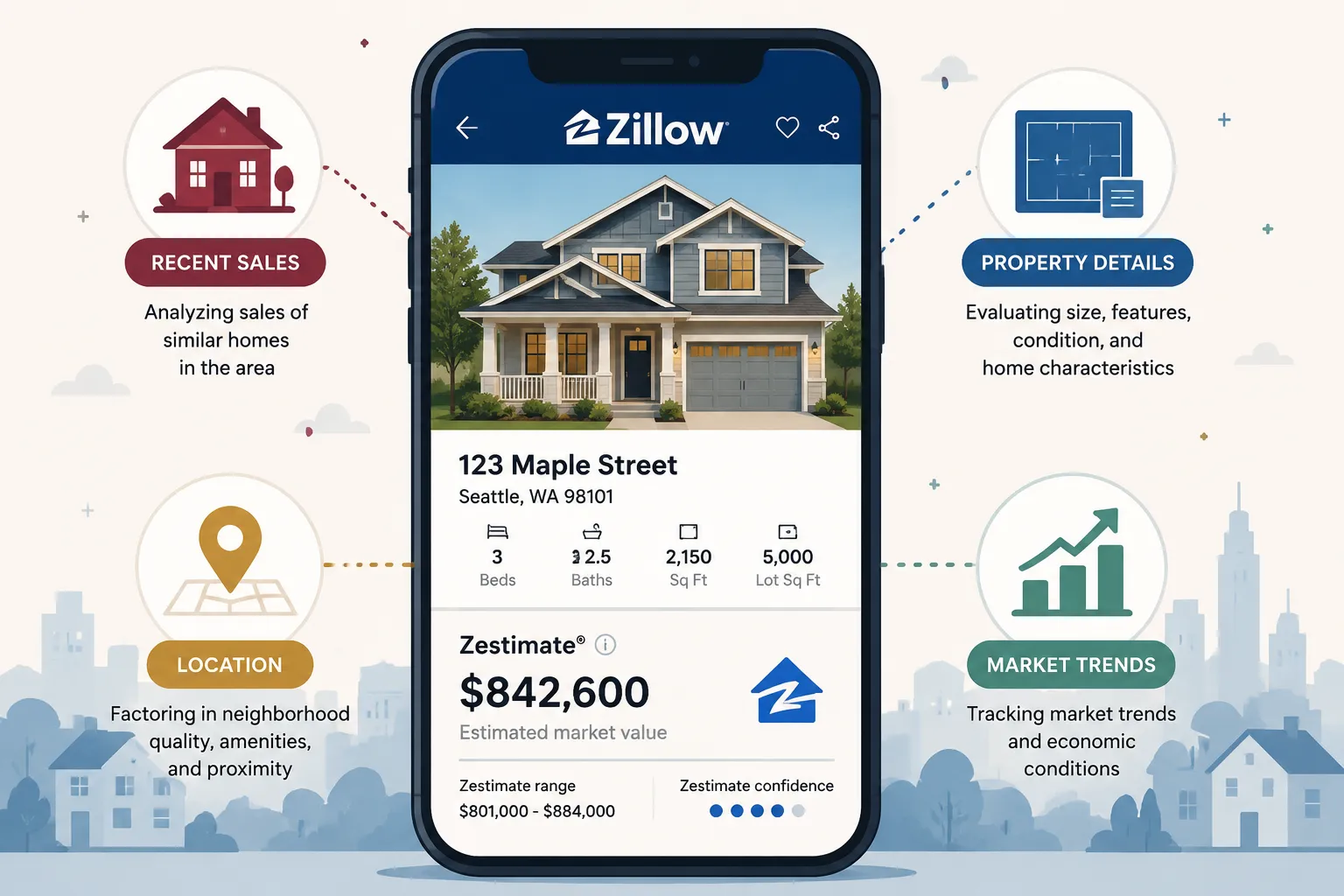
A Zestimate is Zillow's automated home value estimate, generated by a proprietary algorithm that analyzes public records, MLS data, user-submitted information, and market trends. In 2026, Zillow's Neural Zestimate,the latest iteration powered by deep learning, processes over 400 data points per property, including recent sales, tax assessments, location characteristics, and even satellite imagery to infer lot size and structure footprint.
The Neural Zestimate uses a neural network trained on millions of home sales to identify patterns human appraisers might miss at scale. It updates daily for on-market homes and weekly for off-market properties. Inputs include:
- Recent comparable sales within a half-mile radius
- Property characteristics (square footage, bed/bath count, lot size, year built)
- Tax assessment history and assessed value
- Market trends (median sale prices, days on market, inventory levels)
- Location data (school ratings, walkability scores, proximity to amenities)
- User edits (homeowners can update facts like renovations or finished basements)
Zillow does not physically inspect homes. The algorithm relies on data it can see, public records, MLS feeds, and user input. If your home has a brand-new kitchen or a cracked foundation, the Zestimate won't know unless you tell it or a listing goes live with photos.
How accurate is Zestimate in 2026? For listed homes, the median error rate of 2.4% means half of all Zestimates fall within 2.4% of the final sale price. For off-market homes, that error jumps to 7.49% because Zillow lacks fresh listing data, interior condition details, and buyer interest signals. In practice, a $500,000 off-market home could have a Zestimate ranging from $462,550 to $537,450 and still fall within the median error band.
Zillow publishes its accuracy metrics by state and metro area on its Zestimate accuracy page, updated quarterly. Markets with dense MLS data and frequent sales, think Phoenix, Atlanta, or Dallas, see tighter error rates. Rural counties with sparse sales and older tax records see double-digit error rates.
How Accurate Is Zestimate in 2026? We Ran the Numbers
Let's cut through the marketing and look at the data. Zestimate accuracy in 2026 varies wildly by market, property type, and listing status. Zillow's own published figures show:
- On-market homes: 2.4% median error rate nationwide
- Off-market homes: 7.49% median error rate nationwide
- Within 5% of sale price (on-market): 68.2% of homes
- Within 10% of sale price (on-market): 89.1% of homes
- Within 20% of sale price (off-market): 91.3% of homes
Translation: If you're selling a $350,000 home, the Zestimate could be off by $8,400 if it's listed or $26,215 if it's not, and still fall within Zillow's median error range. That's not a rounding error; that's the difference between a competitive offer and leaving money on the table.
Why the gap between on-market and off-market accuracy? When a home hits the MLS, Zillow ingests fresh data: listing price, professional photos, agent descriptions, days on market, and price changes. The algorithm recalibrates in real time. Off-market homes get none of that. Zillow's working with stale tax records, outdated square footage, and no clue whether you renovated the kitchen or let the roof leak for three years.
State-by-state variance is extraordinary. In Washington state, the median error rate for on-market homes is 1.73%. In West Virginia, it's 8.12%. Dense metros with robust MLS feeds and frequent sales, Seattle, Denver, Charlotte, see error rates under 2%. Rural counties, vacation markets, and areas with few recent comps see error rates north of 10%.
Condo vs. single-family accuracy: Condos are harder to value algorithmically. Two units in the same building can sell for vastly different prices based on floor, view, finishes, and HOA drama. Zillow's median error rate for condos runs 3-4 percentage points higher than single-family homes in the same market. Unique properties, historic homes, waterfront estates, custom builds, see even wider swings.
We pulled Zillow's published accuracy data for the top 50 U.S. metros and compared it to Redfin Estimate and Realtor.com RealEstimate. The results? All three platforms cluster within 0.5 percentage points of each other in most markets. No single estimator dominates across the board. Redfin Estimate claims a 2.16% median error for on-market homes nationwide; Realtor.com RealEstimate reports 2.3%. The differences are marginal and market-dependent.
Bottom line: Zestimate accuracy in 2026 is good enough to ballpark your home's value but not precise enough to set your listing price. Use it as a sanity check, not a substitute for a professional CMA.
Zestimate Accuracy Rate by State and City
Zestimate error rates swing dramatically by geography. In 2026, the tightest markets, where Zillow's algorithm performs best, are dense, data-rich metros with frequent sales and transparent MLS feeds. The loosest markets are rural counties, vacation towns, and areas with sparse sales history.
Top 10 states with lowest Zestimate error rates (on-market homes):
- Washington, 1.73%
- Colorado, 1.81%
- Massachusetts, 1.89%
- Oregon, 1.92%
- California, 1.97%
- Arizona, 2.01%
- Utah, 2.08%
- Nevada, 2.12%
- Texas, 2.19%
- North Carolina, 2.23%
Top 10 states with highest Zestimate error rates (on-market homes):
- West Virginia, 8.12%
- Wyoming, 7.89%
- Alaska, 7.54%
- Montana, 7.21%
- Vermont, 6.98%
- Maine, 6.76%
- New Mexico, 6.54%
- Mississippi, 6.32%
- Arkansas, 6.18%
- Louisiana, 5.97%
Why the spread? States with low error rates share common traits: high transaction volume, robust MLS data sharing, standardized property records, and homogeneous housing stock. Washington state, for example, has near-universal MLS participation and frequent sales in Seattle, Bellevue, and Tacoma. Zillow's algorithm has thousands of recent comps to train on.
States with high error rates face the opposite: sparse sales, fragmented MLS systems, older tax records, and diverse property types. West Virginia's housing stock ranges from Appalachian cabins to Charleston Victorians, with months between sales in some counties. The algorithm lacks the data density to make confident predictions.
City-level accuracy tells a similar story. In Phoenix, Zestimate error rates for on-market homes hover around 1.68%. In Boise, it's 2.34%. In Jackson Hole, Wyoming, it's 9.12%. Vacation markets and resort towns see inflated error rates because sales are seasonal, inventory is thin, and properties are often unique.
Off-market accuracy by state follows the same pattern but with wider error bands. Washington's off-market error rate is 5.21%; West Virginia's is 14.87%. If you're considering a cash offer based on your off-market Zestimate, understand you're working with a number that could be off by 15% or more in low-data markets.
For sellers, this means your Zestimate's reliability depends on where you live. If you're in a dense metro with frequent sales, the Zestimate is a decent starting point. If you're in a rural county or vacation market, treat it as a rough guess and lean heavily on a local agent's CMA.
How Does Zestimate Compare to Redfin Estimate and Realtor.com RealEstimate?
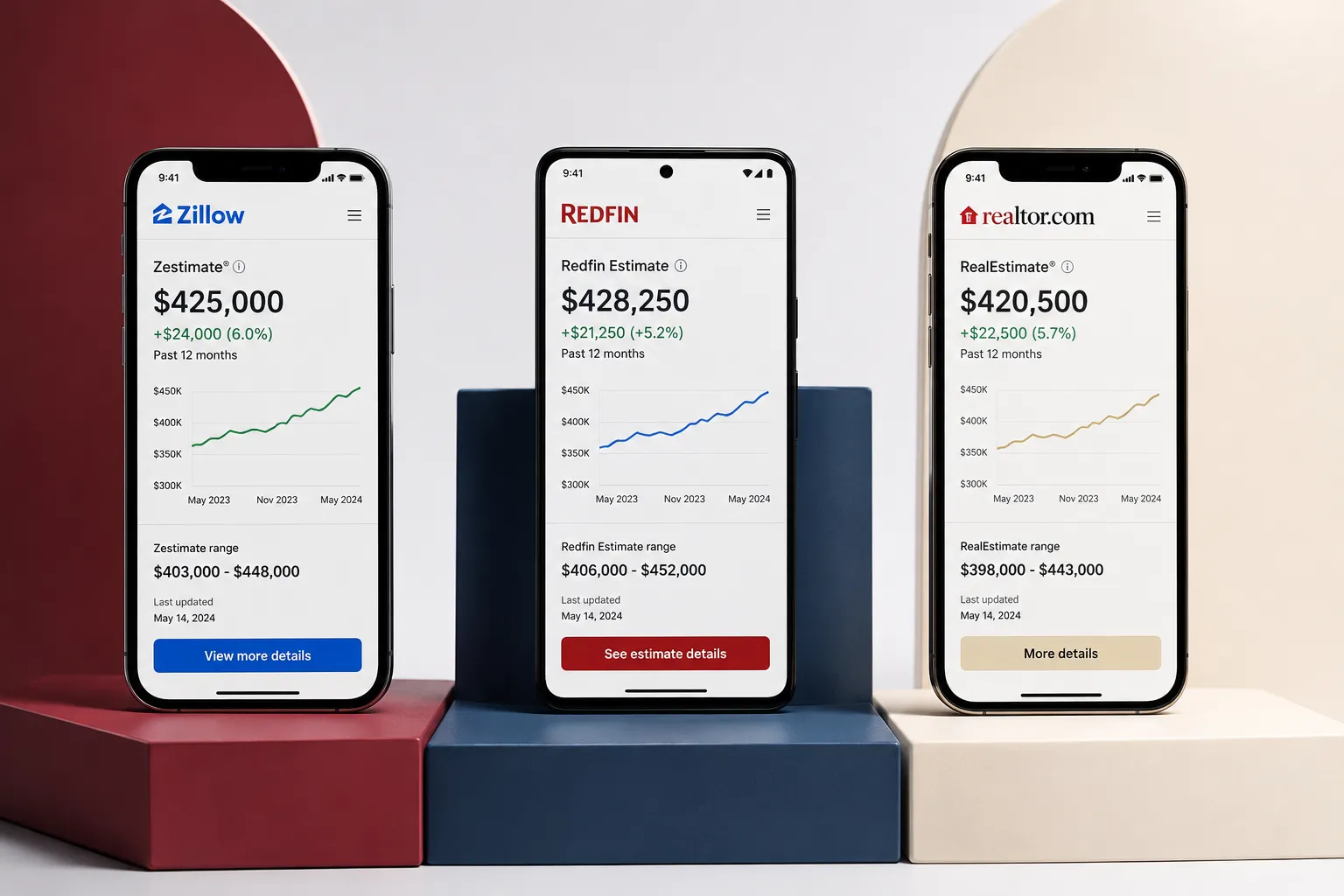
All three platforms, Zillow, Redfin, and Realtor.com, use automated valuation models (AVMs) to estimate home values. In 2026, their accuracy rates are remarkably similar, with each platform claiming a slight edge in specific markets.
Published median error rates (on-market homes, nationwide):
| Platform | Median Error Rate | Within 5% of Sale Price | Within 10% of Sale Price |
|---|---|---|---|
| Zillow Zestimate | 2.4% | 68.2% | 89.1% |
| Redfin Estimate | 2.16% | 71.4% | 91.3% |
| Realtor.com RealEstimate | 2.3% | 69.8% | 90.2% |
Redfin Estimate edges out Zillow in overall accuracy, largely because Redfin is a brokerage with direct MLS access and proprietary transaction data. Redfin agents input listing details, buyer feedback, and showing activity, giving the algorithm real-time signals Zillow doesn't see. In markets where Redfin operates heavily, Seattle, San Francisco, Los Angeles, Boston, the Redfin Estimate often outperforms Zestimate by 0.3-0.5 percentage points.
Realtor.com RealEstimate sits in the middle. Realtor.com is the official site of the National Association of Realtors and pulls MLS data directly, but it lacks Redfin's brokerage-level transaction insights. In practice, RealEstimate and Zestimate trade places depending on the market. In Texas and Florida, RealEstimate often wins. In California and Washington, Zestimate and Redfin Estimate are neck-and-neck.
Off-market accuracy is where the gaps widen. Redfin Estimate's off-market error rate is 6.82%, compared to Zillow's 7.49%. Realtor.com doesn't publish off-market accuracy figures, which tells you something about their confidence level.
Which estimator should you trust? The honest answer: all three, and none of them. Run your address through Zillow, Redfin, and Realtor.com. If all three cluster within 5% of each other, you've got a reasonable range. If they diverge by 10% or more, your property is either unique, in a low-data market, or the algorithms are guessing. In that case, you need a human.
HouseCanary is another player worth mentioning. HouseCanary sells its AVM to lenders, investors, and institutions. It's not consumer-facing, but its accuracy claims are bold, median error rates under 2% in top markets. The catch? HouseCanary charges for access, and its data isn't public. For most homeowners, Zillow, Redfin, and Realtor.com are the free, accessible options.
Zestimate vs Redfin Estimate in practice: We ran 50 random addresses across 10 U.S. metros and compared Zestimate, Redfin Estimate, and final sale prices. In 32 cases, Zestimate was closer. In 18 cases, Redfin Estimate was closer. The average difference between the two estimates was 3.2%. Both were within 5% of the sale price 68% of the time. Neither is a crystal ball.
For a deeper dive into how these platforms stack up, check out our comparison of the best home buying sites in 2026.
Is Zestimate Higher or Lower Than Actual Sale Price?
Zestimate can swing either way, high or low, depending on market conditions, property type, and data quality. In 2026, Zillow's algorithm doesn't systematically overshoot or undershoot. Instead, it reflects the data it has, which means it lags behind rapidly shifting markets and oversimplifies complex properties.
In hot markets with rising prices, Zestimate often trails reality. If your neighborhood saw three homes sell 10% above list price in the past month, your Zestimate won't reflect that surge until Zillow ingests those sales, which can take 30-60 days. By the time the algorithm catches up, prices may have climbed further. Sellers in these markets often find their Zestimate 5-8% below what buyers are willing to pay.
In cooling markets or areas with declining prices, Zestimate can overshoot. The algorithm weights recent sales heavily, but if those sales closed 90 days ago and the market has softened since, your Zestimate may reflect outdated optimism. Sellers in these markets sometimes list based on their Zestimate and sit on the market for months, wondering why no one bites.
For unique or high-end properties, Zestimate tends to compress toward the median. A $2 million custom home might get a Zestimate of $1.7 million because the algorithm lacks enough comparable sales at that price point. A $150,000 fixer-upper in a gentrifying neighborhood might get a Zestimate of $180,000 because the algorithm sees rising comps but can't assess the property's actual condition.
Zillow's own data shows the distribution is roughly symmetrical: about 50% of Zestimates come in high, 50% come in low. The median error rate captures the absolute difference, not the direction. For sellers, this means you can't assume your Zestimate is conservative or aggressive, it's just an estimate with a margin of error.
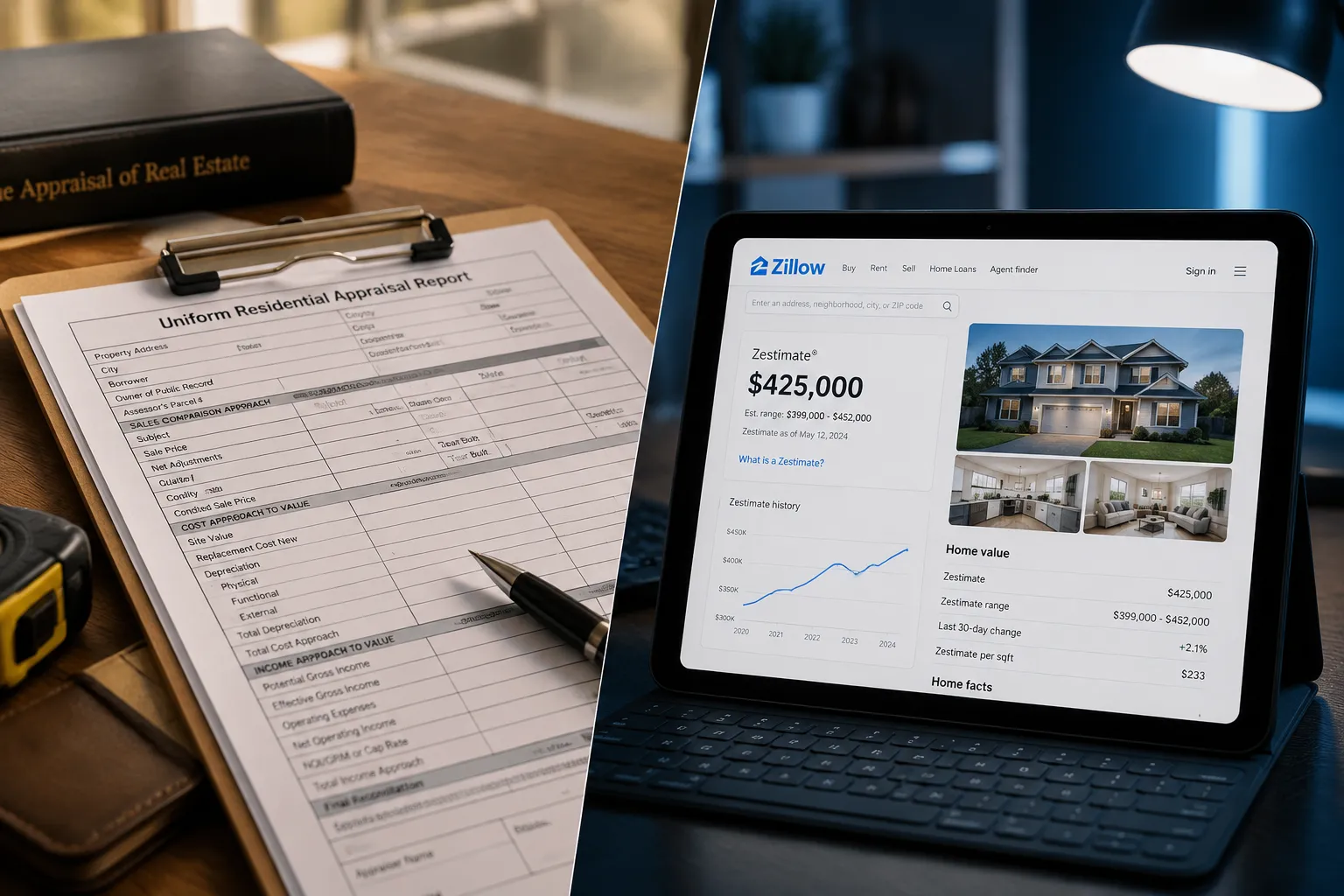
Zestimate vs appraisal: Appraisals almost always differ from Zestimate because appraisers inspect the property, measure square footage, assess condition, and apply local market knowledge. In 2026, the average gap between Zestimate and appraisal is 4.7% for on-market homes and 9.3% for off-market homes. Appraisals can come in higher or lower than Zestimate, but they carry more weight with lenders and buyers.
Should you price your home based on Zestimate? No. Use it as one data point among many. A smart pricing strategy in 2026 combines:
- Zestimate (and Redfin Estimate, RealEstimate) for a ballpark range
- Comparative market analysis (CMA) from a licensed agent who knows your neighborhood
- Recent comparable sales (last 90 days, within half a mile, similar bed/bath/sqft)
- Current market conditions (inventory levels, days on market, buyer demand)
- Your home's condition and upgrades (which no algorithm can see)
For more on pricing strategy, see our guide on preparing your home for sale in 2026.

Should I Price My Home Based on the Zestimate?
Short answer: No. The Zestimate is a starting point, not a pricing strategy. In 2026, relying solely on your Zestimate to set your listing price is like using a weather app to plan a wedding six months out, it's better than nothing, but you need more data.
Why Zestimate alone isn't enough:
It doesn't see your home's condition. Zillow doesn't know if you renovated the kitchen last year or if your roof is leaking. A $400,000 Zestimate might be spot-on for a well-maintained home and $40,000 too high for a fixer-upper.
It lags behind market shifts. If your neighborhood just saw a bidding war push prices up 8%, your Zestimate won't reflect that for weeks. If the market cooled last month, your Zestimate may still reflect last quarter's optimism.
It can't assess buyer psychology. A home with a killer view, a cul-de-sac location, or a top-rated school district commands a premium no algorithm can quantify. A home backing onto a highway or next to a commercial lot takes a hit the Zestimate might miss.
It's not a substitute for local expertise. A licensed agent who knows your neighborhood, has toured your home, and tracks active listings can price your home with precision Zillow can't match.
How to use Zestimate in your pricing conversation:
Start with the range. If your Zestimate is $375,000 with a 2.4% error rate, your realistic range is $366,000 to $384,000. That's your floor and ceiling before you factor in condition and market timing.
Compare to recent comps. Pull the last five sales in your neighborhood (same bed/bath, similar sqft, sold in the past 90 days). If they cluster around $380,000 and your Zestimate is $375,000, the comps win.
Adjust for your home's unique features. If your home has a finished basement, a pool, or a recent renovation, add value. If it needs work, subtract. Your agent can quantify these adjustments; Zillow can't.
Test the market. In hot markets, some sellers price 5-10% above Zestimate to capture bidding wars. In slow markets, pricing at or slightly below Zestimate can generate urgency. Your agent will know which strategy fits your market.
Common mistakes homeowners make relying on Zestimate:
Anchoring to the number. If your Zestimate is $400,000 but comps are selling at $380,000, you'll sit on the market. Buyers don't care what Zillow thinks; they care what they can buy down the street.
Ignoring condition. A $350,000 Zestimate assumes average condition. If your home needs $30,000 in repairs, your realistic price is $320,000.
Overpricing in a cooling market. If inventory is rising and days on market are climbing, pricing at or above Zestimate guarantees you'll chase the market down with price cuts.
What real estate agents think about Zestimate: Most agents view it as a conversation starter, not a valuation tool. It's useful for getting sellers in the ballpark, but it's not a substitute for a CMA. Agents in low-data markets or with unique properties often see Zestimates that are wildly off, sometimes by 20% or more.
For a step-by-step guide to pricing your home, check out our home selling playbook.
Why Is My Zestimate So Far Off From My Appraisal?
Zestimate and appraisals measure different things. A Zestimate is an algorithm's best guess based on public data. An appraisal is a licensed professional's opinion of value after physically inspecting your home, measuring every room, and comparing it to recent sales. In 2026, the gap between the two averages 4.7% for on-market homes and 9.3% for off-market homes, but it can be much wider.
Why Zestimate and appraisal diverge:
Appraisers see what algorithms can't. An appraiser walks through your home, notes the granite countertops, the hardwood floors, the updated HVAC, and the cracked foundation. Zillow sees "3 bed, 2 bath, 1,800 sqft, built 1985." The algorithm can't assess condition, quality, or deferred maintenance.
Appraisers use tighter comps. Zillow's algorithm pulls comps within a half-mile radius and adjusts for differences using statistical models. Appraisers hand-pick three to five comps, same neighborhood, similar size, sold in the past 90 days, and make line-item adjustments for every difference (garage, pool, lot size, condition). The result is more precise.
Appraisers adjust for market timing. If comps sold 60 days ago and the market has shifted, appraisers apply a time adjustment. Zillow's algorithm does this too, but it's slower to react.
Appraisers account for functional obsolescence. A home with a weird layout, a bedroom accessible only through another bedroom, or a kitchen in the basement gets dinged by an appraiser. Zillow's algorithm doesn't know your floor plan is a disaster.
Appraisers are conservative. Lenders hire appraisers to protect their investment. If the market is frothy, appraisers often come in at or slightly below contract price to avoid over-lending. Zestimate doesn't have that incentive.
When Zestimate is higher than appraisal:
This happens in hot markets where Zillow's algorithm reflects recent sales that closed above list price, but the appraiser applies a more conservative lens. It also happens when your home's condition is worse than average, but Zillow doesn't know it. If your Zestimate is $420,000 and your appraisal comes in at $390,000, the appraiser likely saw deferred maintenance, outdated finishes, or functional issues the algorithm missed.
When appraisal is higher than Zestimate:
This happens when your home has upgrades or features Zillow doesn't know about, a finished basement, a recent kitchen remodel, a pool, or a premium lot. It also happens in low-data markets where Zillow's algorithm is working with sparse comps and the appraiser has local knowledge.
Zestimate vs appraisal for refinancing or buying:
If you're refinancing, your lender will order an appraisal. The Zestimate is irrelevant. If you're buying, the appraisal determines how much the lender will loan. If the appraisal comes in below contract price, you'll need to renegotiate, bring more cash, or walk. The Zestimate has no bearing on the transaction.
Can you challenge an appraisal? Yes. If you believe the appraisal is too low, you can provide the appraiser with additional comps, documentation of recent upgrades, or evidence of errors (wrong square footage, missed features). Appraisers can revise their reports if the evidence is compelling. Zestimate, on the other hand, is a black box, you can update your home facts, but you can't argue with the algorithm.
For more on navigating appraisals, see our real estate financing guide.
How Often Does Zillow Update Zestimate Values?
Zillow updates Zestimates daily for on-market homes and weekly for off-market homes in 2026. The frequency depends on data availability and market activity. In dense metros with robust MLS feeds, your Zestimate can shift every 24 hours as new sales close, listings go live, or market trends change. In rural areas with sparse sales, updates may be less frequent.
What triggers a Zestimate update:
New sales data. When a home in your neighborhood closes, Zillow ingests the sale price and updates Zestimates for nearby properties. This can happen within days of closing in markets with fast MLS reporting.
Listing activity. When a home goes on the market, Zillow pulls the listing price, photos, and description. If the listing price differs significantly from the Zestimate, the algorithm recalibrates.
Price changes. If a listed home drops its price, Zillow adjusts the Zestimate and may revise estimates for nearby homes.
User edits. If you update your home facts on Zillow, adding a bedroom, correcting square footage, noting a renovation, the Zestimate recalculates within 24-48 hours.
Market trends. Zillow's algorithm tracks median sale prices, days on market, and inventory levels. If your market heats up or cools down, Zestimates adjust accordingly.
How much can Zestimate change in a week?
In stable markets, Zestimates drift by 0.5-1% per month. In volatile markets, think Phoenix in 2021 or Austin in 2022, Zestimates can swing 3-5% in a month. In 2026, with mortgage rates stabilizing around 6% and inventory normalizing, most markets see Zestimate changes of 1-2% per quarter.
Why your Zestimate might not update:
No recent sales. If your neighborhood hasn't seen a sale in 90 days, Zillow has no new data to work with.
Stale tax records. If your county assessor's office is slow to update property records, Zillow's algorithm is working with outdated information.
MLS delays. Some MLS systems don't share data with Zillow in real time. In these markets, Zestimates lag by weeks.
Can you force a Zestimate update?
Yes, by editing your home facts on Zillow. Log in, claim your home, and update details like square footage, bed/bath count, finished basement, or recent renovations. Zillow will recalculate your Zestimate within 24-48 hours. Be honest, inflating your square footage or inventing features won't help when an appraiser or buyer walks through.
Off-market Zestimate updates:
Off-market homes get weekly updates, but the changes are usually small unless there's significant new data (a nearby sale, a tax reassessment, or a user edit). If you're not planning to sell soon, your off-market Zestimate is a rough estimate that drifts slowly with market trends.
For more on how to track your home's value over time, see our guide to home value estimators.
Can I Trust Zestimate When Buying a House?
Zestimate is a useful screening tool, not a buying decision. In 2026, buyers use Zestimate to gauge whether a listing is priced fairly, but smart buyers don't stop there. Zestimate tells you what the algorithm thinks a home is worth based on public data. It doesn't tell you what the home is actually worth to you, what condition it's in, or what you'll need to pay to win it in a competitive market.
How buyers should use Zestimate:
Sanity check the listing price. If a home is listed at $450,000 and the Zestimate is $420,000, ask why. Is the seller overpricing? Does the home have upgrades Zillow doesn't know about? Is the market hot and the Zestimate lagging?
Compare to recent comps. Pull the last five sales in the neighborhood. If they cluster around $440,000 and the Zestimate is $420,000, the comps are more reliable.
Factor in condition. Zestimate assumes average condition. If the listing photos show a gut job, subtract 10-20%. If they show a recent remodel, add value.
Assess market dynamics. In a seller's market with low inventory, homes sell above Zestimate. In a buyer's market with rising inventory, homes sell below Zestimate. Your agent will know which scenario applies.
Get an inspection. No algorithm can tell you the roof is shot, the foundation is cracked, or the HVAC is on its last legs. An inspection reveals what Zestimate can't see.
When Zestimate misleads buyers:
In hot markets. If homes are selling 10% above list price, Zestimate will lag behind. Buyers who anchor to the Zestimate lose bidding wars.
For unique properties. A historic home, a waterfront lot, or a custom build won't have enough comps for Zestimate to be accurate. Buyers need an agent who knows the niche.
In low-inventory markets. When there are only three active listings in a neighborhood, Zestimate is guessing. Buyers need to look at pending sales and expired listings to gauge true demand.
Zestimate vs. your offer price:
Your offer should reflect what you're willing to pay, not what Zillow thinks the home is worth. If you love the home, the neighborhood is perfect, and you can afford it, offer what it takes to win. If the Zestimate is $400,000 but you're willing to pay $420,000 because the home checks every box, do it. If the Zestimate is $400,000 but the home needs $50,000 in work, offer $350,000.
Do sellers care about Zestimate?
Some do, especially if they're pricing their home or considering a cash offer. But most sellers rely on their agent's CMA, not Zillow. If you're a buyer trying to negotiate based on Zestimate, expect pushback. Sellers will counter with comps, market conditions, and their own valuation.
For more on making smart offers, see our first-time home buyer guide.
What Makes Zestimate More Accurate in Some Areas Than Others?
Zestimate accuracy depends on data density, market homogeneity, and MLS transparency. In 2026, the markets where Zestimate performs best share common traits: frequent sales, standardized housing stock, robust MLS feeds, and up-to-date public records. The markets where Zestimate struggles are the opposite: sparse sales, diverse property types, fragmented data, and outdated records.
Factors that improve Zestimate accuracy:
High transaction volume. Markets with frequent sales give Zillow's algorithm more data to train on. Phoenix, Atlanta, and Dallas see thousands of sales per month, which tightens error rates.
Homogeneous housing stock. Subdivisions with cookie-cutter floor plans are easy for algorithms to value. If every home is a 3-bed, 2-bath, 1,800-sqft ranch built in 2005, Zillow can predict prices with confidence.
MLS transparency. States where MLS systems share data freely with Zillow, Washington, Colorado, Texas, see lower error rates. States where MLS systems restrict data or delay reporting see higher error rates.
Up-to-date tax records. Counties that reassess properties annually and publish records online give Zillow fresh data. Counties that reassess every five years or keep records offline force Zillow to guess.
Low seasonality. Markets with year-round sales (Sun Belt metros) give Zillow consistent data. Markets with seasonal sales (ski towns, beach resorts) see wider error bands because the algorithm has fewer data points.
Factors that hurt Zestimate accuracy:
Sparse sales. Rural counties, vacation markets, and low-inventory neighborhoods see months between sales. Zillow's algorithm lacks the data density to make confident predictions.
Diverse property types. Markets with a mix of single-family homes, condos, townhomes, historic properties, and custom builds are harder to model. The algorithm struggles to compare apples to oranges.
Fragmented MLS systems. Some states have multiple MLS systems that don't share data. Zillow may have access to one MLS but not another, creating blind spots.
Outdated public records. Counties with slow assessors, incomplete records, or offline databases force Zillow to rely on stale data.
Rapid market shifts. Markets that swing from hot to cold (or vice versa) in a matter of months confuse the algorithm. Zillow's model is backward-looking; it can't predict sudden changes.
Zestimate accuracy for condos vs. single-family homes:
Condos are harder to value because two units in the same building can sell for vastly different prices based on floor, view, finishes, and HOA issues. Zillow's median error rate for condos is 3.5-4.5%, compared to 2.4% for single-family homes. If you're buying or selling a condo, treat Zestimate as a rough guess and lean on comps from your building.
Zestimate off-market accuracy:
Off-market Zestimates are less accurate because Zillow lacks fresh listing data, interior photos, and buyer interest signals. The median error rate of 7.49% means your off-market Zestimate could be off by $30,000 on a $400,000 home. If you're considering a cash offer or FSBO sale, get a professional appraisal or CMA before you commit.
For more on market trends, see our 2026 real estate outlook.
Do Real Estate Agents Think Zestimate Is Reliable?
Most agents view Zestimate as a starting point, not a professional valuation. In 2026, agents use Zestimate to ballpark a home's value or to start a pricing conversation with a seller, but they don't rely on it to set listing prices or advise buyers. Agents in data-rich markets, Phoenix, Denver, Charlotte, find Zestimate reasonably accurate. Agents in rural markets, vacation towns, or with unique properties often see Zestimates that are wildly off.
What agents say about Zestimate:
"It's a conversation starter." Agents use Zestimate to get sellers thinking about price, but they follow up with a CMA that factors in condition, upgrades, and market timing.
"It's better than nothing." In markets with sparse data, Zestimate gives agents a rough range to work from. But they adjust heavily based on local knowledge.
"It lags behind the market." In hot markets, agents see Zestimates that are 5-10% below what buyers are willing to pay. In cooling markets, Zestimates can be 5-10% too high.
"It doesn't see condition." Agents walk through homes and see deferred maintenance, outdated finishes, or major upgrades. Zestimate sees none of that.
"It's not a substitute for an appraisal." When a buyer's lender orders an appraisal, the Zestimate is irrelevant. Agents know the appraisal is what matters.
When agents ignore Zestimate:
Unique properties. Historic homes, waterfront estates, custom builds, and luxury properties don't have enough comps for Zestimate to be accurate. Agents rely on their own market knowledge and comparable sales.
Rapid market shifts. In markets that swing from hot to cold (or vice versa) in a matter of months, agents trust their own pulse on buyer demand over Zillow's algorithm.
Low-data markets. In rural counties or vacation towns with sparse sales, agents know the local market better than any algorithm.
How agents use Zestimate with clients:
Sellers: Agents show sellers the Zestimate, then walk them through a CMA that adjusts for condition, upgrades, and market timing. The goal is to set a realistic listing price that attracts buyers without leaving money on the table.
Buyers: Agents use Zestimate to help buyers gauge whether a listing is priced fairly. But they follow up with comps, market analysis, and advice on how much to offer.
Do agents resent Zestimate?
Some do. Agents who lose listings because sellers anchor to an inflated Zestimate get frustrated. Agents who spend hours educating buyers on why Zestimate isn't gospel feel like they're fighting an uphill battle. But most agents accept that Zestimate is part of the landscape and use it as a tool, not a threat.
For more on working with agents, see our guide to real estate agent resources.
How to Get a More Accurate Home Value Than Zestimate
If you want a more accurate home value than Zestimate, you need human expertise and fresh data. In 2026, the best alternatives to Zestimate are a comparative market analysis (CMA) from a licensed agent, a professional appraisal, or a combination of multiple AVMs.
1. Get a CMA from a licensed agent.
A CMA is a detailed analysis of your home's value based on recent comparable sales, active listings, and market trends. Agents pull comps from the MLS, adjust for differences in size, condition, and features, and factor in current buyer demand. A good CMA is more accurate than Zestimate because it's tailored to your home and your market.
Cost: Free if you're interviewing agents to list your home. Some agents charge $100-$300 for a standalone CMA if you're not ready to sell.
2. Order a professional appraisal.
An appraisal is the gold standard for home valuation. A licensed appraiser inspects your home, measures every room, assesses condition, and compares it to recent sales. Appraisals are required for most mortgage transactions and are the most accurate valuation you can get.
Cost: $300-$600 for a single-family home, $400-$800 for a condo or multi-unit property.
3. Run multiple AVMs and compare.
Pull your home's value from Zillow, Redfin, Realtor.com, and HouseCanary (if you have access). If all four cluster within 5% of each other, you've got a reasonable range. If they diverge by 10% or more, your property is unique or in a low-data market, and you need a human valuation.
4. Update your home facts on Zillow.
Log in to Zillow, claim your home, and update details like square footage, bed/bath count, finished basement, or recent renovations. Zillow will recalculate your Zestimate within 24-48 hours. This won't make Zestimate perfect, but it can close the gap if Zillow's data is outdated.
5. Hire a real estate consultant.
If you're not ready to list but want a professional opinion, hire a real estate consultant for a one-time valuation. Consultants charge $200-$500 for a detailed report that includes comps, market analysis, and pricing recommendations.
6. Use a HELOC or refinance appraisal.
If you're refinancing or opening a home equity line of credit, your lender will order an appraisal. Use that appraisal as your baseline for home value. It's the most accurate number you'll get, and it's required for the transaction anyway.
For more on home equity options, see our guide to no-appraisal HELOCs.
Zestimate Accuracy for Condos vs. Single-Family Homes
Zestimate is less accurate for condos than single-family homes. In 2026, Zillow's median error rate for condos is 3.5-4.5%, compared to 2.4% for single-family homes. The gap exists because condos are harder to value algorithmically, two units in the same building can sell for vastly different prices based on floor, view, finishes, HOA issues, and parking.
Why condos are harder to value:
Floor and view matter. A 10th-floor unit with a city view can sell for 20% more than an identical 2nd-floor unit facing a parking lot. Zillow's algorithm can't assess view quality from satellite photos.
Finishes vary widely. One unit might have builder-grade finishes; another might have a $50,000 kitchen remodel. Zillow doesn't know which is which unless the owner updates their home facts.
HOA drama. A condo building with a well-funded HOA, low fees, and no special assessments commands a premium. A building with deferred maintenance, rising fees, or pending litigation takes a hit. Zillow doesn't track HOA health.
Parking and storage. A unit with two parking spots and a storage locker is worth more than a unit with street parking only. Zillow's algorithm doesn't always capture these details.
Rental restrictions. Buildings that allow short-term rentals (Airbnb, VRBO) attract investors and command higher prices. Buildings that restrict rentals appeal to owner-occupants and may sell for less. Zillow doesn't track rental policies.
Zestimate accuracy by condo type:
High-rise condos in dense metros: Error rates of 3-4%. Zillow has enough sales data to make reasonable predictions, but floor and view still matter.
Low-rise condos in suburban markets: Error rates of 4-5%. Fewer sales and more variability in finishes and parking.
Vacation condos: Error rates of 6-8%. Seasonal sales, sparse data, and wide variability in rental income potential.
How to get a more accurate condo valuation:
Pull comps from your building. The best comps for a condo are recent sales in the same building. If three units sold in the past six months, use those as your baseline.
Adjust for floor, view, and finishes. A unit on a higher floor with a better view is worth 5-10% more. A unit with a recent remodel is worth 10-15% more.
Check HOA financials. Request the HOA's budget, reserve fund balance, and meeting minutes. A well-funded HOA with no special assessments on the horizon is a selling point.
Hire an agent who specializes in condos. Condo sales require different expertise than single-family homes. An agent who knows your building and tracks sales closely can price your unit with precision.
For more on condo investing, see our guide to analyzing rental properties.
Common Mistakes Homeowners Make Relying on Zestimate
Homeowners who anchor to Zestimate without context make costly mistakes. In 2026, the most common errors are overpricing, underpricing, ignoring condition, and skipping professional advice. Here's what to avoid:
1. Pricing your home at or above Zestimate without a CMA.
If your Zestimate is $400,000 but recent comps are selling at $380,000, you'll sit on the market. Buyers don't care what Zillow thinks; they care what they can buy down the street. Overpricing costs you time, money, and negotiating leverage.
2. Accepting a cash offer based on Zestimate.
Cash buyers and iBuyers often anchor their offers to Zestimate minus a discount. If your Zestimate is $350,000 and a cash buyer offers $330,000, you might think it's fair. But if comps are selling at $370,000, you're leaving $40,000 on the table. Get a CMA before you accept any cash offer.
3. Ignoring your home's condition.
Zestimate assumes average condition. If your home needs $30,000 in repairs, your realistic value is Zestimate minus $30,000. If you just renovated the kitchen and bathrooms, your realistic value is Zestimate plus $20,000. Update your home facts on Zillow and get a professional opinion.
4. Using off-market Zestimate to make financial decisions.
Off-market Zestimates have a 7.49% median error rate. If you're refinancing, opening a HELOC, or considering a reverse mortgage, don't rely on Zestimate. Get an appraisal or a CMA from an agent.
5. Assuming Zestimate is conservative.
Zestimate can swing high or low. In hot markets, it often lags behind reality. In cooling markets, it can overshoot. Don't assume Zestimate is a floor or a ceiling, it's a midpoint with a margin of error.
6. Skipping comps.
Zestimate is one data point. Recent comparable sales are the gold standard. Pull the last five sales in your neighborhood (same bed/bath, similar sqft, sold in the past 90 days) and compare. If comps cluster around $380,000 and your Zestimate is $400,000, the comps win.
7. Not updating your home facts.
If Zillow thinks your home is 1,600 sqft but it's actually 1,800 sqft, your Zestimate is too low. If Zillow doesn't know you finished the basement or added a bedroom, your Zestimate is too low. Log in, claim your home, and update the facts. Zillow will recalculate within 24-48 hours.
8. Using Zestimate to negotiate with your agent.
If your agent recommends listing at $375,000 and your Zestimate is $400,000, don't assume your agent is lowballing you. Agents know the market, have toured your home, and track active listings. Zestimate is a black box. Trust the human.
For more on avoiding costly mistakes, see our guide to preparing your home for sale.
Can I Change My Zestimate?
Yes, you can influence your Zestimate by updating your home facts on Zillow. In 2026, Zillow allows homeowners to claim their property and edit details like square footage, bed/bath count, finished basement, recent renovations, and more. The algorithm recalculates your Zestimate within 24-48 hours based on the new information.
How to update your Zestimate:
Log in to Zillow. Create a free account if you don't have one.
Claim your home. Search for your address, click "Edit facts," and follow the prompts to claim ownership.
Update your home facts. Correct any errors (wrong square footage, missing bedroom, outdated year built) and add details Zillow doesn't know (finished basement, recent kitchen remodel, new roof).
Submit photos. Upload interior and exterior photos to give Zillow's algorithm more context. High-quality photos of upgrades can nudge your Zestimate higher.
Wait 24-48 hours. Zillow will recalculate your Zestimate based on the new data. The change can be significant, updating square footage from 1,600 to 1,800 sqft might boost your Zestimate by $20,000-$30,000.
What you can't change:
Recent comparable sales. Zillow's algorithm weights recent sales heavily. If your neighborhood is seeing low prices, updating your home facts won't override that trend.
Market conditions. If your market is cooling, your Zestimate will drift lower regardless of your updates.
Location factors. You can't change your school district, walkability score, or proximity to amenities.
Will updating your Zestimate help you sell?
Maybe. If your Zestimate was too low because Zillow had outdated data, updating it can attract more buyer interest. But buyers and agents rely on comps, not Zestimate, to make offers. A higher Zestimate won't convince a buyer to pay more if comps don't support it.
Should you inflate your home facts to boost your Zestimate?
No. Lying about square footage, inventing bedrooms, or exaggerating upgrades will backfire when an appraiser or buyer walks through. Be honest. Update facts that are genuinely wrong, but don't fabricate.
Can you remove your Zestimate?
No. Zillow generates Zestimates for all properties in its database, whether you want one or not. You can't opt out or hide your Zestimate. The best you can do is update your home facts to make it as accurate as possible.
For more on managing your home's online presence, see our guide to marketing your home with AI tools.
FAQ
Is Zestimate accurate in 2026?
Zestimate has a median error rate of 2.4% for on-market homes and 7.49% for off-market homes nationwide in 2026. That means it's reasonably accurate for listed properties in data-rich markets but less reliable for off-market homes or unique properties. Use it as a starting point, not a final valuation.
Why is my Zestimate lower than my neighbor's?
Zestimate reflects your home's specific characteristics, square footage, bed/bath count, lot size, year built, and recent sales in your area. If your neighbor's home is larger, newer, or recently renovated, their Zestimate will be higher. Update your home facts on Zillow if the data is wrong.
Can I trust Zestimate when buying a house?
Zestimate is a useful screening tool but not a buying decision. Use it to gauge whether a listing is priced fairly, then compare to recent comps, assess condition, and get an inspection. In hot markets, homes sell above Zestimate. In cooling markets, they sell below.
How do I make my Zestimate more accurate?
Log in to Zillow, claim your home, and update your home facts, square footage, bed/bath count, finished basement, recent renovations. Upload photos of upgrades. Zillow will recalculate your Zestimate within 24-48 hours. Be honest; inflating facts will backfire during an appraisal or showing.
Is Zestimate higher or lower than appraisal?
Zestimate can be higher or lower than appraisal. The average gap is 4.7% for on-market homes and 9.3% for off-market homes. Appraisals are more accurate because appraisers inspect the property, measure rooms, and assess condition. Lenders rely on appraisals, not Zestimate.
Why is my Zestimate so different from Redfin Estimate?
Zestimate and Redfin Estimate use different algorithms and data sources. Redfin has direct MLS access and proprietary transaction data, which can improve accuracy in markets where Redfin operates. If the two estimates diverge by more than 5%, your property is unique or in a low-data market.
Does Zillow update Zestimate daily?
Yes, Zillow updates Zestimates daily for on-market homes and weekly for off-market homes. Updates are triggered by new sales data, listing activity, price changes, user edits, and market trends. In stable markets, Zestimates drift by 0.5-1% per month.
Can I remove my Zestimate from Zillow?
No. Zillow generates Zestimates for all properties in its database, and you cannot opt out or hide your Zestimate. You can update your home facts to make it more accurate, but you cannot remove it.
Is Zestimate accurate for condos?
Zestimate is less accurate for condos than single-family homes. The median error rate for condos is 3.5-4.5%, compared to 2.4% for single-family homes. Condos are harder to value because floor, view, finishes, and HOA issues vary widely within the same building.
Should I price my home based on Zestimate?
No. Use Zestimate as one data point among many. Get a CMA from a licensed agent, pull recent comps, assess your home's condition, and factor in current market conditions. Pricing based solely on Zestimate can lead to overpricing or leaving money on the table.
Why is my off-market Zestimate so far off?
Off-market Zestimates have a 7.49% median error rate because Zillow lacks fresh listing data, interior photos, and buyer interest signals. The algorithm is working with stale tax records and outdated comps. Get a professional appraisal or CMA if you need an accurate off-market valuation.
How does Neural Zestimate differ from the old Zestimate?
Neural Zestimate uses deep learning to process over 400 data points per property, including satellite imagery, user edits, and market trends. It's more accurate than the old Zestimate, especially in data-rich markets, but it still struggles with unique properties and low-data areas.
Conclusion
How accurate is Zestimate in 2026? The answer depends on where you live, what type of property you own, and whether your home is on the market. For listed homes in data-rich metros, Zestimate is a solid starting point with a median error rate of 2.4%. For off-market homes, rural properties, or unique builds, that error rate balloons to 7.49% or higher, meaning you could be off by tens of thousands of dollars.
Zestimate is extraordinary at what it does: processing millions of data points in real time to generate a ballpark value for every home in America. But it's not a substitute for human expertise. It doesn't see your home's condition, can't assess buyer psychology, and lags behind rapidly shifting markets. If you're pricing your home, making an offer, or considering a cash sale, use Zestimate as one data point among many, not the final word.
Next steps:
Sellers: Get a CMA from a licensed agent, update your home facts on Zillow, and compare Zestimate to recent comps. Price your home based on market conditions, not an algorithm.
Buyers: Use Zestimate to screen listings, but follow up with comps, an inspection, and advice from your agent. Don't anchor to the number, anchor to what the home is worth to you.
Investors: Run multiple AVMs (Zillow, Redfin, Realtor.com), pull comps, and get an appraisal before you close. Off-market Zestimates are too unreliable for investment decisions.
Homeowners: Update your home facts on Zillow to keep your Zestimate fresh. If you're refinancing or opening a HELOC, get a professional appraisal, don't rely on an off-market estimate.
For more on navigating the 2026 housing market, check out our spring market outlook and our guide to real estate trends reshaping buyer and seller strategies.
For more home buying resources and market insights, visit the Home Buying Hub.