


Last updated: July 20, 2026

Quick Answer
Ask Redfin AI is Redfin's ChatGPT-powered assistant built into the Redfin app and website that answers property questions, schedules tours, and surfaces neighborhood data using natural language. It excels at pulling listing details, comparing properties, and booking showings, but it can't give you pricing advice, negotiate offers, or replace the judgment calls a licensed agent makes. Think of it as your 24/7 research assistant, not your broker.
Key Takeaways
- Ask Redfin AI uses OpenAI's technology to answer property questions in conversational language, pulling from Redfin's MLS data and proprietary Redfin Estimate algorithm.
- It handles scheduling tours, retrieving listing facts (square footage, beds, baths, HOA fees), and summarizing neighborhood stats faster than manual searches.
- The AI assistant cannot provide pricing strategy, negotiate on your behalf, interpret inspection reports, or advise on offer terms, those require a human agent.
- Redfin AI vs Zillow AI: Redfin integrates tour booking directly; Zillow's assistant leans heavier on third-party data aggregation and doesn't schedule as seamlessly.
- First-time buyers benefit most from Ask Redfin's ability to explain jargon and surface comps; experienced investors should verify data sources before making financial decisions.
- The tool is free for all Redfin users, no subscription, no hidden fees, no gate keeping the good stuff behind a paywall.
- Common mistakes: trusting the Redfin Estimate as gospel, asking the AI to predict future appreciation, or skipping agent consultation on complex transactions.
- Ask Redfin works best for residential real estate; commercial property support is limited and often deflects to agent referrals.
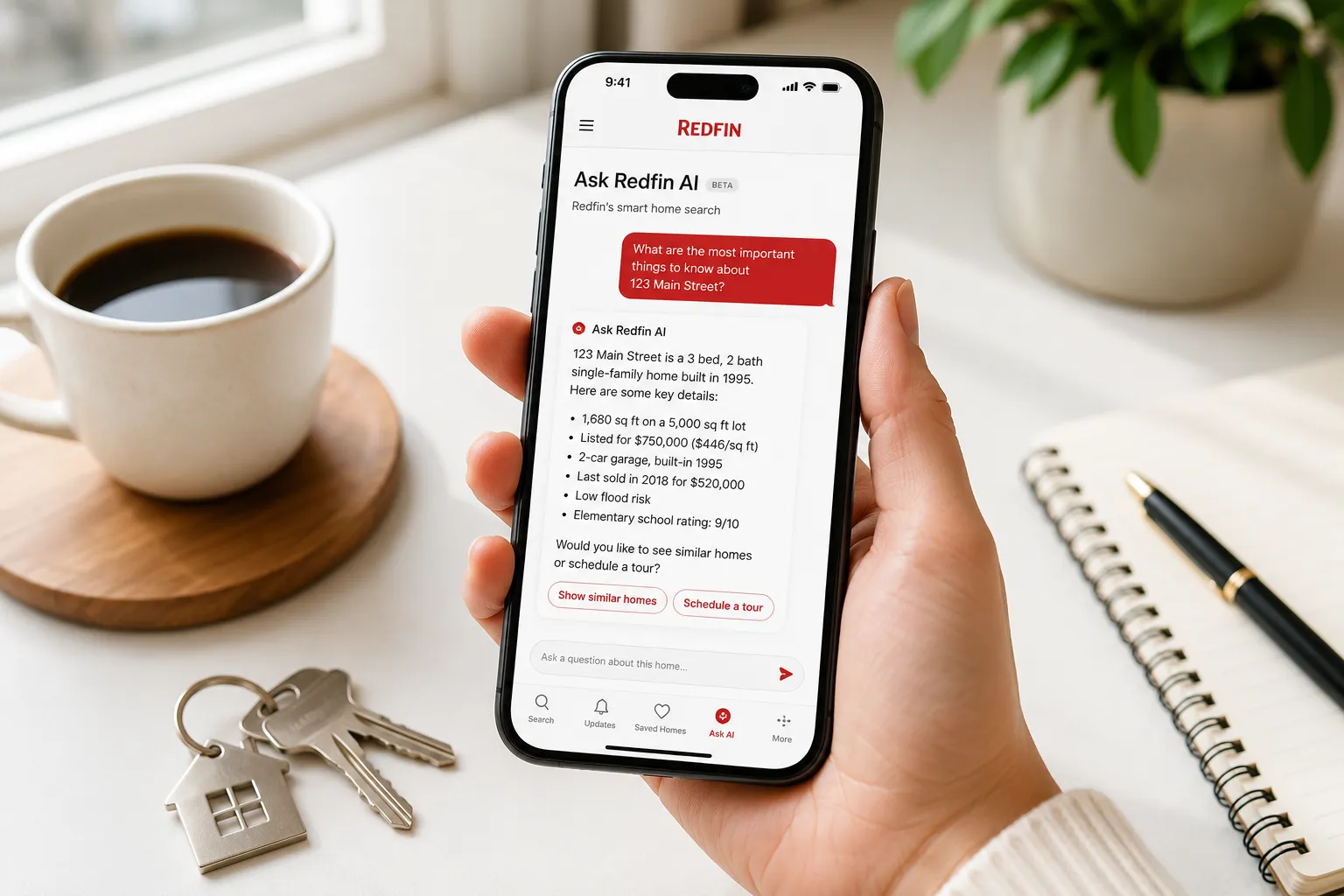
What Is Ask Redfin AI and How Does It Work?
Ask Redfin AI is a conversational search assistant powered by OpenAI's large language model, embedded directly into the Redfin mobile app and desktop site. Launched in late 2023 and refined through 2024-2026, it lets you type or speak questions like "Show me three-bedroom homes under $500K in Austin with good schools" and get instant, structured answers pulled from Redfin's live MLS feeds, public records, and proprietary valuation data.
Under the hood, the AI parses your natural-language query, identifies the key filters (price, beds, location, amenities), and queries Redfin's database in real time. It then formats the results in a chat interface, complete with property cards, photos, and one-tap tour scheduling. The system also remembers context within a session, so follow-up questions like "Which one has the lowest HOA?" don't require you to restate your search.
What makes it different from a standard search bar? Traditional filters force you to click dropdowns and checkboxes. Ask Redfin lets you describe what you want the way you'd tell a friend. It's especially impeccable for buyers who don't yet know the local lingo or exact neighborhood names, just describe the vibe, and the AI surfaces matches.
Data sources: Ask Redfin pulls from MLS listings (updated every 15 minutes in most markets), Redfin's own transaction history, public tax records, school ratings from GreatSchools, walkability scores, and the Redfin Estimate algorithm. It does not access private seller motivations, off-market pocket listings, or agent-only notes, those stay behind the agent firewall.
How accurate is it? For factual listing data (price, square footage, lot size, year built), Ask Redfin is as accurate as the MLS feed it's reading. For estimated values and neighborhood trends, accuracy depends on the Redfin Estimate's performance in your market, more on that below.
If you're curious how Redfin's AI stacks up against other best AI tools for real estate agents, the short answer is: Ask Redfin is consumer-focused, while agent-facing tools like BoomTown or Market Leader lean into CRM and lead nurturing.
Ask Redfin AI: What It Can Tell You (and What It Can't)
Let's cut through the hype and get specific. Here's a feature-by-feature breakdown of what Ask Redfin AI handles extraordinarily well, and where it hits a wall.
What Ask Redfin AI Can Tell You
Property details and listing facts: Ask "What's the HOA fee for 123 Main Street?" or "How many bathrooms does this house have?" and you'll get instant, accurate answers pulled straight from the MLS. The AI can compare multiple listings side by side, highlight price drops, and flag days on market.
Tour scheduling: One of the freshest features, Ask Redfin can book a showing for you in seconds. Say "Schedule a tour for Saturday at 2 PM" and it coordinates with the listing agent's calendar. No phone tag, no email chains. This alone saves first-time buyers hours of friction.
Neighborhood and school data: Ask "What's the walkability score in this area?" or "Are there good elementary schools nearby?" and the AI surfaces GreatSchools ratings, Walk Score, Transit Score, and crime stats. It's pulling from the same public datasets Redfin displays on listing pages, just faster.
Comparable sales (comps): Ask "What did similar homes sell for in this neighborhood?" and the AI retrieves recent comps, though it won't interpret whether those comps justify the asking price. That's where human judgment enters.
Redfin Estimate context: You can ask "What's the Redfin Estimate for this address?" and get the number plus a confidence range. The AI will explain that the estimate is algorithmic, not an appraisal, and note the margin of error for that market.
Mortgage calculator queries: "What would my monthly payment be at 6.5% interest on a $400K loan?" Ask Redfin can run basic payment math, though it won't pre-qualify you or recommend a lender, those require a licensed loan officer.
What Ask Redfin AI Cannot Tell You
Pricing strategy or negotiation advice: The AI will not tell you whether to offer above or below asking, how much to counter, or what contingencies to include. That's agent territory. If you ask, it deflects: "I recommend discussing offer strategy with a Redfin agent."
Future appreciation predictions: Ask "Will this neighborhood go up in value?" and you'll get a polite non-answer. The AI can show historical trends, but it won't forecast, too much liability, too many variables.
Inspection red flags or repair costs: Upload a photo of foundation cracks or ask "Is this roof issue a deal-breaker?" and the AI can't help. It's not trained to interpret structural issues or estimate repair budgets. You need a licensed inspector or contractor.
Off-market or pocket listings: Ask Redfin AI won't surface properties that aren't publicly listed. If a seller is testing the waters privately, the AI has no visibility.
Legal or tax advice: Questions like "Should I form an LLC to buy this rental?" or "What are the capital gains implications?" get deflected to a CPA or attorney. The AI knows its lane.
Agent performance or reviews: You can't ask "Which Redfin agent has the best close rate in Seattle?" The AI won't rank or critique individual agents, it'll offer to connect you with a local partner agent instead.
For a deeper dive into what data sources power accurate home valuations across platforms, check out our guide on which company has the most accurate real estate estimate.
What Questions Can I Ask Redfin AI About Homes?
The sweet spot for Ask Redfin is specific, data-driven questions about active listings and neighborhoods. Here are the query types that work best:
Listing-specific queries:
- "Show me all the photos for 456 Oak Avenue."
- "When was this house last sold, and for how much?"
- "Does this property allow pets?"
- "What's included in the HOA fee?"
- "How long has this listing been on the market?"
Comparative queries:
- "Compare these three homes on price per square foot."
- "Which of these listings has the largest backyard?"
- "Show me the newest listings under $600K in this zip code."
Neighborhood and lifestyle queries:
- "What's the average commute time to downtown from this address?"
- "Are there parks within walking distance?"
- "What's the crime rate in this neighborhood compared to the city average?"
- "Which elementary school serves this address?"
Scheduling and logistics:
- "Book a tour for this Saturday morning."
- "Can I see this house and two others in the same trip?"
- "What times are available for showings this week?"
Mortgage and affordability (basic math only):
- "What's the monthly payment on a $350K loan at 7% interest?"
- "How much do I need for a 20% down payment on this house?"
What to avoid asking:
- Open-ended speculation: "Is this a good investment?"
- Subjective taste: "Will I like this neighborhood?"
- Complex strategy: "Should I waive the inspection contingency?"
The AI is so based when it comes to pulling facts. But the moment you ask it to make a judgment call, it taps out.
Ask Redfin AI vs Zillow AI: Which Is Better?
Both Redfin and Zillow rolled out ChatGPT-powered assistants in 2023-2024, and by 2026 they've each carved out slightly different niches. Here's the honest side-by-side.
| Feature | Ask Redfin AI | Zillow AI Assistant |
|---|---|---|
| Tour Scheduling | Direct booking in-app, syncs with agent calendars | Requests sent to listing agent; less seamless |
| Data Sources | MLS + Redfin transactions + public records | MLS + Zillow’s aggregated data + Zestimate |
| Valuation Tool | Redfin Estimate (generally tighter error margins) | Zestimate (broader coverage, higher variance) |
| Conversational Depth | Strong on property facts, weaker on lifestyle nuance | Better at parsing vague lifestyle queries |
| Agent Integration | Seamless handoff to Redfin partner agents | Connects to Zillow Premier Agent network |
| Cost | Free | Free |
| Best For | Buyers who want fast tour booking + tight comps | Browsers exploring multiple markets casually |
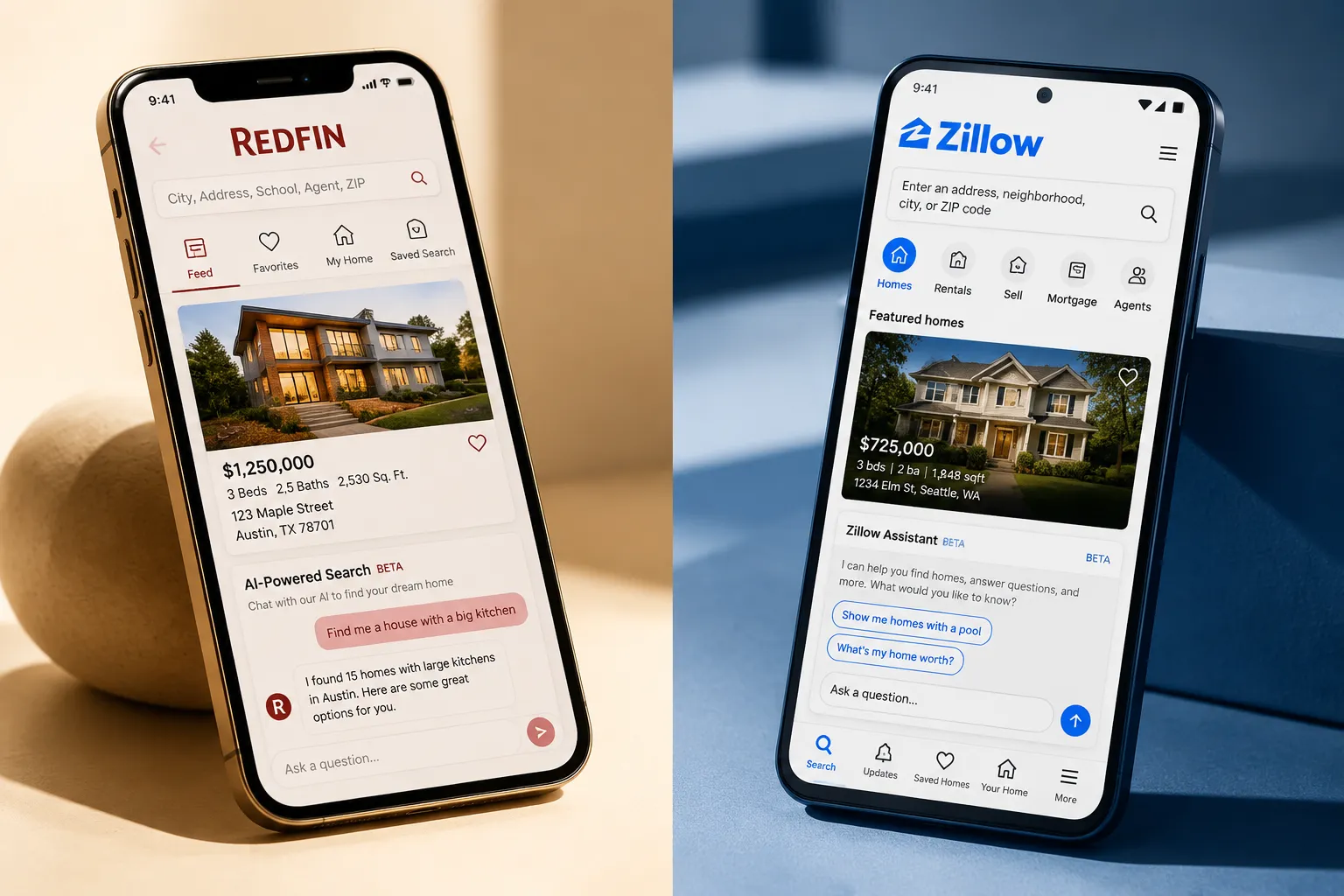
Verdict: If you're serious about touring homes this month, Ask Redfin's scheduling integration is the killer feature. If you're in early research mode and want to explore a dozen cities without commitment, Zillow's broader data aggregation and more forgiving search logic might feel less rigid.
For agents comparing CRM and lead-gen platforms, our Real Geeks pricing guide and Follow Up Boss pricing breakdown offer similar feature-by-feature honesty.
Redfin Estimate accuracy: In most metro markets, Redfin's algorithm has a median error rate around 2-3% for on-market homes and 6-8% for off-market properties. Zillow's Zestimate typically runs 3-5% on-market and 7-10% off-market. Neither is an appraisal, but Redfin's tighter margins give it an edge for pricing strategy.
Redfin app features beyond AI: The Redfin app also includes 3D home tours, real-time MLS updates, and a "Hot Homes" feed that flags listings likely to sell fast. The AI assistant is just one tool in a broader suite.
Can Ask Redfin AI Give Accurate Home Valuations?
Short answer: It can give you the Redfin Estimate, but that's not the same as an accurate, binding valuation.
The Redfin Estimate is a machine-learning model trained on millions of home sales, tax records, and listing data. It updates daily and factors in recent comps, property characteristics, and local market trends. In high-liquidity markets (think Seattle, Austin, Denver), the estimate is often within 2-3% of the final sale price for active listings. In rural or low-inventory areas, the error margin balloons to 8-12%.
What Ask Redfin AI will tell you:
- The current Redfin Estimate for any address
- The confidence range (e.g., "We estimate this home is worth $450K,$490K")
- How the estimate has changed over the past 90 days
- Recent comps that informed the model
What it won't tell you:
- Whether the estimate accounts for that brand-new kitchen remodel you just finished
- If the seller is motivated and likely to accept below estimate
- How much a buyer should actually offer in a bidding war
When to trust the Redfin Estimate: Use it as a starting point for pricing research, not the final word. If you're a seller, compare the Redfin Estimate to a Comparative Market Analysis (CMA) from a licensed agent. If you're a buyer, cross-reference it with recent closed sales in the neighborhood.
When to ignore it: If the property is unique (custom build, historic home, waterfront), if it's in a volatile micro-market, or if major renovations aren't reflected in public records, the algorithm is flying blind.
For a deeper comparison of valuation tools, see our analysis of which company has the most accurate real estate estimate.
What Are the Limitations of Ask Redfin AI?
Let's be real: Ask Redfin AI is extraordinary at what it does, but it's not magic. Here are the hard limits.
No access to private seller data: The AI can't tell you why a seller is moving, whether they're desperate, or if they've already rejected three offers. That intel comes from agent-to-agent conversation.
Can't interpret photos or documents: Upload a photo of a cracked foundation or a termite report, and the AI shrugs. It's not trained on visual diagnostics or document parsing beyond basic listing photos.
No predictive market analysis: Ask "Will home prices in Phoenix drop next year?" and you'll get historical data, not a forecast. The AI won't stick its neck out on future trends, too much liability.
Limited commercial real estate support: Ask Redfin is built for residential buyers and sellers. If you're hunting for retail space or industrial warehouses, the AI deflects to agent referrals. For commercial CRM needs, check out our guide to the best commercial real estate CRM.
Can't negotiate or draft contracts: The AI won't write your offer, suggest contingencies, or counter on your behalf. That's where a licensed agent or attorney steps in.
Context window limits: If you've been chatting for 30 minutes and suddenly ask a question about a listing you mentioned 20 exchanges ago, the AI might lose the thread. It's good, but it's not omniscient.
No emotional intelligence: Ask Redfin won't sense when you're stressed, overwhelmed, or second-guessing. A human agent reads the room and adjusts their approach. The AI just keeps answering questions.
Is Ask Redfin AI Good for First-Time Home Buyers?
Absolutely, with one caveat: use it as your research assistant, not your decision-maker.
First-time buyers often feel intimidated by real estate jargon and don't know what questions to ask. Ask Redfin lowers that barrier. You can type "What's an HOA?" or "Why does this house say 'pending'?" and get plain-English answers without feeling judged.
Where Ask Redfin shines for newbies:
- Jargon translation: The AI explains terms like "contingency," "earnest money," and "appraisal gap" in simple language.
- Neighborhood discovery: Describe your lifestyle ("walkable, good coffee shops, quiet at night") and the AI surfaces matches you might not have found with traditional filters.
- Tour logistics: Booking your first showing is nerve-wracking. The AI makes it feel like ordering an Uber, tap, confirm, done.
- Comps education: Seeing how similar homes sold helps first-timers calibrate expectations and avoid overpaying.

Where first-timers still need human help:
- Offer strategy: How much to bid, which contingencies to include, and when to walk away, those calls require an agent who knows the local market pulse.
- Financing guidance: The AI can calculate payments, but it won't tell you whether to go FHA, conventional, or explore down payment assistance programs. Talk to a loan officer.
- Emotional support: Buying your first home is stressful. An agent provides reassurance, reads between the lines of seller behavior, and advocates for you. The AI can't do that.
Pro tip for first-timers: Use Ask Redfin to build your knowledge base and shortlist properties, then bring that research to a consultation with a Redfin agent (or any buyer's agent you trust). You'll ask smarter questions and make faster decisions.
For more first-time buyer resources, explore our home buying hub.
Does Ask Redfin AI Replace Talking to a Real Estate Agent?
No, and Redfin doesn't pretend it does.
Think of Ask Redfin AI as the pre-game research tool and a licensed agent as the coach who calls the plays. The AI handles the grunt work: filtering listings, pulling comps, scheduling tours, answering factual questions. The agent handles strategy, negotiation, contract review, and the judgment calls that algorithms can't make.
When the AI is enough:
- You're browsing casually and not ready to make an offer.
- You need quick facts about a listing (HOA, square footage, days on market).
- You want to compare properties side by side.
- You're scheduling tours for homes you've already vetted.
When you need a human agent:
- You're ready to write an offer and need pricing strategy.
- The market is competitive and you're facing multiple bids.
- You're buying a fixer-upper and need to estimate repair costs.
- You're selling and need a marketing plan, staging advice, and negotiation firepower.
- You're navigating a complex transaction (estate sale, short sale, new construction).
Redfin's business model: Redfin is a brokerage, not just a tech platform. The AI is designed to feed leads to Redfin agents, not replace them. When the AI hits a question it can't answer, it offers to connect you with a local Redfin partner agent, often with a referral fee baked in.
For agents: If you're worried AI will eat your lunch, here's the reality check: buyers and sellers still crave human expertise for high-stakes decisions. The agents who thrive in 2026 are the ones who embrace AI as a lead-gen and efficiency tool rather than fight it. Tools like Real Geeks and Follow Up Boss help agents automate follow-up and nurture leads, Ask Redfin is just another channel.
Common Mistakes People Make Using Ask Redfin AI
Even the best tool gets misused. Here are the pitfalls we see buyers and sellers stumble into.
Mistake 1: Treating the Redfin Estimate as gospel.
The estimate is a model, not an appraisal. If you price your home based solely on the Redfin Estimate without getting a CMA from an agent, you risk overpricing (and sitting on market) or underpricing (and leaving money on the table).
Mistake 2: Asking the AI to predict the future.
"Will this neighborhood appreciate?" "Should I wait for rates to drop?" The AI can't answer those. It'll show you historical trends, but it won't forecast. Make peace with uncertainty or consult an economist.
Mistake 3: Skipping the agent on complex deals.
Buying a foreclosure, a new-build with builder incentives, or a property with title issues? The AI will give you facts, but it won't navigate the legal and strategic minefields. Hire an agent.
Mistake 4: Assuming the AI knows off-market intel.
If a seller is testing the waters privately or an agent has a pocket listing, Ask Redfin has no visibility. The AI only sees what's publicly listed.
Mistake 5: Over-relying on the AI for neighborhood "feel."
The AI can tell you Walk Score and crime stats, but it can't tell you if the neighbors are friendly, if the street floods every spring, or if that "quiet cul-de-sac" is actually a cut-through for morning commuters. Drive the neighborhood yourself.
Mistake 6: Ignoring data freshness.
MLS feeds update every 15 minutes in most markets, but public records (tax assessments, permits) can lag by months. If the AI says "no recent sales," double-check with an agent, there might be pending deals not yet public.
Mistake 7: Asking the AI to replace due diligence.
The AI won't catch that the seller never pulled permits for the garage conversion, or that the HOA is in litigation. Order a title report, get an inspection, and read the disclosures.
Can Ask Redfin AI Help Me Find Homes in My Budget?
Yes, this is one of its core strengths.
Tell Ask Redfin your budget, desired beds/baths, and location, and it'll surface every active listing that fits. You can refine on the fly: "Show me only homes with a two-car garage" or "Exclude anything with HOA fees over $200/month."
How to get the best results:
- Be specific about your budget ceiling. Say "$450K max" instead of "around $450K." The AI takes you literally.
- Include must-haves and deal-breakers. "I need a fenced yard for my dog" or "No homes on busy streets."
- Ask for payment estimates. "What's the monthly payment on a $400K loan at 6.5% with 10% down?" The AI runs the math instantly.
What the AI won't do:
- Tell you if you're pre-qualified. That's a lender's job. The AI assumes you know your buying power.
- Suggest creative financing. If you're exploring FHA, VA, or USDA loans, or considering seller financing, talk to a loan officer. The AI sticks to conventional math.
- Warn you about hidden costs. The AI shows HOA fees and property taxes, but it won't flag that the roof is 20 years old or the HVAC is on its last legs. Budget for inspections and repairs.
For buyers navigating financing options, our FHA loan vs conventional loan comparison breaks down which path saves you more money.
Why Is Ask Redfin AI Giving Me Wrong Information?
If Ask Redfin serves up a head-scratcher, here's usually why:
Outdated MLS data: Most markets update every 15 minutes, but some lag by hours. If a listing just went pending or the price dropped this morning, the AI might not know yet. Refresh and try again.
Public records lag: Tax assessments, permit records, and ownership history can be months behind. If the AI says "last sold in 2018" but you know it changed hands in 2023, the county recorder's office might not have updated.
Ambiguous queries: Ask "What's the best neighborhood in Austin?" and the AI will struggle, "best" is subjective. Rephrase: "Show me neighborhoods in Austin with Walk Scores above 70 and median home prices under $500K."
Listing agent errors: If the MLS listing says "4 beds" but the AI repeats that and you count only 3 in the photos, the mistake originated with the listing agent, not the AI. Always verify on-site.
Algorithm confidence limits: In low-inventory or rural markets, the Redfin Estimate's error margin widens. The AI will note "low confidence" if the model is uncertain, don't ignore that flag.
Context loss in long chats: If you've been chatting for 20 minutes and suddenly reference "that house I asked about earlier," the AI might lose the thread. Start a fresh session or restate the address.
When in doubt, escalate to a human. If the AI gives you info that contradicts the listing page or feels off, contact a Redfin agent. They can pull the raw MLS data and clarify.
Is Ask Redfin AI Free to Use or Does It Cost Money?
It's free. No subscription, no hidden fees, no gate keeping the good stuff behind a paywall.
Redfin's business model is brokerage commissions, not SaaS subscriptions. The AI is a lead-generation tool designed to get you engaged with listings, schedule tours, and eventually connect you with a Redfin agent. When you buy or sell through Redfin, the company earns a commission, that's how they monetize.
What's included for free:
- Unlimited property searches and AI queries
- Tour scheduling
- Redfin Estimate access
- Neighborhood data and school ratings
- Mortgage calculator
- Saved searches and favorites
What costs money (outside the AI):
- Redfin's listing fee (for sellers): Redfin charges a 1-1.5% listing fee (vs. the traditional 2.5-3%), but you still pay the buyer's agent commission (typically 2.5-3%). Total commission is usually 3.5-4.5% instead of 5-6%.
- Buyer's agent commission: If you use a Redfin agent to buy, you don't pay them directly, the seller pays the buyer's agent commission out of the sale proceeds.
- Redfin Concierge (optional): A paid service that fronts the cost of home improvements before you list, then recoups it at closing. Not related to the AI.
No bait-and-switch: Redfin doesn't lock features behind a "premium" tier. The AI assistant is the same for everyone.
For agents comparing lead-gen platforms, our guide to the best real estate lead generation software covers what's worth paying for and what's just hype.
What Can't Ask Redfin AI Tell Me About a Property?
We've touched on this, but let's consolidate the blind spots.
Seller motivation and negotiation leverage: The AI doesn't know if the seller is divorcing, relocating for a job, or facing foreclosure. That intel comes from agent-to-agent conversation and shapes your offer strategy.
Inspection red flags: The AI can't interpret photos of water stains, foundation cracks, or outdated electrical panels. Hire a licensed inspector.
Permit and code compliance: If the seller added a bedroom without permits, or the deck doesn't meet code, the AI won't catch it. Order a title report and municipal lien search.
HOA drama: The AI shows HOA fees, but it won't tell you the HOA is in litigation, has a special assessment pending, or is notorious for nitpicky violations. Read the HOA docs and talk to neighbors.
Future development: If the empty lot next door is zoned for a 10-story apartment building, the AI won't flag it. Check the city's zoning map and planning department.
Flood risk beyond FEMA maps: The AI can tell you if a property is in a FEMA flood zone, but it won't know if the street floods every heavy rain due to poor drainage. Drive by after a storm.
Neighborhood nuances: Is the street a cut-through for commuters? Do the neighbors throw loud parties? Is there a sex offender registry hit nearby? The AI won't volunteer that, do your own due diligence.
Title issues: Liens, easements, boundary disputes, the AI has no visibility. Order a title search before closing.
Should Experienced Investors Use Ask Redfin AI?
Yes, but with a different mindset than first-time buyers.
Experienced investors use Ask Redfin as a deal-flow filter, not a decision engine. The AI is impeccable at surfacing properties that meet your criteria (price per square foot, cap rate proxies, days on market), but you'll still run your own numbers and verify data.
How investors leverage Ask Redfin:
- Bulk property screening: "Show me all single-family homes under $300K in zip codes 78701-78705 with at least 3 beds." The AI delivers a list in seconds.
- Comps for ARV (After Repair Value): Pull recent sales to estimate what a renovated property will appraise for.
- Days on market tracking: Flag listings that have been sitting, potential negotiation leverage.
- Rental yield estimates: Ask "What's the average rent for a 3-bed in this neighborhood?" The AI pulls rental comps from Redfin's data.
What investors still do manually:
- Cash flow analysis: The AI won't calculate cap rate, cash-on-cash return, or debt service coverage ratio. Use a spreadsheet or tool like best accounting software for real estate investors.
- Rehab cost estimation: The AI can't tell you what it'll cost to gut a kitchen or replace a roof. Get contractor bids.
- Market timing: The AI shows historical trends, but it won't tell you if you're buying at the peak or catching a dip. That's your call.
Pro tip: Pair Ask Redfin with a dedicated investment analysis tool. The AI is your lead source; your spreadsheet is your underwriting engine.
For investors exploring alternative income streams, our guide to best alternatives to REITs for passive income offers eight smarter ways to earn without being a landlord.
Does Ask Redfin AI Work for Commercial Real Estate?
Not really, and Redfin is upfront about it.
Ask Redfin is built for residential buyers and sellers. If you're hunting for office space, retail storefronts, industrial warehouses, or multifamily apartment buildings (5+ units), the AI's data coverage is thin to nonexistent.
What happens if you ask about commercial properties:
- The AI will acknowledge the query and offer to connect you with a commercial real estate agent.
- It might surface a few listings if they're cross-listed in the residential MLS (rare).
- It won't provide cap rate analysis, lease comps, or zoning details.
Why the gap? Commercial real estate data is fragmented across proprietary databases (CoStar, LoopNet, Crexi) and often not publicly listed. Redfin's MLS feeds are residential-focused.
For commercial investors: Use platforms like CoStar, LoopNet, or Crexi for property search, and pair them with a CRM like the best commercial real estate CRM to manage deal flow.
Multifamily note: If you're buying a duplex, triplex, or fourplex (1-4 units), those are often listed in the residential MLS, and Ask Redfin can help. Anything larger is commercial territory.

Frequently Asked Questions
Is Ask Redfin AI available in all U.S. markets?
Yes, Ask Redfin works nationwide wherever Redfin operates, which is most major metros and many smaller markets. Data quality varies by region based on MLS participation and public records availability.
Can I use Ask Redfin AI without creating an account?
You can browse and ask basic questions, but to schedule tours, save favorites, or get personalized recommendations, you'll need a free Redfin account.
Does Ask Redfin AI work on mobile and desktop?
Yes, the AI assistant is embedded in both the Redfin mobile app (iOS and Android) and the Redfin website. The experience is nearly identical across platforms.
How often does Ask Redfin AI update listing data?
MLS data refreshes every 15 minutes in most markets. Public records (tax, permits, ownership) update less frequently, sometimes monthly or quarterly, depending on the county.
Can Ask Redfin AI help me sell my home?
It can answer questions about the selling process, provide a Redfin Estimate, and connect you with a Redfin listing agent. It won't create a marketing plan or stage your home, that's agent work.
Is my conversation with Ask Redfin AI private?
Redfin's privacy policy states that chat data may be used to improve the AI and for lead-generation purposes. If you share personal info (budget, timeline), assume it's visible to Redfin agents.
Can I ask Ask Redfin AI about mortgage rates?
The AI can provide general rate information and calculate payments based on a rate you provide, but it won't give you a personalized rate quote. For that, talk to a lender.
What if Ask Redfin AI can't answer my question?
The AI will either deflect to a Redfin agent, suggest rephrasing your query, or admit it doesn't have the data. It's refreshingly honest about its limits.
Does Ask Redfin AI replace a home inspection?
Absolutely not. The AI can't assess structural integrity, identify code violations, or estimate repair costs. Always hire a licensed inspector before closing.
Can I use Ask Redfin AI to find rental properties?
The AI can surface rental listings if they're in Redfin's database, but coverage is spottier than for-sale homes. For serious rental hunting, try Zillow Rentals, Apartments.com, or Craigslist.
Is Ask Redfin AI better than talking to a real estate agent?
It's faster for factual queries and tour scheduling, but it can't replace an agent's negotiation skills, market intuition, or emotional intelligence. Use both.
Can Ask Redfin AI help with investment property analysis?
It can pull comps and rental estimates, but it won't calculate cap rate, cash flow, or ROI. You'll need a spreadsheet or dedicated investment software for that.
Conclusion
Ask Redfin AI is an extraordinary tool for home buyers and sellers who want fast, accurate answers to factual questions, property details, tour scheduling, neighborhood stats, and comps. It's free, it's fast, and it's impeccable at what it does. But it's not a replacement for a licensed agent, an inspector, or your own due diligence.
Use Ask Redfin AI when you need:
- Quick property facts and listing details
- Tour scheduling without phone tag
- Neighborhood and school data
- Comparable sales to inform your research
- A jargon-free introduction to the home-buying process
Bring in a human when you need:
- Pricing strategy and offer negotiation
- Inspection interpretation and repair cost estimates
- Legal or tax advice
- Market timing and investment analysis
- Emotional support and advocacy
The smartest buyers and sellers in 2026 use AI to handle the grunt work and humans to handle the judgment calls. Let it cook before you see results, spend a week using Ask Redfin to build your knowledge base, then bring that research to a consultation with a Redfin agent (or any agent you trust). You'll ask better questions, make faster decisions, and avoid the common mistakes that cost buyers and sellers thousands.
For more real estate intelligence, free, unbiased, and built by brokers, explore the Real Estate Rank IQ blog. We cover everything from AI tools for agents to market predictions to financing strategies, no paywalls, no brokerage bias, just straight answers.