


Last updated: April 23, 2026

Quick Answer: The best alternatives to REITs for passive income include real estate crowdfunding platforms like Fundrise and Arrived Homes, real estate syndications, private REITs, fractional ownership platforms, tokenized real estate, Yieldstreet, Gatsby Investment, and land investing. Each option offers a different combination of minimum investment, liquidity, expected returns, and accreditation requirements — so the right choice depends entirely on your financial situation and timeline.
Key Takeaways
- Fundrise is the most accessible entry point for non-accredited investors, with a $10 minimum and a flagship fund targeting 8–12% annualized returns.
- Arrived Homes lets you invest in individual rental properties for as little as $100, making fractional real estate investing genuinely beginner-friendly.
- CrowdStreet and real estate syndications offer higher return potential (12–20%+) but require accredited investor status and $25,000+ minimums.
- Yieldstreet blends real estate with other alternative assets, giving non-accredited investors access to multi-asset passive income strategies.
- Gatsby Investment focuses specifically on short-term rental investment projects, targeting returns above 10% with lower minimums than traditional syndications.
- Tokenized real estate is emerging fast — platforms like RealT allow fractional digital real estate investing with blockchain-backed ownership.
- Land investing is one of the most overlooked passive income strategies, with low competition and strong cash flow potential when done right.
- Liquidity is the biggest trade-off across all REIT alternatives — most lock up capital for 3–7 years, so plan accordingly.
- Tax treatment varies significantly across these vehicles — some offer depreciation pass-throughs, others generate ordinary income.
- The best alternatives to REITs for passive income are not one-size-fits-all. Match the vehicle to your timeline, capital, and accreditation status.
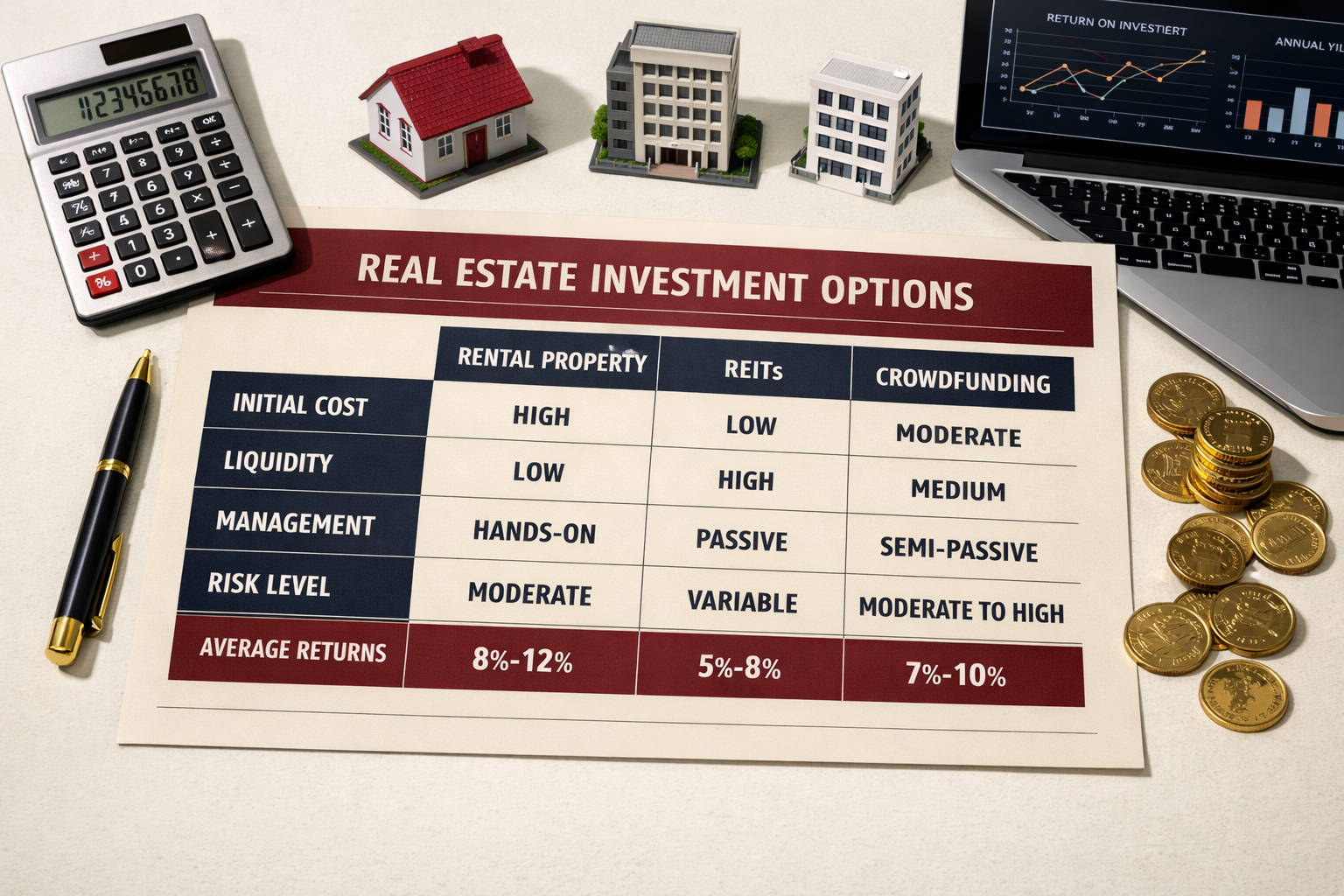
Best Alternatives to REITs for Passive Income: Full Comparison at a Glance
This is the master table every investor should bookmark. At Real Estate Rank IQ, we rank and review real estate investment platforms the same way a broker would evaluate a deal — by looking at the numbers, the fine print, and what other investors are actually experiencing.
| Platform / Strategy | Min. Investment | Accreditation Required | Expected Returns | Liquidity | Risk Level |
|---|---|---|---|---|---|
| Fundrise | $10 | No | 8–12% (estimated) | Low (quarterly windows) | Low–Medium |
| Arrived Homes | $100 | No | 7–15% (projected) | Low (5–7 yr hold) | Low–Medium |
| CrowdStreet | $25,000 | Yes | 12–20%+ | Very Low | Medium–High |
| Yieldstreet | $2,500 | No (some deals) | 8–15% | Low | Medium |
| Gatsby Investment | $1,000 | No | 10–25% (projected) | Low | Medium–High |
| Real Estate Syndications | $25,000–$100,000 | Yes (most) | 12–20%+ | Very Low | Medium–High |
| Private REITs | $1,000–$25,000 | Varies | 6–12% | Low | Medium |
| Fractional Ownership Platforms | $100–$500 | No | 6–12% | Low–Medium | Low–Medium |
| Tokenized Real Estate | $50–$500 | No | 8–15% (estimated) | Medium | Medium–High |
| Land Investing | $500–$5,000 | No | Varies widely | Low | Low–High |
| Short-Term Rental Platforms | $1,000–$5,000 | Varies | 10–25% | Low | Medium–High |
⚠️ Return figures are projections based on platform-reported historical data and should not be taken as guaranteed. All investing involves risk. Past performance does not guarantee future results.
Why Investors Are Looking Beyond Traditional REITs
Publicly traded REITs have been a solid passive income vehicle for decades. They're liquid, diversified, and required by law to distribute at least 90% of taxable income to shareholders. But they're not perfect — and in 2026, a growing number of investors are actively searching for the best alternatives to REITs for passive income.
Here's why:
- Correlation with the stock market. Public REITs trade on exchanges, which means they drop when the broader market drops — even if the underlying real estate is performing fine. That's not true diversification.
- Limited control over asset selection. When you buy a REIT ETF, you own a basket of properties you didn't choose. Some investors want exposure to specific sectors or geographies.
- Compressed yields. As interest rates fluctuate and REIT prices rise, dividend yields can shrink. Many public REITs currently yield 3–5%, which doesn't excite income-focused investors.
- Tax inefficiency. REIT dividends are mostly taxed as ordinary income, not at the lower qualified dividend rate. That stings at higher income brackets.
- New platforms have changed the game. Real estate crowdfunding platforms, fractional ownership apps, and digital real estate investing tools have opened doors that simply didn't exist five years ago. [2]
The result? Investors — from beginners with $100 to accredited investors with $100,000 — are exploring smarter, more targeted passive income real estate strategies. You can also explore our deeper breakdown of REIT real estate investments and the best real estate investments to understand the full landscape before committing capital.

Real Estate Crowdfunding Platforms
Real estate crowdfunding platforms are the most popular category of best alternatives to REITs for passive income right now — and for good reason. They allow fractional real estate investing with low minimums, no landlord responsibilities, and professional asset management. [1]
Fundrise Review: Returns, Fees, and Is It Worth It?
Fundrise is the most accessible real estate investment platform for non-accredited investors, with a $10 minimum and a straightforward fee structure.
What is Fundrise? Fundrise is a Washington D.C.-based alternative investment platform that pools investor capital into eREITs and eFunds — essentially private real estate funds focused on residential and commercial properties across the U.S.
Fundrise Flagship Fund: The Fundrise Flagship Real Estate Fund is their core product, targeting a diversified portfolio of stabilized income-producing properties. It's designed for long-term investors who want steady cash flow and appreciation without picking individual deals.
Fundrise Returns: Historically, Fundrise has reported annualized returns ranging from 8–12% depending on the year and fund. Returns in 2022 dipped due to rising interest rates, but the platform has reported recovery and growth in 2024–2025. These are net returns after fees, though results vary by portfolio and timing.
Fees: Fundrise charges a 0.85% annual asset management fee plus a 0.15% advisory fee — totaling roughly 1% per year. That's competitive for a private real estate fund.
Is Fundrise a good investment? For long-term, passive investors who don't need immediate liquidity, yes. The platform is SEC-registered, transparent about its holdings, and has a track record spanning over a decade.
Is Fundrise legitimate? Absolutely. Fundrise is a registered investment adviser with the SEC and files regular disclosures. It is not a scam.
Is Fundrise a scam? No. It's a legitimate alternative investment platform with millions of investors and full regulatory compliance. The main risk isn't fraud — it's illiquidity and real estate market exposure.
Liquidity: Fundrise offers quarterly redemption windows, but redemptions are not guaranteed. Plan to hold for at least 3–5 years.
Pros:
- Open to non-accredited investors
- Low $10 minimum
- Diversified real estate portfolio
- SEC-registered, transparent reporting
Cons:
- Illiquid — not suitable for short-term capital needs
- Returns can lag during rate hike cycles
- Limited control over individual asset selection
Arrived Homes Review: Is It Legit and Is It a Good Investment?
Arrived Homes lets you buy fractional shares of individual single-family rental properties for as little as $100, earning rental income and appreciation without managing tenants.
Is Arrived legit? Yes. Arrived Homes is a legitimate real estate investment platform backed by investors including Jeff Bezos's venture fund. It's SEC-qualified and files offering circulars for each property.
Is Arrived a good investment? For investors who want property-level transparency and low minimums, it's a solid option. You can browse individual homes, review projected returns, and choose which properties to invest in.
Arrived Homes Reviews: Investor feedback is generally positive around transparency and ease of use. The main criticism is the 5–7 year hold period and limited secondary market liquidity. Some investors note that projected returns don't always match realized returns — which is true of any real estate investment.
Expected Returns: Arrived projects 7–15% annualized returns combining rental income and appreciation, though actual results vary by property and market.
Fees: Arrived charges a 1% sourcing fee and 8% property management fee on gross rents, plus a 1% AUM fee annually.
Pros:
- $100 minimum — genuinely accessible
- Individual property selection
- SEC-qualified offerings
- Passive rental income without tenant management
Cons:
- 5–7 year hold period
- No guaranteed secondary market
- Returns are projections, not guarantees
CrowdStreet: For Accredited Investors Only
CrowdStreet is a commercial real estate marketplace connecting accredited investors directly with institutional-quality deals — office buildings, multifamily complexes, industrial assets, and more.
Accreditation requirement: You must be an accredited investor (net worth over $1M excluding primary residence, or income over $200K/$300K joint for two consecutive years).
Minimum investment: $25,000 per deal, though some offerings go higher.
Expected returns: CrowdStreet deals have historically targeted 12–20%+ IRR depending on the deal type and hold period. These are higher-risk, higher-reward plays.
Liquidity: Very low. Most deals have 3–7 year hold periods with no early exit options.
Risks: CrowdStreet had high-profile issues in 2023 with a sponsor (Nightingale Properties) misappropriating investor funds. The platform has since strengthened vetting processes, but this is a real risk in direct deal investing. Always vet the sponsor, not just the platform.
Pros:
- Access to institutional-quality deals
- Higher return potential
- Detailed deal-level transparency
Cons:
- Accredited investors only
- $25,000+ minimums
- Sponsor risk is real — due diligence is critical
Fundrise vs CrowdStreet: Which Platform Wins?
| Factor | Fundrise | CrowdStreet |
|---|---|---|
| Accreditation | Not required | Required |
| Minimum | $10 | $25,000 |
| Return Target | 8–12% | 12–20%+ |
| Liquidity | Quarterly windows | Very low |
| Deal Control | None (fund-based) | Deal-by-deal selection |
| Best For | Beginners, non-accredited | Accredited, experienced investors |
Choose Fundrise if you're just starting out, aren't accredited, or want a hands-off diversified approach. Choose CrowdStreet if you're accredited, have significant capital, and want direct access to commercial real estate deals with higher return potential.
Yieldstreet: Real Estate and Alternative Assets Combined
Yieldstreet is an alternative investment platform that goes beyond real estate, offering access to art, marine finance, legal finance, and private credit alongside real estate deals.
Minimum investment: $2,500 for most offerings; some are accessible to non-accredited investors through the Yieldstreet Prism Fund.
Expected returns: 8–15% depending on the asset class and deal structure.
Accreditation: Some offerings require accreditation; the Prism Fund does not.
Yieldstreet Reviews: Investors generally appreciate the asset diversity. Criticisms center on complexity — understanding marine finance or legal receivables requires more due diligence than a standard rental property investment.
Tax treatment: Varies by asset class. Real estate deals may offer depreciation benefits; other assets generate ordinary income.
Pros:
- True multi-asset diversification beyond real estate
- Some offerings open to non-accredited investors
- Professionally managed deals
Cons:
- Higher complexity — not purely real estate
- Some deals have high minimums
- Illiquid like most alternative investment platforms
Yieldstreet is a strong pick for investors who want the best alternatives to REITs for passive income but also want exposure to assets completely outside the real estate sector. [2]
Gatsby Investment: Short-Term Rental Passive Income Model
Gatsby Investment is a real estate investment platform focused specifically on short-term rental properties and fix-and-flip projects, targeting higher returns through value-add strategies.
Minimum investment: $1,000 — lower than most comparable platforms.
Expected returns: Gatsby projects 10–25% annualized returns on short-term rental investment projects, though these are higher-risk projections tied to specific project performance.
Accreditation: Not required for all offerings.
Gatsby Investment Reviews: The platform is newer and has a smaller track record than Fundrise or Arrived. Investors cite the short-term rental investment model as genuinely differentiated — most platforms focus on long-term rentals. The higher return projections reflect higher execution risk.
Liquidity: Low. Projects typically run 6–18 months, which is shorter than most alternatives, but capital is locked during that period.
Pros:
- Short project timelines (6–18 months)
- Exposure to short-term rental investment market
- Lower minimum than syndications
- Higher return potential
Cons:
- Newer platform — limited long-term track record
- Higher risk tied to STR market volatility
- Projections are optimistic — verify with actual completed project data
For a broader look at how short-term rental management compares, check out our Airbnb vs Vacasa comparison for investors evaluating the STR space.

Real Estate Syndications: Higher Returns, Higher Minimums
Real estate syndications are one of the most powerful best alternatives to REITs for passive income — but they're not for everyone. They offer institutional-level returns with a structure designed for passive investors who want to stay completely out of operations.
How Syndications Work
A real estate syndication pools capital from multiple passive investors (limited partners) to acquire a property or portfolio. A syndicator (general partner) handles everything: acquisition, financing, management, and eventual sale. Passive investors receive distributions from cash flow and a share of appreciation at exit.
Typical structure:
- Preferred return: 6–8% annually paid to investors before the GP takes profit
- Equity split: Often 70/30 or 80/20 (LP/GP) on profits above the preferred return
- Hold period: 3–7 years
- Minimum investment: $25,000–$100,000
Accredited vs Non-Accredited Options
Most syndications are structured under SEC Regulation D (506(b) or 506(c)), which limits participation to accredited investors. Some operators use Regulation A+ or Regulation CF to open deals to non-accredited investors, but these are less common and typically have lower minimums and smaller deal sizes.
If you're not accredited: Focus on crowdfunding platforms (Fundrise, Arrived) or Regulation CF offerings until you meet accreditation thresholds.
Best Real Estate Syndication Companies
There's no single "best" syndication company — it depends on asset class, geography, and operator track record. Look for operators with:
- 5+ years of operating history
- Audited financials available
- Clear communication cadence with investors
- Verifiable track record of completed deals
- Alignment of interest (GP co-invests their own capital)
Platforms like CrowdStreet, RealtyMogul, and EquityMultiple serve as marketplaces for vetted syndication deals. Always run independent due diligence on the sponsor, not just the platform. [2]
Private REITs vs Public REITs: What's the Real Difference?
Private REITs are not traded on public exchanges, which means they're illiquid but also uncorrelated with daily stock market swings. Public REITs trade like stocks — liquid, but subject to market volatility.
| Factor | Public REITs | Private REITs |
|---|---|---|
| Liquidity | High (trade daily) | Low (quarterly or annual windows) |
| Market Correlation | High | Low |
| Minimum Investment | Price of one share | $1,000–$25,000 |
| Accreditation | Not required | Sometimes required |
| Transparency | SEC-required disclosures | Varies |
| Return Potential | 4–8% dividend yield | 6–12% targeted |
| Examples | VNQ, O, AMT | Fundrise eREITs, Blackstone BREIT |
Choose private REITs if you want real estate exposure without stock market correlation and can lock up capital for 3–5 years. Choose public REITs if you need liquidity or want to invest through a standard brokerage account.
Blackstone's BREIT (Blackstone Real Estate Income Trust) is the most prominent private REIT, but it's primarily available to institutional and high-net-worth investors. Fundrise's eREITs are the most accessible private REIT structure for everyday investors.
Fractional Real Estate Ownership Platforms
Fractional real estate investing lets you own a percentage of a specific property — earning rental income and appreciation proportional to your ownership stake — without buying the whole asset.
Platforms in this space include:
- Arrived Homes — single-family rentals, $100 minimum
- Lofty.ai — tokenized fractional ownership with daily rental income distributions
- RealT — blockchain-based fractional ownership (more on this in the tokenized section)
- Landa — mobile-first fractional real estate investing app
Who it's for: Investors who want property-level transparency, low minimums, and the psychological satisfaction of owning a piece of a specific home or building.
Who it's not for: Investors who need liquidity or want to deploy large amounts of capital efficiently — transaction costs and minimums make fractional ownership less efficient at scale.
Expected returns: 6–12% annualized, combining rental yield and appreciation. [1]
For investors exploring micro investing apps and apps for investing in real estate, fractional ownership platforms are the most direct entry point into cash flow real estate investing without the landlord headaches.
Tokenized Real Estate: The Emerging Option Worth Watching
Tokenized real estate converts property ownership into blockchain-based digital tokens, allowing investors to buy fractional shares with as little as $50 and trade them on secondary markets — a level of liquidity most real estate investments can't match.

This is digital real estate investing at its most cutting-edge. Platforms like RealT and Lofty.ai issue tokens representing fractional ownership of rental properties. Token holders receive daily or weekly rental income distributions directly to their crypto wallets.
Why it matters:
- Lower minimums than almost any other option ($50–$500)
- Secondary market trading provides partial liquidity
- Blockchain-based ownership is transparent and immutable
- Rental income is distributed automatically via smart contracts
Risks to understand:
- Regulatory uncertainty — the SEC has not fully clarified how tokenized real estate tokens are classified
- Platform risk — these are newer companies without long operating histories
- Crypto wallet management adds technical complexity for non-crypto-native investors
- Liquidity on secondary markets is still thin compared to public REITs
Expected returns: 8–15% estimated, combining rental yield and token appreciation. These are early-stage projections with limited historical data.
Our take: Tokenized real estate is fresh, genuinely innovative, and worth watching — but let it cook before you see results. Don't allocate more than 5–10% of your real estate portfolio here until regulatory clarity improves. This is one of the most exciting best alternatives to REITs for passive income on the horizon, but it's still maturing. You can explore how real estate investment technology is reshaping the investment landscape more broadly.
Land Investing for Passive Income
Raw land investing is one of the most overlooked passive income real estate strategies — low competition, minimal management, and strong cash flow when structured correctly.
Here's how it works as a passive income vehicle:
- Buy low, sell with owner financing. Purchase rural or semi-rural land at a discount (often 25–50 cents on the dollar), then sell it to buyers who can't get traditional financing. Collect monthly payments at 10–12% interest rates.
- Lease land for income. Agricultural land, cell tower leases, billboard leases, and solar farm leases all generate passive income without tenants or toilets.
- Buy and hold for appreciation. Land in the path of development can appreciate significantly over 5–10 years.
Minimum investment: $500–$5,000 for rural parcels; more for agricultural or development-adjacent land.
Accreditation: Not required — anyone can buy land.
Liquidity: Low. Land can take months to sell, though owner-financed notes can be sold to note buyers for partial liquidity.
Tax treatment: Land doesn't depreciate (no depreciation deduction), but long-term capital gains rates apply on appreciation. Owner-financed interest income is taxed as ordinary income.
Pros:
- Low competition compared to residential real estate
- No tenants, no structures, no maintenance
- Owner financing creates steady monthly cash flow
- Low minimums to get started
Cons:
- Illiquid
- Requires market research to identify undervalued parcels
- No depreciation tax benefit
- Rural land can be harder to value accurately
Short-Term Rental Investment: Passive Income Without Managing Guests
Short-term rental investment platforms let you earn Airbnb-style returns without managing bookings, guests, or cleaning crews — the platform or a professional management company handles operations.
This is different from owning an Airbnb yourself. Platforms like Gatsby Investment and some real estate syndications specifically target vacation rental investment properties in high-demand tourist markets, then manage them professionally while distributing income to passive investors.
What makes STR investing attractive:
- Nightly rates generate significantly higher gross income than long-term rentals in the same market
- Professional management removes the operational burden
- Strong markets (beach towns, ski resorts, urban centers) have proven demand [3]
What makes it risky:
- STR regulations are tightening in many cities — local bans or permit requirements can kill a deal overnight
- Occupancy rates are more volatile than long-term rentals
- Seasonal markets have income gaps during off-peak periods
Best markets for vacation rental investment in 2026: Coastal markets, mountain resort towns, and secondary cities with strong tourism infrastructure. Check out our guide to what is the best tourist destination in 2026 for market context.
Expected returns: 10–25% projected on well-located STR investments, though actual results vary significantly by market and occupancy.
How to Choose the Right REIT Alternative for Your Situation
Choosing among the best alternatives to REITs for passive income comes down to four factors: how much capital you have, whether you're accredited, how long you can lock up your money, and how much risk you can stomach. Here's the decision framework.
If You Have Less Than $1,000 to Start
Start with Arrived Homes ($100 minimum) or Fundrise ($10 minimum). These platforms are built for beginners, require no accreditation, and give you real estate exposure without a large upfront commitment. Fractional real estate investing at this level is about learning the asset class while your capital grows. [1]
If You Are Not an Accredited Investor
Your best options are Fundrise, Arrived Homes, Yieldstreet's Prism Fund, and some Regulation CF syndication offerings. Avoid platforms that require accreditation — you'll be legally excluded and the risk profile isn't appropriate anyway. Focus on building your net worth toward the $1M accreditation threshold while earning passive income in the meantime.
If You Need Liquidity Within 5 Years
Be honest with yourself here. Most real estate alternatives are illiquid. If you might need this capital within 5 years — for a home purchase, emergency, or life event — real estate crowdfunding platforms are not the right fit. Consider dividend stocks, bond ETFs, or high-yield savings accounts instead. [5]
The one partial exception: public REITs (traded on exchanges) offer daily liquidity. If you need both real estate exposure and liquidity, a REIT ETF like VNQ is still the most practical tool.
If You Are an Accredited Investor With $25,000 or More
This is where the best alternatives to REITs for passive income really open up. Consider:
- CrowdStreet for direct commercial real estate deals
- Real estate syndications through vetted operators
- Yieldstreet for multi-asset diversification
- Private REITs for lower-volatility income
Build a diversified alternative real estate portfolio across 3–5 deals or platforms to manage sponsor and platform risk. Don't put all $25,000 into a single syndication.
Tax Treatment Overview for REIT Alternatives
Tax treatment is one of the biggest differentiators between these vehicles — and one of the most under-discussed topics in passive income real estate content.
| Vehicle | Income Type | Depreciation Pass-Through | Key Tax Benefit |
|---|---|---|---|
| Public REITs | Ordinary income (mostly) | No | 20% QBI deduction (Section 199A) |
| Private REITs (Fundrise) | Ordinary income | Limited | Some QBI deduction eligibility |
| Real Estate Syndications | Ordinary income + capital gains | Yes — significant | Depreciation offsets passive income |
| Crowdfunding (Arrived) | Ordinary income | Partial | Depreciation allocated to investors |
| Tokenized Real Estate | Ordinary income | Unclear | Regulatory uncertainty |
| Land Investing | Ordinary income (interest) + capital gains | No | Long-term capital gains on appreciation |
| STR Platforms | Ordinary income | Yes (if structured correctly) | Depreciation + potential active loss deductions |
The biggest tax advantage in real estate investing is depreciation — and it flows most powerfully through syndications and direct ownership. Investors in the highest tax brackets often find that syndication K-1s generate paper losses that offset other passive income, making the after-tax return significantly better than the headline number suggests.
Always consult a CPA who specializes in real estate before making investment decisions based on tax treatment. The rules around passive activity losses, bonus depreciation, and qualified opportunity zones are complex and change frequently.
For a deeper look at the financial mechanics of real estate investing, our investment hub covers these topics in detail.
Frequently Asked Questions
Is Fundrise a scam?
No. Fundrise is a legitimate, SEC-registered alternative investment platform that has been operating since 2012. It files regular disclosures, has millions of investors, and has a verifiable track record. The main risks are illiquidity and real estate market exposure — not fraud.
Is Arrived legit?
Yes. Arrived Homes is SEC-qualified, backed by notable venture investors, and files individual offering circulars for each property. It is a legitimate fractional real estate investing platform. The risk is standard real estate investment risk — not platform legitimacy.
Are REITs the best passive income investment?
Not necessarily. Public REITs offer liquidity and simplicity, but they correlate with the stock market and their dividends are taxed as ordinary income. Real estate syndications, private REITs, and crowdfunding platforms can offer higher returns and better tax treatment — at the cost of liquidity. The best choice depends on your timeline, capital, and accreditation status.
What is the minimum investment for real estate crowdfunding?
It varies by platform. Fundrise starts at $10, Arrived Homes at $100, Yieldstreet at $2,500, and CrowdStreet at $25,000. Most fractional real estate investing platforms have lowered minimums significantly in recent years.
What is Fundrise's flagship fund?
The Fundrise Flagship Real Estate Fund is Fundrise's core diversified product, investing in a portfolio of income-producing residential and commercial properties across the U.S. It targets 8–12% annualized returns and is open to non-accredited investors.
Is Fundrise a good investment for beginners?
For long-term, passive investors who don't need liquidity, yes. It's one of the most beginner-friendly real estate investment funds available, with a $10 minimum, transparent reporting, and a diversified portfolio. Don't invest capital you might need within 3–5 years.
What is the difference between a private REIT and a public REIT?
Public REITs trade on stock exchanges and offer daily liquidity. Private REITs are not publicly traded, offer limited redemption windows, and are less correlated with stock market movements. Private REITs typically target higher returns but require longer holding periods.
Can non-accredited investors access real estate syndications?
Most syndications are restricted to accredited investors under SEC Regulation D. Some operators use Regulation A+ or Regulation CF to open deals to non-accredited investors, but options are more limited. Platforms like Fundrise and Arrived Homes are the best entry points for non-accredited investors.
What is tokenized real estate?
Tokenized real estate converts property ownership into blockchain-based digital tokens. Investors buy fractional shares of properties with low minimums ($50–$500) and receive rental income distributions via smart contracts. It's an emerging form of digital real estate investing with regulatory uncertainty still being resolved.
How is land investing a passive income strategy?
Land investors generate passive income primarily through owner financing — buying land at a discount and selling it to buyers at retail price with monthly installment payments at 8–12% interest rates. It's a cash flow real estate investing strategy with no tenants, no structures, and low competition. [3]
What are the best real estate crowdfunding platforms for beginners?
Fundrise and Arrived Homes are the top picks for beginners. Both are open to non-accredited investors, have low minimums, and offer transparent reporting. Fundrise is better for hands-off diversification; Arrived is better for investors who want to choose specific properties.
How do I start investing in real estate for passive income with no experience?
Start with a low-minimum platform like Fundrise or Arrived Homes. Invest a small amount ($100–$500) to learn how the platform works, review quarterly reports, and understand how distributions are calculated. Scale up as you build confidence and knowledge. Our best crowdfunding sites for investors guide covers the top platforms in more detail.
Conclusion
The best alternatives to REITs for passive income in 2026 are more accessible, more diverse, and more sophisticated than ever before. Whether you're a first-time investor with $100 and a Arrived Homes account, or an accredited investor deploying $100,000 into a commercial real estate syndication, there's a vehicle built for your situation.
The key is matching the right tool to your actual goals — not chasing the highest projected return without understanding the liquidity trade-offs and risk profile underneath it.
At Real Estate Rank IQ, we'll keep ranking and reviewing these platforms as the market evolves, so you're never gatekeeping yourself from the best opportunities because of outdated information. So based on everything covered here, the move is clear: start with what you can afford, understand the tax treatment, and let it cook before you see results. Passive income real estate is extraordinary when you approach it with impeccable due diligence — and that's exactly what this guide is built to help you do.
Ready to go deeper? Explore our investment hub and our breakdown of real estate investment technology to stay ahead of where the market is heading.
References
[1] Passive Income Ideas – https://www.mintos.com/blog/passive-income-ideas/
[2] 10 REIT Alternatives To Increase Your Investment Income – https://saratogainvestmentcorp.com/articles/10-reit-alternatives-to-increase-your-investment-income/
[3] Blog Best Passive Income Ideas 2026 – https://www.thelandgeek.com/blog-best-passive-income-ideas-2026/
[5] Passive Income – https://www.usbank.com/financialiq/manage-your-household/personal-finance/passive-income.html













Comments 1