
Last updated: July 20, 2026

Quick Answer
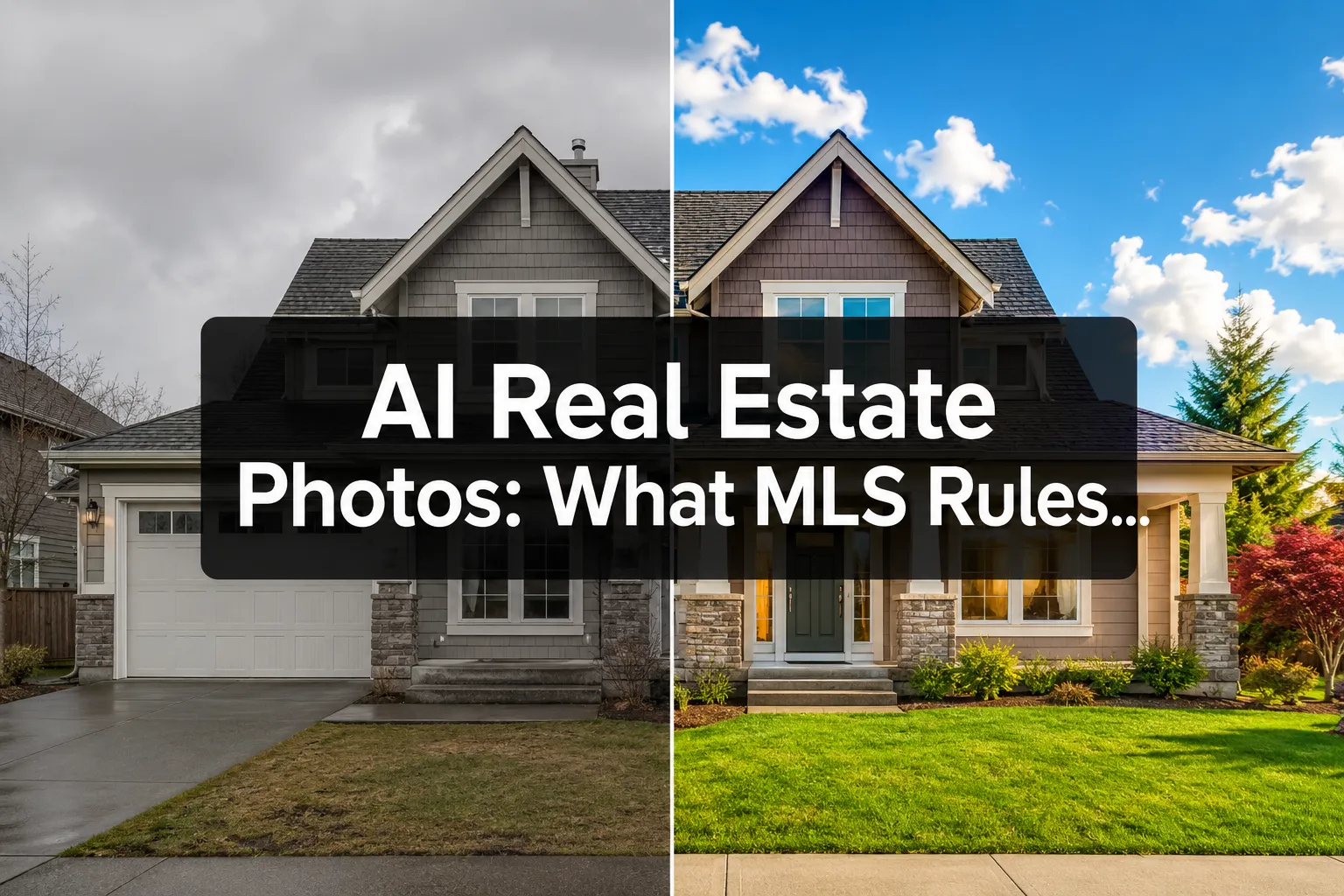
AI real estate photos are allowed by most MLS boards in 2026, but with strict disclosure requirements. You can use AI for sky replacement, virtual staging, lawn enhancement, and day-to-dusk conversions, as long as you clearly label them as digitally altered and don't misrepresent the property's actual condition. Removing structural defects, adding features that don't exist, or failing to disclose AI enhancements can trigger MLS violations, Fair Housing complaints, and potential license sanctions. The line between enhancement and misrepresentation is now enforced by automated detection tools like Restb.ai that scan every uploaded listing photo.
Key Takeaways
- Most MLS boards now require explicit disclosure when AI photo editing alters a property's appearance beyond basic color correction and cropping
- Sky replacement, virtual staging, and lawn greening are generally allowed with proper "digitally enhanced" or "virtually staged" labels
- Removing structural elements (power lines, fences, neighboring buildings) without disclosure is considered material misrepresentation in 2026
- NAR guidance emphasizes that photos must represent the property's current, actual condition, AI edits that mislead buyers violate Fair Housing and ethics rules
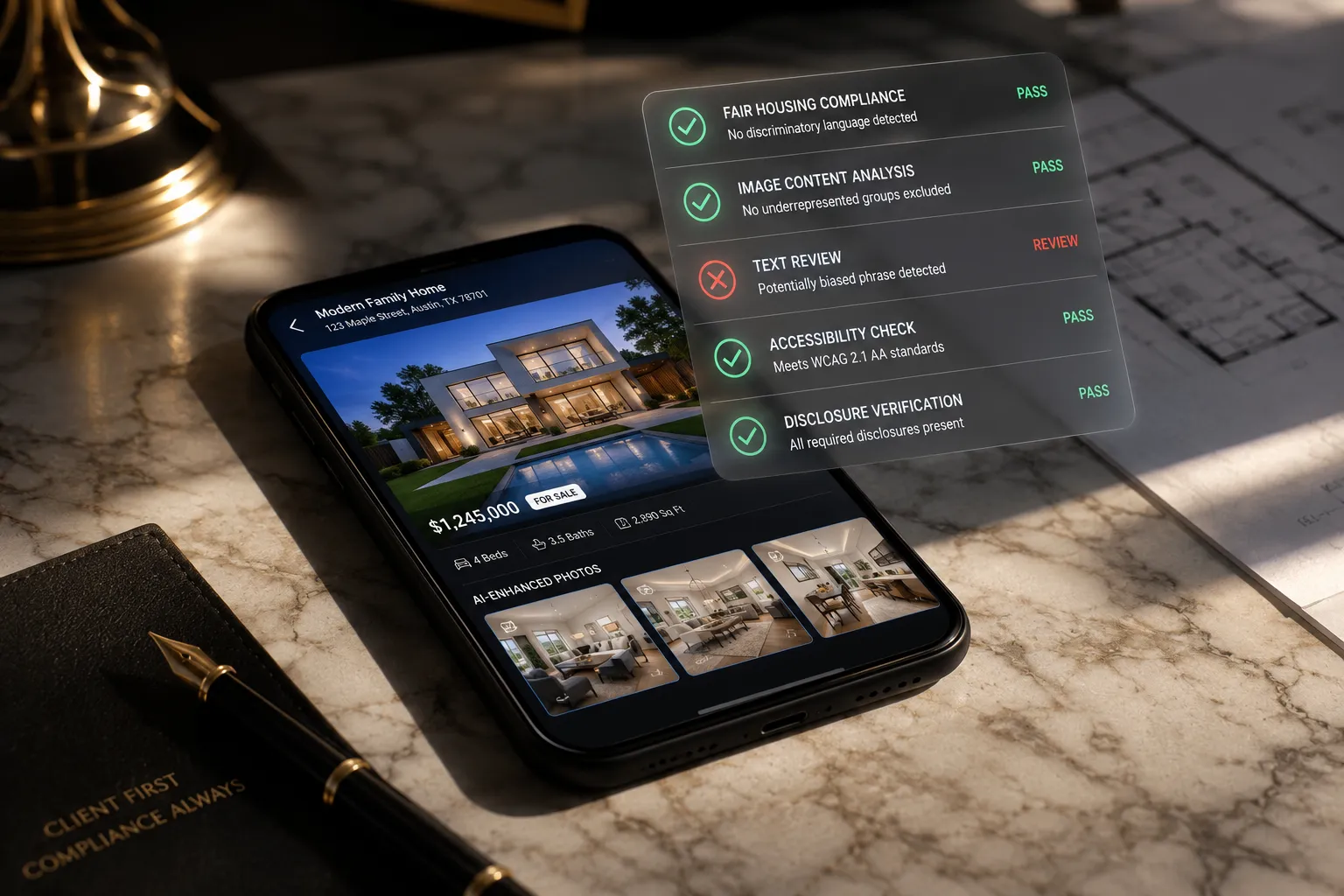
- Automated compliance tools like Restb.ai now scan MLS uploads and flag AI-edited photos, making undisclosed edits easier to catch
- Disclosure language must appear in photo captions, listing remarks, or both, placement varies by MLS
- Penalties for violations range from listing removal and fines to license suspension for repeat offenders
- Luxury listings don't get special exemptions, the same disclosure rules apply regardless of price point
- State-level regulations are emerging, with California and New York leading stricter AI photo disclosure laws in 2026
What Are the Current MLS Rules for AI-Edited Real Estate Photos?
In 2026, MLS rules for AI photo editing real estate listings fall into three tiers: allowed without disclosure, allowed with disclosure, and prohibited. Basic adjustments like brightness, contrast, white balance, and cropping don't require disclosure, these are considered standard photography corrections. AI enhancements that change the property's appearance, such as sky replacement, virtual staging, lawn greening, and day-to-dusk editing, are allowed but must be clearly labeled. Edits that misrepresent the property's condition or add features that don't exist are banned outright.
The National Association of Realtors updated its photo guidelines in late 2025 to address AI tools directly. The core principle: photos must accurately represent the property as it exists today. If an AI edit creates an expectation the property can't meet in person, it crosses into misrepresentation territory.
Most regional MLS boards adopted NAR's framework but added their own disclosure language requirements. Some require the phrase "digitally enhanced" in the photo caption. Others mandate a checkbox during upload or a statement in the listing remarks. A few MLS systems now auto-detect AI edits using computer vision and prompt agents to add disclosure before the listing goes live.
What counts as standard editing (no disclosure needed):
- Brightness, contrast, saturation adjustments
- White balance correction
- Cropping and straightening
- Lens distortion correction
- HDR bracketing and exposure blending
- Minor blemish removal (dust spots, small stains)
What requires disclosure:
- Sky replacement or enhancement
- Virtual staging (furniture, decor)
- Lawn and landscaping color enhancement
- Day-to-dusk conversion
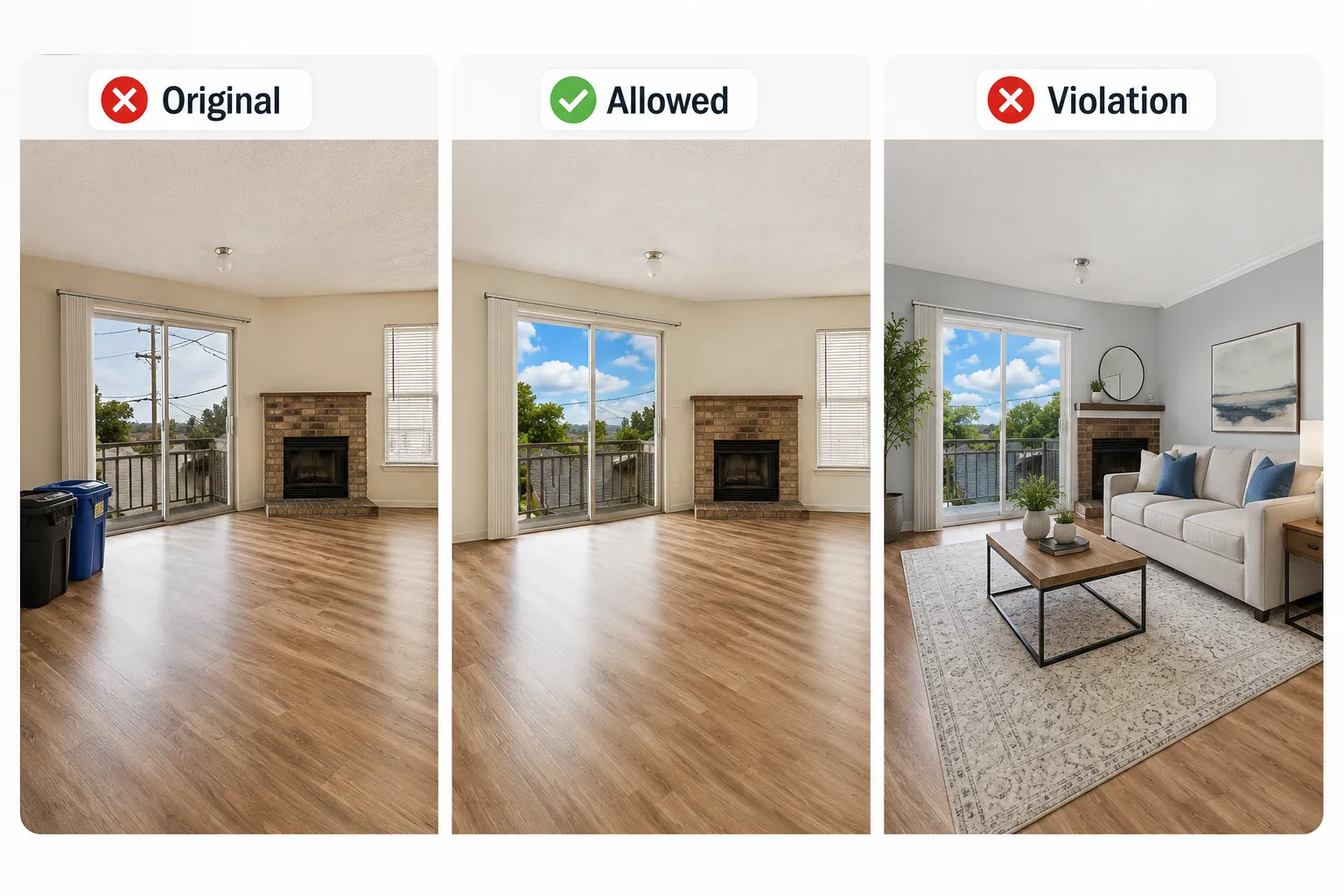
- Decluttering (removing visible items like trash cans, cars)
- Object removal (power lines, fences, signs)
- Weather enhancement (adding sunshine, removing rain)
What's prohibited:
- Adding rooms, features, or structures that don't exist
- Removing or hiding structural defects
- Altering property boundaries or lot size
- Changing architectural elements (rooflines, windows, siding)
- Misrepresenting condition (making old look new)
- Removing neighboring properties or context that affects value
For agents managing multiple listings, best real estate marketing automation platforms now include built-in compliance checks that flag photos needing disclosure before MLS upload.
Can I Use AI to Enhance Listing Photos Without Disclosing It?
No. Using AI photo editing real estate tools without disclosure violates MLS rules in 2026 and exposes you to ethics complaints, listing removal, fines, and license sanctions. Even if your local MLS hasn't explicitly updated its photo policy, NAR's Code of Ethics Standard of Practice 12-5 requires that photos and marketing materials present properties accurately. Undisclosed AI enhancements that alter appearance fall under misrepresentation.
The bigger risk: you'll probably get caught. MLS systems now integrate AI detection tools like Restb.ai that analyze uploaded photos for signs of digital manipulation. These systems flag sky replacements, object removal, virtual staging, and other common AI edits with high accuracy. When flagged, the listing is held for review, and the agent must either add disclosure or revert to unedited photos.
Beyond MLS enforcement, buyers who feel misled by AI-enhanced photos can file Fair Housing complaints if they believe the edits concealed property defects or neighborhood characteristics. In 2026, we've seen cases where undisclosed AI edits, like removing nearby industrial buildings or power lines, led to post-closing lawsuits and broker liability.
Why agents skip disclosure (and why it backfires):
- They assume "everyone does it" and no one checks
- They fear disclosure will make the listing look less appealing
- They don't realize their MLS has updated rules
- They use third-party editing services that don't mention compliance
What happens when you're caught:
- Listing suspended until corrected
- MLS fines (typically $250,$1,000 per violation)
- Mandatory ethics training
- Formal complaint filed with state real estate commission
- Repeat violations can trigger license suspension
- Broker liability if client sues over misrepresentation
The irony: properly disclosed AI-enhanced photos perform just as well as undisclosed ones. Buyers in 2026 understand that "virtually staged" or "sky enhanced" labels mean the photo shows the property's potential, not a bait-and-switch. Transparency builds trust. Hiding edits destroys it.
If you're serious about scaling your real estate business without compliance headaches, check out our guide to marketing automation for real estate agents, it covers how to automate disclosure workflows so you never upload a non-compliant photo again.
Which MLS Boards Require Disclosure for AI-Generated Real Estate Images?
Most major MLS boards in 2026 require disclosure for AI-enhanced listing photos, though the specific language and placement vary. California Regional MLS (CRMLS), Bright MLS (Mid-Atlantic), MRED (Chicago), and NWMLS (Seattle) all mandate disclosure when AI tools alter a property's appearance beyond standard corrections. Florida's MLS systems (Miami Realtors, Stellar MLS) adopted similar rules in early 2026 after a wave of complaints about misleading virtual staging.
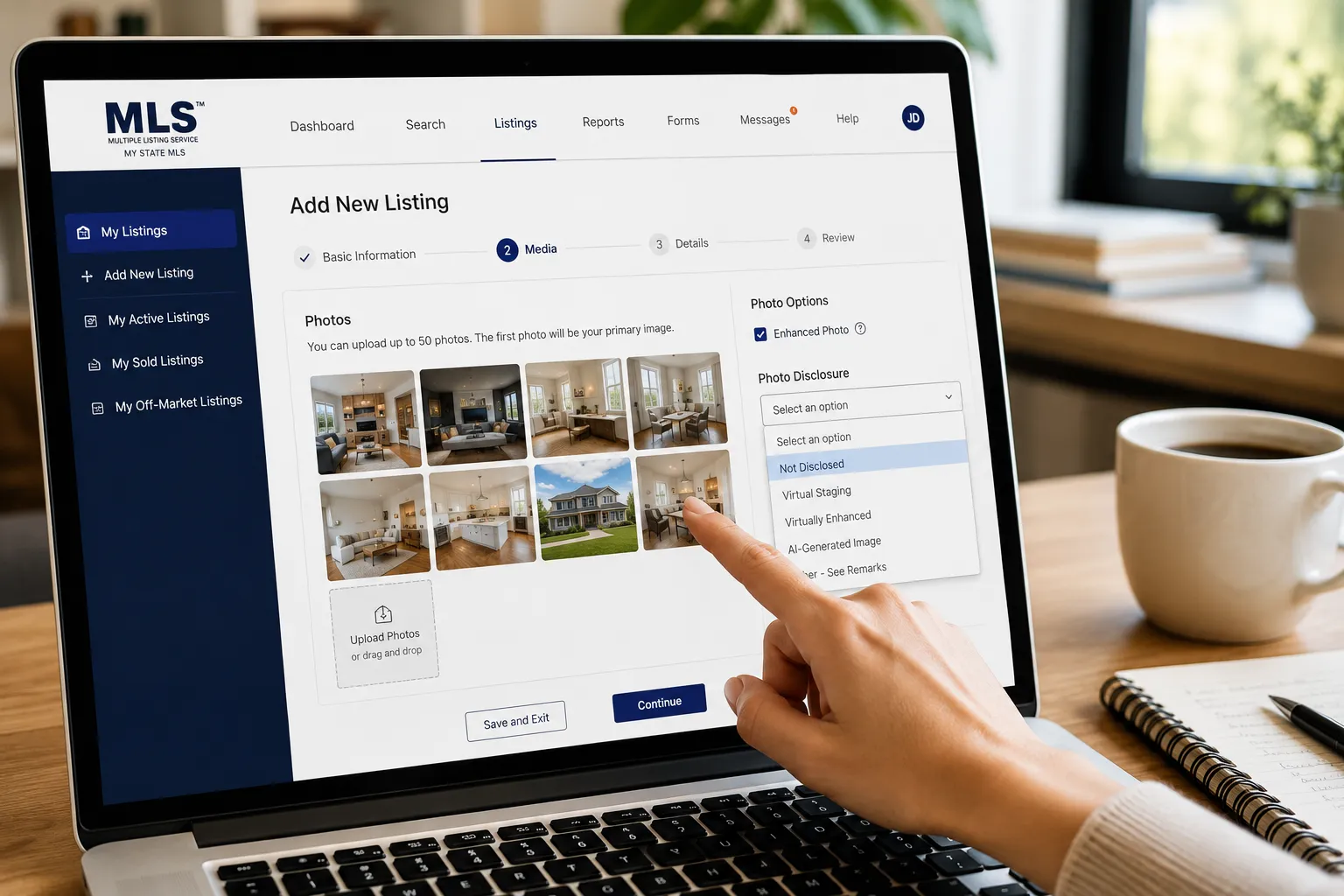
Texas MLS boards (NTREIS, HAR) require agents to check a "digitally altered" box during photo upload and include disclosure language in listing remarks. New York's MLS systems (MLSLI, HGMLS) go further, requiring the phrase "AI Enhanced" or "Digitally Staged" in each photo's caption, not just the listing description.
Smaller regional MLS boards often follow NAR guidance without adding specific enforcement mechanisms, which means compliance depends on agent honesty and post-complaint review. But even in markets without explicit AI photo rules, Standard of Practice 12-5 still applies, you're required to present properties accurately.
MLS boards with strict AI photo disclosure rules (2026):
- California Regional MLS (CRMLS), disclosure required in photo captions
- Bright MLS (DC, MD, VA, PA, DE, WV), "digitally enhanced" label mandatory
- MRED (Chicago), checkbox during upload + listing remarks disclosure
- NWMLS (Seattle), virtual staging must be labeled in caption
- NTREIS (Dallas), "AI edited" disclosure in remarks
- Houston Association of Realtors (HAR), checkbox + caption requirement
- Miami Realtors, "virtually staged" or "digitally enhanced" in caption
- Stellar MLS (Florida), disclosure in photo caption and remarks
- MLSLI (Long Island), "AI Enhanced" required in caption
- HGMLS (Hudson Gateway, NY), disclosure in caption and listing description
What disclosure language looks like:
- "This photo has been digitally enhanced."
- "Virtually staged, furniture not included."
- "Sky replacement used for marketing purposes."
- "Lawn and landscaping color enhanced."
- "Day-to-dusk conversion, actual daytime photo available."
Some MLS systems auto-populate disclosure language when you check the "digitally altered" box. Others require you to type it manually. A few use AI detection to pre-fill the disclosure field, which you can edit but not delete.
If you're managing listings across multiple MLS boards, best CRM for real estate agents platforms now include MLS-specific compliance templates that auto-insert the correct disclosure language based on where you're listing.
AI Virtual Staging vs Traditional Staging: MLS Compliance in 2026

AI virtual staging and traditional physical staging have different disclosure requirements under 2026 MLS rules. Physical staging, where you rent furniture and decor to furnish a vacant property, doesn't require disclosure because the staged setup exists in real life when buyers tour the home. AI virtual staging, where furniture and decor are digitally added to photos of empty rooms, must be disclosed because the furnishings don't exist and buyers will see empty rooms in person.
The disclosure language matters. "Virtually staged" or "digitally staged" clearly communicates that the furniture is not included. Vague phrases like "staged for marketing" can confuse buyers into thinking the furniture conveys with the property, which creates liability.
From a performance standpoint, AI virtual staging works. Listings with virtually staged photos get more clicks and showings than vacant room photos, even with disclosure. Buyers understand the concept, they're looking at the space's potential, not a promise of included furniture. The key is making the disclosure obvious so no one feels tricked when they walk into an empty house.
AI virtual staging pros:
- Costs $25,$75 per room vs $2,000,$5,000 for physical staging
- Turnaround in 24-48 hours vs 1-2 weeks for physical staging
- No furniture rental, delivery, or removal logistics
- Easy to test multiple design styles
- Works for properties in any condition
AI virtual staging cons:
- Requires clear "virtually staged" disclosure
- Buyers may feel disappointed seeing empty rooms in person
- Can't stage outdoor spaces as convincingly
- Some buyers distrust digitally altered photos
- MLS compliance varies by region
Traditional staging pros:
- No disclosure required, what you see is what you get
- Buyers experience the staged setup during tours
- Creates emotional connection in person
- Works for open houses and video tours
- No compliance risk
Traditional staging cons:
- Expensive, especially for large homes
- Logistical hassle (scheduling, delivery, removal)
- Furniture can get damaged during showings
- Limited style options based on rental inventory
- Not cost-effective for lower-priced listings
For most agents, the move is to use AI virtual staging for online marketing and invest in physical staging only for high-value listings or homes that need serious help showing well. Just make sure your MLS disclosure is airtight.
If you're exploring AI tools beyond photos, our best AI tools for real estate agents guide covers everything from listing descriptions to lead follow-up automation.
What Happens If I Violate MLS Photo Editing Rules With AI?
Violating MLS photo editing rules with AI triggers a compliance review that can result in listing suspension, fines, mandatory ethics training, and formal complaints filed with your state real estate commission. The severity depends on whether it's your first offense, whether the violation was intentional, and whether buyers or other agents filed complaints.
First-offense penalties (typical):
- Listing suspended until corrected
- Warning letter from MLS
- Required to complete photo compliance training
- $250,$500 fine
- Incident noted in your MLS account
Repeat-offense penalties:
- $1,000+ fines per violation
- Temporary MLS suspension (30-90 days)
- Formal ethics complaint filed with state commission
- Mandatory broker review of all your listings
- Potential license suspension if pattern of misrepresentation is found
Severe violations (material misrepresentation):
- Immediate listing removal
- MLS suspension (6 months to permanent)
- State license suspension or revocation
- Civil liability if buyer sues for fraud or misrepresentation
- Broker E&O insurance claim (and premium increase)
The most common violation: removing structural elements or defects without disclosure. An agent in Florida lost her license in 2025 after repeatedly using AI to remove visible mold, roof damage, and foundation cracks from listing photos. The MLS flagged the edits, buyers complained, and the state commission found a pattern of intentional misrepresentation.
Less severe but still costly: failing to disclose virtual staging or sky replacement. These violations usually result in fines and training, not license action, but they damage your reputation and create friction with your broker.
How violations get caught:
- Automated AI detection tools (Restb.ai, MLS-integrated scanners)
- Buyer complaints after touring the property
- Other agents reporting suspicious photos
- MLS random compliance audits
- Post-closing disputes and lawsuits
The takeaway: the risk-reward ratio of undisclosed AI edits is terrible. You save maybe 10 minutes by skipping disclosure and risk thousands in fines, license sanctions, and legal liability. Just add the disclosure.
For agents who want to stay ahead of compliance changes, our real estate news and market updates section covers new MLS rules, NAR policy shifts, and state-level regulations as they roll out.
Are AI Sky Replacements Allowed in Real Estate Listings?
Yes, AI sky replacements are allowed in real estate listings in 2026, but you must disclose them. Most MLS boards permit sky replacement as long as the photo caption or listing remarks include language like "sky enhanced" or "digitally altered." The edit must be realistic, replacing a gray sky with blue is fine, but adding a sunset that never happens at that property's orientation crosses into misrepresentation.
Sky replacement is one of the most common AI photo edits in real estate because it dramatically improves curb appeal without changing the property itself. A home photographed under overcast skies looks dull and uninviting. Swap in a blue sky with a few clouds, and the same house looks fresh and move-in ready. Buyers understand this is a marketing enhancement, not a promise of permanent sunshine.
Best practices for AI sky replacement:
- Use realistic skies that match the property's climate and season
- Avoid dramatic sunsets or unnatural colors
- Disclose the edit in photo captions or listing remarks
- Provide at least one unedited exterior photo in the listing
- Don't replace skies in photos showing weather-related defects (roof damage, drainage issues)
When sky replacement becomes misrepresentation:
- Replacing skies to hide weather patterns that affect the property (constant fog, heavy rain)
- Using sky edits to conceal nearby industrial pollution or smoke
- Adding skies that misrepresent the property's orientation or sun exposure
- Replacing skies in photos showing structural damage to make defects less visible
The compliance line: if the sky replacement changes a buyer's perception of the property's condition, location, or livability, it's misrepresentation. If it's purely aesthetic enhancement, it's allowed with disclosure.
Tools like BoxBrownie and Restb.ai offer one-click sky replacement with automatic disclosure language generation, making compliance easy. If you're using these tools as part of a broader real estate marketing automation workflow, make sure your MLS upload process includes a disclosure checkpoint.
Do I Need to Label AI-Enhanced Photos on Zillow and Realtor.com?
Yes, you should label AI-enhanced photos on Zillow and Realtor.com even though these platforms don't enforce disclosure as strictly as MLS systems. Zillow's terms of service require that listing photos accurately represent the property, and Realtor.com (operated by Move, Inc.) follows NAR guidelines. While neither platform actively scans for AI edits or requires specific disclosure language, failing to disclose can lead to buyer complaints, listing removal, and legal liability.
The practical reason to disclose: buyers who feel misled by photos are more likely to leave negative reviews, file complaints with your broker, or escalate to Fair Housing claims. In 2026, transparency is the baseline expectation. Buyers know AI tools exist, and they're fine with enhanced photos as long as you're upfront about it.
How to disclose AI edits on Zillow and Realtor.com:
- Add "Virtually Staged" or "Digitally Enhanced" to photo captions
- Include disclosure language in the listing description
- Upload at least one unedited photo for comparison
- Use Zillow's "Virtual Tour" or "3D Home" tags to set expectations
- Respond to buyer questions about photo accuracy in comments
Zillow's algorithm favors listings with high-quality photos, so AI-enhanced images can improve your listing's visibility. But the boost only works if buyers trust the photos. Undisclosed edits that lead to disappointed showings hurt your listing's engagement metrics and push it down in search results.
Realtor.com syndicates listings from MLS feeds, so if your MLS listing includes disclosure, it usually carries over. But if you're uploading photos directly to Realtor.com (for FSBO or off-market listings), you're responsible for adding disclosure manually.
Platforms with stricter photo policies:
- Redfin, requires disclosure for virtual staging and major edits
- Trulia, follows Zillow's guidelines (same parent company)
- Homes.com, requires accurate representation, no specific AI disclosure rules yet
- Compass and Sotheby's proprietary platforms, follow NAR guidelines
For agents managing listings across multiple platforms, best email marketing software for real estate agents can automate disclosure language insertion across MLS, Zillow, Realtor.com, and your own website.

What Photo Edits Are Considered Misrepresentation by MLS?
MLS boards consider any photo edit that materially misrepresents a property's condition, features, or surroundings as a violation. Material misrepresentation means the edit changes information a reasonable buyer would rely on when deciding to tour or make an offer. Adding features that don't exist, removing defects, altering property boundaries, and hiding neighborhood context all fall into this category.
The test: if a buyer tours the property and says "this doesn't match the photos," you've crossed the line. Minor differences are expected, lighting, angles, and lens choice affect how spaces look. But if the photo shows a feature, condition, or view that doesn't exist in real life, it's misrepresentation.
Edits that are always misrepresentation:
- Adding rooms, structures, or features (pools, decks, garages) that don't exist
- Removing or hiding structural defects (cracks, water damage, mold, roof issues)
- Altering property boundaries or lot size
- Changing architectural elements (adding windows, changing rooflines, altering facades)
- Removing neighboring properties or structures that affect value
- Digitally renovating spaces to look newer or upgraded
- Removing signs of deferred maintenance (peeling paint, broken fixtures, overgrown landscaping)
Edits in the gray zone (context-dependent):
- Removing power lines, allowed with disclosure in some MLS boards, prohibited in others
- Decluttering (removing trash cans, cars, personal items), allowed with disclosure if it doesn't hide defects
- Lawn greening, allowed with disclosure unless it hides drainage or landscaping issues
- Object removal (fences, signs), allowed with disclosure if it doesn't misrepresent property boundaries
Edits that are clearly allowed with disclosure:
- Sky replacement (realistic skies only)
- Virtual staging (furniture and decor)
- Day-to-dusk conversion
- Color correction and brightness adjustments
- HDR and exposure blending
The safest approach: if you're unsure whether an edit crosses the line, either skip it or disclose it. Disclosure protects you even if the edit is borderline. Hiding an edit guarantees liability if someone complains.
For agents building long-term businesses, reputation matters more than any single listing. Our real estate farming guide explains how to dominate your local market through trust and consistency, undisclosed AI edits undermine both.
Best AI Real Estate Photo Tools That Are MLS Compliant
The best AI real estate photo tools in 2026 include built-in compliance features like automatic disclosure language, MLS-specific templates, and edit tracking. BoxBrownie, Restb.ai, VirtualStagingAI, and PhotoUp lead the market because they understand MLS rules and make it easy to stay compliant while delivering high-quality edits.
BoxBrownie, Industry standard for virtual staging, sky replacement, and day-to-dusk edits. Offers MLS-compliant disclosure templates and 24-hour turnaround. Pricing: $24,$32 per photo for virtual staging, $1.60,$4 per photo for sky replacement and enhancements.
Restb.ai, AI-powered photo editing and compliance detection. Used by MLS boards to scan for undisclosed edits, but also offers agent-facing tools for virtual staging, object removal, and enhancement. Includes automatic disclosure language generation. Pricing: Custom enterprise pricing for MLS boards, $0.10,$0.50 per photo for agent tools.
VirtualStagingAI, Fast, affordable virtual staging with one-click furniture styles. Includes "Virtually Staged" watermark option and disclosure templates. Pricing: $16,$24 per room.
PhotoUp, Full-service photo editing (HDR, virtual staging, sky replacement, decluttering) with human quality control. Offers MLS disclosure add-on service. Pricing: $1.50,$5 per photo depending on edit complexity, virtual staging $25,$35 per room.
Styldod, Virtual staging and renovation visualization. Includes disclosure language in downloadable files. Pricing: $24,$29 per room for virtual staging.
VisualStager, DIY virtual staging software with drag-and-drop furniture. Includes disclosure watermark option. Pricing: $19,$39/month subscription.
Apply Design, Virtual staging and renovation mockups. Offers MLS-compliant disclosure templates. Pricing: $17,$24 per room.
Peddle, AI-powered virtual staging and enhancement with compliance tracking. Pricing: $8,$15 per photo.
Key features to look for:
- Automatic disclosure language generation
- MLS-specific compliance templates
- Edit tracking and version control
- Realistic, high-quality output
- Fast turnaround (24-48 hours)
- Bulk upload and processing
- Integration with MLS upload workflows
Most agents use a combination: BoxBrownie or PhotoUp for high-priority listings, VirtualStagingAI or Peddle for volume work. The cost difference between compliant and non-compliant tools is negligible, there's no reason to risk violations to save a few dollars per photo.
If you're scaling your listing volume, best real estate lead generation software can help you fill your pipeline while these tools handle the photo compliance side.
How Much Do MLS-Approved AI Photo Editing Services Cost?
MLS-approved AI photo editing services cost between $1.50 and $35 per photo in 2026, depending on the complexity of the edit. Basic enhancements like sky replacement, color correction, and brightness adjustments run $1.50,$5 per photo. Virtual staging costs $16,$35 per room. Day-to-dusk conversions cost $4,$8 per photo. Object removal and decluttering cost $3,$10 per photo depending on how much work is involved.
Typical pricing breakdown:
- Sky replacement: $1.60,$4 per photo
- Virtual staging: $16,$35 per room
- Day-to-dusk conversion: $4,$8 per photo
- Lawn greening: $2,$5 per photo
- Object removal (power lines, trash cans, cars): $3,$10 per photo
- Decluttering: $3,$8 per photo
- HDR blending and color correction: $1.50,$3 per photo
- Full exterior enhancement package: $15,$25 per photo
Most services offer volume discounts. If you're editing 20+ photos per listing, you can negotiate package pricing that brings the per-photo cost down 20-30%. Some services include MLS disclosure language generation as a free add-on, while others charge $5,$10 per listing for compliance documentation.
Cost comparison: AI editing vs traditional methods
- AI virtual staging: $16,$35 per room vs physical staging: $2,000,$5,000 total
- AI sky replacement: $2,$4 per photo vs reshooting on a clear day: $200,$500 photographer fee
- AI day-to-dusk: $4,$8 per photo vs twilight photoshoot: $300,$600 photographer fee
- AI decluttering: $3,$8 per photo vs hiring cleaners and rescheduling shoot: $150,$300
The ROI is clear: AI editing costs a fraction of traditional methods and delivers results in 24-48 hours instead of days or weeks. For a typical listing with 25 photos, you're looking at $100,$300 in AI editing costs vs $2,000,$5,000 for physical staging and reshoots.
Free and low-cost options:
- Canva (basic photo editing, not real estate-specific): Free,$13/month
- Fotor (AI enhancement tools): Free,$9/month
- Pixlr (online photo editor): Free,$8/month
- Remove.bg (background removal): Free for low-res, $9/month for high-res
Free tools work for basic edits but lack real estate-specific features like virtual staging, day-to-dusk conversion, and MLS disclosure templates. For professional listings, the $1.50,$35 per photo investment in purpose-built tools is worth it.
For agents tracking ROI across marketing spend, best accounting software for real estate agents can help you categorize photo editing as a listing expense and measure its impact on days-on-market and sale price.
Can Luxury Real Estate Agents Use More AI Editing Than Regular Listings?
No, luxury real estate agents must follow the same MLS AI photo rules as agents selling entry-level homes. Price point doesn't change disclosure requirements or what counts as misrepresentation. The misconception that luxury listings get more leeway comes from the fact that high-end properties often have professional photography, staging, and marketing budgets that make AI edits less necessary, but when AI tools are used, the same compliance rules apply.
Luxury buyers are often more sophisticated and more likely to notice discrepancies between photos and reality. They're also more likely to have attorneys review purchase agreements and pursue legal action if they feel misled. Undisclosed AI edits on a $5 million listing carry the same MLS violation risk as a $200,000 listing, but the financial and reputational stakes are higher.
Why luxury agents sometimes push boundaries:
- They assume high-end buyers expect "aspirational" marketing
- They're competing with other agents using aggressive photo enhancement
- They have larger marketing budgets and access to advanced AI tools
- They believe luxury listings are held to different standards
Why this backfires:
- Luxury buyers tour fewer properties and scrutinize details more carefully
- High-end transactions involve more parties (attorneys, inspectors, appraisers) who review marketing materials
- Luxury agents' reputations depend on trust and discretion, undisclosed edits destroy both
- MLS boards and state commissions make examples of high-profile violations
The smart play for luxury agents: invest in professional photography, physical staging, and high-quality video tours so AI edits are minimal. When you do use AI tools (virtual staging for vacant estates, sky replacement for exterior shots), disclose them clearly. Luxury marketing should emphasize quality and authenticity, not digital trickery.
For agents building luxury practices, our best states to invest in real estate guide covers high-end markets where photo quality and compliance matter most.
Common Mistakes Realtors Make With AI Photo Editing and MLS Rules
The most common mistake realtors make with AI photo editing is assuming "everyone does it" and skipping disclosure. This leads to MLS violations, buyer complaints, and license risk. Other frequent errors include over-editing to the point of misrepresentation, using AI to hide defects, failing to check MLS-specific disclosure requirements, and relying on third-party editors who don't understand compliance.
Top mistakes and how to avoid them:
Mistake 1: No disclosure because "it looks natural"
Just because an AI edit looks realistic doesn't mean it's compliant. Sky replacement, virtual staging, and lawn greening all require disclosure even if buyers can't tell the photo was edited.
Mistake 2: Using generic disclosure language
"Photos enhanced for marketing" is too vague. Use specific language: "Virtually staged, furniture not included" or "Sky replacement used in exterior photos."
Mistake 3: Disclosing in the wrong place
Some MLS boards require disclosure in photo captions, others in listing remarks, some in both. Check your MLS rules and follow them exactly.
Mistake 4: Over-editing to the point of misrepresentation
AI tools make it easy to go too far. Removing power lines, fences, and neighboring structures without disclosure crosses into misrepresentation. If the edit changes what a buyer sees in person, disclose it or skip it.
Mistake 5: Using AI to hide defects
Removing visible damage, mold, stains, or structural issues is always misrepresentation, even with disclosure. AI edits should enhance presentation, not conceal problems.
Mistake 6: Assuming luxury listings get special treatment
They don't. The same MLS rules apply regardless of price point.
Mistake 7: Not checking MLS updates
MLS boards update photo policies regularly. Rules that didn't exist in 2024 are now enforced in 2026. Check your MLS bulletin board and attend compliance training.
Mistake 8: Relying on editors who don't know MLS rules
Offshore editing services and freelance platforms often deliver great-looking photos with zero compliance consideration. If you outsource editing, make sure the service understands MLS disclosure requirements or add disclosure yourself before uploading.
Mistake 9: Forgetting to disclose on syndication sites
Your MLS disclosure might not carry over to Zillow, Realtor.com, or your brokerage website. Add disclosure manually on every platform where the photos appear.
Mistake 10: Not keeping unedited versions
If a buyer or MLS board questions your photos, you need to produce the originals. Keep unedited versions of every photo you enhance.
For agents who want to automate compliance and avoid these mistakes, automated real estate agent tools can flag non-compliant photos before they go live.
Do Different States Have Different MLS Rules for AI Photos?
Yes, MLS rules for AI photos vary by state and region in 2026, though most follow NAR's national framework. California and New York have the strictest disclosure requirements, with state-level regulations that go beyond MLS policies. Texas and Florida MLS boards enforce disclosure but leave specific language up to individual agents. Smaller states often rely on NAR guidance without adding state-specific rules.
State-level AI photo regulations (2026):
California, State law requires disclosure of "materially altered" real estate marketing images. MLS boards (CRMLS, BAREIS, SDMLS) mandate disclosure in photo captions. Violations can trigger state license action independent of MLS penalties.
New York, Department of State guidance requires disclosure of virtual staging and major photo edits. MLS boards (MLSLI, HGMLS) require "AI Enhanced" or "Digitally Staged" labels in captions.
Texas, TREC (Texas Real Estate Commission) follows NAR guidelines. Individual MLS boards (NTREIS, HAR, ABOR) set their own disclosure language requirements.
Florida, No state-level AI photo law, but MLS boards (Miami Realtors, Stellar MLS, MFRMLS) require disclosure. State license action possible under existing misrepresentation rules.
Illinois, IDFPR (Department of Financial and Professional Regulation) considers undisclosed AI edits as potential license violations. MRED (Chicago MLS) requires disclosure checkbox and listing remarks.
Washington, No state-specific AI photo law. NWMLS (Seattle) requires disclosure for virtual staging and major edits.
Arizona, Colorado, Nevada, Oregon, Follow NAR guidelines with MLS-specific disclosure requirements but no state-level regulations yet.
States without specific AI photo rules, Most other states rely on NAR Code of Ethics and MLS policies. Violations are handled as misrepresentation cases under existing license law.
The trend: more states are adding AI-specific disclosure requirements as complaints increase. California and New York are leading the way, and other states are watching to see if state-level regulation is necessary or if MLS enforcement is sufficient.
What this means for agents:
- If you list in multiple states, learn each state's rules
- When in doubt, follow the strictest standard (California/New York model)
- State license action is more serious than MLS fines, don't assume MLS compliance equals state compliance
- Keep up with state real estate commission bulletins and rule updates
For agents working across state lines, best real estate markets for flipping houses covers regional compliance considerations for investors and agents marketing renovated properties.
What Counts as Material Misrepresentation in AI-Edited Property Photos?
Material misrepresentation in AI-edited property photos means any edit that changes information a reasonable buyer would rely on when deciding to tour, make an offer, or complete a purchase. The key word is "material", the edit must affect something that matters to the transaction. Adding a feature that doesn't exist, removing a defect, altering property boundaries, or hiding neighborhood context all qualify.
Courts and real estate commissions use the "reasonable buyer" test: would a reasonable buyer, seeing the edited photo, form an expectation about the property that can't be met in reality? If yes, it's material misrepresentation.
Examples of material misrepresentation:
- Adding a pool, deck, or garage that doesn't exist
- Removing visible structural damage (cracks, water stains, roof issues)
- Digitally renovating kitchens or bathrooms to look upgraded
- Removing neighboring properties or structures (industrial buildings, power plants, highways)
- Altering lot lines or property boundaries
- Removing signs of flooding, drainage issues, or environmental hazards
- Changing architectural features (adding windows, altering rooflines)
- Making old or damaged features look new or repaired
Examples that are NOT material misrepresentation (with disclosure):
- Sky replacement (realistic skies only)
- Virtual staging (furniture and decor)
- Lawn greening (unless it hides drainage issues)
- Decluttering (removing trash cans, cars, personal items)
- Day-to-dusk conversion
- Color correction and brightness adjustments
The gray zone:
- Removing power lines, material if they significantly affect views or property value, not material if they're minor background elements
- Removing fences, material if they define property boundaries, not material if they're temporary or decorative
- Removing signs, material if they indicate zoning or land use restrictions, not material if they're temporary yard signs
The safest rule: if an edit changes what a buyer sees during a tour, it's material. If it only changes how the photo looks, it's enhancement. When in doubt, disclose.
Legal consequences of material misrepresentation:
- Buyer can rescind the purchase contract
- Buyer can sue for damages (difference between represented and actual value)
- MLS violations and fines
- State license suspension or revocation
- Broker E&O insurance claim
- Fair Housing complaints if the misrepresentation relates to protected characteristics or neighborhood demographics
For agents and sellers preparing listings, our 60-day home selling plan covers how to present your property accurately while maximizing appeal, no misrepresentation required.
Allowed vs Prohibited: AI Real Estate Photo Edits in 2026
Here's the definitive breakdown of what AI photo edits are allowed, allowed with disclosure, or prohibited under 2026 MLS rules. This table reflects NAR guidance and the most common MLS board policies. Always check your local MLS for specific requirements.
| Edit Type | Status | Disclosure Required? | Notes |
|---|---|---|---|
| Brightness/contrast adjustment | Allowed | No | Standard photo correction |
| White balance correction | Allowed | No | Standard photo correction |
| Cropping and straightening | Allowed | No | Standard photo correction |
| HDR blending | Allowed | No | Standard photo technique |
| Sky replacement (realistic) | Allowed with disclosure | Yes | “Sky enhanced” in caption |
| Virtual staging | Allowed with disclosure | Yes | “Virtually staged” required |
| Lawn greening | Allowed with disclosure | Yes | “Digitally enhanced” recommended |
| Day-to-dusk conversion | Allowed with disclosure | Yes | “Dusk photo enhanced” in caption |
| Decluttering (trash, cars) | Allowed with disclosure | Yes | Only if not hiding defects |
| Power line removal | Allowed with disclosure | Yes | MLS-specific; some prohibit entirely |
| Weather enhancement | Allowed with disclosure | Yes | Adding sunshine, removing rain |
| Adding features (pools, decks) | Prohibited | N/A | Material misrepresentation |
| Removing structural defects | Prohibited | N/A | Material misrepresentation |
| Altering property boundaries | Prohibited | N/A | Material misrepresentation |
| Digital renovation (making old look new) | Prohibited | N/A | Material misrepresentation |
| Removing neighboring properties | Prohibited | N/A | Material misrepresentation |
| Changing architectural elements | Prohibited | N/A | Material misrepresentation |
Disclosure language templates:
Copy these into your MLS photo captions or listing remarks:
- "This photo has been digitally enhanced for marketing purposes."
- "Virtually staged, furniture and decor not included with property."
- "Sky replacement used in exterior photos."
- "Lawn and landscaping color enhanced."
- "Day-to-dusk conversion, actual daytime photo available upon request."
- "Digitally decluttered, some items removed for presentation."
- "Power lines removed for marketing purposes, visible from property."
For agents building systems that scale, best transaction management software can store disclosure templates and auto-populate them based on which AI edits you use.
FAQ: AI Real Estate Photos and MLS Rules 2026
Can I use AI to remove a neighbor's junk from listing photos?
Yes, with disclosure. Decluttering photos by removing visible items like trash cans, cars, or yard debris is allowed as long as you label the photo "digitally enhanced" or "decluttered for marketing." The edit can't hide property defects or misrepresent boundaries.
Do I need to disclose AI edits if the listing is off-market or FSBO?
Yes. Even if you're not uploading to MLS, NAR's Code of Ethics applies to all marketing materials. Buyers who feel misled can file complaints or sue for misrepresentation regardless of how the property was marketed.
What happens if my MLS auto-detects AI edits I didn't disclose?
Your listing will be held for review. You'll need to add disclosure or replace the photos with unedited versions before the listing goes live. Repeat violations trigger fines and potential MLS suspension.
Can I use AI to make a fixer-upper look move-in ready?
No. Digitally renovating spaces to look upgraded when they're not is material misrepresentation. You can use virtual staging to show potential, but the staging must be disclosed and can't misrepresent the property's actual condition.
Are AI-generated floor plans subject to the same disclosure rules as photos?
Yes. If you use AI to create or enhance floor plans, they must accurately represent the property's layout and dimensions. Adding rooms or altering square footage is misrepresentation.
Do I need separate disclosure for each edited photo or one disclosure for the whole listing?
It depends on your MLS. Some require disclosure in each edited photo's caption. Others allow a single disclosure statement in the listing remarks. Check your MLS photo policy.
Can I use AI to change the season in listing photos?
Only with disclosure. Adding fall foliage or snow to a summer photo is allowed if you label it "digitally enhanced" or "seasonal effect added." But it can't misrepresent the property's climate or location.
What if my photographer uses AI editing without telling me?
You're still responsible for MLS compliance. Always ask your photographer what edits they apply and add disclosure if needed. Keep unedited versions of all photos.
Can I use AI to remove "For Sale" signs from competitor listings in neighborhood photos?
No. Altering photos of other properties without permission can violate copyright and trademark laws, and misrepresenting neighborhood context violates MLS rules.
Do I need to disclose AI edits on social media posts?
Yes. Any marketing material that shows AI-edited photos should include disclosure, even on Instagram, Facebook, or TikTok. It protects you from misrepresentation claims and builds trust with your audience.
Can I use AI to add virtual furniture to outdoor spaces like patios and decks?
Yes, with disclosure. Virtual staging works for outdoor spaces as long as you label it "virtually staged" and the furniture placement is realistic.
What if a buyer complains about AI edits after closing?
If the edits were properly disclosed, you're protected. If they weren't disclosed and the buyer can prove material misrepresentation, they may have grounds for a lawsuit or rescission claim.
Conclusion
AI real estate photos are a powerful marketing tool in 2026, but only when used within MLS rules and with proper disclosure. The line between enhancement and misrepresentation is clear: edits that improve presentation are allowed with disclosure, edits that mislead buyers are prohibited, and edits that hide defects or add features that don't exist are always violations.
The compliance landscape has tightened significantly. Automated detection tools like Restb.ai scan MLS uploads, state-level regulations are emerging in California and New York, and buyers are more aware of AI editing than ever. The days of undisclosed photo manipulation are over, and that's a good thing for the industry.
For agents, the path forward is straightforward: use AI tools to create extraordinary listing presentations, disclose every edit that changes the property's appearance, and keep unedited versions for reference. The cost of compliance is negligible, a few seconds to add disclosure language. The cost of violations is steep, fines, license sanctions, and reputation damage that can take years to repair.
For buyers and sellers, the message is equally clear: expect AI-enhanced photos, demand disclosure, and tour properties in person before making decisions. Photos show potential, not promises. The best agents use AI to help you see what's possible while staying impeccable about what's real.
The real estate industry is still figuring out how to balance AI innovation with consumer protection. Let it cook before we see the final results. But in 2026, the baseline is set: transparency wins, shortcuts lose, and the agents who master compliant AI photo editing will dominate their markets.
If you're ready to build a real estate business that scales without cutting corners, explore our agent resources hub for tools, training, and strategies that actually work. Because at the end of the day, the best marketing is the truth, just presented in the best possible light.
SEO Meta Title: AI Real Estate Photos: What MLS Rules Allow in 2026
Tags: ai real estate photos, mls photo rules, ai photo editing real estate, virtual staging disclosure, real estate photography, mls compliance, nar photo guidelines, ai enhanced listing photos, real estate marketing, property photos