


Last updated: July 20, 2026

Quick Answer
AI negotiation prep for home buyers means using tools like ChatGPT or Claude to analyze comparable sales, days-on-market data, and seller concessions before you write your offer. You feed the AI raw property data and ask it to build a fact-based justification memo that explains why your offer price is fair. The AI doesn't replace your agent, it prepares the case your agent will use at the negotiating table. Most buyers who skip this step walk in with a number but no story, and sellers smell weakness.
Key Takeaways
- AI negotiation tools analyze comps, days on market, and seller concessions to build a data-backed offer strategy before you negotiate.
- ChatGPT and Claude can generate offer-justification memos in minutes when you provide clean property data and neutral prompts.
- The best workflow: gather comps and DOM data, feed it to AI with a structured prompt, generate a memo, then ask the AI to argue the seller's side to pressure-test your case.
- AI prep costs nothing if you use free tiers of ChatGPT or Claude; premium versions ($20/month) handle larger datasets and longer outputs.
- First-time buyers benefit most because AI levels the playing field, you get the same data-driven strategy experienced investors use.
- Common mistakes include feeding the AI incomplete comps, asking it to "negotiate" instead of "prepare," and ignoring your agent's local market knowledge.
- In hot markets, AI helps you justify escalation clauses and identify which concessions to request when bidding over asking.
- You need: recent comps (3-6 months), days on market for each comp, your target property's listing history, and any known seller motivations.
What Is AI Negotiation Prep for Buying a House?
AI negotiation prep for buying a house is the process of using artificial intelligence tools, primarily large language models like ChatGPT, Claude, or Gemini, to analyze property data, build a fact-based offer strategy, and draft persuasive justification documents before you submit an offer or enter negotiations. You're not asking the AI to negotiate for you. You're asking it to organize your evidence, spot patterns in comparable sales, and translate raw numbers into a coherent argument that explains why your offer price is reasonable.
Think of it like prepping for a debate. You wouldn't walk into a courtroom without organizing your evidence first. The same logic applies when you're about to make the biggest purchase of your life. AI negotiation home buying tools let you walk into that offer conversation with a memo that says, "Here's why $485,000 is fair based on five comps sold in the last 90 days, all of which closed below list price after sitting on the market for 30+ days."
The AI doesn't know your local market better than your agent. It doesn't have insider knowledge about the seller's divorce or job relocation. What it does have is the ability to process dozens of data points in seconds and present them in a format that makes your case look impeccable. When your agent sits down with the listing agent, they're not guessing, they're armed with a document that shows you did your homework.
We've seen buyers use this approach to save thousands on their final purchase price, not because the AI magically lowered the price, but because the seller's agent couldn't argue with the data. When you show up with comps analysis ChatGPT helped you organize, you're no longer just another buyer throwing out a number. You're a buyer who knows the market.
For more context on how today's buyers are navigating the 2026 market, check out our guide on U.S home buyers market trends in 2026.
AI Negotiation Prep for Home Buyers: Build Your Offer Case First
Here's the truth: most buyers walk into negotiations with a price in mind but no story to back it up. They say, "We'll offer $475K," and when the seller counters at $510K, they either fold or walk away. AI negotiation prep for home buyers flips that script. You build your offer case first, before you submit anything, so when the seller pushes back, you're ready with data, not desperation.
The workflow is simple. You gather comparable sales data (comps), days-on-market stats, and any known seller concessions from recent transactions. You feed that data into an AI tool with a structured prompt that asks it to analyze the numbers and draft an offer-justification memo. The AI outputs a document that explains, in plain English, why your offer is fair based on market conditions. You review it, refine it with your agent, and use it as the foundation for your negotiation strategy.
This isn't about replacing your agent. It's about showing up prepared. Your agent knows the local market, the neighborhood dynamics, and the personalities involved. The AI knows how to organize data and spot patterns. Together, they're a powerful combo. We've worked with buyers who used this exact process to negotiate $15,000 off the asking price in a competitive market, simply because they could prove their offer was based on reality, not emotion.
The best part? This process takes about 30 minutes once you have the data. You're not spending hours manually comparing spreadsheets or trying to remember which comp had the bigger yard. The AI does the heavy lifting, and you walk away with a professional-looking memo that makes you look like you've been doing this for years.
If you're a first-time buyer, this levels the playing field. Experienced investors and move-up buyers already know how to build these cases, they've done it before. AI gives you the same advantage without the learning curve. For more tips on navigating your first purchase, see our First-Time Home Buyers Tips for Gen Z.
How Does AI Help You Prepare a Home Offer Before Negotiating?
AI helps you prepare a home offer by taking raw property data, comps, listing prices, days on market, square footage, condition notes, and turning it into a structured argument that justifies your offer price. You're essentially outsourcing the grunt work of data analysis to a tool that can process dozens of variables in seconds and present them in a format that's easy to understand and hard to argue with.
Here's how it works in practice. You pull recent comparable sales from your MLS access (or ask your agent to pull them), along with days-on-market data from Redfin or Zillow. You note any seller concessions, did the seller pay closing costs? Offer a home warranty? Drop the price twice before closing? You compile this into a simple list or table. Then you open ChatGPT or Claude and paste in a prompt like this:
Sample Prompt:
"I'm preparing an offer on a 3-bedroom, 2-bath home listed at $525,000. Below are five comparable sales from the last 90 days in the same neighborhood. Analyze the data and draft a one-page offer justification memo that explains why an offer of $490,000 is reasonable based on these comps, days on market, and market conditions. Include a summary of each comp, the average price per square foot, and any patterns in seller concessions."
You paste in your comp data, hit enter, and the AI generates a memo in about 60 seconds. The output includes a summary paragraph, a breakdown of each comp, an analysis of price trends, and a conclusion that ties it all together. You review it, adjust any details the AI got wrong (it's not perfect), and share it with your agent.
The AI doesn't negotiate for you. It doesn't call the listing agent or write the offer contract. It prepares the case so that when your agent does negotiate, they have a document that says, "Here's why this offer makes sense." That's the difference between walking in with confidence and walking in with hope.
We've seen this approach work in both buyer's markets and competitive markets. In a buyer's market, the memo reinforces that you're offering fair value and the seller should take it seriously. In a hot market, it helps you justify an escalation clause or explain why you're not going $50K over asking like everyone else. Either way, you're negotiating from a position of strength.
For a deeper dive into how to use AI tools effectively, check out our Top 13 Real Estate AI Tools for Investors in 2026.
AI Negotiation Tools vs Traditional Real Estate Agent Advice

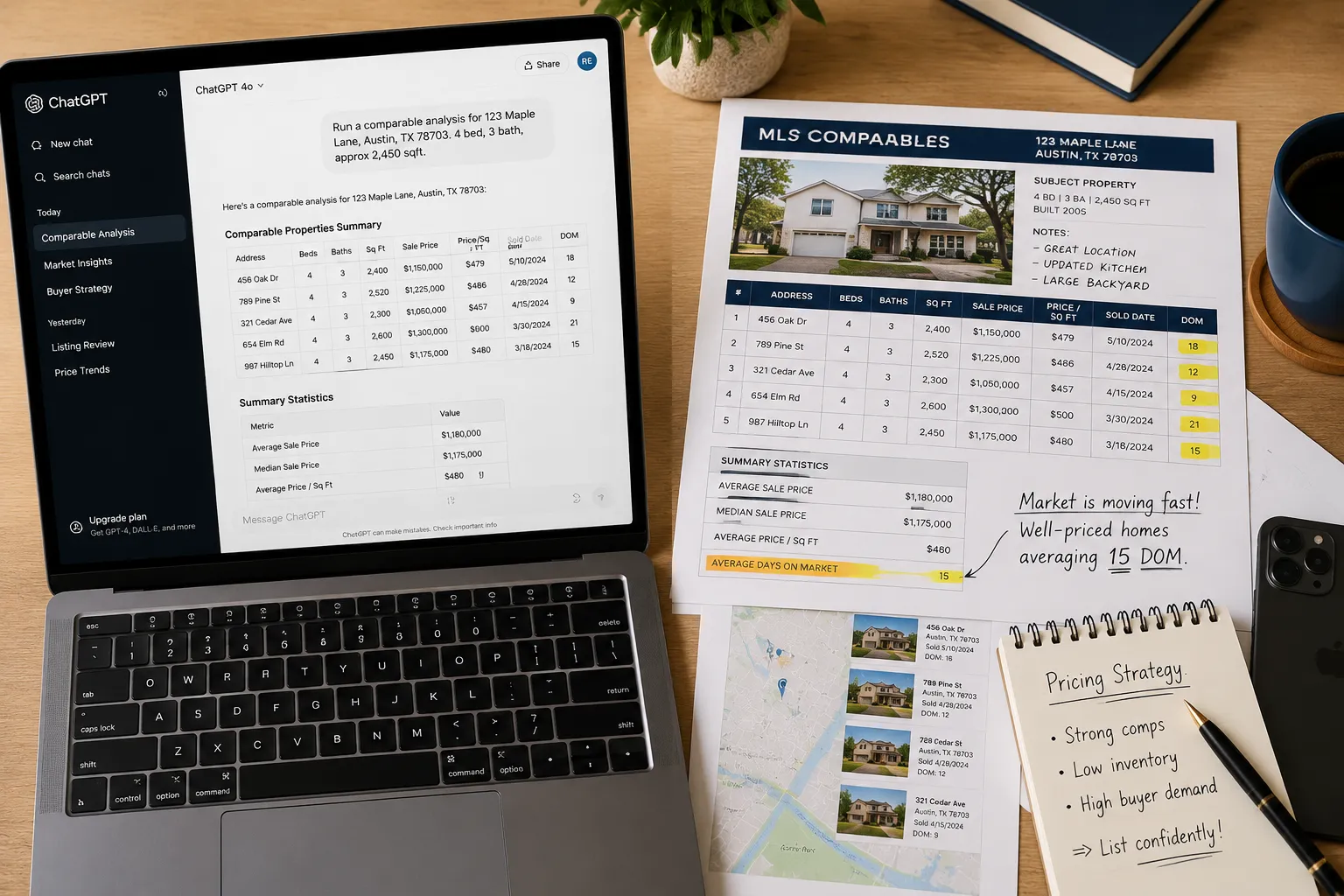
AI negotiation tools and traditional real estate agent advice aren't competitors, they're complementary. Your agent brings local market knowledge, relationship capital with other agents, and years of experience reading between the lines of a seller's motivation. AI brings speed, data processing power, and the ability to generate professional documents in minutes. The best buyer negotiation strategy in 2026 uses both.
Here's what AI does better: organizing large datasets, spotting patterns across dozens of comps, and drafting structured documents without emotional bias. If you hand ChatGPT 15 comparable sales and ask it to calculate average price per square foot, identify outliers, and summarize trends, it'll do it in seconds. Your agent could do the same thing, but it would take an hour, and they'd rather spend that hour on the phone with the listing agent building rapport.
Here's what your agent does better: understanding why a particular comp sold for more (the seller was a contractor and upgraded everything), knowing that the listing agent always counters high on the first round, and recognizing that the seller's timeline matters more than the price. AI doesn't know that the seller's kid starts school in August and they need to close by July 15. Your agent does.
The mistake buyers make is thinking they have to choose one or the other. You don't. Use AI to prepare the data-driven case, then hand it to your agent and say, "Here's what the numbers say. What am I missing?" Your agent will add context, adjust for factors the AI can't see, and use the memo as a starting point for the actual negotiation.
We've worked with agents who love this approach because it saves them time and makes their clients look sharp. We've also worked with agents who resist it because they think it undermines their expertise. If your agent falls into the second camp, show them the memo and explain that you're not trying to replace them, you're trying to make their job easier. Most agents come around once they see the quality of the output.
For more on how to work effectively with your agent, see our guide on negotiation power moves to save thousands on your next home.
Best AI Apps for Home Buyers to Build Offer Strategy
The best AI apps for home buyers to build an offer strategy are ChatGPT (OpenAI), Claude (Anthropic), and Google Gemini. All three are large language models capable of analyzing property data, drafting justification memos, and pressure-testing your negotiation case. The differences come down to interface, output style, and how much data you can feed them in a single prompt.
ChatGPT is the most popular option. The free tier (GPT-3.5) handles basic comps analysis and memo drafting, but it has a shorter context window, so you're limited to about 10-12 comps per prompt. ChatGPT Plus ($20/month) gives you access to GPT-4, which can handle longer datasets, produces more nuanced analysis, and is better at following complex instructions. If you're serious about using AI for negotiation prep, the $20/month is worth it.
Claude (by Anthropic) is the underdog that's gaining traction among real estate professionals. Claude's free tier is generous, and its paid version (Claude Pro, also $20/month) has a larger context window than ChatGPT, meaning you can paste in more comps and get a more thorough analysis. Claude also tends to produce more conversational, less robotic output, which is helpful if you're planning to share the memo with your agent or use it in a buyer presentation.
Google Gemini is the newest player. It's free, it's fast, and it integrates with Google Workspace, so if you're already using Google Sheets to track your comps, you can feed that data directly into Gemini. The downside is that Gemini's output can be hit-or-miss, it's great for quick summaries but less reliable for detailed, structured memos. Use it for brainstorming or quick checks, but lean on ChatGPT or Claude for the final document.
All three tools are free to start, so you can test them before committing to a paid plan. We recommend trying all three with the same dataset and comparing the outputs. You'll quickly figure out which one matches your workflow and produces the style of memo you prefer.
For more on how AI is transforming real estate workflows, check out our article on Marketing Your Home with AI Tools in 2026.
How Much Does AI Negotiation Software Cost for Home Buying?
AI negotiation software for home buying costs anywhere from $0 to $20 per month, depending on which tool you use and whether you need premium features. The free tiers of ChatGPT, Claude, and Google Gemini are sufficient for most buyers who are preparing a single offer or working on one property at a time. If you're an investor analyzing multiple deals simultaneously or a buyer who wants faster response times and longer outputs, the paid versions are worth the $20/month.
Here's the breakdown. ChatGPT Free (GPT-3.5) gives you unlimited access but slower response times and a shorter context window. You can analyze 8-10 comps per prompt, which is enough for most single-family home offers. ChatGPT Plus ($20/month) gets you GPT-4, faster responses, priority access during peak times, and the ability to handle 20+ comps in a single prompt. If you're buying in a competitive market and need to move fast, the $20 is a no-brainer.
Claude Free offers a similar experience to ChatGPT Free but with a slightly larger context window, so you can paste in more data before hitting the limit. Claude Pro ($20/month) is the best value if you're doing heavy data analysis, it can handle massive datasets and produces cleaner, more structured output. We've seen buyers use Claude Pro to analyze entire neighborhoods of comps in one session.
Google Gemini is free for most users and doesn't have a paid tier yet (as of early 2026). It's fast and integrates with Google Workspace, but the output quality isn't as consistent as ChatGPT or Claude. Use it as a supplementary tool, not your primary one.
The bottom line: if you're buying one home and you're on a budget, start with the free versions. If you're serious about using AI to gain an edge in negotiations, $20/month for ChatGPT Plus or Claude Pro is a fraction of what you'll save on your purchase price if the strategy works. We've seen buyers save $10,000+ on a single transaction using these tools, which makes the $20 subscription look like the best investment you'll make all year.
For more on budgeting for your home purchase, see our guide on Best Mortgage Options for Gen Z Home Buyers 2026.
Can AI Actually Help Me Get a Lower Price on a House?
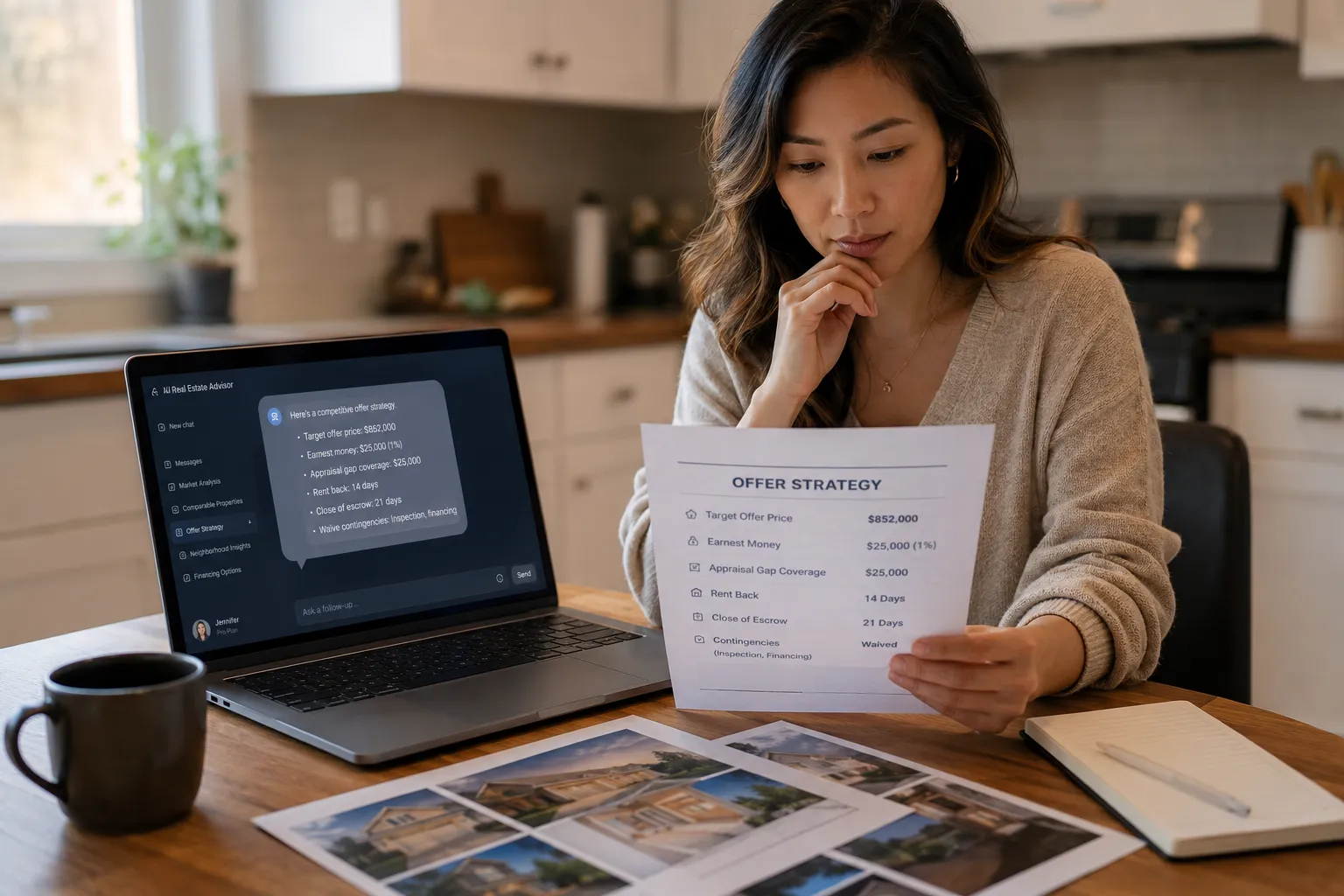
AI can help you get a lower price on a house by giving you a data-backed justification for your offer that's harder for the seller to dismiss. It doesn't magically lower the price, it arms you with the evidence and structure you need to negotiate from a position of strength. When you show up with a memo that says, "Here are five comps that closed below list price in the last 60 days, and here's why your property fits that pattern," the seller's agent has to respond to the data, not just your opinion.
Here's the reality: sellers and their agents are more likely to accept a lower offer if they believe it's based on market reality, not lowball tactics. AI helps you build that credibility. When your offer includes a one-page justification memo that breaks down price per square foot, days on market trends, and recent seller concessions in the neighborhood, you're signaling that you're a serious buyer who's done the homework. That's very different from the buyer who offers $50K under asking with no explanation.
We've worked with buyers who used AI-generated offer strategy documents to negotiate $15,000 to $25,000 off the asking price in markets where sellers were initially firm on their number. The key was that the memo didn't just say, "We think it's worth less." It said, "Here's why the market says it's worth less, and here's the data to prove it." That shift in framing makes all the difference.
Does it work every time? No. If the seller has multiple offers or the property is priced correctly for a hot market, no amount of data will convince them to drop the price. But in situations where the seller is motivated, the property has been sitting, or the market is cooling, a well-prepared AI negotiation case can absolutely tip the scales in your favor.
The other benefit: even if you don't get a lower price, you might get better terms. Sellers are more willing to cover closing costs, include appliances, or offer a home warranty when they see that you're a prepared buyer who's not going to nickel-and-dime them later. AI helps you negotiate the whole package, not just the price.
For more on how to approach negotiations strategically, check out our article on negotiation power moves to save thousands on your next home.
What Data Does AI Use to Prepare My Home Offer Case?
AI uses comparable sales data (comps), days-on-market statistics, listing price history, property condition notes, and any known seller concessions to prepare your home offer case. The quality of the AI's output depends entirely on the quality of the data you feed it. Garbage in, garbage out. If you give the AI incomplete or outdated comps, it'll generate a memo that looks professional but won't hold up under scrutiny.
Here's what you need to gather before you prompt the AI:
1. Comparable Sales (Comps): Pull 5-10 recent sales (ideally within the last 90 days) of similar properties in the same neighborhood or zip code. Include the address, sale price, square footage, number of bedrooms and bathrooms, lot size, and any notable features (pool, garage, recent renovations). Your agent can pull this from the MLS, or you can use Redfin, Zillow, or RPR (Realtors Property Resource) if you have access.
2. Days on Market (DOM): For each comp, note how many days it was listed before it sold. This is critical. A house that sold in 5 days signals a hot market; a house that sat for 60 days signals buyer leverage. The AI will use this to assess whether your target property is overpriced relative to how fast similar homes are moving.
3. Listing Price History: Did the seller drop the price? How many times? By how much? Price reductions are a sign of seller motivation, and the AI will flag this as leverage for your offer. You can find this on Redfin or Zillow under the property's listing history.
4. Seller Concessions: Did any of the comps include seller-paid closing costs, home warranties, or appliances? If so, note it. This shows the AI (and the seller's agent) that concessions are common in the market, which strengthens your case if you're asking for them.
5. Property Condition Notes: If you've toured the property or have inspection notes, include any major issues (old roof, outdated HVAC, cosmetic repairs needed). The AI can factor these into the justification for a lower offer.
Once you have this data, you paste it into the AI with a structured prompt. The AI analyzes the numbers, identifies patterns, and drafts a memo that ties it all together. The better your data, the stronger your case.
For more on how to gather and interpret property data, see our guide on Best Home Buying Sites in the U.S. for 2026.
Is AI Negotiation Prep Worth It for First-Time Home Buyers?
AI negotiation prep is absolutely worth it for first-time home buyers because it levels the playing field. Experienced buyers and investors already know how to build data-driven offer cases, they've done it before. First-timers are walking into negotiations for the first time, often against sellers who've sold multiple properties and agents who've closed hundreds of deals. AI gives you the same analytical firepower without the learning curve.
Here's why it matters. First-time buyers tend to make two mistakes: they either offer too much because they're afraid of losing the house, or they offer too little because they don't understand the market. Both mistakes cost money. AI negotiation prep helps you land in the middle, offering a price that's fair based on data, not emotion. When you walk into that negotiation with a memo that says, "Here's why $480K is reasonable," you're not guessing. You're making an informed decision.
The other benefit: confidence. First-time buyers often feel intimidated by the process. They don't know what questions to ask, what data matters, or how to push back when the seller counters. AI prep gives you a script. You can say, "Based on the comps we analyzed, here's why we think our offer is fair." That's a much stronger position than, "We just feel like it's too expensive."
We've worked with first-time buyers who used AI negotiation prep to save $10,000 to $20,000 on their first purchase. The savings paid for closing costs, moving expenses, and furniture. More importantly, they walked away from the transaction feeling like they got a fair deal, not like they got taken advantage of.
The cost is minimal, free if you use ChatGPT or Claude's free tiers, $20/month if you want premium features. Compare that to the thousands you could save (or overpay) by negotiating blind. It's a no-brainer.
For more first-time buyer guidance, check out our First-Time Home Buyers Tips for Gen Z and Best States for First-Time Home Buyers: 2026 Rankings.
Common Mistakes When Using AI for Home Offer Preparation
The most common mistakes when using AI for home offer preparation are feeding it incomplete data, asking it to "negotiate" instead of "prepare," ignoring your agent's local knowledge, and treating the AI's output as final without reviewing it. AI is a tool, not a magic wand. If you use it wrong, you'll get a polished-looking memo that's full of holes.
Mistake #1: Incomplete or Outdated Comps. If you feed the AI comps from six months ago in a fast-moving market, the analysis will be off. Use recent sales (last 60-90 days) and make sure the properties are truly comparable, same neighborhood, similar size, similar condition. Don't compare a renovated 3-bed to a fixer-upper 3-bed and expect the AI to catch the difference unless you tell it.
Mistake #2: Asking the AI to Negotiate. AI doesn't negotiate. It prepares. If you prompt it with, "Write an email to the seller's agent negotiating a lower price," you'll get a generic, awkward email that sounds like it was written by a robot. Instead, ask it to "draft a one-page offer justification memo" or "analyze these comps and explain why $490K is fair." The AI is great at organizing data and drafting documents. It's terrible at reading the room or building rapport.
Mistake #3: Ignoring Your Agent's Input. The AI doesn't know that the seller's agent always counters high, or that the neighborhood is about to get a new school, or that the seller is divorcing and needs to close fast. Your agent knows all of this. Use the AI to build the data case, then sit down with your agent and ask, "What am I missing?" They'll add context that makes the memo 10x stronger.
Mistake #4: Treating the Output as Final. AI makes mistakes. It might miscalculate price per square foot, misinterpret a data point, or include a comp that's not actually comparable. Always review the output, fact-check the numbers, and adjust anything that doesn't make sense. The AI is a first draft, not a final product.
Mistake #5: Overcomplicating the Prompt. Keep your prompts simple and structured. Don't write a paragraph of instructions and expect the AI to follow all of it. Use bullet points, clear data, and one specific ask. Example: "Analyze these five comps and draft a memo explaining why $485K is fair. Include average price per square foot and days on market trends."
For more on how to avoid common buyer mistakes, see our guide on First-Time Home Buyer Tips: A Real Estate Agent's Full Guide.
What If the AI Gives Me Wrong Comps for My Offer?
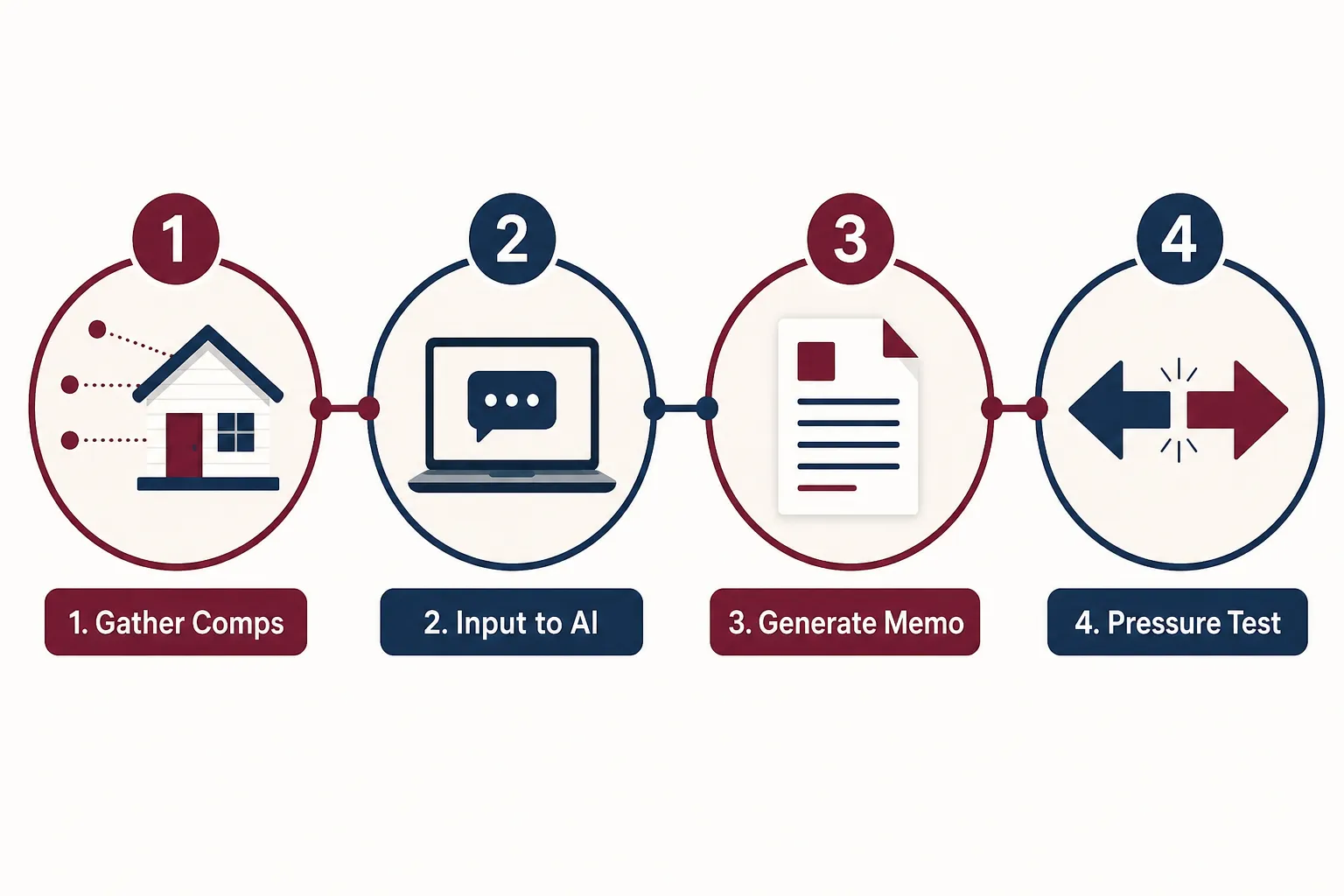
If the AI gives you wrong comps for your offer, it's because you either fed it bad data or didn't give it enough context to filter correctly. AI doesn't pull comps from the MLS or Redfin on its own, it only works with the data you provide. If you paste in a list of properties and one of them is a foreclosure sale or a comp from a different school district, the AI will include it unless you tell it not to.
Here's how to fix it. Before you prompt the AI, review your comp list and make sure every property is truly comparable. Same neighborhood (or adjacent), similar square footage (within 10-15%), similar condition, and sold within the last 60-90 days. If you're not sure whether a comp is valid, ask your agent or cross-check it on Redfin. Don't rely on the AI to make that judgment call, it can't.
When you prompt the AI, be explicit about what you want. Instead of saying, "Analyze these comps," say, "Analyze these five comps and exclude any that are foreclosures, short sales, or outside the 85210 zip code." The more specific your instructions, the better the output.
If the AI does include a bad comp in the memo, just delete it and regenerate the section. You can also ask the AI to revise: "Remove the comp at 123 Main St because it was a foreclosure sale. Recalculate the average price per square foot without it." The AI will adjust the analysis in seconds.
The bigger point: AI is a tool, not a replacement for your judgment. You're the quality control. Review every comp, fact-check every number, and make sure the final memo reflects reality. If you catch a mistake and fix it, the memo is still 10x faster and more professional than anything you'd build manually.
For more on how to interpret property data accurately, check out our article on Best Home Buying Sites in the U.S. for 2026.
Do Experienced Buyers Need AI Negotiation Prep Tools?
Experienced buyers don't need AI negotiation prep tools the way first-timers do, but they use them anyway because they save time and produce cleaner, more professional output. If you've bought five properties, you already know how to pull comps, calculate price per square foot, and build an offer case. But do you want to spend an hour doing it manually, or do you want to spend 10 minutes feeding data to ChatGPT and get a polished memo you can hand to your agent?
Here's the value for experienced buyers: speed and scalability. If you're an investor analyzing multiple deals at once, AI lets you generate offer-justification memos for three properties in the time it would take you to manually analyze one. You're not learning how to negotiate, you're automating the grunt work so you can focus on strategy and execution.
Experienced buyers also use AI to pressure-test their assumptions. You might think a property is worth $500K based on your gut and experience, but when you feed the comps into Claude and ask it to analyze the data, it might flag something you missed, like a trend of seller concessions in the neighborhood or a pattern of price reductions. The AI doesn't replace your expertise; it adds a second layer of analysis that catches blind spots.
The other use case: presentation. If you're submitting an offer in a competitive market, a one-page AI-generated memo makes you look sharp. It signals to the seller's agent that you're a serious buyer who's done the homework, not just another investor throwing out lowball offers. That credibility can be the difference between getting a callback and getting ignored.
Bottom line: experienced buyers don't need AI to know what they're doing, but they use it because it makes them faster, sharper, and more scalable. If you're still doing everything manually in 2026, you're leaving money and time on the table.
For more on how investors are using AI to scale their operations, see our guide on Top 13 Real Estate AI Tools for Investors in 2026.
How to Combine AI Offer Prep with Your Realtor's Advice
Combining AI offer prep with your realtor's advice is simple: use the AI to build the data case, then sit down with your agent and ask them to add context, adjust for local market factors, and refine the strategy. The AI handles the numbers; your agent handles the nuance. Together, they give you a negotiation strategy that's both data-driven and market-smart.
Here's the workflow. First, gather your comps, days-on-market data, and listing history. Feed it to ChatGPT or Claude with a structured prompt and generate your offer-justification memo. Review it, fact-check the numbers, and make sure it looks clean. Then send it to your agent with a note: "Here's what the data says. What am I missing? What would you adjust based on what you know about this seller and this market?"
Your agent will add the human layer. They might say, "The comps look good, but the seller's agent told me they have a backup offer, so we need to come in stronger." Or, "The days-on-market trend is accurate, but this neighborhood is about to get a new park, so prices are trending up, let's adjust the memo to acknowledge that." That's the context the AI can't provide.
Once your agent reviews the memo and adds their input, you have a final document that's both data-backed and market-aware. Your agent can use it in negotiations, include it with your offer, or reference it when the seller counters. It's a team effort, and the result is stronger than either the AI or the agent could produce alone.
We've worked with agents who love this approach because it makes their clients look prepared and makes their job easier. We've also worked with agents who initially resist it because they think it's unnecessary. If your agent falls into the second camp, show them the memo and explain that you're not trying to replace their expertise, you're trying to make their job easier and your offer stronger. Most agents come around once they see the quality of the output.
For more on how to work effectively with your agent, see our guide on negotiation power moves to save thousands on your next home.
Does AI Negotiation Prep Work in Hot Housing Markets?
AI negotiation prep works in hot housing markets, but the strategy shifts. In a hot market, you're not using AI to justify a lowball offer, you're using it to justify an escalation clause, explain why you're offering asking price (not over), or identify which concessions to request when you know you'll have to bid competitively. The AI helps you stay grounded in data when everyone else is bidding with emotion.
Here's how it plays out. In a hot market, properties sell fast, often with multiple offers. Sellers expect offers at or above asking, and they're less motivated to negotiate. But even in a hot market, not every property is priced correctly. AI negotiation prep helps you identify when a property is overpriced relative to recent comps, even if it's getting attention. If the data shows that similar homes sold for $510K in the last 30 days and this one is listed at $540K, you can use that information to justify offering asking price instead of going over.
The other use case: escalation clauses. If you're submitting an escalation clause (e.g., "We'll beat any offer by $5K up to $530K"), you can include an AI-generated memo that explains why $530K is your ceiling based on comps and market data. This signals to the seller that you're serious but not desperate, and it gives them confidence that your escalation is based on reality, not just a number you pulled out of thin air.
AI also helps you identify which concessions to request. In a hot market, sellers are less likely to cover closing costs or include appliances, but if the data shows that recent sales in the neighborhood included those concessions, you have leverage to ask. The AI memo becomes proof that your request is reasonable, not greedy.
The key is to adjust your expectations. In a hot market, AI negotiation prep won't get you $20K off the asking price. But it will help you avoid overpaying, justify your offer when you're competing, and identify opportunities to negotiate terms even when the price is firm.
For more on navigating competitive markets, check out our article on Spring 2026 Housing Market: Lower Rates & Rising Inventory.
What Information Do I Need to Input for AI to Build My Offer Case?
To build a strong offer case, you need to input comparable sales data, days-on-market statistics, listing price history, property condition notes, and any known seller concessions. The more complete and accurate your data, the stronger the AI's analysis and the more credible your final memo.
Here's the checklist:
1. Comparable Sales (5-10 properties):
- Address
- Sale price
- Square footage
- Bedrooms / bathrooms
- Lot size
- Sale date
- Notable features (pool, garage, renovations)
2. Days on Market (for each comp):
- How many days each property was listed before it sold
- Note any that sold unusually fast or slow
3. Listing Price History (for your target property):
- Original list price
- Any price reductions (amount and date)
- Current list price
4. Seller Concessions (if known):
- Did the seller pay closing costs?
- Include appliances or furniture?
- Offer a home warranty?
- Make repairs before closing?
5. Property Condition Notes:
- Age of roof, HVAC, appliances
- Any deferred maintenance or needed repairs
- Cosmetic condition (updated vs. dated)
6. Market Context (optional but helpful):
- Average days on market for the neighborhood
- Recent trends (prices rising, falling, or flat)
- Any upcoming developments (new schools, infrastructure)
Once you have this data, organize it into a simple list or table. You don't need fancy formatting, just clean, readable data. Then paste it into your AI tool with a structured prompt like this:
Sample Prompt:
"I'm preparing an offer on a 3-bed, 2-bath home at 456 Elm St, listed at $525,000. Below are five comparable sales from the last 90 days. Analyze the data and draft a one-page offer justification memo explaining why an offer of $490,000 is reasonable. Include average price per square foot, days on market trends, and any patterns in seller concessions."
The AI will generate a memo in about 60 seconds. Review it, adjust any errors, and share it with your agent. That's the entire workflow.
For more on how to gather and organize property data, see our guide on Best Home Buying Sites in the U.S. for 2026.
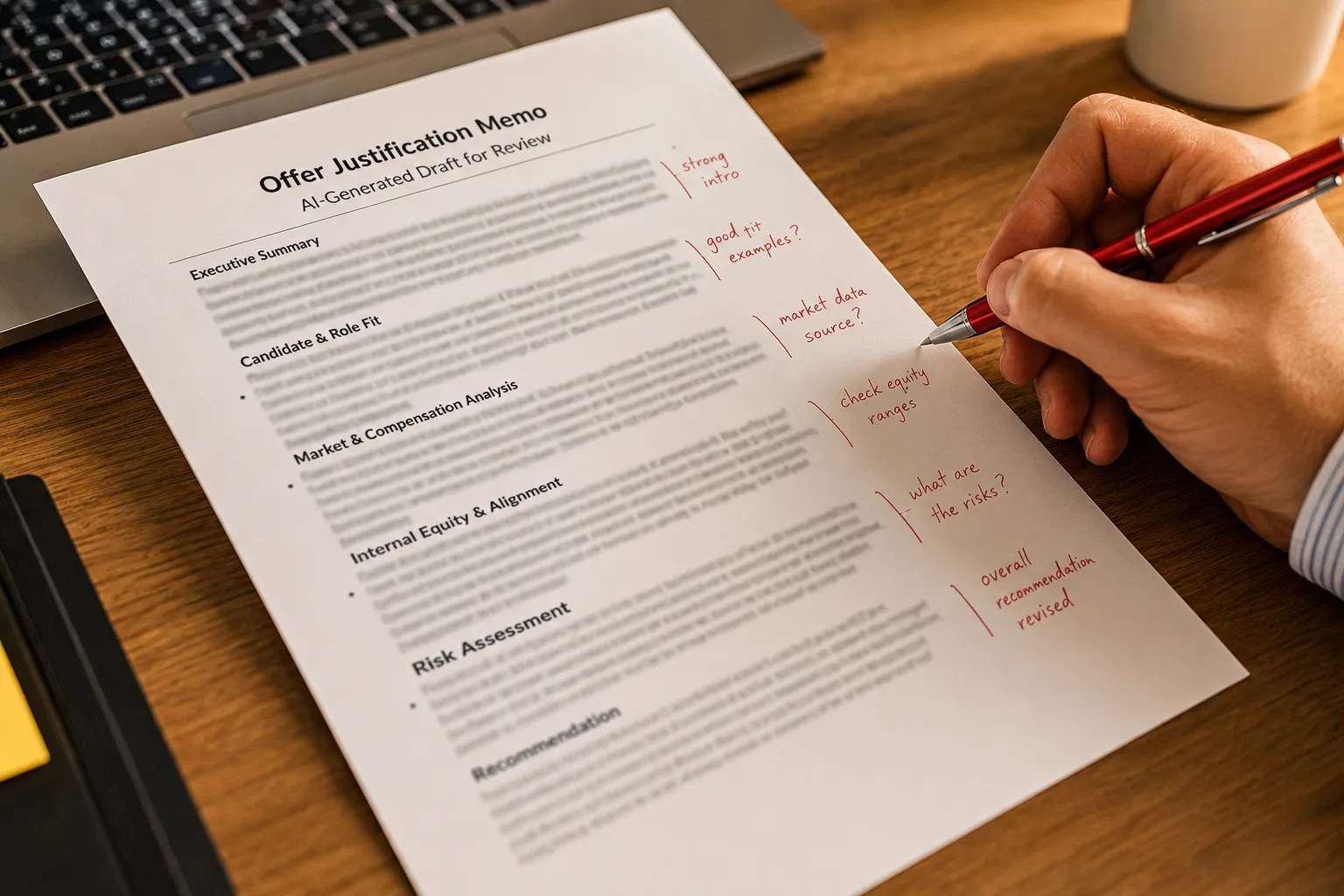
The Build-Your-Case Workflow: Step-by-Step
Here's the full AI negotiation prep workflow, broken into four steps. This is the exact process we use and recommend to buyers who want to walk into negotiations prepared.
Step 1: Gather Comps and Days-on-Market Data
Pull 5-10 recent comparable sales from the MLS, Redfin, Zillow, or RPR. Focus on properties sold in the last 60-90 days, in the same neighborhood or zip code, with similar square footage, bedrooms, and condition. For each comp, note the sale price, square footage, days on market, and any seller concessions. Also pull the listing price history for your target property, original list price, any reductions, and current price.
Step 2: Feed the Data to AI with a Neutral Prompt
Open ChatGPT, Claude, or Gemini. Paste in your comp data and use a structured prompt like this:
Verbatim Prompt:
"I'm preparing an offer on a [bedrooms]-bedroom, [bathrooms]-bathroom home at [address], listed at $[list price]. Below are [number] comparable sales from the last [timeframe]. Analyze the data and draft a one-page offer justification memo that explains why an offer of $[your offer price] is reasonable based on these comps, days on market, and market conditions. Include a summary of each comp, the average price per square foot, and any patterns in seller concessions or price reductions."
Hit enter. The AI will generate a memo in 60-90 seconds.
Step 3: Generate an Offer-Justification Memo
Review the AI's output. Check the math (price per square foot, averages), make sure the comps are accurate, and adjust any language that sounds too robotic or generic. Add a sentence or two of context if needed (e.g., "The seller has reduced the price twice in the last 30 days, signaling motivation"). Save the memo as a PDF or Word doc.
Step 4: Pressure-Test It by Asking the AI to Argue the Seller's Side
This is the step most buyers skip, and it's the most valuable. Copy your memo and paste it back into the AI with this prompt:
Verbatim Prompt:
"You are the seller's agent. Review the buyer's offer justification memo below and argue why the seller should reject the offer and counter at $[higher price]. What are the strongest points in the seller's favor?"
The AI will generate a counter-argument. Read it carefully. If the AI identifies weaknesses in your case (e.g., "The buyer's comps are all smaller properties" or "The market has shifted in the last 30 days"), go back and address those weaknesses in your memo. This pressure-test makes your final case bulletproof.
Sample Output Memo (Abbreviated):
Offer Justification Memo
Property: 456 Elm St, Phoenix, AZ 85210
List Price: $525,000
Proposed Offer: $490,000
Summary:
Based on five comparable sales in the 85210 zip code over the last 90 days, an offer of $490,000 represents fair market value for 456 Elm St. The average sale price per square foot for comparable properties is $245, which supports a valuation of $490,000 for this 2,000-square-foot home. Additionally, the property has been on the market for 45 days, and the seller has reduced the price twice, indicating motivation to close.
Comparable Sales Analysis:
- 123 Oak Ave, Sold $505,000 | 2,050 sq ft | $246/sq ft | 30 DOM
- 789 Pine Rd, Sold $480,000 | 1,950 sq ft | $246/sq ft | 60 DOM
- 321 Maple Dr, Sold $495,000 | 2,000 sq ft | $248/sq ft | 25 DOM
- 654 Birch Ln, Sold $475,000 | 1,900 sq ft | $250/sq ft | 50 DOM
- 987 Cedar Ct, Sold $510,000 | 2,100 sq ft | $243/sq ft | 20 DOM
Average Price Per Square Foot: $246
Estimated Value for 456 Elm St (2,000 sq ft): $492,000
Market Trends:
The average days on market for comparable properties is 37 days. The subject property has been listed for 45 days, suggesting it is priced above market expectations. The seller has reduced the price from $545,000 to $525,000, indicating flexibility.
Conclusion:
An offer of $490,000 is supported by recent comparable sales and reflects current market conditions. We believe this offer represents a fair and competitive price for both parties.
That's the workflow. Four steps, 30 minutes, and you walk away with a professional memo that makes you look like you've been doing this for years.
For more on how to execute a winning buyer strategy, see our guide on negotiation power moves to save thousands on your next home.
Ethics and Roles: AI Prepares, Your Agent Negotiates
Let's be clear about roles. AI prepares the case. Your agent negotiates. The AI doesn't call the listing agent, read body language, or adjust strategy mid-conversation. Your agent does. The AI organizes data and drafts documents. Your agent uses those documents to build rapport, apply pressure, and close the deal. Both matter.
Here's why this distinction is important. Some buyers think AI can replace their agent, and some agents think AI undermines their value. Both are wrong. AI is a tool that makes your agent more effective, not obsolete. When your agent walks into a negotiation with a data-backed memo, they're negotiating from a position of strength. They can say, "Here's why our offer is fair," and hand over a document that proves it. That's a much stronger position than, "My client just feels like it's too expensive."
The ethical line is this: use AI to prepare, not to deceive. Don't fabricate comps, don't cherry-pick data to make your case look stronger than it is, and don't present the AI's output as if it came from a licensed appraiser or CMA. Be transparent. If the seller's agent asks, "Where did you get this analysis?" you can say, "We used AI to organize the comps and draft the memo, and our agent reviewed it for accuracy." That's honest, and it's smart.
Your agent's role is to add the human layer, context, strategy, and relationship-building. They know the local market, the personalities involved, and the unwritten rules of negotiation. The AI doesn't. Use the AI to do the heavy lifting, then let your agent do what they do best: negotiate.
We've seen this partnership work beautifully when both sides understand their role. The buyer uses AI to prepare a strong case, the agent uses that case to negotiate effectively, and the seller respects the process because it's grounded in data. That's how you close deals in 2026.
For more on how to work effectively with your agent, see our guide on negotiation power moves to save thousands on your next home.
FAQ
Can I use AI to negotiate directly with the seller's agent?
No. AI doesn't negotiate, it prepares. Use AI to draft your offer-justification memo, then hand it to your agent. Your agent handles all direct communication with the seller's agent. AI can't read tone, build rapport, or adjust strategy mid-conversation. That's your agent's job.
Do I need a paid ChatGPT subscription to use AI for offer prep?
Not necessarily. ChatGPT's free tier (GPT-3.5) can handle basic comps analysis and memo drafting for most single-family home offers. If you're analyzing multiple properties or need faster, more detailed output, ChatGPT Plus ($20/month) or Claude Pro ($20/month) are worth it.
How long does it take to generate an offer-justification memo with AI?
About 60-90 seconds once you have your data organized. The time-consuming part is gathering comps and days-on-market data, which takes 15-30 minutes depending on your access to MLS or Redfin. The AI generates the memo almost instantly.
What if my agent doesn't want to use AI-generated documents?
Show them the memo and explain that you're not trying to replace their expertise, you're trying to make their job easier. Most agents appreciate the time savings and the professional presentation. If they still resist, ask them to review it and add their input. The goal is collaboration, not replacement.
Can AI help me negotiate seller concessions like closing costs or repairs?
Yes. If your comps show that recent sales included seller-paid closing costs or home warranties, the AI can flag that pattern in your memo. You can use that data to justify requesting similar concessions in your offer.
Is AI negotiation prep legal?
Yes. You're using AI to organize public data and draft a document. There's nothing illegal about it. Just don't misrepresent the AI's output as a licensed appraisal or CMA, and always have your agent review the final memo.
What's the best AI tool for first-time home buyers?
ChatGPT (free or Plus) is the easiest to use and most widely available. Claude is great if you need to analyze larger datasets. Google Gemini is fine for quick checks but less reliable for detailed memos. Start with ChatGPT and upgrade to Plus if you need more power.
How do I know if my comps are good enough for AI analysis?
Your comps should be recent (last 60-90 days), similar in size (within 10-15% square footage), in the same neighborhood or adjacent area, and in similar condition. If you're not sure, ask your agent to review your comp list before you feed it to the AI.
Can AI help me in a bidding war?
Yes. AI can help you justify an escalation clause, identify your ceiling price based on comps, and draft a memo that explains why you're offering what you're offering. It won't win the bidding war for you, but it'll help you stay grounded in data when emotions run high.
What if the AI's memo doesn't match my agent's opinion?
Trust your agent. The AI only knows the data you fed it. Your agent knows the local market, the seller's situation, and factors the AI can't see. Use the AI memo as a starting point, then adjust based on your agent's input.
Do I need to include the AI memo with my offer?
Not always. Some agents include it to show the seller that the buyer is serious and prepared. Others use it internally to guide their negotiation strategy. Ask your agent what makes sense for your market and situation.
Can I use AI to prepare offers on multiple properties at once?
Yes. This is one of the biggest advantages for investors. You can generate offer-justification memos for three properties in the time it would take to manually analyze one. Just make sure you're using accurate, property-specific data for each memo.
Conclusion
AI negotiation prep for home buyers isn't about replacing your agent or gaming the system, it's about showing up prepared with a data-backed case that's harder for sellers to dismiss. When you use tools like ChatGPT or Claude to organize comps, analyze days-on-market trends, and draft a professional offer-justification memo, you're signaling that you're a serious buyer who's done the homework. That credibility matters, especially in markets where sellers have options.
The workflow is straightforward: gather your comps and DOM data, feed it to the AI with a neutral prompt, generate a memo, and pressure-test it by asking the AI to argue the seller's side. The entire process takes about 30 minutes, and the result is a document that makes you look like you've been negotiating real estate for years, even if this is your first offer.
First-time buyers benefit most because AI levels the playing field. Experienced buyers and investors use it to save time and scale their operations. Either way, the cost is minimal (free to $20/month), and the potential savings are significant. We've seen buyers save $10,000 to $25,000 on a single transaction using this approach, simply because they could prove their offer was based on market reality, not emotion.
The key is to use AI as a tool, not a replacement. Your agent brings local knowledge, relationship capital, and negotiation expertise that no algorithm can match. The AI brings speed, data processing power, and the ability to generate professional documents in seconds. Together, they give you a negotiation strategy that's both data-driven and market-smart.
If you're buying a home in 2026, you owe it to yourself to try this approach. Gather your comps, open ChatGPT or Claude, and build your case before you submit your offer. Let it cook before you see results, but when those results come, you'll be glad you put in the work.
For more on navigating the 2026 housing market, check out our guides on Best States for First-Time Home Buyers: 2026 Rankings, Spring 2026 Housing Market: Lower Rates & Rising Inventory, and Top 13 Real Estate AI Tools for Investors in 2026.
SEO Meta Title: AI Negotiation Prep for Home Buyers: Build Your Offer Case
Tags: ai negotiation home buying, negotiate house price with ai, offer strategy ai, comps analysis chatgpt, days on market negotiation, seller concessions data, ai counter offer letter, home offer negotiation prompts, buyer negotiation strategy 2026, first-time home buyers, real estate AI tools, ChatGPT real estate
For more home buying resources and market insights, visit the Home Buying Hub.