

Last updated: July 20, 2026

Quick Answer
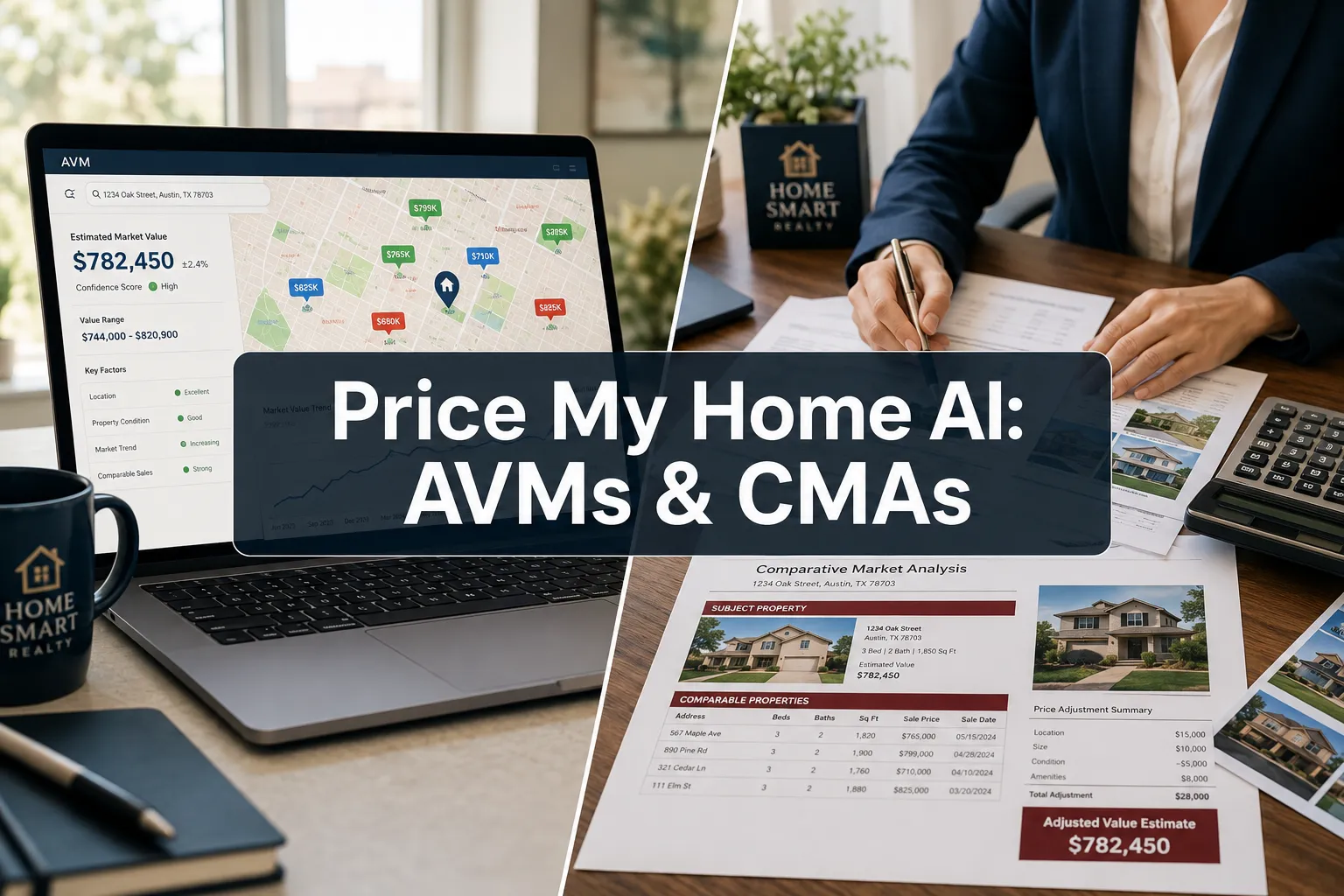
Price My Home AI combines automated valuation models (AVMs) with comparative market analysis (CMAs) to give you a realistic pricing band before listing. Run three named AVMs (Zillow Zestimate, Redfin Estimate, and HouseCanary or RPR RVM), compare the spread, then layer in a broker's CMA to account for condition, upgrades, and hyperlocal buyer behavior. This smart middle ground prevents the two costliest mistakes: overpricing that adds 60+ days on market, and underpricing that leaves tens of thousands on the table.
Key Takeaways
- AVMs analyze public records and recent sales but miss condition, upgrades, and micro-market nuances that drive final sale price.
- A professional CMA costs nothing when you interview listing agents and captures what algorithms can't see: buyer sentiment, staging impact, and neighborhood-specific demand shifts.
- Running three AVMs reveals the confidence interval, a tight spread (under 5%) suggests strong data; a wide spread (10%+) signals you need human expertise.
- Homes priced more than 5% above market average sit 68% longer and sell for 3-7% less than correctly priced comparables, according to 2025 National Association of Realtors data.
- The smart middle workflow: collect three AVM estimates, calculate the range, request two agent CMAs, and price within the overlap zone where data and local intelligence agree.
- Zillow's Zestimate has a median error rate of 2.4% for on-market homes but 7.49% for off-market properties, meaning your pre-listing estimate could be off by $37,000 on a $500,000 home.
- Free online estimates work for refinancing ballpark checks but should never be your sole pricing tool when selling, the cost of a 10% overpricing mistake is $50,000 in lost equity on a median U.S. home.
- Hybrid tools like HouseCanary and RPR RVM blend AVM data with agent input, offering a middle path for FSBO sellers who want more than a Zestimate but aren't ready to commit to a listing agent.
What Is an AVM in Real Estate?
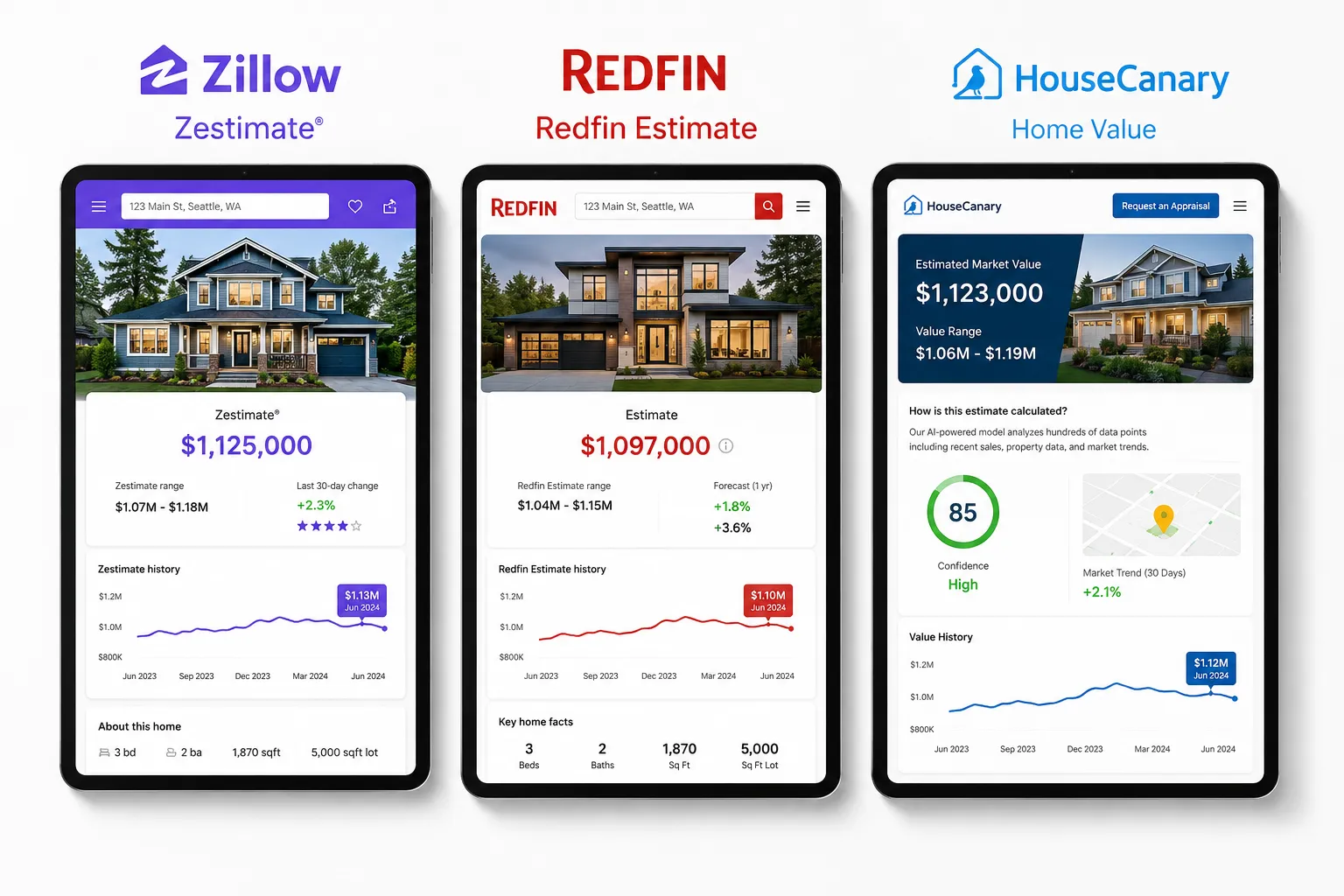
An automated valuation model (AVM) is a software algorithm that estimates a property's market value using public records, tax assessments, recent sales, and sometimes MLS data. Zillow's Zestimate, Redfin Estimate, and HouseCanary are the most recognized consumer-facing AVMs in 2026. These tools pull comparable sales within a radius, adjust for square footage and bed/bath count, and spit out a number in seconds.
AVMs shine when data is rich and properties are cookie-cutter. Think: suburban tract homes built in the same decade, similar lot sizes, standard finishes. The algorithm has dozens of near-identical comps to reference, so the estimate lands close. But AVMs stumble on unique properties, recent renovations, and condition variables. A kitchen remodel that cost you $60,000 might add $15,000 to the AVM estimate, or zero, if the algorithm doesn't know it happened.
Who should use AVMs: First-time sellers researching ballpark value, homeowners checking equity for refinancing, and investors screening deals before making offers. AVMs are extraordinary for speed and free access, but they're the opening act, not the headliner.
Who should not rely on AVMs alone: Anyone listing a home in the next 90 days, sellers in markets with low inventory or rapid price shifts, and owners of custom homes, historic properties, or anything with significant off-market improvements. If your home has a story the algorithm can't read, you need human translation.
How Does a CMA Differ from an AVM?
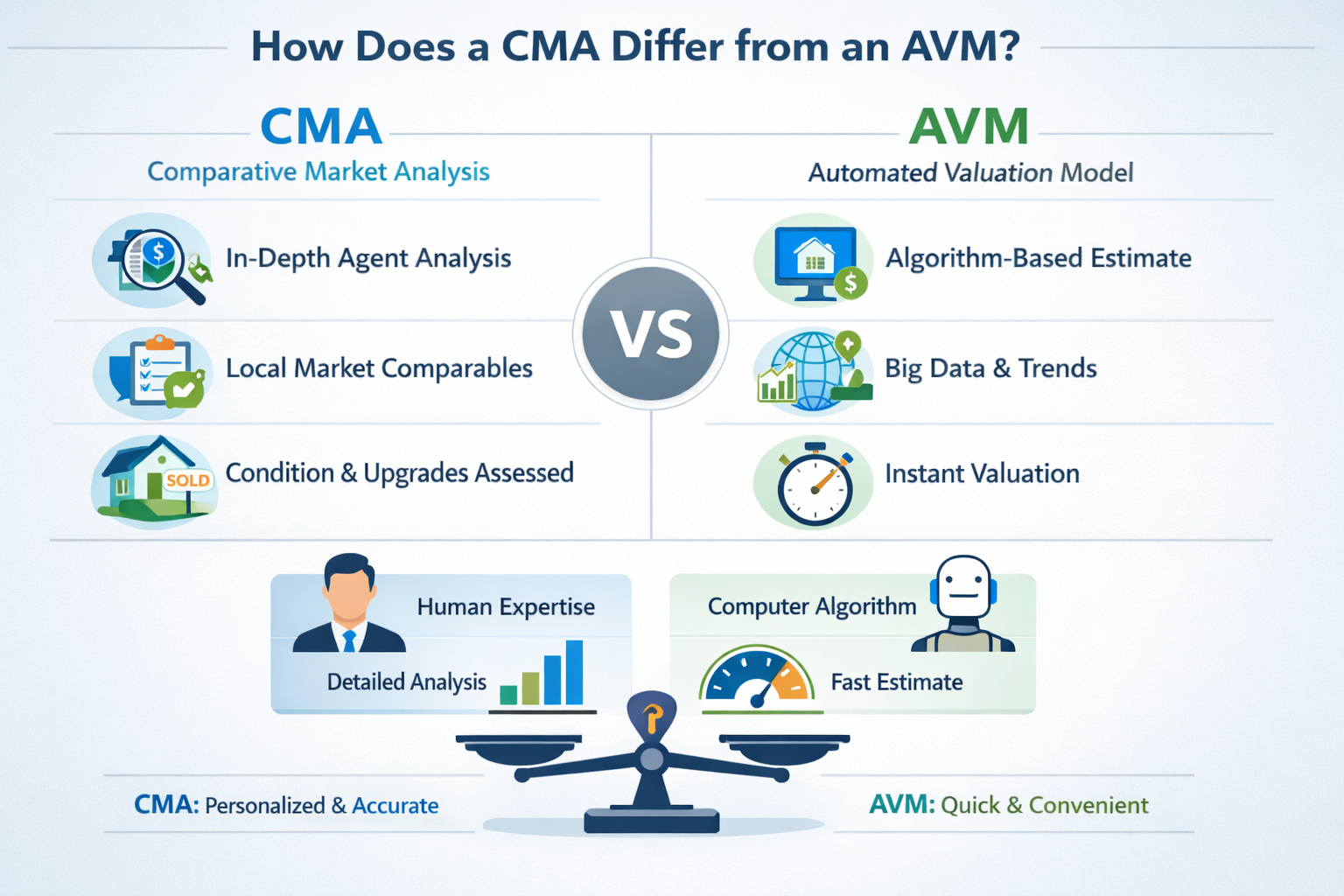
A comparative market analysis (CMA) is a manual valuation prepared by a licensed real estate agent or broker. The agent pulls active listings, pending sales, and closed comps, just like an AVM, but then walks through your home, photographs upgrades, notes deferred maintenance, and adjusts each comparable for differences in condition, location micro-factors (cul-de-sac vs. busy street), and current buyer demand signals.
The CMA captures what AVMs miss: your quartz countertops vs. the comp's laminate, your finished basement vs. the comp's unfinished storage, your home's position at the top of the hill with mountain views vs. the comp's flat lot backing to a highway. A skilled agent also factors in absorption rate (how fast homes are selling in your price band), days on market trends, and whether buyers are currently prioritizing move-in-ready condition or fixer-upper discounts.
Cost: Zero, when you request a CMA as part of interviewing listing agents. Most brokers provide a free CMA to win your listing. If you're not ready to list and want a standalone CMA, some agents charge $200-$500, though this is rare.
Accuracy edge: CMAs typically land within 3-5% of final sale price when prepared by an experienced local agent. AVMs average 5-10% error rates for off-market homes, according to 2025 industry benchmarks. The human edge comes from reading the room, literally. An agent sees your impeccable staging, your fresh paint, your curb appeal upgrades, and adjusts the number up. The algorithm sees your tax record from 2019 and guesses.
For a deeper dive into how agents build these reports, check out our guide on marketing your home with AI tools in 2026.

Can AI Accurately Price My Home?
AI can accurately price your home if your property fits the training data and recent comps are plentiful. In practice, that means AVMs work best for:
- Homes in subdivisions with 20+ sales in the past six months
- Properties with standard finishes and no major custom features
- Markets with stable, predictable price trends
AI struggles with:
- Custom builds, historic homes, and architecturally unique properties
- Homes with significant off-permit improvements (finished basements, ADUs, high-end kitchens not reflected in tax records)
- Rapidly shifting markets where last month's comps are already stale
- Low-inventory neighborhoods where the last comparable sale was nine months ago
The 2026 reality: Zillow's Zestimate has a median error rate of 2.4% for on-market homes (homes currently listed with full MLS data) but 7.49% for off-market properties. Redfin Estimate performs similarly. That 7.49% error translates to a $37,450 swing on a $500,000 home, enough to cost you a buyer if you overprice, or leave serious money on the table if you underprice.
When AI is good enough: Refinancing checks, estate planning ballparks, and initial research before interviewing agents. If you're just curious what your home might be worth and you're not listing for six months, an AVM gives you a useful starting point.
When AI is not good enough: Pricing your listing. The stakes are too high. Overpricing by 10% adds an average of 68 extra days on market and results in a final sale price 3-7% below market, according to 2025 NAR data. That's a double penalty: you wait longer and net less. Underpricing by 5% costs you $25,000 on a $500,000 home, money you'll never recover.
AVM vs CMA: Which Is More Accurate?
CMAs are more accurate for listing decisions, period. But the gap narrows depending on property type and market conditions.
AVM accuracy by scenario:
- Tract home, stable market, rich comp data: AVM within 3-5% of final sale price
- Unique home, low inventory, volatile market: AVM within 10-15% (often useless for pricing)
- Off-market property with recent renovations: AVM error rate climbs to 7-10%
CMA accuracy by scenario:
- Experienced local agent, thorough walkthrough: CMA within 3-5% of final sale price
- Agent unfamiliar with micro-market or rushed analysis: CMA within 5-8%
- Agent cherry-picking comps to justify a high list price (to win your listing): CMA can be inflated by 5-10%, this is the dark side of free CMAs
The smart move: Use both. Run three AVMs to establish the data-driven floor and ceiling, then get two CMAs from competing agents to see where human expertise lands. If the CMAs cluster within the AVM range, you have high confidence. If one CMA is 10% higher than the AVMs and the other CMA, that agent is likely inflating the number to win your business, a red flag.
For context on how market conditions affect pricing strategy, see our analysis of how the economy shapes real estate prices and demand in 2026.
How Much Does a Professional CMA Cost?
A professional CMA costs nothing when you request it as part of interviewing listing agents. Every broker competing for your listing will prepare a free CMA to demonstrate their market knowledge and justify their recommended list price. This is standard practice and expected.
Standalone CMA pricing (rare): If you want a CMA but you're not ready to list, maybe you're planning to sell in 12 months and want to budget for repairs, some agents charge $200-$500 for a detailed written report. Most agents skip this fee if they believe you'll list with them eventually. FSBO sellers sometimes pay for a standalone CMA to avoid the listing commitment.
What you get in a free listing CMA:
- 6-12 comparable sales (closed, pending, and active) with photos and adjustment notes
- Absorption rate and days-on-market trends for your price band
- Recommended list price with supporting rationale
- Suggested staging, repair, and pre-listing improvements
- Market positioning strategy (price high and negotiate vs. price aggressively for multiple offers)
Red flag: An agent who provides a one-page printout with three comps and a number. That's not a CMA; that's a Zillow screenshot with a logo. A real CMA is 10-20 pages, shows the agent's work, and explains why each comp was included or excluded.
Pro tip: Request CMAs from two agents with different brokerage affiliations. Compare their recommended list prices, comp selections, and market narratives. If both agents land within 3% of each other, you have a solid pricing band. If one is 8% higher, dig into their reasoning, they may see something the other missed, or they may be inflating to win your listing.
Do Zillow Estimates Use AVM Technology?
Yes. Zillow's Zestimate is the most widely recognized consumer AVM in the U.S. It uses a proprietary machine learning model trained on hundreds of millions of data points: public records, tax assessments, MLS sales, user-submitted updates, and even Zillow's own traffic data (how often users view a listing, save it, or request a tour).
How the Zestimate works in 2026:
- Base data layer: County records (square footage, bed/bath count, lot size, year built, last sale price)
- Comparable sales: Recent closed sales within a geographic radius, weighted by similarity
- Market trends: Citywide and ZIP-code price trends over the past 12 months
- User-submitted edits: Homeowners can update their property details (finished basement, new kitchen, etc.) via Zillow's homeowner dashboard
- Behavioral signals: Zillow's algorithm considers how long similar homes sit on the market and how often buyers engage with listings in your area
Zestimate accuracy (2026 data):
- On-market homes: 2.4% median error rate (homes currently listed with full MLS data)
- Off-market homes: 7.49% median error rate (homes not currently for sale)
- Within 5% of sale price: 68% of Zestimates for on-market homes
- Within 10% of sale price: 89% of Zestimates for on-market homes
What this means for sellers: If your home is not yet listed, the Zestimate could be off by $37,450 on a $500,000 property. Once you list and the MLS data feeds into Zillow, the estimate tightens, but by then, you've already set your list price. So the Zestimate is most useful after you've made the pricing decision, not before.
Redfin Estimate: Similar methodology, slightly better accuracy in markets where Redfin has a strong brokerage presence (Seattle, San Francisco, Los Angeles, Portland). Redfin claims a 2.16% median error rate for on-market homes and 6.94% for off-market properties.
HouseCanary and RPR RVM: These are broker-facing AVMs with more granular data access. HouseCanary incorporates rental comps, foreclosure risk, and neighborhood investment trends. RPR (Realtors Property Resource) RVM is available only to NAR members and blends AVM data with agent input, creating a hybrid model.
For a broader look at how online tools are reshaping home buying, explore our ranking of the best home buying sites in the U.S. for 2026.
What Are the Biggest Mistakes When Using Automated Home Valuations?
1. Trusting a single AVM as gospel.
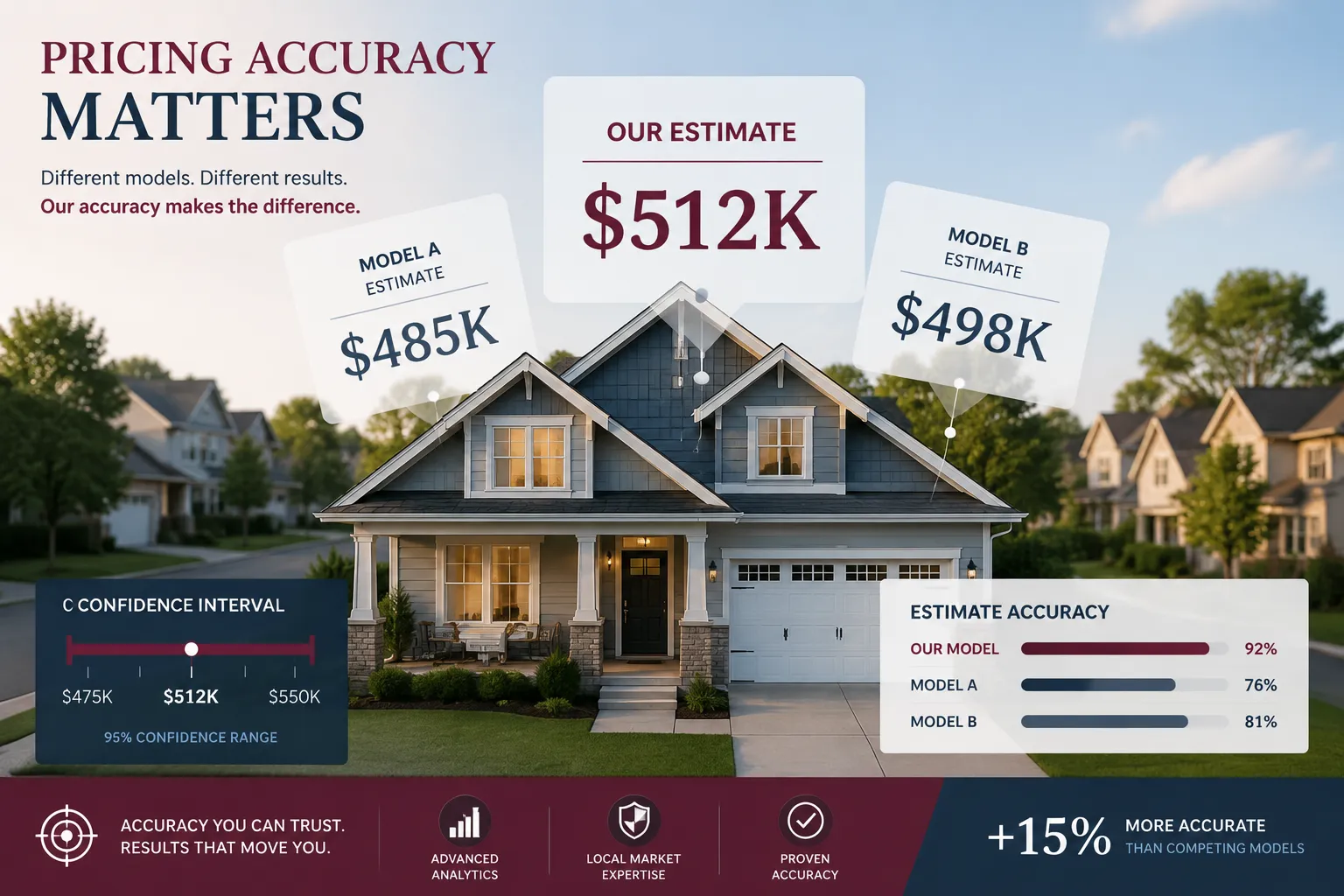
One estimate is a data point, not a conclusion. Zillow might say $485K, Redfin $512K, and HouseCanary $498K. That $27K spread tells you the algorithm confidence is low, you need human input.
2. Ignoring the confidence score.
Most AVMs display a confidence range (e.g., $485K ± $24K). If the range is wide, the model is guessing. Treat it as a rough sketch, not a blueprint.
3. Overpricing based on an outlier AVM.
If two AVMs say $500K and one says $540K, don't list at $539K because you like that number. The outlier is likely wrong, and you'll pay for it in days on market.
4. Underpricing because the AVM missed your upgrades.
You spent $80K on a kitchen remodel last year, but the tax assessor hasn't caught up and the AVM doesn't know. If you price at the AVM estimate, you're giving away equity. This is where the CMA saves you, the agent sees the quartz, the soft-close cabinets, the pendant lighting, and adjusts up.
5. Using an AVM in a low-inventory market.
If the last comparable sale in your neighborhood was six months ago and inventory has dropped 40% since then, the AVM is pricing your home in a market that no longer exists. Current buyer competition and urgency aren't in the algorithm.
6. Listing without cross-checking the comps.
Pull the AVM's comparable sales and look at the photos. Are they actually comparable? A 1,200-square-foot fixer-upper is not comparable to your 1,200-square-foot move-in-ready home, even if the algorithm thinks they're twins.
7. Skipping the agent CMA to "save time."
The CMA is free and takes one hour of your time (the walkthrough). Skipping it to list faster is like skipping the home inspection to close faster, you'll regret it when the deal falls apart or you leave money on the table.
Is an AVM Good Enough to Price My Home for Sale?
No. An AVM is good enough to start your pricing research, but not to finish it.
When an AVM alone might work (rare):
- You're selling a tract home in a subdivision with 30+ sales in the past six months
- Your home is in original condition with no major upgrades or deferred maintenance
- The market is stable (not spiking or crashing)
- You're willing to accept a 5-7% margin of error
When an AVM will cost you money (common):
- Your home has custom features, recent renovations, or unique lot characteristics
- Inventory in your price band is low (under 2 months of supply)
- The market is shifting rapidly (rates dropped 0.5% last month, buyer urgency spiked)
- You're in a neighborhood with wide variation in home condition and finishes
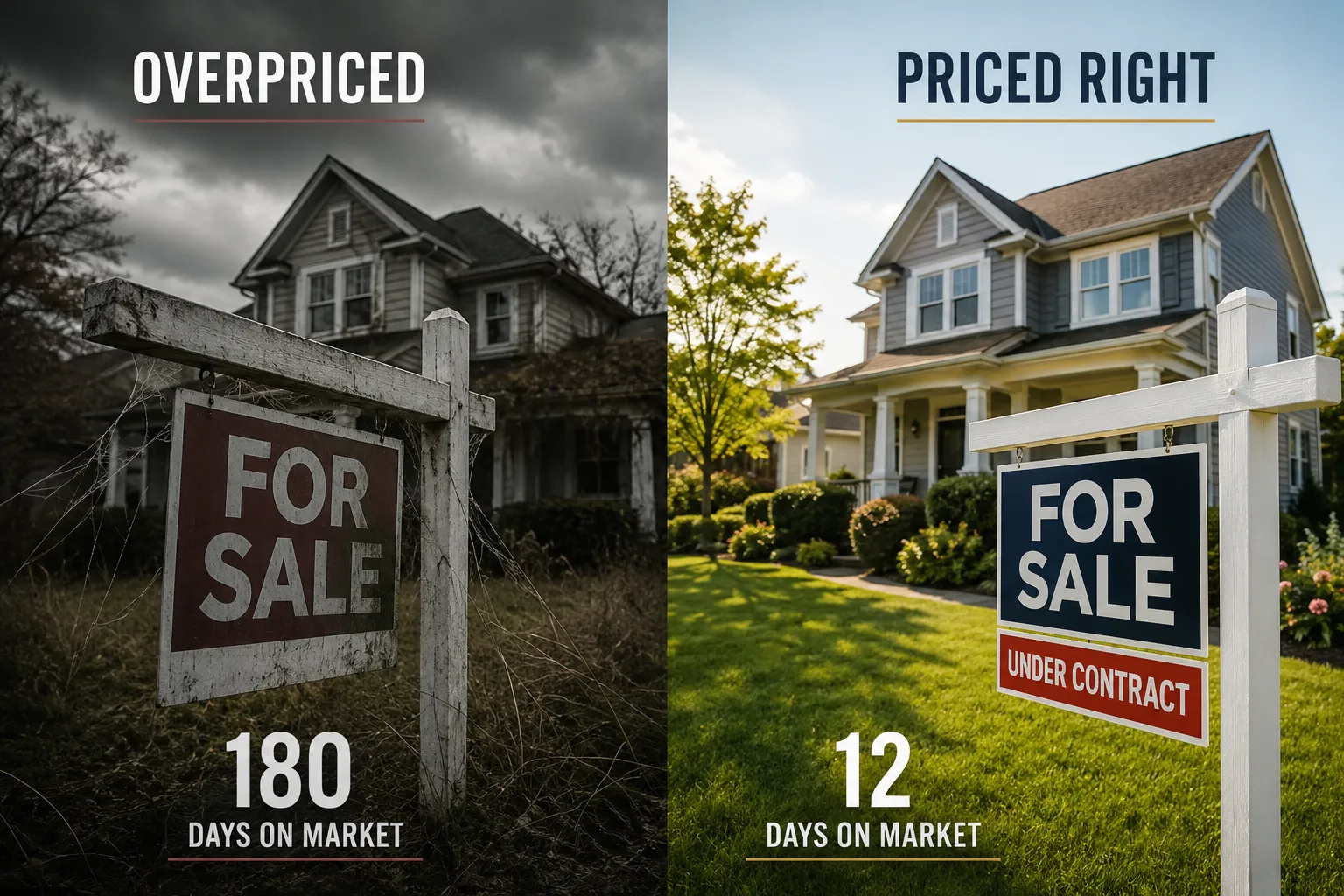
The math on overpricing: Homes priced 5-10% above market average sit 68% longer (an extra 60+ days) and sell for 3-7% below market, according to 2025 NAR data. On a $500K home, that's a $15K-$35K penalty plus the carrying cost of an extra two months of mortgage, insurance, and utilities.
The math on underpricing: Pricing 5% below market to spark a bidding war works in hot markets with under 1.5 months of inventory. In balanced or slow markets, you just gave away $25K. The agent CMA tells you which market you're in.
Bottom line: Use the AVM to set your expectations and filter out agents who quote a list price wildly outside the AVM range. But don't list without a CMA. The cost of getting it wrong is too high.
For sellers preparing to list this spring, our preparing your home for sale in 2026 guide walks through the full pre-listing checklist.
When Should I Use a Realtor CMA Instead of an Online Estimate?
Use a realtor CMA when:
1. You're listing within the next 90 days.
Pricing is the highest-leverage decision in the selling process. A 5% pricing error costs you $25K on a $500K home. The CMA is free and takes one hour, there's no rational reason to skip it.
2. Your home has significant upgrades or unique features.
New roof, solar panels, finished basement, custom landscaping, smart home systems, none of this shows up in the AVM. The agent adjusts for it in the CMA.
3. Inventory in your area is low or shifting fast.
If there are only four active listings in your price band and two just went pending, the market dynamics have changed since the last AVM update. The agent knows this; the algorithm doesn't.
4. You're in a transitional neighborhood.
Gentrifying areas, new construction moving in, school district changes, zoning shifts, these factors drive buyer behavior but don't show up in historical sales data. The agent reads the tea leaves; the AVM reads last year's data.
5. You want a pricing strategy, not just a number.
The CMA includes market positioning advice: price high and negotiate, price at market for a steady sale, or price slightly below to trigger multiple offers. The AVM gives you a number with no context.
6. You're interviewing agents and want to compare their market knowledge.
Request CMAs from two agents. Compare their comp selections, adjustment rationale, and recommended list prices. The agent who shows their work and explains the "why" behind the number is the one you want.
When the online estimate is enough:
- You're refinancing and need a ballpark value for the lender
- You're checking equity for a HELOC or home equity loan
- You're researching home values in a new city before making an offer
- You're not selling for 12+ months and just want to track your home's value over time
For first-time sellers navigating the listing process, our first-time home sellers guide covers the full timeline and decision tree.
How Do Hybrid Home Valuation Tools Work?
Hybrid valuation tools blend AVM data with agent input, creating a middle ground between fully automated estimates and full-service CMAs. The two most common hybrid models in 2026 are HouseCanary and RPR RVM (Realtors Property Resource Residential Valuation Model).
HouseCanary:
- Data sources: Public records, MLS, rental comps, foreclosure risk, neighborhood investment trends
- Agent layer: Licensed agents can request a HouseCanary report, review the AVM output, and adjust for property-specific factors the algorithm missed
- Output: A valuation report with confidence score, comp photos, and agent notes explaining adjustments
- Cost: $75-$150 per report (agent-facing tool, not direct-to-consumer)
- Best for: FSBO sellers who want more than a Zestimate but aren't ready to commit to a listing agent
RPR RVM:
- Data sources: MLS, tax records, deed transfers, and NAR member input
- Agent layer: Only available to NAR members; agents input property condition, upgrades, and local market intelligence
- Output: A valuation range with supporting comps and market trend graphs
- Cost: Free to NAR members (included in membership dues)
- Best for: Agents preparing CMAs and sellers working with buyer's agents who provide RVM reports as a value-add
How the hybrid model improves accuracy:
- AVM establishes the baseline: Algorithm pulls comps and calculates a data-driven estimate
- Agent reviews and adjusts: Agent walks the property (or reviews photos), notes condition and upgrades, and adjusts the AVM up or down
- Final output blends both: The report shows the AVM estimate, the agent-adjusted estimate, and the rationale for the difference
Accuracy edge: Hybrid models typically land within 3-6% of final sale price, splitting the difference between pure AVMs (5-10% error) and full CMAs (3-5% error). The trade-off is cost and time, you pay for the agent's input, but less than you'd pay for a full listing CMA (which is free if you list with that agent).
When to use a hybrid tool:
- You're selling FSBO and want a professional valuation without committing to a listing agent
- You're in a market with limited agent availability (rural areas, vacation markets)
- You want a second opinion after receiving a CMA that feels inflated or deflated
What Data Do AVMs Miss That CMAs Capture?
AVMs are data-rich but context-poor. Here's what the algorithm doesn't see:
1. Property condition.
The AVM knows your home is 2,200 square feet, built in 1998, with four bedrooms and 2.5 baths. It doesn't know your carpet is stained, your HVAC is 18 years old, or your roof is leaking. The agent sees this in the walkthrough and adjusts down. Conversely, if your home is move-in-ready with fresh paint, new flooring, and updated fixtures, the agent adjusts up.
2. Upgrades and improvements.
You spent $60K on a kitchen remodel last year. Unless you pulled a permit and the tax assessor updated your record, the AVM doesn't know. The agent photographs the quartz countertops, the custom cabinetry, the farmhouse sink, and adjusts the value up by $20K-$40K depending on market demand for high-end kitchens.
3. Lot characteristics.
The AVM knows your lot is 0.25 acres. It doesn't know you back to a nature preserve, have mountain views, or sit on a cul-de-sac. The agent knows buyers pay a 5-10% premium for these features in your market and adjusts accordingly.
4. Micro-location factors.
Two homes on the same street, same square footage, same bed/bath count. One backs to a busy road; the other backs to a park. The AVM treats them as twins. The agent adjusts the busy-road home down by $15K and the park-view home up by $10K.
5. Current buyer sentiment.
The AVM uses historical sales data. It doesn't know that buyers in your market are currently prioritizing home offices, that open floor plans are commanding a premium, or that homes without garages are sitting 30% longer. The agent knows this from showing feedback and recent offer patterns.
6. Absorption rate and inventory trends.
The AVM knows homes in your ZIP code sold for a median of $485K over the past six months. It doesn't know that inventory dropped 40% last month and the three most recent sales went for 5% over asking. The agent knows this and adjusts your pricing strategy to capture the urgency.
7. Deferred maintenance red flags.
The AVM doesn't see the foundation crack, the outdated electrical panel, the asbestos siding, or the mold in the basement. The agent does, and adjusts down, or advises you to fix it before listing.
8. Staging and presentation impact.
A staged home sells for 5-10% more than an identical unstaged home, according to 2025 Real Estate Staging Association data. The AVM doesn't account for this. The agent does, and either adjusts the value up if you're staging or advises you to stage to hit the higher price point.
For a deeper dive into how to prepare your home to maximize value, see our guide on best home improvements before selling.
Are Free Home Value Estimates Reliable?
Free home value estimates are reliable for what they are, algorithmic guesses based on incomplete data. They're reliable enough for casual research, refinancing ballparks, and setting initial expectations. They're not reliable enough to price a listing.
Reliability by use case:
| Use Case | Reliability | Why |
|---|---|---|
| Refinancing ballpark | High | Lender will order an appraisal anyway; you just need a rough number to decide if refinancing makes sense |
| Checking equity for HELOC | High | Same as above, the lender's appraisal is the final word |
| Researching home values before making an offer | Medium | Useful for filtering out overpriced listings, but don't rely on it to justify your offer |
| Pricing your listing | Low | Too much margin of error; the cost of getting it wrong is too high |
| Estate planning or divorce settlement | Low | Legal and financial decisions require a certified appraisal, not an algorithm guess |
Accuracy benchmarks (2026 data):
- Zillow Zestimate (off-market): 7.49% median error rate
- Redfin Estimate (off-market): 6.94% median error rate
- HouseCanary AVM: 6.2% median error rate
- RPR RVM (agent-adjusted): 4.8% median error rate
- Agent CMA: 3-5% typical error rate
- Certified appraisal: 1-3% typical error rate
Translation: On a $500K home, the Zestimate could be off by $37,450. The agent CMA could be off by $15K-$25K. The appraisal could be off by $5K-$15K. If you're refinancing and the number just needs to be "close enough," the Zestimate works. If you're pricing a listing and a 5% error costs you $25K, you need the CMA.
When free estimates are most reliable:
- Tract homes in data-rich markets (suburbs with frequent sales)
- Properties in original condition with no major upgrades
- Stable markets with predictable price trends
When free estimates are least reliable:
- Custom homes, historic properties, and architecturally unique builds
- Homes with significant off-market improvements
- Low-inventory markets with infrequent sales
- Rapidly shifting markets (rate drops, inventory spikes, demand surges)
Who Should Not Rely on Automated Home Valuations?
1. Sellers listing within 90 days.
The stakes are too high. A 5% pricing error costs you $25K on a $500K home. Get the free CMA.
2. Owners of custom or unique properties.
If your home is one-of-a-kind, custom build, historic, architecturally significant, or on a unique lot, the AVM has no good comps to reference. The estimate will be a wild guess.
3. Homeowners with recent major improvements.
New kitchen, finished basement, solar panels, new roof, landscaping overhaul, if it's not in the tax record, the AVM doesn't know. You'll underprice if you trust the algorithm.
4. Sellers in low-inventory markets.
If there are fewer than five comparable sales in the past six months, the AVM is extrapolating from stale data. The agent knows what the current three buyers in your price band are willing to pay; the algorithm doesn't.
5. Anyone in a rapidly shifting market.
Rates dropped 0.5% last month, and buyer urgency spiked. Or rates jumped 0.75%, and buyers pulled back. The AVM uses six-month trailing data; it's always behind the curve. The agent is in the market every day and adjusts in real time.
6. FSBO sellers who want to maximize sale price.
If you're selling without an agent to save the commission, you're already taking on pricing risk, marketing risk, and negotiation risk. Don't compound it by using an AVM to set your price. Pay for a standalone CMA ($200-$500) or use a hybrid tool like HouseCanary.
7. Homeowners in transitional neighborhoods.
Gentrifying areas, new construction moving in, school district changes, these factors shift buyer behavior fast, but the AVM won't catch it until six months of sales data accumulate. The agent sees it happening in real time.
8. Anyone making legal or financial decisions based on home value.
Divorce settlements, estate planning, tax appeals, these require a certified appraisal, not an algorithm guess. The AVM is not a legal document.
Can I Use an AVM for Refinancing or Just Selling?
You can, and should, use an AVM for refinancing research. It's one of the few scenarios where the AVM's margin of error doesn't matter, because the lender will order a professional appraisal before approving your loan.
How AVMs fit into the refinancing process:
Step 1: Check your AVM estimate. Pull your Zestimate, Redfin Estimate, and HouseCanary value. Average the three. This gives you a ballpark of your home's current value.
Step 2: Calculate your loan-to-value (LTV) ratio. Divide your remaining mortgage balance by the AVM estimate. If you owe $300K and your home is worth $500K, your LTV is 60%. Most lenders require LTV under 80% to refinance without PMI.
Step 3: Decide if refinancing makes sense. If your LTV is under 80% and current rates are at least 0.5% lower than your existing rate, refinancing likely saves you money. If your LTV is over 80%, you'll need to bring cash to closing or accept PMI.
Step 4: Apply for refinancing. The lender orders an appraisal. The appraiser's value is the final word, not the AVM. If the appraisal comes in lower than the AVM, your LTV ratio rises and you may not qualify for the loan terms you wanted.
Why the AVM works for refinancing:
- You're not making a pricing decision based on the AVM, the lender's appraiser is.
- The AVM just helps you decide whether to start the refinancing process.
- If the AVM is off by 5%, it doesn't cost you money, it just means you wasted time applying for a loan you won't qualify for.
Why the AVM doesn't work for selling:
- You are making a pricing decision based on the AVM.
- If the AVM is off by 5%, you either overprice (and sit on market for 60+ extra days) or underprice (and leave $25K on the table).
- The cost of the error is real money, not just wasted time.
Other scenarios where AVMs are useful:
- HELOC applications: Same logic as refinancing, the lender will appraise, so the AVM is just a screening tool.
- Checking equity before a cash-out refinance: You want to know if you have enough equity to pull $50K for a renovation. The AVM gives you a rough answer.
- Tracking your home's value over time: If you're not selling for years, checking the AVM quarterly lets you monitor your equity growth.
- Researching home values in a new city: You're relocating and want to know what $500K buys in Denver vs. Austin. AVMs give you a quick comparison.
For more on using equity strategically, see our guide on how soon you can do a HELOC after purchasing a home.
The Smart Middle Ground: A Step-by-Step Home Pricing Workflow
Here's the workflow we recommend to every seller who wants to price their home correctly without overpaying for expertise or leaving money on the table.
Step 1: Run three AVMs and record the estimates.
- Zillow Zestimate: zillow.com (search your address, click "See Zestimate")
- Redfin Estimate: redfin.com (search your address, scroll to "Redfin Estimate")
- HouseCanary or RPR RVM: Ask a friend who's a Realtor to pull the RPR RVM, or pay $75-$150 for a HouseCanary report
Example output:
- Zillow: $485,000
- Redfin: $512,000
- HouseCanary: $498,000
Step 2: Calculate the spread.
High estimate ($512K) minus low estimate ($485K) = $27K spread, or 5.6% of the midpoint.
What the spread tells you:
- Spread under 5%: High confidence. The data is strong, and the AVMs agree. You can trust the range.
- Spread 5-10%: Medium confidence. The AVMs are guessing, but not wildly. You need a CMA to narrow it.
- Spread over 10%: Low confidence. The AVMs have no idea. You absolutely need a CMA, and possibly a pre-listing appraisal.
Step 3: Request CMAs from two listing agents.
Interview two agents with strong local market share. Ask each to prepare a CMA. Give them the same information: your home's condition, recent upgrades, and your timeline.
Example output:
- Agent A: $505,000 recommended list price
- Agent B: $515,000 recommended list price
Step 4: Compare the CMA range to the AVM range.
- AVM range: $485K – $512K (midpoint $498K)
- CMA range: $505K – $515K (midpoint $510K)
The CMAs landed at the high end of the AVM range. This suggests your home's condition and upgrades justify pricing above the AVM midpoint.
Step 5: Choose your list price within the overlap zone.
The overlap zone is where the AVM range and CMA range intersect. In this example, that's $505K – $512K.
Pricing strategy options:
- Price at $512K (top of overlap): If inventory is low and buyer urgency is high, price at the top to maximize your net. Be prepared to negotiate down to $500K-$505K.
- Price at $508K (middle of overlap): Balanced strategy. Attracts serious buyers, leaves room to negotiate, and avoids the "overpriced" stigma.
- Price at $505K (bottom of overlap): Aggressive strategy to spark multiple offers. Works best in hot markets with under 1.5 months of inventory.
Step 6: Monitor feedback and adjust.
List at your chosen price. Track showings, showing feedback, and offer activity for the first two weeks.
- 10+ showings, 2+ offers in first week: You priced it right (or slightly under). Accept the best offer or counter for more.
- 5-9 showings, 1 offer in first two weeks: You're in the zone. Let it cook before you see results.
- Under 5 showings, no offers in first two weeks: You're overpriced. Drop the price by 3-5% immediately. Every extra week on market costs you negotiating leverage.
For more on how to avoid the most common pricing mistakes, check out our guide on 7 pricing mistakes that trigger price cuts and lowball offers.
Overpricing Risks: What the Data Says
Overpricing is the single most expensive mistake sellers make, and the penalty is double: you wait longer and you net less.
2025 NAR data on overpricing:
- Homes priced 5-10% above market average sit 68% longer than correctly priced homes (an extra 60+ days on market).
- Homes that sit more than 60 days sell for 3-7% below market average, because buyers assume something is wrong and lowball.
- Homes that undergo a price reduction sell for 2-4% less than they would have if priced correctly from day one.
Translation on a $500K home:
- Overprice by 10% ($550K): You sit for 90 extra days, then drop to $515K, then finally accept $485K after 120 days on market. You netted $15K less than if you'd priced at $500K on day one, plus you paid an extra four months of mortgage, insurance, utilities, and maintenance.
Why overpricing backfires:
You miss the launch window. The first two weeks on market generate 60% of your total showings. If you're overpriced, serious buyers skip your listing. By the time you drop the price, the launch buzz is gone.
You attract the wrong buyers. Buyers shopping at $550K have different expectations than buyers shopping at $500K. When they tour your home, they compare it to other $550K listings, and yours falls short. They don't make offers.
You signal desperation with price cuts. Every price reduction tells buyers you're motivated. After two cuts, buyers assume you'll take any offer. They lowball.
You lose negotiating leverage. A home that's been on market for 90 days has zero leverage. Buyers know you're stuck. They offer 5-10% under asking and refuse to budge.
The fresh-listing premium:
Homes priced correctly from day one sell for 2-5% more than homes that undergo price reductions, according to 2025 Zillow research. Buyers perceive fresh listings as desirable and compete for them. Stale listings are damaged goods.
Bottom line: It's better to price $10K under market and spark a bidding war than to price $10K over market and sit for 90 days. The bidding war nets you more money, faster, with less stress.
FAQ
What is the most accurate free home value estimator?
Redfin Estimate has the lowest median error rate among free consumer AVMs at 6.94% for off-market homes and 2.16% for on-market homes, according to 2026 data. Zillow Zestimate is a close second at 7.49% off-market and 2.4% on-market. For maximum accuracy, run both and average the results.
How much does a CMA cost if I'm not listing yet?
Most agents provide a free CMA if they believe you'll list with them eventually. If you want a standalone CMA with no listing commitment, expect to pay $200-$500. FSBO sellers and homeowners planning to list in 12+ months are the typical buyers of standalone CMAs.
Can I trust Zillow's Zestimate to price my home?
Not alone. The Zestimate has a 7.49% median error rate for off-market homes, which translates to a $37,450 swing on a $500K property. Use the Zestimate as a starting point, but layer in a Redfin Estimate, a HouseCanary report, and at least one agent CMA before setting your list price.
What's the difference between an AVM and an appraisal?
An AVM is an algorithm-generated estimate based on public records and recent sales. An appraisal is a licensed professional's opinion of value after a physical inspection of your home. Lenders require appraisals for mortgages and refinancing. Sellers use AVMs and CMAs for pricing research.
How do I know if my home is overpriced?
If you have fewer than five showings in the first two weeks on market and zero offers, you're overpriced. Showing feedback that mentions "price" or "value" is another red flag. Compare your price per square foot to recent closed sales in your neighborhood, if you're 10% higher, you're overpriced.
Should I price my home at the high end of the AVM range?
Only if your home's condition and upgrades justify it, and only if inventory in your price band is low (under 2 months of supply). In balanced or slow markets, pricing at the high end adds 30-60 days on market and triggers price reductions. Price in the middle of the range for a steady sale.
What's a hybrid home valuation tool?
A hybrid tool blends AVM data with agent input. HouseCanary and RPR RVM are the two most common. The algorithm generates a baseline estimate, then a licensed agent reviews the property and adjusts for condition, upgrades, and local market factors. Accuracy is typically 3-6%, splitting the difference between pure AVMs and full CMAs.
How accurate is the Redfin Estimate compared to Zillow?
Redfin Estimate is slightly more accurate in markets where Redfin has a strong brokerage presence (Seattle, San Francisco, Los Angeles, Portland). Nationally, Redfin's median error rate is 6.94% for off-market homes vs. Zillow's 7.49%. The difference is small enough that you should run both and average them.
Can I use an AVM for a divorce settlement or estate planning?
No. Legal and financial decisions require a certified appraisal, not an algorithm estimate. Courts and estate attorneys will not accept an AVM as a legal document. Expect to pay $400-$600 for a certified appraisal.
What's the biggest mistake sellers make with AVMs?
Trusting a single AVM as gospel and listing at that price without cross-checking comps or getting a CMA. The second-biggest mistake is ignoring the AVM's confidence range, if the range is ±$30K, the estimate is a guess, not a fact.
How do I get a free CMA without committing to a listing agent?
Request CMAs from two agents and tell them upfront you're interviewing multiple agents and haven't made a decision yet. Most agents will still provide a free CMA to compete for your business. If an agent refuses unless you sign a listing agreement, move on, that's a red flag.
What should I do if the CMA is 10% higher than the AVM?
Dig into the agent's reasoning. Ask which comps they used and why. If the agent cherry-picked high-end sales to justify an inflated price (to win your listing), that's a red flag. If the agent has a legitimate rationale, your home has upgrades the AVM missed, or the market shifted recently, the higher price may be justified. Get a second CMA to confirm.
Conclusion
Price My Home AI works best when you treat it as a starting point, not a finish line. Run three AVMs to establish the data-driven range, then layer in two agent CMAs to capture what the algorithms miss: condition, upgrades, micro-location factors, and current buyer sentiment. Price within the overlap zone where data and local intelligence agree, and monitor feedback closely in the first two weeks.
The cost of overpricing is real: 60+ extra days on market, a 3-7% discount on final sale price, and the stress of watching your listing go stale. The cost of underpricing is equally real: $25K left on the table on a $500K home. The smart middle ground, AVMs plus CMAs, gives you the confidence to price it right from day one, capture the fresh-listing premium, and net the most money in the shortest time.
Next steps:
- Run your Zestimate, Redfin Estimate, and HouseCanary or RPR RVM today.
- Calculate the spread. If it's over 10%, you need a CMA immediately.
- Interview two listing agents and request free CMAs.
- Compare the AVM range to the CMA range and price within the overlap.
- List, monitor feedback, and adjust within two weeks if needed.
For more on preparing your home to maximize value, explore our home selling strategies hub and our guide on best home improvements before selling.
For more home buying resources and market insights, visit the Home Buying Hub.