

Last updated: July 20, 2026

Quick Answer: Most buyers need between 3% and 20% of the purchase price for a down payment, plus an additional 2%,5% of the loan amount for closing costs, plus reserves covering 2-6 months of mortgage payments. On a $300,000 home, that realistically means having $15,000,$75,000 saved before you close, and the exact number depends heavily on your loan type, credit score, and location.
Key Takeaways
- The minimum down payment to buy a house is 3% for conventional loans and 3.5% for FHA loans, but 0% options exist for VA and USDA loans.
- Closing costs typically run 2%,5% of the loan amount and are separate from your down payment.
- On a $300,000 home, expect to need roughly $15,000,$25,000 minimum out of pocket (with low-down-payment programs), or up to $75,000+ if putting 20% down.
- First-time homebuyers earning $70,000 a year can generally afford a home in the $200,000,$250,000 range, depending on debt load and local taxes.
- Bad credit raises your cost, FHA allows scores as low as 580, but you'll pay more in mortgage insurance and interest.
- "No money down" programs exist but come with income limits, location restrictions, and other trade-offs.
- California and Texas have very different cost realities, the same income buys far less in San Francisco than in San Antonio.
- Skipping a 20% down payment doesn't have to be a dealbreaker, but you need to understand what PMI costs you monthly.
- Hidden costs like home inspections, moving expenses, and immediate repairs trip up more first-time buyers than any other factor.
- Use a mortgage calculator as a starting point, but get a real pre-approval letter before you fall in love with a listing.
How Much Money Do You Need to Buy a House? Real Math Explained
The real answer to how much money do you need to buy a house is: more than most people think, but less than most people fear. The number isn't one figure, it's a stack of figures that hit at different stages of the transaction.
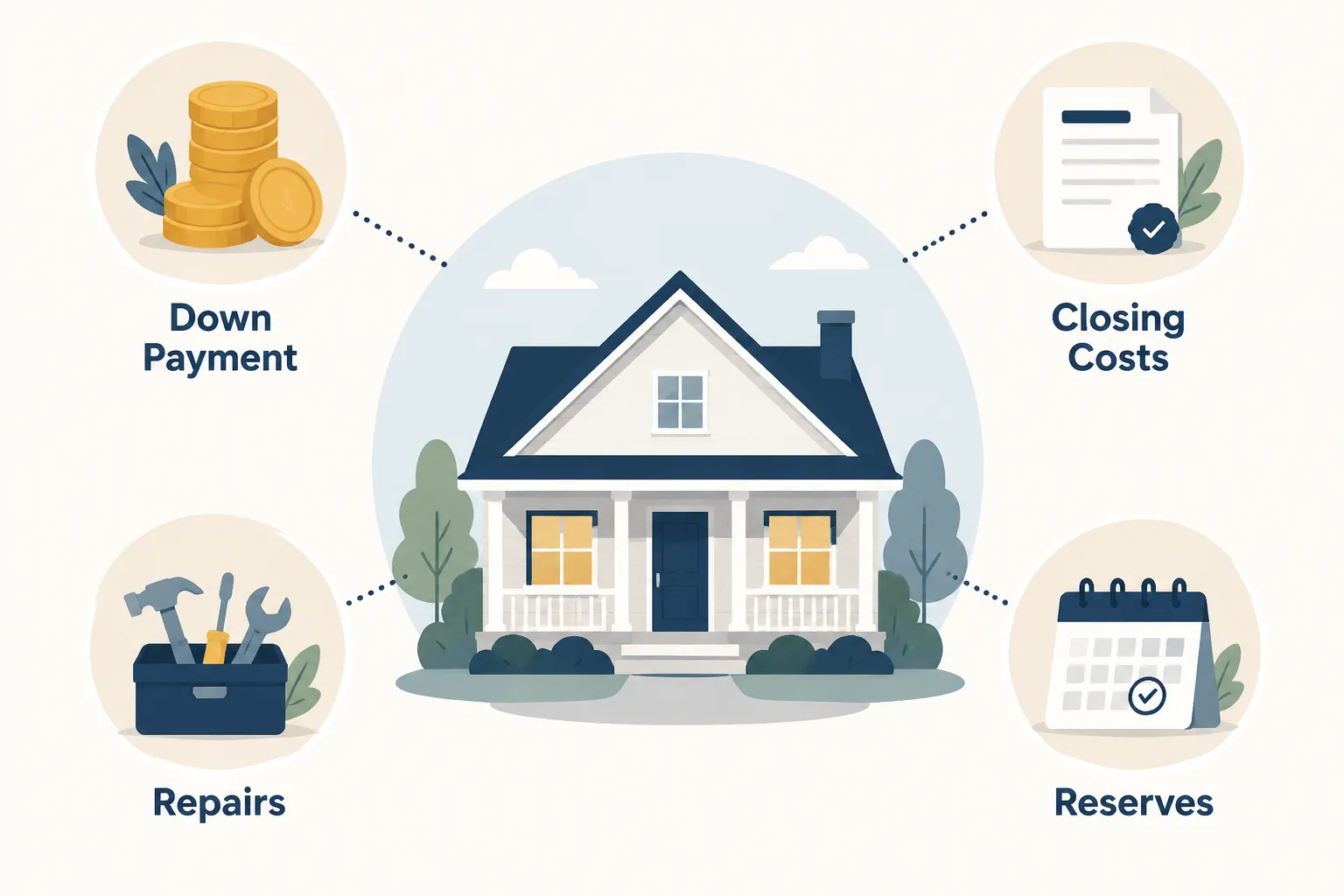
Here's how the money breaks down across four buckets:
1. Down Payment
The percentage of the purchase price you pay upfront. Ranges from 0% to 20%+ depending on loan type.
2. Closing Costs
Fees paid at settlement, lender fees, title insurance, appraisal, prepaid taxes, and more. Budget 2%,5% of the loan amount.
3. Cash Reserves
Most lenders want to see 2-6 months of mortgage payments sitting in your bank account after closing.
4. Move-In Costs
Inspections, repairs, moving trucks, appliances, and the random stuff no one budgets for. Budget at least $2,000,$5,000.
Real Example: $300,000 Home
| Cost Category | Low Estimate | High Estimate |
|---|---|---|
| Down Payment (3%,20%) | $9,000 | $60,000 |
| Closing Costs (2%,5%) | $5,820 | $14,550 |
| Reserves (2 months) | $3,000 | $5,000 |
| Move-In Costs | $2,000 | $5,000 |
| Total Range | ~$19,820 | ~$84,550 |
The spread is wide because loan type, lender, and market all move the needle. That's why the "real math" matters more than any single headline number.
What Is the Minimum Down Payment to Buy a House?
The minimum down payment depends entirely on the loan program you qualify for. There is no single universal answer.
- Conventional loan (Fannie Mae/Freddie Mac): 3% minimum for first-time buyers, 5% for repeat buyers in most cases
- FHA loan: 3.5% with a credit score of 580+; 10% if your score is 500-579
- VA loan (active military, veterans, eligible spouses): 0% down, no down payment required
- USDA loan (rural and suburban areas): 0% down, income and location limits apply
- Jumbo loans: Typically 10%,20% minimum, varies by lender
So yes, the minimum down payment to buy a house can legally be zero if you qualify for VA or USDA. But zero down doesn't mean zero cash needed. Closing costs still apply.
For a deeper breakdown of how FHA and conventional loans compare on total cost, check out our guide on FHA loan vs conventional loan: which saves more money in 2026.
How Much Should You Have Saved Before Buying a House?
Before you start touring homes, you should have enough saved to cover your down payment, closing costs, reserves, and a buffer for surprises, not just the down payment alone. That's the part most buyers get wrong.
A practical savings target by home price:
- $200,000 home: Save $12,000,$22,000 minimum (3% down + costs + buffer)
- $300,000 home: Save $18,000,$30,000 minimum
- $400,000 home: Save $24,000,$40,000 minimum
- $500,000 home: Save $30,000,$50,000 minimum
These are minimum targets using low-down-payment programs. If you're going for 20% down to avoid private mortgage insurance (PMI), multiply the home price by 0.20 and add $10,000,$15,000 for costs and reserves on top.
Pro tip: Don't drain your savings to zero at closing. Lenders check your bank statements, and showing up to the closing table with nothing left is a red flag that can delay or kill the deal.
Down Payment vs. Closing Costs, What's the Difference?
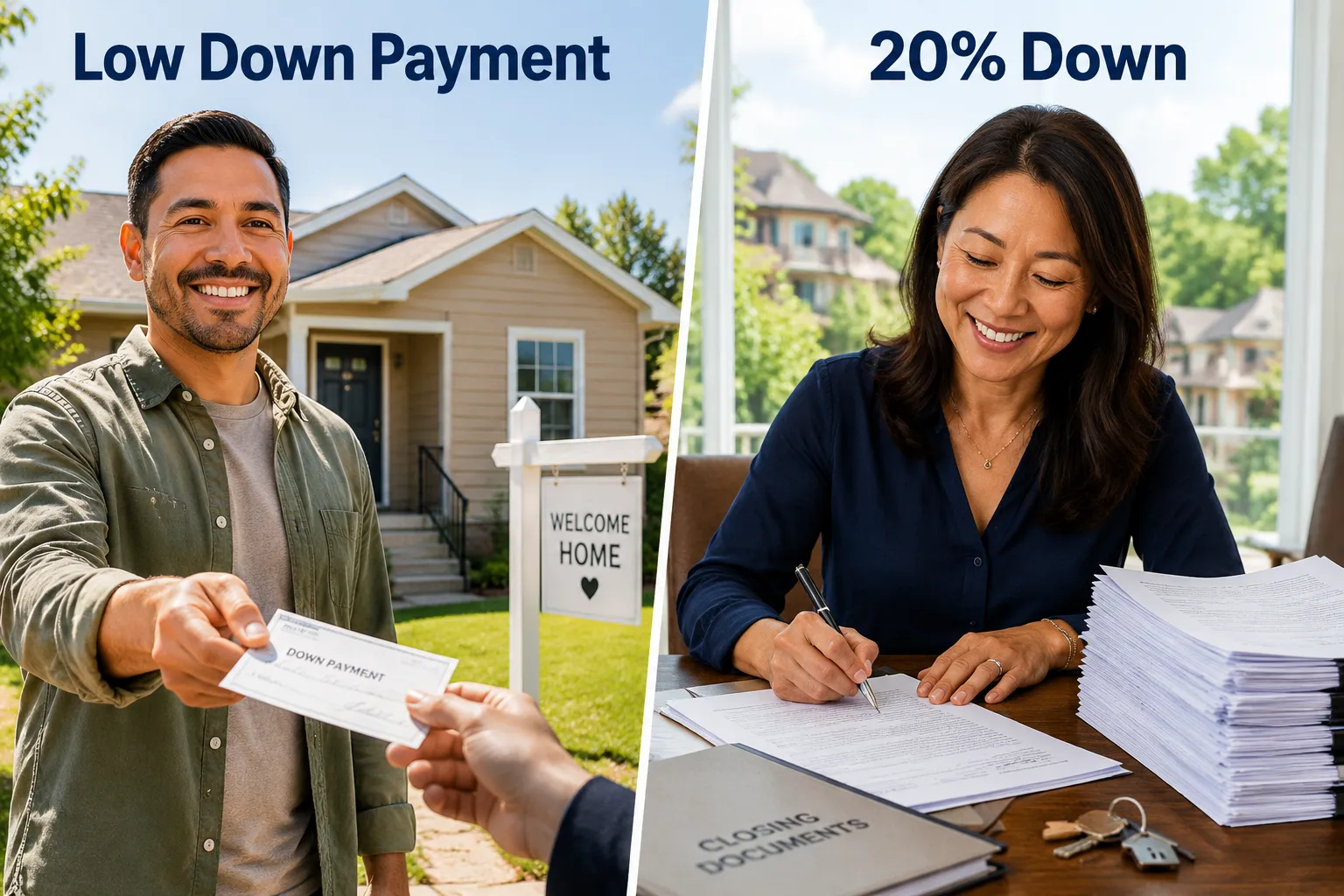
These are two separate buckets of money, and confusing them is one of the most common first-timer mistakes. Your down payment goes toward the purchase price of the home. Closing costs are fees paid to third parties, the lender, title company, government, and others, for processing the transaction.
What closing costs typically include:
- Loan origination fee (0.5%,1% of loan amount)
- Appraisal fee ($400,$700)
- Title search and title insurance ($500,$1,500+)
- Attorney or settlement fees ($500,$1,000, varies by state)
- Prepaid homeowners insurance (first year, often required upfront)
- Prepaid property taxes (2-3 months in escrow)
- Recording fees and transfer taxes (varies by state)
- Credit report fee ($25,$50)
On a $300,000 home with a $9,000 down payment (3%), your loan amount is $291,000. At 3% closing costs, that's roughly $8,730 in fees, on top of your down payment. So you'd need about $17,730 just to get to the closing table, before reserves or move-in costs.
Some lenders offer "seller concessions" or "lender credits" that can reduce out-of-pocket closing costs, but those usually come with a higher interest rate or a higher purchase price, so nothing is truly free.
For a full picture of how financing structures affect your total cost, our real estate financing guide covering mortgages, credit, and down payments is worth bookmarking.
Can You Buy a House With No Money Down?
Yes, but it comes with specific eligibility requirements. Two federally backed programs allow zero down payment to buy a house: VA loans and USDA loans.
VA Loans
- Available to active-duty military, veterans, and eligible surviving spouses
- No down payment, no PMI
- Competitive interest rates
- Requires a VA funding fee (typically 1.25%,3.3% of loan amount, can be rolled into the loan)
USDA Loans
- Available in designated rural and some suburban areas
- Income limits apply (generally 115% of area median income)
- No down payment required
- Requires an upfront guarantee fee (1% of loan amount) and annual fee (0.35%)
State and Local Down Payment Assistance (DPA) Programs
Many states and cities offer grants or forgivable loans that cover down payments and sometimes closing costs for income-qualifying buyers. These programs are seriously underused, so based to take advantage of free money that's sitting on the table.
If you don't qualify for VA or USDA, you still have options. Some lenders offer conventional 97 loans (3% down), and FHA loans start at 3.5%. The key is knowing what you qualify for before assuming you need 20%.
What Does It Cost to Buy a House Besides the Down Payment?
The down payment is the headline number, but the money needed to buy a house extends well beyond it. Here's what people consistently forget to budget for:
Before You Close:
- Home inspection: $300,$600 (always worth it)
- Pest/termite inspection: $75,$150
- Radon test: $100,$300
- Survey: $400,$700 (sometimes required)
At Closing:
- All closing costs listed above
- Homeowners insurance first-year premium (often required upfront)
- HOA fees or initiation fees if applicable
After You Move In:
- Moving costs: $1,000,$5,000+ depending on distance
- Immediate repairs or updates (even "move-in ready" homes have surprises)
- New appliances if not included
- Lawn care, window treatments, basic tools
A realistic all-in budget adds $5,000,$15,000 to whatever your down payment and closing costs total. Don't let this number scare you off, just plan for it. Let it cook before you see results from your savings plan, and you'll get there.
Should You Save 20% Down or Can You Put Less?
Putting 20% down is not a requirement, it's a strategy. Whether it makes sense depends on your financial situation, how long you plan to stay in the home, and what the opportunity cost of that extra cash looks like.
The case for 20% down:
- No PMI (private mortgage insurance), which typically costs 0.5%,1.5% of the loan annually
- Lower monthly payment
- More equity from day one
- Stronger offer in competitive markets
The case for putting less down:
- Keep cash for emergencies, repairs, and investments
- Buy sooner rather than waiting years to save more
- PMI is cancellable once you hit 20% equity
- In appreciating markets, getting in earlier can outweigh PMI costs
PMI reality check: On a $300,000 home with 5% down, PMI might cost $100,$200/month. At 20% down, that disappears. But if waiting 3 more years to save 20% means missing $40,000 in appreciation, the math shifts.
If you're curious about investing the difference instead of locking it into a down payment, our piece on how to invest in real estate with $5,000 or less shows what's possible on the other side of that decision.
How Much Money Do First-Time Homebuyers Need?
First-time buyers have access to more programs and lower minimum requirements than repeat buyers in many cases, which is genuinely extraordinary news that a lot of people don't know about.
If you make $70,000 a year:
Using the standard 28% front-end debt-to-income ratio, your maximum monthly housing payment (PITI, principal, interest, taxes, insurance) should stay around $1,633. At current 2026 mortgage rates near 6.5%, that payment supports a loan of roughly $215,000,$230,000. Add a 5% down payment and you're shopping in the $225,000,$245,000 range.
That number shifts based on:
- Your existing debts (student loans, car payments, credit cards)
- Local property tax rates
- Homeowners insurance costs
- HOA fees
First-time buyer programs worth knowing:
- Fannie Mae HomeReady: 3% down, reduced PMI for income-qualifying buyers
- Freddie Mac Home Possible: 3% down, flexible income sources count
- FHA loans: 3.5% down, more lenient credit requirements
- HUD-approved housing counseling: Free advice on programs in your area
For state-specific guidance, our best states for first-time home buyers rankings for 2026 breaks down where your dollar stretches furthest.
How Much Money Do You Need to Buy a House in California vs. Texas?
Location changes everything. The money needed to buy a house in California is dramatically different from what you need in Texas, even for the same lifestyle.
California:
The median home price in California as of 2026 sits well above $750,000 statewide, with coastal metros like Los Angeles, San Francisco, and San Diego pushing $900,000,$1.5M+. At 5% down on a $800,000 home, you're looking at $40,000 just for the down payment, plus $16,000,$40,000 in closing costs. California also has some of the highest property transfer taxes in the country.
- Minimum realistic savings for a California home purchase: $60,000,$100,000+
- First-time buyer programs: CalHFA offers down payment assistance but has income and price limits
Texas:
The median home price in Texas varies widely, Austin has climbed significantly, but markets like San Antonio, El Paso, and parts of Houston remain far more accessible. A $300,000 home in Texas requires $9,000,$15,000 down (3%,5%) plus $6,000,$15,000 in closing costs. Texas has no state income tax, but property taxes are notably high, often 1.5%,2.5% of assessed value annually.
- Minimum realistic savings for a Texas home purchase: $18,000,$35,000
- Texas State Affordable Housing Corporation (TSAHC) offers DPA programs for eligible buyers
The bottom line: how much money do you need to buy a house depends as much on your ZIP code as your loan type.
What If You Don't Have Enough Money for a Down Payment?
Not having a full down payment saved doesn't automatically mean you're locked out. There are impeccable legitimate paths forward.
Options to explore:
Down payment assistance programs, State, county, and city programs often provide grants or low-interest second loans. Search HUD's database for programs in your area.
Gift funds, FHA, VA, and conventional loans all allow down payment gifts from family members. Documentation is required.
Employer assistance programs, Some large employers offer homebuying assistance as a benefit. Worth asking HR.
401(k) loan or hardship withdrawal, Possible but comes with penalties and long-term retirement cost. Use cautiously.
Seller concessions, Negotiate for the seller to cover closing costs, freeing up your cash for the down payment.
Rent-to-own agreements, A portion of rent goes toward a future purchase. Terms vary widely, read carefully.
Wait and save, Sometimes the most so based move is patience. A disciplined savings plan over 12-24 months beats a rushed purchase with no cushion.
What you shouldn't do: deplete every account you have to scrape together a down payment and arrive at homeownership with zero financial runway. That's how a $3,000 HVAC repair becomes a financial crisis.
What Hidden Costs Do People Forget When Buying a House?
The fresh buyers who get blindsided aren't the ones who didn't read, they're the ones who only read about the down payment. Here's what consistently gets gate-kept from the standard homebuying conversation:
The costs nobody puts in the headline:
- Home warranty: $400,$700/year. Optional but worth it on older homes.
- Utility deposits and setup: $200,$500 when switching services.
- Property tax proration: Depending on closing date, you may owe months of taxes at closing.
- HOA transfer fees: Some HOAs charge $200,$1,000 to transfer membership.
- Flood insurance: Required in flood zones, not included in standard homeowners insurance. Can add $500,$2,000+/year.
- Immediate landscaping or exterior work: That "charming" overgrown yard costs money to fix.
- Paint, flooring, or cosmetic updates: Even a "move-in ready" home rarely matches your vision without some spend.
- New locks: $150,$400. Always change them. Always.
These aren't reasons not to buy, they're reasons to budget honestly. The buyers who thrive are the ones who go in with eyes wide open and a few thousand in reserve beyond their closing costs.
Our 2026 real estate trends guide covering how stable rates are reshaping buyer strategies has more context on what today's market conditions mean for buyers planning their moves.
How Much Does It Cost to Buy a House If You Have Bad Credit?
Bad credit raises the cost of buying a home in two ways: higher interest rates and stricter loan requirements. But it doesn't make homeownership impossible.
Credit score impact on mortgage costs (estimates):
- 760+: Best rates available, lowest PMI costs
- 700-759: Slightly higher rate, minimal PMI impact
- 660-699: Noticeably higher rate, higher PMI
- 620-659: Limited conventional options, FHA becomes primary path
- 580-619: FHA only (3.5% down), expect significantly higher rate
- Below 580: FHA requires 10% down; most conventional lenders will decline
Real cost difference: On a $250,000 loan, the difference between a 6.5% rate (good credit) and an 8.0% rate (poor credit) is roughly $240/month, or about $86,000 over 30 years. That's not a small number.
What to do if your credit needs work:
- Pay down revolving credit card balances below 30% utilization
- Dispute any errors on your credit report
- Avoid opening new credit accounts in the 12 months before applying
- Ask your lender about rapid rescore services
Even a 40-60 point improvement in your score can move you into a better loan tier. It's worth taking 6-12 months to clean up your credit before applying if you're in a borderline range.

How Much Money Do You Need to Buy a House? Real Math for Investors
Real estate investors face a different set of numbers. If you're buying a rental property or a fix-and-flip rather than a primary residence, the money needed to buy a house changes significantly.
Investment property down payment requirements:
- Conventional investment property loans: 15%,25% down (no FHA or VA for non-owner-occupied)
- Hard money loans: Often 10%,30% down with higher interest rates (8%,14%+)
- Portfolio loans: Varies by lender
For investors, the question isn't just "how much to get in", it's "what's the return on that capital?" A property that requires $60,000 down and generates $800/month in net cash flow is a very different proposition than one requiring the same down payment with $200/month.
For investors exploring alternative entry points, our guides on cash flow real estate investing and hard money lenders for beginners cover the financing side in detail.
FAQ: How Much Money Do You Need to Buy a House?
Q: How much money do you need to buy a house for the first time?
A: First-time buyers using low-down-payment programs typically need 5%,8% of the purchase price in total savings, covering a 3%,3.5% down payment, closing costs, and a small reserve. On a $250,000 home, that's roughly $12,500,$20,000.
Q: Is there a how much money do you need to buy a house calculator I can use?
A: Yes, most lenders and real estate sites (Zillow, Bankrate, NerdWallet) offer mortgage calculators. Enter the home price, down payment percentage, interest rate, and loan term to estimate your monthly payment. For total cash needed, add closing costs (2%,5% of loan) and 2 months of reserves on top.
Q: How much money do you need to buy a house at $300k?
A: On a $300,000 home, plan for $9,000,$15,000 down (3%,5%), plus $6,000,$15,000 in closing costs, plus $3,000,$5,000 in reserves. Total: roughly $18,000,$35,000 minimum. Going to 20% down raises that to $75,000+.
Q: I make $70,000 a year, how much house can I afford?
A: Using the 28% housing expense rule, your maximum monthly payment is around $1,633. At 6.5% interest on a 30-year loan, that supports a loan of approximately $215,000,$230,000. With a 5% down payment, you can shop in the $225,000,$245,000 range, assuming manageable existing debt.
Q: Do you need a down payment to buy a house?
A: Not always. VA loans (for eligible veterans and military) and USDA loans (for qualifying rural/suburban areas) require zero down payment. State and local down payment assistance programs can also cover the down payment for income-qualifying buyers.
Q: What money is needed to buy a house beyond the down payment?
A: Closing costs (2%,5% of loan), cash reserves (2-6 months of payments), home inspection fees ($300,$600), and move-in costs ($2,000,$10,000+). Budget for all four categories, not just the down payment.
Q: How much money do you need to buy a house in California?
A: California's median home prices make it one of the most expensive states. On an $800,000 home, expect to need $40,000,$80,000+ in total cash depending on down payment size and closing costs. CalHFA programs can help income-qualifying buyers with down payment assistance.
Q: How much money do you need to buy a house in Texas?
A: Texas is more accessible than California. On a $300,000 home, budget $18,000,$35,000 total. Keep in mind that Texas property taxes are high, factor that into your monthly payment estimate.
Q: Can you get a mortgage with only 3% down?
A: Yes. Fannie Mae's HomeReady and Freddie Mac's Home Possible programs both allow 3% down for qualifying buyers. FHA loans allow 3.5% down with a 580+ credit score. PMI will apply until you reach 20% equity.
Q: What if I don't have enough saved for a down payment?
A: Explore down payment assistance programs through your state housing finance agency, ask about gift funds from family, negotiate seller concessions at closing, or take time to build savings. Rushing in without adequate reserves creates financial risk.
Q: Is it better to save 20% or buy sooner with less down?
A: It depends on your market and timeline. In rapidly appreciating markets, buying sooner often outweighs PMI costs. In flat or declining markets, waiting to save more can make sense. Run the numbers for your specific situation rather than following a blanket rule.
Q: How much does bad credit add to the cost of buying a house?
A: A credit score below 660 can cost you an extra 1%,2% in interest rate, which translates to $150,$300+ more per month on a $250,000 loan. Over 30 years, that difference can exceed $50,000,$100,000 in total interest paid.
Conclusion: Your Real Homebuying Number Starts With Honest Math
The question of how much money do you need to buy a house doesn't have a single clean answer, but it does have a clear framework. Down payment, closing costs, reserves, and move-in costs are the four buckets. Every buyer's total is different based on loan type, credit score, home price, and location.
Your next steps:
- Calculate your target range, Use a mortgage calculator to estimate what monthly payment you can afford, then work backward to a home price range.
- Check your credit score, Know where you stand before talking to a lender. A few months of credit improvement can change your loan options significantly.
- Research loan programs, VA, USDA, FHA, and state DPA programs can dramatically reduce how much cash you need upfront.
- Get pre-approved, not just pre-qualified, A pre-approval letter tells you exactly what you qualify for and makes your offer competitive.
- Build your full savings target, Don't stop at the down payment. Include closing costs, reserves, and a buffer for surprises.
- Understand your market, Whether you're buying in California, Texas, or anywhere in between, local prices and tax rates change the math entirely.
The buyers who succeed aren't necessarily the ones with the most money, they're the ones who did the real math before falling in love with a listing. That's the edge. And now you have it.
For more on how the current market affects your buying power, check out our Spring 2026 housing market outlook on lower rates and rising inventory and our full breakdown of how the economy shapes real estate prices and demand.