
Last updated: October 7, 2026

Quick Answer
High mortgage rates strand home sellers as buyer demand plummets because a 30-year fixed rate near 7.28% pushes monthly payments out of reach for most shoppers, even as home prices stay flat or rise [3]. Sellers who still need to move are cutting prices at the fastest September pace since 2018, while inventory climbs and pending sales keep sliding [1]. The result is a market with more homes to choose from but fewer buyers who can actually afford one.
Key Takeaways
- The average 30-year fixed mortgage hit 7.28% for the week ending October 1, 2026, the biggest weekly jump since October 2022 [3].
- Mortgage News Daily tracked rates as high as 7.60% on September 30, 2026 [3].
- 20.8% of active listings carried a price cut in September, the highest September share since 2018 [1].
- Active listings reached 1,161,615 in September, up 5.4% year over year, while new listings fell 0.7% [1].
- Pending home sales dropped 4.1% year over year and 6.2% month over month in September [1].
- Only about 5.6% of sellers pulled their homes off the market in September, close to last year's rate, so this is not a mass exodus [1].
- August existing-home sales fell to a 3.98 million annual pace, the slowest since June 2025 [3].
- A 2026 bump in the conforming loan limit to $832,750 helps some buyers borrow more, but it does not fix the monthly payment math for most shoppers.
Why Are Mortgage Rates So High Right Now
Mortgage rates climbed because bond markets reacted to inflation data, Federal Reserve signals, and a jump in Treasury yields during September 2026, not because lenders decided to make life harder on purpose. Realtor.com tracked the 30-year fixed rate crossing 7% for the first time since January 2025, then watching it rise another 40 basis points through the month [5].
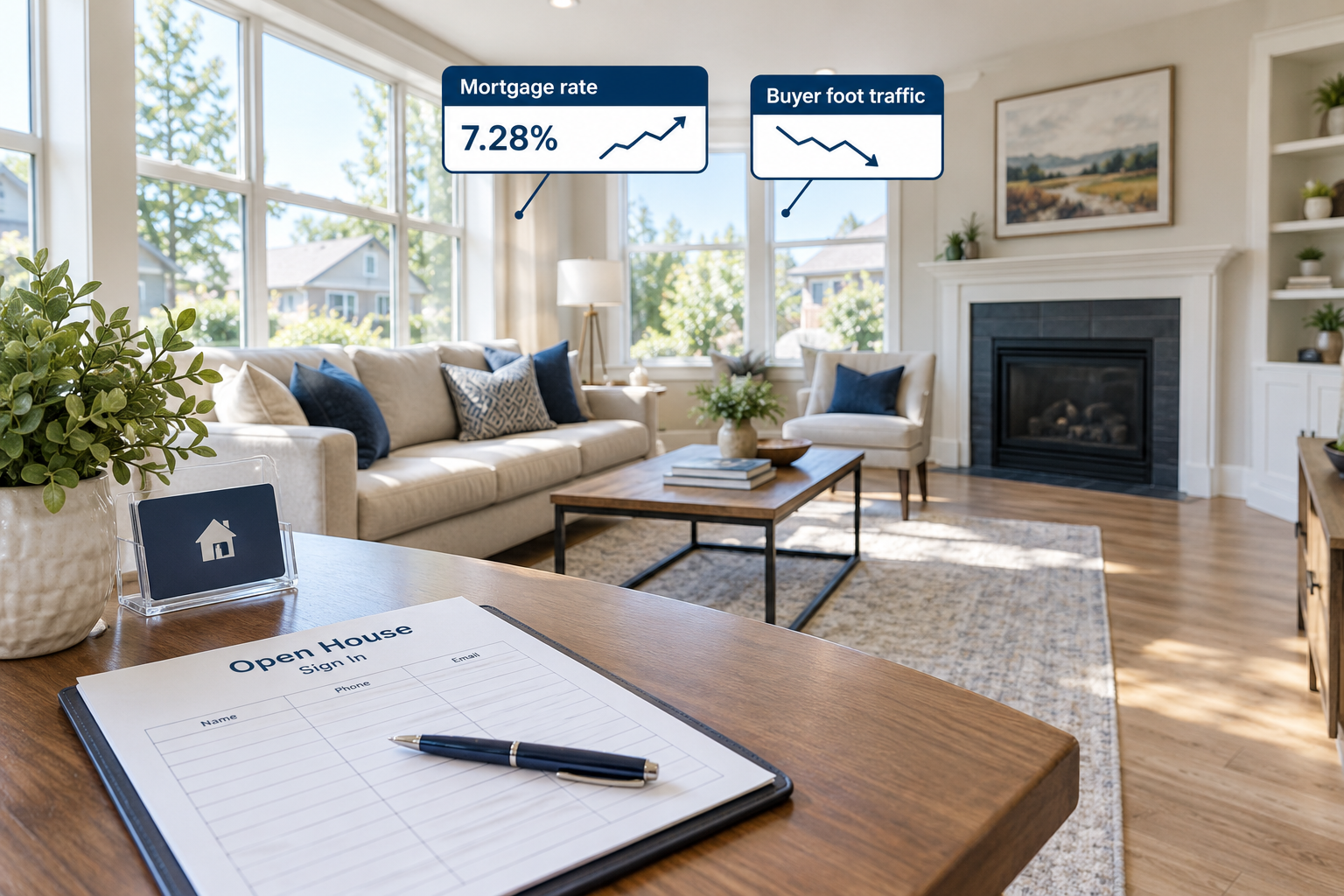
Freddie Mac's survey put the average at 7.28% for the week ending October 1, up from 7.03% the week before, the sharpest weekly climb since October 2022 [3]. Mortgage News Daily, which updates daily rather than weekly, caught rates touching 7.60% on September 30 [3]. That gap between the two trackers matters: daily data shows volatility that weekly averages smooth over.
If you want the mechanics behind why your specific quote might run higher or lower than the headline average, our breakdown on mortgage rates hitting 7.28% and the ways to still land a lower one walks through lender credits, rate buydowns, and timing tricks that actually move the number on your closing disclosure.
How High Mortgage Rates Strand Home Sellers as Buyer Demand Plummets
High mortgage rates strand home sellers as buyer demand plummets because the monthly payment math breaks before the price tag does. A buyer who qualified for a $450,000 home at 6% often qualifies for something closer to $400,000 at 7.28%, and that gap pushes a lot of shoppers out of the market entirely rather than into a smaller house.
Sellers feel this as silence. Fewer showings. Fewer offers. Open houses that used to pull fifteen groups now pull three. NAR's reporting on the September rate spike pointed to exactly this pattern: inventory climbing while pending sales fall, which is the opposite of a healthy, balancing market [3]. A balanced market has rising supply matched by steady demand. What's happening instead is rising supply chasing shrinking demand, and that's an extraordinary split to see play out in the same data set.
Common mistake: pricing a home based on what the neighbor's house sold for in spring 2025, before rates spiked. That comp is stale. Pull sold data from the last 30 days, not the last 12 months.
What Happens to Home Prices When Mortgage Rates Increase
Home prices do not fall right away when mortgage rates increase. They stall, then sellers start discounting one listing at a time until the median catches up to reality.
That's exactly what September 2026 data shows:
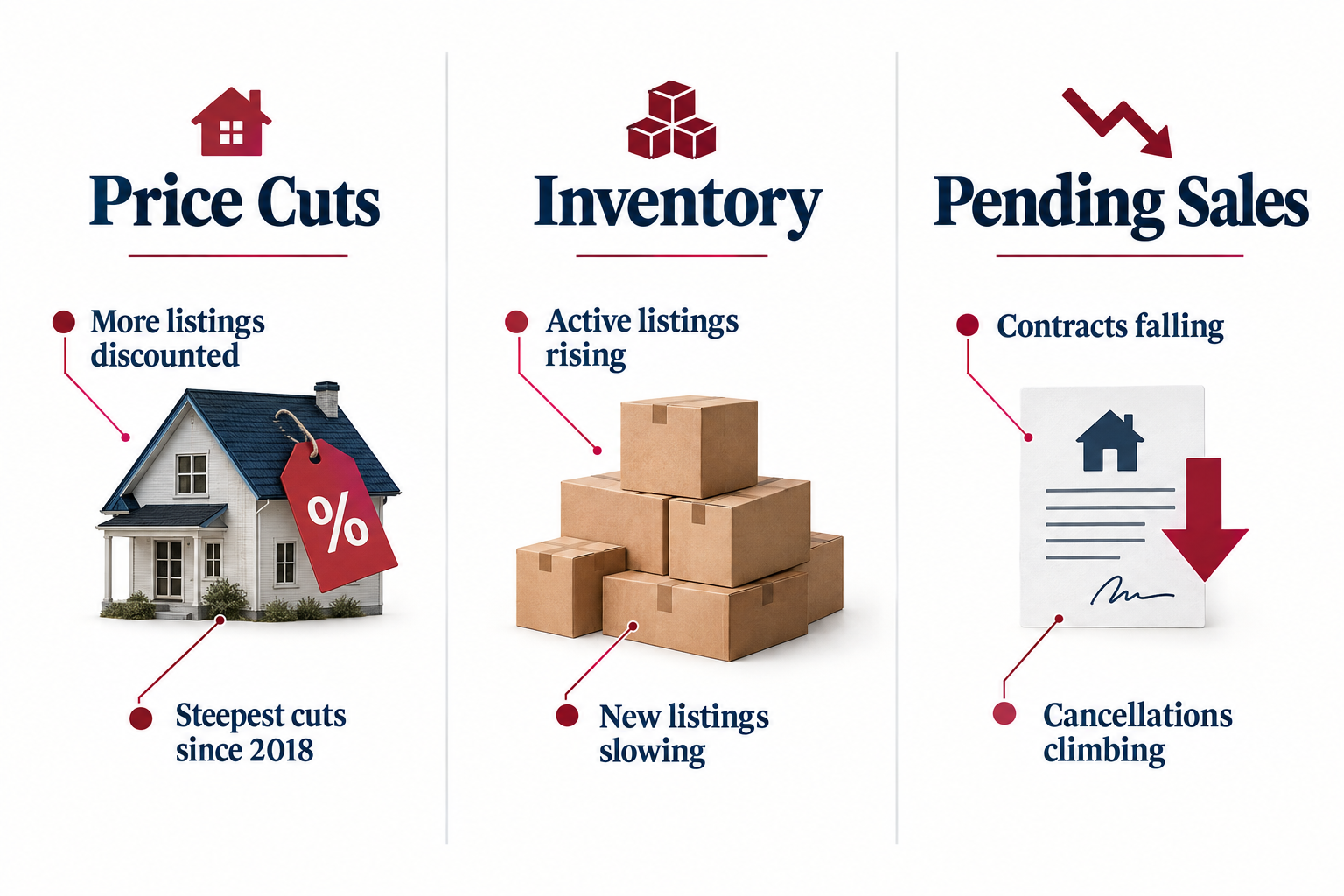
- 20.8% of active listings had a price reduction, up 0.9 percentage points from a year earlier and the highest September share since 2018 [1].
- That figure also marks the highest reading for any month since October 2022 [1].
- Active listings hit 1,161,615, up 5.4% year over year and 1.9% from August, while new listings fell 0.7% to roughly 394,830 [1].
- Inventory sits just 9.1% below typical pre-pandemic levels, the narrowest gap in the current recovery stretch, even though listings remain 58.8% above the rock-bottom levels seen in September 2022 [1].
Realtor.com's chief economist Danielle Hale has described this as a market where buyers technically hold more negotiating leverage, but can't fully use it because financing costs are eating the savings [3]. Her colleague Jake Krimmel put it more bluntly: inventory and pending sales have been drifting apart for months, which looks like stagnation more than rebalancing [1]. If you're pricing a listing right now, our guide to AI-assisted home pricing tools like AVMs and CMAs can help you land on a number that matches where buyers actually are, not where the market was a year ago.
Buyer's Market or Seller's Market: Where 2026 Stands
The country is tilting toward a buyer's market on paper, with more homes available and longer time on market, but high rates keep it from becoming a true buyer's feast. CNN's reporting on the national shift described growing inventory and softer demand as the two forces pulling the market away from sellers [10].
| Signal | Seller's Market Looks Like | What September 2026 Actually Shows |
|---|---|---|
| Months of supply | Under 4 months | Around 4.9 months [3] |
| Price reductions | Rare, under 10% of listings | 20.8% of listings [1] |
| New listings trend | Rising to meet demand | Down 0.7% year over year [1] |
| Pending sales | Climbing or flat | Down 4.1% year over year [1] |
| Negotiating power | Seller sets terms | Buyer can ask, seller often agrees |
Can You Negotiate Seller Concessions When Rates Are High
Yes, and in most metros right now you should expect to. Rate buydowns, closing cost credits, and home warranty add-ons have become normal asks rather than exceptions. A buyer who can't quite clear the payment threshold at 7.28% might clear it with a 2-1 buydown funded by seller credit, and plenty of sellers are agreeing because the alternative is another month of carrying costs with no offer at all.
Before you say yes to any concession, run the actual numbers against your full breakdown of seller closing costs and how to trim them. A concession that costs you $6,000 to get a deal closed this month often beats three more months of carrying a vacant, price-reduced listing.
What Can Sellers Do When Buyers Can't Afford the Mortgage
Sellers have three real levers when buyers can't stretch to meet the payment: cut the price, cover part of the financing cost, or wait. Most sellers in September 2026 picked the first option.
A short checklist for sellers stuck in this exact spot:
- Re-price against last 30 days of solds, not last year's comps.
- Offer a rate buydown or closing cost credit instead of (or alongside) a price cut.
- Fix the cheap stuff that kills showings fast: smell, clutter, dated paint, broken fixtures.
- Get a pre-listing inspection so surprises don't blow up a buyer's already-tight budget mid-contract.
- Ask your agent the hard questions before assuming the listing itself is the problem.
That last point matters more than most sellers think. If your home has sat for weeks with no offers, work through our list of pointed questions to ask your broker when a home isn't selling before you assume the market alone is to blame. Sometimes it's the market. Sometimes it's the photos.
Price Cuts Show How High Mortgage Rates Strand Home Sellers as Buyer Demand Plummets Nationwide
The September price-cut data is the clearest proof point of the whole story. Almost 1 in 5 active listings got a discount last month, the steepest September rate since 2018 [1], and that's not a handful of overpriced luxury homes skewing the average. It's a broad, nationwide pattern of ordinary sellers adjusting to buyers who simply can't borrow what they used to borrow.
Only about 5.6% of listings got pulled off the market entirely in September, barely different from a year earlier [1]. That tells you most sellers aren't quitting. They're cutting, waiting, and hoping October brings relief.
Should You Sell Now or Wait for Rates to Drop
Sell now if you need to move for a job, a family reason, or a life change that doesn't bend to the mortgage market. Wait if your sale is purely optional and you can comfortably carry the home for another 6 to 12 months.
Waiting has a cost most sellers underestimate: every month on the sidelines is a month of taxes, insurance, and maintenance with zero equity movement if prices stay flat. Our 2026 mortgage rate forecast and whether a fall drop is realistic breaks down what most forecasters actually expect over the next two quarters, and it's not a dramatic plunge back to 2021 territory.
Rate relief, if it comes, shows up in Fed policy first and mortgage applications months later. Let it Cook before you see Results. is basically the housing market's unofficial motto right now.
How Long Do High Mortgage Rates Usually Last
High mortgage rate periods have historically lasted anywhere from 18 months to several years, depending on what's driving them. HousingWire's coverage of the current swing noted that rates have moved unusually fast in both directions over the past two years, which makes short-term predictions shaky at best [8].
The 1970s and early 1980s saw double-digit rates for the better part of a decade. The 2022 to 2026 stretch has been choppier, swinging between roughly 6% and 7.6% rather than holding steady at any one level. That volatility is itself the story: sellers and buyers both keep expecting a clean trend and keep getting whiplash instead.
Decision rule: if you're timing a sale around a rate drop, plan for "sometime in the next 12 to 18 months" rather than "next quarter." Forecasters have been wrong in both directions for three years running.
How Much Does a 1% Mortgage Rate Increase Cut Your Buying Power
A 1 percentage point rate increase typically cuts a buyer's purchasing power by roughly 10%, based on standard 30-year fixed amortization math. On a $400,000 loan, the difference between 6% and 7% adds about $260 to the monthly principal and interest payment alone, before taxes or insurance.
| Rate | Est. Monthly P&I on $400,000 Loan | Approx. Change vs. 6% |
|---|---|---|
| 6.00% | $2,398 | Baseline |
| 7.00% | $2,661 | +$263/month |
| 7.28% | $2,735 | +$337/month |
| 8.00% | $2,935 | +$537/month |
Figures are illustrative, principal and interest only, no taxes or insurance included. Actual payments vary by lender, credit profile, and loan terms.
That $337 monthly gap at 7.28% versus 6% translates to tens of thousands of dollars in lost buying power over the life of the loan, which is exactly why qualified buyers keep walking away from homes they could afford a year ago.
Are There First-Time Buyer Programs in a High-Rate Market
Yes. Down payment assistance, FHA loans, and state housing finance agency programs all still exist in 2026, and several expanded alongside the higher conforming loan limit. FHFA raised the standard one-unit conforming loan limit to $832,750 for 2026, up from $806,500, with high-cost areas now capped at $1,249,125.
That limit increase helps buyers in expensive metros borrow more through conventional financing instead of jumbo loans, which often carry stricter underwriting. For a full state-by-state rundown of what's actually available, our guide to down payment assistance programs for first-time buyers in 2026 is the place to start before assuming you're priced out entirely.
Is It Better to Rent or Buy When Mortgage Rates Are High
Renting makes more sense short-term if you expect to move within 2 to 3 years or can't clear 3 to 6 months of reserves after closing. Buying still makes sense if you plan to stay 5+ years and can lock a payment you can comfortably carry even if rates don't drop.
NAR has pointed out that when rates eventually ease, buyers tend to come back fast, which pushed a jump in fall home sales activity the last time rates cooled meaningfully [9]. Buying now and refinancing later is a real strategy, not just a sales pitch, but it only works if today's payment is survivable without the refinance.
What Mortgage Rate Counts as Normal or Good
A "good" mortgage rate in 2026 is any rate below the current market average that your credit, down payment, and loan type can actually qualify you for, generally a full point or more under 7.28%. A "normal" rate depends entirely on which decade you're comparing against.
The sub-3% rates from 2020 and 2021 were historically unusual, not the baseline. Rates in the 6% to 7% range sit closer to the longer-term historical pattern most housing economists reference [2]. If your quote comes in at 6.3% while the headline average sits at 7.28%, that's not a bad rate. That's impeccable shopping.
Adjustable-Rate Mortgages vs Fixed Rates in a High-Rate Market
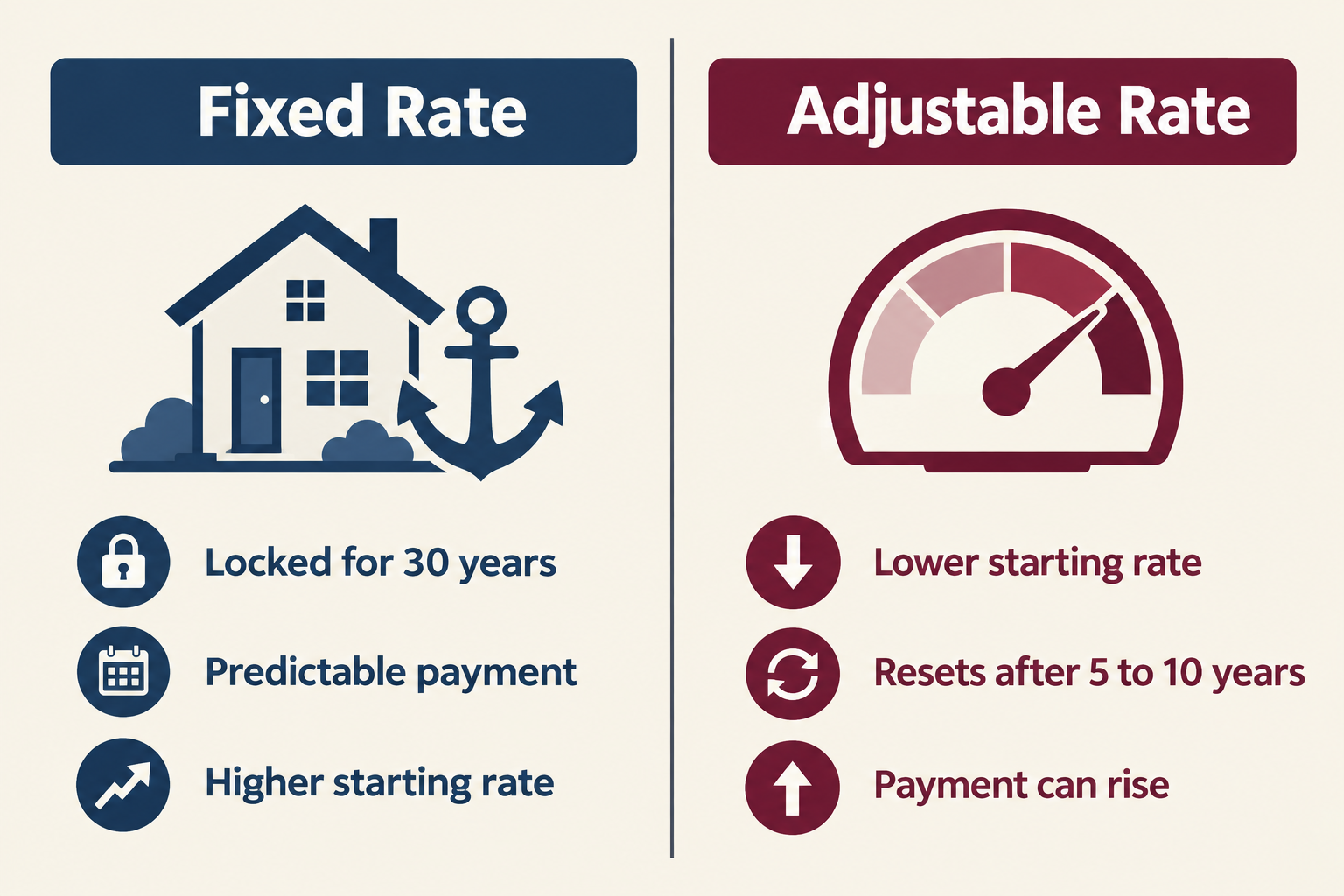
Adjustable-rate mortgages (ARMs) typically start lower than fixed rates right now, which makes them tempting when the 30-year fixed average sits above 7%. Fixed rates lock your payment for the full loan term, while ARMs reset after an initial period, usually 5, 7, or 10 years.
Choose a fixed rate if you plan to stay in the home past the ARM's reset period, or you want payment certainty over payment savings.
Choose an ARM if you're confident you'll sell or refinance before the first reset, and the lower starting rate meaningfully improves what you qualify for today.
The full tradeoffs, including how rate caps work and what happens if rates are still high at your reset date, are covered in our straight-talk breakdown of adjustable-rate mortgage pros and cons.
Frequently Asked Questions
Is now a bad time to sell a house?
Not automatically. Homes priced against current comps and marketed well are still selling, just slower and often with a concession attached. Overpriced listings are the ones stalling out.
Why are so many houses sitting unsold right now?
Buyer qualifying power dropped as rates climbed past 7%, while sellers were slower to adjust prices, creating a gap that's only now closing through discounts [1].
Will mortgage rates drop before the end of 2026?
Most forecasters expect gradual easing rather than a sharp drop, tied to Fed policy moves that take months to reach mortgage pricing [8].
Do price cuts mean the housing market is crashing?
No. A 20.8% price-cut share is high for September, but it reflects a correction to current buyer budgets, not a 2008-style collapse [1].
Should I buy now or wait for lower rates?
Buy now if the payment works for your budget today and you plan to stay several years. Waiting risks higher prices offsetting any rate savings later.
What's a realistic rate to expect on a new mortgage in late 2026?
Expect somewhere between 6.8% and 7.6% depending on credit score, loan type, and lender, based on the current Freddie Mac and Mortgage News Daily readings [3].
Are seller concessions common right now?
Yes. Rate buydowns and closing cost credits have become standard negotiating tools in markets where buyer demand has softened.
How much lower does my offer need to be to get accepted in this market?
There's no universal number. Pull 30-day sold comps for the specific neighborhood and price within 2% to 3% of recent closed sales, not list prices.
Conclusion
The gap between rising inventory and falling buyer demand is the whole story of the 2026 housing market right now. Rates near 7.28% strand plenty of sellers who assumed a quick sale, while buyers who technically have more homes to choose from still can't stretch their budgets far enough to act. Neither side is wrong. The math just doesn't line up yet.
If you're selling, price against the last 30 days of closed sales, put a concession on the table before a price cut, and fix anything that kills a showing in the first ten seconds. If you're buying, get a real pre-approval before you fall for a listing you can't actually carry, and don't assume rates will bail you out in the next 90 days. Fresh comps, fresh numbers, fresh expectations. That's the only move that works in a market this stuck.
References
[1] Sellers Slash Prices Historic Pace September 2026 Report – https://www.realtor.com/news/trends/sellers-slash-prices-historic-pace-september-2026-report/
[2] Housing Market Update – https://crosscountrymortgage.com/mortgage/resources/housing-market-update/
[3] Higher Mortgage Rates Have Buyers Redoing The Math – https://www.nar.realtor/news/real-estate-news/higher-mortgage-rates-have-buyers-redoing-the-math
[4] Price Cuts Reach Yearly High 100000568 – https://finance.yahoo.com/real-estate/articles/price-cuts-reach-yearly-high-100000568.html
[5] Mortgage Rates Today Fed Rate Hike September 24 2026 – https://www.realtor.com/news/trends/mortgage-rates-today-fed-rate-hike-september-24-2026/
[6] More Homes More Price Cuts 100038916 – https://finance.yahoo.com/real-estate/articles/more-homes-more-price-cuts-100038916.html
[7] US Housing News Podcast – https://podcasts.apple.com/us/podcast/us-housing-news/id1759401596
[8] Mortgage Rates Have Gone Wild So Whats Next For Housing – https://www.housingwire.com/articles/mortgage-rates-have-gone-wild-so-whats-next-for-housing/
[9] Buyers Reemerge Lower Mortgage Rates Lift Fall Home Sales – https://www.nar.realtor/news/real-estate-news/economy/buyers-reemerge-lower-mortgage-rates-lift-fall-home-sales
[10] Us Housing Market Shifting Toward Buyers – https://edition.cnn.com/2026/09/21/economy/us-housing-market-shifting-toward-buyers