

Last updated: July 20, 2026

Quick Answer: Zillow AI collects your search behavior, saved homes, filter settings, location data, and browsing patterns to build a personalized profile that shapes every listing you see. The app uses machine learning models, including the Neural Zestimate, BuyAbility, and natural language search, to predict what you want before you type it. Understanding how this system works gives buyers real leverage to get better results and avoid being quietly steered toward listings that serve Zillow's business model more than yours.
Key Takeaways
- Zillow tracks search history, saved homes, time spent on listings, filter changes, and location data to build a buyer profile.
- The Neural Zestimate uses computer vision and hundreds of data inputs to estimate home values, but it still carries a median error rate that varies by market.
- BuyAbility is Zillow's real-time affordability tool that connects mortgage pre-qualification data to your search results.
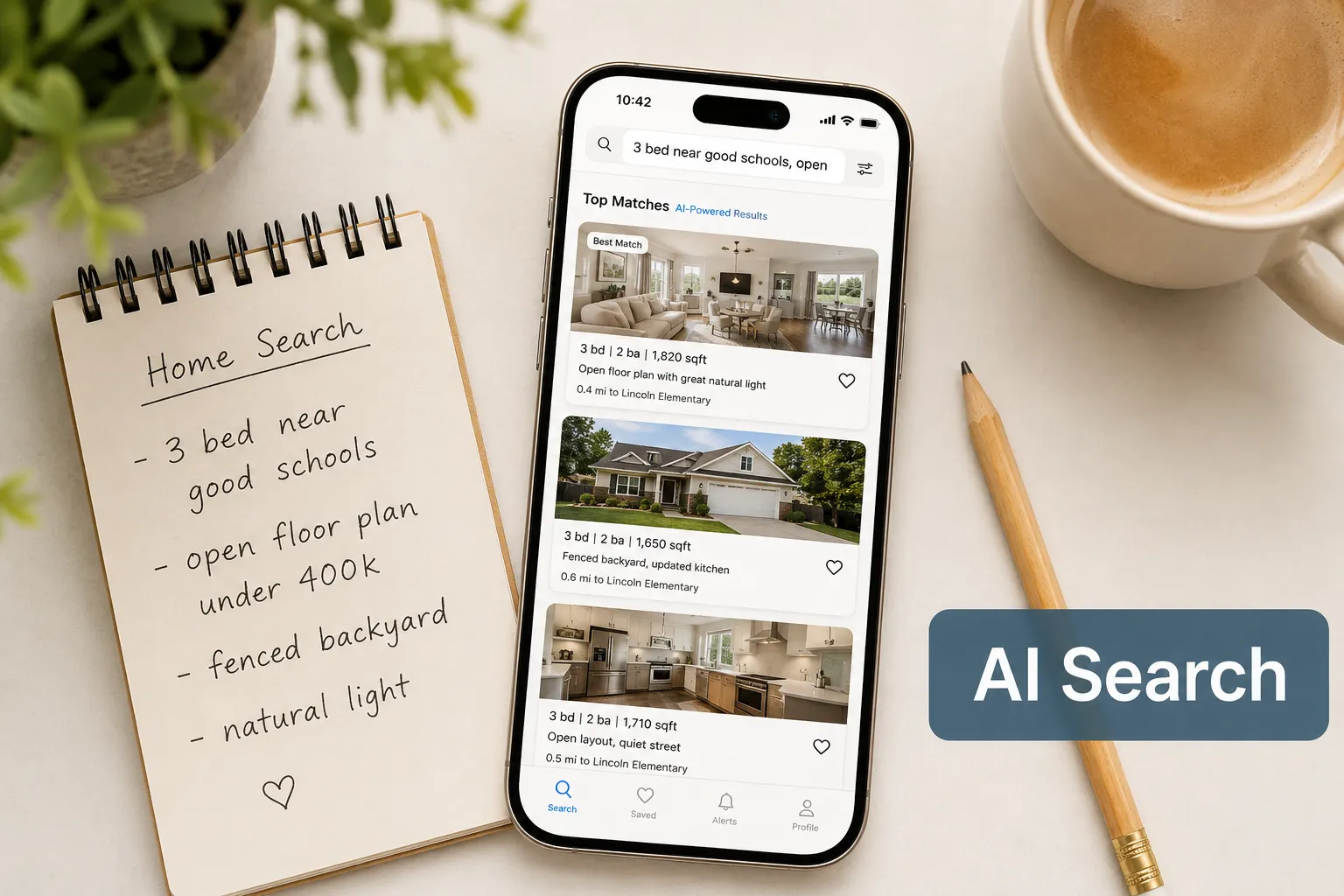
- Zillow's natural language search lets buyers type conversational queries like "3-bed home with a big yard near good schools" and get relevant results.
- Zillow AI recommendations are shaped by what you click, save, and ignore, so your behavior directly trains your own feed.
- Zillow does share data with advertising partners and affiliated services; it does not sell your raw search history to third parties in the traditional sense, but data flows into its ad ecosystem.
- You can reset your search history and adjust privacy settings in the app, but full data deletion requires a formal account deletion request.
- AI recommendations are a starting point, not a replacement for a licensed agent who knows the neighborhood, the sellers, and what's not on the listing.
What Data Does Zillow Collect When You Search for Homes
Zillow collects a broad range of behavioral and personal data every time you open the app. This includes the homes you view, how long you spend on each listing, which photos you scroll through, the filters you set, homes you save or heart, and searches you run. It also captures your device type, IP address, approximate location, and, if you're logged in, your account history going back to your first session.
Here's a breakdown of the main data categories Zillow tracks:
- Search queries, keywords, location terms, and filter settings (beds, baths, price range, home type)
- Engagement signals, time on listing, photos viewed, virtual tours started, 3D walkthroughs completed
- Save and favorite actions, homes added to your saved list, removed, or revisited multiple times
- Contact actions, whether you requested a showing, contacted an agent, or clicked "Connect with a lender"
- Location data, GPS-level location if permissions are granted, or IP-based location if not
- Linked accounts, if you connect a Google or Apple account, Zillow can correlate data across platforms
- Mortgage and financial inputs, income, credit range, and down payment estimates entered into BuyAbility or pre-qualification tools
The app also uses cookies and pixel tracking on its website version, which means browsing Zillow on a desktop browser without being logged in still generates a behavioral profile tied to your device.
Common mistake: Many buyers assume that browsing without an account means Zillow isn't tracking them. That's not accurate. Device-level tracking and cookies build a profile regardless of login status.
Zillow AI Explained: What the App Knows About Your Search
This is the core of what Zillow AI does, and it's worth being direct about it. Zillow AI explained simply: the app builds a predictive model of your preferences by combining everything you do in the app with external data sources like public property records, tax assessments, neighborhood demographics, school ratings, and market trend data. That combined profile is what drives your personalized feed, your recommended listings, and the order in which homes appear in your results.
The system is not one single algorithm. It's a stack of models working together:
- Neural Zestimate, Zillow's deep learning home valuation model that analyzes listing photos, floor plans, tax records, comparable sales, and neighborhood data to generate a home value estimate.
- BuyAbility, a real-time affordability tool that connects your financial inputs (income, debt, credit score range, down payment) to live mortgage rates to show which homes you can realistically afford.
- Natural language search, a conversational search feature that lets you describe what you want in plain English instead of clicking through filters.
- Zillow Showcase listings, an enhanced listing format that uses AI-generated floor plans, interactive tours, and high-quality media to give buyers more information per listing.
- Personalization engine, the recommendation layer that re-ranks listings based on your behavioral history.
What makes Zillow AI explained worth paying attention to is that these systems interact. A buyer who consistently views homes with open floor plans, spends extra time on listings with large kitchens, and saves homes in a specific school district will see that pattern reflected in their feed, even if they never explicitly searched for those features.
For a deeper look at how Zillow is integrating AI tools beyond the app itself, check out our breakdown of Zillow's Google NotebookLM AI Home Buying Guide.
How Does Zillow AI Predict What Houses You Want to Buy
Zillow's recommendation engine predicts preferences by analyzing behavioral patterns and comparing them to aggregate data from millions of other buyers with similar profiles. The system identifies what buyers with your search history eventually purchased or toured, then surfaces similar homes for you.
The prediction model weighs several signals:
- Recency, searches and saves from the last 7 to 14 days carry more weight than older activity.
- Frequency, homes you've viewed multiple times signal stronger interest than one-time clicks.
- Depth of engagement, scrolling through all 40 photos and starting a 3D tour signals much stronger interest than a 10-second glance.
- Negative signals, homes you skip quickly or dismiss train the model on what you don't want.
- Filter consistency, if you always add "garage" and "no HOA" to your filters, the model learns those are non-negotiables.
The personalization engine also applies collaborative filtering, the same logic Netflix uses to recommend shows. If buyers with your behavioral profile consistently ended up touring homes with certain features, Zillow assumes those features matter to you, even if you never filtered for them.
Decision rule: If your feed feels stale or off-target, the fastest fix is to deliberately engage with listings that match what you actually want, open them, scroll through photos, save them. That retrains your feed faster than changing filters alone.
Is Zillow Selling My Search History to Other Companies
Zillow does not sell your raw search history to third parties in the traditional sense. What it does do is share data with advertising partners, affiliated companies (including Zillow Home Loans, ShowingTime, and Trulia), and service providers who help operate the platform. This is standard practice for large consumer platforms and is disclosed in Zillow's privacy policy.
What that means practically:
- Advertising partners receive audience segments and behavioral signals that allow them to target you with relevant ads, mortgage lenders, moving companies, home improvement brands, without receiving your individual search records directly.
- Zillow's own affiliated services (like Zillow Home Loans) receive data that allows them to show you pre-qualification offers timed to your search activity.
- Third-party analytics tools used by Zillow (like Google Analytics) collect behavioral data that flows into Google's ad ecosystem.
The honest framing here: Zillow's business model is built on connecting buyers with agents, lenders, and service providers who pay for that access. Your search behavior is the product that makes those connections valuable. That's not sinister, it's how free platforms work, but it's worth knowing so you can make informed choices about what you share.
Edge case: If you use Zillow's mortgage tools and enter income or credit information, that data is subject to different regulations (including FCRA and GLBA) and is handled with stricter controls than general browsing data.
How Accurate Is Zillow's Home Value Estimates
The Neural Zestimate is Zillow's most technically sophisticated AI feature, and it's genuinely impressive, but it has real limitations buyers and sellers need to understand. Zillow reports that its nationwide median error rate for on-market homes is approximately 2.4%, while off-market homes carry a higher median error rate closer to 6.9% (Zillow's own accuracy data, published on their website). Those numbers vary significantly by market.
What the Neural Zestimate does well:
- Analyzes listing photos using computer vision to assess condition, finishes, and layout quality
- Incorporates floor plan data to adjust for square footage accuracy
- Updates frequently as new comparable sales data becomes available
- Performs well in high-transaction markets with abundant data (Phoenix, Dallas, Atlanta)
Where it struggles:
- Rural and low-transaction markets with limited comparable sales
- Unique or custom homes that don't fit standard comparison models
- Properties with recent renovations not captured in public records
- Markets with rapid price movement where recent sales data lags
The straight answer for sellers: Don't list based on the Zestimate alone. Use it as a reference point, then get a comparative market analysis from a licensed agent who has actually been inside comparable homes. If you're preparing to list, our guide on home sellers pricing strategies for 2026 covers how to price with real data, not just app estimates.

What's the Difference Between Zillow AI Recommendations and Manual Search Filters
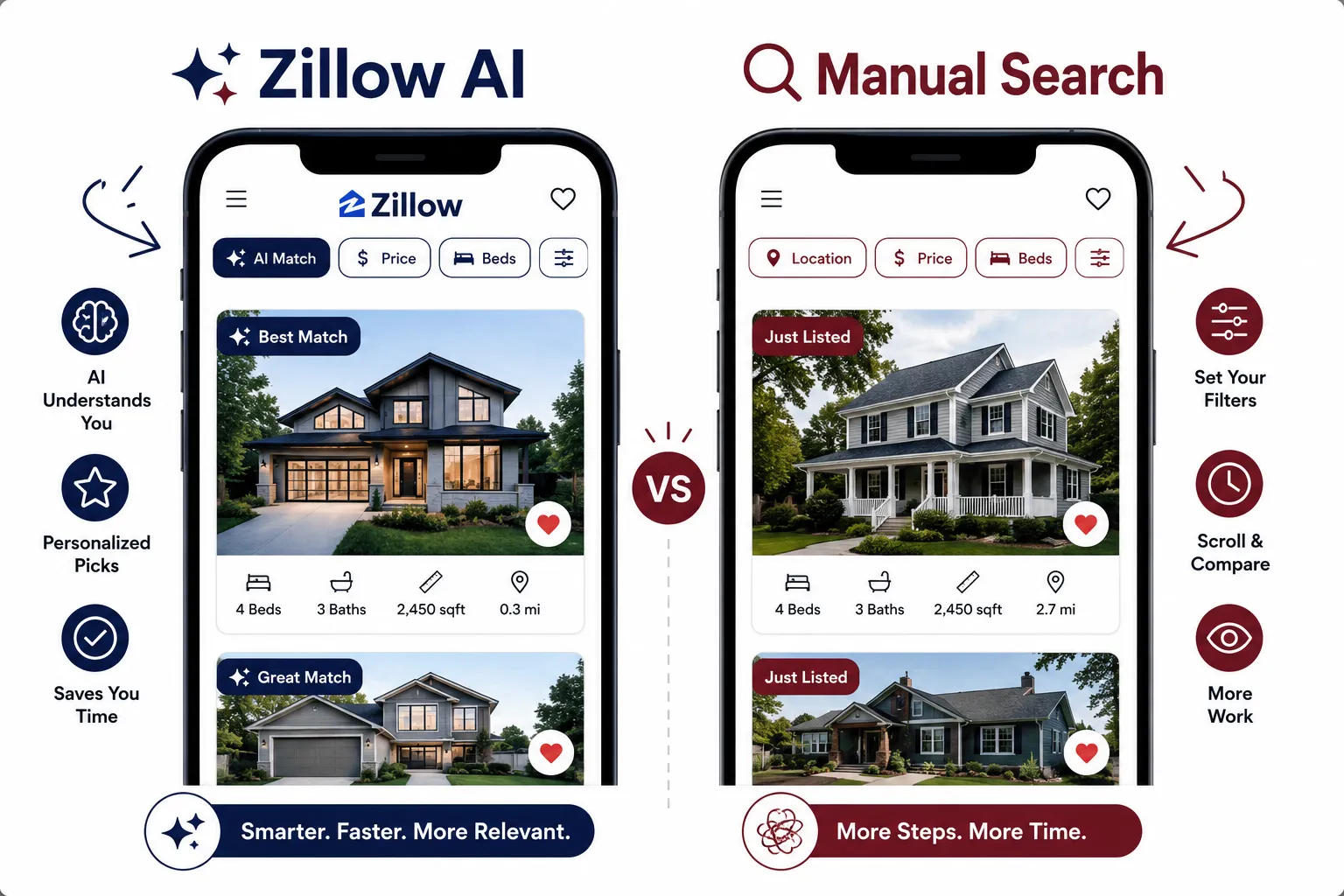
Manual search filters give you explicit control, you set the price range, bed count, bath count, home type, and location. Zillow AI recommendations work on top of those filters, re-ranking results and surfacing additional listings based on your behavioral history. They serve different purposes and work best together.
| Feature | Manual Filters | AI Recommendations |
|---|---|---|
| Control | Full, you set every parameter | Partial, AI infers preferences |
| Accuracy | Exactly what you specify | Probabilistic, based on patterns |
| Discovery | Limited to what you know to search for | Can surface homes you wouldn't have found |
| Bias risk | Low | Higher, reflects past behavior, not future needs |
| Best use | Narrowing a known requirement | Exploring adjacent options |
The practical issue with relying too heavily on AI recommendations: they reflect your past behavior, not your evolving needs. A buyer who spent three months searching for condos before deciding to look at townhomes will have a feed that keeps pushing condos long after the preference shifted. The algorithm needs time to catch up, which is why manually adjusting filters and engaging with new listing types is the faster path to a recalibrated feed.
So based: The buyers who get the most out of Zillow AI are the ones who treat the app like a two-way conversation, they signal their preferences deliberately, not just passively scroll.
Does Zillow Use My Search History to Raise Prices or Hide Listings
Zillow does not use individual search history to raise home prices, it has no mechanism to do that, since listing prices are set by sellers and their agents. What Zillow does control is listing visibility and ranking order, which is where the more relevant question sits.
Zillow Showcase listings, the enhanced listing format that agents and sellers pay a premium for, receive preferential placement in search results. This means a home with a standard listing may rank lower than a comparable Showcase listing even if it's a better match for your search criteria. That's a business model decision, not a personalization decision, but the effect is the same: what you see first isn't always what's most relevant to you.
Zillow also operates its own iBuyer-adjacent services and mortgage products. Homes that generate leads for Zillow Home Loans or connect to Zillow's Premier Agent network may receive algorithmic advantages that aren't visible to the average buyer.
What this means for buyers: The first page of results is not a neutral ranking. Treat it as a starting point and use the "Sort by" options (newest listings, price low-to-high) to break out of the default algorithmic order and see what you might be missing.
For comparison, see how Redfin handles AI-powered search differently in our Redfin ChatGPT app guide.
How Does Zillow Know My Budget and Preferences
Zillow infers budget from multiple signals even before you enter any financial information. The price range you filter for, the homes you save versus skip, and the neighborhoods you search in all feed into a budget model. If you consistently view $400,000 to $450,000 homes in suburban zip codes and skip anything above $475,000, the system registers that ceiling.
BuyAbility takes this further by connecting actual financial inputs to real-time mortgage rate data. When you enter your estimated income, monthly debts, credit score range, and down payment amount, BuyAbility calculates a personalized home price range and monthly payment estimate using current rates. That data then integrates with your search to highlight homes within your realistic buying range.
Preference inference works similarly. Zillow tracks:
- Which architectural styles you engage with most
- Whether you consistently view homes with pools, garages, or large lots
- How you respond to different neighborhood types (urban, suburban, rural)
- Which school districts appear most in your saved homes
- How much time you spend on listings with specific amenities
Fresh insight: Zillow's preference model is impeccable at identifying patterns you may not have consciously articulated. Buyers sometimes discover their own non-negotiables by looking at what the app keeps surfacing, it's essentially a mirror of your subconscious search behavior.
If you want to understand how your budget fits current market conditions, our current mortgage rates guide gives you the rate context to make BuyAbility numbers mean something real.

Why Does Zillow Show Me Homes I Didn't Search For
Zillow's recommendation engine surfaces homes outside your explicit search criteria for several reasons, and not all of them are in your interest. Understanding the difference matters.
Legitimate reasons:
- Collaborative filtering identified homes that buyers with your profile consistently liked
- Your engagement signals suggest preferences you haven't explicitly filtered for
- New listings in adjacent areas match your behavioral profile even if outside your search zone
- The algorithm is testing new listing types to refine its model of your preferences
Business-driven reasons:
- Showcase listings receive placement boosts regardless of match quality
- Premier Agent-connected listings may surface more frequently
- Homes that generate mortgage inquiries for Zillow Home Loans may receive visibility advantages
The Zillow AI search experience is designed to keep you engaged in the app longer, which is a platform goal, not a buyer goal. More time in the app means more ad impressions, more agent connection requests, and more mortgage leads. That's not gate keeping information, it's just the honest business model reality.
Practical fix: If off-target recommendations are cluttering your feed, use the "Not interested" or dismiss function on listings that don't fit. That negative signal recalibrates the algorithm faster than any setting change.
Zillow Natural Language Search: 5 Examples That Actually Work
Zillow's natural language search is one of its most genuinely useful AI features. Instead of clicking through a filter menu, you type a description of what you want in plain English and the system interprets your intent. Here are five example queries that work well in the app:
"3-bedroom home with a big backyard near good elementary schools under $425,000 in Austin", This pulls location, price ceiling, bedroom count, lot preference, and school quality into a single query.
"Modern open floor plan townhouse with garage no HOA in Atlanta suburbs", Targets architectural style, home type, specific amenity, and HOA exclusion simultaneously.
"Fixer-upper under $300,000 within 30 minutes of downtown Denver", Combines condition preference, price ceiling, and commute radius.
"Single-story home with at least 2,000 square feet and a home office in Phoenix", Addresses accessibility preference, size floor, and specific room type.
"Waterfront property with a dock under $600,000 in Florida", Location-specific amenity search with price ceiling.
The Zillow AI search engine handles these queries by parsing intent and mapping it to available listing data. It performs best when queries are specific and include at least one location anchor. Vague queries like "nice house in a good area" return less useful results because the system lacks enough constraints to filter meaningfully.
Let it cook before you see results: Natural language search results improve as you engage with what surfaces. The first set of results trains the next query's context, so spending a few minutes clicking through and dismissing listings sharpens subsequent searches.
Can I Turn Off Zillow's Tracking and Data Collection
You can reduce Zillow's data collection, but you cannot fully turn it off while using the app. Here's what's actually available:
In the Zillow app (iOS/Android):
- Go to Account > Privacy Settings to manage marketing communications and some personalization features
- Revoke location permissions in your device settings (Settings > Privacy > Location Services > Zillow) to stop GPS tracking
- Use "Limit Ad Tracking" on iOS or "Opt out of Ads Personalization" on Android to reduce cross-app ad targeting
On Zillow's website:
- Use the cookie preference center (typically accessible via the footer) to opt out of non-essential tracking cookies
- Browsing in incognito/private mode prevents cookie-based tracking but not IP-based tracking
For California residents (CCPA) and other state privacy law protections:
- Zillow's privacy policy includes a "Do Not Sell or Share My Personal Information" option for eligible residents
- This limits data sharing with advertising partners but does not stop internal data use
What you cannot turn off: Core functional tracking (session data, search queries, saved homes) is required for the app to work. If you want to use Zillow, some level of data collection is the price of admission.
How Can I Delete My Zillow Search History and Data
Deleting your Zillow data requires a few different steps depending on what you want removed.
To clear search history within the app:
- Go to Search > Recent Searches and clear individual queries or all recent searches
- This removes the visible history but does not delete the underlying behavioral data from Zillow's servers
To delete saved homes:
- Go to Saved Homes and remove listings individually or in bulk
To request full account data deletion:
- Submit a data deletion request through Zillow's Privacy Request form (accessible via their privacy policy page)
- Under CCPA (California) and similar state laws, Zillow is required to delete personal data upon verified request within 45 days
- Account deletion removes your profile and associated data, but some data may be retained for legal and fraud prevention purposes
Practical reality: Clearing your search history resets the visible layer of your account but the algorithmic profile built from your behavior may persist in anonymized or aggregated form even after deletion. If privacy is a serious concern, using Zillow without a logged-in account and with location permissions disabled gives you the most functional access with the least data exposure.

What Personal Information Does the Zillow App Store About You
Beyond search behavior, Zillow stores a broader set of personal information for users with accounts. This is what's in your Zillow profile:
- Identity data, name, email address, phone number, and any connected social accounts
- Financial data, income estimates, credit score ranges, down payment amounts, and debt information entered into BuyAbility or mortgage tools
- Communication records, messages sent to agents through Zillow's platform, showing requests, and contact form submissions
- Transaction history, if you've used Zillow Offers (now discontinued) or Zillow Home Loans, transaction-related data is retained
- Device and technical data, device identifiers, browser type, operating system, and app version
- Inferred data, Zillow's derived conclusions about your preferences, budget range, timeline, and buyer stage
The inferred data category is the one most buyers don't think about. Zillow doesn't just store what you did, it stores what it concluded about you based on what you did. That profile is what gets shared with advertising partners and affiliated services.
Is Zillow's AI Better Than a Real Estate Agent for Finding Homes
Zillow AI is extraordinary at processing large amounts of listing data quickly and surfacing options a buyer might not have found manually. A real estate agent is extraordinary at things AI cannot do: reading a seller's motivation, knowing which listings have undisclosed issues, negotiating terms, and understanding hyper-local market dynamics that don't show up in any database.
Where Zillow AI wins:
- Speed, it surfaces hundreds of relevant listings in seconds
- Breadth, it covers every listed property in a market simultaneously
- Availability, 24/7, no scheduling required
- Pattern recognition, it identifies preference patterns across large datasets
Where a licensed agent wins:
- Off-market and pocket listings not on Zillow
- Neighborhood-level knowledge (which streets flood, which HOAs are dysfunctional, which builders cut corners)
- Negotiation strategy and relationship with the listing agent
- Identifying red flags in disclosures and inspection reports
- Representing your interests legally and fiduciarily
The honest answer: use Zillow AI to do the heavy lifting on discovery and initial filtering. Use a licensed agent for everything that happens after you find a home you like. They're not competing tools, they're complementary ones.
For sellers thinking about whether AI tools can replace traditional marketing, our guide on marketing your home with AI tools in 2026 gives a grounded look at what AI handles well and where human expertise still wins.
What Mistakes Do People Make Trusting Zillow's AI Suggestions
The biggest mistakes buyers make with Zillow AI fall into a few consistent patterns. Knowing them in advance saves real money and real frustration.
Mistake 1: Treating the Zestimate as a price ceiling for offers. The Neural Zestimate is a starting reference, not an appraisal. In competitive markets, homes routinely sell 5% to 15% above Zestimate. Using it as your offer anchor without a proper CMA from an agent can cost you the home.
Mistake 2: Assuming the first page of results is the best match. Showcase listings and Premier Agent-connected properties receive placement advantages. The home that's actually best for your needs might be on page three.
Mistake 3: Letting a stale behavioral profile limit your search. If your preferences have shifted, new budget, new location priority, new lifestyle needs, your old engagement history is actively working against you. Reset it deliberately.
Mistake 4: Entering financial data without understanding where it goes. Income and credit information entered into BuyAbility flows into Zillow's mortgage ecosystem. You may start receiving calls from Zillow Home Loans or affiliated lenders. That's not a bug, it's the intended outcome.
Mistake 5: Skipping the "Sort by: Newest" view. The default sort order is algorithmic. Sorting by newest listings shows you what just hit the market before the algorithm has decided whether to show it to you, which is often where the best opportunities live.
For buyers who want to sharpen their negotiation position after finding a home, our negotiation power moves guide covers how to use market data to your advantage at the offer table.

Neural Zestimate Explained: Can Zillow AI Predict Home Values Accurately
The Neural Zestimate is Zillow's deep-learning home valuation model, and it is genuinely more sophisticated than the original Zestimate that launched in 2006. Zillow reports a national median error rate of roughly 2.4% for on-market homes and around 7.5% for off-market homes, but these figures vary significantly by market and property type.
What feeds the Neural Zestimate:
- Public tax and assessment records
- Recent comparable sales (comps) within the surrounding area
- Listing history, including prior sale prices and days on market
- Physical property data: square footage, lot size, bed/bath count, year built
- Satellite and street-level imagery (used to assess condition signals)
- Neighborhood-level data: school ratings, walkability scores, proximity to amenities
- Market velocity data: how fast homes are selling in that zip code
Where it gets it wrong:
- Unique or custom properties with few true comps
- Rapidly shifting local markets where recent sales data is thin
- Homes with significant unreported renovations or damage
- Rural areas with low transaction volume
The Neural Zestimate is impeccable as a starting point for research. It is not a substitute for a licensed appraiser or a comparative market analysis from an agent. If a listing's Zestimate is 15% below asking price, that is a conversation to have with your agent, not a reason to skip the showing.
For context on which platforms produce the most accurate estimates overall, see our analysis of what company has the most accurate real estate estimate.
How often does Zillow AI update its predictions? Zillow updates Zestimates daily for most markets when new data is available. In high-volume markets, this can mean multiple adjustments per week as new comps close. In slower markets, updates may be less frequent.
What Privacy Concerns Should I Know About Zillow AI
The most important privacy concern with Zillow AI is not that the app is doing something illegal, it is that most users do not understand what they agreed to when they signed up.
Key concerns buyers and sellers should be aware of:
Lead data sharing: When you click "Contact Agent" on a Zillow listing, your contact information and behavioral profile are shared with that agent (and potentially other Premier Agents in that market). You may receive outreach from agents you did not directly contact.
Affiliated lender data sharing: If you use BuyAbility or Zillow's mortgage pre-qualification tools, your financial data can be shared with Zillow Home Loans and affiliated lenders. This is disclosed in the terms of service but is easy to miss.
Third-party data enrichment: Zillow's privacy policy permits the use of third-party data to enrich user profiles. This means data about you from outside Zillow can be combined with your on-platform behavior.
Data retention: Even if you delete your account, some data may be retained for legal compliance or fraud prevention purposes for a defined period.
The straight answer: Zillow AI personalization serves Zillow's business model first. The recommendations it surfaces are shaped by what you want AND by which agents and listings are paying for visibility. That is not a reason to stop using the app, it is a reason to use it with both eyes open.
For buyers who want to understand the full picture of what they are agreeing to before a purchase, our breakdown of U.S. home buyer market trends in 2026 gives useful context on how digital tools are reshaping the buying process.
How Is Zillow AI Different From Other Real Estate Apps
Zillow AI is the most data-rich personalization system among major U.S. real estate apps, largely because Zillow has the largest user base and the longest behavioral data history. That scale advantage is real, but it comes with trade-offs.
Zillow vs. Redfin vs. Realtor.com, AI feature comparison:
Zillow: Neural Zestimate, BuyAbility, Zillow Showcase, natural language search, ChatGPT app integration for conversational queries, NotebookLM integration for research-style home buying guidance. Largest listing database, most aggressive personalization.
Redfin: ChatGPT-powered natural language search, agent-integrated tour scheduling, and a more transparent commission model. Redfin's AI search is strong but its personalization depth is less developed than Zillow's. See our full guide on Redfin's ChatGPT app for real estate searches.
Realtor.com: Solid MLS data coverage, basic personalization, and a more straightforward search experience. Less AI-forward than Zillow but often more complete in listing coverage for certain markets.
Choose Zillow AI if: You want the most personalized experience, you are early in your search and want broad market exposure, and you are comfortable with data-driven recommendations.
Choose manual search or Redfin if: You want more control over what you see, you are in a specific niche market, or you prefer a less algorithmically filtered experience.
The honest assessment: No single app shows you everything. Extraordinary buyers use two or three platforms in parallel during the research phase, then narrow to one when they get serious.
Is Zillow AI Worth Using or Should You Search Manually
Zillow AI is worth using as a research and discovery tool, it is not a replacement for a licensed agent or manual due diligence. The algorithm is genuinely good at surfacing options you might not have found through manual filtering, especially early in your search.
Use Zillow AI for:
- Initial market exploration and price range calibration
- Getting a quick Zestimate read on a neighborhood's value range
- Natural language searches when you know what you want but not exactly where
- BuyAbility to get a realistic affordability anchor before talking to a lender
- Tracking price changes and days on market for specific listings
Do not rely on Zillow AI for:
- Final valuation decisions, get a licensed appraisal or agent CMA
- Assuming you are seeing all available listings, you are not
- Interpreting "Zestimate vs. asking price" gaps without agent context
- Making offers based on AI recommendations alone
The bottom line: Zillow AI is an impeccable starting point. It is a tool, not an advisor. The buyers who get the best outcomes use the app to generate options and then bring a licensed agent in to evaluate them. If you are a seller trying to understand how AI tools affect your listing's visibility, our 60-day home selling plan with AI tools is worth bookmarking.
Conclusion: How to Use Zillow AI Without Getting Played by It
Zillow AI explained in one sentence: it is a powerful discovery engine that works best when you feed it accurate signals, and it serves Zillow's business model alongside yours.
The buyers who get the most out of the platform treat it like a research tool, not an oracle. Use natural language search to explore. Use BuyAbility to anchor your budget. Use the Neural Zestimate to flag pricing outliers. Save intentionally, dismiss actively, and keep your filters honest.
But know what the algorithm is not doing: it is not showing you every listing. It is not giving you unbiased rankings. And it is not replacing the judgment of a licensed agent who knows your local market from the inside.
Your next steps:
- Log into your Zillow account and audit your saved homes, remove anything that does not reflect your real search criteria
- Try at least one natural language search using the examples in this article
- Run BuyAbility with accurate financial inputs to get a realistic affordability range
- Cross-reference any serious listing on Realtor.com or your local MLS to confirm full market coverage
- Bring a licensed agent into the process before you make any offer, AI surfaces options, agents close deals
For sellers, understanding how AI tools affect your listing's visibility is equally important. Our guide on preparing your home for sale in 2026 covers the steps that actually move the needle before you list.
Zillow AI is fresh, it is genuinely useful, and it keeps getting better. Use it with intention and it works for you. Use it passively and it works for Zillow.
Frequently Asked Questions
Does Zillow track me when I'm not logged in?
Yes. Zillow uses cookies, device identifiers, and IP-based tracking that build a behavioral profile regardless of login status. Browsing in private/incognito mode reduces but does not eliminate this tracking.
What is the Neural Zestimate and how is it different from the original Zestimate?
The Neural Zestimate uses deep learning and computer vision to analyze listing photos and floor plans in addition to public records data. The original Zestimate relied primarily on tax records and comparable sales. The Neural Zestimate is more accurate for on-market homes but still carries meaningful error rates in low-transaction and rural markets.
Can Zillow AI tell me if a neighborhood is safe?
Zillow provides neighborhood data including school ratings and some demographic information, but it does not provide direct crime statistics. It links to third-party crime data sources. The AI does not make safety assessments, that judgment requires local knowledge and direct research.
What is BuyAbility and is it the same as a mortgage pre-approval?
BuyAbility is Zillow's real-time affordability estimator that uses your financial inputs and current mortgage rates to show a realistic home price range. It is not a mortgage pre-approval. A pre-approval requires a formal lender application, credit pull, and income verification. BuyAbility is a planning tool, not a lending commitment.
Why does Zillow keep showing me homes above my budget?
The algorithm may be testing whether your stated budget ceiling is a hard limit or a soft preference. It may also be surfacing Showcase listings that fall slightly outside your range. Consistently dismissing above-budget listings trains the model to respect that ceiling more strictly.
Does Zillow share data with real estate agents who pay for Premier Agent?
Premier Agents receive buyer contact information when a buyer initiates contact through Zillow. Zillow does not give Premier Agents access to a buyer's full search history or behavioral profile. What agents receive is lead contact data, name, phone, email, and the specific listing that triggered the inquiry.
How often does the Zestimate update?
Zillow updates Zestimates frequently, in many markets, daily, as new comparable sales data, tax records, and listing information become available. The update frequency varies by market data availability.
Is Zillow Showcase worth it for sellers?
Zillow Showcase gives listings enhanced placement, AI-generated floor plans, and interactive media. It costs sellers (or their agents) a premium. Whether it's worth it depends on your market's competitiveness and how much of your buyer pool is searching on Zillow specifically. For a broader look at listing preparation, see our guide on preparing your home for sale in 2026.
Can I use Zillow's natural language search on desktop?
Zillow's natural language search is primarily available through the mobile app. The desktop version has a standard search bar with filter menus. The conversational search experience is most developed in the iOS and Android app versions as of 2026.
Does Zillow integrate with ChatGPT or other AI assistants?
Zillow has explored integrations with AI tools including a NotebookLM-powered home buying guide. These integrations are separate from the core app's AI features and are designed to help buyers research neighborhoods and market conditions conversationally. See our full breakdown of Zillow's Google NotebookLM integration for details.
Conclusion: Work the Algorithm, Don't Just Trust It
Zillow AI explained in plain terms is this: the app is an extraordinary data collection and pattern-matching machine that gets better at predicting your preferences the more you use it. That's genuinely useful. It's also a platform built to generate leads for agents, lenders, and service providers, which means the listings it surfaces and the order it surfaces them in are shaped by business incentives, not just your best interests.
The buyers who get the most out of Zillow AI are the ones who understand both sides of that equation. Use the Natural Zestimate as a reference, not a gospel. Use BuyAbility to understand your range, then get an actual pre-approval from a lender. Use natural language search to discover options you wouldn't have found manually. And use a licensed agent for everything that requires judgment, negotiation, and local knowledge that no algorithm has yet managed to replicate.
Actionable next steps:
- Audit your Zillow account's saved searches and clear any that no longer reflect your current priorities, your feed will recalibrate within days.
- Try at least one natural language search query using the five examples above and compare the results to your standard filter-based search.
- Sort results by "Newest" at least once per session to break out of the default algorithmic ranking.
- Review Zillow's privacy settings and revoke location permissions if you're not getting value from location-based features.
- Cross-reference any Zestimate with a licensed agent's CMA before making an offer or setting a listing price.
The app knows a lot about your search. Now you know what it knows, and that changes how you use it.
Tags: Zillow AI, Neural Zestimate, Zillow BuyAbility, Zillow natural language search, home buying apps 2026, Zillow data privacy, Zillow Showcase listings, real estate AI tools, Zillow personalization, how Zillow ranks listings, Zillow app features 2026, AI home search
For more home buying resources and market insights, visit the Home Buying Hub.