

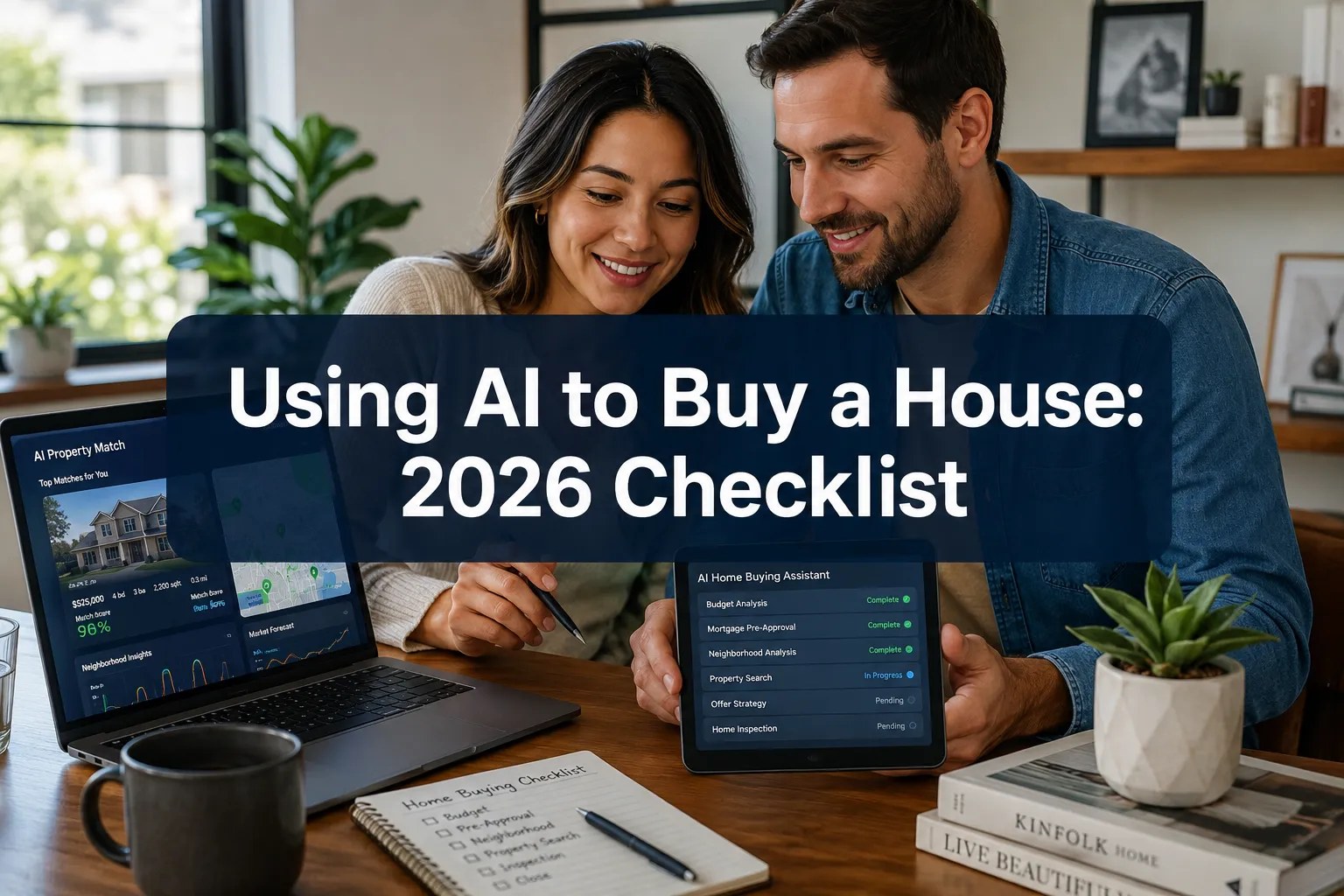
Last updated: July 20, 2026

Quick Answer
Using AI to buy a house in 2026 means running specific prompts through ChatGPT, Claude, or NotebookLM to research neighborhoods, analyze flood risk, compare mortgages, review HOA documents, and estimate closing costs, but you still need licensed professionals for inspections, legal review, and final lending decisions. AI handles the data-heavy research and math; humans handle the liability and judgment calls. This checklist walks you through exactly which AI tool to use at each step, the exact prompts to run, and where to stop and call a professional.
Key Takeaways
- AI for home buyers accelerates due diligence but does not replace inspectors, attorneys, or lenders, use it for research, not final decisions.
- ChatGPT and Claude excel at neighborhood vetting, mortgage comparison, and document summarization when fed the right prompts.
- NotebookLM organizes property documents, HOA bylaws, and inspection reports into searchable, queryable knowledge bases.
- First Street and FEMA flood data can be analyzed by AI to translate risk scores into plain-English summaries for any address.
- AI closing cost estimates are accurate for ballpark budgeting but must be verified by your lender before you wire funds.
- Permit history and property records from county assessor sites can be uploaded to AI tools for instant red-flag detection.
- First-time home buyer AI tools are free or low-cost in 2026, making due diligence accessible to buyers who can't afford full consulting teams.
- AI due diligence home buying works best when you treat AI as a research assistant, not a decision-maker, always verify critical facts.
- Caution zones: Never skip human review for structural inspections, title insurance, legal contracts, or final loan approval.
- This checklist gives you the exact AI tool and prompt for each step, so you can move faster without cutting corners.
Using AI to Buy a House: What It Actually Means in 2026
Using AI to buy a house means running targeted prompts through tools like ChatGPT, Claude, or NotebookLM to handle the research-heavy, time-consuming parts of due diligence, neighborhood analysis, flood risk translation, mortgage math, HOA document review, and closing cost estimation. You're not replacing your real estate agent, inspector, or attorney. You're giving yourself a research assistant that works 24/7, doesn't charge hourly, and can process hundreds of pages of documents in seconds.
In 2026, ai for home buyers has matured past the hype phase. We're not talking about AI that "predicts" whether you'll love a neighborhood or claims to replace human judgment. We're talking about practical, verifiable tasks: summarizing a 60-page HOA covenant, calculating whether a 6.5% mortgage beats a 6.1% mortgage with higher fees, or pulling permit history from county records and flagging unpermitted additions. These are tasks that used to require hours of manual work or expensive consultants. Now they take minutes and cost nothing if you're using free AI tools.
The shift happened because the tools got better at handling real-world documents and data, and because buyers, especially first-time buyers, realized they were paying thousands in avoidable mistakes simply because they didn't have time to read everything. AI due diligence home buying doesn't mean cutting corners. It means reading every corner faster and knowing which corners need a licensed professional to double-check.
Here's what AI handles well: data aggregation, pattern recognition, document summarization, comparative analysis, and math. Here's what it doesn't handle: liability, legal interpretation, structural engineering judgment, and final lending decisions. If you treat AI as a research layer that feeds into human decision-making, you'll move faster and smarter. If you treat it as a replacement for professionals, you'll end up in a lawsuit or a money pit.
This checklist is built for U.S. home buyers who want to use AI without getting burned. Every step includes the specific tool, the exact prompt, and a clear line where you stop and call a human. Let's get into it.
How AI Helps With Home Buying in 2026: The Real Use Cases
AI helps with home buying by automating the research and analysis tasks that used to eat up evenings and weekends, neighborhood vetting, school ratings, crime data, flood risk, mortgage comparison, HOA review, and closing cost math. It doesn't make the final decision for you, but it gives you the information you need to make that decision faster and with more confidence.
AI neighborhood research is one of the highest-value use cases. You can feed ChatGPT or Claude an address and ask it to summarize walkability scores, school ratings, crime trends, nearby amenities, and recent sales comps. The AI pulls from public data sources (Zillow, GreatSchools, local crime databases) and delivers a plain-English summary in under a minute. You're not getting a custom appraisal, but you're getting enough context to decide whether a neighborhood is worth a deeper dive.
AI mortgage comparison is another killer app. You can paste loan estimates from three different lenders into ChatGPT and ask it to calculate total interest paid over 30 years, break down closing costs, and highlight which loan saves you the most money. The AI doesn't care which lender you pick, it just does the math. This is especially useful for first-time buyers who don't have a mortgage broker on speed dial and don't want to spend hours in spreadsheets.
ChatGPT buy a house workflows are becoming standard in 2026. Buyers are using ChatGPT to draft offer letters, summarize inspection reports, review title documents, and even generate questions to ask during final walkthroughs. The tool is free, fast, and surprisingly good at translating jargon into normal human language. You're not trusting it to negotiate on your behalf, but you're using it to prepare so you show up informed.
Property history search AI is where things get interesting. You can upload county assessor records, permit history, and tax documents to NotebookLM or Claude, then ask questions like "Were there any unpermitted additions?" or "Has this property ever been flagged for code violations?" The AI scans the documents and flags anything unusual. You still need to verify with the county or a title company, but you're starting with a much clearer picture.
Flood risk data home analysis is critical in 2026, especially as climate risk becomes a bigger factor in insurance and resale value. You can pull a property's flood zone designation from FEMA, then ask ChatGPT or Claude to explain what that zone means in plain English, estimate insurance costs, and flag whether the property has flooded in the past. First Street Foundation's flood risk scores can also be fed into AI for a second opinion. This doesn't replace a flood certification, but it tells you whether you need one before you waste time on a property that's uninsurable.
AI closing cost estimate tools are now accurate enough for budgeting. You can feed ChatGPT your purchase price, down payment, loan type, and state, and it will estimate closing costs within a few hundred dollars. Lenders still provide the official numbers, but having a ballpark figure early helps you avoid sticker shock and negotiate better.
The common thread: AI handles the grunt work so you can focus on the judgment calls. It's not magic, and it's not foolproof, but it's extraordinarily useful if you know how to prompt it correctly. That's what the rest of this checklist is for.
AI Home Buying Tools vs Traditional Real Estate Agent: What's the Difference?
AI home buying tools handle research, data analysis, and document summarization; traditional real estate agents handle negotiation, market access, legal compliance, and relationship management. You don't choose one or the other, you use AI to make your agent more effective and yourself more informed.
A traditional real estate agent brings market knowledge, negotiation experience, access to MLS listings, and legal accountability. They know which neighborhoods are trending, which sellers are motivated, and how to structure an offer that gets accepted. They also carry errors-and-omissions insurance, which means if they screw up, you have recourse. AI tools carry zero liability. If ChatGPT tells you a neighborhood is safe and it's not, you have no one to sue.
AI tools bring speed, scalability, and zero bias. They don't care if you're a first-time buyer with a tight budget or a cash investor. They don't push you toward properties that pay higher commissions. They process data faster than any human and don't get tired after the tenth property tour. But they also don't know that the seller's agent is notoriously difficult, or that the house down the street just went under contract for $20K over asking, or that the local inspector everyone uses is booked for three weeks.
In 2026, the best buyers use both. They use AI to pre-screen neighborhoods, compare mortgages, and review documents, then they bring that research to their agent and say, "Here's what I found, what am I missing?" The agent fills in the gaps: local market nuances, off-market opportunities, negotiation strategy, and contract red flags. The AI makes the agent's job easier because the buyer shows up educated, and the agent makes the AI's output actionable because they know which data points actually matter in that specific market.
First time home buyer AI tools are especially valuable because they level the playing field. If you've never bought a house before, you don't know what questions to ask. AI can generate those questions for you. You can ask ChatGPT, "What should I look for during a final walkthrough?" or "What are common red flags in an HOA covenant?" and get a checklist in seconds. Your agent might give you the same advice, but now you're not relying solely on their memory or goodwill, you have a second source.
The mistake buyers make is thinking AI replaces the agent. It doesn't. It replaces the hours you used to spend Googling, the spreadsheets you used to build by hand, and the documents you used to skim because you didn't have time to read them. Your agent still handles the parts that require human judgment, local expertise, and legal accountability. AI just makes sure you're not walking into those conversations blind.
If you're buying For Sale By Owner (FSBO), AI becomes even more critical because you don't have an agent's safety net. You'll need AI to help you draft offers, review contracts, and flag issues that an agent would normally catch. But you'll also need a real estate attorney to review everything before you sign, because AI can't protect you from legal liability.
Bottom line: AI tools and agents are complementary, not competitive. Use AI to do the research, use your agent to do the deal.
Best AI Platforms for House Hunting and Property Analysis in 2026
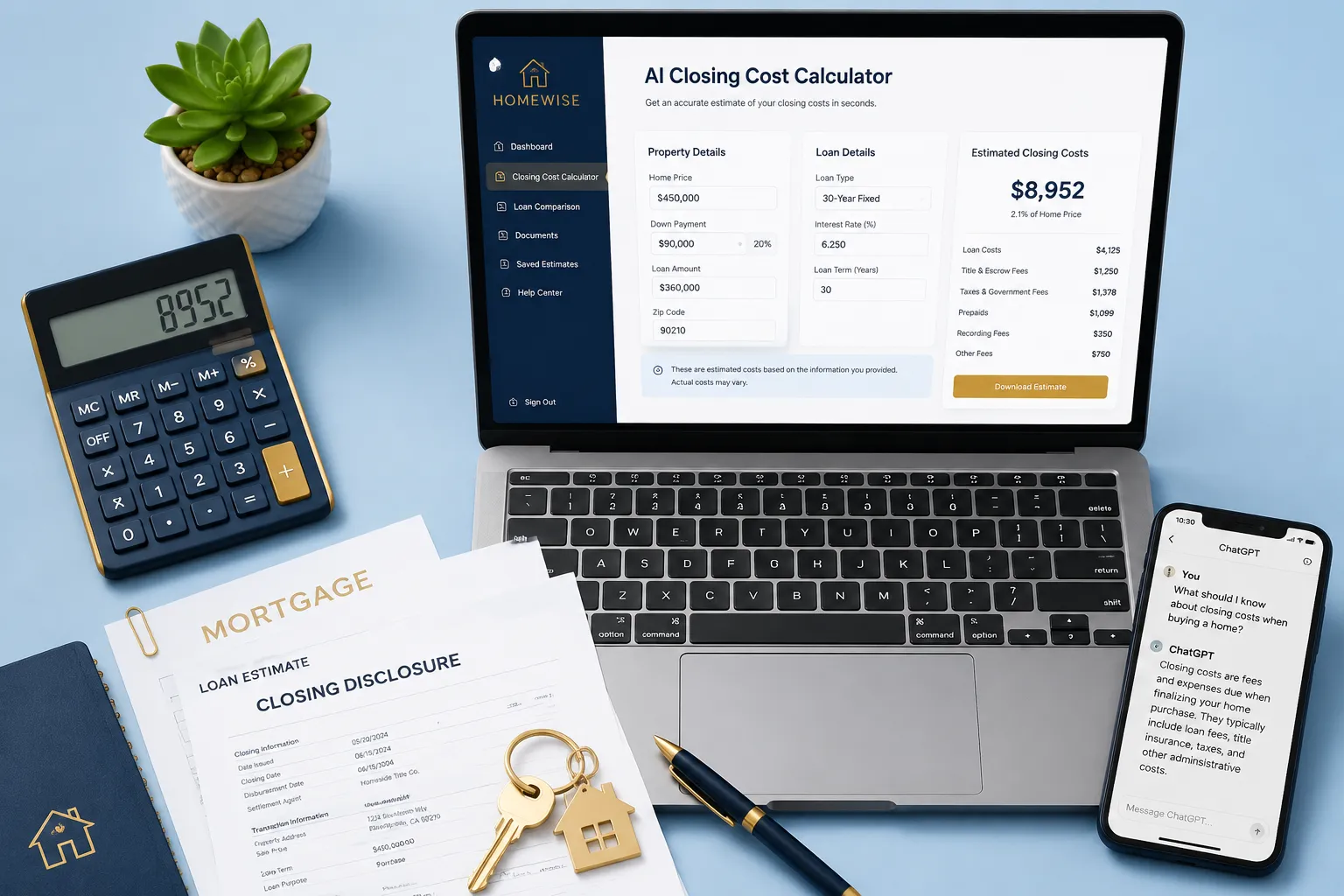
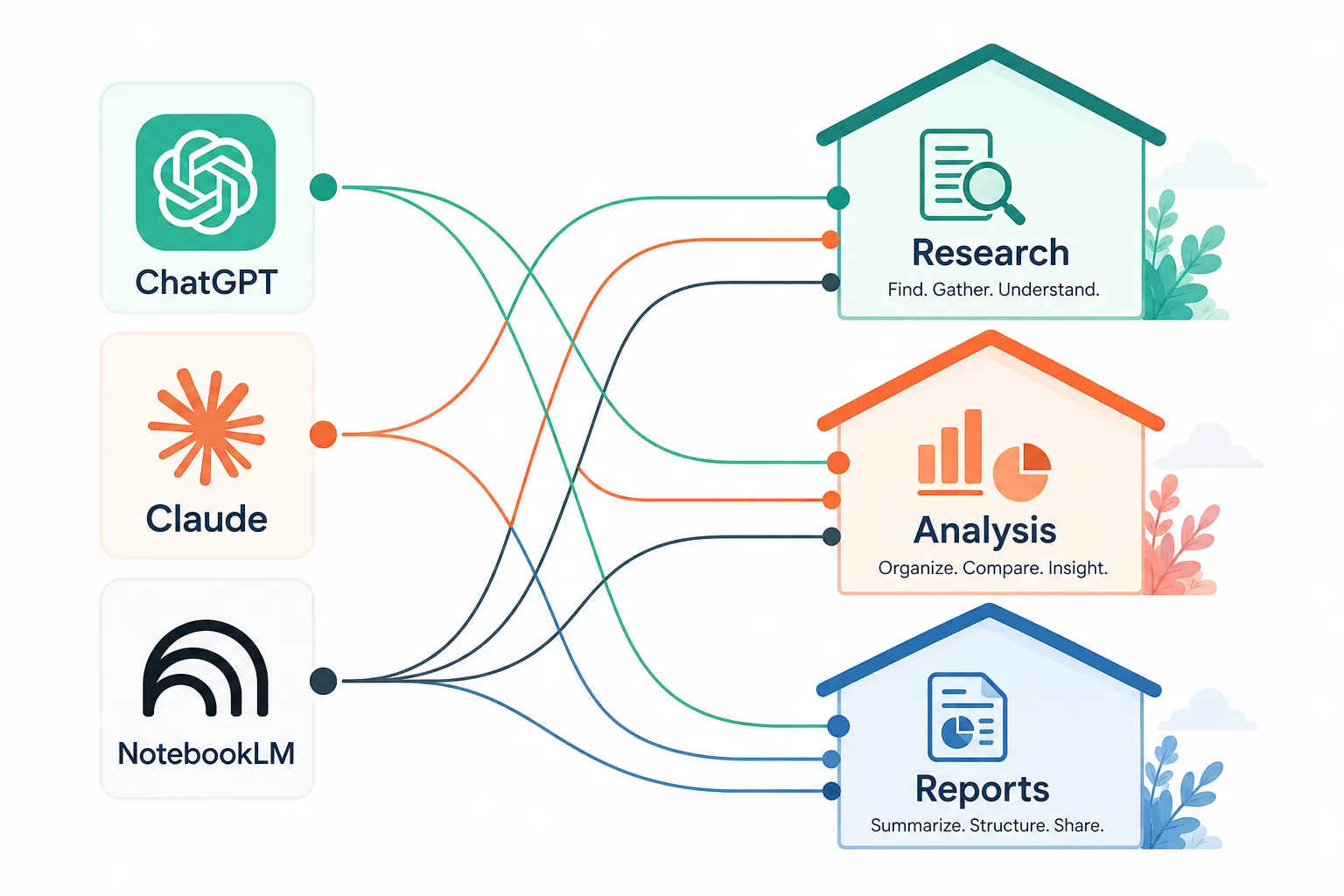
The best AI platforms for house hunting and property analysis in 2026 are ChatGPT (for general research and mortgage math), Claude (for document analysis and long-form summarization), and NotebookLM (for organizing and querying property documents). Each tool has specific strengths, and the best buyers use all three depending on the task.
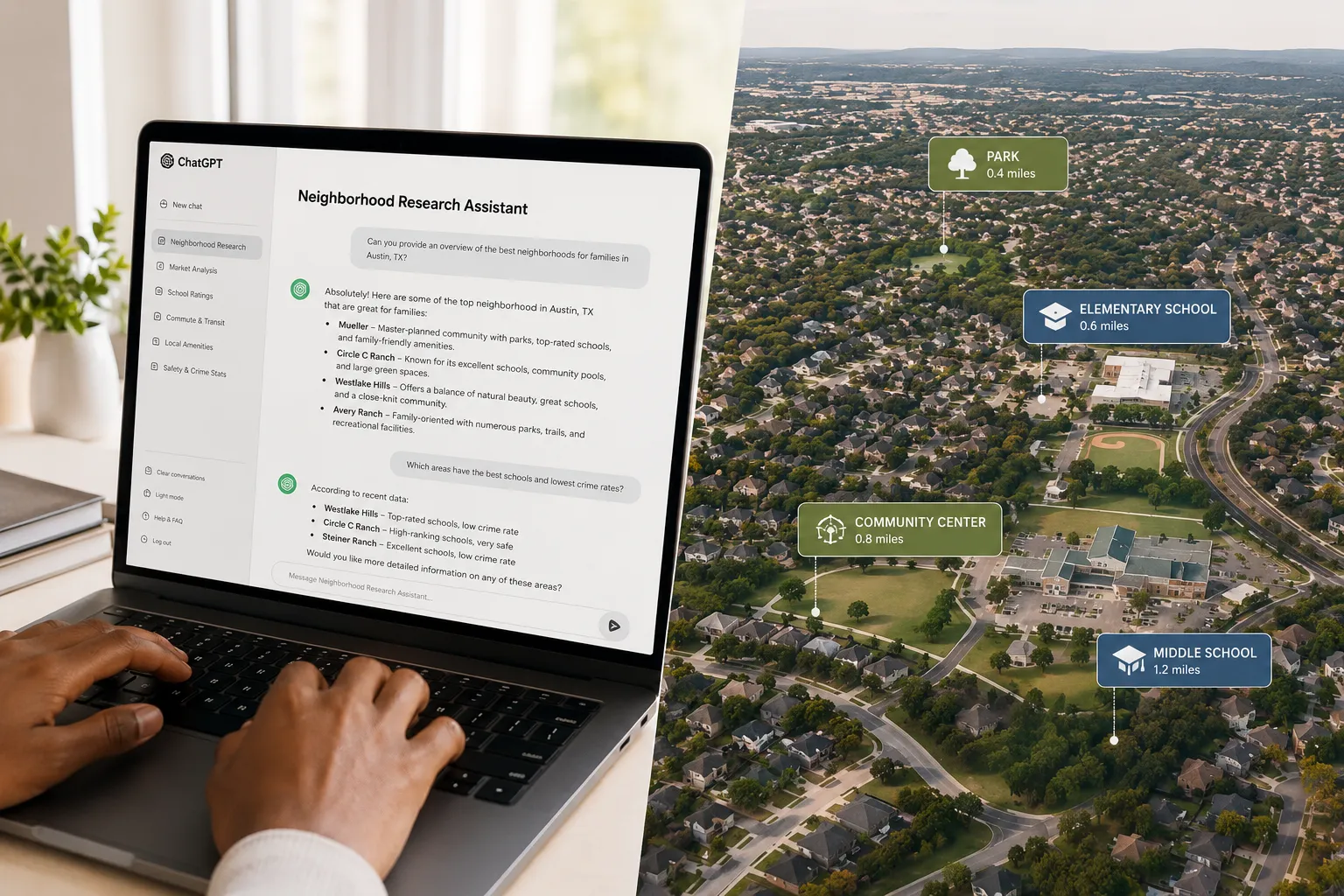
ChatGPT is the Swiss Army knife. It's free (or $20/month for the Plus version), fast, and handles most general research tasks. You can ask it to summarize neighborhood data, compare mortgage offers, estimate closing costs, or generate questions for your home inspector. The free version (GPT-3.5) is fine for basic tasks; the Plus version (GPT-4) is better for complex analysis and longer documents. ChatGPT's biggest strength is conversational flexibility, you can ask follow-up questions, refine your prompts, and iterate until you get the answer you need.
Claude (by Anthropic) is better for document-heavy tasks. It can process up to 200,000 tokens in a single conversation, which means you can upload an entire HOA covenant, inspection report, or title commitment and ask specific questions. Claude is also better at nuanced analysis, it's less likely to hallucinate facts and more likely to say "I don't have enough information" when it doesn't know something. The free tier is generous, and the paid tier ($20/month) is worth it if you're reviewing a lot of documents. Claude is the tool you use when you need to read a 60-page HOA document and don't want to miss the clause that bans short-term rentals.
NotebookLM (by Google) is purpose-built for organizing research. You upload all your property documents, listing details, inspection reports, HOA bylaws, permit history, loan estimates, and NotebookLM creates a searchable knowledge base. You can then ask questions like "What did the inspector say about the roof?" or "Are there any special assessments mentioned in the HOA docs?" and NotebookLM pulls the relevant passages. It's free, and it's impeccable for buyers who are juggling multiple properties or who want to keep all their research in one place. NotebookLM doesn't generate new analysis, it just makes your existing documents queryable.
Zillow's AI tools are also worth mentioning. In 2026, Zillow integrated Google's NotebookLM into its platform, allowing buyers to create AI-powered research notebooks directly from listing pages. You can save properties, add notes, and ask the AI to compare features or flag concerns. It's not as powerful as using NotebookLM standalone, but it's convenient if you're already using Zillow for your search. For more on this integration, see our guide to Zillow's Google NotebookLM.
First Street Foundation provides free flood risk scores for any U.S. address. You can't query it with AI directly, but you can pull the risk score and feed it into ChatGPT or Claude for interpretation. First Street's data is more granular than FEMA's, and it accounts for future climate projections. If you're buying in a coastal or flood-prone area, this is non-negotiable research.
County assessor websites and FEMA flood maps are public data sources that AI can help you interpret. You can download property records, permit history, and flood zone designations, then upload them to Claude or NotebookLM for analysis. The AI won't replace a title search or flood certification, but it will flag issues that warrant further investigation.
HouseCanary and Skyline AI are paid platforms that offer AI-powered property valuation and investment analysis. They're overkill for most home buyers, but if you're an investor or buying in a competitive market, they provide deeper data than Zillow or Redfin. For a detailed comparison, check out our HouseCanary vs Skyline AI review.
The key is matching the tool to the task. Use ChatGPT for quick research and math, Claude for document analysis, NotebookLM for organization, and specialized platforms like First Street or HouseCanary when you need deeper data. Don't try to force one tool to do everything, each has its lane, and the best buyers know which lane to use when.
The 10-Step AI Due-Diligence Checklist for Buying a House in 2026
This is the checklist. Each step includes the specific AI tool, the exact prompt to run, and a clear line where you stop and call a professional. Follow this in order, and you'll cover 90% of the research that used to take weeks.
Step 1: AI Neighborhood Research and Walkability Analysis
Tool: ChatGPT or Claude
Prompt: "Analyze the neighborhood around [full address]. Include walkability score, school ratings, crime trends over the past 3 years, nearby amenities (grocery stores, parks, hospitals), and recent home sales within 0.5 miles. Highlight any red flags."
What you're looking for: A plain-English summary of whether the neighborhood fits your lifestyle and budget. AI pulls from public data sources like Walk Score, GreatSchools, local crime databases, and Zillow sales comps. You're not getting a custom appraisal, but you're getting enough context to decide whether to keep looking.
Caution: AI can't visit the neighborhood. It doesn't know if the park is well-maintained or if the grocery store is sketchy. Use AI to pre-screen, then visit in person at different times of day (morning, evening, weekend) to verify the vibe.
Next step: If the neighborhood passes your initial screen, move to Step 2. If not, cross it off and move on.
Step 2: Flood Risk and Climate Data Analysis
Tool: ChatGPT or Claude + First Street Foundation data
Prompt: "I'm considering buying a home at [full address]. The FEMA flood zone is [zone designation]. The First Street flood risk score is [score]. Explain what this means in plain English, estimate annual flood insurance costs, and tell me if this property has flooded in the past 20 years."
What you're looking for: A clear explanation of flood risk and insurance costs. FEMA zones (A, AE, X, etc.) are confusing; AI translates them into normal language. First Street scores (1-10 scale) account for future climate risk, which FEMA doesn't.
Caution: AI can't replace a flood certification or elevation certificate. If the property is in a high-risk zone, you'll need a licensed surveyor to determine the base flood elevation and whether the home is compliant. Don't skip this, flood insurance can cost thousands per year, and some properties are uninsurable.
Next step: If flood risk is acceptable, move to Step 3. If it's high, get a flood certification before you make an offer.
Step 3: Property History and Permit Search
Tool: Claude or NotebookLM + county assessor records
Prompt: "I've uploaded the property history and permit records for [address]. Flag any unpermitted additions, code violations, or ownership changes that might indicate problems. Summarize the findings."
What you're looking for: Red flags like unpermitted additions (which can kill resale value), unresolved code violations, or frequent ownership changes (which might indicate structural issues or title problems).
Caution: AI can only analyze the documents you give it. If the county's records are incomplete or outdated, AI won't catch it. Always verify with the county directly and consider a title search to uncover liens or easements.
Next step: If the property history is clean, move to Step 4. If there are red flags, consult a real estate attorney before proceeding.
Step 4: HOA Document Review and Red Flag Detection
Tool: Claude (best for long documents)
Prompt: "I've uploaded the HOA covenant, bylaws, and recent meeting minutes for [property address]. Flag any clauses that restrict rentals, impose special assessments, or limit renovations. Summarize the monthly fees and what they cover."
What you're looking for: Deal-breakers like rental restrictions (if you plan to rent it out later), high special assessments (which can add thousands to your costs), or renovation limits (if you want to remodel). Also check whether the HOA is financially healthy, low reserves or deferred maintenance are red flags.
Caution: AI can summarize documents, but it can't interpret legal nuances or predict future HOA decisions. If the HOA has a history of litigation or special assessments, hire a real estate attorney to review the documents before you close.
Next step: If the HOA terms are acceptable, move to Step 5. If not, walk away or negotiate concessions.
Step 5: Mortgage Comparison and Total Cost Analysis
Tool: ChatGPT
Prompt: "I have three loan estimates. Loan A: 6.5% rate, $3,200 closing costs, no points. Loan B: 6.1% rate, $5,800 closing costs, 1 point. Loan C: 6.3% rate, $4,000 closing costs, 0.5 points. Purchase price is $400,000, down payment is $80,000, loan term is 30 years. Calculate total interest paid over 30 years for each loan and tell me which one saves the most money."
What you're looking for: A clear comparison of total costs, not just monthly payments. Buyers often focus on the lowest rate, but higher closing costs or points can wipe out the savings. AI does the math in seconds.
Caution: AI uses the numbers you give it. If your lender's estimate is wrong or incomplete, the AI's analysis will be wrong too. Always verify the final loan terms with your lender before you lock in a rate.
Next step: Choose the loan that saves the most money over your expected ownership period, then move to Step 6.
Step 6: AI Closing Cost Estimate and Budget Check
Tool: ChatGPT
Prompt: "I'm buying a home in [state] for $400,000 with a $80,000 down payment and a conventional loan. Estimate my closing costs, including lender fees, title insurance, escrow, recording fees, and prepaid taxes. Break it down line by line."
What you're looking for: A ballpark estimate of closing costs so you can budget accurately. Closing costs typically run 2-5% of the purchase price, but they vary by state and loan type.
Caution: This is an estimate, not a guarantee. Your lender will provide an official Loan Estimate (LE) three days after you apply. Use AI for early budgeting, but don't wire funds based on AI's numbers, verify everything with your lender and closing attorney.
Next step: If the closing costs fit your budget, move to Step 7. If not, negotiate with the seller to cover part of the costs or shop for a cheaper loan.
Step 7: Inspection Report Summarization and Follow-Up Questions
Tool: Claude or NotebookLM
Prompt: "I've uploaded my home inspection report. Summarize the major issues, estimate repair costs for each, and generate a list of follow-up questions I should ask the inspector or contractor."
What you're looking for: A plain-English summary of what's wrong with the house and how much it will cost to fix. Inspection reports are dense and full of jargon; AI translates them into actionable information.
Caution: AI can't inspect the house. It can only summarize what the inspector wrote. If the inspector missed something (which happens), AI won't catch it. Always hire a licensed inspector, and consider specialized inspections (sewer scope, radon, mold) if the property is older or in a high-risk area.
Next step: If the inspection issues are minor or fixable, move to Step 8. If they're major (foundation, roof, electrical), negotiate repairs or walk away.
Step 8: Title Document Review and Lien Check
Tool: Claude
Prompt: "I've uploaded the preliminary title report for [address]. Flag any liens, easements, or encumbrances that could affect my ownership or resale value. Summarize the findings."
What you're looking for: Red flags like unpaid property taxes, mechanic's liens, or easements that restrict how you can use the property. Title issues can delay closing or kill the deal entirely.

Caution: AI can't replace a title search or title insurance. Always buy owner's title insurance, and hire a real estate attorney to review the title commitment before you close. If there are liens or easements, your attorney will tell you whether they're deal-breakers.
Next step: If the title is clean, move to Step 9. If there are issues, work with your attorney to resolve them before closing.
Step 9: Final Walkthrough Checklist Generation
Tool: ChatGPT
Prompt: "Generate a final walkthrough checklist for a [property type, e.g., single-family home] in [state]. Include items to check for functionality (appliances, HVAC, plumbing), condition (walls, floors, fixtures), and contract compliance (agreed-upon repairs completed)."
What you're looking for: A comprehensive checklist so you don't miss anything during the final walkthrough. This is your last chance to catch issues before you own the property.
Caution: AI generates a generic checklist. Customize it based on your inspection report and contract terms. If the seller agreed to fix the roof, make sure the roof is actually fixed, don't just check a box.
Next step: Complete the walkthrough, verify all repairs, and confirm that the property matches the contract. If everything checks out, move to Step 10.
Step 10: Closing Document Review and Red Flag Detection
Tool: Claude
Prompt: "I've uploaded my Closing Disclosure and HUD-1 settlement statement. Compare the final numbers to my Loan Estimate. Flag any discrepancies, unexpected fees, or errors. Summarize the findings."
What you're looking for: Errors or surprises in your closing costs. Lenders sometimes add fees that weren't in the original estimate, or they miscalculate taxes and insurance. Catching these errors before closing can save you thousands.
Caution: AI can flag discrepancies, but it can't interpret legal language or advise you on whether to proceed. Always have a real estate attorney review your closing documents before you sign. If there are errors, your attorney will negotiate corrections with the lender or title company.
Next step: If the closing documents are accurate, sign and close. If there are errors, delay closing until they're fixed. Never sign documents you don't understand or that contain errors.
How Much Does AI Home Buying Software Cost in 2026?
AI home buying software in 2026 ranges from free (ChatGPT, NotebookLM, First Street) to $20/month (ChatGPT Plus, Claude Pro) for general research tools, and $50-$300/month for specialized platforms like HouseCanary or Skyline AI. Most buyers can complete the entire due-diligence checklist using only free tools.
Free tools:
- ChatGPT (free tier): General research, mortgage math, closing cost estimates
- Claude (free tier): Document analysis, HOA review, inspection summaries
- NotebookLM: Document organization and querying
- First Street Foundation: Flood risk scores
- County assessor websites: Property records and permit history
- FEMA flood maps: Flood zone designations
Paid tools ($20/month):
- ChatGPT Plus: Faster responses, access to GPT-4, better document analysis
- Claude Pro: Higher usage limits, longer documents, priority access
Specialized platforms ($50-$300/month):
- HouseCanary: AI-powered property valuation and market analysis
- Skyline AI: Investment property analysis and portfolio management
- Redfin Premier Agent tools: Market insights and lead generation (for agents, not buyers)
For most buyers, the free tools are enough. You only need paid tools if you're buying multiple properties, analyzing investment deals, or need deeper market data. The $20/month tier (ChatGPT Plus or Claude Pro) is worth it if you're reviewing a lot of documents or need faster responses, but it's not mandatory.
The real cost isn't the software, it's the time you invest learning how to prompt AI effectively. If you follow this checklist and use the exact prompts provided, you'll get 90% of the value without spending a dime. Let it cook before you see results, don't expect AI to replace your judgment overnight.
Can AI Predict Future Home Value Accurately?
AI cannot predict future home value accurately enough to base a purchase decision on. AI-powered valuation models (like Zillow's Zestimate or HouseCanary's forecasts) are useful for ballpark estimates and trend analysis, but they're not reliable for individual properties over long time horizons. Too many variables, local market shifts, interest rate changes, neighborhood development, climate events, are impossible to model with precision.
What AI can do: Estimate current market value based on recent comps, identify pricing trends in a neighborhood, and flag properties that are overpriced or underpriced relative to similar homes. AI is good at pattern recognition and data aggregation, so it can tell you whether a property is priced fairly today.
What AI can't do: Predict whether a property will appreciate 5% or 15% over the next five years, forecast which neighborhoods will gentrify, or account for black-swan events (recessions, natural disasters, policy changes). AI models are trained on historical data, and real estate markets are shaped by future events that haven't happened yet.
Example: In 2021, AI models predicted continued price growth based on pandemic-era trends. Then interest rates spiked in 2022, and prices flattened or fell in many markets. The AI wasn't "wrong", it just couldn't predict the Fed's rate hikes.
Bottom line: Use AI to evaluate whether a property is fairly priced today, not to predict whether it will make you rich tomorrow. If you're buying a home to live in, focus on whether it fits your budget and lifestyle. If you're buying an investment property, use AI to analyze cash flow and rental comps, not to gamble on appreciation. For more on analyzing rental properties, see our complete investor checklist.
What Are the Risks of Using AI to Buy a House?
The risks of using AI to buy a house include over-reliance on incomplete or outdated data, misinterpretation of AI-generated summaries, skipping professional reviews (inspections, legal, lending), and liability gaps when AI makes mistakes. AI is a research tool, not a decision-maker, if you treat it as the latter, you'll end up in trouble.
Risk 1: Garbage in, garbage out. AI can only analyze the data you give it. If you upload an incomplete inspection report or outdated property records, the AI's analysis will be flawed. Always verify that your source documents are current and complete.
Risk 2: Hallucinations and errors. AI sometimes invents facts or misinterprets data, especially when dealing with ambiguous language or incomplete information. Always cross-check critical facts (flood zones, permit status, HOA fees) with official sources.
Risk 3: No liability. If ChatGPT tells you a property is safe and it's not, you can't sue OpenAI. If your real estate agent gives you bad advice, you can sue them. AI carries zero legal accountability, which means you bear all the risk.
Risk 4: Skipping professionals. The biggest risk is using AI as an excuse to skip inspections, legal review, or lender verification. AI can summarize an inspection report, but it can't inspect the house. It can review an HOA document, but it can't interpret legal nuances. Always hire licensed professionals for tasks that carry liability.
Risk 5: Over-confidence. AI makes research so easy that buyers sometimes think they know more than they do. You can run a hundred prompts and still miss the one thing that kills the deal. Stay humble, ask questions, and lean on professionals when you're out of your depth.
Mitigation: Use AI for research and analysis, but always verify critical facts with licensed professionals. Treat AI as a research assistant, not a replacement for human judgment.
Is AI Home Buying Right for First-Time Buyers?
AI home buying is especially right for first-time buyers because it levels the playing field, you get access to research and analysis tools that used to require expensive consultants or years of experience. AI helps you ask the right questions, avoid common mistakes, and show up to negotiations informed.
Why first-time buyers benefit:
- You don't know what you don't know. AI can generate checklists, flag red flags, and explain jargon so you're not flying blind.
- You're budget-constrained. AI tools are free or cheap, which matters when you're already stretching to afford a down payment.
- You're time-constrained. AI does in minutes what used to take hours, so you can research properties without quitting your job.
- You're intimidated. Buying a house is overwhelming, and AI makes it less scary by breaking the process into manageable steps.
What first-time buyers need to watch out for:
- Don't skip professionals. AI can't replace your agent, inspector, or attorney. Use it to prepare, not to replace.
- Don't trust AI blindly. Verify critical facts with official sources and licensed professionals.
- Don't let AI rush you. Just because you can research faster doesn't mean you should decide faster. Take your time, visit properties in person, and trust your gut.
For more guidance tailored to first-time buyers, check out our first-time homebuyer guide and our best mortgage options for Gen Z buyers.
Common Mistakes When Relying on AI for Real Estate Decisions
The most common mistakes when relying on AI for real estate decisions are skipping professional reviews, trusting AI-generated numbers without verification, using AI to replace human judgment, and failing to cross-check critical facts with official sources.
Mistake 1: Skipping the home inspection. AI can summarize an inspection report, but it can't inspect the house. Some buyers think they can skip the inspection if AI says the property looks good. Don't. Always hire a licensed inspector, and consider specialized inspections (sewer, radon, mold) for older homes.
Mistake 2: Trusting AI's flood risk analysis without verification. AI can interpret FEMA zones and First Street scores, but it can't replace a flood certification or elevation certificate. If you're in a high-risk zone, get a professional survey before you close.
Mistake 3: Using AI to negotiate. AI can help you prepare for negotiations by analyzing comps and estimating repair costs, but it can't read the room or adjust strategy on the fly. Negotiation is a human skill, use AI to inform your strategy, not to execute it.
Mistake 4: Relying on AI for legal interpretation. AI can summarize contracts and flag unusual clauses, but it can't give legal advice or predict how a court would interpret a contract. Always hire a real estate attorney to review contracts, title documents, and closing disclosures.
Mistake 5: Ignoring your gut. AI is data-driven, which means it misses intangibles like neighborhood vibe, property condition, and seller motivation. If something feels off, trust your instincts and dig deeper, don't let AI talk you into a bad decision.
Mistake 6: Over-optimizing. Some buyers run so many AI analyses that they talk themselves out of every property. Real estate is imperfect, no house will check every box. Use AI to identify deal-breakers, not to chase perfection.
Do I Still Need a Lawyer If I Use AI to Buy a House?
Yes, you still need a real estate attorney even if you use AI to buy a house. AI can review documents and flag issues, but it can't provide legal advice, represent you in disputes, or protect you from liability. Attorneys handle the parts of the transaction that carry legal risk, contract review, title issues, closing disclosures, and post-closing disputes.
What a lawyer does that AI can't:
- Interpret legal language. Contracts are written in legalese, and AI can summarize them but can't advise you on whether a clause is enforceable or risky.
- Negotiate on your behalf. If the seller refuses to fix inspection issues or the title has liens, your attorney negotiates a resolution. AI can't do that.
- Protect you from liability. If something goes wrong after closing (title defect, undisclosed issue, contract dispute), your attorney represents you. AI doesn't.
- Review closing documents. Closing disclosures and HUD-1 statements are complex, and errors are common. Your attorney catches those errors before you sign.
When to hire a lawyer:
- Always, if you're buying FSBO. Without an agent, you need a lawyer to handle contract review, title search, and closing.
- Always, if the property has title issues. Liens, easements, or ownership disputes require legal expertise.
- Always, if you're in a state that requires attorney involvement. Some states (New York, Massachusetts, etc.) require attorneys for real estate closings.
- Strongly recommended in all other cases. Even if your state doesn't require it, hiring a lawyer is cheap insurance against expensive mistakes.
Cost: Real estate attorneys typically charge $500-$2,000 for a residential transaction, depending on complexity and location. That's a fraction of what you'll lose if you skip the lawyer and something goes wrong.
How to Verify AI-Generated Property Reports Are Accurate
To verify AI-generated property reports are accurate, cross-check critical facts with official sources, county assessor records, FEMA flood maps, MLS listings, and licensed professionals (inspectors, appraisers, attorneys). AI is a research tool, not a source of truth.
Verification checklist:
- Flood risk: Cross-check AI's flood zone interpretation with FEMA's official flood map and First Street's risk score. If the property is in a high-risk zone, get a flood certification from a licensed surveyor.
- Property history: Verify permit records with the county assessor or building department. AI can flag unpermitted additions, but only the county can confirm whether permits were pulled.
- HOA fees and rules: Confirm monthly fees and special assessments with the HOA directly. AI can summarize documents, but HOAs sometimes have verbal agreements or pending assessments that aren't in the written bylaws.
- Sales comps: Cross-check AI's comparable sales with MLS data or Zillow. AI sometimes pulls outdated or inaccurate comps, especially in fast-moving markets.
- Closing costs: Verify AI's closing cost estimate with your lender's Loan Estimate. AI uses averages; your lender uses your actual loan terms.
- Inspection issues: Confirm AI's repair cost estimates with contractor quotes. AI uses industry averages, but actual costs vary by location and contractor.
Red flags that AI is wrong:
- Numbers that seem too good to be true (e.g., flood insurance for $200/year in a high-risk zone)
- Vague or hedged language ("This property may have flooded" instead of "This property flooded in 2018")
- Contradictions between AI's summary and the source document
- Missing information (e.g., AI says "no special assessments" but the HOA minutes mention a pending roof replacement)
Bottom line: AI is fast and convenient, but it's not infallible. Always verify critical facts with official sources and licensed professionals before you make a decision.
What Happens If AI Misses Major Home Defects?
If AI misses major home defects, you bear the financial and legal consequences, AI carries no liability. This is why you must hire a licensed home inspector, even if AI summarizes the inspection report. AI can only analyze the documents you give it; it can't inspect the property or catch issues the inspector missed.
Scenario 1: AI summarizes an incomplete inspection report. If your inspector missed a cracked foundation or faulty wiring, AI won't catch it either. The solution: hire a reputable inspector with errors-and-omissions insurance, and consider specialized inspections (sewer scope, radon, mold) for older homes.
Scenario 2: AI misinterprets the inspection report. AI might downplay a serious issue or flag a minor issue as critical. The solution: read the full inspection report yourself, ask the inspector to explain anything unclear, and get contractor quotes for major repairs.
Scenario 3: AI doesn't know what it doesn't know. Some defects (asbestos, lead paint, underground oil tanks) don't show up in standard inspections. AI can't flag issues that aren't in the documents. The solution: ask your inspector about common issues in your area, and order specialized tests if the property was built before 1980.
Legal recourse: If you discover a major defect after closing, your recourse depends on whether the seller disclosed it and whether your inspector missed it. If the seller failed to disclose a known defect, you can sue for damages. If your inspector missed it, you can file a claim against their insurance. If AI missed it, you have no recourse, AI doesn't carry insurance.
Bottom line: AI is a research assistant, not a substitute for professional inspections. Always hire licensed professionals for tasks that carry liability.
Are Older Homes Harder for AI to Evaluate Than New Construction?
Yes, older homes are harder for AI to evaluate than new construction because they have more variables, renovation history, outdated systems, hidden defects, and incomplete records. AI struggles with ambiguity and missing data, which are common in older properties.
Why older homes are harder:
- Incomplete records. Older homes often have gaps in permit history, ownership records, and renovation documentation. AI can't analyze data that doesn't exist.
- Hidden defects. Older homes are more likely to have issues that don't show up in documents, knob-and-tube wiring, asbestos, lead paint, foundation settling. AI can't inspect the property, so it can't catch these.
- Renovation quality. AI can tell you a kitchen was renovated in 2015, but it can't tell you whether the work was done well or by a licensed contractor. You need an inspector for that.
- Outdated systems. Older homes often have HVAC, plumbing, or electrical systems that are near end-of-life. AI can flag this if it's in the inspection report, but it can't estimate remaining lifespan or replacement costs as accurately as a contractor.
Why new construction is easier:
- Complete records. New homes have full permit history, builder warranties, and detailed specifications. AI can analyze this data easily.
- Fewer unknowns. New homes have new systems, so there's less risk of hidden defects or deferred maintenance.
- Standardized features. New construction follows current building codes, so AI can make more accurate comparisons and cost estimates.
Bottom line: If you're buying an older home, lean more heavily on professional inspections and less on AI analysis. AI is still useful for document review and research, but it can't replace the judgment of an experienced inspector or contractor.
Can AI Help Negotiate Home Price and Closing Costs?
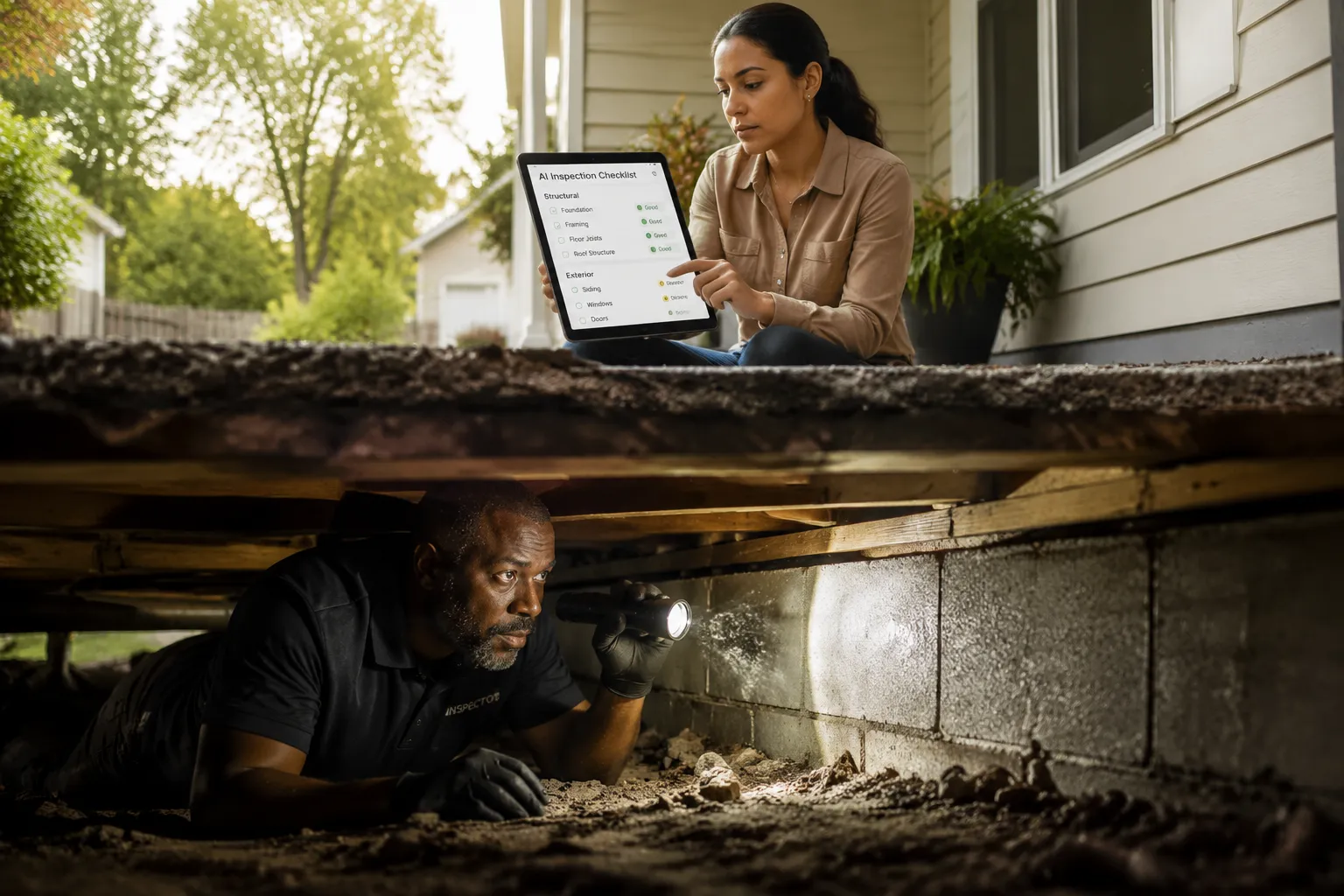
AI can help you prepare for negotiations by analyzing comparable sales, estimating repair costs, and calculating total ownership costs, but it can't negotiate on your behalf. Negotiation requires human judgment, relationship management, and real-time adaptation, skills AI doesn't have.
How AI helps with negotiation prep:
- Comps analysis: AI can pull recent sales of similar homes and calculate whether the asking price is fair. You can use this data to justify a lower offer.
- Repair cost estimates: AI can estimate the cost of fixing inspection issues, which gives you leverage to negotiate a price reduction or seller credits.
- Closing cost breakdown: AI can estimate your closing costs and identify areas where you might negotiate (e.g., asking the seller to cover part of the title insurance or escrow fees).
- Total cost comparison: AI can calculate the total cost of ownership (mortgage, taxes, insurance, HOA, maintenance) so you know your walk-away number before you start negotiating.
What AI can't do:
- Read the room. Negotiation is about timing, tone, and relationship. AI doesn't know if the seller is motivated or if your agent has rapport with the listing agent.
- Adjust strategy. If the seller counters your offer, you need to decide whether to accept, counter again, or walk away. AI can't make that call.
- Handle emotions. Buying a house is emotional, and negotiations can get tense. AI doesn't have empathy or conflict-resolution skills.
Bottom line: Use AI to arm yourself with data, then let your agent handle the actual negotiation. If you're buying FSBO, use AI to prepare your strategy, but consider hiring a real estate attorney to negotiate on your behalf.
Frequently Asked Questions
What is AI due diligence when buying a house?
AI due diligence means using tools like ChatGPT, Claude, or NotebookLM to research neighborhoods, analyze flood risk, review HOA documents, compare mortgages, and summarize inspection reports. It's a research layer that speeds up the process but doesn't replace licensed professionals.
How does AI help with home buying in 2026?
AI automates research-heavy tasks, neighborhood vetting, document summarization, mortgage math, closing cost estimates, so you can make informed decisions faster. It's especially useful for first-time buyers who don't have experience or expensive consultants.
What are the best AI platforms for house hunting?
ChatGPT (general research), Claude (document analysis), and NotebookLM (organization) are the top free tools. Paid platforms like HouseCanary and Skyline AI offer deeper data but are overkill for most buyers.
Can AI replace a real estate agent?
No. AI handles research and analysis; agents handle negotiation, market access, legal compliance, and relationship management. Use AI to make your agent more effective, not to replace them.
Is AI home buying safe for first-time buyers?
Yes, if you use AI as a research tool and still hire licensed professionals (inspector, attorney, lender). AI helps first-time buyers ask the right questions and avoid common mistakes.
What are the risks of using AI to buy a house?
Over-reliance on incomplete data, skipping professional reviews, trusting AI blindly, and liability gaps when AI makes mistakes. Always verify critical facts with official sources and licensed professionals.
Can AI predict future home value?
No. AI can estimate current market value and identify pricing trends, but it can't predict future appreciation with enough accuracy to base a purchase decision on.
Do I still need a home inspector if I use AI?
Yes. AI can summarize inspection reports, but it can't inspect the property or catch issues the inspector missed. Always hire a licensed inspector with errors-and-omissions insurance.
How much does AI home buying software cost?
Free (ChatGPT, NotebookLM, First Street) to $20/month (ChatGPT Plus, Claude Pro) for general tools. Specialized platforms cost $50-$300/month but aren't necessary for most buyers.
Can AI help me negotiate a lower home price?
AI can help you prepare by analyzing comps and estimating repair costs, but it can't negotiate on your behalf. Use AI to arm yourself with data, then let your agent handle the negotiation.
What happens if AI gives me wrong information?
You bear the consequences, AI carries no liability. Always verify critical facts with official sources and licensed professionals before making decisions.
Are older homes harder for AI to evaluate?
Yes. Older homes have more variables, incomplete records, and hidden defects. AI is still useful for document review, but lean more heavily on professional inspections for older properties.
Conclusion
Using AI to buy a house in 2026 means running the right prompts through the right tools at the right time, and knowing when to stop and call a professional. AI handles the research-heavy, time-consuming parts of due diligence: neighborhood vetting, flood risk analysis, document summarization, mortgage comparison, and closing cost estimation. It doesn't replace your agent, inspector, attorney, or lender. It makes them more effective by giving you the information you need to ask better questions and make smarter decisions.
The 10-step checklist in this guide gives you the exact AI tool and prompt for each stage of the process, from initial neighborhood research to final closing document review. Follow it in order, verify critical facts with official sources, and hire licensed professionals for tasks that carry liability. If you do that, you'll move faster, avoid common mistakes, and show up to every conversation informed.
AI for home buyers is no longer experimental, it's practical, accessible, and extraordinarily useful. But it's only as good as the person using it. Treat AI as a research assistant, not a decision-maker. Stay humble, ask questions, and lean on professionals when you're out of your depth. Let it cook before you see results, and don't rush the process just because AI makes research faster.
If you're a first-time buyer, AI levels the playing field. If you're a move-up seller or investor, it saves you time and money. Either way, the tools are free, the prompts are in this guide, and the only thing stopping you is inertia. Start with Step 1, run the prompt, and see what you learn. The house you buy will be better for it.
For more on navigating the 2026 market, check out our Spring 2026 housing market outlook and our guide to best home buying sites.
SEO Meta Title: Using AI to Buy a House: 2026 Due-Diligence Checklist
SEO Meta Description: Complete 10-step AI home buying checklist for 2026. Exact prompts for ChatGPT, Claude & NotebookLM to research neighborhoods, analyze flood risk & compare mortgages.
Tags: using ai to buy a house, ai for home buyers, ai due diligence home buying, chatgpt buy a house, first time home buyer ai tools, ai neighborhood research, ai mortgage comparison, property history search ai, flood risk data home, ai closing cost estimate, home buying checklist, real estate ai tools, zillow notebooklm
For more home buying resources and market insights, visit the Home Buying Hub.