
Last updated: August 23, 2026

Quick Answer: Radon inspection cost runs between $15 and $30 for a DIY test kit, or $125 to $300 for a certified professional test. If radon levels come back at or above 4 picocuries per liter (pCi/L), the EPA action level, you are looking at a radon mitigation system cost of $800 to $2,500 installed. That is the number sellers would rather you never see on an inspection report.
Key Takeaways
- Professional radon testing cost ranges from $125 to $300 as a standalone service; add-on testing during a home inspection typically runs $50 to $150 extra.
- DIY radon test kits cost $15 to $30 at hardware stores, but professional tests carry more legal weight in real estate transactions.
- The EPA radon action level is 4 pCi/L. Any reading at or above that number warrants mitigation.
- Radon mitigation system cost averages $800 to $2,500, with most homeowners paying around $1,200 to $1,500 for a standard sub-slab depressurization system.
- About 1 in 15 U.S. homes has elevated radon levels, according to the EPA.
- Radon testing is not automatically included in a standard home inspection. You must request and pay for it separately in most cases.
- Buyers can negotiate radon mitigation costs into the purchase contract. Sellers can, and often do, push back.
- High radon levels found after closing become the buyer's problem and cost entirely.
- Short-term tests take 48 to 96 hours; long-term tests run 90 days or more and give a more accurate annual average.
- Radon risk varies significantly by region. The EPA's radon map by state shows the highest concentrations in the Midwest, Mountain West, and parts of the Northeast.
How Much Does a Radon Inspection Cost
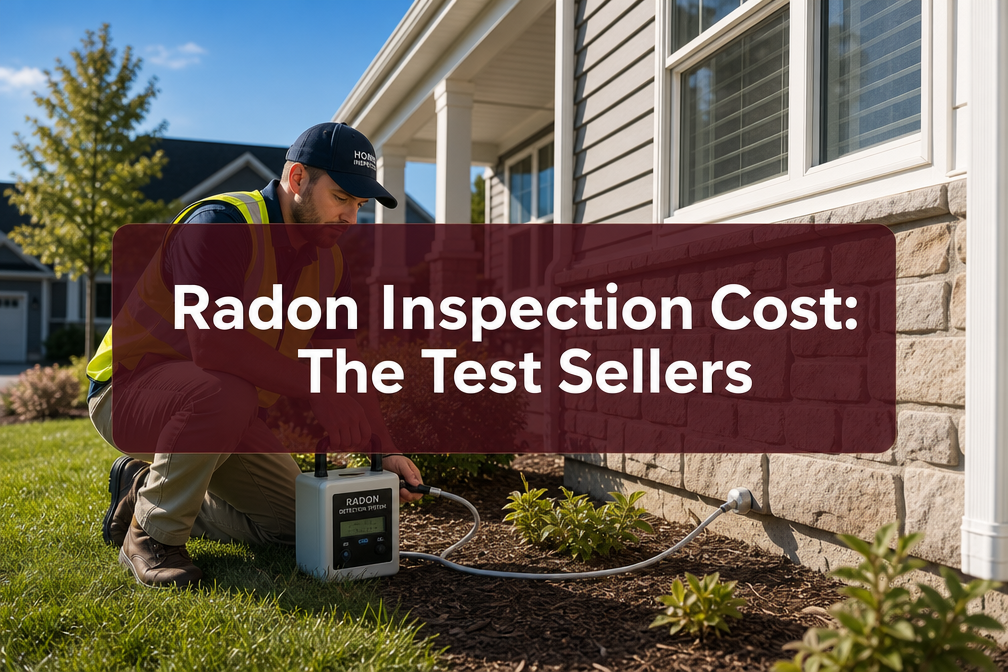
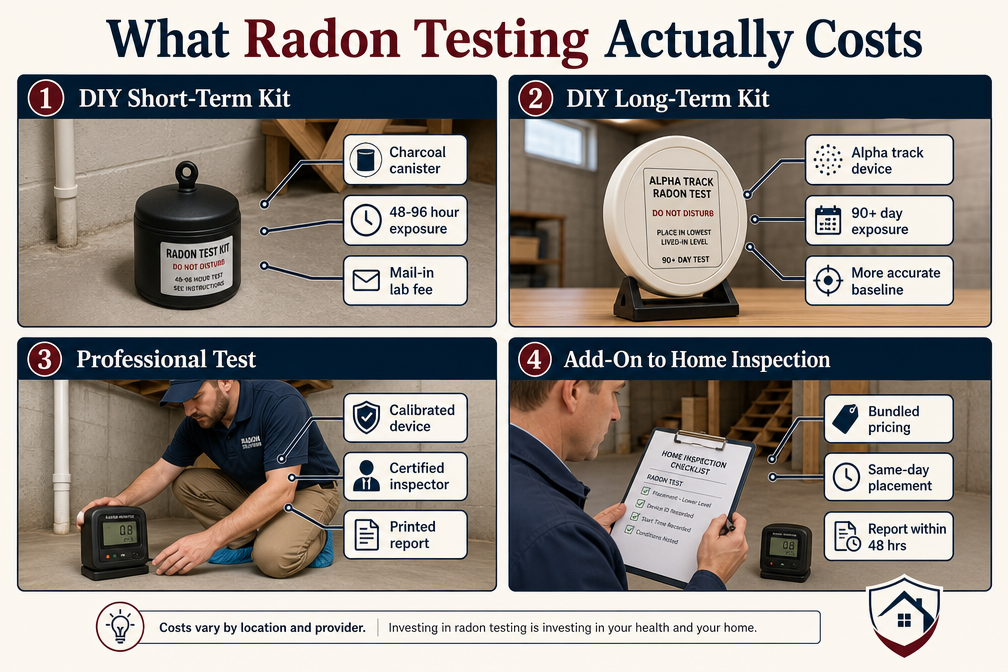
Radon inspection cost depends on whether you hire a certified professional or run the test yourself. Professional radon testing costs $125 to $300 for a standalone inspection. A DIY short-term radon test kit runs $15 to $30 at most hardware stores or online.
Here is the full breakdown:
| Test Type | Cost Range | Turnaround |
|---|---|---|
| DIY short-term kit (charcoal canister) | $15 to $30 | 2 to 7 days after lab submission |
| DIY long-term kit (alpha track) | $25 to $50 | 90 to 365 days |
| Professional short-term test | $125 to $300 | 48 to 96 hours on-site, report within 48 hrs |
| Add-on to home inspection | $50 to $150 extra | Same schedule as inspection |
| Continuous electronic monitor (pro) | $150 to $300 | 48 hours minimum |
The price spread on professional tests comes down to your region, the inspector's certification level, and whether the test is bundled with other services. In high-radon states like Iowa, Minnesota, or Pennsylvania, certified radon inspectors are more common and pricing tends to be competitive. In lower-risk coastal markets, a standalone radon test may cost more simply because fewer inspectors specialize in it.
Decision rule: For a real estate transaction, pay for the professional test. A certified inspector's report carries legal standing in negotiations. A DIY kit result, while useful for your own awareness, is harder to use as leverage at the closing table.
Radon Inspection Cost: The Test Sellers Hope You Skip and Why It Matters
Radon is a colorless, odorless radioactive gas that forms naturally from the decay of uranium in soil and rock. It seeps into homes through foundation cracks, slab penetrations, and crawl spaces. The EPA estimates radon causes approximately 21,000 lung cancer deaths per year in the United States, making it the second leading cause of lung cancer after smoking.
So is radon dangerous? Yes, at sustained elevated levels it absolutely is. The risk is not from a single weekend of exposure. It is from years of breathing air in a home where radon concentrations sit at or above 4 pCi/L without anyone knowing.
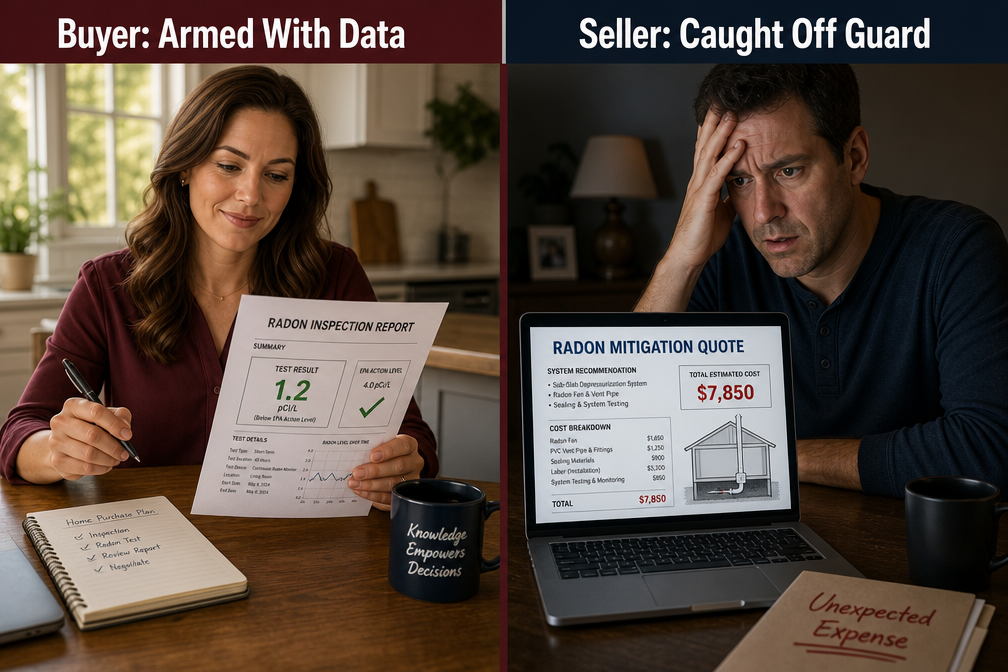
The reason sellers sometimes hope buyers skip radon testing is straightforward: a high reading creates a negotiable defect. Once it is documented in writing, the buyer has grounds to request either a price reduction, a seller credit, or a fully installed radon mitigation system before closing. That is money out of the seller's proceeds.
For buyers already stretched thin on a transaction, radon testing cost feels like one more line item. At $125 to $300, it is also one of the cheapest forms of protection available in any home purchase. For context, see how other pre-closing costs stack up in our breakdown of seller closing costs explained.
What Is a Safe Radon Level and When Does Mitigation Kick In
The EPA radon action level is 4 pCi/L. At or above that number, the EPA recommends mitigation. The World Health Organization sets its reference level lower, at 2.7 pCi/L, but U.S. real estate transactions and most state disclosure laws use the EPA threshold.
Here is how readings translate into action:
| Radon Level | Risk Classification | Recommended Action |
|---|---|---|
| Below 2 pCi/L | Low | No action required |
| 2 to 3.9 pCi/L | Moderate | Consider mitigation; retest in long-term |
| 4 pCi/L and above | Elevated (EPA action level) | Mitigate |
| 8 pCi/L and above | High | Mitigate promptly |
| 20 pCi/L and above | Very high | Mitigate as soon as possible |
The average indoor radon level in U.S. homes is about 1.3 pCi/L, according to the EPA. Outdoor air typically runs around 0.4 pCi/L. A reading of 4 pCi/L is roughly 35 times higher than outdoor background levels.
Common mistake: Some buyers see a reading of 3.8 pCi/L and assume they are fine because it is technically below the action level. The EPA itself says that any radon level above 2 pCi/L carries enough risk that mitigation is worth considering, especially in a home where young children will live.
Radon Inspection Cost vs Radon Mitigation Cost: What You Are Actually Facing
The radon inspection cost is the small number. The radon mitigation cost is where the real money shows up.
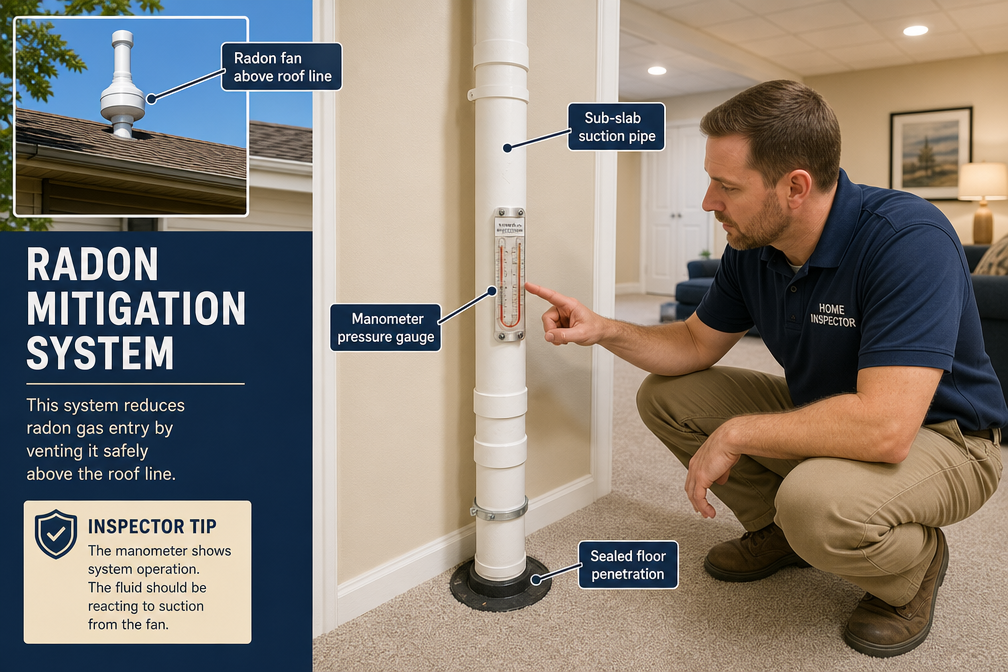
Radon mitigation system cost for a standard sub-slab depressurization (SSD) system runs $800 to $2,500, with a national average around $1,200 to $1,500. This involves drilling one or more holes through the basement floor slab, inserting a PVC pipe, and running it up through or outside the home to a continuously running fan that exhausts radon-laden air above the roofline.
Additional factors that push the cost higher:
- Multiple suction points: Homes with complex slab configurations or block foundation walls may need two or three suction points, adding $300 to $500 per additional point.
- Crawl space sealing: If the home has a crawl space, sealing it with a vapor barrier before depressurization adds $500 to $2,000 depending on size.
- Drain tile systems: Some homes require active drain tile depressurization instead of sub-slab, which can run $2,500 to $5,000.
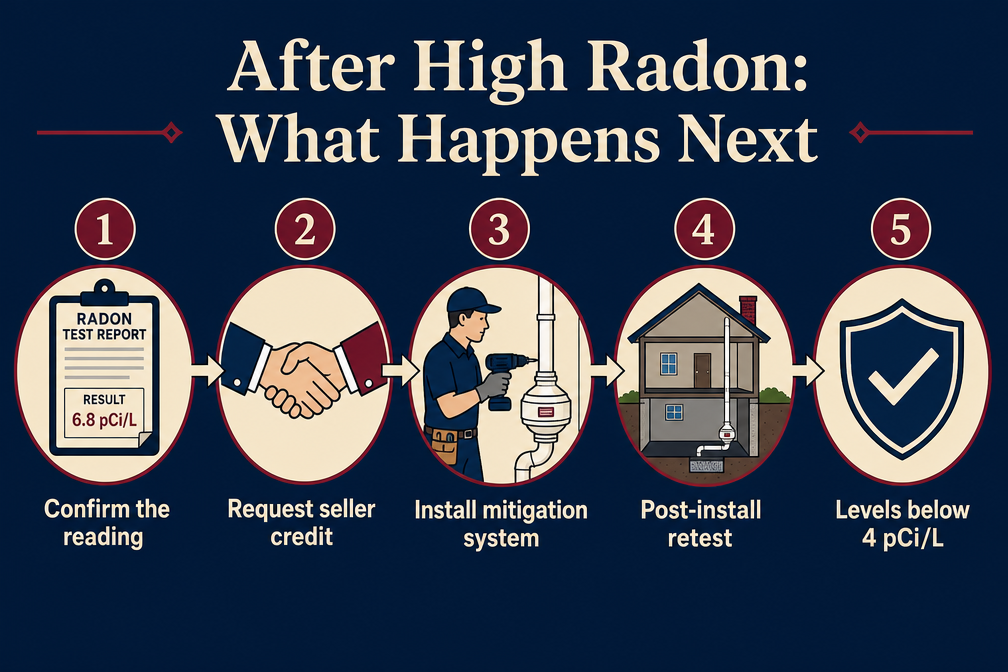
- Post-mitigation retest: Budget $75 to $150 for a follow-up test 24 to 48 hours after the system is installed to confirm the levels dropped below 4 pCi/L.
For buyers negotiating a credit, the total ask is typically the mitigation system cost plus the retest. If you are a seller trying to understand your exposure before listing, our guide to spring home selling mistakes that cost you real money covers this and several other pre-listing blind spots.
Does a Standard Home Inspection Include Radon Testing
No, a standard home inspection does not automatically include radon testing. A general home inspector examines the structure, roof, electrical, plumbing, HVAC, and visible defects. Radon testing is a separate service that requires different equipment, a different certification, and a different fee.
Some inspection companies offer radon testing as an add-on, bundled into the appointment for an additional $50 to $150. That bundled pricing is usually the best deal available because the inspector is already on-site. The radon test device gets placed during the inspection and picked up 48 hours later.
What to ask your inspector before booking:
- Are you certified for radon testing in this state?
- Do you use a continuous electronic monitor or charcoal canisters?
- Is the radon report separate from the home inspection report?
- How long after test placement will I receive results?
Not every home inspector holds a radon certification. In states with mandatory radon certification programs, like Illinois, Ohio, and Tennessee, you need a separately licensed radon professional. In states without mandatory certification, the inspector may still be qualified through the National Radon Proficiency Program (NRPP) or the National Radon Safety Board (NRSB).
For a full picture of what a property inspection covers and what falls outside its scope, that resource breaks down every category.
Can You Test for Radon Yourself Instead of Hiring Someone
Yes, DIY radon test kits work and the EPA endorses them for initial screening. A short-term charcoal canister kit costs $15 to $30 and is available at Home Depot, Lowe's, or Amazon. You place it in the lowest livable area of the home, leave it for 48 to 96 hours, seal it, and mail it to the included lab. Results come back in a few days.
DIY radon test kit accuracy compared to professional:
DIY kits are reasonably accurate when used correctly. The main variables that affect reliability are placement, closed-house conditions (windows and doors closed 12 hours before and during the test), and avoiding placement near drafts, high humidity, or exterior walls. Professional tests use calibrated continuous electronic monitors that record hourly readings, which makes them harder to game and easier to defend in a negotiation.
For real estate transactions specifically, the practical difference matters:
- A certified professional's report is harder for a seller or their agent to dispute.
- Some states require a certified test result before a seller is legally obligated to respond to a mitigation request.
- Continuous monitors catch anomalies (like a seller opening windows during the test period) that a charcoal canister cannot detect.
Bottom line: DIY kits are fine for personal awareness. For a transaction where you plan to negotiate, pay for the professional test.
Short-Term vs Long-Term Radon Test: Which One Do You Need
Short-term tests run 48 to 96 hours and are the standard for real estate transactions because they fit inside a typical inspection period. Long-term tests run 90 days to one year and give a more accurate picture of the home's annual average radon exposure.
Short-term test: Best for real estate transactions, initial screening, and situations where you need results fast. More susceptible to day-to-day weather and ventilation fluctuations, so a single short-term test can read higher or lower than the true average.
Long-term test: Best for confirming a borderline short-term result (between 2 and 4 pCi/L) or for your own home after purchase. Alpha track detectors used in long-term tests cost $25 to $50 and are mailed to a lab after the exposure period.
The EPA recommends that if a short-term test comes back between 4 and 8 pCi/L, you run a second short-term test or a long-term test before committing to mitigation. If the first test comes back above 8 pCi/L, the EPA says to mitigate without waiting for a follow-up.
For real estate purposes, most contracts give buyers 7 to 14 days for inspections. A 48-hour radon test fits comfortably inside that window.
Why Do Real Estate Agents Sometimes Skip Radon Testing
Some agents skip recommending radon testing because it can complicate a transaction. A high radon reading creates a documented defect that the buyer can use to renegotiate price, request a credit, or in some cases walk away. Agents working on commission have a financial incentive to close deals, and any test that might unravel one can feel like a liability.
This is not universal. Most experienced agents recommend radon testing as standard practice, especially in high-risk regions. The legal exposure of not recommending it, particularly in states with radon disclosure laws, far outweighs the commission risk.
The agents who skip it tend to fall into one of two categories: newer agents who do not know the risk map well enough, or agents in markets where radon testing is not culturally standard. In low-radon zones like Florida or Hawaii, agents rarely raise it. In Iowa, where roughly 71% of homes have tested above the EPA action level according to state health department data, skipping radon testing is professional malpractice.
For buyers: Ask for radon testing in writing as part of your inspection contingency. Do not wait for your agent to bring it up.
For sellers: If you have never tested your home, test it before listing. A pre-listing test costs the same as a buyer-ordered test, but it gives you time to install mitigation before the home hits the market rather than scrambling during a contract period. That is a smart approach that experienced sellers use to protect their negotiating position.
Who Pays for Radon Mitigation and Can You Negotiate It
In a real estate transaction, who pays for radon mitigation is entirely negotiable. There is no universal rule. The outcome depends on the contract terms, local market conditions, and how motivated each party is to close.
Common negotiation outcomes:
- Seller pays for full mitigation before closing: The seller hires a certified contractor, installs the system, and provides a post-mitigation test showing levels below 4 pCi/L. This is the cleanest outcome for the buyer.
- Seller provides a closing cost credit: The seller credits the buyer a fixed dollar amount (typically $1,000 to $2,000) to cover mitigation after closing. The buyer handles the installation. This is common in competitive markets where sellers resist doing work.
- Price reduction: The buyer negotiates a lower purchase price to account for the mitigation cost. Less common but possible.
- Buyer absorbs the cost: In very hot markets, buyers sometimes accept elevated radon as-is and plan to mitigate after closing. This shifts the full radon mitigation system cost to the buyer.
Does radon affect home value? Yes, an undisclosed or unmitigated radon problem can reduce a home's value and make it harder to sell. A properly installed and documented mitigation system is generally viewed as a positive by informed buyers because it means the problem has already been addressed.
For a broader look at what buyers typically ask sellers to fix or credit, our article on the home seller credit buyers ask for most is worth reading before you sit down to negotiate.
Radon Inspection Cost by State and Region
Radon testing cost does not vary dramatically by state, but radon risk does. The EPA's radon map by state divides U.S. counties into three zones based on predicted average indoor radon levels.
EPA Radon Zone Classifications:
- Zone 1 (Highest risk, predicted average above 4 pCi/L): Much of the Midwest (Iowa, Illinois, Indiana, Ohio), Mountain West (Colorado, Wyoming, Montana), and parts of Pennsylvania and New York.
- Zone 2 (Moderate risk, predicted average 2 to 4 pCi/L): Large portions of the South, mid-Atlantic, and Pacific Northwest.
- Zone 3 (Lower risk, predicted average below 2 pCi/L): Most of Florida, Hawaii, coastal California, and parts of Texas.
Important caveat: Zone 3 does not mean radon-free. Geology is local. A Zone 3 county can have individual homes with readings above 10 pCi/L depending on soil composition, foundation type, and ventilation. The EPA and state health departments consistently say that every home should be tested regardless of zone.
Professional radon testing cost by region (approximate ranges in 2026):
| Region | Typical Professional Test Cost |
|---|---|
| Midwest (high-risk states) | $100 to $200 |
| Mountain West | $125 to $250 |
| Northeast | $150 to $300 |
| South | $125 to $275 |
| Pacific Coast | $150 to $300 |
These ranges reflect market pricing, not risk level. In high-radon states, more certified inspectors compete for business, which tends to keep prices lower.
What Happens If You Find High Radon After Buying a House
If you discover high radon levels after closing, the cost is yours unless you can prove the seller knew and failed to disclose it. Most states have disclosure laws requiring sellers to reveal known radon problems, but a seller who never tested has no legal obligation to disclose what they did not know.
Your options after closing:
- Install a mitigation system. This is the most direct path. Budget $800 to $2,500 for a standard sub-slab depressurization system. Get three quotes from NRPP or NRSB certified contractors.
- Check the seller's disclosure statement. If the seller checked "no known radon issues" on a disclosure form and you later find evidence they had prior test results, you may have a legal claim. Consult a real estate attorney.
- Review your home inspection report. Some inspectors note radon risk factors (sump pits, visible cracks in the foundation slab) even when they do not test. That documentation matters.
- Contact your state radon office. Every state has a radon program through the state health or environmental department. Many offer free or subsidized test kits for homeowners.
The real lesson: radon inspection cost is a rounding error compared to the cost of finding out after closing. A $150 test during the inspection period gives you negotiating power. The same $150 spent after closing gives you nothing except confirmation of a problem you now own.
Radon Inspection Red Flags and Common Mistakes
Even buyers who order radon testing can make errors that undermine the results or leave money on the table.
Red flags during the testing process:
- Seller opens windows during the test period. This is sometimes called "test gaming" and it artificially lowers readings. Continuous electronic monitors detect this because they log hourly data. Charcoal canisters do not.
- Test placed on the wrong floor. Radon testing should be conducted on the lowest livable level of the home. A test placed on the second floor of a three-story home will read lower than the basement where occupants actually spend time.
- Test placed near a sump pit without noting it. Sump pits are a major radon entry point. An inspector who places the test device away from known entry points may underestimate actual exposure.
- Using a test result from a previous owner. Radon levels change over time as foundations settle, new cracks form, and ventilation patterns shift. A test from five years ago is not a reliable current reading.
Common mistakes buyers make:
- Skipping radon testing to save $150 during a transaction involving hundreds of thousands of dollars.
- Accepting a seller credit that does not cover the full mitigation cost, including the post-install retest.
- Negotiating mitigation without specifying that the contractor must be certified and the post-mitigation result must show levels below 4 pCi/L.
- Forgetting to retest after a mitigation system is installed. Fans fail. Pipes develop leaks. Annual retesting costs $15 to $30 with a DIY kit and confirms the system is still working.
For sellers, the most impactful thing you can do before listing is test the home yourself. If levels are elevated, install mitigation before the buyer's inspector ever sets foot in the basement. A home with a documented, functioning mitigation system and a post-install reading below 2 pCi/L is a selling point, not a liability. That is powerful from a negotiation standpoint, and experienced listing agents know it.
FAQ
How long does a radon test take?
A short-term professional radon test takes 48 to 96 hours on-site. The inspector places a continuous monitor or charcoal canister, returns to collect it, and delivers a report within 24 to 48 hours after collection. The full process from placement to report typically runs 3 to 5 days.
Is radon testing worth the money?
Yes. At $125 to $300 for a professional test, radon testing is one of the lowest-cost inspections available in a real estate transaction. A positive result gives you negotiating leverage worth $800 to $2,500 in mitigation costs. A negative result gives you documented peace of mind.
Do I need a radon test if the home has a mitigation system already installed?
Yes. You need to verify the system is working and that current levels are below 4 pCi/L. Systems can fail, fans can stop running, and pipes can develop leaks. Always test, even with an existing system.
Can a seller refuse to fix radon after inspection?
Yes. In most states, sellers are not legally required to mitigate radon unless it is written into the contract. If your purchase contract does not include a radon contingency, the seller can decline your request. This is why the radon contingency language in your offer matters.
What is the difference between a radon inspection and a radon test?
They are often used interchangeably. A radon test measures the current radon concentration in the air. A radon inspection may include the test plus a visual assessment of entry points, foundation conditions, and existing mitigation systems. Professional inspectors typically provide both.
Does a finished basement affect radon levels?
Yes. A finished basement with carpet, drywall, and sealed surfaces can trap radon more effectively than an unfinished one. Testing is especially important in homes where the basement is used as living space.
How often should you retest for radon?
The EPA recommends retesting every two years, or after any major renovation, change in HVAC systems, or foundation work. If a mitigation system is installed, retest within 24 hours of installation and then annually.
Can radon levels vary between seasons?
Yes. Radon levels tend to be higher in winter when homes are closed up and lower in summer with more ventilation. A short-term test conducted in winter may read higher than the annual average. Long-term tests account for seasonal variation.
What states have the highest radon levels?
According to EPA zone data, Iowa, Minnesota, North Dakota, South Dakota, Pennsylvania, Colorado, and Montana have the highest concentrations of Zone 1 counties. Iowa consistently reports the highest percentage of homes above the EPA action level.
Is a radon mitigation system permanent?
The system itself is designed to last 20 or more years, but the fan typically needs replacement every 5 to 10 years at a cost of $150 to $300. Annual retesting confirms the system is still performing.
Conclusion
Radon inspection cost is the $150 line item that can save you from a $2,500 surprise or, far worse, years of elevated exposure in a home you thought was safe. For buyers under contract right now, add radon testing to your inspection contingency today if it is not already there. Specify in writing that a reading at or above 4 pCi/L triggers a mitigation requirement, and that any seller-installed system must be followed by a certified post-install retest showing levels below 4 pCi/L.
For sellers, test before you list. A home with a documented mitigation system and a clean post-install reading is a strong selling point in a market where buyers are scrutinizing every line of an inspection report. Skipping the test does not make the radon go away. It just means someone else will find it at the worst possible moment in your transaction.
If you are working through the full picture of what inspections reveal and how to handle the results, our complete property inspections guide covers every major category. And if radon mitigation costs are part of a larger conversation about what to fix before listing, the first-time home sellers guide walks through exactly how to prioritize repairs without over-spending.
The test costs $150. The payoff is slow, but those results protect your money, your health, and your negotiating position at the closing table.