
Last updated: August 23, 2026

Quick Answer: The questions to ask at an open house that agents dodge are the ones that reveal uncomfortable truths about price history, property defects, seller motivation, neighborhood risks, and hidden costs. Listing agents represent the seller, not you, and they are trained to redirect, deflect, or answer vaguely when a direct answer would hurt the deal. Knowing which questions to ask, and how to ask them, is the difference between a smart purchase and an expensive surprise.
Key Takeaways
- The listing agent at an open house works for the seller. Every answer they give is filtered through that relationship.
- How long a home has been on the market and whether the price has been reduced are two of the most revealing data points a buyer can pull, and agents routinely avoid volunteering either.
- Asking whether a previous contract fell through is basic due diligence. A prior deal collapse often signals inspection problems, appraisal gaps, or title issues.
- Property taxes, HOA fees, and utility costs are frequently understated or omitted at open houses. Always ask for 12 months of actual utility bills.
- Questions about foundation problems, water intrusion, and roof age are essential, they belong on every buyer's checklist, even if the agent squirms.
- Neighborhood crime data, flood zone status, and planned zoning changes are public record. Ask anyway to see how the agent responds.
- What not to say at an open house matters as much as what to ask. Revealing your budget ceiling or emotional attachment hands the seller negotiating leverage.
- Open house etiquette for buyers includes being respectful, but it does not include staying quiet about the things that protect your money.
Why Agents Dodge Certain Questions During Open House Viewings
The listing agent at an open house has one client: the seller. That is not a conspiracy, it is just how real estate agency works, and most buyers either forget it or never knew it. When you walk through that front door, the agent greeting you is legally obligated to act in the seller's best interest, which means their answers to your questions will always be shaped by what helps the deal close.
That does not make every agent dishonest. Most are following their training, which teaches them to stay positive, redirect uncomfortable questions, and avoid making disclosures that go beyond what the law requires. The result is a specific pattern: fresh paint smell, spotless staging, and a lot of "I'd have to check on that" responses when you ask anything that actually matters.
Understanding this upfront changes how you approach every open house question. You are not being paranoid. You are being a buyer.
Questions to Ask at an Open House That Agents Dodge About Price and Market History
Ask directly: "How long has this home been on the market, and has the price been reduced since it was listed?"
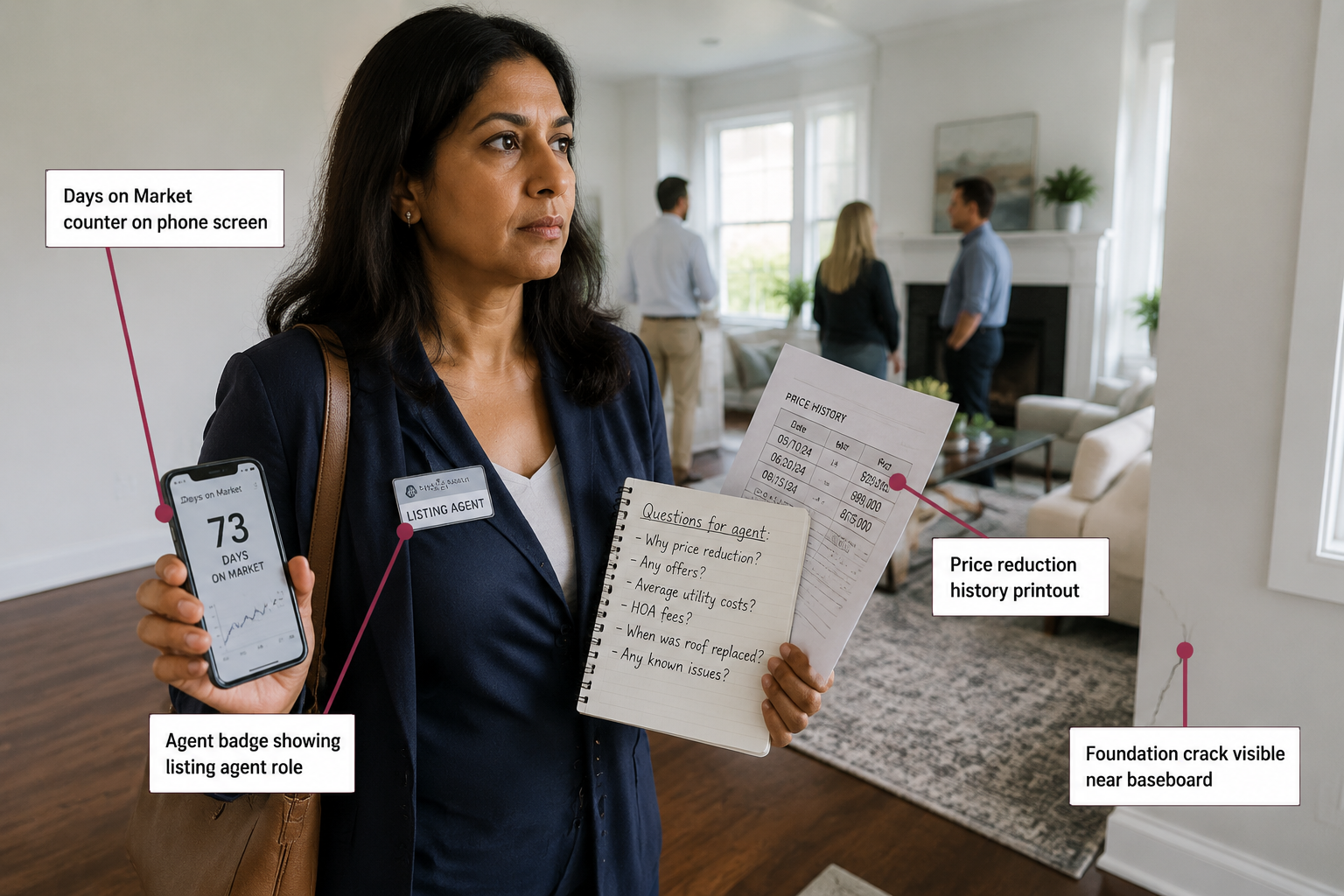
These two questions reveal more about a property's real position than any marketing brochure. A home sitting on the market for 60 or 90 days in a market where the median days on market is 29 (per NAR's July 2026 data) is telling you something. Either it was overpriced, something came up in a prior inspection, or there is a neighborhood issue suppressing buyer interest.
Agents will sometimes answer the days-on-market question by referencing only the current listing period, quietly ignoring a prior listing that expired or was withdrawn. The trick is to ask about "total time on market, including any prior listing periods." You can also pull this yourself from Zillow or Redfin before you walk in the door, which makes the agent's answer a character test as much as an information request.
Key questions to ask:
- How long has the house been on the market?
- Has the price been reduced since the original listing? By how much?
- Was this home listed before under a different MLS number?
- Did a previous contract fall through? If so, why?
That last one matters for what it reveals. A fallen contract almost always traces back to one of three things: a bad inspection result, an appraisal that came in under the agreed price, or a title problem. Agents are not required to volunteer this information in most states, but they cannot lie when you ask directly. Watch the pause before the answer.
For more context on how sellers price strategically, the home sellers pricing strategies playbook for 2026 breaks down exactly how listing prices are set and where the gaps appear.
Questions to Ask at an Open House That Agents Dodge About the Seller
The seller's reason for leaving and their timeline are two of the most useful negotiating signals a buyer can gather, and agents are trained to keep both vague.
Asking "why is the seller moving?" is not rude. It is smart. A seller relocating for a job offer in another city has a hard deadline. A seller who already bought their next home is carrying two mortgages. Both situations create real motivation to negotiate, and that motivation directly affects what offer they will accept.
Agents will typically answer with something like "they're looking for a change" or "it's a lifestyle decision." That is the dodge. Push a little: "Do they have a specific timeline they're working toward?" If the seller needs to close by a certain date, that information is worth real money to you.
What to ask about the seller's situation:
- What is the seller's ideal closing timeline?
- Are they already under contract on another home?
- Have they received any offers yet? How many?
- How many offers has the seller received on this property?
That last question, how many offers has the seller received, is gold. Zero offers after 45 days is a very different conversation than three offers in the first weekend. Agents may say they "can't disclose" the number of offers in some states, but asking still tells you something. If they deflect hard, there are probably no other offers.
What to Look for at an Open House: Property Problems Agents Try to Sidestep
Questions about known property defects are the ones agents most consistently redirect, and they are the ones that matter most to your wallet.
Sellers are required by law in most states to disclose known material defects, but "known" is doing a lot of work in that sentence. The listing agent will have seen the seller's disclosure form before the open house. They know what is on it. The question is whether they will tell you what is not on it, or what was disclosed in vague language.
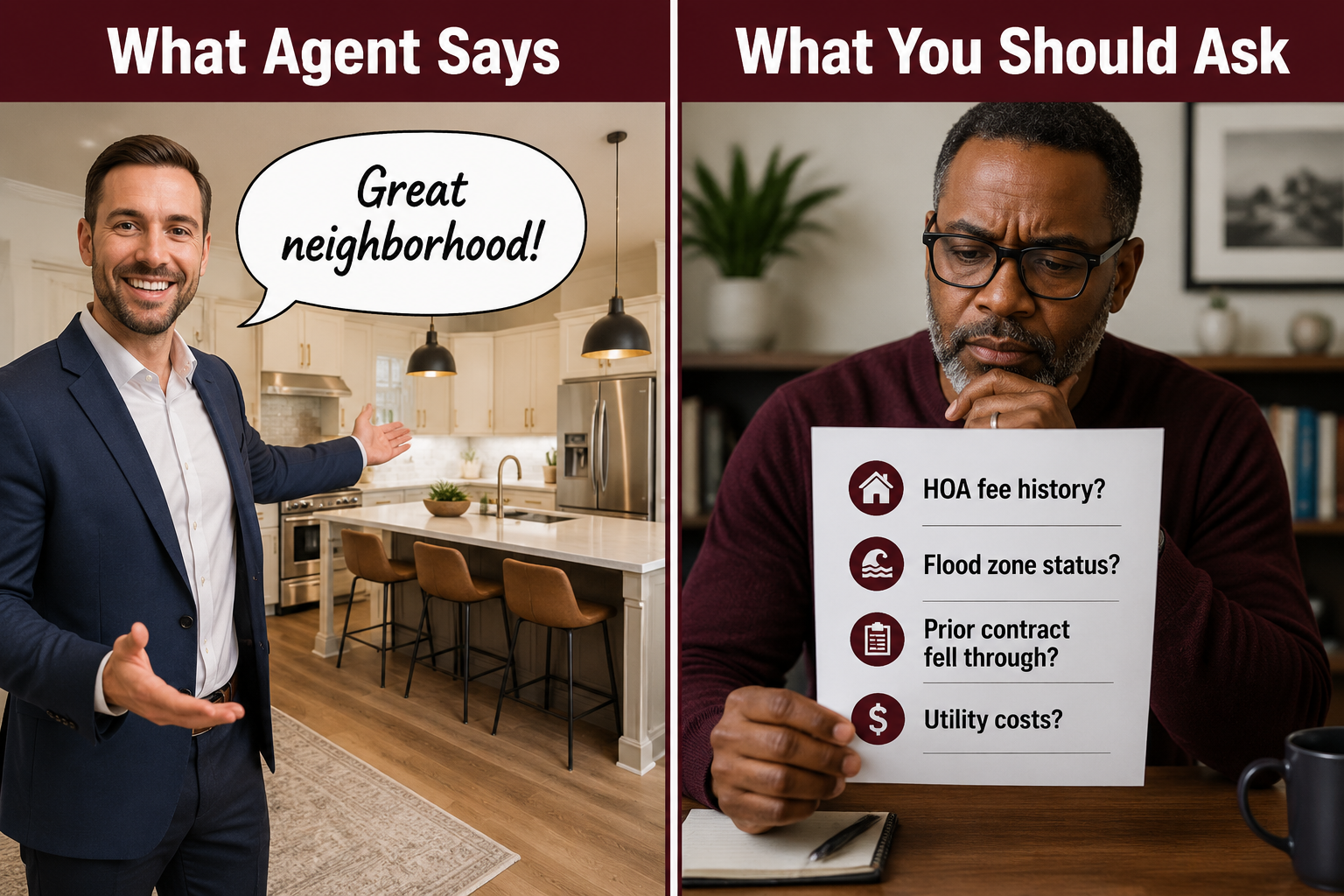
Ask these questions directly, and watch the body language:
- Are there any known issues with the house that are disclosed in the seller's disclosure?
- Has there ever been water intrusion, flooding, or moisture in the basement or crawl space?
- How old is the roof, and when was it last inspected?
- Are there any known foundation issues or settling?
- Has the home ever had mold remediation?
- Have there been any major repairs or renovations? Were permits pulled?
The permit question is especially important. Unpermitted work, a finished basement or added bathroom done without permits, can create serious problems at closing and after. Lenders sometimes refuse to finance homes with unpermitted additions, and you can inherit the liability for bringing the work up to code.
On foundation problems and water damage specifically: if you see fresh paint on basement walls, new carpet over old subflooring, or a dehumidifier running during the showing, those are red flags at an open house worth investigating before you make an offer. The home renovation apps guide is useful for estimating what repair costs might look like if you find something.
Questions About Property Taxes and HOA Fees Agents Don't Want to Discuss
Property taxes and HOA fees are two of the biggest ongoing costs of homeownership, and both are routinely understated or omitted during open house conversations.
Agents are not required to walk you through the full cost of ownership, and many do not. The mortgage payment estimate on the flyer almost never includes property taxes, HOA fees, or insurance. Those three line items can add $500 to $1,500 per month to the real cost of a home, and buyers who do not ask often discover this at closing or, worse, in their first year of ownership.
Ask specifically:
- What are the current annual property taxes on this home?
- Has the property been reassessed recently, or will it be reassessed after sale?
- Is there an HOA? What are the monthly or annual fees?
- What does the HOA fee cover, and what does it not cover?
- Are there any special assessments pending or recently approved?
- Has the HOA increased fees in the past three years?
The reassessment question is one agents almost never bring up. In many counties, a sale triggers a reassessment at the new purchase price, which can significantly increase the tax bill compared to what the current owner pays. Checking the county assessor's website before the open house gives you the current assessed value and the tax rate, so you can do the math yourself.
Special assessments are another trap. An HOA can vote to levy a special assessment for a new roof on the common building, a repaved parking lot, or a pool repair. If one is pending, you could owe thousands within months of closing.
How to Ask About Crime Rates and Neighborhood Issues Without Seeming Rude
Asking about neighborhood safety is completely reasonable, and a good agent will answer it honestly. An agent who deflects is giving you information through the deflection itself.
Fair housing law prevents agents from making statements about the racial or ethnic composition of a neighborhood, which is appropriate. But that law does not prevent you from asking about crime rates, school ratings, or neighborhood trends, and it does not prevent agents from pointing you toward public data sources.
How to ask:
- Where can I find current crime data for this neighborhood?
- Are there any ongoing neighborhood concerns I should be aware of?
- How have property values in this specific block trended over the past three years?
- Are there any planned developments, road projects, or zoning changes nearby?
That last question about zoning and future development is one of the most underused open house questions for buyers. A vacant lot two blocks away could become a distribution warehouse, a gas station, or a 200-unit apartment complex. All of that is public record in the municipality's planning department. Agents often genuinely do not know, but asking whether they have checked is fair.
You can pull crime data from local police department websites, NeighborhoodScout, or SpotCrime before the open house. Bringing that data with you and asking the agent to respond to it is far more effective than asking them to volunteer it cold.
For buyers doing serious neighborhood research before making an offer, the 10 spring house hunting filters that stop you overpaying covers exactly this kind of pre-offer due diligence.
How to Ask About Utilities and Energy Costs That Agents Avoid
Utility costs are almost never discussed at open houses, and the gap between what a buyer assumes and what they actually pay can be significant, especially in older homes or climates with extreme seasons.
A polished open house presentation can make a drafty, poorly insulated 1970s home look like a dream. The staging hides nothing about the $400 monthly gas bill in January or the aging HVAC system that will need replacement within two years.
Ask for:
- 12 months of actual utility bills (gas, electric, water/sewer)
- The age and condition of the HVAC system
- When the water heater was last replaced
- Whether the home has been energy audited
- The type of insulation and its approximate R-value
Agents will sometimes say the seller does not want to share utility bills, which is their right. But a seller who refuses to share utility history on a home they have lived in for 11 years (the current national median tenure) is making a statement. You can also request this information formally through your buyer's agent after the open house.
Red Flags at an Open House: When the Agent Won't Answer Your Questions
An agent who consistently deflects, redirects, or gives non-answers to direct questions is a red flag in itself. The pattern matters as much as any individual response.
Specific behaviors to watch for:
- Vague answers to direct questions: "The sellers have really loved this home" is not an answer to "why is the seller moving?"
- Redirecting to the disclosure form: "Everything is disclosed in the seller's disclosure" often means "I don't want to say it out loud."
- Urgency manufacturing: Phrases like "we have a lot of interest" or "I'd expect multiple offers by Sunday" without specifics are pressure tactics, not information.
- Dismissing your questions: Any version of "you don't need to worry about that" is a signal to worry about exactly that.
- Who is the listing agent working for? If you have not asked this directly, ask it now. The answer should be "the seller." If the agent implies they are working for both you and the seller, that is a dual agency situation with its own set of complications.
Open house etiquette for buyers does not require you to stay polite at the expense of your financial interests. You can be respectful and still be direct. The agents who give straight answers to hard questions are the ones worth trusting.
What Not to Say at an Open House
What you say at an open house can be used against you in negotiations just as much as what you ask can protect you.
The listing agent is listening to every conversation you have, including the one with your spouse in the kitchen. Anything you say can be reported back to the seller, and sellers use that information to negotiate harder.
Avoid saying:
- Your maximum budget or how much you are pre-approved for
- How much you love the house or that you can "see yourself living here"
- That you are in a hurry to buy or that this is the best home you have seen
- Anything negative about the home in front of the agent (save that for your own agent, privately)
- That you would pay asking price or above asking without negotiation
The classic mistake is the buyer who walks into the kitchen and says "this is exactly what we've been looking for" within earshot of the listing agent. That sentence just told the seller they do not need to negotiate on price, repairs, or closing costs.
For buyers running their own open house on the selling side, the open house safety plan guide covers what sellers need to protect during showings.
Can I Take Photos at an Open House?
Yes, in most cases you can take photos at an open house, but you should ask the agent first. It is standard open house etiquette for buyers to request permission before photographing the interior.
Most listing agents will say yes. Some sellers request no photos for privacy reasons, particularly in high-end properties or homes where personal items are still present. If photos are allowed, photograph anything that concerns you: the crack in the ceiling, the water stain near the window, the age label on the water heater. These photos become your reference when you are reviewing the home inspection report later.
Do not photograph personal documents, family photos, or anything that is clearly private. That is both an etiquette issue and potentially a legal one.
How to Get Honest Answers From Real Estate Agents at Open Houses
The most effective way to get honest answers is to ask questions you already know the partial answer to, so you can measure the response against what you know.
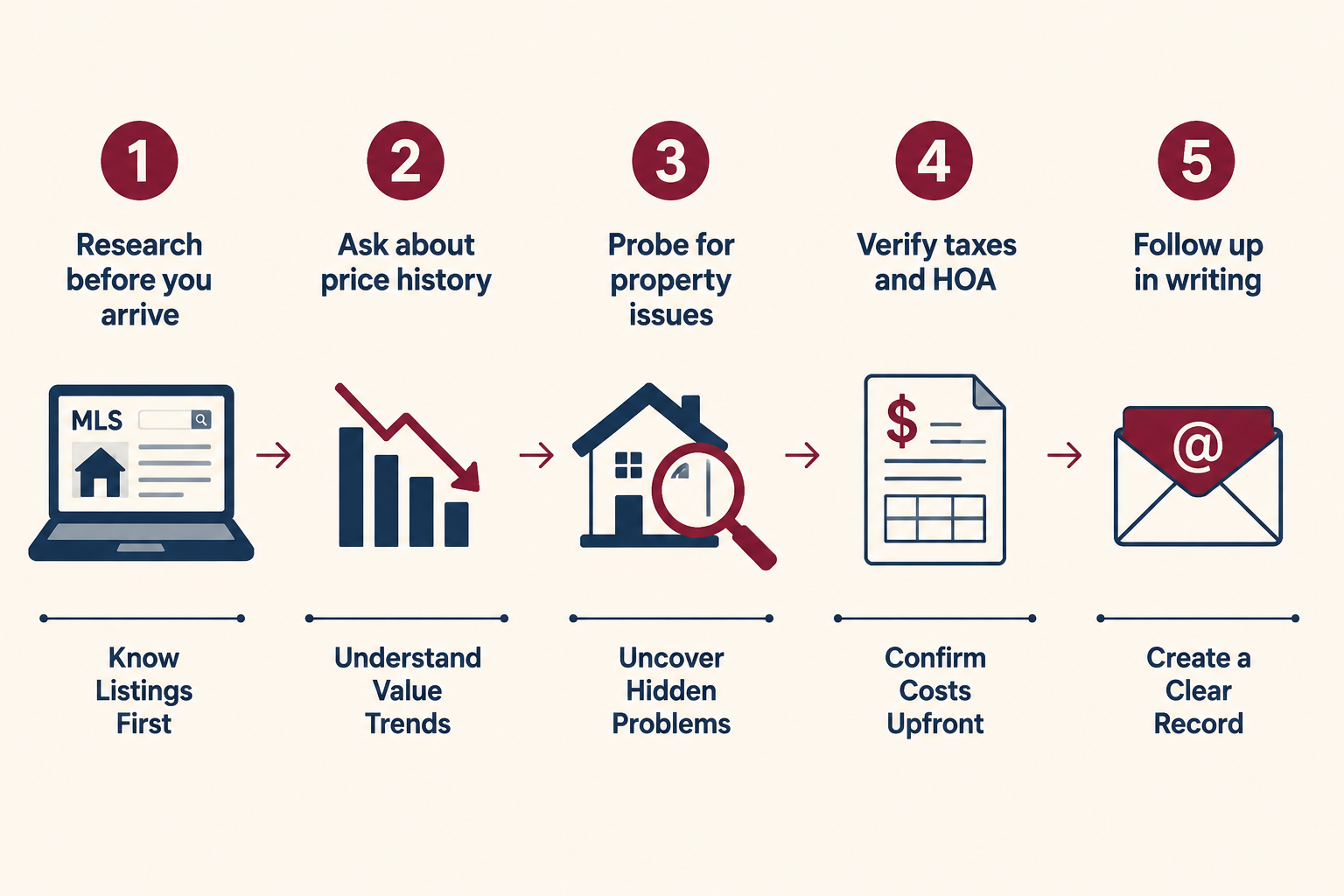
Before any open house, spend 15 minutes pulling the property's listing history from Zillow or Redfin, the county tax record, the flood zone map from FEMA's portal, and any recent permit history from the municipality. Walk in informed.
When you ask "how long has the house been on the market?" and you already know the answer is 73 days, the agent's response tells you whether they are going to be straight with you. If they say "just a few weeks," you know to treat every subsequent answer with skepticism.
Your buyer's agent, if you have one, can pull even more data, including comparable sales, prior listing prices, and the seller's purchase history. The open house is a first look, not a final decision. Use it to gather information and identify what needs deeper investigation.
For first-time buyers working through this process, the first-time home buyer tips guide from a real estate agent walks through the full process from search to close.
Open House Questions Checklist
Use this before and during every open house.
Before you arrive:
- Pull the listing history (days on market, price reductions, prior listings)
- Check the county tax record for current assessed value and tax amount
- Verify flood zone status on FEMA's flood map service
- Research recent sales of comparable homes within half a mile
- Check the municipality's permit database for recent work
At the open house, ask:
- How long has the home been on the market?
- Has the price been reduced? By how much?
- Did a previous contract fall through? Why?
- Why is the seller moving?
- What is the seller's timeline?
- Are there any known issues with the house?
- Has there been any water intrusion or foundation work?
- How old is the roof, HVAC, and water heater?
- What are the current property taxes?
- Is there an HOA? What are the fees and any pending assessments?
- Can I see 12 months of utility bills?
- Are there any planned developments or zoning changes nearby?
- Who does the listing agent represent?
What to observe:
- Fresh paint in isolated spots (possible cover-up)
- Running dehumidifiers or fans
- Uneven floors or sticking doors (foundation movement)
- Water stains on ceilings or near windows
- Smell of mildew, fresh paint, or heavy air freshener
FAQ
What questions do real estate agents avoid answering at open houses?
Agents most commonly avoid or deflect questions about why the seller is moving, whether a prior contract fell through, how long the home has actually been on the market across all listing periods, known property defects beyond the disclosure form, and whether the price has room to negotiate.
Is the listing agent at an open house working for me?
No. The listing agent represents the seller. Their legal obligation is to act in the seller's best interest. Any information you share with them, including your budget or how much you want the home, can be passed to the seller.
How do I find out if a price was reduced before the open house?
Check Zillow, Redfin, or Realtor.com for the listing history. Most portals show price reduction history. You can also ask the agent directly and compare their answer to what the portal shows.
What does it mean if a previous contract fell through?
It usually means the inspection revealed significant problems, the appraisal came in below the agreed price, or there was a title issue. It is not always a deal-killer, but it is always worth investigating before you make an offer.
Can I ask about crime rates at an open house?
Yes. Agents cannot make statements about neighborhood demographics under fair housing law, but they can direct you to public crime data sources. If an agent refuses to engage with the question at all, look up the data yourself from local police department reports or NeighborhoodScout.
What should I never say at an open house?
Never reveal your maximum budget, say you love the home, admit you are in a hurry to buy, or discuss your negotiating strategy within earshot of the listing agent. Everything you say can be reported to the seller.
How do I ask about foundation problems without seeming difficult?
Ask it directly: "Has there been any foundation work or settling issues with this home?" It is a standard buyer question, and any agent who treats it as offensive is telling you something about the home.
What is open house etiquette for buyers?
Ask permission before photographing, do not bring food or drinks, keep children close, do not open drawers or cabinets unless specifically invited to, and be respectful of the space. None of that means staying quiet about questions that protect your financial interests.
How many offers should I ask about?
Ask "how many offers has the seller received?" Some agents will answer, some will say they cannot disclose that information. Either way, the response gives you useful context. Zero offers after a long market time is very different from multiple offers in the first week.
What red flags at an open house should I watch for?
Running dehumidifiers, isolated fresh paint, uneven floors, sticking doors, water stains near windows or ceilings, heavy air freshener masking odors, and an agent who deflects every direct question are all worth noting.
Should I hire a buyer's agent before attending open houses?
You do not have to, but having a buyer's agent means you have someone in your corner who can pull deeper data, attend the open house with you, and ask questions on your behalf without tipping your hand to the listing agent.
What questions about utilities do agents avoid?
Agents rarely volunteer utility costs, HVAC age, or insulation quality. Ask specifically for 12 months of utility bills and the age of the major systems. A seller who refuses to share utility history on a long-held home is worth questioning further.
Conclusion
Walking into an open house without a list of questions is like signing a contract without reading it. The staging is flawless, the cookies smell fresh, and the agent is impeccably friendly, but none of that tells you whether the basement floods, the HOA is raising fees, or the seller already dropped the price twice and is still sitting on zero offers.
The questions to ask at an open house that agents dodge are not trick questions. They are the basic due diligence that protects a purchase that, for most buyers, represents the largest financial commitment of their lives. Asking how long the house has been on the market, whether a previous contract fell through, what the actual property taxes are, and what is known about foundation or water issues is not aggressive. It is reasonable, it should be standard.
Come prepared. Pull the listing history before you walk in. Know the flood zone status. Have the tax record in your phone. Then ask your questions directly, watch the responses carefully, and let the answers, or the lack of them, do the work.
For sellers preparing for their own open house and thinking about what buyers will ask, the 60-day home selling checklist is a strong starting point for getting ahead of the hard questions before they come up.