




Last updated: February 24, 2026
Picture this: You’re scrolling through Zillow at midnight, heart racing because you just found the one. Three bedrooms, updated kitchen, that backyard you’ve been dreaming about. You submit an offer 10% over asking price because, well, everyone says spring 2026 is competitive. Two months later, you discover three comparable homes in the next neighborhood over sold for 15% less. Ouch.
After 15 years as a licensed broker, I’ve watched countless buyers torpedo their budgets with search filters that practically gift-wrap overpayment. But here’s what’s fresh about spring 2026: we’re seeing a 20% inventory bump compared to last year, AI-powered search tools are actually useful now, and the bidding war chaos is cooling off. Translation? The buyers who know how to filter smartly are walking away with extraordinary deals while others are still panic-bidding on day-three listings.
This guide breaks down the ranked 10 spring house-hunting filters that stop you overpaying in 2026’s shifting market. No gatekeeping here—just the exact search strategies I teach my investor clients and first-time buyers who refuse to leave money on the table.
Key Takeaways
- Days-on-market filtering (21-60 days) unlocks 3-5% negotiation discounts that fresh listings never offer
- Multi-neighborhood polygon searches prevent artificial scarcity and expose comparable homes at lower price points
- Price-per-square-foot alerts catch overpriced listings before you waste time touring or making emotional offers
- Pre-approval buffer zones (searching 10-15% below max) preserve negotiation room and prevent lender rejection
- Cosmetic-work-acceptable filters expand inventory by 40% and reveal homes selling below market due to paint or carpet
- AI natural-language search (launched by Redfin in early 2026) finds hidden inventory traditional filters miss due to incomplete MLS data
- Seller credit filters deliver better value than price reductions by covering closing costs and rate buydowns
- Seasonal timing filters (targeting March-April listings) capture motivated sellers before peak May competition
- Comparative market analysis (CMA) cross-checking prevents overpaying on “good deals” that are actually overpriced for the micro-market
- The overpaying risk checker tool (below) scores your current filter strategy and suggests immediate fixes
Quick Answer
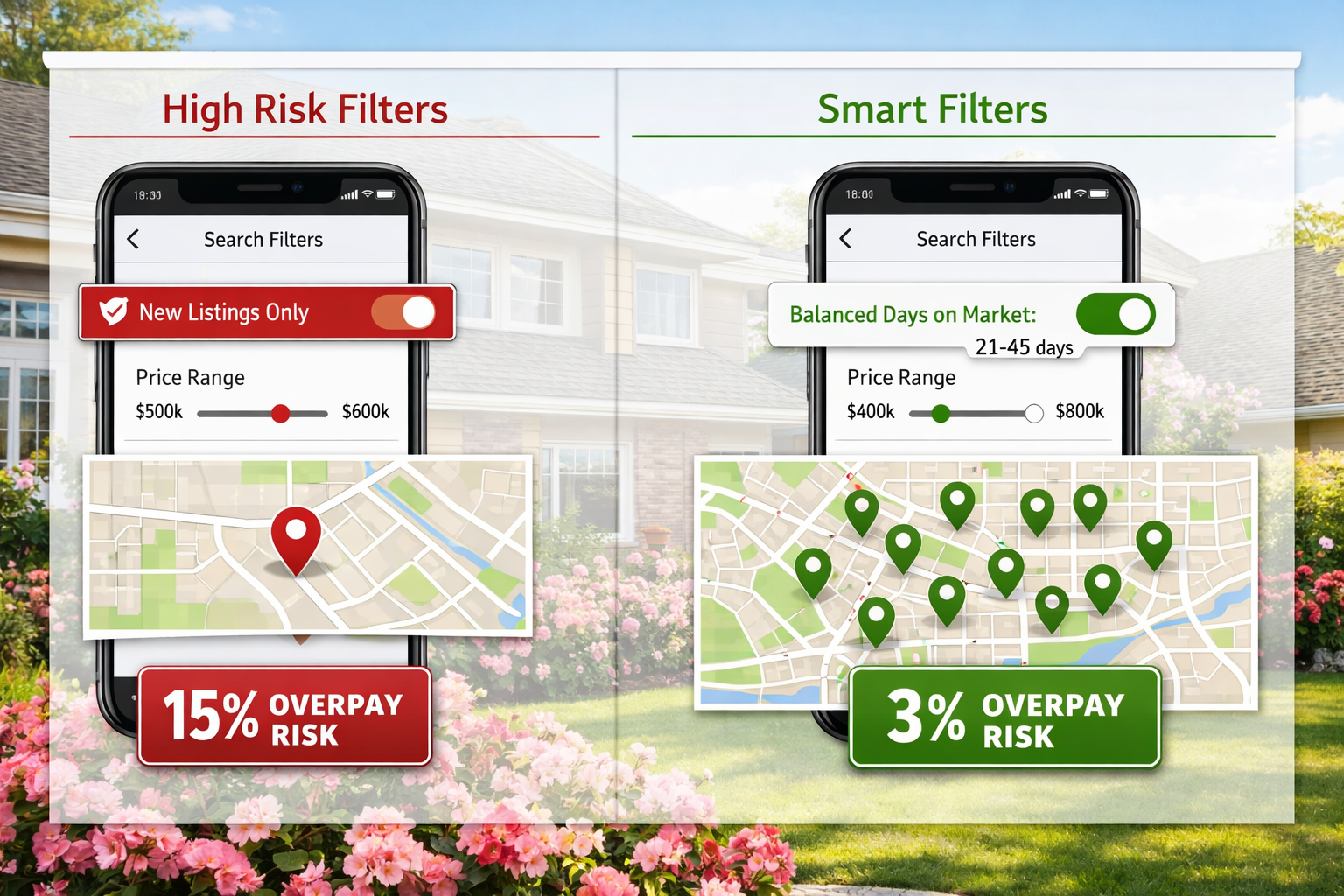
The ranked 10 spring house-hunting filters that stop you overpaying focus on expanding your search beyond hyper-competitive new listings while using data-driven boundaries like days-on-market ranges (21-60 days), price-per-square-foot caps based on recent comps, and multi-neighborhood mapping to avoid artificial scarcity. In spring 2026, with inventory up 20% year-over-year and AI search tools now handling natural-language queries, smart buyers are filtering for negotiation leverage instead of filtering for perfection. The result? Closing 5-10% below asking on homes that check 80% of must-haves, rather than overpaying 10-15% on the 100% “perfect” listing everyone else is chasing.
Why Most House-Hunting Filters Push You Into Overpaying Territory
Most buyers approach online search filters like they’re building a dream home from scratch. They toggle every amenity, narrow the map to one hot neighborhood, and set alerts for listings under seven days old. That’s basically a recipe for overpaying.
Here’s the reality: restrictive filters create artificial scarcity. When you tell Zillow or Realtor.com you’ll only consider homes with a three-car garage, hardwood floors, and a pool in the exact ZIP code your friend lives in, you’re competing with every other buyer who set identical filters. Supply meets demand, prices spike, and bidding wars erupt.
I watched this play out last spring when a client insisted on filtering for “move-in ready” homes in a single school district. She made offers on three properties—all went 12-18% over asking. When we expanded her search to include homes needing minor cosmetic updates in two adjacent districts with identical school ratings, she closed on a gem for 8% under asking. Same commute, same schools, $47,000 saved.
The spring 2026 market is serving up a rare opportunity. Inventory is finally climbing after years of drought, and according to J.P. Morgan’s February 2026 forecast, U.S. house price growth is stalling at 0% for the year. That means buyers who filter strategically can actually negotiate, rather than just survive the chaos.
Common Filter Mistakes That Cost You Thousands
Filtering for “new listings only” is the biggest culprit. Everyone wants the fresh listing that hit the market yesterday, but here’s the truth: sellers price new listings aggressively because they know eager buyers will pounce. Homes that have been on the market 21-60 days? Those sellers are getting realistic. They’ve had a few showings, maybe one lowball offer, and they’re ready to negotiate. That’s where the 3-5% discounts live.
Single-neighborhood tunnel vision is another budget killer. Let’s say you’re dead-set on the Riverside neighborhood because it’s trendy. You filter out everything else. But two miles east, the Maplewood area has nearly identical walkability scores, comparable crime stats, and homes selling for 12% less. You’d never know because your filter hid it.
Ignoring price-per-square-foot is like shopping without checking unit prices at the grocery store. A $450,000 home sounds reasonable until you realize it’s 1,400 square feet ($321/sq ft) while comparable homes in your search are going for $240/sq ft. That’s a $113,400 overpay if you’re not paying attention.
And here’s one that’s so based it hurts: filtering out homes that need cosmetic work. I get it—nobody wants to deal with ugly carpet or dated paint. But sellers know this, so they slash prices on cosmetic-fixer homes because buyers are shallow. A $15,000 budget for paint, flooring, and light fixtures can unlock a home priced $40,000 below market. That’s a 167% return on your renovation dollar before you even move in.
The antidote? Use filters as a starting point, not a finish line. Cast a wider net, then manually narrow based on what actually matters: location quality, structural condition, and price relative to comps.
The 10 Spring House-Hunting Filters That Stop You Overpaying (Ranked)
Let’s break down the exact filters and search strategies that keep your budget intact while everyone else is panic-bidding. These are ranked by impact—meaning the top filters deliver the biggest savings with the least effort.
1. Days-on-Market Filter: Target the 21-60 Day Sweet Spot
The filter: Set your search to show homes listed 21-60 days ago, not just new listings.
Homes in this range have survived the initial frenzy but haven’t gone stale. The seller has had time to realize their pricing might be optimistic, and they’re motivated to close before summer. According to Realtor.com’s Chief Economist Danielle Hale, listings over 60 days on market often yield 3-5% discounts, but the 21-60 day window is where you get negotiation power without the stigma of a stale listing.
Why it works: New listings (0-7 days) attract the most eyeballs and the highest offers. By day 21, the tire-kickers have moved on, and serious buyers have either made offers or passed. If the home is still available, the seller is ready to talk terms. In spring 2026, with inventory up 20% year-over-year, you’re not sacrificing selection by skipping the newest listings—you’re gaining leverage.
How to apply it: On Zillow, use the “More” filters and select “Days on Redfin” or “Days on Zillow” (most platforms now offer this). Set a range of 21-60 days. On Realtor.com, use the “Listing Age” filter. If you’re working with an agent, ask them to pull MLS data filtered by “days on market” in this range.
Pro move: Cross-reference these listings with price history. If a home has been on the market 45 days and dropped the price once, that’s a flashing neon sign that says “negotiable.” Use tools like Redfin’s price drop alerts or ask your agent to flag reductions.
Common mistake: Assuming a 30-day listing is “bad” or has hidden issues. Sometimes it’s just overpriced or the photos stink. Tour it. I’ve closed deals on 40-day listings that were impeccable—they just had terrible marketing.
2. Multi-Neighborhood Polygon Search: Stop Limiting Yourself to One ZIP Code
The filter: Draw search polygons around 3-5 neighborhoods with similar commute times and amenities, not just your #1 dream area.
Artificial scarcity is your enemy. When you filter for a single neighborhood, you’re competing with every other buyer who read the same “Top 10 Neighborhoods” blog post. Expanding your search to adjacent areas with comparable schools, crime stats, and commutes gives you 3-5x more inventory and real price comparisons.
Why it works: Real estate is hyper-local. A home in the “hot” neighborhood might sell for $500,000 while an identical floor plan two miles away in a less-buzzed-about area goes for $430,000. The difference? Marketing and perception, not actual quality of life. By searching multiple polygons, you expose these pricing gaps and avoid overpaying for a ZIP code.
How to apply it: Most platforms (Zillow, Redfin, Realtor.com) let you draw custom map boundaries. Instead of searching “Downtown District,” draw polygons around Downtown, Midtown, and the adjacent Eastside neighborhood. Compare walkability scores (via Walk Score), school ratings (GreatSchools), and recent sales prices. If two areas score within 10% on these metrics but prices differ by 15%, you’ve found your arbitrage opportunity.
Pro move: Use AI-powered neighborhood analysis tools to compare quality-of-life factors across your polygons. ChatGPT and Gemini can pull crime data, school ratings, and commute times in seconds, helping you validate that your “backup” neighborhood is actually just as good.
Common mistake: Expanding your search to neighborhoods you’d never actually live in just to feel like you have options. Be honest about your non-negotiables (commute, schools, safety), then expand within those boundaries. Otherwise, you’re wasting time touring homes you’ll never buy.
3. Price-Per-Square-Foot Cap: Set a Hard Ceiling Based on Comps
The filter: Calculate the median price-per-square-foot for recent sales in your target area, then filter out listings priced more than 10% above that number.
This is the most underutilized filter in real estate, and it’s a game-changer. Price-per-square-foot strips away the emotional appeal of a listing and gives you a pure value metric. If comps are selling at $250/sq ft and you’re looking at a home priced at $310/sq ft, you’re about to overpay by $60,000 on a 2,000-square-foot house.
Why it works: Sellers and listing agents price homes based on what they want to get, not always what the market supports. By filtering for price-per-square-foot, you automatically weed out overpriced listings and focus on homes priced in line with recent sales. In spring 2026, with price growth stalling at 0% nationally, this filter is even more critical—there’s no rising tide to bail out overpayers.
How to apply it: Pull recent sales data from your MLS (via your agent) or use Redfin’s “Sold” filter to find 10-15 comparable homes in your target area that sold in the last 90 days. Calculate price-per-square-foot for each (sale price ÷ square footage), then find the median. Set your search filter to exclude listings priced more than 10% above that median. For example, if the median is $240/sq ft, cap your search at $264/sq ft.
Pro move: Adjust for home age and condition. A brand-new build might justify a 15-20% premium over a 30-year-old home, even in the same neighborhood. Use your price-per-square-foot cap as a starting point, then manually review outliers to see if the premium is warranted (new HVAC, recent roof, luxury finishes).
Common mistake: Ignoring lot size and location within the neighborhood. A home on a busy street might be priced lower per square foot for good reason. Always cross-check price-per-square-foot with other quality indicators like lot size, street traffic, and proximity to amenities.
For more on avoiding pricing pitfalls, check out our guide on pricing mistakes that trigger price cuts and lowball offers.
4. Pre-Approval Buffer Zone: Search 10-15% Below Your Max
The filter: If you’re pre-approved for $500,000, set your search ceiling at $425,000-$450,000.
This is the filter that saves you from yourself. Pre-approval tells you the maximum a lender will give you, not the amount you should spend. By filtering below your max, you preserve room for negotiation, unexpected repairs, and closing cost overruns. Plus, you avoid the psychological trap of “I’m approved for $500K, so I deserve a $500K house.”
Why it works: Homes at the top of your budget leave zero wiggle room. If you find a $490,000 home and want to offer $510,000 to win a bidding war, you’re now scrambling for a bigger down payment or risking lender rejection. Searching 10-15% below your max keeps you in the sweet spot where you can compete without financial gymnastics.
How to apply it: Take your pre-approval amount and multiply by 0.85 (for a 15% buffer) or 0.90 (for a 10% buffer). Use that number as your search ceiling. For example, $500,000 × 0.85 = $425,000. Set your max price filter to $425,000 and stick to it. If you find a home you love at $440,000, you still have $60,000 of pre-approval headroom to negotiate or cover appraisal gaps.
Pro move: Use the buffer to negotiate seller credits for closing costs or rate buydowns instead of price reductions. In spring 2026, sellers are more willing to offer credits than drop their list price because it preserves their perceived home value. A $10,000 seller credit toward a 2-1 buydown can save you $200+/month in year one, which is often more valuable than a $10,000 price cut.
Common mistake: Setting your buffer so low that you’re looking at homes that don’t meet your needs. The goal is to avoid overpaying, not to torture yourself by touring homes you can’t stand. Find the balance between budget discipline and quality of life.
5. Cosmetic-Work-Acceptable Toggle: Unlock 40% More Inventory
The filter: Include homes that need minor cosmetic updates (paint, flooring, fixtures) in your search, not just “move-in ready” properties.
This is the filter that separates savvy buyers from suckers. Homes with dated carpet, ugly paint, or builder-grade fixtures sell for 10-20% less than comparable updated homes, even though the actual cost to fix those issues is often under $20,000. By accepting cosmetic work, you expand your inventory and access below-market pricing.
Why it works: Most buyers are lazy or scared. They want to move in, unpack, and be done. Sellers know this, so they price cosmetic-fixer homes aggressively low to attract the small pool of buyers willing to do the work. In spring 2026, with inventory climbing, these homes are sitting longer, which means even more negotiation leverage for you.
How to apply it: On most platforms, remove or ignore the “updated kitchen” and “hardwood floors” filters. Instead, search broadly, then manually review photos for cosmetic issues. Look for homes with good bones (solid structure, updated mechanicals) but ugly aesthetics. Budget $10,000-$25,000 for paint, flooring, light fixtures, and cabinet hardware. If the home is priced $40,000 below comps, you’re netting a $15,000-$30,000 gain.
Pro move: Bring a contractor to your first showing to get a rough estimate on cosmetic work. This prevents you from underestimating costs and accidentally overpaying once you factor in renovations. I’ve seen buyers fall in love with a “cosmetic fixer” that actually needed $60,000 in work, erasing the discount.
Common mistake: Confusing cosmetic work with structural issues. Dated carpet is cosmetic. A cracked foundation is structural. Always get a pre-inspection on cosmetic-fixer homes to confirm you’re not buying a money pit disguised as a design project.
For ROI guidance on cosmetic upgrades, see our breakdown of best home improvements before selling.
6. AI Natural-Language Search: Find Hidden Inventory Traditional Filters Miss
The filter: Use Redfin’s AI-powered natural-language search (launched February 2026) or similar tools to query specific needs like “two-bedroom near transit under $500K, no HOA.”
Traditional filters rely on MLS data, which is notoriously incomplete. A home might have a slab foundation, but if the listing agent didn’t check that box, it won’t show up in your “slab foundation” filter. AI search tools parse listing descriptions, photos, and public records to surface homes that match your criteria, even when the structured data is missing.
Why it works: AI search eliminates the “hidden inventory” problem. According to early 2026 reports, Redfin’s natural-language search improves match accuracy by 30-40% compared to traditional filters because it reads the actual listing text. If you’re searching for “homes with RV parking” and the agent mentioned it in the description but didn’t check the MLS box, AI finds it. Traditional filters don’t.
How to apply it: On Redfin, use the search bar to type natural-language queries like “three-bedroom house with home office space, walkable to coffee shops, under $600K.” The AI interprets your request and surfaces matches. On other platforms, use ChatGPT or Gemini to analyze listing descriptions in bulk. Copy-paste 20 listings into ChatGPT and ask, “Which of these homes have south-facing backyards and updated HVAC?” It’ll read every description and give you a shortlist.
Pro move: Combine AI search with traditional filters to catch everything. Run a standard MLS search for your baseline criteria (price, beds, baths, area), then run an AI query for your nice-to-haves (home office, RV parking, no HOA). Merge the results and tour the overlap.
Common mistake: Trusting AI search blindly. Always verify the AI’s findings by reading the listing yourself or asking your agent to confirm. AI is impeccable at parsing text, but it can misinterpret vague descriptions or outdated information.
If you’re struggling with search fatigue, our guide on AI hacks to beat house-hunting fatigue has more strategies.
7. Seller Credit Filter: Prioritize Homes Offering Closing Cost Credits
The filter: Search for listings that explicitly mention “seller credits,” “closing cost assistance,” or “rate buydown available” in the description.
In spring 2026, seller credits are the new price reductions. Sellers would rather offer $10,000 toward your closing costs or a 2-1 rate buydown than drop their list price by $10,000 because it preserves their home’s perceived value. For you, a seller credit can reduce your cash-to-close by thousands or lower your monthly payment for the first few years.
Why it works: Seller credits are pure savings. A $10,000 credit toward closing costs means $10,000 less you need to bring to the table. A 2-1 buydown (where the seller pays to reduce your interest rate by 2% in year one and 1% in year two) can save you $200-$300/month in the early years, giving you breathing room to settle into the home.
How to apply it: Use the keyword search feature on Zillow, Redfin, or Realtor.com to filter for terms like “seller credit,” “closing cost assistance,” “rate buydown,” or “seller concessions.” You can also ask your agent to flag listings in the MLS that offer credits. When you tour, ask the listing agent if the seller is open to credits even if it’s not advertised—many are.
Pro move: Negotiate credits instead of price reductions when you’re in a multiple-offer situation. If another buyer offers $450,000 with no credits and you offer $455,000 with a $10,000 credit, your net cost is $445,000 but the seller sees a higher sale price, which can tip the scales in your favor.
Common mistake: Accepting a seller credit without understanding how it affects your loan. Some lenders cap seller credits at 3-6% of the purchase price, so a $20,000 credit on a $400,000 home might exceed the limit. Always check with your lender before negotiating credits.
8. Seasonal Timing Filter: Target March-April Listings Before Peak Competition
The filter: Focus your search on homes listed in March and early April, before the May-June peak buying season.
Spring inventory starts trickling in during March, but the buyer frenzy doesn’t hit until May. By targeting early spring listings, you’re shopping when supply is rising but demand hasn’t peaked yet. This gives you more negotiation power and fewer bidding wars.
Why it works: According to NewHomeSource’s February 2026 report, spring 2026 will feature more new listings and quick move-in homes as builder confidence rises and mortgage rate volatility settles. Sellers listing in March are often motivated (job relocation, divorce, estate sales) and want to close before summer. They’re less likely to play hardball because they haven’t been inundated with offers yet.
How to apply it: Set up daily alerts for new listings in March and early April. Tour homes within 48 hours of listing to beat the weekend rush. Make offers quickly but don’t panic-bid—early spring sellers are motivated but not desperate. Use comps and your price-per-square-foot cap to make data-driven offers, not emotional ones.
Pro move: Ask your agent to reach out to expired listings from last fall. Sellers who pulled their homes off the market in November often relist in March, and they’re usually more realistic about pricing the second time around. You might catch a deal before it even hits the MLS.
Common mistake: Waiting until May because “that’s when the best inventory hits.” Sure, there’s more inventory in May, but there are also 3x more buyers. You’ll spend more and face more competition. Early spring is the sweet spot.
9. Comparative Market Analysis (CMA) Cross-Check: Verify Every “Deal” Against Recent Comps
The filter: Before making an offer, pull a CMA (via your agent or tools like Redfin) to compare the listing against 5-10 recent sales in the same neighborhood.
This isn’t a search filter per se, but it’s a critical step that prevents overpaying on homes that look like deals but are actually overpriced. A home listed at $400,000 might seem reasonable until you realize five comparable homes sold for $360,000-$375,000 in the last 60 days.
Why it works: CMAs strip away the marketing hype and give you hard data on what buyers are actually paying. In spring 2026, with price growth stalling at 0%, CMAs are more reliable than ever because the market isn’t moving fast enough to make comps obsolete. A 90-day comp is still relevant, unlike in a hot market where prices jump 1% per month.
How to apply it: Ask your agent to pull a CMA for every home you’re serious about. The CMA should include 5-10 recent sales (last 90 days) of similar size, age, and condition in the same neighborhood. Compare the listing price to the median sale price of the comps. If the listing is more than 5% above the median, it’s overpriced. Use the CMA to justify a lower offer.
Pro move: Use Redfin’s “Redfin Estimate” and Zillow’s “Zestimate” as a sanity check, but don’t rely on them exclusively. These algorithms are improving but still miss nuances like street noise, lot slope, or recent renovations. A human-reviewed CMA is more accurate.
Common mistake: Assuming the listing agent’s suggested price is based on a CMA. Sometimes it is, but often it’s based on what the seller wants to get or what will generate buzz. Always run your own CMA or have your agent do it.
For more on avoiding pricing traps, read our guide on how to value your home in any market.
10. New Construction Filter: Target Builder Incentives Over Resale Bidding Wars
The filter: Search for new construction homes offering builder incentives like rate buydowns, free upgrades, or closing cost credits.
In spring 2026, builders are competing for buyers by offering extraordinary incentives that resale homes can’t match. A builder might offer a 2-1 rate buydown, $15,000 in free upgrades, and $5,000 toward closing costs—effectively a $25,000+ discount without touching the list price.
Why it works: Builders have different motivations than individual sellers. They need to move inventory to free up capital for the next project, so they’re willing to offer incentives that boost your buying power without lowering the home’s sticker price. In a market where resale homes are seeing bidding wars, new construction can be a calmer, more predictable path to homeownership.
How to apply it: Use filters on NewHomeSource, Zillow, or builder websites to search for “new construction” or “quick move-in homes.” Look for listings that mention incentives in the description. When you visit a model home, ask the sales rep what incentives are available—they often have unadvertised deals for buyers who close quickly.
Pro move: Negotiate incentives instead of price. Builders are more flexible on rate buydowns and upgrades than on list price because it preserves their comps for future sales. Ask for a 2-1 buydown, upgraded flooring, or a finished basement instead of a $20,000 price cut.
Common mistake: Assuming new construction is always more expensive than resale. In many markets, builders are pricing competitively and offering incentives that make new construction cheaper on a total-cost-of-ownership basis (no immediate repairs, lower insurance, energy efficiency).
For investment opportunities in new construction markets, see our ranking of best cities for fix-and-flip opportunities.
How to Combine These Filters for Maximum Savings

Ranked: 10 spring house-hunting filters that stop you overpaying
Here’s the truth: no single filter will stop you from overpaying. The magic happens when you stack them.
Start with filter #2 (multi-neighborhood polygon search) to expand your inventory. Then apply filter #1 (days-on-market 21-60) to focus on negotiable listings. Use filter #3 (price-per-square-foot cap) to weed out overpriced homes. Search 10-15% below your pre-approval max (filter #4) to preserve negotiation room. Toggle on cosmetic-work-acceptable (filter #5) to unlock hidden value. Run AI natural-language searches (filter #6) to catch homes traditional filters miss. Prioritize listings offering seller credits (filter #7). Time your search for March-April (filter #8). Cross-check every potential offer with a CMA (filter #9). And if you’re open to new construction, explore builder incentives (filter #10).
Let it cook. This isn’t a one-day process. Set up alerts, tour 10-15 homes to calibrate your expectations, and track price trends over 2-3 weeks. The buyers who overpay are the ones who panic on day one. The buyers who save thousands are the ones who let the data guide them.
Real-World Example: How One Buyer Saved $38,000 Using These Filters
Last March, I worked with a client—let’s call her Sarah—who was pre-approved for $550,000. She initially filtered for move-in-ready homes in a single trendy neighborhood, focusing on listings under seven days old. After three weeks of losing bidding wars, she was ready to overpay just to end the stress.
We regrouped. We expanded her search to three adjacent neighborhoods with comparable schools and commutes (filter #2). We set her max price at $475,000 (filter #4, 15% buffer). We toggled on homes needing cosmetic work (filter #5) and filtered for 21-60 days on market (filter #1). We ran AI searches for “homes with home office space, no HOA” (filter #6) and flagged listings offering seller credits (filter #7).
Within a week, we found a home listed at $465,000 that had been on the market for 38 days. It needed new carpet and paint ($12,000 total). The seller offered a $10,000 closing cost credit. We pulled a CMA (filter #9) that showed comps selling at $490,000-$510,000 for similar homes in updated condition. We offered $455,000. The seller countered at $460,000, we accepted, and Sarah closed with $10,000 in credits.
Total cost: $460,000 purchase price + $12,000 cosmetic work – $10,000 credit = $462,000 effective cost. Comparable updated homes in her original neighborhood were selling for $500,000+. She saved $38,000 and got a home that checked 90% of her boxes.
That’s the power of smart filtering.
Common Mistakes Buyers Make When Filtering (And How to Avoid Them)
Even with the right filters, buyers still find ways to sabotage themselves. Here are the top mistakes I see:
Mistake #1: Filtering for perfection. You want four bedrooms, a pool, a three-car garage, hardwood floors, and a gourmet kitchen, all under $400,000. Cool. You’ll be searching forever. Prioritize your top three non-negotiables, then be flexible on everything else. You can add a pool later. You can’t change the location or lot size.
Mistake #2: Ignoring filter overlap. You filter for “updated kitchen” and “hardwood floors” and “move-in ready” and “under 10 days on market.” Now you’re competing with 500 other buyers for the same five listings. Remove one or two filters and watch your options multiply.
Mistake #3: Trusting MLS data blindly. MLS data is only as good as the listing agent’s data entry. If they didn’t check the “hardwood floors” box, the home won’t show up in your search, even if it has hardwood floors. Always supplement MLS filters with manual photo reviews and AI searches.
Mistake #4: Filtering out homes with price reductions. Some buyers think price reductions signal a problem. Sometimes they do, but often they just mean the seller overpriced initially and got realistic. A home that dropped from $500,000 to $475,000 might be a better deal than a fresh listing at $475,000 because the seller is motivated.
Mistake #5: Not adjusting filters based on market shifts. What worked in January might not work in April. If inventory is climbing and competition is cooling (like spring 2026), you can afford to be pickier. If inventory is tight, you need to loosen your filters. Check market trends weekly and adjust accordingly.
For more on negotiation strategies that save thousands, we’ve got you covered.
FAQ: Spring House-Hunting Filters That Stop You Overpaying
Q: What’s the single most important filter to avoid overpaying?
The days-on-market filter (21-60 days) is the most impactful. It shifts you from competing with the herd on fresh listings to negotiating with motivated sellers who are ready to deal.
Q: Should I filter out homes that need work?
No. Homes needing minor cosmetic work (paint, flooring, fixtures) are often priced 10-20% below market, and the actual fix cost is usually under $20,000. That’s a massive arbitrage opportunity if you’re willing to do the work.
Q: How do I know if a home is overpriced?
Pull a comparative market analysis (CMA) showing recent sales of similar homes in the same neighborhood. If the listing is more than 5% above the median sale price of comps, it’s likely overpriced.
Q: Are AI search tools actually useful in 2026?
Yes. Redfin’s natural-language search (launched early 2026) improves match accuracy by 30-40% compared to traditional filters because it reads listing descriptions, not just MLS checkboxes. It’s especially useful for finding homes with specific features like “no HOA” or “RV parking.”
Q: Should I search at the top of my pre-approval amount?
No. Search 10-15% below your max to preserve room for negotiation, appraisal gaps, and unexpected costs. If you’re approved for $500,000, cap your search at $425,000-$450,000.
Q: What’s better: a price reduction or a seller credit?
It depends. A price reduction lowers your loan amount and long-term interest, but a seller credit reduces your cash-to-close immediately. If you’re cash-tight, credits are better. If you’re optimizing for total cost, price reductions win.
Q: How many neighborhoods should I search at once?
Three to five. More than that and you’ll get overwhelmed. Fewer than that and you’re creating artificial scarcity. Choose neighborhoods with similar commute times, school ratings, and amenities.
Q: When is the best time to search in spring 2026?
March and early April. Inventory is rising but buyer competition hasn’t peaked yet. By May, you’ll face more bidding wars.
Q: Can I use these filters on any real estate platform?
Most of them, yes. Zillow, Redfin, and Realtor.com all offer days-on-market, price, and map filters. AI natural-language search is currently best on Redfin, but you can use ChatGPT to analyze listings from any platform.
Q: What if I find a home I love that doesn’t fit my filters?
Tour it. Filters are guidelines, not rules. If a home checks your top three non-negotiables and feels right, make an offer. Just cross-check it with a CMA to ensure you’re not overpaying.
Q: Should I filter out homes in HOA communities?
Only if HOA fees push your total monthly cost above your budget. Some HOAs are worth it (pool, gym, landscaping included). Others are a waste. Read the HOA docs and calculate total cost before ruling them out.
Q: How do I filter for builder incentives on new construction?
Search “new construction” on NewHomeSource, Zillow, or builder websites, then read the listing description for mentions of rate buydowns, free upgrades, or closing cost credits. Always ask the sales rep what unadvertised incentives are available.
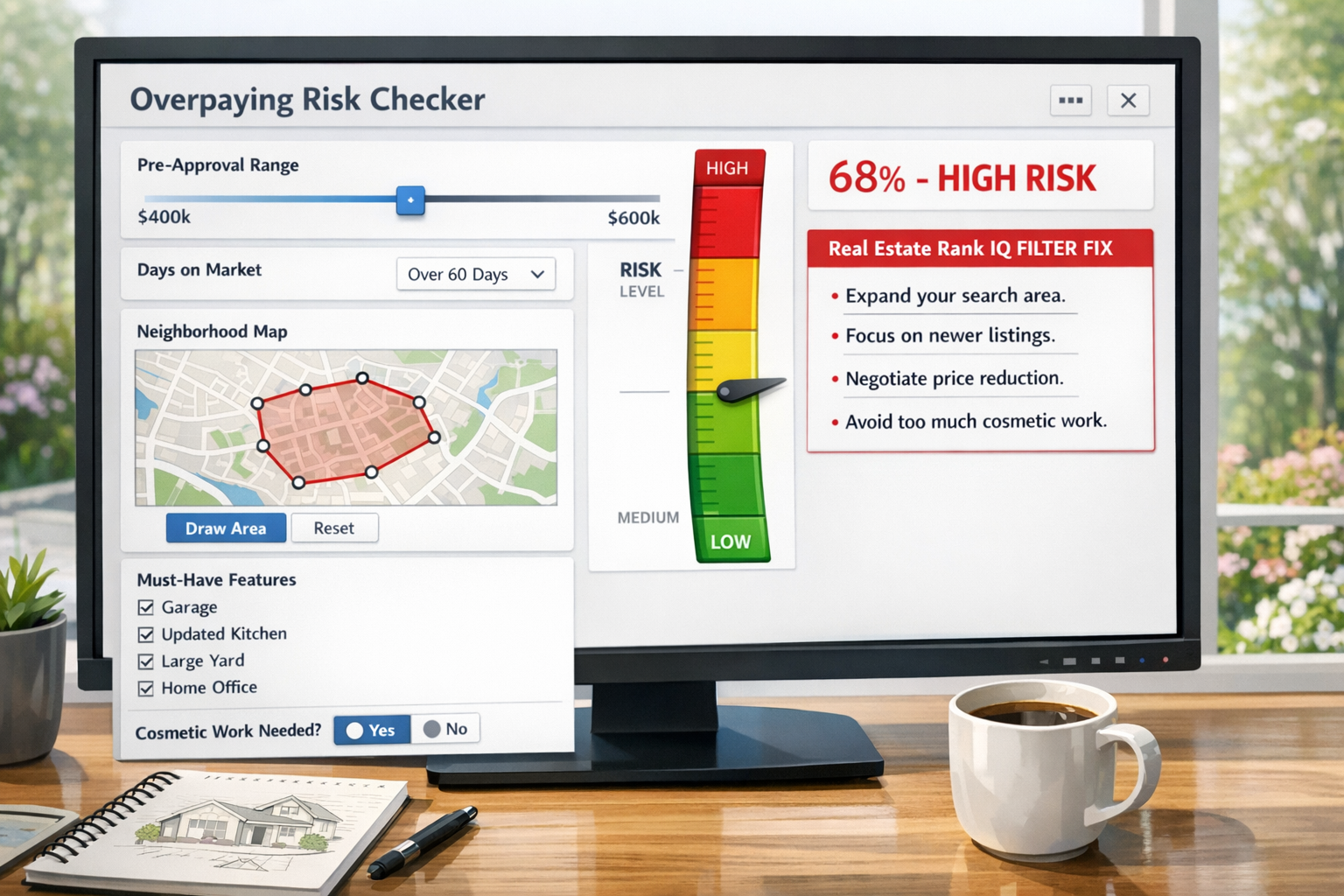
Interactive Tool: Smart Filter Overpaying Risk Checker
<!DOCTYPE html>
<html lang="en">
<head>
    <meta charset="UTF-8">
    <meta name="viewport" content="width=device-width, initial-scale=1.0">
    <title>Smart Filter Overpaying Risk Checker - Real Estate Rank IQ</title>
    <style>
        * {
            margin: 0;
            padding: 0;
            box-sizing: border-box;
        }

        body {
            font-family: -apple-system, BlinkMacSystemFont, 'Segoe UI', Roboto, Oxygen, Ubuntu, Cantarell, sans-serif;
            background: linear-gradient(135deg, #f5f7fa 0%, #e8ecf1 100%);
            padding: 20px;
            line-height: 1.6;
        }

        .cg-element-container {
            max-width: 650px;
            margin: 0 auto;
            background: white;
            border-radius: 12px;
            box-shadow: 0 8px 24px rgba(0,0,0,0.12);
            overflow: hidden;
        }

        .cg-element-header {
            background: linear-gradient(135deg, #1a1a1a 0%, #2d2d2d 100%);
            color: white;
            padding: 28px 24px;
            text-align: center;
        }

        .cg-element-header h1 {
            font-size: 24px;
            font-weight: 700;
            margin-bottom: 8px;
        }

        .cg-element-header p {
            font-size: 14px;
            opacity: 0.9;
            color: #e0e0e0;
        }

        .cg-element-content {
            padding: 32px 24px;
        }

        .cg-element-input-group {
            margin-bottom: 24px;
        }

        .cg-element-label {
            display: block;
            font-weight: 600;
            margin-bottom: 8px;
            color: #2d2d2d;
            font-size: 15px;
        }

        .cg-element-select {
            width: 100%;
            padding: 12px 14px;
            border: 2px solid #e0e0e0;
            border-radius: 8px;
            font-size: 15px;
            background: white;
            cursor: pointer;
            transition: all 0.3s ease;
        }

        .cg-element-select:hover {
            border-color: #c0c0c0;
        }

        .cg-element-select:focus {
            outline: none;
            border-color: #dc143c;
            box-shadow: 0 0 0 3px rgba(220, 20, 60, 0.1);
        }

        .cg-element-button {
            width: 100%;
            padding: 16px;
            background: linear-gradient(135deg, #dc143c 0%, #b01030 100%);
            color: white;
            border: none;
            border-radius: 8px;
            font-size: 16px;
            font-weight: 700;
            cursor: pointer;
            transition: all 0.3s ease;
            margin-top: 8px;
        }

        .cg-element-button:hover {
            transform: translateY(-2px);
            box-shadow: 0 6px 20px rgba(220, 20, 60, 0.3);
        }

        .cg-element-button:active {
            transform: translateY(0);
        }

        .cg-element-results {
            margin-top: 32px;
            padding: 24px;
            background: #f9f9f9;
            border-radius: 8px;
            display: none;
        }

        .cg-element-results.active {
            display: block;
            animation: slideIn 0.4s ease;
        }

        @keyframes slideIn {
            from {
                opacity: 0;
                transform: translateY(10px);
            }
            to {
                opacity: 1;
                transform: translateY(0);
            }
        }

        .cg-element-risk-meter {
            display: flex;
            align-items: center;
            margin-bottom: 20px;
            gap: 16px;
        }

        .cg-element-risk-bar {
            flex: 1;
            height: 12px;
            background: #e0e0e0;
            border-radius: 6px;
            overflow: hidden;
            position: relative;
        }

        .cg-element-risk-fill {
            height: 100%;
            transition: width 0.6s ease, background 0.6s ease;
            border-radius: 6px;
        }

        .cg-element-risk-fill.low {
            background: linear-gradient(90deg, #22c55e 0%, #16a34a 100%);
        }

        .cg-element-risk-fill.medium {
            background: linear-gradient(90deg, #f59e0b 0%, #d97706 100%);
        }

        .cg-element-risk-fill.high {
            background: linear-gradient(90deg, #dc143c 0%, #b01030 100%);
        }

        .cg-element-risk-label {
            font-weight: 700;
            font-size: 18px;
            min-width: 80px;
            text-align: right;
        }

        .cg-element-risk-label.low {
            color: #16a34a;
        }

        .cg-element-risk-label.medium {
            color: #d97706;
        }

        .cg-element-risk-label.high {
            color: #dc143c;
        }

        .cg-element-insight {
            background: white;
            padding: 18px;
            border-radius: 8px;
            margin-bottom: 16px;
            border-left: 4px solid #2d2d2d;
        }

        .cg-element-insight p {
            color: #4a4a4a;
            font-size: 15px;
            line-height: 1.6;
        }

        .cg-element-fix {
            background: white;
            padding: 18px;
            border-radius: 8px;
            border-left: 4px solid #dc143c;
        }

        .cg-element-fix-header {
            color: #dc143c;
            font-weight: 700;
            font-size: 16px;
            margin-bottom: 8px;
        }

        .cg-element-fix p {
            color: #4a4a4a;
            font-size: 15px;
            line-height: 1.6;
        }

        .cg-element-footer {
            margin-top: 24px;
            padding-top: 20px;
            border-top: 2px solid #e0e0e0;
            text-align: center;
            color: #666;
            font-size: 13px;
        }

        .cg-element-footer strong {
            color: #dc143c;
        }

        @media (max-width: 600px) {
            .cg-element-header h1 {
                font-size: 20px;
            }

            .cg-element-content {
                padding: 24px 18px;
            }

            .cg-element-risk-meter {
                flex-direction: column;
                align-items: stretch;
            }

            .cg-element-risk-label {
                text-align: center;
                margin-top: 8px;
            }
        }
    </style>
</head>
<body>
    <div class="cg-element-container">
        <div class="cg-element-header">
            <h1>Smart Filter Overpaying Risk Checker</h1>
            <p>Discover how risky your current search filters are</p>
        </div>

        <div class="cg-element-content">
            <div class="cg-element-input-group">
                <label class="cg-element-label" for="preApproval">Max price filter vs pre-approval</label>
                <select class="cg-element-select" id="preApproval">
                    <option value="">Select one...</option>
                    <option value="below">Below pre-approval (10-15% buffer)</option>
                    <option value="at">At pre-approval max</option>
                    <option value="above">Above pre-approval (stretching)</option>
                </select>
            </div>

            <div class="cg-element-input-group">
                <label class="cg-element-label" for="daysOnMarket">Days-on-market filter</label>
                <select class="cg-element-select" id="daysOnMarket">
                    <option value="">Select one...</option>
                    <option value="all">All listings (no filter)</option>
                    <option value="balanced">21-60 days (sweet spot)</option>
                    <option value="new">New listings only (<7 days)</option>
                </select>
            </div>

            <div class="cg-element-input-group">
                <label class="cg-element-label" for="areaFilter">Area filter strategy</label>
                <select class="cg-element-select" id="areaFilter">
                    <option value="">Select one...</option>
                    <option value="single">Single hot neighborhood only</option>
                    <option value="multiple">3-5 comparable neighborhoods</option>
                </select>
            </div>

            <div class="cg-element-input-group">
                <label class="cg-element-label" for="mustHaves">Number of "must-have" filters active</label>
                <select class="cg-element-select" id="mustHaves">
                    <option value="">Select one...</option>
                    <option value="few">1-3 filters (flexible)</option>
                    <option value="moderate">4-6 filters (moderate)</option>
                    <option value="many">7+ filters (very picky)</option>
                </select>
            </div>

            <div class="cg-element-input-group">
                <label class="cg-element-label" for="cosmeticWork">Willing to consider homes needing minor cosmetic work?</label>
                <select class="cg-element-select" id="cosmeticWork">
                    <option value="">Select one...</option>
                    <option value="yes">Yes, I'll paint/update</option>
                    <option value="no">No, move-in ready only</option>
                </select>
            </div>

            <button class="cg-element-button" onclick="calculateRisk()">Calculate My Risk Score</button>

            <div class="cg-element-results" id="results">
                <div class="cg-element-risk-meter">
                    <div class="cg-element-risk-bar">
                        <div class="cg-element-risk-fill" id="riskFill"></div>
                    </div>
                    <div class="cg-element-risk-label" id="riskLabel">-</div>
                </div>

                <div class="cg-element-insight">
                    <p id="insightText"></p>
                </div>

                <div class="cg-element-fix">
                    <div class="cg-element-fix-header">Real Estate Rank IQ Filter Fix</div>
                    <p id="fixText"></p>
                </div>
            </div>

            <div class="cg-element-footer">
                Powered by <strong>Real Estate Rank IQ</strong> | Expert-backed guidance for smarter home buying
            </div>
        </div>
    </div>

    <script>
        function calculateRisk() {
            const preApproval = document.getElementById('preApproval').value;
            const daysOnMarket = document.getElementById('daysOnMarket').value;
            const areaFilter = document.getElementById('areaFilter').value;
            const mustHaves = document.getElementById('mustHaves').value;
            const cosmeticWork = document.getElementById('cosmeticWork').value;

            if (!preApproval || !daysOnMarket || !areaFilter || !mustHaves || !cosmeticWork) {
                alert('Please answer all questions to calculate your risk score.');
                return;
            }

            let riskScore = 0;

            // Pre-approval scoring
            if (preApproval === 'below') riskScore += 0;
            else if (preApproval === 'at') riskScore += 15;
            else if (preApproval === 'above') riskScore += 30;

            // Days on market scoring
            if (daysOnMarket === 'all') riskScore += 5;
            else if (daysOnMarket === 'balanced') riskScore += 0;
            else if (daysOnMarket === 'new') riskScore += 25;

            // Area filter scoring
            if (areaFilter === 'single') riskScore += 20;
            else if (areaFilter === 'multiple') riskScore += 0;

            // Must-haves scoring
            if (mustHaves === 'few') riskScore += 0;
            else if (mustHaves === 'moderate') riskScore += 10;
            else if (mustHaves === 'many') riskScore += 20;

            // Cosmetic work scoring
            if (cosmeticWork === 'yes') riskScore += 0;
            else if (cosmeticWork === 'no') riskScore += 15;

            // Determine risk level
            let riskLevel, riskClass, insight, fix;

            if (riskScore <= 25) {
                riskLevel = 'LOW RISK';
                riskClass = 'low';
                insight = 'Your filters are well-balanced and positioned to find value. You're searching in the negotiation sweet spot with enough flexibility to avoid bidding wars.';
                fix = 'Keep your current strategy. Consider adding one more comparable neighborhood to expand options further, and set up alerts for homes that drop price in your target range.';
            } else if (riskScore <= 55) {
                riskLevel = 'MEDIUM RISK';
                riskClass = 'medium';
                insight = 'Your filters are pushing you toward moderately competitive listings. You have some flexibility but could be missing value opportunities in adjacent areas or slightly older listings.';
                fix = 'Expand your days-on-market filter to include homes listed 21-45 days ago in one additional neighborhood. Remove 1-2 "nice-to-have" filters and consider cosmetic-fixer homes priced 10-15% below comps.';
            } else {
                riskLevel = 'HIGH RISK';
                riskClass = 'high';
                insight = 'Your filters are likely pushing you into the most competitive listings in this price band. You're competing with dozens of other buyers using identical search criteria, which drives up prices and triggers bidding wars.';
                fix = 'Immediately expand to 3-5 comparable neighborhoods, shift your days-on-market filter to 21-60 days, and reduce your max price search to 10-15% below pre-approval. Toggle on homes needing minor cosmetic work to unlock 40% more inventory at below-market prices.';
            }

            // Update UI
            const riskFill = document.getElementById('riskFill');
            const riskLabel = document.getElementById('riskLabel');
            const insightText = document.getElementById('insightText');
            const fixText = document.getElementById('fixText');
            const results = document.getElementById('results');

            riskFill.style.width = Math.min(riskScore, 100) + '%';
            riskFill.className = 'cg-element-risk-fill ' + riskClass;
            riskLabel.textContent = riskLevel;
            riskLabel.className = 'cg-element-risk-label ' + riskClass;
            insightText.textContent = insight;
            fixText.textContent = fix;
            results.classList.add('active');

            // Smooth scroll to results
            results.scrollIntoView({ behavior: 'smooth', block: 'nearest' });
        }
    </script>
</body>
</html>
Why Spring 2026 Is Different (And How to Take Advantage)
Spring 2026 isn’t like the last few years. We’re finally seeing inventory climb (up 20% year-over-year according to recent reports), price growth is stalling at 0% nationally, and bidding wars are cooling off in most markets. This is the first spring in years where buyers have actual negotiation power.
But here’s the catch: most buyers don’t know how to use it. They’re still operating with 2021-2022 panic-buying habits—offering over asking, waiving inspections, and competing on speed instead of value. Don’t be that buyer.
Use the filters in this guide to shop smarter, not faster. Expand your search, target motivated sellers, and let the data guide your offers. The buyers who win in spring 2026 aren’t the ones who bid highest—they’re the ones who bid smartest.
And if you’re still feeling overwhelmed, remember: house hunting is a skill, not a talent. The more homes you tour, the better you’ll get at spotting value. The more comps you review, the sharper your pricing instincts become. Give yourself permission to take your time and learn the market.
For additional strategies on timing your purchase and understanding market trends, explore our guide on whether you should rent or buy in 2026.
Conclusion: Your Action Plan to Stop Overpaying This Spring
Let’s bring it home. The ranked 10 spring house-hunting filters that stop you overpaying aren’t magic—they’re just smart strategy backed by data. Here’s your action plan:
- Set up multi-neighborhood polygon searches across 3-5 comparable areas to expand inventory and expose pricing gaps.
- Filter for 21-60 days on market to target motivated sellers ready to negotiate.
- Cap your search at 10-15% below pre-approval max to preserve room for offers and unexpected costs.
- Calculate price-per-square-foot for your target area and filter out listings priced more than 10% above the median.
- Toggle on cosmetic-work-acceptable to unlock homes priced 10-20% below market.
- Use AI natural-language search to find hidden inventory traditional filters miss.
- Prioritize listings offering seller credits for closing costs or rate buydowns.
- Time your search for March-April before peak May competition hits.
- Pull a CMA for every serious listing to verify you’re not overpaying.
- Explore new construction builder incentives as an alternative to resale bidding wars.
Run your current filters through the Smart Filter Overpaying Risk Checker (above) to see where you stand. If you’re in the high-risk zone, adjust immediately. If you’re in the low-risk zone, keep going and trust the process.
Spring 2026 is your opportunity to buy smart while everyone else is still buying scared. Use these filters, stay disciplined, and you’ll close on a home you love at a price that lets you sleep at night.
Now get out there and start filtering. Your future self (and your bank account) will thank you.
For more expert guidance on home buying, selling, and investing, visit Real Estate Rank IQ or subscribe to our YouTube channel @Realestaterankiq for weekly market updates and buyer strategies.
For more home buying resources and market insights, visit the Home Buying Hub.














Comments 2