
Last updated: July 20, 2026

Quick Answer: Selling a house in 2026 takes an average of 30 to 60 days from listing to closing, depending on your market, price point, and how well the home is prepared. In hot markets, homes can go under contract in under two weeks. In slower markets or with overpriced listings, sellers are looking at 90 days or more.
Key Takeaways
- The national median days on market for existing homes sits around 32 days as of mid-2026, per National Association of Realtors (NAR) data.
- Closing after an accepted offer adds another 30 to 45 days for financed buyers, according to ICE Mortgage Technology's 2025 Origination Insight Report.
- Homes priced within 3% of market value sell up to 50% faster than overpriced listings, per Zillow research.
- Cash sales can close in as few as 7 to 14 days, bypassing the appraisal and mortgage underwriting timeline entirely.
- Spring (March through June) consistently produces the fastest sale timelines, with homes selling up to 18.5 days faster than the annual average, according to ATTOM Data Solutions.
- FSBO (For Sale By Owner) homes take longer to sell and net sellers less money, NAR's 2024 Profile of Home Buyers and Sellers found FSBO homes sold for a median of $380,000 vs. $435,000 for agent-assisted sales.
- Mortgage rates holding near 6% in 2026 are keeping some buyers cautious, which means pricing strategy and home condition are more important than ever.
What's the Average Time to Sell a House in 2026?
The average time to sell a house in 2026 is roughly 30 to 75 days total, that breaks down into time on market (days from listing to accepted offer) plus the closing period (offer acceptance to funded sale). For most sellers using a traditional financed buyer, expect the full process to run 60 to 75 days.
Here's how that timeline actually stacks up:
| Stage | Typical Timeframe | Notes |
|---|---|---|
| Pre-listing prep | 1 to 4 weeks | Staging, repairs, photography |
| Days on market | 15 to 45 days | Varies widely by market |
| Offer to closing | 30 to 45 days | Financed buyers; 7-14 days cash |
| Total (financed buyer) | 45 to 90+ days | Depends on pricing and market |
| Total (cash buyer) | 21 to 35 days | Fastest realistic timeline |
The national median days on market for existing homes was approximately 32 days as of Q2 2026, according to NAR's monthly existing home sales data. That number has crept up from the sub-20-day frenzy of 2021 and 2022, reflecting a market that's more balanced but still competitive in the right price ranges.
Are Houses Selling Faster or Slower in 2026?
Compared to 2023 and 2024, homes are selling at a slightly more normalized pace in 2026. The days-on-market figure has stabilized rather than accelerating or crashing, which is actually good news for sellers who price correctly.
Mortgage rates hovering near 6% throughout 2026 have kept a lid on buyer demand, but they haven't killed it. Our 2026 real estate trends breakdown covers exactly how stable rates are reshaping both buyer and seller strategies this year.
The short version: buyers are more selective, which means the extraordinary homes, well-priced, well-staged, in strong school districts, are still moving fast. The ones sitting? Overpriced, under-prepared, or in markets with rising inventory.
What Factors Affect How Quickly a House Sells?
Several variables directly control how long your home sits on the market. Understanding these before you list is the difference between a 14-day sale and a 90-day headache.
Pricing is the single biggest factor. Homes priced at or slightly below market value generate more showings, more offers, and faster sales. Zillow's research consistently shows that overpriced homes, even by 5 to 10%, can sit two to three times longer than comparable correctly priced homes.
Location and local market conditions matter enormously. A home in Austin, Texas sells on a completely different timeline than one in rural Ohio. Check the Spring 2026 housing market outlook for a read on how inventory shifts are playing out regionally.
Home condition and staging affect buyer psychology and offer speed. Fresh paint, impeccable curb appeal, and clean staging create urgency. Deferred maintenance creates doubt, and doubt creates delays.
Other factors that affect sale speed:
- Seasonality, spring and early summer are fastest
- Interest rate environment, lower rates bring more active buyers
- Local inventory levels, fewer competing homes = faster sales
- Marketing quality, professional photos, video tours, and MLS exposure matter
- Agent experience, a skilled listing agent knows how to generate urgency
Does Pricing Affect How Fast a House Sells?
Pricing is the most direct lever a seller controls. The data on this is so based it's almost unfair to ignore: homes listed at fair market value receive offers faster, generate multiple-offer situations more often, and close without price reductions.
Overpricing by even 5% can double your days on market. Here's the psychology behind it, buyers and their agents are watching new listings closely. An overpriced home gets shown, gets passed over, and then sits. After 30+ days, buyers start asking "what's wrong with it?" even if the answer is simply "the seller got greedy."
The 2026 home sellers pricing playbook breaks down exactly how to price for speed without leaving money on the table. The strategy is fresh and it works.
Decision rule: Price within 2% of your agent's comparative market analysis (CMA) recommendation. If you want to test a slightly higher price, give it no more than 7 to 10 days before adjusting. Stale listings lose momentum fast.
What's the Difference Between Listing Time and Time on Market?
These two terms get mixed up constantly, and the confusion costs sellers real clarity on their timeline.
- Listing time (or "days listed") starts the moment your home hits the MLS. It includes all days the home is active, including any periods where it goes back on market after a failed contract.
- Time on market (TOM) or days on market (DOM) is the industry-standard metric tracking how long a home is actively listed before going under contract for the first time.
Some MLSs also track cumulative days on market (CDOM), which resets if a listing is withdrawn and re-listed, a tactic some agents use to make a stale listing look fresh. Buyers' agents know this trick. So do savvy buyers.
For sellers, the practical takeaway: every day past 30 on market costs you negotiating power. Buyers see DOM data. A listing at 60+ days signals room to negotiate, whether that's fair or not.
How Long Does Closing Take After an Offer Is Accepted?
Once an offer is accepted, the closing timeline depends primarily on how the buyer is financing the purchase. For financed buyers, expect 30 to 45 days. For cash buyers, 7 to 21 days is realistic.
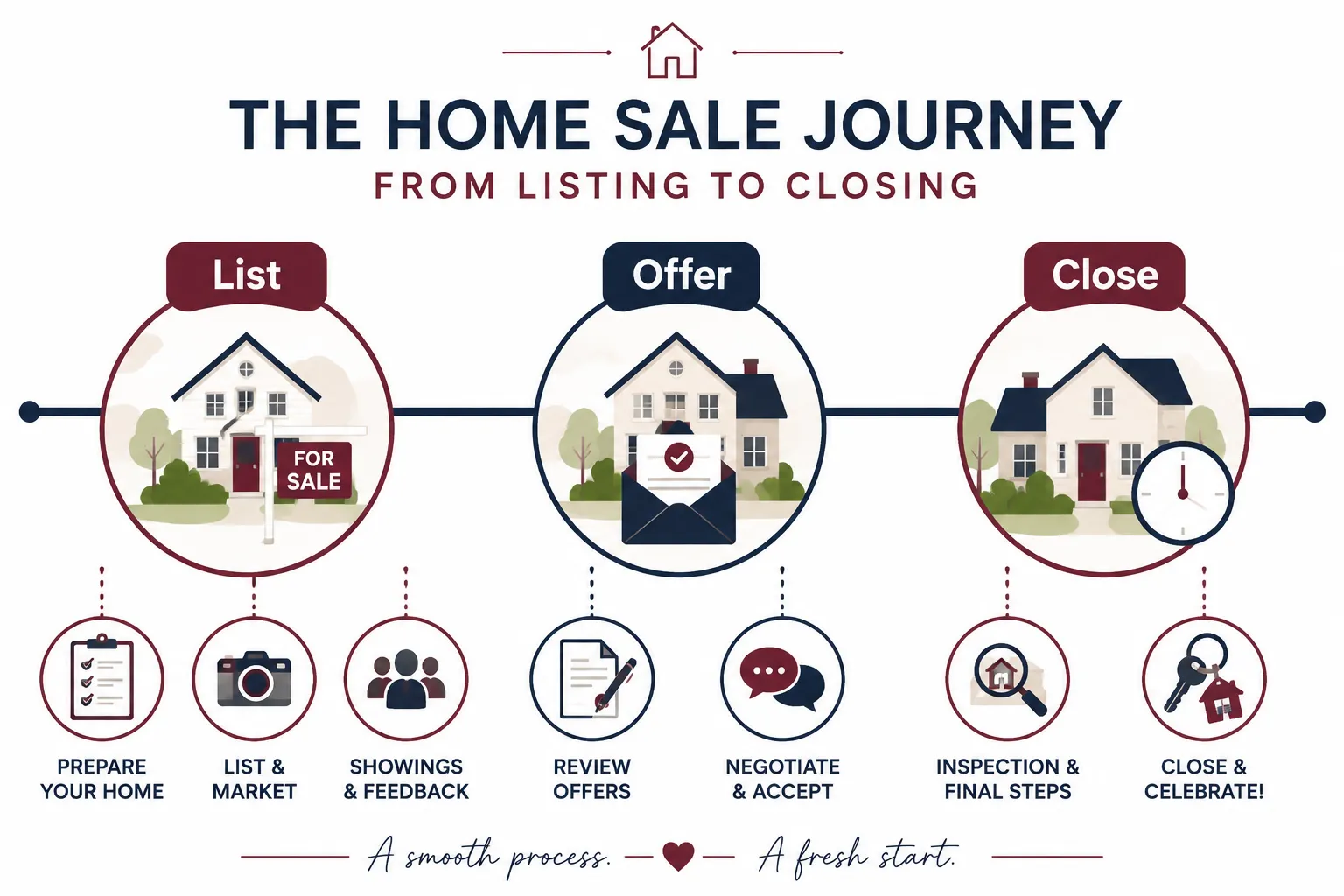
Here's what happens during that closing window:
- Earnest money deposit, typically due within 1 to 3 business days of contract execution
- Home inspection, usually scheduled within 5 to 10 days (buyer's responsibility)
- Appraisal, ordered by the lender, typically completed within 7 to 14 days of order
- Loan underwriting, can take 2 to 3 weeks depending on lender workload and file complexity
- Title search and insurance, runs concurrently, usually 1 to 2 weeks
- Final walkthrough, 24 to 48 hours before closing
- Closing day, signing, funding, key transfer
For a deeper look at the inspection process specifically, our property inspections guide walks through what to expect and how to avoid delays caused by repair negotiations.
Common mistake: Sellers who don't address known issues before listing often face extended timelines when inspection findings trigger renegotiations or repair requests. Get ahead of it.
How Long Does the Inspection and Appraisal Process Take?
The inspection and appraisal together typically add 10 to 21 days to the post-offer timeline. Neither can be skipped in a financed transaction, and both can become sticking points if not managed well.
Home inspection: A licensed inspector typically completes the physical inspection in 2 to 4 hours. The written report follows within 24 to 48 hours. Buyers then have a negotiation period (usually 5 to 10 days per contract terms) to request repairs, credits, or price reductions.
Appraisal: The lender orders the appraisal after the inspection period clears. Appraisers are often backlogged, so scheduling can take 5 to 10 days, with the report delivered 3 to 7 days after the visit. If the appraisal comes in low, expect another round of negotiations, or a deal that falls apart.
Edge case: In competitive markets, some buyers are waiving inspection contingencies to win offers. That speeds up the timeline but shifts risk entirely to the buyer. Sellers love it; buyers should think carefully.
Can You Sell a House Faster With a Real Estate Agent vs. FSBO?
Yes, and the data isn't close. Sellers who use a licensed agent consistently sell faster and for more money than FSBO sellers.
NAR's 2024 Profile of Home Buyers and Sellers found that FSBO homes sold for a median of $380,000 compared to $435,000 for agent-assisted sales. That's a $55,000 gap. FSBO homes also tend to sit longer because they get less MLS exposure, fewer professional showings, and weaker negotiation support.
The counterargument, "I'll save the commission", rarely holds up when you factor in the price difference, longer carrying costs, and the time investment of managing the sale yourself.
That said, FSBO can work in extremely hot markets where any listing gets multiple offers regardless of marketing quality. But in a normalized 2026 market? Let it cook before you see results with FSBO, and you might be waiting a while.
For agents looking to sharpen their listing game, our 60-day home selling plan with AI tools is an extraordinary resource worth bookmarking.

How Long Do Houses Typically Sit on the Market in Different States?
State-level data tells a very different story than national averages. Markets in the Southeast and Mountain West are moving faster than the Midwest and Northeast in 2026.
Here's a snapshot of approximate median days on market by region as of mid-2026 (sourced from Redfin and NAR regional data):
| State/Region | Approx. Median DOM | Market Tempo |
|---|---|---|
| Florida (South) | 45 to 60 days | Slower, high inventory |
| Texas (Austin/DFW) | 28 to 40 days | Moderate, stabilizing |
| California (LA/SD) | 20 to 35 days | Competitive, low inventory |
| New York (NYC metro) | 35 to 55 days | Mixed by borough/suburb |
| Midwest (OH, IN, MI) | 25 to 45 days | Affordable, steady demand |
| Southeast (NC, TN, GA) | 22 to 38 days | Active, migration-driven |
| Mountain West (CO, AZ) | 30 to 50 days | Cooling from peak frenzy |
Florida is worth calling out specifically, the state saw a significant inventory surge in 2025 and 2026, pushing days on market well above the national average in many metros. If you're selling in Florida right now, pricing strategy is everything.
For a state-by-state breakdown of where buyers are finding the best conditions, check out our best states for first-time home buyers 2026 rankings.
How Long Does It Take to Sell a House if the Market Is Slow?
In a slow market, the honest answer is 60 to 120 days or more, and that's before closing. Slow markets are defined by rising inventory, fewer active buyers, and increasing price reductions across the board.
Signs you're in a slow market:
- Homes in your neighborhood are sitting 45+ days without offers
- Active listings are accumulating faster than they're going under contract
- Price reductions are common on comparable homes
- Open houses are drawing low attendance
In a slow market, sellers need to be more aggressive on preparation, pricing, and marketing. Gatekeeping your best negotiating tactics in a slow market is a losing strategy, put everything on the table upfront.
What actually moves homes in slow markets:
- Pricing at or slightly below comparable sales (not above)
- Offering buyer incentives (rate buydowns, closing cost credits)
- Impeccable staging and professional photography
- Flexible showing schedules
- Pre-listing inspection to eliminate buyer uncertainty
Our guide on spring home selling mistakes that cost real money is a straight-talk read for sellers in any market tempo.
What Time of Year Do Houses Sell Quickest?
Spring is the undisputed fastest season for home sales. March through June consistently produces the highest buyer activity, most competitive offers, and shortest days on market.
ATTOM Data Solutions' analysis found that homes listed in late May sell up to 18.5 days faster than the annual average. The combination of tax refund season, school-year timing for families, and longer daylight hours creates a natural surge in buyer activity every spring.
Seasonal breakdown:
- Spring (March, June): Fastest. Most buyers, most competition, best prices.
- Summer (July, August): Still active, slight slowdown in late August as school starts.
- Fall (September, October): Moderate. Serious buyers still active, less competition from other sellers.
- Winter (November, February): Slowest. Fewer buyers, but those who are active are motivated.
The caveat: listing in spring also means more competition from other sellers. A fresh, well-priced listing in October can sometimes outperform a mediocre spring listing simply because there's less noise.
How to Sell a House Faster in 2026
The fastest sellers in 2026 share a few non-negotiable habits. None of this is gatekeeping, it's just what works.
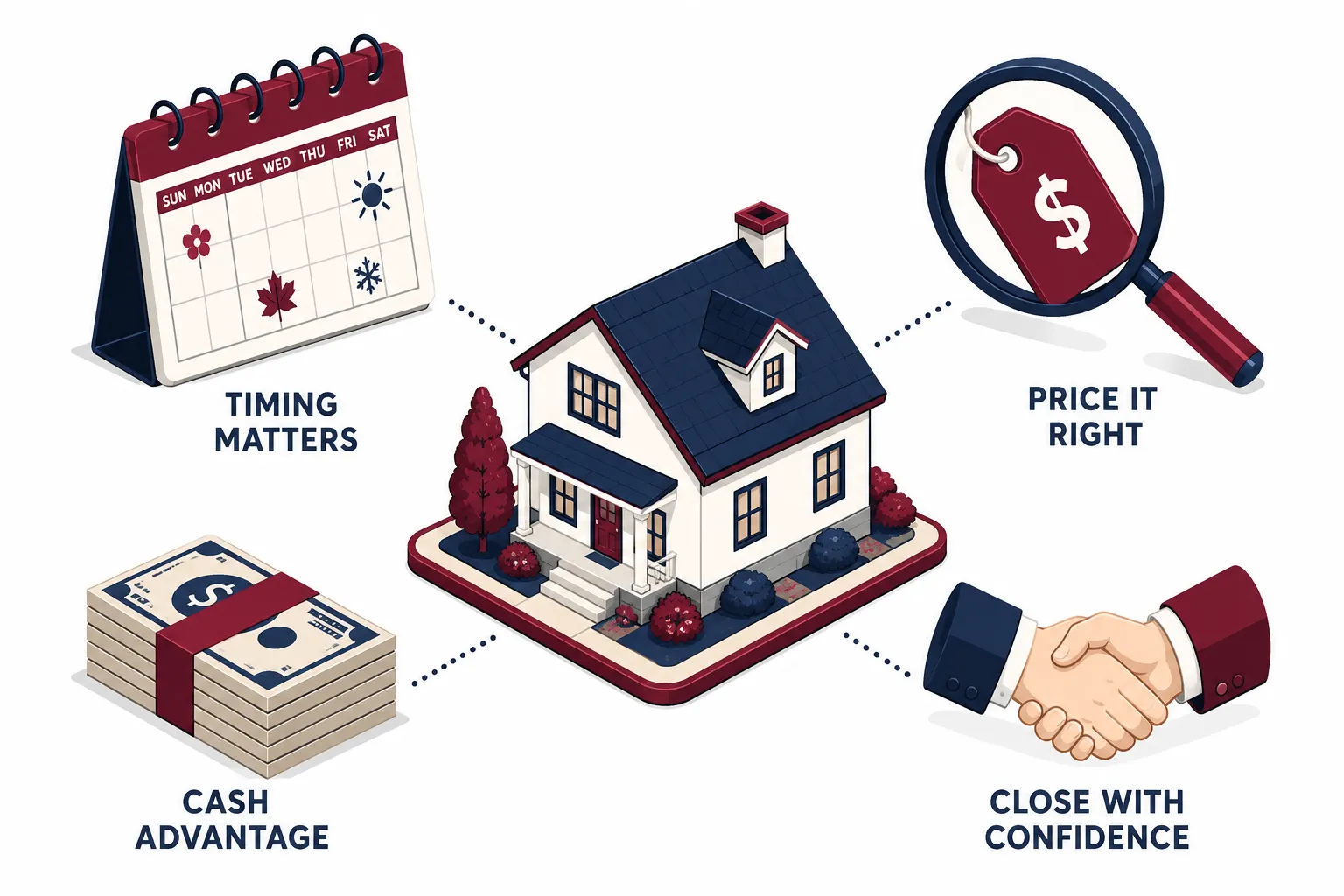
1. Price it right from day one. The first 7 to 14 days on market generate the most traffic. Don't waste that window with an aspirational price.
2. Stage it like a model home. Declutter, depersonalize, and deep clean. Consider professional staging for vacant homes, it consistently reduces days on market.
3. Invest in professional photography and video. Listings with professional photos get significantly more online views. In 2026, 3D tours and drone footage are standard expectations in most price ranges.
4. Market beyond the MLS. Social media, targeted digital ads, and email campaigns to buyer's agent databases all accelerate exposure. Our guide to marketing your home with AI tools in 2026 covers exactly how to do this without spending a fortune.
5. Offer buyer incentives. With rates near 6%, offering a mortgage rate buydown or closing cost credit can be the difference between getting an offer and watching buyers walk. Check our seller concessions playbook for 2026 for specific tactics.
6. Be flexible on showings. Homes that are easy to show get shown more. Lockboxes, flexible scheduling, and same-day showing availability all help.
What's the Fastest Way to Sell a House for Cash?
Cash sales are the fastest path to closing, full stop. A cash transaction eliminates mortgage underwriting, appraisal contingencies, and most of the waiting that drags out financed deals.
Cash sale timeline:
- Offer acceptance to closing: 7 to 21 days
- No appraisal required (unless buyer requests one)
- No lender underwriting delays
- Fewer contingencies = fewer opportunities for deals to fall apart
Who buys houses for cash in 2026:
- iBuyers (Opendoor, Offerpad), fast but typically below market value
- Real estate investors and wholesalers
- Fix-and-flip operators
- Individual cash buyers (more common in higher price ranges)
The tradeoff: cash buyers almost always offer below market value. The discount varies, iBuyers typically offer 5 to 15% below what you'd net on the open market. For sellers who prioritize speed and certainty over maximum price, it's a legitimate option.
For investors on the buy side looking at cash purchase opportunities, our best real estate markets for flipping houses in 2026 is worth a read.
Why Is My House Taking So Long to Sell?
If your home has been sitting for 30+ days without a serious offer, one of four things is almost certainly true.
1. It's overpriced. This is the answer 80% of the time. Pull fresh comps. If similar homes are selling and yours isn't, the price is the problem.
2. It's not showing well. Bad photos, cluttered rooms, deferred maintenance, or poor curb appeal all kill buyer interest before they even schedule a showing.
3. The marketing is weak. If your listing has bad photos, no virtual tour, and minimal social media exposure, you're invisible to a large portion of the buyer pool.
4. There's a specific objection buyers aren't voicing. Location issues (busy road, proximity to commercial zoning), HOA restrictions, or unusual floor plans can quietly kill deals. Your agent should be collecting showing feedback and reporting it back to you.
If you're stuck and want straight answers, our article on 5 questions to ask your broker when your home isn't selling is a must-read. No sugarcoating.
FAQ: How Long Does It Take to Sell a House in 2026?
How long does it take to sell a house in 2026 on average?
The full process, from listing to closing, takes 45 to 75 days for most sellers using a financed buyer. In hot markets, homes can go under contract in 7 to 14 days, with closing following 30 to 45 days later.
What is the fastest a house can sell?
With a cash buyer and motivated parties on both sides, a house can close in as few as 7 days. iBuyers like Opendoor can close in 14 to 21 days. These timelines require no financing contingencies and minimal inspection negotiations.
Does listing price affect how fast a house sells?
Directly and significantly. Homes priced at market value sell faster and with fewer price reductions. Overpricing by even 5% can double or triple days on market, according to Zillow's pricing research.
How long does the closing process take after an offer is accepted?
For financed buyers, closing typically takes 30 to 45 days after offer acceptance. Cash buyers can close in 7 to 21 days. The main variables are lender processing speed, appraisal scheduling, and how cleanly the inspection period resolves.
What month is the best time to sell a house?
Late May and early June produce the fastest sales and highest prices historically, per ATTOM Data Solutions. The spring selling season (March through June) is consistently the most active period for buyer demand.
Is it faster to sell with an agent or FSBO?
Agent-assisted sales consistently close faster and at higher prices. NAR's 2024 data shows FSBO homes sold for a median of $55,000 less than agent-assisted sales. FSBO works best in extreme seller's markets with very low inventory.
How long does it take to sell a house in a slow market?
In a buyer's market or high-inventory environment, expect 60 to 120+ days from listing to closing. Sellers in slow markets need to be more aggressive on pricing, incentives, and marketing to compete.
Why do some houses sit on the market for months?
Overpricing is the most common cause. Other factors include poor condition, weak marketing, location challenges, or a mismatch between the home's features and what local buyers want. After 30+ days, buyers start assuming something is wrong, even if it isn't.
What to Do Before You List: A Quick Pre-Listing Checklist
Before your home hits the market, run through this list to set yourself up for the fastest possible sale:
- Get a comparative market analysis (CMA) from a licensed agent
- Address any deferred maintenance or obvious repair items
- Deep clean and declutter every room
- Consider professional staging (especially for vacant homes)
- Hire a professional real estate photographer
- Research buyer incentives (rate buydowns, closing cost credits)
- Confirm your agent's MLS strategy and social media marketing plan
- Review your timeline and coordinate with your next move
For a full 60-day prep plan, our 60-day home selling checklist with AI tools walks through every step in detail.
The Bottom Line on Selling a House in 2026
The question of how long does it take to sell a house in 2026 doesn't have one universal answer, but it does have a formula. Price it right, prepare it well, market it aggressively, and work with an experienced agent. Do those four things and you're looking at 30 to 60 days, start to finish.
Skip any of those steps and the timeline stretches fast. The 2026 market rewards preparation and punishes wishful pricing.
Sellers who treat the process like a strategy, not just a transaction, are the ones walking away with the best results. That means doing the homework before the sign goes in the yard, not after the first price reduction.
For more straight-talk real estate guidance from brokers who've been in the field for over 15 years, visit realestaterankiq.com, free, unbiased, and built for every price point.
References
- National Association of Realtors (NAR). 2024 Profile of Home Buyers and Sellers. https://www.nar.realtor/research-and-statistics/research-reports/highlights-from-the-profile-of-home-buyers-and-sellers
- NAR. Existing Home Sales Monthly Data, 2026. https://www.nar.realtor/research-and-statistics/housing-statistics/existing-home-sales
- ICE Mortgage Technology. Origination Insight Report, 2025. https://www.icemortgagetechnology.com/resources/origination-insight-report
- ATTOM Data Solutions. Best Days to Sell a House Analysis. https://www.attomdata.com/news/market-trends/
- Zillow Research. Pricing and Days on Market Analysis. https://www.zillow.com/research/
- Redfin. Real Estate Market Data and Regional Reports, 2026. https://www.redfin.com/news/data-center/