

Last updated: April 23, 2026

Quick Answer: Hard money loans are short-term, asset-backed loans funded by private lenders — not banks. They close in 3–10 days, require little to no income documentation, and are primarily used for fix-and-flip projects, bridge financing, and construction. Rates typically run 9%–14% with 1–4 points, and approval is based on the property's value, not your credit score. The best national lenders in 2026 include Kiavi, LendingOne, and Do Hard Money — but the right choice depends on your state, deal type, and experience level.
Key Takeaways
- 🏠 Hard money loans are secured by real property, not your income or credit history
- ⚡ Approval and funding can happen in as little as 3–7 days — compared to 30–90 days at a bank
- 📊 Expect interest rates between 9% and 14%, plus 1–4 origination points in 2026
- 🔑 Most lenders lend up to 65%–75% of LTV or 70%–90% of ARV on fix-and-flip deals
- 💳 Bad credit hard money loans exist — some lenders work with scores as low as 500
- 🏗️ Hard money covers fix-and-flip, construction, land, bridge, and owner-occupied scenarios
- 🔄 You can refinance a hard money loan into a DSCR or conventional loan once the property stabilizes
- ⚠️ FinCEN's March 2026 regulation now requires reporting for cash buyers and LLC/trust purchases — compliance matters
- 🗺️ State-specific lenders in Texas, Florida, Georgia, New York, and more offer local market expertise
- 📋 Always verify licensing, check references, and read the prepayment penalty clause before signing

Hard Money Lenders for Beginners: What You Need to Know Before Borrowing
If you're new to real estate investing, hard money lenders for beginners can feel like a foreign language — fast money, high rates, and lenders who don't seem to care about your W-2. Here's the straight answer: that's exactly how it works, and it's not as scary as it sounds once you understand the mechanics.
Hard money loans are short-term loans secured by real estate. The lender's main concern is the property's value — specifically what it will be worth after repairs (the After-Repair Value, or ARV). Your credit score, job history, and tax returns take a back seat. This makes hard money the go-to financing tool for house flippers, wholesalers turning deals, and investors who need to move fast in competitive markets.
At Real Estate Rank IQ, we cut through the noise in real estate financing so investors — whether they're on deal one or deal ten — can find the right capital source without overpaying. This guide covers everything hard money lenders for beginners need to know: what these loans cost, who qualifies, which lenders are actually worth trusting, and how to exit a hard money loan cleanly once your project is done.
Before you approach any lender, understand these three fundamentals:
- Hard money is a tool, not a lifeline. It's designed for short-term projects with a clear exit strategy — a sale, a refinance, or a lease.
- Speed costs money. The convenience of a 5-day close comes with higher rates than conventional financing. Build that cost into your deal analysis.
- The property is the collateral. If the deal goes sideways, the lender takes the asset. There's no gray area here.
What Is a Hard Money Loan? (Plain English Breakdown)
A hard money loan is a short-term, asset-backed loan funded by private investors or private lending companies — not traditional banks or credit unions. The loan is "hard" because it's secured by a hard asset: real property.
Unlike a conventional mortgage that evaluates your debt-to-income ratio, employment history, and credit profile over weeks of underwriting, hard money lenders focus almost entirely on the deal itself. What's the property worth today? What will it be worth after repairs? Is there enough equity cushion to protect the lender if things go wrong?
How hard money differs from other loan types:
| Feature | Hard Money | Conventional Mortgage | DSCR Loan | Bridge Loan |
|---|---|---|---|---|
| Approval basis | Property value | Borrower financials | Property cash flow | Property equity |
| Time to close | 3–10 days | 30–60 days | 2–4 weeks | 1–3 weeks |
| Loan term | 6–24 months | 15–30 years | 15–30 years | 6–24 months |
| Typical rate | 9%–14% | 6%–8% | 7%–10% | 8%–12% |
| Credit required | 550–620 min (many flexible) | 620–740+ | 620–680+ | 580–640+ |
| Income docs | Rarely required | Always required | Not required | Rarely required |
| Best for | Fix-and-flip, construction | Primary residence | Stabilized rentals | Gap financing |
For a deeper look at how DSCR loans compare as a long-term strategy, check out our DSCR loan requirements guide for real estate investors.
How Hard Money Loans Actually Work
Hard money loans follow a straightforward structure, but the details matter — especially for first-timers. Gelt Financial's Jack Miller, with 35+ years in private lending, notes that hard money approvals routinely happen in 3–5 days versus a bank's 30–45 day timeline, with no income or credit checks required [1]. That speed is the product's biggest selling point, but it comes with a structure you need to understand before you sign.
Loan Structure and Draw Schedules
Most hard money loans for fix-and-flip or construction projects don't hand you all the money upfront. Instead, they use a draw schedule — you receive funds in stages as work is completed and inspected.
Typical draw structure:
- Initial draw: Covers purchase price (or a portion of it)
- Subsequent draws: Released after each renovation milestone is verified (rough plumbing, framing, electrical, final finish)
- Final draw: Released upon project completion, often tied to a certificate of occupancy or appraisal
This protects the lender. It also means you need working capital to front renovation costs between draws — a detail many hard money lenders for beginners miss until they're mid-project and cash-strapped.
How Hard Money Lenders Evaluate Deals
Lenders run their own internal underwriting, but the core formula is consistent:
- LTV (Loan-to-Value): What percentage of the current property value are they lending? Most cap at 65%–75%.
- ARV (After-Repair Value): For fix-and-flip deals, lenders often lend up to 70%–90% of ARV. Stormfield Capital notes professional private lenders in 2026 are offering up to 92.5% LTC (Loan-to-Cost) leverage on strong deals [2].
- Exit strategy: How are you paying this loan back? Sale, refinance, or rental conversion? Lenders want a realistic plan.
- Borrower experience: First-time investors may face lower LTV limits or higher rates compared to experienced flippers.
Points, Fees, and Hidden Costs to Watch For
This is where deals get expensive fast. Beyond the interest rate, hard money loans carry:
- Origination points: 1–4 points (1 point = 1% of loan amount). On a $300,000 loan, 2 points = $6,000 upfront.
- Underwriting/processing fees: $500–$2,500
- Appraisal fees: $400–$800
- Draw inspection fees: $100–$300 per draw
- Extension fees: If your project runs long, expect 0.5%–2% per month extension penalty
- Prepayment penalties: Some lenders charge if you pay off early — always read this clause
Common mistake: New investors calculate their profit based on the interest rate alone and forget to factor in points, draw fees, and extension costs. Run the full cost of capital, not just the rate.
Hard Money Loan Requirements: Full Breakdown
Hard money loan requirements are less rigid than conventional financing, but they're not nonexistent. Here's what lenders actually look at in 2026.
Credit Score Requirements
Most hard money lenders set a minimum credit score between 550 and 650. Some go lower — especially for experienced investors with strong deal equity. Traditional banks deny 43% of commercial loans and require 620+ FICO scores as a baseline [6]. Hard money lenders are far more flexible, but a higher score can still unlock better rates.
General credit tiers:
- 680+: Best rates, highest LTV, minimal friction
- 620–679: Standard terms, may require larger down payment
- 550–619: Available with strong deal equity or co-borrower
- 500–549: Limited lenders, higher rates, lower LTV — but options exist (covered below)
Loan-to-Value and After-Repair Value Ratios
- Standard LTV: 65%–75% of current as-is value
- ARV-based lending: 70%–90% of ARV (common in fix-and-flip)
- LTC (Loan-to-Cost): Some construction lenders go up to 90%–92.5% of total project cost [2]
The higher the LTV, the more risk the lender takes — and the more they'll charge in rate and points to compensate.
Experience Requirements by Lender
Some lenders are explicitly built for first-timers (Do Hard Money, for example). Others prefer borrowers with at least 1–3 completed flips before they'll offer top-tier terms. Experienced investors with a track record of 5+ deals often get:
- Lower interest rates (0.5%–1% reduction)
- Higher LTV approvals
- Faster underwriting
- More flexibility on property condition
Property Types That Qualify
Most hard money lenders will fund:
- ✅ Single-family residences (SFR)
- ✅ 2–4 unit multifamily
- ✅ Small multifamily (5–20 units, varies by lender)
- ✅ Fix-and-flip properties
- ✅ New construction (ground-up)
- ✅ Commercial properties (select lenders)
- ✅ Vacant land (select lenders — see land loans section)
- ✅ Owner-occupied hard money loans (limited lenders, stricter rules)
- ❌ Primary residences (most lenders avoid due to federal consumer protection laws)
Current Hard Money Loan Rates
In 2026, hard money interest rates typically range from 9% to 14%, with most deals landing between 10% and 12% for standard fix-and-flip projects. Origination fees run 1–4 points. Loan terms are generally 6–24 months.
Rate factors that move your number up or down:
| Factor | Rate Impact |
|---|---|
| Strong credit (680+) | ↓ Rate |
| Low LTV (under 65%) | ↓ Rate |
| Experienced borrower (5+ deals) | ↓ Rate |
| Distressed property condition | ↑ Rate |
| High LTV (80%+) | ↑ Rate |
| First-time investor | ↑ Rate |
| Rural or non-standard market | ↑ Rate |
| Short loan term (6 months) | Neutral to ↓ |
For context on where conventional mortgage rates sit right now, our current mortgage rates guide for 2026 shows 30-year fixed rates around 6.11% — a significant gap from hard money, which is the price you pay for speed and flexibility.
The Moody's 2026 Outlook confirms investors are increasingly shifting toward Asset-Backed Finance (ABF) structures like hard money, prioritizing property value over borrower balance sheets for the flexibility banks simply can't offer [2].
Best Hard Money Lenders Nationally (Full Comparison Table)
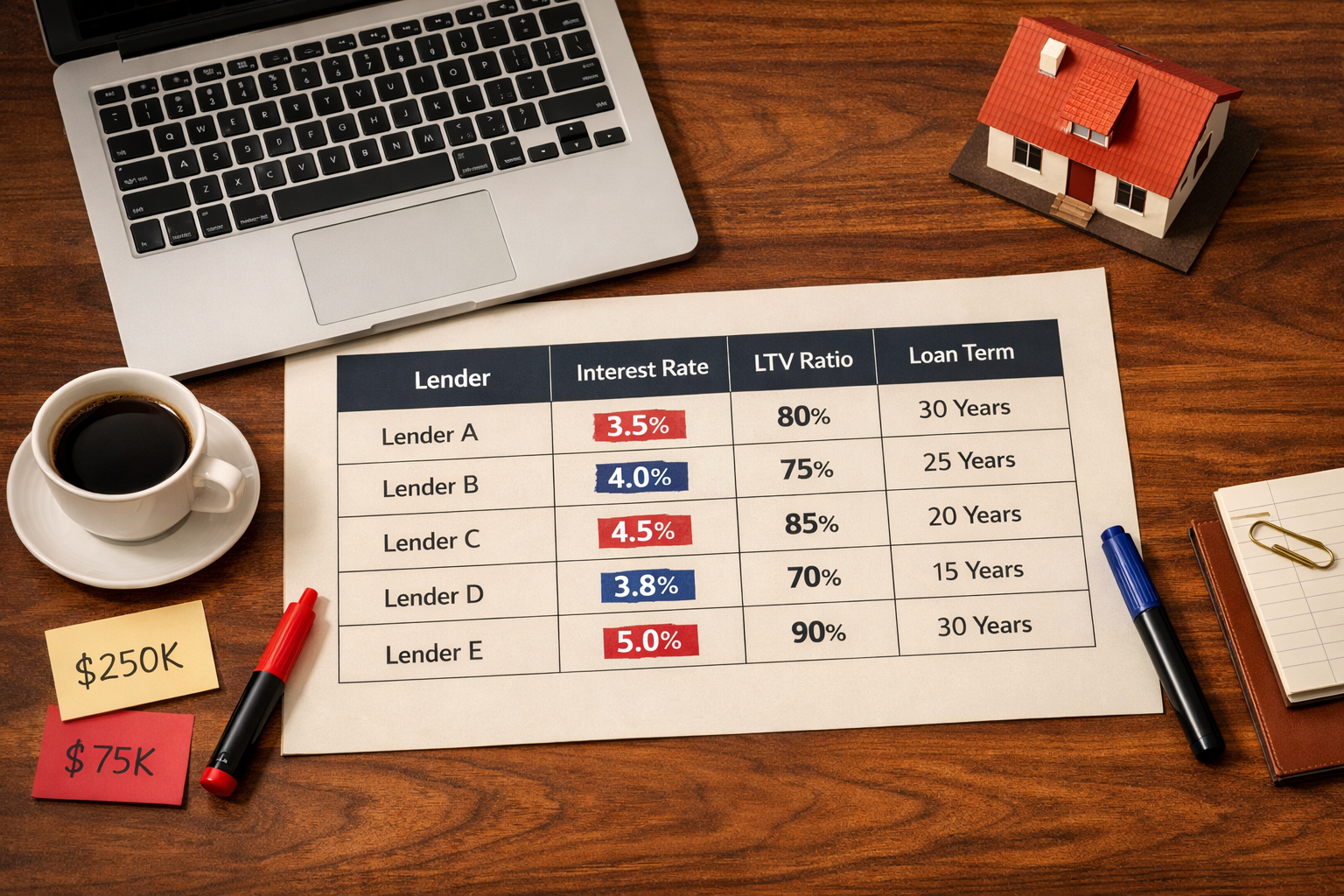
Here's a direct comparison of the top national hard money lenders operating in 2026. This is the table hard money lenders for beginners should bookmark before making any calls.
| Lender | Rates | Max LTV/ARV | Loan Terms | Min Credit | Best For |
|---|---|---|---|---|---|
| Kiavi | 9.25%–12% | 90% ARV | 12–24 months | 640 | Fix-and-flip, scale investors |
| LendingOne | 9.5%–13% | 90% ARV | 12–24 months | 620 | Fix-and-flip, rental bridge |
| Do Hard Money | 12%–15% | 70% ARV | 6–12 months | No minimum | Beginners, bad credit |
| RCN Capital | 9.99%–12.5% | 85% ARV | 12–18 months | 620 | Brokers, experienced investors |
| Lima One Capital | 9.5%–13% | 90% ARV | 13–24 months | 600 | Fix-and-flip, new construction |
| Groundfloor | 7.5%–14% | 90% ARV | 6–12 months | 640 | Crowdfunded, smaller deals |
| CoreVest | 8.5%–12% | 75% LTV | 12–24 months | 660 | Portfolio lenders, bridge |
| Insula Capital Group | 10%–13% | 90% ARV | 12–24 months | 620 | Nationwide, fast close |
Kiavi Review
Kiavi (formerly LendingHome) is one of the most tech-forward hard money lenders in the country. Their platform is built for speed — investors can get a rate quote online in minutes, and closings happen in as few as 5 business days. Kiavi is particularly strong for experienced fix-and-flip investors who want a streamlined, repeat-deal relationship.
Kiavi highlights:
- Rates starting around 9.25% for qualified borrowers
- Up to 90% of ARV on fix-and-flip loans
- Minimum 640 credit score
- Available in 32+ states
- No income verification required
- Strong tech platform for tracking draws and loan status
Best for: Investors doing multiple flips per year who want a lender that scales with their volume.
Do Hard Money Review
Do Hard Money is one of the few lenders explicitly designed as a hard money lender for beginners. They work with investors who have no experience, bad credit, or both — and their education-forward approach means they'll walk you through deal analysis before funding.
Do Hard Money highlights:
- No minimum credit score requirement
- Rates typically 12%–15% (higher due to risk profile)
- Up to 70% ARV
- Available nationwide
- Coaching and deal analysis support included
- Best for first-time flippers who need guidance alongside capital
Best for: True beginners who need a lender that doubles as a mentor.
LendingOne Review
LendingOne is a solid mid-tier national lender with strong terms for both fix-and-flip and bridge financing. They're known for responsive service and competitive rates for investors with moderate experience.
LendingOne highlights:
- Rates from 9.5%
- Up to 90% of ARV
- Minimum 620 credit score
- Loan amounts from $75,000 to $10 million
- Available in 45+ states
- Offers both fix-and-flip and rental bridge products
Best for: Investors with 1–5 deals under their belt who want competitive rates and national coverage.
For a broader look at financing options for flipping, our best loans for flipping houses guide covers how hard money stacks up against other flip financing tools.
Best Hard Money Lenders by State
Local lenders often offer faster service, better market knowledge, and more flexible terms than national platforms. Here's a state-by-state breakdown of where to find hard money in the most active U.S. markets.
Texas (Dallas, Houston, San Antonio, Fort Worth, Austin)
Texas is one of the hottest hard money markets in 2026. Fix-and-flip activity surged in markets like Dallas, Houston, and San Antonio due to affordable entry points and strong resale demand [5]. Hard money lenders in Dallas, Houston, San Antonio, Fort Worth, and Austin are plentiful — both national players and local private lenders operate actively here.
Notable lenders active in Texas:
- Longhorn Investments — Dallas-based, strong for SFR flips
- Insula Capital Group — Nationwide with strong Texas presence [1]
- Lima One Capital — Active in Houston and Dallas
- TexasLender.com — Regional focus, fast closings
Texas has no state income tax and a landlord-friendly legal environment, which keeps both investor demand and hard money lending volume high year-round.
Florida (Tampa, Miami)
Florida's 2026 private lending laws streamlined processes for hard money lenders significantly — providing clearer asset-based underwriting exemptions and faster approvals without mandatory credit checks. Hard money lenders in Tampa and Miami are particularly active in the fix-and-flip and short-term rental conversion space.
Notable lenders active in Florida:
- Kiavi — Strong Florida presence
- LendingOne — Active statewide
- MOR Financial — Fast closings, 24-hour approvals on qualifying deals [3]
Georgia
Georgia's market — especially Atlanta — has seen consistent fix-and-flip demand in 2026, driven by housing shortages and ground-up development activity [5]. Hard money lenders in Georgia typically offer competitive rates given the volume of investor activity.
Notable lenders active in Georgia:
- Lima One Capital — Headquartered in Greenville, SC with heavy Georgia coverage
- Insula Capital Group — Active statewide [1]
- RCN Capital — Strong broker network in Atlanta market
Illinois (Chicago)
Hard money lenders in Chicago operate in a market with higher property values and more complex deal structures. Expect slightly higher minimum loan amounts and stricter property condition requirements from Chicago-area lenders.
Notable lenders active in Illinois:
- LendingOne — Active in Chicago metro
- CoreVest — Strong for multifamily bridge in Chicago
- Stratton Equities — Nationwide with Illinois coverage
New York and New Jersey
Hard money lenders in NY and hard money lenders in NJ operate in some of the most expensive and legally complex markets in the country. Expect higher minimum loan amounts ($150,000+), stricter licensing requirements, and more conservative LTV ratios.
Notable lenders active in NY/NJ:
- Broadmark Realty Capital — Active in NY metro
- Conventus — Strong NY presence
- RCN Capital — Active in NJ with broker-friendly terms [6]
Edge case: New York's usury laws cap certain loan rates. Always verify your lender is properly licensed for NY transactions — HousingWire warns that unlicensed private lenders in 2026 face severe state fines and usury penalties.
California
California is a high-volume hard money market driven by expensive properties and active fix-and-flip demand. MOR Financial reported funding over $500M with 24-hour approvals and 3–7 day funding for LA real estate investors as of early 2026 [3].
Notable lenders active in California:
- MOR Financial — LA-focused, fast funding [3]
- Kiavi — Active statewide
- North Coast Financial — SoCal specialist
Colorado and Denver
Hard money lenders in Colorado and Denver serve a market with strong appreciation history and active investor demand. Denver's competitive market means fast closings matter — local lenders often have an edge over national platforms here.
Notable lenders active in Colorado:
- LendingOne — Active in Denver metro
- Montegra Capital Resources — Colorado-based private lender
- Insula Capital Group — Nationwide coverage [1]
Michigan
Hard money lenders in Michigan serve markets like Detroit, Grand Rapids, and Lansing — all of which have seen renewed fix-and-flip activity as home values recovered and investor interest grew.
Notable lenders active in Michigan:
- Lima One Capital — Active statewide
- Do Hard Money — Nationwide, strong for Michigan beginners
- Renovo Financial — Midwest-focused
Massachusetts and Boston
Hard money lenders in Boston operate in one of the tightest housing markets in the country. High property values mean higher loan amounts, and lenders here tend to be more selective about deal quality and borrower experience.
Notable lenders active in Massachusetts:
- RCN Capital — Connecticut-based with strong MA presence [6]
- CoreVest — Active in Boston metro
- Patch of Land — Nationwide with MA coverage
Hard Money Loans for Bad Credit: Your Real Options
Bad credit doesn't automatically disqualify you from hard money financing. This is one area where hard money genuinely stands apart from conventional lending — and it's why hard money lenders for beginners with imperfect credit histories have real options.
500 Credit Score Hard Money Lenders
Yes, 500 credit score hard money lenders exist. They're not common, but they operate — primarily in markets with strong deal equity. The trade-off is straightforward: lower credit means lower LTV, higher rates, and more points.
What to expect at a 500 credit score:
- Rates: 13%–16%
- LTV: 50%–60% of as-is value
- Points: 3–5
- Lender examples: Do Hard Money, select local private lenders
Decision rule: If your deal has 40%+ equity built in (meaning you're buying well below market), a 500 credit score hard money lender can still make the deal work. If your margins are thin, fix your credit first.
No Credit Check Hard Money Loans
Hard money loans with no credit check are typically offered by individual private money lenders or small private lending shops rather than institutional hard money companies. These lenders base 100% of their decision on the asset.
Where to find no-credit-check hard money:
- Local real estate investor associations (REIAs)
- Private money lender directories
- Real estate attorney referrals
- Peer-to-peer lending platforms
Important: "No credit check" doesn't mean no due diligence. These lenders will scrutinize the property, your exit strategy, and often require a personal guarantee. The property is still on the line.
Hard Money Fix and Flip Loans: What's Different
Hard money fix and flip loans are the most common use case for private lending — and the product most lenders have optimized for. Flipping houses with hard money is essentially the standard operating procedure for active investors who need to move fast.
What makes fix and flip hard money different:
- Loans are structured around ARV, not current value
- Draw schedules align with renovation milestones
- Loan terms are short (6–18 months) to match a typical flip timeline
- Lenders often offer rehab budgets alongside purchase financing
Typical fix and flip hard money structure:
- Purchase price financing: 80%–90% of purchase price
- Rehab budget: 100% of rehab costs (draw-based)
- Total exposure: Capped at 70%–90% of ARV
- Term: 12 months standard, with 3–6 month extensions available
Hard money loan example:
- Property purchase price: $150,000
- Estimated rehab: $50,000
- ARV (after repair value): $280,000
- Lender offers 85% of ARV = $238,000 max loan
- Total project cost = $200,000
- Loan covers full purchase + rehab with room to spare
For a full breakdown of the best cities to execute fix-and-flip strategies right now, check out our ranked list of best cities for fix-and-flip opportunities.

Hard Money Construction Loans: How They Work
Hard money lender construction loans fund ground-up development projects — not just renovations. These are more complex than fix-and-flip loans because the collateral (the completed building) doesn't exist yet when the loan is made.
How construction hard money works:
- Loan is based on the as-completed value (ACV) of the finished project
- Funds are released in draws tied to construction milestones
- Lenders typically fund 70%–80% of total project cost
- Rates are slightly higher than fix-and-flip (10%–15%)
- Terms run 12–24 months to cover construction timelines
What lenders require for construction loans:
- Detailed construction budget and timeline
- Licensed general contractor (GC) with verifiable experience
- Architectural plans and permits (or proof they're in process)
- Strong land equity or significant down payment
- Demonstrated borrower experience (most lenders want 1–2 completed projects)
Housing shortages in 2026 are driving ground-up development activity in markets like Texas and Georgia [5], making hard money construction loans one of the fastest-growing segments in private lending.
Hard Money Land Loans
Hard money land loans are the trickiest product in the private lending space. Raw land has no income, no improvements, and limited comparable sales — which makes it hard for lenders to feel comfortable.
What to know about hard money land loans:
- LTV is much lower than improved property loans: typically 35%–50% of land value
- Rates are higher: 12%–16%
- Most lenders require a clear development plan (entitlements, permits, or zoning approval)
- Loan terms are short: 6–12 months
- Not all hard money lenders offer land loans — you'll need to specifically seek out lenders who list this product
Best use cases for hard money land loans:
- Acquiring land quickly before a competitor
- Bridging to a construction loan once permits are secured
- Short-term hold while entitlements are processed
Hard Money Bridge Loans vs Hard Money Loans: Key Differences
Hard money bridge loans and traditional hard money loans are often confused — and sometimes the terms are used interchangeably. They're related but serve different purposes.
Hard money bridge loan: Short-term financing that "bridges" the gap between two transactions. For example, buying a new property before selling an existing one, or holding a property while securing permanent financing.
Traditional hard money loan: Primarily used for acquisition and renovation of distressed properties with a clear exit via sale or refinance.
| Feature | Hard Money Bridge Loan | Hard Money Fix and Flip |
|---|---|---|
| Primary purpose | Gap financing between transactions | Acquisition + renovation |
| Property condition | Can be stabilized | Usually distressed |
| Loan term | 6–12 months | 6–18 months |
| Draw schedule | Typically no draws | Draw-based for rehab |
| Exit strategy | Sale of existing asset or refi | Sale of renovated property |
| Rate | 8%–12% | 9%–14% |
Choose a bridge loan if: You own a stabilized asset and need short-term capital to close on a new deal before your current property sells.
Choose a fix-and-flip hard money loan if: You're buying a distressed property, renovating it, and selling within 6–18 months.
Hard Money vs DSCR Loan: Which Should You Use?
This is one of the most common questions hard money lenders for beginners ask — and the answer depends entirely on what you're doing with the property.
Use hard money if:
- The property needs significant repairs
- You need to close in under 2 weeks
- You're flipping (not holding)
- The property won't qualify for conventional financing in its current state
Use a DSCR loan if:
- The property is stabilized and generating rental income
- You want a 15–30 year term with predictable payments
- You're building a rental portfolio (not flipping)
- You want to avoid income documentation requirements on a long-term hold
RCN Capital offers DSCR loans starting at 6.99% with 80% LTV and 15–30 year terms for stabilized rentals [6] — a completely different product from their hard money offering. The right tool depends on the stage of your deal.
For a full breakdown of DSCR qualification, our DSCR loan requirements guide covers everything from DSCR ratios to property cash flow minimums.
How to Refinance Out of a Hard Money Loan
Refinancing a hard money loan — often called a "hard money refinance" — is the planned exit strategy for investors who want to hold a property long-term after completing renovations.
The standard refinance path:
- Complete the renovation and stabilize the property (lease it up or get a certificate of occupancy)
- Wait for seasoning — most conventional and DSCR lenders require 3–6 months of ownership before they'll refinance
- Get a new appraisal based on the improved property value
- Apply for a DSCR loan or conventional mortgage using the new appraised value
- Pay off the hard money loan with the refinance proceeds
Refinance hard money loan example:
- Bought distressed property for $150,000 with a $200,000 hard money loan (including rehab)
- After renovation, property appraises at $280,000
- DSCR lender refinances at 75% LTV = $210,000
- Pays off hard money loan, investor pulls out equity or holds with lower-rate long-term debt
Watch out for: Hard money loans with prepayment penalties. If your lender charges 2% to pay off early, that eats into your refinance savings. Always negotiate this clause before signing.
For context on how current rates affect your refinance math, our 2026 real estate trends guide covers how stable 6% conventional rates are reshaping investor strategies this year.
How to Vet a Hard Money Lender Before You Sign Anything
Not every lender calling themselves a "hard money lender" is legitimate, experienced, or properly licensed. This is the section that separates smart investors from cautionary tales.
The impeccable vetting checklist:
- ✅ Verify state licensing. HousingWire warns that many private lenders in 2026 are operating without proper mortgage licenses, exposing borrowers to legal risk. Check your state's Department of Financial Institutions or NMLS registry.
- ✅ Check FinCEN compliance. As of March 1, 2026, FinCEN's regulation 31 CFR Part 1031.320 requires Real Estate Reports for cash buyers, hard money investors, and LLC/trust purchases [7]. A compliant lender will know this regulation and have reporting processes in place.
- ✅ Ask for references. Request contact information for 3–5 recent borrowers. Any legitimate lender will provide them without hesitation.
- ✅ Read the term sheet line by line. Pay specific attention to: prepayment penalty, extension fees, draw inspection fees, and default provisions.
- ✅ Confirm funding timeline. Get the estimated close date in writing. A lender who can't commit to a timeline is a red flag.
- ✅ Understand the default clause. What happens if you miss a payment or need more time? Know the answer before you're in that situation.
- ✅ Check online reviews. Google, BiggerPockets forums, and state real estate investor associations are good sources for real borrower feedback.
- ✅ Avoid lenders who pressure you to close fast. Legitimate speed is earned through process efficiency. Artificial urgency is a manipulation tactic.
So based: The best hard money lenders don't gatekeep information. They explain their terms clearly, answer questions directly, and have a track record you can verify. If a lender gets evasive when you ask about fees or references, walk away.

Frequently Asked Questions
Q: What credit score do I need for a hard money loan?
Most hard money lenders require a minimum credit score between 550 and 650. Some lenders — like Do Hard Money — have no minimum credit score requirement. A higher score (680+) unlocks better rates and higher LTV, but bad credit alone won't disqualify you if the deal has strong equity.
Q: How fast can a hard money loan close?
Most hard money loans close in 3–10 business days. Some lenders like MOR Financial advertise 24-hour approvals with 3–7 day funding [3]. Compare that to conventional banks, which take 30–90 days.
Q: Can I get a hard money loan with no money down?
Rarely. Most lenders require 10%–35% down depending on the deal. Some lenders offer 90% ARV financing on fix-and-flip deals, which can effectively cover the full purchase and rehab if you buy well below ARV. True zero-down hard money is uncommon and typically reserved for experienced investors with strong track records.
Q: What is a hard money loan used for?
Hard money loans are used for fix-and-flip projects, ground-up construction, bridge financing, land acquisition, and short-term holds on investment properties. They're not designed for primary residences or long-term holds.
Q: How do I become a hard money lender?
To become a hard money lender, you need capital to deploy (your own or pooled from investors), a clear lending criteria framework, and proper licensing in your state. Most states require a mortgage lending license for hard money activity. Many private lenders start by funding deals for investors they know personally before scaling to a broader portfolio. Consult a real estate attorney before structuring any lending arrangements.
Q: Are hard money loans bad for beginners?
Hard money loans aren't bad for beginners — they're just expensive if used carelessly. Hard money lenders for beginners work best when the deal math is solid, the exit strategy is clear, and the investor has accounted for all costs including points, fees, and holding costs. The mistake beginners make is treating hard money like a bank loan with a higher rate. It's a different product entirely.
Q: What is the difference between a hard money loan and a private money loan?
Hard money loans come from institutional private lenders with defined programs, rates, and underwriting criteria. Private money loans come from individual investors — friends, family, or private individuals — with terms negotiated deal by deal. Both are asset-backed and faster than banks, but private money is typically more flexible and relationship-driven.
Q: Can I refinance a hard money loan into a conventional mortgage?
Yes, but most conventional lenders require 3–6 months of seasoning (ownership) before they'll refinance. Once the property is renovated and stabilized, you can refinance into a DSCR loan or conventional mortgage based on the new appraised value. This is the standard exit strategy for investors who want to hold properties long-term after a renovation.
Q: Do hard money lenders check income?
Most hard money lenders do not require income verification. Approval is based primarily on the property's value and the borrower's exit strategy. Some lenders may ask for a brief financial overview for larger loans, but W-2s and tax returns are rarely required.
Q: What happens if I default on a hard money loan?
If you default, the lender can foreclose on the property. Hard money lenders move faster than banks in the foreclosure process because the loan terms typically include expedited default provisions. Always have a backup exit strategy — if your primary plan (a sale) falls through, know your secondary plan (a refinance or rental conversion) before you borrow.
Conclusion
Hard money lending in 2026 is more accessible, more competitive, and more regulated than it's ever been. For investors who understand the product — its costs, its timeline, and its exit requirements — it's an extraordinary tool that opens deals no bank would touch. For investors who treat it casually, it's an expensive lesson.
The extraordinary lenders on this list — Kiavi, LendingOne, Do Hard Money, Lima One, and the state-specific options covered above — all have track records worth examining. But the lender you choose matters less than the deal you bring them. Hard money is still a business relationship, and the best terms go to investors who show up prepared.
At Real Estate Rank IQ, we believe real estate intelligence should be free, unbiased, and built by people who've actually done the deals. Whether you're a hard money lender for beginners trying to close your first flip or an experienced investor comparing rates across five lenders, the fundamentals don't change: know your numbers, know your exit, and never let the speed of hard money pressure you into a deal that doesn't pencil.
Let it cook before you see results. Run the deal analysis twice. And when you find the right lender for your market and your strategy, move with confidence.
For more on building your investment strategy from the ground up, explore our real estate financing guide covering mortgages, credit, and down payments and our top 5 real estate investments ranked for 2026.
References
[1] The Ultimate 2026 Real Estate Investor Playbook Why Hard Money Lenders Are Dominating Every U.S. Market From Alabama To Wyoming – https://insulacapitalgroup.com/the-ultimate-2026-real-estate-investor-playbook-why-hard-money-lenders-are-dominating-every-u-s-market-from-alabama-to-wyoming/
[2] Private Lending Hard Money Guide 2026 Real Estate Trends 2 – https://stormfieldcapital.com/blog/private-lending-hard-money-guide-2026-real-estate-trends-2/
[3] Hard Money Lenders Los Angeles Fast Financing For Real Estate Investors In 2026 – https://www.morfinancial.com/hard-money-lenders-los-angeles-fast-financing-for-real-estate-investors-in-2026/
[4] Best Hard Money Lenders – https://theclose.com/best-hard-money-lenders/
[5] Top 5 Real Estate Investment Trends Shaping Hard Money Lending In 2026 And What It Means For Your Deal – https://insulacapitalgroup.com/top-5-real-estate-investment-trends-shaping-hard-money-lending-in-2026-and-what-it-means-for-your-deal/
[6] 2025 Hard Money Loans Why Brokers Need Them Now – https://rcncapital.com/blog/2025-hard-money-loans-why-brokers-need-them-now
[7] FinCEN Real Estate Reporting Regulation Watch – https://www.youtube.com/watch?v=548XN1hgzus
For more rental analysis and investing guides, visit the Investment Hub.