
Last updated: July 20, 2026

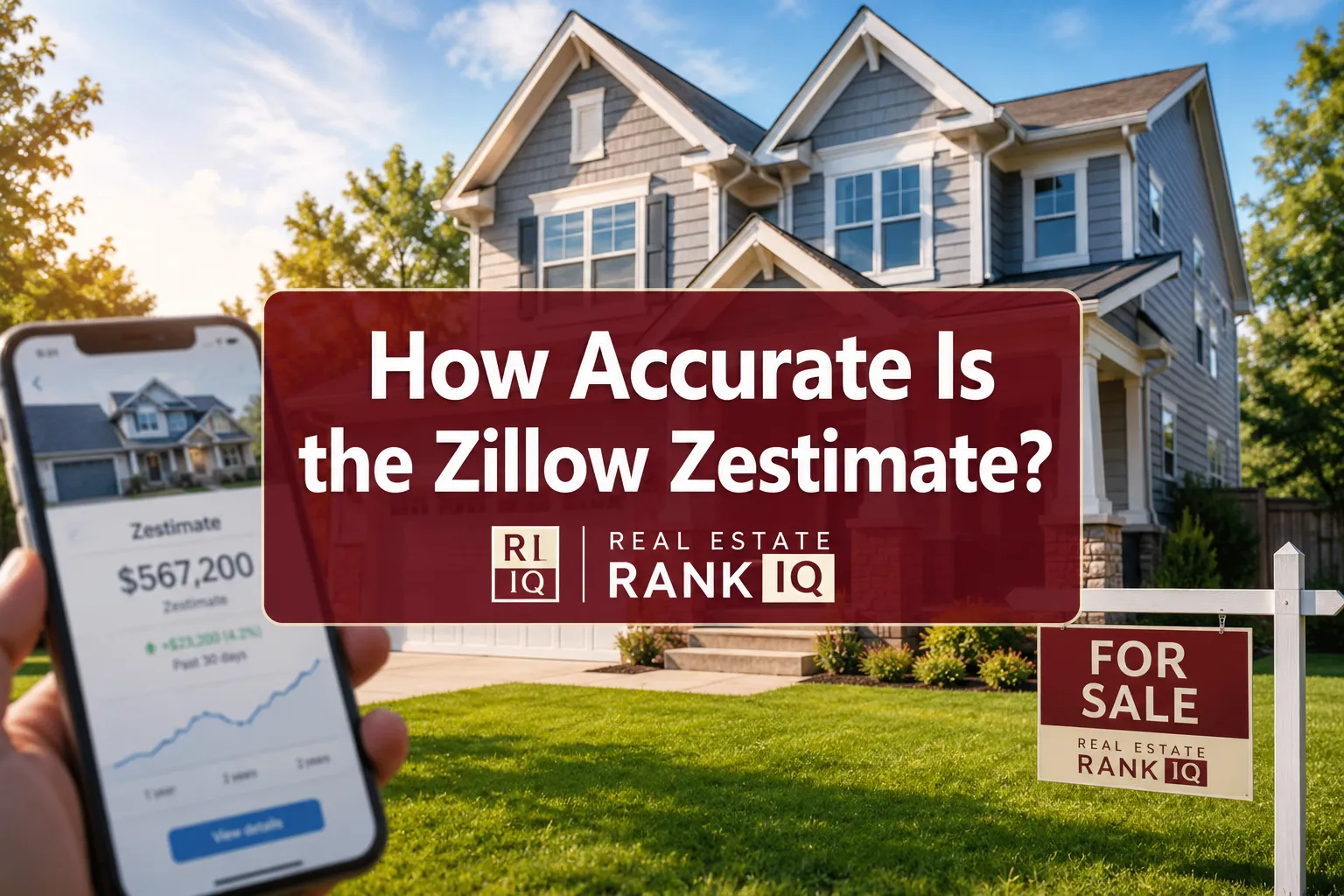
Quick Answer: The Zillow Zestimate is a starting point for curiosity, not a pricing tool. Zillow's own published data shows a national median error rate of roughly 2.4% for on-market homes and 7.49% for off-market homes, meaning on a $400,000 house, the Zestimate could be off by $30,000 or more. Sellers who price based on it risk leaving money on the table or sitting on a stale listing for months.
Key Takeaways
- Zillow reports a median error rate of 2.4% for listed homes and 7.49% for off-market homes, per Zillow's own accuracy data (2023).
- On a $500,000 home, a 7.49% error equals a $37,450 swing, enough to blow a deal or a budget.
- The Zestimate is a proprietary algorithm using public records, tax assessments, and MLS data, it cannot see inside your home.
- Licensed appraisers and agent-prepared Comparative Market Analyses (CMAs) consistently outperform the Zestimate in accuracy for pricing decisions.
- Redfin's Estimate claims a median error rate of 2.08% for on-market homes, slightly tighter than Zillow's published figure.
- The Zestimate does NOT directly affect property taxes or mortgage approvals, lenders use licensed appraisals.
- Sellers who price from the Zestimate alone are more likely to trigger price cuts and lowball offers, according to real estate professionals.
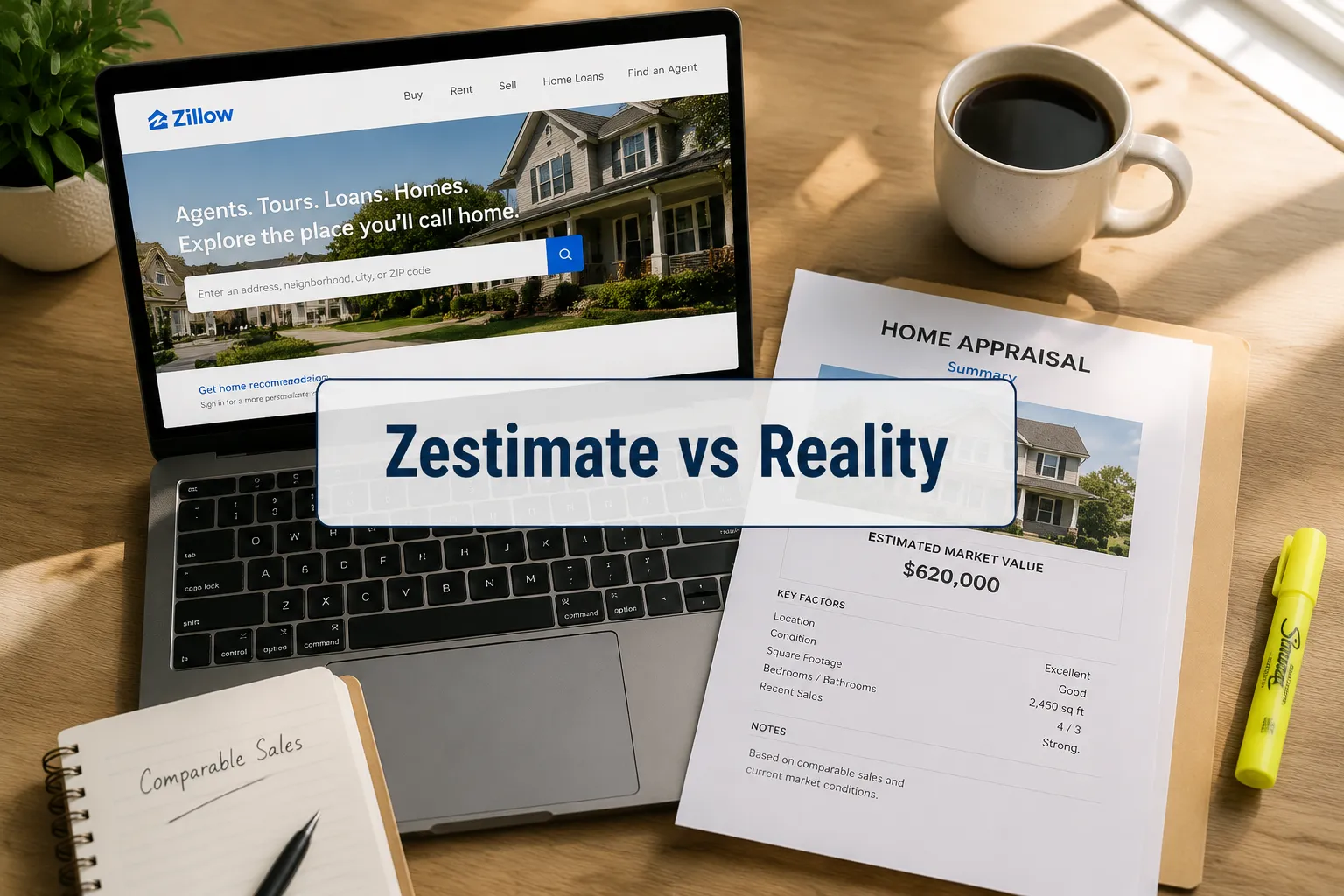
What Is a Zillow Zestimate and How Does It Work?
The Zestimate is Zillow's automated home valuation model (AVM), a computer-generated estimate of a property's current market value. It pulls from public records, tax assessments, MLS listing data, and user-submitted information to produce a single dollar figure that millions of homeowners check like a stock ticker.
Zillow's algorithm weighs several data inputs:
- Public property records, square footage, lot size, bedroom and bathroom count
- Tax assessment history, what the county says the home is worth for tax purposes
- Recent sales data, comparable homes sold nearby (comps)
- MLS listing details, when available, active listing prices and days on market
- User-submitted updates, homeowners can add renovation details, which Zillow factors in
The model runs continuously and refreshes as new data flows in. Think of it like Google Maps giving you a route estimate, useful for a general sense of direction, but you wouldn't trust it to tell you which lane to be in during rush hour.
The Zestimate is available for over 100 million U.S. properties, per Zillow's own reporting. That reach is impressive. The accuracy, though, is a different conversation.
How Accurate Is the Zillow Zestimate Compared to Actual Home Sales?
The Zestimate is most accurate for on-market homes and least accurate for off-market ones. Zillow publishes its own accuracy metrics, and the numbers are worth reading carefully before anyone prices a home based on them.
Per Zillow's published accuracy data (as of 2023):
| Property Status | Median Error Rate | Error on $400K Home |
|---|---|---|
| On-market (listed) | 2.4% | ~$9,600 |
| Off-market | 7.49% | ~$29,960 |
The reason on-market homes are more accurate is straightforward: Zillow has access to the actual listing price, which anchors the estimate. Off-market homes have no such anchor, so the algorithm is working with older comps and public records that may be years out of date.
A 2021 study by researchers at the University of Colorado Denver found that AVMs, including Zillow's, showed significantly wider error ranges in rural markets and neighborhoods with low transaction volume, where comparable sales data is thin. (Source: Journal of Real Estate Research, 2021.)
The bottom line: Even on a good day, the Zestimate is working with incomplete information. For pricing a home to sell, that's not good enough.
Why Is My Zillow Zestimate So Different from My Home's Real Value?
The Zestimate can't see what makes your home worth more, or less, than the algorithm assumes. This is the single biggest reason homeowners feel blindsided when the number doesn't match reality.
Common reasons the Zestimate misses the mark:
- Interior updates the algorithm doesn't know about, a renovated kitchen, new hardwood floors, or a finished basement can add significant value that never gets recorded in public data unless a homeowner manually updates Zillow's listing.
- Condition issues, a roof that needs replacement, foundation problems, or deferred maintenance can tank actual value well below the Zestimate.
- Micro-location factors, being on a busy road, backing up to a commercial property, or sitting in a flood zone affects buyer demand in ways no algorithm captures cleanly.
- Unique or non-standard properties, custom homes, historic properties, and unusual floor plans have fewer true comps, which forces the algorithm to use less relevant sales data.
- Rapidly shifting markets, in markets where prices are moving fast (up or down), the Zestimate lags because it relies on closed sales that may be 60-90 days old.
If your Zestimate looks wildly off, it's not a glitch. It's the algorithm doing its best with the data it has, which often isn't enough. Check out our breakdown of which states are experiencing the most dramatic housing price shifts to understand how fast-moving markets make AVMs even less reliable.

Can You Use the Zillow Zestimate to Price Your Home for Sale?
No, and this is where we get direct with sellers. Using the Zestimate as your listing price is one of the most common and costly mistakes in residential real estate. So based on what we've seen across hundreds of transactions, the sellers who lean on the Zestimate without a CMA are the same ones calling their agent three weeks later asking why they're not getting offers.
Here's why the Zestimate fails as a pricing tool:
- It's a passive estimate, not a market strategy. Pricing a home requires understanding current buyer demand, active competition, and days-on-market trends in your specific zip code, none of which the Zestimate accounts for in real time.
- Overpricing triggers price cuts. Homes that sit too long accumulate stigma. Buyers assume something is wrong. Price reductions signal desperation. Our guide on 7 pricing mistakes that trigger price cuts and lowball offers covers exactly how this spiral starts.
- Underpricing costs you equity. If the Zestimate is running low because it missed your renovations, pricing to it means you're giving away money you earned.
What to do instead: Request a Comparative Market Analysis from a licensed agent. A good CMA pulls recent closed sales, active listings, and expired listings within a tight geographic radius, and a skilled agent adjusts for condition, upgrades, and market momentum. That's the impeccable standard for pricing, not an algorithm.
Zillow Zestimate vs. Appraisal, Which Is More Accurate?
A licensed appraisal is more accurate than the Zestimate for nearly every pricing and financing decision. This isn't a close call.
A licensed appraiser physically inspects the property, measures square footage, evaluates condition, and applies professional judgment to comparable sales. They're regulated, credentialed, and legally accountable for their opinion of value. Lenders require them for a reason.
The Zestimate is none of those things. It's a free, automated estimate built for consumer browsing, not for underwriting a mortgage or setting an asking price.
Where each tool belongs:
- Zestimate: Casual research, ballpark equity checks, initial curiosity
- Licensed appraisal: Mortgage financing, estate settlements, divorce proceedings, tax appeals, serious pricing decisions
- Agent CMA: Listing price strategy, buyer offer analysis, pre-listing preparation
One more thing worth knowing: Zillow itself states in its terms of service that the Zestimate "is not an appraisal and cannot be used in place of an appraisal." That's the company's own disclaimer. So based on that alone, pricing a home off the Zestimate is gate keeping your own equity from yourself.
For a deeper look at which platforms come closest to appraisal-level accuracy, see our analysis of which company has the most accurate real estate estimate.
Does the Zillow Zestimate Affect Property Taxes or Your Mortgage?
The Zestimate does not directly affect your property taxes or mortgage approval. Both of those processes use separate, independent valuations.
Property taxes are based on your county assessor's valuation, a government function that operates on its own schedule and methodology, completely separate from Zillow. Your Zestimate going up does not trigger a tax reassessment.
Mortgage approvals require a licensed appraisal ordered by the lender. The appraiser is selected from an approved panel and works independently from the borrower and the listing agent. The Zestimate is not submitted to, reviewed by, or considered by the underwriter.
Where the Zestimate can indirectly cause problems: homeowners who see a high Zestimate sometimes overestimate their available home equity and make financial decisions, like applying for a HELOC, based on inflated assumptions. If the appraisal comes in lower, the loan-to-value ratio changes and the deal can fall apart. Our guide on how soon you can do a HELOC after purchasing a home covers this exact scenario.
How Often Does Zillow Update the Zestimate?
Zillow updates Zestimates frequently, often daily for active listings and weekly or monthly for off-market properties, depending on data availability in that market.
For on-market homes, the Zestimate refreshes as new MLS data, price changes, and nearby sales are recorded. For off-market homes in low-transaction markets, updates may be infrequent because there simply isn't new comparable data to process.
This matters for sellers because a Zestimate can look stale right when you need it most, especially in a market that's been moving fast. If your neighborhood had a cluster of strong sales in the last 30 days, those may not be fully reflected yet. Let it cook before you see results in the Zestimate, the algorithm needs time to absorb new comps.
Zestimate vs. Redfin Estimate, Which Is More Accurate?
Both are AVMs, and both have limitations, but Redfin's Estimate edges out Zillow's in published accuracy for on-market homes.
Published accuracy comparison (most recent available data):
| Tool | On-Market Median Error | Off-Market Median Error |
|---|---|---|
| Zillow Zestimate | 2.4% | 7.49% |
| Redfin Estimate | ~2.08% | Not publicly specified |
Redfin's model benefits from direct MLS access in most markets, which gives it more current listing data. Zillow aggregates from multiple sources, which can introduce lag.
That said, neither tool is a substitute for a professional valuation. The difference between 2.08% and 2.4% is statistically interesting but practically irrelevant when you're pricing a $600,000 home, both could still be off by $12,000,$15,000.
For a full breakdown of the top AVM tools and how they stack up, our real estate estimate accuracy comparison is worth reading before you make any pricing or offer decisions.
Is the Zillow Zestimate Accurate for New Construction Homes?
The Zestimate is particularly unreliable for new construction. New builds often have no prior sales history, no tax assessment reflecting current value, and no comparable closed sales in a brand-new subdivision, all of which the algorithm depends on.
Builders set prices based on construction costs, lot premiums, and market positioning. The Zestimate may lag the actual market price by months or show a value based on entirely different neighborhood comps that don't reflect the new community's pricing tier.
If you're buying new construction in 2026, the builder's pricing and a buyer's agent CMA are far more relevant than any AVM. Our new-home construction surge guide covers how builders are pricing and what incentives are actually available right now.
Zillow Zestimate Is Wrong, What Should You Do Instead?
Fresh data from a real professional beats stale data from an algorithm every time. Here's the action plan when the Zestimate doesn't reflect your home's actual value:
For sellers:
- Request a CMA from a licensed agent, ideally two or three agents competing for your listing.
- Order a pre-listing appraisal if your home has significant upgrades or unique features.
- Update your Zillow listing manually with renovation details, finished square footage, and recent improvements.
- Review our home sellers pricing strategies playbook for a full 2026 framework.
For buyers:
- Use the Zestimate as a conversation starter, not a negotiation anchor.
- Ask your agent for a buyer's CMA on any property you're seriously considering.
- Factor in inspection findings, the Zestimate has no idea what's behind the walls. Our property inspections guide walks through exactly what to look for.
For homeowners checking equity:
- Talk to a lender or broker about an equity analysis before applying for a HELOC or cash-out refinance.
- Don't make financial decisions based on a Zestimate number alone.
Can You Dispute or Correct Your Zillow Zestimate?
Yes, homeowners can submit updates directly through Zillow to improve the accuracy of their Zestimate. This is one of the most underused tools available, and it's extraordinary how many sellers skip this step before listing.
What you can update on Zillow:
- Square footage
- Number of bedrooms and bathrooms
- Recent renovations (kitchen, bathrooms, roof, HVAC)
- Finished basement or added living space
- Pool, garage, or accessory dwelling unit additions
After submitting updates, Zillow typically recalculates the Zestimate within a few days. The change may be modest or significant depending on what was missing from the original data.
What you cannot change:
- The algorithm's weighting of comparable sales
- Market conditions or demand signals
- The fundamental limitations of an AVM
Updating Zillow is a smart pre-listing move, but it's still not a substitute for a professional valuation. Think of it as cleaning up the data so the algorithm has a fair shot, not as a way to inflate your number.
How Much Margin of Error Does the Zillow Zestimate Have?
The margin of error varies significantly by market, property type, and data availability. Zillow's published national median error rates are 2.4% (on-market) and 7.49% (off-market), but those are medians, meaning half of all estimates fall outside even those ranges.
What the error looks like in dollar terms:
| Home Value | 2.4% Error (On-Market) | 7.49% Error (Off-Market) |
|---|---|---|
| $250,000 | $6,000 | $18,725 |
| $400,000 | $9,600 | $29,960 |
| $600,000 | $14,400 | $44,940 |
| $900,000 | $21,600 | $67,410 |
In luxury markets, rural areas, and neighborhoods with few recent sales, the error rate can exceed 10-15%. That's not a rounding error, that's a down payment.

Why Shouldn't You Rely on the Zestimate When Selling Your House?
Pricing your home is one of the highest-stakes financial decisions most people make. The Zestimate was built for browsing, not for that moment.
Here's the straight answer from brokers with over 15 years in the field: the sellers who price from the Zestimate without professional input are the same sellers who end up with stale listings, price reductions, and buyers who sense desperation. The algorithm doesn't know your market. It doesn't know your home. And it definitely doesn't know what a motivated buyer in your zip code will actually pay in 2026.
The impeccable pricing strategy starts with a CMA, layers in current market data, and accounts for the real condition and features of your specific property. That's what moves homes.
For a complete picture of where the 2026 housing market stands, including which markets are cooling and which are still competitive, our U.S. home buyers market trends in 2026 gives you the full context.
Frequently Asked Questions
Q: Is the Zillow Zestimate ever accurate?
Yes, it's most accurate for on-market homes in high-transaction urban markets with abundant comparable sales data. In those conditions, the median error rate drops to around 2.4% (Zillow, 2023). For off-market homes in rural or low-volume markets, accuracy drops significantly.
Q: Can a Zestimate hurt my home sale?
Indirectly, yes. If buyers research your home before touring it and see a Zestimate lower than your asking price, it can create a negotiation anchor that works against you. Conversely, a high Zestimate can attract buyers who then feel misled when the appraisal comes in lower.
Q: Does Zillow's Zestimate affect what a lender will loan me?
No. Lenders use licensed appraisals for underwriting decisions. The Zestimate is not submitted to lenders and plays no role in mortgage approval or loan amount.
Q: How accurate is the Zillow Zestimate for condos?
Condos in large buildings can be more accurately estimated because there are usually many comparable units with recent sales. However, floor level, view, and unit condition still create variations the algorithm can't fully capture.
Q: Should I update my Zillow listing before selling?
Yes. Submitting accurate square footage, bedroom/bathroom counts, and recent renovation details gives the algorithm better data and can improve your Zestimate before buyers start researching your home.
Q: Is the Zestimate more accurate in some states than others?
Yes. States with robust public MLS data and high transaction volume, like California, Texas, and Florida, generally produce more accurate Zestimates. States with non-disclosure laws (where sale prices aren't publicly recorded) produce less accurate estimates because the algorithm lacks closed sale data.
Q: What's the best free alternative to the Zestimate?
Redfin's Estimate is the closest free alternative with a slightly tighter published error rate. For a full comparison of AVM tools, see our most accurate real estate estimate comparison.
Q: Can I use the Zestimate for investment property analysis?
Use it as a starting point only. For serious investment decisions, pair it with a professional appraisal, agent CMA, and your own rental income analysis. Our top real estate AI tools for investors covers more precise valuation tools built for investment use cases.
The Bottom Line: Treat the Zestimate Like a Weather Forecast
The Zestimate is a fresh data point, not a definitive answer. Like a weather forecast, it gives you a reasonable range to work with, but you wouldn't cancel your outdoor wedding based on a 10-day outlook. Pricing your home, or making a six-figure offer, deserves better than that.
Here's what to do with this information right now:
- Sellers: Get a CMA from a licensed agent before setting your asking price. If your home has significant upgrades, consider a pre-listing appraisal. Update your Zillow listing with accurate data so buyers and the algorithm start from the right place.
- Buyers: Use the Zestimate to flag properties that look mispriced, then verify with your agent's CMA before making an offer.
- Homeowners: Check your Zestimate periodically for ballpark equity awareness, but don't make financing decisions based on it without a professional opinion.
- Investors: Treat any AVM as one data point in a stack. Pair it with rental comps, neighborhood trends, and a professional valuation before committing capital.
The Zestimate is a tool. Like any tool, it's only as good as the person using it, and only useful when applied to the right job. Pricing your home is not that job.
For more straight-talk real estate guidance from brokers who've been in the field, visit Real Estate Rank IQ, ranked by brokers, read by everyone.
References
- Zillow. (2023). Zestimate Accuracy. https://www.zillow.com/zestimate/
- Redfin. (2023). How Accurate Is the Redfin Estimate? https://www.redfin.com/redfin-estimate
- Schulz, R., & Werwatz, A. (2021). Automated Valuation Models and Their Limitations in Low-Transaction Markets. Journal of Real Estate Research.
- National Association of Realtors. (2023). Profile of Home Buyers and Sellers. https://www.nar.realtor/research-and-statistics