

Last updated: August 23, 2026

Quick Answer
Downsizing your home can trigger a capital gains shock when your profit from selling exceeds the IRS exclusion limits of $250,000 for single filers or $500,000 for married couples filing jointly. Any gain above those thresholds gets taxed at long-term capital gains rates of 0%, 15%, or 20%, depending on your income. After a decade of home appreciation averaging 40% to 50% in many U.S. markets, a surprising number of ordinary homeowners are crossing those limits without realizing it.
Key Takeaways
- The IRS allows single homeowners to exclude up to $250,000 in profit from a home sale, and married couples up to $500,000, but only if they meet the 2-of-5-year ownership and use test.
- Long-term capital gains tax rates in 2026 are 0%, 15%, or 20% based on taxable income. High earners may also owe a 3.8% Net Investment Income Tax (NIIT) on top of that.
- Your taxable gain is sale price minus your cost basis. Cost basis includes your original purchase price plus qualifying home improvements, not just what you paid at closing.
- Downsizing to a condo or 55-plus community does not automatically reset your tax clock. The 2-of-5 rule applies regardless of where you move next.
- Second homes, vacation properties, and inherited homes follow different rules and generally do not qualify for the primary residence exclusion.
- Reinvesting your home sale proceeds into a new home does NOT eliminate capital gains tax. That rule ended in 1997.
- A buy-before-you-sell bridge loan can help with timing, but it does not change your tax exposure on the sale.
- Tracking every home improvement receipt from the day you buy is the single most effective way to reduce your taxable gain.
- Selling the family home emotionally is real, but the financial preparation needs to happen months before the sign goes in the yard.
What Is Capital Gains Tax on a Home Sale
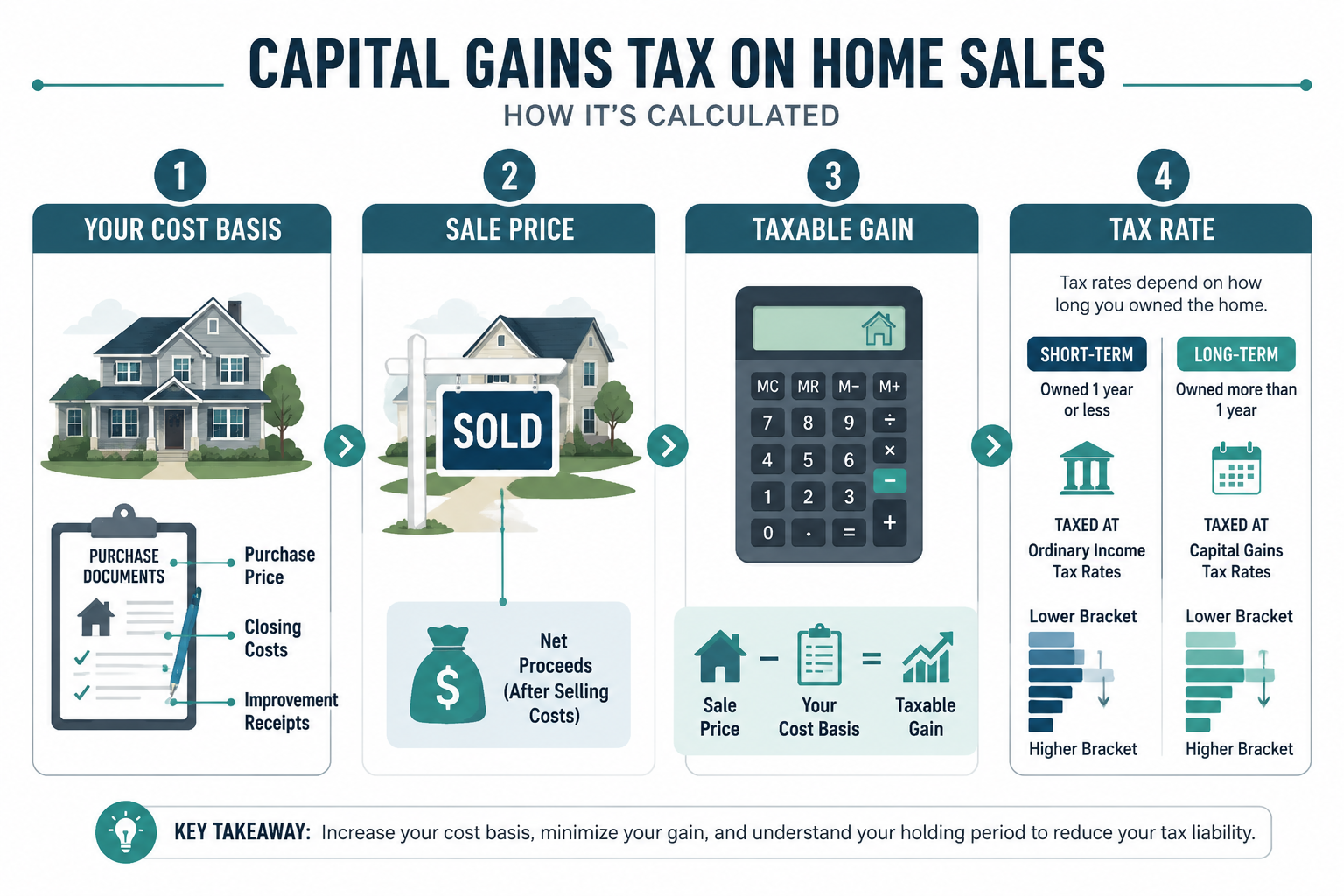
Capital gains tax on a home sale is the federal tax owed on the profit you make when you sell a property. Profit here means your net sale price minus your adjusted cost basis. It is not the full sale price.
For example: you bought a home in 2012 for $280,000, added a $40,000 kitchen renovation and $15,000 in documented improvements, and sold in 2026 for $780,000. Your adjusted cost basis is $335,000. Your gain is $445,000. As a married couple, you exclude $500,000, so you owe nothing. As a single filer, you exclude $250,000 and owe tax on $195,000.
Short-term vs. long-term rates matter:
- Homes sold after less than one year of ownership: gains taxed as ordinary income (up to 37% in 2026)
- Homes sold after more than one year: long-term capital gains rates apply (0%, 15%, or 20%)
- High earners: an additional 3.8% NIIT applies if modified adjusted gross income exceeds $200,000 (single) or $250,000 (married filing jointly)
Most homeowners downsizing after retirement or after a long hold qualify for long-term rates. The shock comes from not knowing the gain is taxable at all.
Downsizing Your Home Can Trigger a Capital Gains Shock, Here Is Why It Happens
Downsizing your home can trigger a capital gains shock for one simple reason: home values in most U.S. markets have climbed far faster than the exclusion limits, which have not been adjusted for inflation since 1997.
The $250,000/$500,000 exclusion was set when the median U.S. home price was around $145,000. The median existing-home price hit $434,100 in July 2026, according to the National Association of Realtors. A homeowner who bought in a hot market 15 years ago and paid $300,000 could easily be sitting on a $600,000 to $700,000 home today. After the exclusion, a single filer could owe federal tax on $100,000 or more in gain.
Who gets hit hardest:
- Single filers in high-appreciation markets (California, Texas metros, Florida coastal, Pacific Northwest)
- Homeowners who inherited a property and later used it as a primary residence without meeting the full 2-of-5 rule
- Sellers who never tracked improvement receipts and are calculating gain on the raw purchase price
- Retirees downsizing after 20-plus years in the same home
The NAR's 2025 Profile of Home Buyers and Sellers found the median seller tenure is now 11 years, an all-time high. That is 11 years of appreciation compounding inside a home before the sale. For many sellers in 2026, that math is compelling.
This is not a niche problem. It is a mainstream one that most sellers discover at the worst possible moment: when they are already under contract.
How Much Can You Exclude From Capital Gains When Selling Your House
The IRS primary residence exclusion lets you exclude up to $250,000 in profit if you are single, or up to $500,000 if you are married filing jointly, provided you meet two conditions.
The 2-of-5 rule:
- You owned the home for at least 2 of the last 5 years before the sale
- You used the home as your primary residence for at least 2 of the last 5 years before the sale
The two years do not have to be consecutive. You can rent the home for up to three years and still qualify if you lived there for two of the five years before closing.
What the exclusion does NOT cover:
- Gain from a home office deduction claimed on previous tax returns (depreciation recapture applies)
- Any portion of the home used exclusively for business or rental
- Gain on a second home or vacation property
- Gain on a home you owned for less than 2 years (partial exclusion may apply for certain hardships)
Partial exclusion situations: if you sell early due to a job change, health issue, or unforeseen circumstance, the IRS allows a prorated exclusion. A single filer who lived in the home for one year (half of two) could exclude up to $125,000.
What Is the Difference Between Primary Residence and Investment Property Capital Gains
A primary residence sale qualifies for the $250,000/$500,000 exclusion. An investment property sale does not.
For investment properties, every dollar of gain is taxable at long-term capital gains rates (assuming you held more than one year). On top of that, depreciation recapture is taxed at a flat 25% rate on any depreciation you claimed or could have claimed during ownership.
| Property Type | Exclusion Available | Depreciation Recapture | 1031 Exchange Eligible |
|---|---|---|---|
| Primary residence | Yes, up to $500K (married) | Only if home office claimed | No |
| Investment property | No | Yes, up to 25% rate | Yes |
| Second home / vacation | No | Only if rented | Possibly, if rented |
| Mixed-use (partial rental) | Partial | Yes, on rental portion | No |
The line between primary and investment can blur. If you rented your home for three of the last five years before selling, you lose the exclusion entirely, even if you lived there for two of those five years. The IRS requires both ownership AND use.
For those managing rental properties or considering a move to investment real estate, the First Time Second Home Investors Guide to Property Management Costs, Benefits and How to Pick the Right Company breaks down what changes once your home becomes an income property.

How Long Do You Need to Own a Home to Avoid Capital Gains Tax
You need to own AND live in the home for at least 2 of the 5 years immediately before the sale date to qualify for the full primary residence exclusion. Ownership alone is not enough. You must also meet the use test.
The clock resets on each property. Moving from one home to another does not carry over any time credit. If you buy a smaller home after downsizing, you start fresh on a new 2-year clock for that property.
Edge cases worth knowing:
- If you sell before hitting 2 years and the reason qualifies (job relocation of 50+ miles, serious illness, or other IRS-defined unforeseen circumstances), you may claim a partial exclusion
- You can only use the exclusion once every 2 years
- Periods of non-qualified use (renting the home out after 2009) reduce the exclusion proportionally
Downsizing checklist item #1: before listing, confirm your exact move-in date against your planned closing date. Missing the 2-year threshold by even one day disqualifies the full exclusion.
What If Your Home Appreciated Too Much, Capital Gains Above the Exclusion
This is exactly where downsizing your home can trigger a capital gains shock in the most painful way. If your gain exceeds the exclusion, the overage is taxable, and there is no rollover or deferral available for primary residences.
Strategies to reduce taxable gain legally:
- Add every qualifying improvement to your cost basis. Kitchen remodels, bathroom additions, new roofs, HVAC systems, landscaping, and permanent fixtures all count. Repairs do not. Keep every receipt from day one.
- Include selling costs. Agent commissions, closing costs, staging fees, and legal fees all reduce your net proceeds and lower your taxable gain.
- Time the sale to a lower-income year. If you are retiring and your income drops, your capital gains rate may drop from 20% to 15% or even 0%.
- Consider installment sales. Spreading the gain over multiple years through seller financing can keep annual income below higher-rate thresholds.
- Talk to a CPA before listing. Not after. The decisions that reduce your tax bill happen before you sign the listing agreement, not at the closing table.
For sellers preparing to list, the Home Sellers Pricing Strategies: The 2026 Playbook That Actually Moves Properties covers how pricing decisions interact with your net proceeds.
Can You Avoid Capital Gains Tax by Downsizing Your Home
You can reduce or eliminate capital gains tax when downsizing your home, but only through specific IRS-approved methods. There is no blanket exemption just because you are moving to a smaller place.
What actually works:
- Meeting the 2-of-5 primary residence test and staying within the exclusion limits
- Raising your cost basis through documented improvements
- Timing the sale to coincide with a lower-income year
- Using a 1031 exchange if the property is an investment property (not available for primary residences)
- Gifting the property or placing it in a trust (estate planning strategies with their own rules and timelines)
What does NOT work:
- Reinvesting proceeds into a new home. This strategy ended with the Taxpayer Relief Act of 1997. There is no rollover provision for primary residences.
- Waiting to sell. Appreciation continues to accumulate, which may push your gain further above the exclusion.
- Moving to a no-income-tax state. Federal capital gains tax applies regardless of state residency.
Do You Pay Capital Gains Tax If You Reinvest Home Sale Proceeds
No, reinvesting your home sale proceeds into a new home does not eliminate or defer capital gains tax for primary residences. That rule has not existed since 1997.
The only deferral mechanism available for real estate is the Section 1031 like-kind exchange, which applies exclusively to investment and business properties, not homes you live in. If you sell your primary residence and buy another primary residence with the proceeds, your capital gains tax liability is calculated at the time of sale, period.
This is one of the most common misconceptions among sellers who bought their first home before 1997 or who heard the old rule from a parent or neighbor. It is solid as a piece of advice that it gets passed down like a family recipe, except this one expired 29 years ago.
For investment properties: a 1031 exchange lets you defer capital gains tax by rolling proceeds into a like-kind replacement property within 180 days. There are strict identification and timeline rules. A qualified intermediary must hold the funds. This is not a DIY process.
Capital Gains Tax on Second Home or Vacation Property
A second home or vacation property does not qualify for the primary residence exclusion. Every dollar of gain is subject to capital gains tax.
If you used the vacation home as a rental for part of the year, the tax picture gets more complex:
- Rented fewer than 15 days per year: rental income is tax-free, but you cannot deduct rental expenses. The home is treated as a personal residence.
- Rented 15 or more days per year: rental income is taxable, you can deduct proportional expenses, and depreciation recapture applies at sale.
- Rented more than 14 days AND personal use was less than the greater of 14 days or 10% of rental days: the property is classified as a rental property, not a vacation home, and 1031 exchange rules may apply.
The threshold question is whether the property qualifies as your primary residence under the 2-of-5 rule. Some retirees who moved into a former vacation home full-time have successfully claimed the exclusion after meeting the 2-year use requirement. This requires careful documentation and, again, a CPA conversation before listing.
Capital Gains Tax on an Inherited Home When You Sell It
Inherited homes receive a stepped-up cost basis, which is one of the most favorable tax treatments in the entire tax code. The basis steps up to the fair market value of the property on the date of the original owner's death, not the price they paid decades ago.
Example: your parent bought a home in 1985 for $90,000. It was worth $520,000 at the time of their death. You inherit it and sell it 18 months later for $545,000. Your taxable gain is $25,000 ($545,000 minus the stepped-up basis of $520,000), not $455,000.
Key rules for inherited property:
- The stepped-up basis applies regardless of how long you hold the property after inheriting it
- If you use the inherited home as your primary residence for 2 of the next 5 years before selling, you may qualify for the primary residence exclusion on top of the stepped-up basis
- If multiple heirs inherit the property, each heir's share gets the stepped-up basis
- Inherited property held for any period qualifies for long-term capital gains rates, even if sold the day after inheriting
The stepped-up basis is a powerful planning tool, but it requires that the property actually passes through an estate. Homes transferred as gifts during the owner's lifetime do not receive a stepped-up basis.
Downsizing After Retirement: The Full Financial Picture
Downsizing after retirement is not just a tax question. The financial reality is more layered than most sellers expect, and downsizing your home can trigger a capital gains shock that disrupts a carefully planned retirement income strategy.
The smaller home higher price per square foot problem: in most desirable retirement markets, condos and smaller single-family homes cost more per square foot than the larger suburban homes being vacated. A 3,000-square-foot home in a suburb may sell for $200 per square foot. A 1,200-square-foot condo in a walkable urban neighborhood or 55-plus community may run $350 to $450 per square foot. The net equity freed up after the move can be smaller than expected.
Downsizing to a condo HOA fees: monthly HOA fees in condo communities range from $200 to over $1,000 per month depending on amenities, building age, and reserve fund health. A $600 monthly HOA fee equals $7,200 per year, which can offset a significant portion of the mortgage savings from moving to a smaller space.
Cost of moving when downsizing: a local move averages $1,000 to $2,500. A cross-country move averages $4,000 to $10,000 or more depending on volume. Add storage costs if the new home is not ready, and the cost of moving when downsizing can easily reach $15,000 to $20,000 all-in.
What to do with furniture when downsizing: most sellers underestimate how much furniture simply does not fit a smaller home. Estate sales, consignment, and donation are the main options. Factor in the time and cost of liquidating large pieces before closing.
Downsizing and property taxes: moving to a different county or state resets your property tax assessment. Some states offer senior property tax exemptions or portability provisions that transfer a portion of your existing assessment cap. California's Proposition 19 (effective 2021) allows homeowners 55 and older to transfer their property tax base to a replacement home anywhere in the state. Check your destination state's rules before assuming any savings.
55-plus community vs. regular neighborhood: 55-plus communities offer amenities, social programming, and maintenance-included living. They also carry age restrictions, HOA governance, and resale limitations. A regular neighborhood offers more flexibility but fewer built-in services. The right choice depends on lifestyle preferences, not just cost.
Aging in place vs. downsizing: staying in the current home and modifying it for accessibility can cost $5,000 to $80,000 depending on the scope of modifications. For some homeowners, aging in place vs. downsizing comes down to whether the current home can realistically be adapted, and whether the equity freed by selling is needed for retirement income.
When to downsize your home: the financial case is strongest when you have met the 2-of-5 rule, your gain is within or close to the exclusion limit, and the destination market offers genuine cost savings after accounting for HOA fees, property taxes, and moving costs. The emotional case for selling the family home emotionally is a separate conversation, but it should not be rushed by market timing pressure.
For sellers working through the pre-listing preparation process, the Preparing Your Home for Sale in 2026 This Spring guide covers the practical steps before the sign goes in the yard.

How Much Does Downsizing Actually Save
How much does downsizing actually save depends on four variables: the price difference between the sold home and the purchased home, the ongoing cost difference (mortgage, HOA, taxes, insurance), the one-time transaction costs, and the capital gains tax owed.
A realistic scenario:
- Sell a $750,000 home (married couple, $300,000 original purchase, $100,000 in improvements = $400,000 basis, $350,000 gain, fully excluded)
- Buy a $450,000 condo
- Net equity freed: approximately $250,000 after agent commissions, closing costs, and moving expenses
- Monthly savings: mortgage payment drops from $2,800 to $0 (if purchased with cash), but HOA adds $500/month and property taxes in the new location add $400/month
- True monthly savings: closer to $1,900/month, not $2,800
Now run the same scenario where the gain is $600,000 instead of $350,000. The couple owes tax on $100,000 of gain above the exclusion. At a 15% long-term rate, that is $15,000 in federal tax. At 20% plus 3.8% NIIT for higher earners, it is $23,800. That is money that does not go into the retirement account.
How much does downsizing actually save? The honest answer: often less than sellers project, because the transaction costs, destination market prices, and potential tax bill are rarely included in the initial mental math. Running the full net sheet before listing is not optional. It is the whole game.
For help thinking through the numbers before you list, the 8 Spring Home Selling Mistakes 2026 That Cost You $40K+ article covers the financial errors sellers make most often.
Buy Before You Sell: Bridge Loans and Timing Your Downsize
A buy-before-you-sell bridge loan is a short-term loan that lets you purchase your next home before your current home closes. It bridges the gap between the two transactions, which is especially useful in competitive markets where contingency offers are routinely rejected.
How it works:
- The lender advances funds based on the equity in your current home
- You close on the new property, then list and sell the old one
- The bridge loan is repaid from the proceeds of the sale
- Terms typically run 6 to 12 months at rates 1% to 2% above conventional mortgage rates
The tax angle: a bridge loan does not change your capital gains exposure. Your gain is still calculated on the sale of the original home, and the tax is owed in the year of that sale. The bridge loan is purely a liquidity tool, not a tax strategy.
Who it makes sense for: sellers with substantial equity, a clear plan to sell within 6 to 12 months, and the income to carry two housing payments temporarily. It is not a fit for sellers who are uncertain about the sale timeline or who are working with tight margins.
For buyers weighing financing options in the current market, the Top 7 Down Payment Strategies Ranked: The Best Ways to Buy a Home covers how equity from a prior home fits into a broader buying strategy.
Common Mistakes People Make With Home Sale Capital Gains
These are the errors that cost sellers the most, and most of them are avoidable with basic preparation.
1. Not tracking home improvements
Sellers who cannot document improvements are stuck using only their purchase price as the cost basis. A $50,000 kitchen remodel that was never recorded adds $50,000 to the taxable gain. Keep every permit, contractor invoice, and receipt in a dedicated folder from day one of ownership.
2. Assuming the reinvestment rule still applies
As covered above, this rule ended in 1997. Sellers who believe buying a new home wipes out the tax bill are in for a shock at tax time.
3. Forgetting depreciation recapture
If you ever claimed a home office deduction, the IRS requires depreciation recapture on that portion of the home at a 25% rate, regardless of the primary residence exclusion.
4. Missing the 2-year window by days
Some sellers rush to close before confirming they have met the 2-of-5 rule. Missing the threshold by even a few days can cost tens of thousands of dollars.
5. Not accounting for state capital gains tax
Federal tax is only part of the bill. States like California tax capital gains as ordinary income (up to 13.3% in 2026). A seller in a high-tax state may owe both federal and state tax on the same gain.
6. Selling the family home emotionally without financial preparation
The decision to sell the family home emotionally is often made quickly after a life event: a spouse's death, a health diagnosis, or a family move. Sellers in this situation sometimes list within weeks without consulting a tax professional. The financial consequences can last years.
For sellers who want to avoid the most common listing errors, the 7 Pricing Mistakes That Trigger Price Cuts and Lowball Offers is a useful resource worth reading before setting your ask.
Should You Downsize or Rent Instead: Tax Implications
Renting instead of downsizing is a legitimate option that some homeowners overlook, and it carries a different tax profile.
If you rent out your current home instead of selling:
- Rental income is taxable as ordinary income
- You can deduct mortgage interest, property taxes, insurance, repairs, and depreciation
- Depreciation reduces your cost basis over time, which increases your taxable gain when you eventually sell
- If you rent for more than 3 years before selling, you may no longer qualify for the primary residence exclusion (you must have lived there 2 of the last 5 years)
If you sell and then rent your next home:
- You capture the tax exclusion now while you still qualify
- You avoid the capital gains exposure growing larger with continued appreciation
- You retain flexibility without the obligations of ownership
The decision rule: if your gain is currently within the exclusion limit and you expect continued appreciation to push it above the threshold, selling now and renting temporarily may be the more tax-efficient path. If your gain is already above the exclusion, renting the current home while you plan a tax strategy may buy you time to consult a CPA about installment sale or other options.
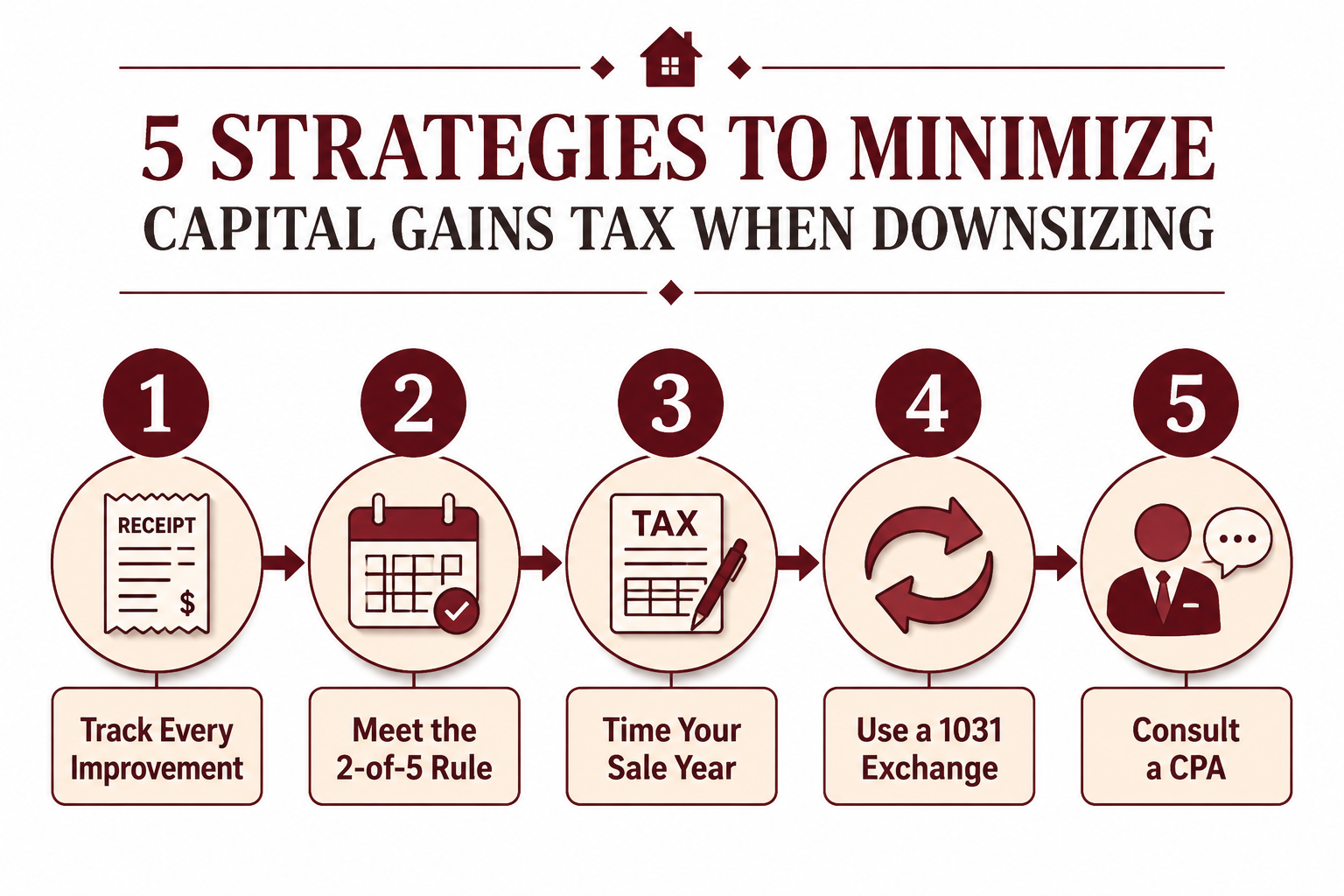
How to Minimize Capital Gains Tax When Selling Your House
Minimizing capital gains tax when selling your house starts years before the sale, not weeks before closing.
The most effective steps, in order:
- Document every capital improvement from day one. Additions, renovations, new systems, and permanent upgrades all raise your cost basis. Cosmetic repairs do not.
- Confirm your 2-of-5 eligibility before listing. Do not assume. Pull your records and verify the exact dates.
- Include all selling expenses in your net proceeds calculation. Agent commissions (typically 5% to 6%), title fees, transfer taxes, staging, and pre-listing repairs all reduce your taxable gain.
- Time the sale to a lower-income year. If you are retiring or reducing work hours, waiting until your income drops can move you into a lower capital gains bracket.
- Consult a CPA or tax attorney before signing a listing agreement. The strategies available to you depend on your specific numbers, state of residence, and filing status. Generic advice has limits. A proper tax plan takes a full cycle to pay off.
- Consider an installment sale if the gain is large. Spreading the gain over several years through seller financing can keep annual income below the 20% threshold.
- If the property is an investment property, explore a 1031 exchange. This does not apply to primary residences but is the most powerful deferral tool available for rental and investment properties.
For sellers who want to understand how the full selling process fits together before the tax conversation, the First-Time Home Sellers Guide With Expert Tips and Market Insights covers the end-to-end picture from listing to closing.
FAQ
Q: Does the $250,000/$500,000 exclusion apply automatically?
A: No. You must meet the 2-of-5 ownership and use test and file correctly. The exclusion is not automatic, it is claimed on IRS Form 8949 and Schedule D when you file your tax return for the year of the sale.
Q: Can I use the exclusion more than once?
A: Yes, but only once every 2 years. If you sell two homes within a 24-month period, only one sale qualifies for the full exclusion.
Q: What counts as a home improvement for cost basis purposes?
A: Permanent improvements that add value, extend the home's life, or adapt it to a new use qualify. Examples include additions, new roofs, HVAC systems, kitchen remodels, bathroom additions, and landscaping. Routine maintenance and repairs (painting, fixing a leaky faucet) do not qualify.
Q: Is there a capital gains tax calculator I can use?
A: The IRS does not offer an official capital gains calculator, but IRS Publication 523 (Selling Your Home) provides the worksheet. Tax software like TurboTax and H&R Block walks through the calculation step by step. For a rough estimate: subtract your adjusted cost basis (purchase price plus improvements plus selling costs) from your net sale price, subtract the applicable exclusion, and apply your long-term capital gains rate based on your taxable income.
Q: Do I owe capital gains tax if I sell at a loss?
A: No. Capital gains tax only applies to gains. A loss on a primary residence sale is also not deductible, which is a different but equally important point.
Q: What is the Net Investment Income Tax and does it apply to home sales?
A: The NIIT is a 3.8% surtax on investment income for taxpayers above $200,000 (single) or $250,000 (married filing jointly) in modified adjusted gross income. The portion of your home sale gain that exceeds the primary residence exclusion may be subject to the NIIT in addition to regular capital gains tax.
Q: If I inherited a home and lived in it for 2 years, can I claim the exclusion?
A: Yes. If you use the inherited home as your primary residence for at least 2 of the 5 years before selling, you can claim the exclusion on any gain above the stepped-up basis. This combination of the stepped-up basis and the primary residence exclusion is one of the most favorable tax outcomes available for inherited property.
Q: Does moving to a no-income-tax state help with federal capital gains?
A: Only for state-level taxes. Federal capital gains tax applies regardless of where you live. Moving from California to Texas before selling eliminates California's state capital gains tax (up to 13.3%), but the federal bill remains unchanged.
Q: What happens if I sell my home and buy a smaller one in the same year?
A: Both transactions are independent for tax purposes. Your gain on the sale is calculated and taxed in the year of the sale. The purchase of the smaller home has no effect on that calculation.
Q: Is there any way to defer capital gains on a primary residence sale?
A: For primary residences, the only real deferral is timing: selling in a year when your income is lower can reduce the rate. There is no rollover or exchange mechanism for primary residences. Installment sales spread the gain over multiple years but do not defer the tax entirely.
Q: When should I start planning for capital gains before a downsize?
A: Ideally, 12 to 24 months before you plan to sell. That window gives you time to gather improvement records, confirm your 2-of-5 eligibility, consult a CPA, and potentially time the sale to a lower-income year. Waiting until you are under contract leaves almost no options.
Q: Does a 55-plus community purchase affect my capital gains on the prior home sale?
A: No. The type of home you buy next has no bearing on the capital gains tax owed on the home you sold. The 55-plus community vs. regular neighborhood decision is a lifestyle and cost question, not a tax question.
Conclusion
Downsizing your home can trigger a capital gains shock that catches even financially savvy sellers off guard. The exclusion limits have not moved since 1997. Home values have. That gap is now wide enough to create a real federal tax bill for ordinary homeowners who bought in appreciating markets and held for a decade or more.
The good news is that this is a solvable problem, but only if you address it before listing. Here are the next steps worth taking now:
- Pull your original purchase documents and list every capital improvement you can document
- Confirm your exact move-in date against your planned sale date to verify 2-of-5 eligibility
- Run a rough gain calculation using your estimated sale price minus your adjusted cost basis
- If the gain is within $100,000 of the exclusion limit, schedule a meeting with a CPA before signing a listing agreement
- Research your destination state's property tax rules, senior exemptions, and portability provisions
- Get a full net sheet from your agent that includes commissions, closing costs, moving expenses, and estimated tax before you commit to a price
The financial preparation for a downsize works best when it starts early. Selling the family home emotionally is hard enough. Walking into closing without knowing your tax exposure makes it harder.
For sellers who are ready to start the listing process with clear eyes, the Home Selling Hub at Real Estate Rank IQ covers everything from pricing strategy to closing day.