
Last updated: July 20, 2026

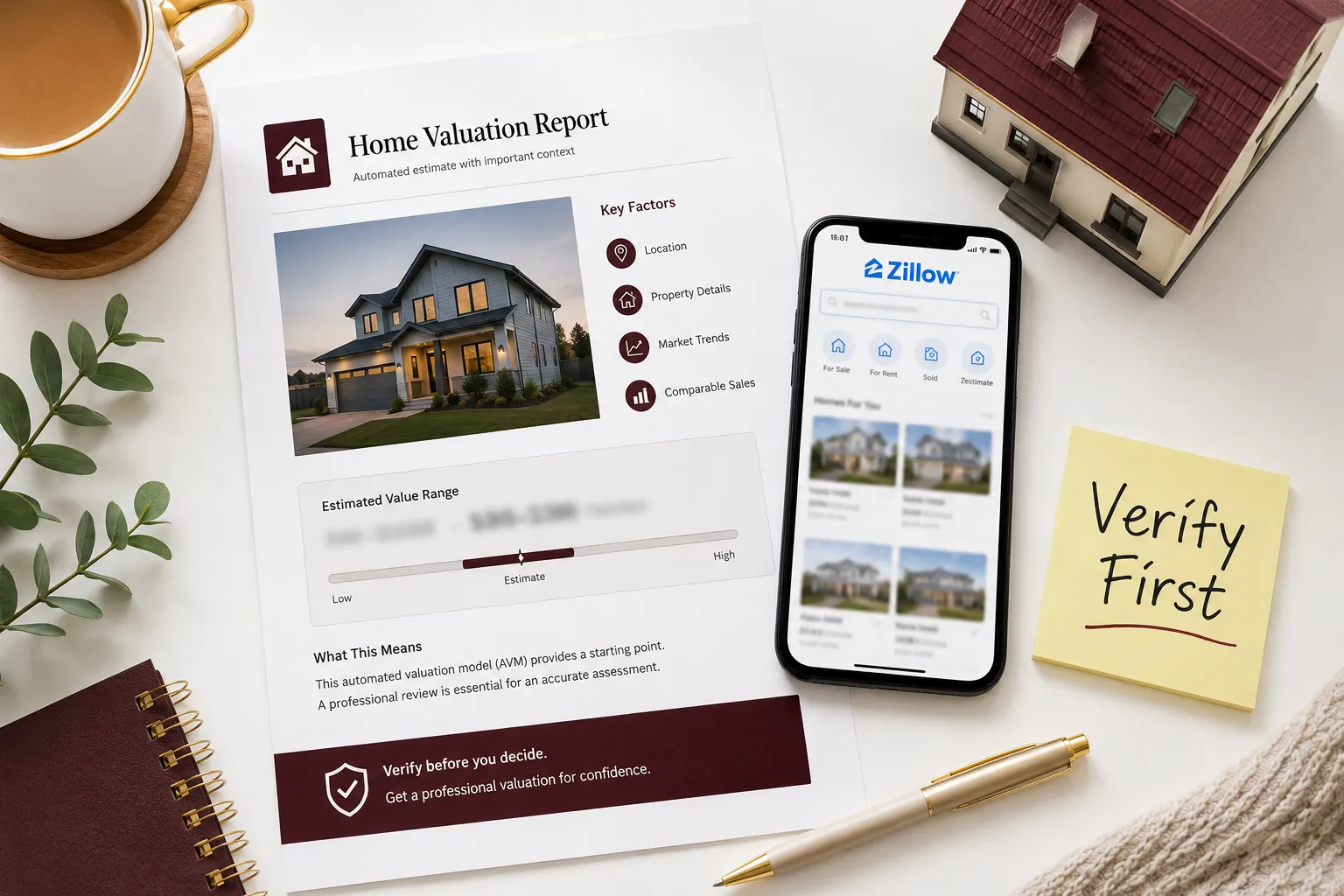
Quick Answer: An Automated Valuation Model (AVM) is a software-driven tool that uses public property records, recent sales data, and statistical algorithms to estimate a home's market value in seconds, no human appraiser required. AVMs power the price estimates you see on Zillow, Redfin, and dozens of lender platforms. They're fast and free, but they have real blind spots that every buyer, seller, and investor needs to understand before making a decision.
Key Takeaways
- AVM stands for Automated Valuation Model, a computer program that estimates home value using data, not a physical visit.
- Major AVM providers include Zillow (Neural Zestimate), Redfin Estimate, HouseCanary, Cotality (formerly CoreLogic), and ICE.
- AVMs use comparable sales, property characteristics, and statistical models like hedonic pricing and machine learning regression.
- Every AVM produces a confidence score, a reliability rating that tells you how much to trust the estimate.
- Fannie Mae and Freddie Mac accept AVMs for certain low-risk refinance transactions, but traditional purchase loans still typically require a full appraisal.
- AVM accuracy drops sharply in rural markets, thin data areas, and for unique or heavily renovated homes.
- The median error rate for most consumer AVMs ranges from roughly 2% to 7% in active markets, but can spike well above that in slow or unusual markets.
- Never make a final offer or listing price decision based solely on an AVM. Use it as a starting point, not a finish line.
- An AVM is not the same as a CMA (Comparative Market Analysis) or a licensed appraisal.
What Does AVM Stand For in Real Estate?
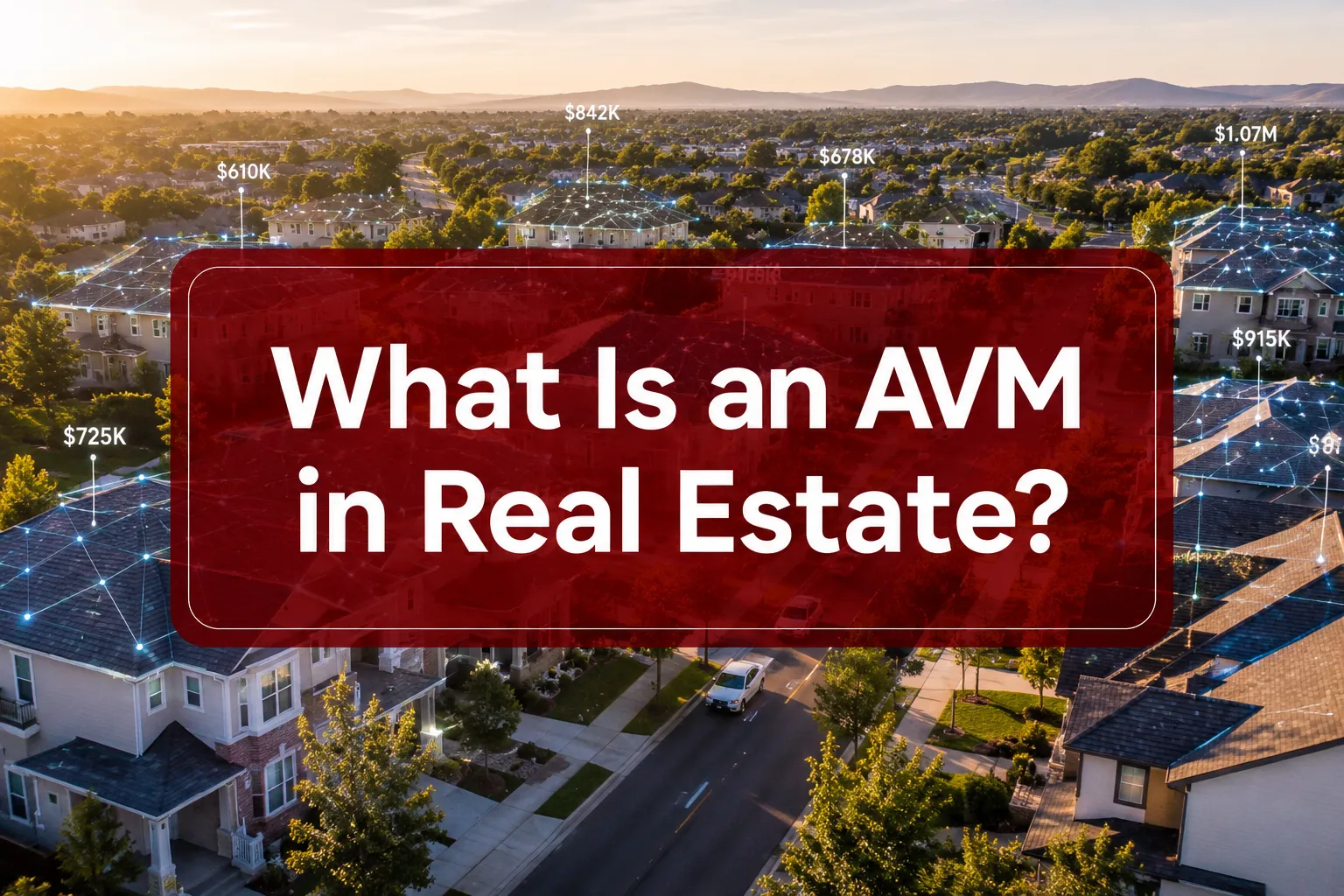
AVM stands for Automated Valuation Model. It's a computer-generated estimate of a property's market value, produced by running property data through a mathematical algorithm. No appraiser visits the home. No agent walks the neighborhood. The model does all the work in milliseconds.
The term gets used loosely across the industry, so let's be precise. An AVM is not:
- A licensed appraisal (which requires a certified professional and a physical inspection)
- A CMA or Comparative Market Analysis (which an agent builds manually using local knowledge)
- A tax assessment (which governments use for property tax purposes, often lagging market values by years)
An AVM is a statistical estimate. Think of it like a weather forecast, useful directional information, but not a guarantee of what you'll actually experience.
The question of what is an AVM in real estate comes up constantly in 2026 because these tools now appear everywhere: mortgage applications, iBuyer platforms, home equity decisions, and every major real estate search portal. Understanding how they work is no longer optional for serious buyers and sellers.
What Data Do AVMs Use to Estimate Home Value?
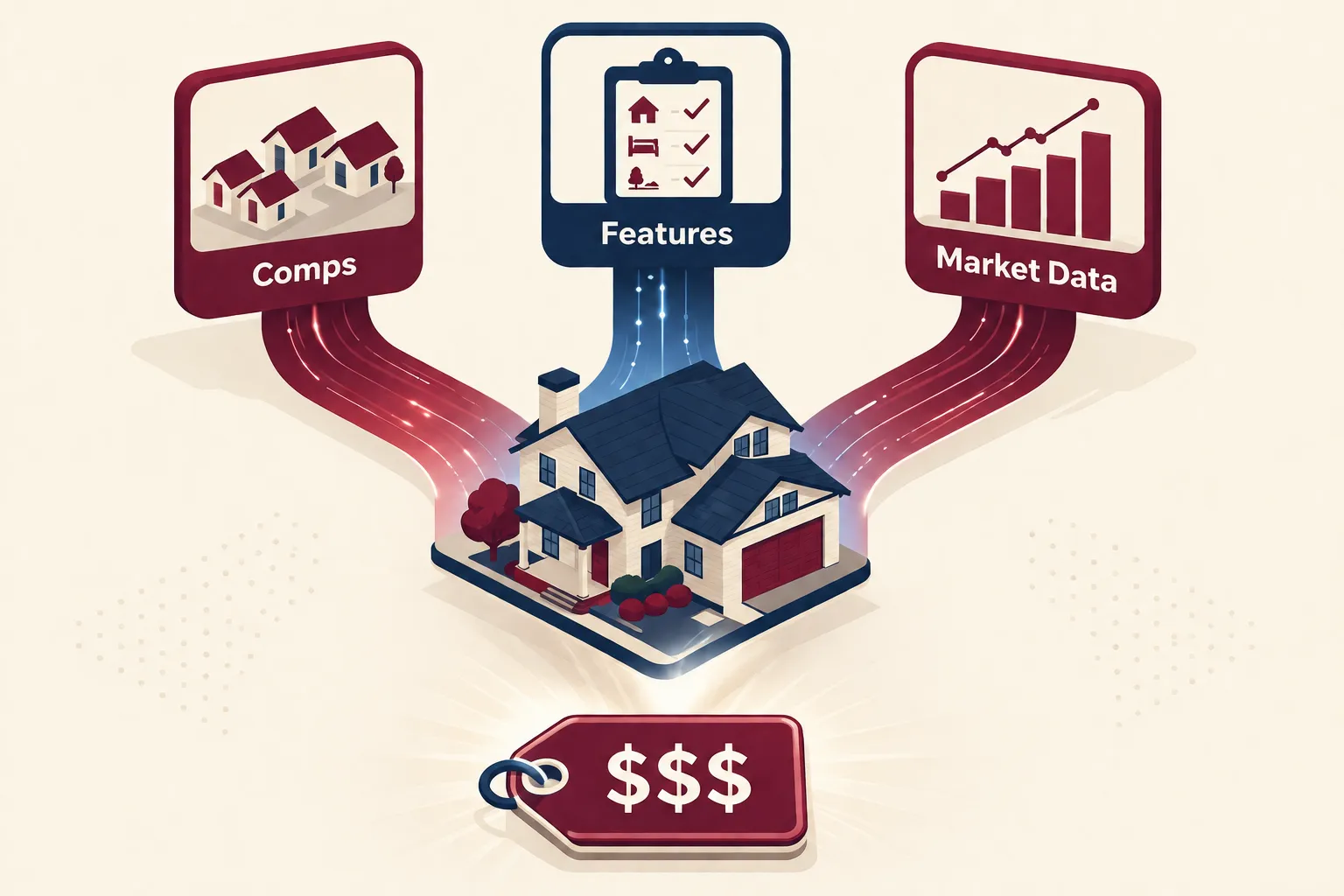
AVMs pull from several data sources simultaneously, then run that data through statistical models to produce a price estimate. The core inputs are:
Public Records Data
- County assessor records (square footage, lot size, year built, bedroom/bathroom count)
- Deed transfers and recorded sale prices
- Tax assessment history
MLS and Transaction Data
- Recent comparable sales (comps) within a defined radius and time window
- Days on market, list price vs. sale price ratios
- Foreclosure and distressed sale records
Property Characteristics (Hedonic Features)
A hedonic pricing model breaks a home's value into individual features and assigns a dollar contribution to each one. For example, the model might calculate that a third bathroom in a specific zip code adds approximately $18,000 to value, or that a corner lot adds 4%. Every feature, garage, pool, fireplace, school district rating, gets a weight.
Market Trend Data
- Local price appreciation rates
- Inventory levels and days-on-market trends
- Interest rate environment (some advanced models factor this in)
The more data available in a given area, the more accurate the AVM. That's the whole game.
How Do AVMs Work, The Plain-English Math
Here's how the algorithm actually prices your home, explained so a 7th grader could follow it.
Step 1, Find the Comps
The model searches for recently sold homes near yours that share similar characteristics: similar size, age, bedroom count, and location. These are called comparable sales or "comps."
Step 2, Apply Hedonic Adjustments
No two homes are identical. The hedonic pricing model adjusts for differences. If a comp has a pool and yours doesn't, the model subtracts an estimated pool value. If your home has an extra bathroom, it adds that value back. This is the same logic a human appraiser uses, the AVM just does it with equations instead of judgment.
Step 3, Run the Regression
Most AVMs use a form of multiple regression analysis, a statistical technique that finds the relationship between property features and sale prices across thousands of transactions. The output is a formula that predicts price based on inputs.
Advanced platforms like Zillow's Neural Zestimate layer in machine learning and neural networks, which can detect non-linear patterns that traditional regression misses. Think of it as regression that learns from its own mistakes over time.
Step 4, Output a Value and Confidence Score
The model spits out an estimated value AND a confidence score AVM rating. A high confidence score (often shown as a percentage or a letter grade) means the model found plenty of good comparable data. A low confidence score means the model is guessing harder, and you should trust it less.
This is the part most people skip over. Always check the confidence score before acting on any AVM estimate.

AVM vs Appraisal, What's the Difference?
An AVM and a licensed appraisal both try to answer the same question, what is this home worth?, but they get there very differently.
| Factor | AVM | Licensed Appraisal |
|---|---|---|
| Who produces it | Algorithm / software | Certified human appraiser |
| Physical inspection | None | Yes, interior and exterior |
| Speed | Seconds | 1-2 weeks typically |
| Cost | Free to low-cost | $400,$700+ depending on market |
| Accepted by lenders | Sometimes (refinance/low-risk) | Required for most purchase loans |
| Accounts for condition | Rarely | Yes |
| Accounts for renovations | Rarely | Yes |
| Legal standing | None | Legally defensible document |
The bottom line: an appraisal wins on accuracy and legal weight. An AVM wins on speed and cost. For major financial decisions, buying, selling, or refinancing, an appraisal is the standard. AVMs are best used as a quick gut-check before you go deeper.
AVM vs CMA, Which One Should You Use?
An AVM and a CMA (Comparative Market Analysis) are not the same thing, and the difference matters when you're pricing a listing or making an offer.
A CMA is prepared by a licensed real estate agent who manually selects comparable sales, adjusts for local nuances, and applies professional judgment. An experienced agent knows that the house on the corner of Elm Street floods every spring, or that the school rezoning last year changed buyer demand in that subdivision. An algorithm doesn't know any of that.
Use an AVM when:
- You want a fast ballpark before calling an agent
- You're monitoring a neighborhood's price trends over time
- You're an investor screening multiple properties quickly (see our guide on top real estate AI tools for investors)
Use a CMA when:
- You're actively listing a home and need a defensible price
- You're preparing an offer and need to know fair market value
- The market is moving fast and you need current, human-filtered data
Use a licensed appraisal when:
- A lender requires it (almost always for purchase loans)
- You're disputing a tax assessment
- You need a legally defensible value for estate, divorce, or legal purposes
The question of what is an AVM in real estate versus what a CMA delivers is one of the most common points of confusion for first-time buyers. They're complementary tools, not interchangeable ones.
How Accurate Are Automated Valuation Models for Home Pricing?
AVM accuracy varies significantly by provider, market density, and property type. In active urban and suburban markets with plenty of recent sales data, top AVMs perform reasonably well. In thin markets or for unusual properties, accuracy falls off fast.
Here's what the major providers have published or disclosed about their own median error rates (the percentage by which the estimate misses the actual sale price at the median):
| AVM Provider | Median Error Rate (On-Market) | Median Error Rate (Off-Market) | Notes |
|---|---|---|---|
| Zillow Neural Zestimate | ~2.4% | ~7.49% | Zillow’s self-reported figures; on-market accuracy benefits from active listing data |
| Redfin Estimate | ~2.08% | ~6.49% | Redfin’s self-reported figures; strong in markets where Redfin has direct MLS access |
| HouseCanary | ~2.5-3.5% (estimated) | Varies | Institutional-grade AVM used by lenders; exact consumer figures not publicly published |
| Cotality (CoreLogic) | Varies by product tier | Varies | Primary lender-facing AVM; not consumer-published; widely used in mortgage origination |
| ICE (Intercontinental Exchange) | Varies by product tier | Varies | Lender and servicer platform; not consumer-facing; institutional accuracy standards |
Important context: These are median error rates. Half of all estimates fall outside that range. A 2.4% median error on a $400,000 home still means the estimate could be off by nearly $10,000 at the midpoint, and significantly more in the tail.
The on-market vs. off-market gap is the real story. When a home is actively listed, AVMs can pull current listing data to sharpen the estimate. When a home is off-market (no active listing), the model has less to work with, and error rates roughly double or triple.

Why Is My AVM Estimate Lower Than My Realtor's Opinion?
This is one of the most common frustrations sellers face, and the answer is almost always one of three things.
1. The AVM doesn't know about your renovations.
Did you gut the kitchen last year? Replace the roof? Add a finished basement? The AVM is working from public records, which often lag by months or years. Your county assessor may still have your home listed with the original 1990s kitchen. The algorithm prices what it sees in the data, not what's actually in your home.
2. Your agent is pricing for current demand, not historical comps.
A good agent accounts for buyer sentiment, current inventory levels, and neighborhood momentum, things an algorithm can't fully capture. If your market is hot right now and inventory is tight, an experienced agent may price above what the AVM suggests because they know buyers are competing. For context on how broader economic forces shape these dynamics, check out our piece on how the economy shapes real estate prices and demand.
3. The AVM's comps may be stale or poorly matched.
If the algorithm pulled comps from 8 months ago in a rising market, or matched your 4-bedroom colonial to a 3-bedroom ranch because they're the same square footage, the estimate will be off.
The AVM isn't always wrong. Sometimes agents overprice to win a listing. If your AVM is significantly lower than your agent's CMA, ask the agent to walk you through their comp selection line by line. That conversation is worth having before you commit to a list price.
Are AVMs Reliable for Buying and Selling Decisions?
AVMs are a solid starting point but a poor finish line. Here's the honest breakdown:
Where AVMs are reliable:
- Getting a quick ballpark on a home you're considering touring
- Monitoring price trends in a target neighborhood over several months
- Screening investment properties before ordering a full analysis (our HouseCanary vs Skyline AI comparison covers this in depth for investors)
- Checking whether a listing price is in a reasonable range
Where AVMs are not reliable:
- Setting a final list price without agent input
- Making an offer without a CMA or appraisal contingency
- Evaluating a home with major renovations, unique architecture, or custom features
- Any property in a rural, low-transaction, or highly specialized market
The so-based move here is to treat the AVM like a first draft. It gives you context. It does not give you certainty.
How Do AVMs Handle Homes in Rural or Unique Areas?
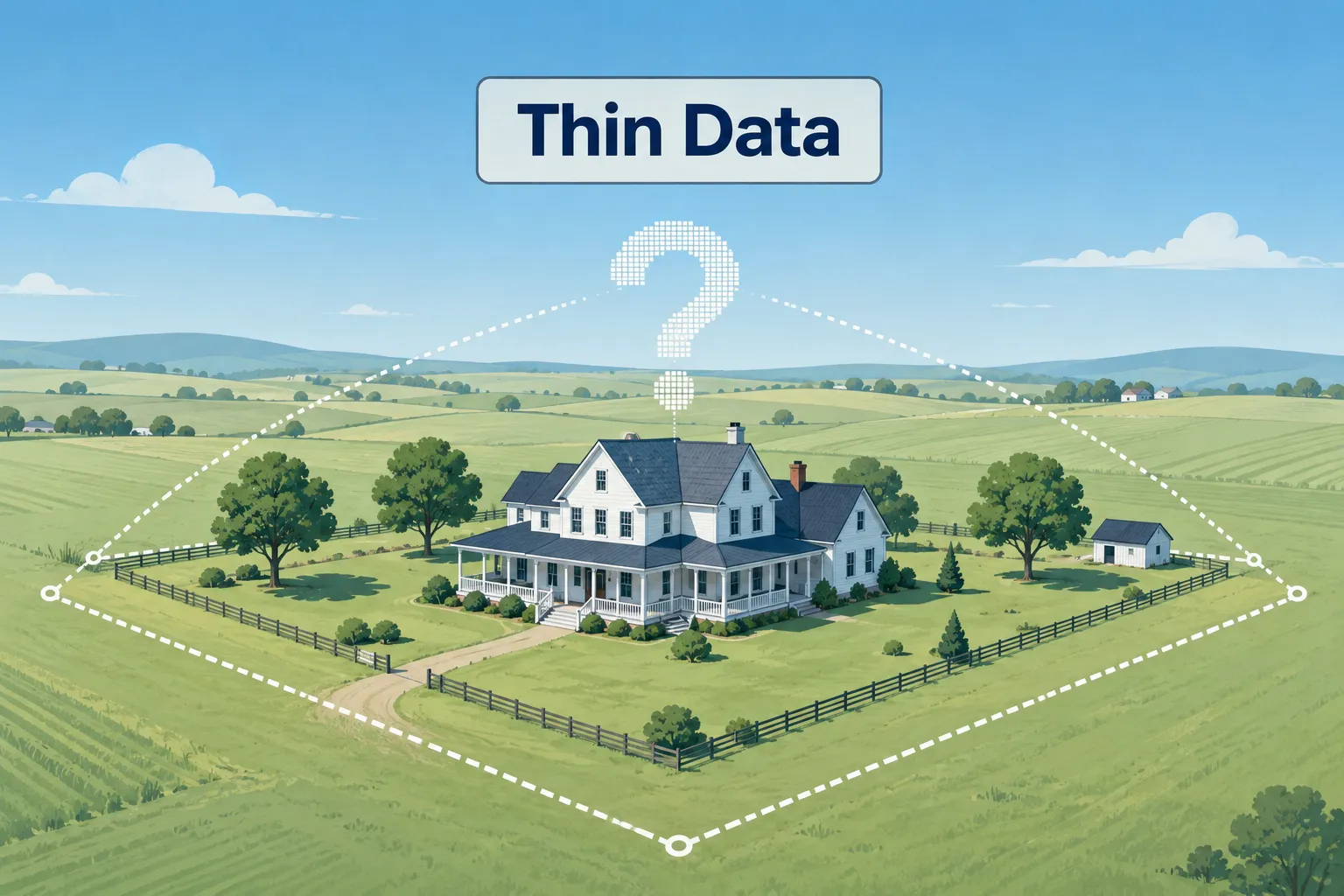
This is where automated valuation models genuinely struggle, and it's not gatekeeping to say so, it's just math. AVMs need comparable sales data to function. No comps, no accuracy.
Rural markets: In areas where fewer than 5-10 homes sell per year within a reasonable radius, the model has almost nothing to work with. It may pull comps from 20+ miles away, or from sales that are 2-3 years old. Both scenarios produce estimates with low confidence scores and wide error ranges.
Unique properties: A custom-built home with unusual architecture, a converted barn, a historic property with original details, or a home with a large acreage component, none of these fit neatly into a regression model built on standard suburban homes. The algorithm will try to match it to something, but the match will be imprecise.
Heavily renovated homes: As noted above, public records rarely reflect recent improvements. A $150,000 whole-home renovation may not show up in the AVM's data at all.
If you're buying or selling a unique or rural property, skip straight to a licensed appraisal and a CMA from an agent with genuine local expertise. The AVM is not your friend in these situations. This also applies to investors analyzing properties in emerging markets, our guide on the best real estate markets for flipping houses covers how to supplement AVM data with boots-on-the-ground research.
What Are the Biggest Limitations of Automated Home Valuations?
The limitations of automated valuation models are worth knowing before you rely on one. Here's the full list:
- No interior condition data. An AVM cannot see deferred maintenance, water damage, outdated systems, or a beautifully staged interior. Two identical floor plans on the same street can differ by $50,000 based on condition alone.
- Renovation lag. Permit data and assessor records update slowly. Recent improvements are often invisible to the model.
- Thin comp pools. Low-volume markets produce unreliable estimates regardless of how sophisticated the algorithm is.
- Outlier sales skew results. One distressed sale or one over-market sale in a small comp pool can pull the estimate significantly off.
- No neighborhood nuance. The algorithm doesn't know that one block has a noise problem from a nearby highway, or that a new coffee shop just opened and is driving buyer demand.
- Confidence score is often ignored. Most users see the number and stop. The confidence score is the most important part of the AVM output, and most people never look at it.
- Off-market accuracy is significantly lower. This point deserves repeating. If your home isn't currently listed, expect a wider error range.
Zillow Zestimate vs AVM, Which Is More Accurate?
The Zillow Neural Zestimate is an AVM. It's one of the most well-known consumer-facing automated valuation models in the U.S., but it's not a separate category, it's a specific implementation of AVM technology.
What makes the Zestimate distinctive is its use of neural networks (hence "Neural Zestimate"), which allow it to process more complex patterns than traditional regression models. Zillow also benefits from direct MLS data feeds in most markets, which gives it a significant data advantage over models that rely solely on public records.
The Redfin Estimate uses a similar machine-learning approach and, in markets where Redfin has direct MLS access, often performs comparably or slightly better on median error rates for on-market homes.
Institutional AVMs from Cotality (formerly CoreLogic) and ICE are generally considered more accurate for lender use cases because they're built on deeper data pipelines and are regularly validated against actual loan performance. But they're not consumer-facing, you won't find them on a public website.
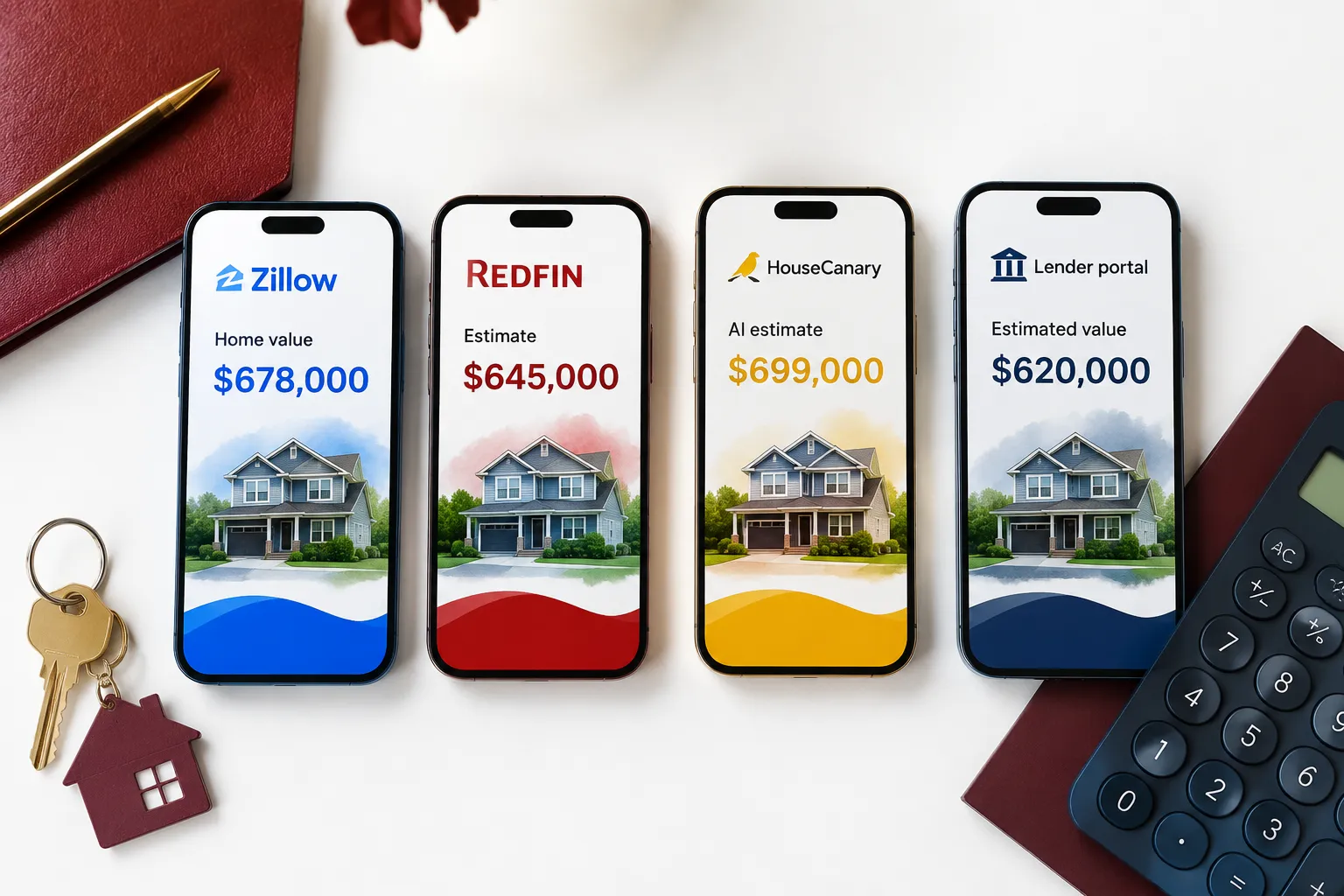
The honest answer: no single AVM is consistently "most accurate" across all markets and property types. The best approach is to check two or three AVMs, note whether their estimates are in a similar range, and look at each one's confidence score. If they're all clustered together with high confidence scores, you have a reasonable ballpark. If they're spread far apart or showing low confidence, treat all of them with skepticism.
Do Lenders Accept AVM Valuations Instead of Appraisals?
Yes, in specific, limited circumstances. This is where Fannie Mae and Freddie Mac guidelines matter.
Both government-sponsored enterprises have approved the use of AVMs for certain low-risk transactions, primarily:
- Refinance transactions where the borrower has significant equity and the loan-to-value ratio is low
- Home equity loans and HELOCs where lenders assess risk against existing equity
- Property inspection waivers (PIWs), Fannie Mae's program that allows appraisal waivers on eligible refinances based on AVM data
For standard purchase transactions, a full appraisal is still the norm and typically required by lenders. The AVM may be used internally by the lender as a risk check, but it doesn't replace the appraisal in the loan file.
The short version: if you're refinancing with strong equity in a well-documented market, your lender may accept an AVM-based valuation and skip the traditional appraisal. If you're buying a home with a conventional mortgage, plan on a full appraisal. For a deeper look at how financing works from the ground up, our real estate financing guide covers the full picture.
Can You Use an AVM Valuation to Refinance Your Home?
Yes, in many cases. This is one of the most practical applications of AVM technology for homeowners in 2026.
When you apply for a refinance, your lender will order their own valuation, often through an institutional AVM provider like Cotality or ICE, to determine your current loan-to-value ratio. If the AVM comes back with a strong confidence score and the numbers support the loan terms, the lender may issue a property inspection waiver and proceed without a traditional appraisal.
This saves you $400,$700 in appraisal fees and speeds up closing by 1-2 weeks.
When an AVM-based refinance works:
- Your home is in an active, well-documented market
- You have at least 20% equity
- The loan amount is within conforming limits
- The AVM confidence score is high
When you'll still need a full appraisal:
- Your home is in a rural or thin-data market
- You've made significant improvements the AVM data doesn't reflect
- The lender's AVM returns a low confidence score
- You're doing a cash-out refinance above certain LTV thresholds
If you want the appraisal waiver, it helps to understand what the AVM sees. Pull the Zestimate and Redfin Estimate before applying. If both are comfortably above your target loan amount, you're in a good position. If they're borderline, prepare for a full appraisal.
How Often Do AVMs Update Their Price Predictions?
Update frequency varies by provider, but here's the general landscape:
- Zillow Neural Zestimate: Updates daily for most properties with active listing data; less frequent for off-market homes
- Redfin Estimate: Updates daily for listed homes; periodic updates for off-market properties
- HouseCanary: Updates monthly for its institutional AVM products; varies by subscription tier
- Cotality and ICE: Update on a scheduled basis tied to data refresh cycles; typically monthly or quarterly for lender-facing products
More frequent updates don't always mean more accurate updates. A daily update in a thin market is just the model recalculating with the same limited data. The update frequency matters most in fast-moving markets where recent sales are happening regularly and feeding new information into the model.
If you're tracking a neighborhood's price trajectory over time, checking an AVM monthly gives you a reasonable trend line. Checking it daily in a slow market is mostly noise.
Common Mistakes People Make Trusting AVM Estimates
The question of what is an AVM in real estate is only half the equation. Knowing how people misuse them is just as important.
Mistake 1, Treating the AVM as the final word on price.
It's a starting point. Always verify with a CMA from a local agent before listing or making an offer.
Mistake 2, Ignoring the confidence score.
A low confidence score is the AVM telling you it's guessing. Most people see the number and ignore the score. Don't be that person.
Mistake 3, Using an AVM for a unique or heavily renovated property.
The algorithm doesn't know about your $80,000 kitchen remodel. Get an appraisal or a CMA instead.
Mistake 4, Comparing AVMs without checking their data freshness.
Some platforms pull older comp data. If the AVM you're looking at hasn't updated in 90 days, its estimate may not reflect current market conditions.
Mistake 5, Using a single AVM.
Check at least two or three. If they're all in a similar range, you have more confidence. If they're spread by 10%+, that spread itself is information, it means the data is thin or the property is hard to value.
Mistake 6, Letting an AVM talk you out of a good deal.
Sometimes AVMs undervalue properties in rapidly appreciating markets because they're working from historical data. If your agent's CMA and your own research suggest a property is underpriced, don't let a lagging algorithm be the reason you walk away. For sellers facing a similar dilemma, our piece on questions to ask your broker when your home isn't selling is worth reading.
What Is an AVM in Real Estate? The Full Plain-English Breakdown
Understanding what is an AVM in real estate means understanding the math behind it, and it's actually not that complicated once you strip away the jargon.
The Three Core Methods AVMs Use
1. Hedonic Pricing Model
This is the workhorse of most AVM systems. A hedonic pricing model breaks a home down into individual features, bedrooms, bathrooms, square footage, lot size, garage, pool, school district rating, and assigns a dollar value to each one based on how buyers in that market have historically priced those features.
Think of it like building a burger. Each topping (extra bedroom, finished basement, updated kitchen) adds a specific dollar amount to the base price. The model adds them all up and spits out a value. That's the hedonic approach.
2. Comparable Sales (Comps) Analysis
AVMs also look at what similar homes nearby sold for recently. The algorithm identifies "comps", properties that match your home's size, age, style, and location, and uses those sale prices as anchors. The more recent and similar the comps, the more accurate the estimate.
3. Statistical Regression
Behind both methods sits regression analysis, a statistical technique that finds the relationship between variables (like square footage and price) across thousands of data points. The model draws a mathematical "best fit" line through all that data and uses it to predict where your home lands.
Modern platforms like Zillow's Neural Zestimate layer machine learning on top of these traditional methods. Neural networks can catch non-linear patterns, like the fact that a third bathroom adds more value in a four-bedroom home than in a two-bedroom condo, that basic regression misses.
What Is a Confidence Score AVM?
A confidence score is the AVM's way of saying "here's how sure we are about this number." It's usually expressed as a range or a letter grade. A high-confidence estimate means the model had plenty of recent, similar sales data to work with. A low-confidence score means the estimate is a rough guess, the model didn't have enough comparable data and the margin of error widens significantly.
Always check the confidence score before acting on an AVM number. A low-confidence estimate on a unique property could be off by 15% or more in either direction.
Why Is My AVM Estimate So Different From My Real Estate Agent's Price?
This is one of the most common frustrations buyers and sellers hit, and the answer is almost always one of these five reasons:
Recent renovations the AVM doesn't know about. If you put $40,000 into a kitchen remodel last year, the algorithm has no idea. It's pricing the home based on what the tax records and old listing data say, not what it looks like today.
Thin comparable sales data. In slower markets or rural areas, there simply aren't enough recent sales for the algorithm to anchor on. The AVM is essentially guessing, and the confidence score will reflect that.
Unique or custom features. A home with a guest house, a commercial-grade workshop, or a custom pool sits outside the normal comp range. The algorithm averages those features against standard homes and often gets it wrong.
Market timing lag. AVMs update on different schedules, some daily, some weekly, some less frequently. In a fast-moving market, the AVM might be pricing based on sales from three months ago while your agent is pricing based on what closed last week.
The agent knows the neighborhood micro-dynamics. A great agent doing a fresh CMA knows that the house two blocks over sold for $30,000 under asking because of a foundation issue, and they'll exclude it from comps. The AVM doesn't know that. It just sees a sale price.
This is exactly why the phrase "let it cook before you see results" applies to AVM data, the algorithm needs time and transaction volume to get accurate. In hot markets with lots of sales, it cooks beautifully. In thin markets, it's still raw.
Best Free AVM Tools for Checking Home Value
These are the most widely used free AVM tools available to consumers in 2026:
- Zillow (Neural Zestimate), zillow.com; best for quick estimates with a large data set; on-market accuracy is strong
- Redfin Estimate, redfin.com; slightly more accurate on-market due to direct MLS data feeds; updates frequently
- Realtor.com Home Value Estimator, powered by third-party AVM data; useful as a cross-reference
- Chase MyHome, free tool from Chase Bank; pulls from a lender-grade AVM; good for homeowners monitoring equity
- Bank of America Home Value Estimator, similar to Chase; lender-grade AVM for existing homeowners
Pro tip: Run your address through at least three different tools and compare the outputs. If they're all within 3-5% of each other, you have a reasonably reliable range. If they're spread by 10% or more, that's a signal the data is thin and you need a CMA from a local agent.
For sellers specifically, our guide on preparing your home for sale in 2026 pairs well with this research step.
Who Uses AVMs and Why Do Real Estate Companies Rely on Them?
AVMs are used across the entire real estate ecosystem, not just by curious homeowners checking their Zestimate.
Mortgage lenders use AVMs from providers like Cotality (formerly CoreLogic) and ICE Mortgage Technology to run quick valuations during loan origination and refinancing. They're also used for portfolio monitoring, banks regularly run AVMs across their entire mortgage book to flag properties that may have dropped below acceptable equity thresholds.
Real estate investors use institutional-grade AVMs like HouseCanary to screen large volumes of properties quickly before deciding which ones warrant deeper due diligence.
iBuyers and cash offer platforms built their entire business models on AVM technology, using algorithms to generate instant offers at scale. The accuracy of those AVMs directly determines whether the company makes or loses money.
Real estate agents use AVM data as a starting point for CMAs, though experienced agents know to treat it as one data input among many rather than a final answer.
Government-sponsored enterprises, Fannie Mae and Freddie Mac, use AVMs to assess collateral risk across the loans they guarantee, making AVM accuracy a systemic issue for the entire U.S. mortgage market.
If you're an agent looking to incorporate smarter tools into your workflow, our guide to best AI tools for real estate agents covers how AVM-adjacent technology fits into a modern practice.
Conclusion: How to Use AVM Data Without Getting Burned
Understanding what is an AVM in real estate gives you a real advantage, whether you're buying, selling, or just keeping tabs on your equity. These tools are extraordinary at what they do: processing massive datasets at machine speed to give you a fast, free starting point. But they're a starting point, not a finish line.
Here's how to use them right:
- Run three AVMs (Zillow, Redfin, Realtor.com) and note the range, not just one number.
- Check the confidence score before putting any weight on the estimate.
- Update your home facts on Zillow and Redfin if you've done renovations, the algorithm can only work with what it knows.
- Get a CMA from a local agent before listing or making an offer, especially if the AVM confidence is low or your property is unique.
- Understand the lag, AVM data trails real market conditions, so pair it with current market trend data.
For buyers and sellers navigating the 2026 market, AVMs are one of the freshest tools in your research kit. Use them smart, cross-reference everything, and don't let a single algorithm make a six-figure decision for you.
For the latest on what's moving the market right now, check out our U.S. homeowners national real estate updates for 2026.
Tags: automated valuation model, AVM accuracy, Zestimate algorithm, AVM vs appraisal, hedonic pricing model, HouseCanary, Zillow Neural Zestimate, home valuation tools, real estate algorithms, confidence score AVM, Redfin Estimate, do lenders use AVMs
For more home buying resources and market insights, visit the Home Buying Hub.
Conclusion, What to Do With This Information Right Now
Understanding what is an AVM in real estate and how algorithms price your home is genuinely useful knowledge, but only if you act on it correctly.
Here's the practical takeaway:
If you're selling: Pull the Zestimate and Redfin Estimate for your home today. Check the confidence score on each. Then compare those numbers to the CMA your agent provides. If there's a significant gap, ask your agent to explain the difference comp by comp. That conversation will sharpen your pricing strategy. Also read our guide on preparing your home for sale in 2026 to make sure the physical condition of your home matches the price you're targeting.
If you're buying: Use AVMs to screen neighborhoods and get a quick read on whether a listing price is in a reasonable range. But never waive your appraisal contingency based on an AVM alone. The appraisal is your protection.
If you're refinancing: Check your home's AVM estimates before applying. If both major consumer AVMs show strong equity and high confidence scores, ask your lender whether a property inspection waiver is available for your loan type.
If you're investing: AVMs are extraordinary screening tools when you're evaluating dozens of properties quickly. But let it cook before you see results, do the deeper due diligence on any property you're serious about. Our cash flow real estate investing guide walks through the full analysis process.
The algorithm is impeccable at processing data at scale. It is not impeccable at understanding your specific home. Use it accordingly.
Frequently Asked Questions
What does AVM stand for in real estate?
AVM stands for Automated Valuation Model. It's a software program that estimates a property's market value using public records, comparable sales, and statistical algorithms, without a physical inspection.
Is a Zestimate an AVM?
Yes. Zillow's Zestimate (now called the Neural Zestimate) is one of the most widely used consumer-facing automated valuation models in the U.S. It uses machine learning and neural networks to generate its estimates.
How accurate is an AVM?
In active markets, top AVMs like the Zillow Neural Zestimate and Redfin Estimate report median error rates of roughly 2-3% for on-market homes. For off-market homes, median error rates typically rise to 6-8% or higher. Accuracy drops significantly in rural areas and for unique properties.
Can an AVM replace a home appraisal?
Not for most purchase transactions. Lenders require a licensed appraisal for conventional purchase loans. AVMs may be accepted for certain refinance transactions and home equity products where Fannie Mae or Freddie Mac guidelines allow property inspection waivers.
What is a confidence score on an AVM?
A confidence score indicates how much reliable data the AVM found to produce its estimate. A high confidence score means the model had plenty of good comparable sales data. A low confidence score means the estimate is less reliable and should be verified with a CMA or appraisal.
Why does my AVM estimate differ from my agent's CMA?
AVMs work from public records and historical sales data. They don't account for recent renovations, current buyer demand, or local market nuances. A CMA prepared by a local agent incorporates current market conditions and professional judgment that algorithms can't replicate.
Do lenders use AVMs?
Yes. Lenders use institutional AVM products from providers like Cotality (formerly CoreLogic) and ICE for risk assessment, refinance decisions, and home equity products. These are different from consumer-facing tools like Zillow and are generally held to higher accuracy standards.
How often does the Zestimate update?
Zillow updates the Neural Zestimate daily for homes with active listing data. Off-market homes update less frequently, depending on data availability in that market.
What is a hedonic pricing model?
A hedonic pricing model breaks a home's total value into the individual contributions of its features, square footage, bedrooms, bathrooms, lot size, school district, and so on. Each feature gets a statistical weight based on how buyers in that market have historically valued it. AVMs use hedonic models as a core component of their valuation math.
Should I use an AVM to decide my listing price?
Use it as a starting reference, not a final answer. Always pair it with a CMA from a local agent who knows your specific neighborhood. The AVM gives you a data-driven baseline; the CMA gives you market-aware context.
Which AVM is most accurate?
No single AVM is most accurate across all markets and property types. Redfin and Zillow both report strong median error rates for on-market homes in active markets. For off-market or rural properties, accuracy varies widely. Checking multiple AVMs and comparing their confidence scores gives you a more reliable picture than relying on any one tool.
Can an AVM account for a major renovation?
Generally, no. AVMs pull from public records and assessor data, which often lag actual improvements by months or years. If you've made significant renovations, a licensed appraisal is the only reliable way to capture that added value in a formal valuation.
For more real estate intelligence delivered straight from brokers who've been in the field, visit Real Estate Rank IQ or subscribe to our newsletter at news@realestaterankiq.com. Ranked by brokers. Read by everyone.