

Last updated: August 23, 2026

Quick Answer: What does contingent mean in real estate? Not sold yet, a contingent listing means a seller has accepted an offer, but the deal depends on one or more conditions being met before it officially closes. The home is still technically available if those conditions fall apart. Until every contingency is satisfied or waived, the property is not sold.
Key Takeaways
- Contingent means an offer has been accepted, but specific conditions must be met before the sale is final
- The most common contingencies are home inspection, financing, and appraisal
- A contingent home is not the same as sold, deals fall through roughly 3% to 5% of the time, according to NAR data
- Contingent differs from pending: pending means contingencies have been cleared and closing is imminent
- Buyers can still submit backup offers on contingent homes in most markets
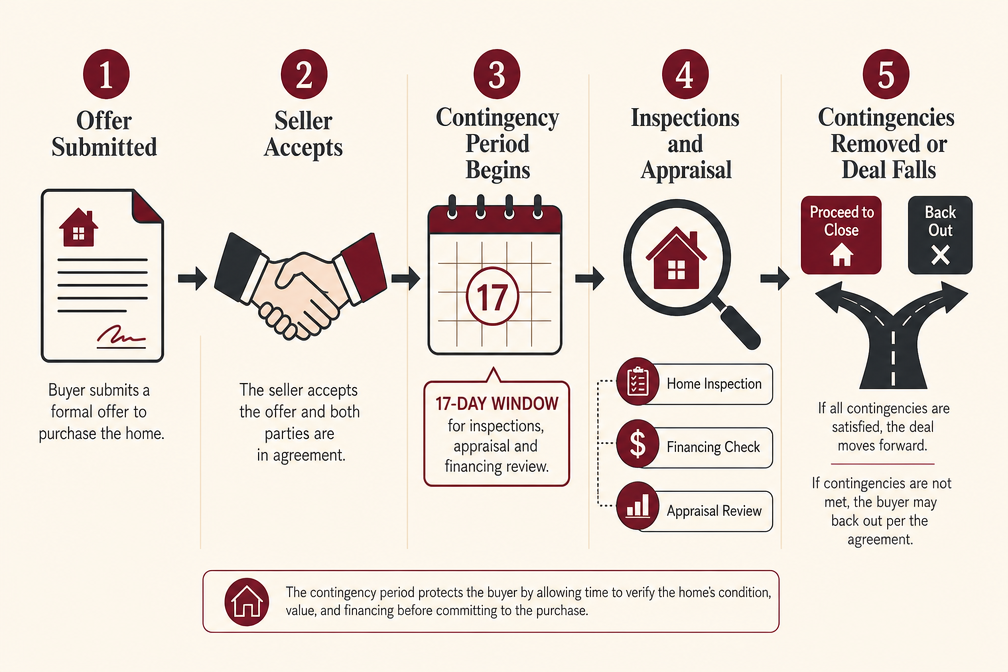
- The average contingency period runs 17 to 30 days depending on the contract terms and state
- A kick-out clause lets sellers continue marketing and accept a better offer under specific conditions
- Removing contingencies speeds up closing but increases buyer risk, know what you are waiving before you sign
What Does Contingent Mean in Real Estate, Exactly?
A contingent status in real estate means a seller has accepted a buyer's offer, but the transaction is not finalized. One or more conditions, called contingencies, must be satisfied before the deal moves to closing. If those conditions are not met, either party may have the right to walk away, often without penalty.
Think of it like a conditional job offer. You got the call, they want you, but the background check and drug test still have to clear. The job is not yours until those boxes are checked.
For buyers scrolling listings and seeing "contingent," this is the key thing to understand: that home is not sold yet. The door may still be open.
What does contingent mean in realty across different states? The mechanics are the same, but the specific language and timelines vary by state contract forms. In California, the standard residential purchase agreement sets a 17-day default inspection period. In Texas, the option period typically runs 7 to 10 days. Always check your state's standard forms.
What Does Contingent Mean in Real Estate vs. Pending vs. Sold?
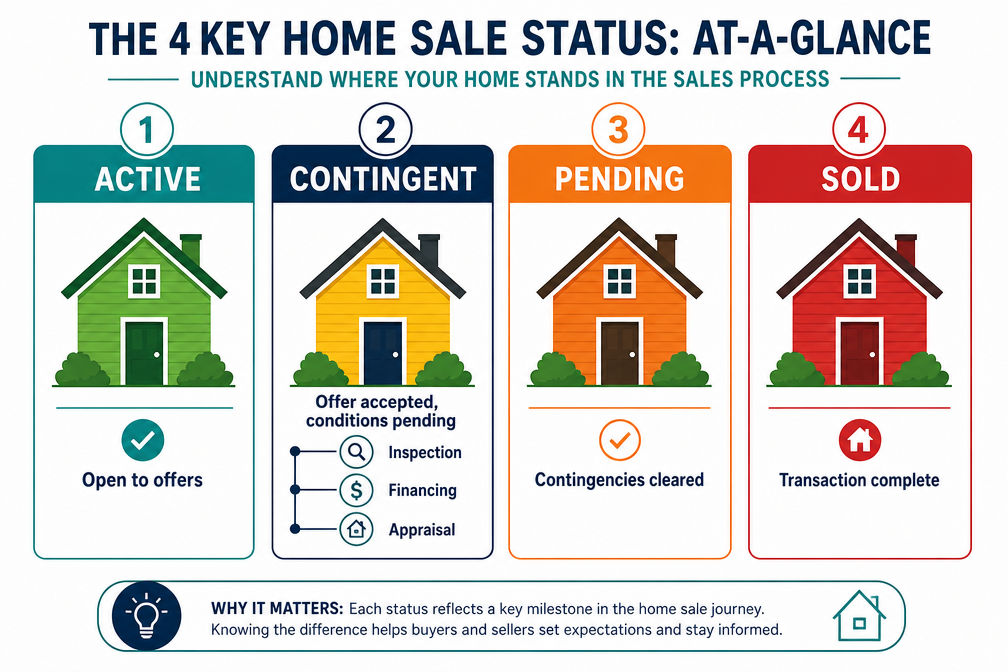
Contingent, pending, and sold are three different listing statuses, and mixing them up can cost a buyer a real opportunity.
| Status | What It Means | Can You Make an Offer? |
|---|---|---|
| Active | No accepted offer; fully available | Yes |
| Active Contingent | Accepted offer with conditions; some MLSs show this separately | Yes, as a backup |
| Contingent | Accepted offer, conditions still in play | Yes, as a backup |
| Pending | Contingencies cleared, closing scheduled | Rarely, depends on seller |
| Sold | Transaction complete, title transferred | No |

Contingent vs pending is the comparison buyers get wrong most often. Pending is further along. Once a listing flips to pending, the buyer and seller have typically signed off on all contingency removals and the transaction is heading straight to the closing table. Contingent means the deal is still in the conditional phase.
Does contingent mean sold? No. A contingent home sale can still unravel. Pending is much closer to a done deal, but even pending transactions occasionally fall apart before closing.
Under contract vs contingent is another phrase worth sorting out. "Under contract" is a broad term that can describe both contingent and pending stages. Some agents use it interchangeably with contingent. When you see "under contract," ask specifically whether contingencies have been removed.
What Are the Most Common Contingencies in a Home Sale?
The three contingencies that appear in the vast majority of residential contracts are inspection, financing, and appraisal. Each one gives the buyer a defined window to evaluate a specific risk and either proceed or exit.
Home Inspection Contingency
The buyer hires a licensed inspector to evaluate the property's condition. If the inspection reveals problems, the buyer can request repairs, ask for a price reduction, or cancel the contract. This is the most frequently used contingency and the one most likely to generate negotiation after the initial offer is accepted.
Financing Contingency
Also called a mortgage contingency, this protects the buyer if their loan falls through. If the lender denies the mortgage or changes the terms materially, the buyer can exit and recover their earnest money deposit. This matters a lot in a market where rates near 6.6% to 6.8% (as of mid-2026) can shift a buyer's qualification status.
Appraisal Contingency
The lender requires an appraisal to confirm the home's value supports the loan amount. If the appraisal comes in below the purchase price, the buyer can renegotiate, make up the difference in cash, or walk away. In a market where 80% of metro areas saw price gains in Q2 2026 (NAR), appraisal gaps are a live risk.
Other contingencies buyers and sellers encounter include:
- Home sale contingency, the buyer must sell their current home first
- Title contingency, clear title must be confirmed before closing
- HOA document review, buyer reviews condo or HOA rules within a set window
- Radon, mold, or septic inspections, specific to property type or location
How Long Does a Contingent Offer Last?
Most contingency periods run between 7 and 30 days, depending on the type of contingency and the contract terms both parties agreed to.
Here are typical windows by contingency type:
- Inspection contingency: 7 to 17 days (California default is 17 days; many other states use 10)
- Financing contingency: 21 to 30 days, sometimes longer for complex loans
- Appraisal contingency: 14 to 21 days, often tied to the financing timeline
- Home sale contingency: 30 to 60 days, sometimes with a kick-out clause attached
How long does contingent last overall? The full contingency phase from accepted offer to contingency removal typically runs 2 to 4 weeks for a standard purchase with inspection and financing contingencies. Add a home sale contingency and that window stretches considerably.
Once the contingency period expires, the buyer must either formally remove the contingency in writing or the seller may have grounds to cancel the contract, depending on state law. Missing a contingency deadline is one of the most common and expensive mistakes first-time buyers make.
Can a Contingent Offer Fall Through?
Yes, contingent offers fall through regularly. NAR data has consistently shown that roughly 3% to 5% of home purchase contracts are terminated before closing in any given month. The actual rate varies by market conditions, rate environment, and buyer pool.
The most common reasons a contingent home sale collapses:
- Inspection reveals major defects, foundation issues, roof failures, plumbing problems that the seller won't repair or credit
- Buyer's financing falls through, job loss, credit score change, or lender denial after appraisal
- Low appraisal with no resolution, buyer can't cover the gap and seller won't reduce the price
- Buyer's home doesn't sell in time, home sale contingency expires without a buyer
- Title issues, liens, boundary disputes, or ownership problems surface during the title search
How often do contingent offers fall through at the inspection stage specifically? Industry estimates suggest roughly 5% to 10% of deals that reach the inspection phase terminate because of inspection findings, though the number is higher in older housing stock.
If you are a seller watching your deal unravel, this is also why keeping the listing marketed, or at minimum accepting a backup offer, is a legitimate strategy.
Can You Make an Offer on a Contingent House?
Yes, you can make an offer on a contingent house in most cases. It is called a backup offer, and it is more common than most buyers realize.
A backup offer in real estate is a written offer submitted to the seller while the primary contract is still active. If the first deal falls through, the backup offer automatically moves into first position without the seller having to relist the property.
How to approach a backup offer:
- Ask the listing agent whether the seller is accepting backups. Not all sellers want the paperwork, but many do.
- Submit a clean offer. Fewer contingencies and a strong earnest money deposit make a backup offer more compelling.
- Negotiate the backup offer terms. Some backup offers include a clause that lets you withdraw if you find another property before the primary deal falls through.
- Set a time limit. You do not want to be locked in a backup position indefinitely. Include a clause that lets you exit after a defined period.
Can you make an offer on a contingent home if it shows "active contingent" on the MLS? Yes. Active contingent is a specific MLS status used in some markets that signals the seller is still open to backup offers. It is essentially a green light to submit.
One thing to keep in mind: submitting a backup offer does not give you the right to pressure the primary buyer or the seller. You are in a holding pattern. Backup offers require patience.
What Happens with a Financing Contingency?
A financing contingency protects the buyer if their mortgage falls apart. It is one of the most consequential clauses in any residential contract, and buyers often underestimate how much can go wrong between pre-approval and closing.
Here is what the financing contingency actually covers:
- Lender denies the loan after underwriting
- Buyer's interest rate lock expires and the new rate makes the loan unaffordable
- Buyer's employment status changes (layoff, job switch, going self-employed)
- Credit score drops due to new debt opened between offer and closing
- Debt-to-income ratio shifts because of another financial change
What happens if the financing contingency is not removed in time? The seller typically has the right to issue a notice to perform, giving the buyer a short window (often 48 to 72 hours) to either remove the contingency or cancel the contract. If the buyer cannot remove it and does not cancel, the seller can terminate and potentially keep the earnest money.
For buyers using a DSCR loan or investor financing, the financing contingency timeline can be longer because those loans go through a different underwriting process than conventional mortgages.
Waiving the financing contingency is a competitive move in hot markets, but it is serious risk if your loan is not rock solid. Only waive it if you have a fully underwritten approval, not just a pre-qualification letter.
What Does a Contingent Appraisal Problem Actually Look Like?
An appraisal contingency problem happens when the appraiser's value comes in below the agreed purchase price. The lender will only loan against the appraised value, so the gap becomes the buyer's problem.
A real-world example: the purchase price is $450,000. The appraiser values the home at $425,000. The lender will loan based on $425,000. That leaves a $25,000 gap.
The buyer's options at that point:
- Renegotiate the price down to the appraised value, the seller has to agree
- Pay the gap in cash, bring an extra $25,000 to closing
- Split the difference, buyer and seller each absorb part of the gap
- Challenge the appraisal, submit comparable sales the appraiser may have missed; this works occasionally
- Walk away, exercise the appraisal contingency and recover the earnest money deposit
With median existing-home prices at $434,100 as of July 2026 (NAR) and prices still climbing in most markets, appraisal gaps are not rare. Buyers who waive the appraisal contingency to win in a bidding war are taking on real financial exposure. That is a so-based strategy only if you have the cash reserves to back it up.
How to Remove Contingencies from an Offer
Removing a contingency means the buyer formally waives their right to exit the contract based on that specific condition. It is done in writing, typically on a standardized form provided by the state's real estate association.
The process:
- Complete the required inspections or reviews within the contingency window
- Decide whether to proceed, if everything checks out, you remove the contingency
- Sign the contingency removal form, your agent prepares this; it goes to the seller
- Seller acknowledges receipt, both parties now have a binding, unconditional contract
- Move toward closing, once all contingencies are removed, the deal is effectively pending
Common mistake: buyers who miss the contingency removal deadline without formally extending it. If the deadline passes and the buyer has not removed the contingency or requested an extension, the seller may issue a notice to perform. Always calendar your contingency deadlines the day you go under contract.
Removing contingencies early is a negotiating tool in competitive markets. Sellers love certainty. A buyer who removes the inspection contingency after a satisfactory inspection, rather than waiting until the last day, signals confidence and can sometimes extract a small concession in return.
For buyers who want to stay sharp on the mechanics of real estate transactions, the RERIQ Hub covers these topics in depth, written by licensed brokers who have been through hundreds of these deals.
What Is a Kick-Out Clause and How Does It Affect a Contingent Deal?
A kick-out clause (also called a release clause) is a seller protection built into a home sale contingency. It lets the seller continue marketing the property and accept a new offer even while the original contingent deal is active.
Here is how a contingent with kick-out clause works in practice:
- Seller accepts Buyer A's offer, which includes a home sale contingency (Buyer A must sell their current home first)
- The kick-out clause is included, giving Buyer A a defined window (typically 48 to 72 hours) to remove the home sale contingency if the seller receives a better offer
- Seller continues showing the home
- Buyer B submits a strong offer
- Seller notifies Buyer A, who now has 48 to 72 hours to either remove the home sale contingency and proceed, or release the contract
- If Buyer A cannot remove the contingency in time, Buyer B's offer takes over
For sellers, the kick-out clause is real protection against being locked into a deal that could sit stalled for 60 days. For buyers using a home sale contingency, it is a real risk that the deal gets kicked out from under them.
Buyers in this position should have their current home listed and ideally under contract before the kick-out clock starts.
What Does Contingent Mean If You Are the Buyer?
If you are the buyer with an accepted contingent offer, you are in the driver's seat but the car is not yours yet. Your earnest money is at stake, your timeline is running, and every contingency is a checkpoint you need to actively manage.

Here is what being the buyer in a contingent deal actually requires:
- Schedule your inspection immediately. Good inspectors book fast. Do not wait until day 10 of a 17-day window.
- Stay in constant contact with your lender. Provide every document they request within 24 hours. Delays in underwriting are the most common reason financing contingencies expire.
- Do not open new credit accounts. No new car loans, no new credit cards, nothing that changes your debt-to-income ratio before closing.
- Read every contingency deadline on your contract. Write them on your calendar. Set phone reminders.
- Communicate through your agent. Every request, every concern, every extension request goes through proper channels.
What does contingent mean in a house sale for your earnest money? Your deposit is protected as long as you exercise your contingencies properly and within the deadline. If you miss a deadline or try to exit without a valid contingency reason, you risk losing the deposit.
What does a contingent house mean for your timeline? From accepted offer to closing, most contingent transactions take 30 to 45 days. Add a home sale contingency and that stretches to 60 days or more.
What Happens When a Home Inspection Fails on a Contingent Deal?
A failed home inspection does not automatically kill the deal. It opens a negotiation. What happens next depends on what was found, how bad it is, and how motivated both parties are.
Minor issues (cosmetic damage, small repairs, aging appliances): the buyer typically requests a credit or asks the seller to fix specific items before closing. Most deals survive this.
Major issues (foundation problems, roof failure, active water intrusion, electrical hazards, mold): the buyer has real leverage. Options include:
- Requesting the seller make all repairs before closing
- Asking for a price reduction to cover the repair cost
- Requesting a credit at closing so the buyer handles repairs after purchase
- Walking away entirely and recovering the earnest money
What does contingent mean in real estate when the inspection reveals something serious? It means the buyer has a legitimate exit. If the seller refuses to negotiate and the buyer cannot accept the condition of the property, the buyer exercises the inspection contingency, cancels the contract in writing within the deadline, and gets their deposit back.
The inspection contingency is the most buyer-friendly protection in a standard residential contract. Waiving it to compete in a bidding war cuts you out of one of your most important safety nets. Only skip it if you are an experienced investor who has already assessed the property thoroughly.
For buyers who want to understand how property valuations and estimates factor into their decisions, our breakdown of which company has the most accurate real estate estimate is worth reading before you go under contract.
Contingent Offer FAQ
What does contingent mean in real estate in simple terms?
A seller accepted an offer, but the deal has conditions attached. Until those conditions are met, the home is not sold. The buyer or seller can still exit if a condition is not satisfied.
Is contingent the same as under contract?
Not exactly. "Under contract" is a broad term covering both contingent and pending stages. Contingent means conditions are still active. Pending means conditions have been cleared. Always ask which stage a property is in.
Can I still buy a house that is listed as contingent?
Yes. You can submit a backup offer. If the primary deal falls through, your offer moves into first position automatically. Ask the listing agent whether the seller is accepting backups.
How often do contingent offers fall through?
NAR data shows roughly 3% to 5% of contracts terminate before closing in a given month. Inspection and financing issues are the top two causes.
What does active contingent mean on a listing?
Active contingent is an MLS status used in some markets. It signals that the seller has an accepted offer with contingencies but is still open to backup offers. It is a direct invitation to submit a backup.
Does contingent mean the seller can still accept other offers?
In most standard contracts, no, unless there is a kick-out clause. With a kick-out clause, the seller can accept a new offer and give the original buyer a short window to remove their contingency or step aside.
How long does a contingent status last on a listing?
Typically 2 to 6 weeks depending on the contingencies involved. A standard inspection and financing contingency deal resolves in 2 to 4 weeks. A home sale contingency can stretch to 60 days or more.
What happens to my earnest money if the deal falls through on a contingency?
If you cancel within the contingency window and follow the proper procedure, you get your earnest money back. If you miss the deadline or try to exit without a valid contingency reason, the seller may keep the deposit.
What is the difference between contingent and pending in real estate?
Contingent means conditions are still being worked through. Pending means all contingencies have been removed and the deal is heading to closing. Pending is much closer to a done deal.
What does it mean contingent in real estate when a home sale contingency is involved?
The buyer must sell their own home before the purchase can close. This is the most complex contingency type and often includes a kick-out clause that lets the seller keep marketing the property.
Can a seller back out of a contingent deal?
Sellers have limited ability to exit once they have accepted an offer. However, if the buyer misses a contingency deadline or fails to perform, the seller may have grounds to cancel. Sellers should work with a real estate attorney before attempting to exit a signed contract.
What does contingent home sale mean for the seller's timeline?
It means your home is effectively off the market while the buyer satisfies their conditions. If the deal falls through, you go back to active status and restart the process. This is why many sellers keep showing the home and accepting backup offers.
Conclusion: What to Do Now That You Know What Contingent Means
What does contingent mean in real estate? Not sold yet, and that distinction matters whether you are the buyer, the seller, or someone watching a listing hoping it comes back on the market.
For buyers under contract: calendar every contingency deadline today. Schedule your inspection within 48 hours of going under contract. Stay responsive to your lender. Do not open new credit. And read every line of your contingency removal form before you sign it.
For sellers with a contingent offer: decide now whether you want to accept backup offers. If your deal has a home sale contingency, consider whether a kick-out clause belongs in the agreement. Keep your listing visible if your MLS allows it.
For buyers watching a contingent listing: submit a backup offer if the home fits your needs. Backup offers cost you nothing to submit and put you in position to benefit if the primary deal collapses.
The contingency period is where most real estate deals either get stronger or fall apart. Understanding the mechanics, what each contingency covers, what the deadlines mean, and what your rights are at every stage, is the difference between a clean closing and a stressful scramble.
For a broader look at how market conditions affect buyers and sellers right now, check out the latest national real estate updates for 2026. And if you are an investor evaluating deals rather than a primary home buyer, our guide to cash flow real estate investing breaks down how contingencies play out differently on investment purchases.