


Last updated: July 20, 2026

Quick Answer: The minimum credit score to buy a house in 2026 depends on the loan type. FHA loans accept scores as low as 500, conventional loans typically require a 620 minimum, VA and USDA loans have no official score floor but most lenders want at least 580-620. The higher your score, the better your rate, and in a market where 30-year rates are still hovering near 6%, that difference is real money.
Key Takeaways
- The minimum credit score to buy a house with an FHA loan is 500 (with 10% down) or 580 (with 3.5% down)
- Conventional loans require a minimum credit score of 620, though most lenders prefer 660 or higher
- VA and USDA loans have no official minimum, but lenders typically want 580-640
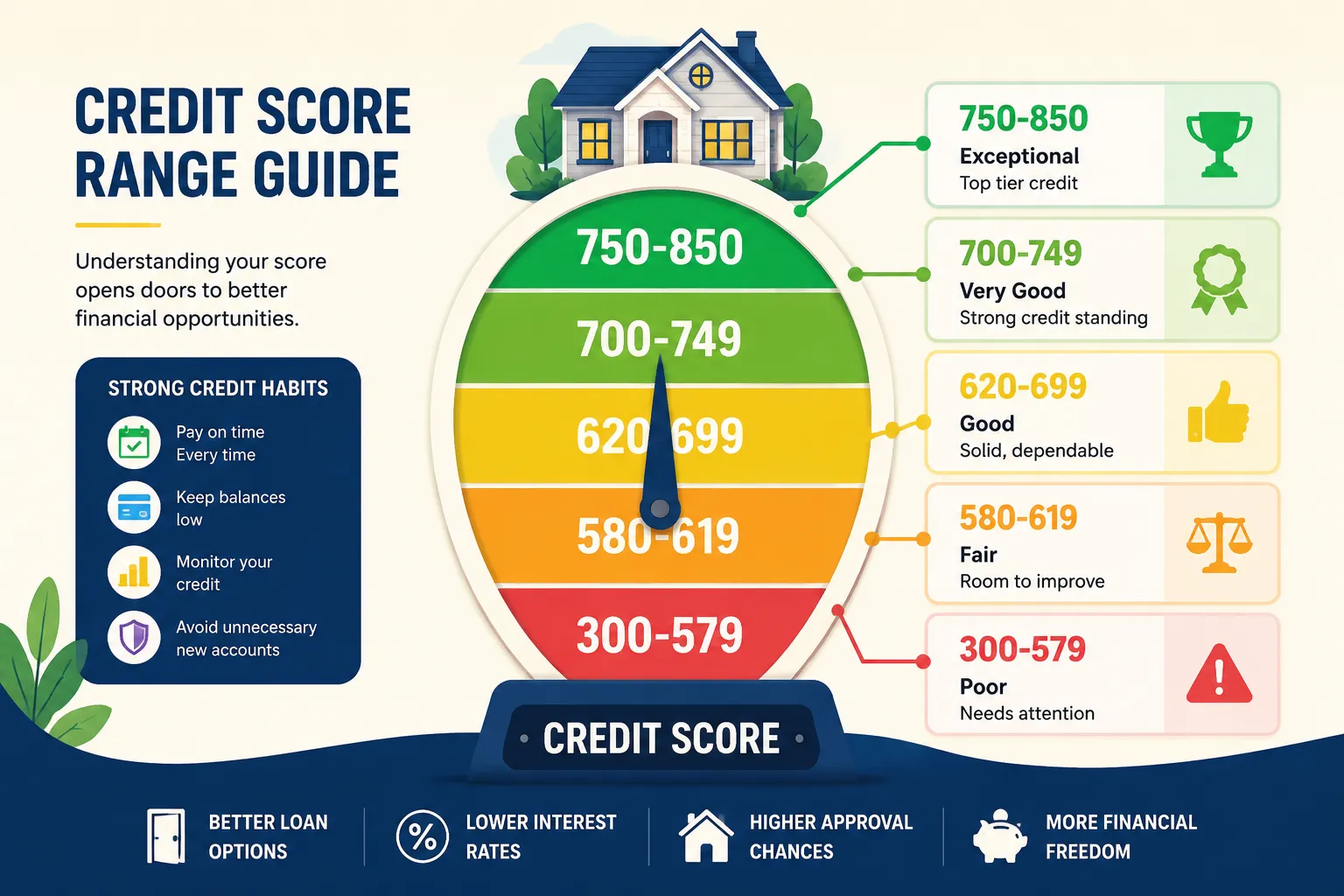
- A score of 700 is solid, 750 is very good, and 800+ puts you in the best rate tier available
- Your credit score directly affects your mortgage interest rate, a 100-point difference can cost or save tens of thousands over the life of a loan
- First-time home buyers can qualify with scores as low as 580 using FHA programs
- Hard credit inquiries from mortgage applications drop your score by roughly 5-10 points temporarily
- You can improve your credit score meaningfully in 3-6 months with the right strategy
- Shopping multiple lenders within a 14-45 day window counts as one inquiry under FICO scoring models
- Buying a house with no down payment is possible through VA and USDA loans, but credit and income requirements still apply
What Credit Score Do You Need to Buy a House in 2026?
The short answer: it depends on which loan you're using. But let's not gatekeep the real numbers here, most U.S. home buyers in 2026 can qualify for a mortgage with a score somewhere between 580 and 640, depending on the loan program. The question is whether you'll qualify for a good rate or one that quietly drains your wallet for 30 years.
Here's the breakdown by loan type:
| Loan Type | Minimum Credit Score | Notes |
|---|---|---|
| FHA Loan | 500 (10% down) / 580 (3.5% down) | Most lender overlays require 580+ |
| Conventional Loan | 620 | Best rates at 740+ |
| VA Loan | No official minimum | Most lenders require 580-620 |
| USDA Loan | No official minimum | Most lenders require 580-640 |
| Jumbo Loan | 700-720 typically | Stricter underwriting |
The credit score requirements above reflect federal guidelines and typical lender overlays as of 2026. Individual lenders can set stricter standards, called overlays, that go beyond the program minimums. So the number on your credit report is the starting point, not the finish line.
For a deeper look at how financing works from the ground up, check out our Real Estate Financing Guide covering mortgages, credit, and down payments.
What's the Minimum Credit Score to Get a Mortgage in 2026?
The absolute floor for a federally backed mortgage in 2026 is a 500 credit score through the FHA program, but that comes with a 10% down payment requirement. For most buyers, the practical minimum is 580, which unlocks FHA's 3.5% down payment option.
For conventional loans, 620 is the hard floor set by Fannie Mae and Freddie Mac guidelines. Below that number, conventional financing simply isn't available regardless of your income or down payment size.
The real-world picture looks like this:
- Below 500: No federally backed loan options. Non-QM lenders may still work with you, but expect higher rates and fees. See our guide on non-QM mortgage lenders and when to use one for more on that path.
- 500-579: FHA only, 10% down required
- 580-619: FHA with 3.5% down; VA/USDA with lender approval
- 620-659: Conventional loans become available; rates are higher
- 660-699: Solid conventional territory; decent rates
- 700-739: Good rates across most programs
- 740+: Best conventional rates; top-tier pricing
Common mistake: Many buyers assume their score is fine because they checked it on a free app. Those consumer scores (VantageScore) often differ from the FICO Score 2, 4, and 5 models that mortgage lenders actually use. Pull your mortgage-specific FICO scores before assuming you're in the clear.
FHA Loan Credit Score Requirements in 2026
FHA loans remain the most accessible path for buyers with lower credit scores in 2026. The Federal Housing Administration sets the baseline, 500 minimum, but the fha credit score requirements 2026 that most lenders actually enforce sit at 580 or higher due to lender overlays.
FHA loan with 580 credit score: You qualify for the standard 3.5% down payment program. This is the sweet spot for buyers who have steady income but haven't had time to build a perfect credit history.
FHA loan with 600 credit score: You're in comfortable FHA territory. Most lenders will approve you without additional conditions, and you may find more lenders competing for your business.
Key FHA facts for 2026:
- Down payment: 3.5% (580+ score) or 10% (500-579 score)
- Mortgage Insurance Premium (MIP) is required for the life of the loan if your down payment is under 10%
- Debt-to-income ratio limit: generally 43-50% depending on compensating factors
- The property must meet FHA condition standards
The minimum credit score to buy a house fha is technically 500, but practically speaking, you'll have a much easier time, and access to more lenders, at 580 or above.
Conventional Loan vs. FHA: Credit Score Requirements Compared
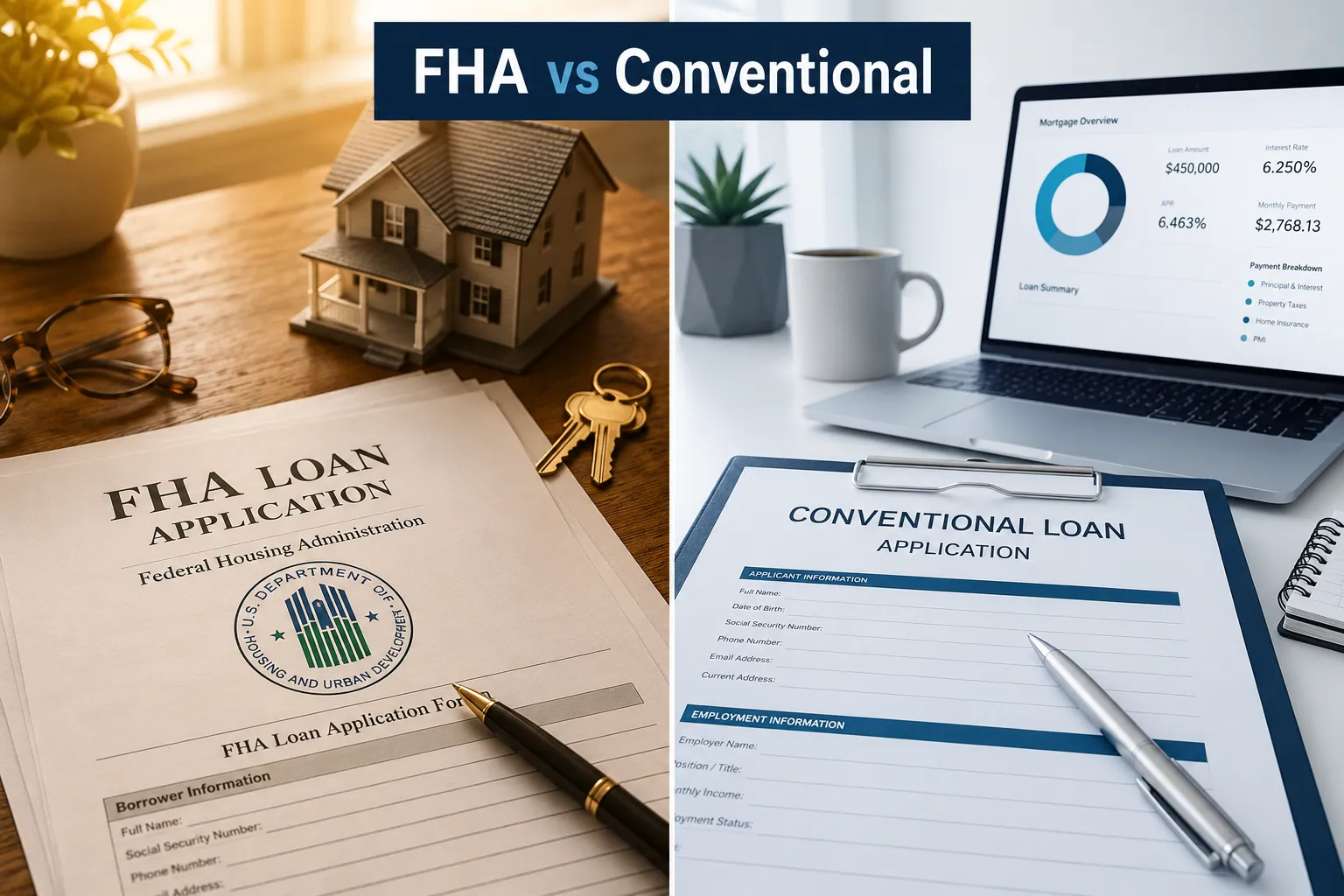
The minimum credit score for conventional loan approval is 620, compared to 580 for FHA. But the real difference between these two programs isn't just the entry point, it's what happens to your costs at different score levels.
Choose FHA if:
- Your score is between 580-639
- You have limited savings for a down payment (3.5% minimum)
- You have higher debt-to-income ratios
Choose Conventional if:
- Your score is 620+ and ideally 700+
- You can put 20% down (eliminates PMI entirely)
- You want to cancel mortgage insurance later (FHA MIP often stays for life)
The cost difference is significant. A buyer with a 620 score on a conventional loan will pay a much higher interest rate than someone with a 740 score on the same loan amount. On a $300,000 mortgage, that rate gap can mean $200-$400 more per month, and over $50,000 more across a 30-year term.
This is why the minimum credit score for first-time home buyer decisions matters so much. Knowing what credit score is needed to buy a $300,000 house isn't just about qualifying, it's about qualifying at a rate that doesn't eat your budget alive.
Credit Score Requirements for VA Loans and USDA Loans
VA and USDA loans are two of the most underused programs in real estate, and they're extraordinary options for buyers who qualify. Neither program has an official government-mandated minimum credit score, but that doesn't mean lenders will approve anyone.
VA Loans (Veterans Affairs):
- No official minimum credit score from the VA
- Most lenders require 580-620 as their internal minimum
- No down payment required for eligible veterans and active-duty service members
- No private mortgage insurance (PMI)
- Funding fee applies (can be financed into the loan)
USDA Loans:
- No official minimum from USDA, but most lenders require 580-640
- The minimum credit score for usda loan approval at most lenders sits at 640 for automated underwriting
- No down payment required
- Property must be in an eligible rural or suburban area
- Income limits apply
If you're a veteran asking what credit score do you need to buy a house with no down payment, the VA loan is your most powerful tool. USDA is the equivalent path for buyers in eligible areas who aren't veterans.
How Much Does Credit Score Affect Mortgage Rates?
Your credit score is one of the biggest pricing factors in mortgage lending, and the impact is not small. A 100-point difference in score can change your interest rate by 0.5% to 1.5%, depending on the lender and loan type.
Here's what that looks like in real dollars on a $300,000 30-year fixed mortgage (estimated rate ranges based on 2026 market conditions):
- 620-639 score: Rate approximately 7.0-7.5%, monthly payment around $1,995-$2,098
- 660-679 score: Rate approximately 6.5-7.0%, monthly payment around $1,896-$1,995
- 700-719 score: Rate approximately 6.25-6.5%, monthly payment around $1,847-$1,896
- 740-759 score: Rate approximately 6.0-6.25%, monthly payment around $1,799-$1,847
- 760+ score: Rate approximately 5.875-6.0%, monthly payment around $1,774-$1,799
Note: These are estimated ranges based on prevailing 2026 rate environments. Actual rates vary by lender, loan type, down payment, and market conditions. See our breakdown of current mortgage rates in 2026 for the latest data.
The difference between a 620 and 760 score on that $300,000 loan could be $200+ per month, that's $72,000+ over 30 years. So based on the numbers alone, every point you add to your score before applying is worth real money.
Is 700 a Good Credit Score to Buy a House? What About 750 or 800?
Yes, and each tier gets better.
Is 700 a good credit score to buy a house? Absolutely. At 700, you qualify for conventional loans, FHA, VA, and USDA programs. You'll get competitive rates, though not the absolute best tier. Most lenders will approve you without issue, and you'll have solid options across multiple loan types.
Is 750 a good credit score to buy a house? Very good. At 750, you're in the upper tier of conventional pricing. You'll qualify for the best rates most lenders advertise, and you'll have strong negotiating leverage with multiple lenders competing for your business.
Is 800 a good credit score to buy a house? That's impeccable credit territory. An 800+ score puts you in the top 20% of U.S. borrowers. You'll get the lowest rates available, the smoothest underwriting process, and lenders will be eager to work with you. The difference between 760 and 800 in rate pricing is typically small, but the approval process is noticeably faster and easier.
The practical takeaway: Getting to 740-760 should be the target for most buyers. That's where the best conventional rate tiers kick in. Chasing 800+ before buying has diminishing returns on rate savings, though it never hurts.
What Credit Score Do First-Time Homebuyers Need?
First-time buyers have more options than most people realize. The minimum credit score for first-time home buyer programs varies, but several paths exist for scores as low as 580.
What does your credit score need to be to buy a house for the first time?
- FHA: 580 for 3.5% down (the most popular first-time buyer route)
- Conventional 97 (Fannie Mae/Freddie Mac): 620 minimum, 3% down
- HomeReady (Fannie Mae): 620 minimum, income limits apply, 3% down
- Home Possible (Freddie Mac): 660 minimum, 3% down
- VA: No minimum (for eligible veterans), 0% down
- USDA: 580-640 depending on lender, 0% down in eligible areas
First-time buyers should also check state-level programs. Many states offer down payment assistance, rate buydowns, or grant programs that layer on top of federal loan programs, and some have their own credit score requirements that differ from federal minimums.
For a state-by-state look at where first-time buyers have the best shot, our Best States for First-Time Home Buyers rankings breaks down the data.
What If My Credit Score Is Too Low to Buy a House?
A score below 580 doesn't mean homeownership is off the table, it means you need a plan and time to let it cook before you see results.
Immediate options if your score is below 580:
- Non-QM loans: Some lenders offer non-qualified mortgage products for borrowers outside standard credit guidelines. Rates are higher, but it's a path. Read more about non-QM mortgage lenders and when they make sense.
- Co-borrower strategy: Adding a co-borrower with stronger credit can help you qualify and improve your rate
- Seller financing: In some transactions, sellers carry the note directly, no bank required
- Rent-to-own agreements: Lock in a purchase price now while building credit
If none of those fit, the most powerful move is a focused credit improvement plan. Six months of intentional work can shift a 560 score to 620+ for many borrowers.
Also worth reading: our guide on HELOC options for borrowers with bad credit, useful context for understanding how lenders think about risk at different score levels.
How to Improve Your Credit Score Before Buying a Home
The most effective credit improvement strategies are straightforward, but they require consistency. Here's what actually moves the needle:
Step 1: Pull your actual mortgage FICO scores
Get your FICO Score 2 (Experian), FICO Score 4 (TransUnion), and FICO Score 5 (Equifax). These are what mortgage lenders use, not the VantageScore on free apps.
Step 2: Attack credit utilization first
Credit utilization (how much of your available credit you're using) accounts for roughly 30% of your FICO score. Paying down revolving balances to below 30%, ideally below 10%, can raise your score 20-50 points relatively quickly.
Step 3: Dispute errors on your credit report
Request free reports from AnnualCreditReport.com. Errors, wrong balances, duplicate accounts, accounts that aren't yours, are more common than most people expect. Disputing and correcting them can produce fast score gains.
Step 4: Don't close old accounts
Length of credit history matters. Closing old cards reduces your average account age and available credit, both of which can hurt your score.
Step 5: Avoid new credit applications
Each hard inquiry costs you roughly 5-10 points. Pause any new credit applications for at least 6 months before applying for a mortgage.
Step 6: Become an authorized user
If a family member has a long-standing card with low utilization and perfect payment history, being added as an authorized user can boost your score, even if you never use the card.

How Long Does It Take to Improve Your Credit Score for a Home Purchase?
The timeline depends on what's dragging your score down. Some fixes are fast, others take time.
- Paying down high balances: Score improvement visible within 30-60 days (after the next billing cycle reports)
- Disputing errors: 30-45 days for the credit bureau investigation process
- Building payment history: 6-12 months of on-time payments to see meaningful movement
- Recovering from a late payment: 12-24 months for significant recovery, though impact fades over time
- Recovering from a bankruptcy or foreclosure: 2-7 years depending on the event type
For most buyers who are 20-50 points away from their target score, a 3-6 month focused effort is realistic. For buyers who are 100+ points away, plan for 12-24 months.
The key mindset: start now. Every month you delay is a month of mortgage payments at a higher rate.
Does Credit Score Matter More Than Down Payment for Mortgages?
Both matter, but they affect different things. Your credit score determines whether you qualify and what rate you get. Your down payment affects your loan-to-value ratio, whether you need mortgage insurance, and which programs you're eligible for.
Credit score matters more for:
- Interest rate pricing (the single biggest long-term cost driver)
- Loan program eligibility
- Approval likelihood
Down payment matters more for:
- Eliminating PMI (20% down on conventional loans)
- Reducing monthly payment
- Equity position from day one
- Qualifying for certain programs (FHA requires minimum 3.5% at 580+)
The honest answer: a higher credit score with a smaller down payment often beats a lower score with a larger down payment, because the rate difference compounds over decades. But the best position is strong on both.
Common Mistakes That Hurt Your Credit Score When Applying for a Mortgage
These are the moves that quietly sink mortgage applications, and they're more common than you'd think.
Mistake 1: Opening new credit accounts before closing
A new car loan, credit card, or any hard inquiry during the mortgage process can change your debt-to-income ratio and drop your score mid-underwriting. Lenders often do a second credit pull right before closing.
Mistake 2: Missing a payment
One 30-day late payment can drop a good score by 60-110 points. Set autopay for minimums on everything during the home-buying process.
Mistake 3: Maxing out a credit card
Even temporarily. High utilization reports immediately and tanks your score before you've had a chance to pay it down.
Mistake 4: Co-signing for someone else's loan
That debt counts against your DTI ratio and adds risk to your profile.
Mistake 5: Closing credit cards to "clean up" your profile
This reduces available credit and raises utilization, the opposite of what you want.
Mistake 6: Rate shopping without understanding inquiry windows
Multiple mortgage inquiries within a 14-45 day window (depending on the FICO version) count as a single inquiry. Spread them out beyond that window and each one counts separately.
How Many Points Does a Mortgage Application Hurt Your Credit Score?
A single mortgage hard inquiry typically lowers your credit score by 5-10 points. For most borrowers in the 680-750 range, this is a minor and temporary dip.
The good news: FICO scoring models are designed to encourage rate shopping. Multiple mortgage inquiries made within a 14-day window (older FICO models) or 45-day window (newer FICO models) are treated as a single inquiry. So shopping 4-5 lenders in a focused window costs you the same as applying to one.
The score impact from a mortgage inquiry typically fades within 3-12 months as long as no new derogatory information appears.
Bottom line: Don't avoid rate shopping out of fear of credit score damage. The savings from finding a better rate far outweigh a temporary 5-10 point dip.
Frequently Asked Questions
What credit score do you need to buy a house for the first time?
First-time buyers can qualify with a 580 credit score using an FHA loan with 3.5% down. For conventional loans, the minimum is 620. VA and USDA loans have no official floor but most lenders want 580-640.
Can you buy a house with a 580 credit score?
Yes. A 580 score qualifies you for an FHA loan with 3.5% down. You can also potentially qualify for VA or USDA loans depending on the lender. Conventional loans require at least 620.
Can you get a mortgage with a 620 credit score?
Yes. A 620 score meets the minimum for conventional loans and comfortably qualifies for FHA, VA, and USDA programs. Your rate will be higher than a 740+ borrower, but you can absolutely get approved.
What credit score is needed to buy a $300,000 house?
The loan amount doesn't change the credit score requirement, the loan type does. For a $300,000 home, you'd need 580+ for FHA, 620+ for conventional, or 580-640 for VA/USDA. A higher score means a lower rate and lower monthly payment on that $300,000 loan.
What credit score do you need to buy a house with no down payment?
VA loans (for eligible veterans) and USDA loans (for eligible rural/suburban areas) both offer zero down payment options. Most lenders require a 580-640 score for these programs.
Is a 700 credit score good enough to buy a house?
Yes, 700 is a solid score that qualifies for all major loan programs. You'll get competitive rates, though not the absolute best tier. Most lenders will approve you without issue.
How fast can I raise my credit score to buy a house?
Paying down revolving balances can show results within 30-60 days. A focused 3-6 month effort can realistically add 20-50+ points for many borrowers. Bigger score gaps (100+ points) typically take 12-24 months.
Does applying to multiple lenders hurt my credit score?
Not significantly, as long as you shop within a 14-45 day window. FICO treats multiple mortgage inquiries in that window as a single inquiry. The rate savings from shopping multiple lenders far outweigh the minor temporary dip.
What's the difference between FHA and conventional credit score requirements?
FHA accepts scores as low as 580 (with 3.5% down) or 500 (with 10% down). Conventional loans require a minimum of 620. FHA is more accessible at lower scores, but conventional loans avoid lifetime mortgage insurance for buyers who put 20% down.
What credit score do I need for a USDA loan?
USDA has no official minimum, but most lenders require 580-640. Automated underwriting systems generally approve at 640+, while scores below that may require manual underwriting.
Can I buy a house with a 500 credit score?
Technically yes, through FHA with a 10% down payment. In practice, very few lenders will approve a 500-579 score even for FHA. Your best path at that level is a credit improvement plan or exploring non-QM lenders.
Does credit score matter more than income for a mortgage?
Both are required, income determines how much you can borrow, credit score determines the rate and whether you qualify at all. A high income with a low credit score can still result in denial or a very high rate. They work together.
Conclusion: Your Credit Score Is the Price Tag on Your Mortgage
Here's the straight talk: what credit score do you need to buy a house in 2026 isn't a one-size answer, it's a spectrum. The floor is 500 for FHA, 580 for practical purposes, and 620 for conventional loans. But the score that actually saves you money is 740 and above.
The buyers who win in 2026 aren't necessarily the ones with the biggest down payments. They're the ones who did the prep work, pulled their real mortgage FICO scores, paid down their balances, avoided new credit applications, and let it cook before submitting that application.
Your action plan:
- Pull your mortgage FICO scores (not VantageScore) from myFICO.com
- Identify your biggest score drags, utilization, late payments, errors
- Pay revolving balances below 30% (ideally below 10%)
- Dispute any errors on all three bureau reports
- Set a 3-6 month timeline if you're within 50 points of your target
- Get pre-approved with multiple lenders within a 14-45 day window to protect your score
- Choose the loan program that fits your score, down payment, and long-term cost
If you're already in the 700+ range, you're in fresh territory, start shopping lenders now. And if you're still building, check out our guide on understanding credit scores for real estate transactions for a deeper breakdown.
The market in 2026 is moving. Rates are still elevated, inventory is shifting, and buyers who show up prepared, with strong credit and a clear financing strategy, are the ones getting to the closing table. That could be you.
For more on what the 2026 market looks like for buyers, see our U.S. home buyers market trends in 2026 and our Spring 2026 Housing Market outlook.