
Last updated: August 23, 2026

Quick Answer
Should I appeal my property tax assessment? Yes, in most cases it is worth at least checking. Studies from property tax advocacy organizations estimate that between 30% and 60% of U.S. properties are overassessed, yet roughly 74% of homeowners never file an appeal. The process is free or low-cost in most counties, takes a few hours of preparation, and a successful appeal can cut hundreds or even thousands of dollars from your annual tax bill permanently.
Key Takeaways
- Roughly 74% of homeowners never appeal their property tax assessment, even though a significant share of properties carry inflated valuations.
- The property tax appeal success rate for homeowners who file with solid comparable sales evidence runs between 40% and 60% in most jurisdictions.
- How much you can save appealing property taxes depends on the gap between your assessed value and true market value, but reductions of 10% to 20% on the assessment are common wins.
- Filing an appeal does not automatically trigger a higher assessment in most states, but a handful of jurisdictions do allow assessors to raise values during a hearing.
- Deadlines to appeal a property tax assessment are strict and vary by county, typically running 30 to 90 days after the assessment notice is mailed.
- You do not need a lawyer for most residential appeals. A property tax appeal service or a licensed appraiser can help for complex cases.
- Homestead exemptions, senior property tax exemptions, and veteran exemptions are separate from appeals and should be checked first since they require zero evidence to qualify.
- The documents you need are your assessment notice, recent comparable sales within one mile, and any evidence of property condition issues.
- If your property was recently purchased below the assessed value, that sale price alone is often your strongest argument.
Should I Appeal My Property Tax Assessment? Here Is What the Numbers Say
Should I appeal my property tax assessment is a question most homeowners ask once, then quietly drop. That is a costly habit. Property assessors are working from mass appraisal models that update on cycles of one to five years depending on the state. They are not walking through your basement or checking whether the square footage on file is accurate. Errors accumulate.
The property tax appeal success rate varies by county and state, but data from tax appeal firms and state-level administrative review boards consistently shows that homeowners who show up with comparable sales data win meaningful reductions in 40% to 60% of cases. The homeowners who do not show up win nothing.
A few things drive that 74% non-appeal rate. Most homeowners assume the assessment is correct, assume the process is complicated, or simply miss the deadline. None of those assumptions hold up once you actually look at your assessment notice and spend thirty minutes pulling recent sales in your neighborhood.
The math on is it worth appealing property taxes is straightforward. If your home is assessed at $400,000 and the actual market value is $350,000, a successful appeal could reduce your taxable value by $50,000. At a 1.2% effective tax rate, that is $600 per year, every year, until the next reassessment cycle. Most counties reassess every three to five years, so you could be looking at $1,800 to $3,000 in total savings from a single afternoon of work.
How Do I Know If My Property Is Overassessed?
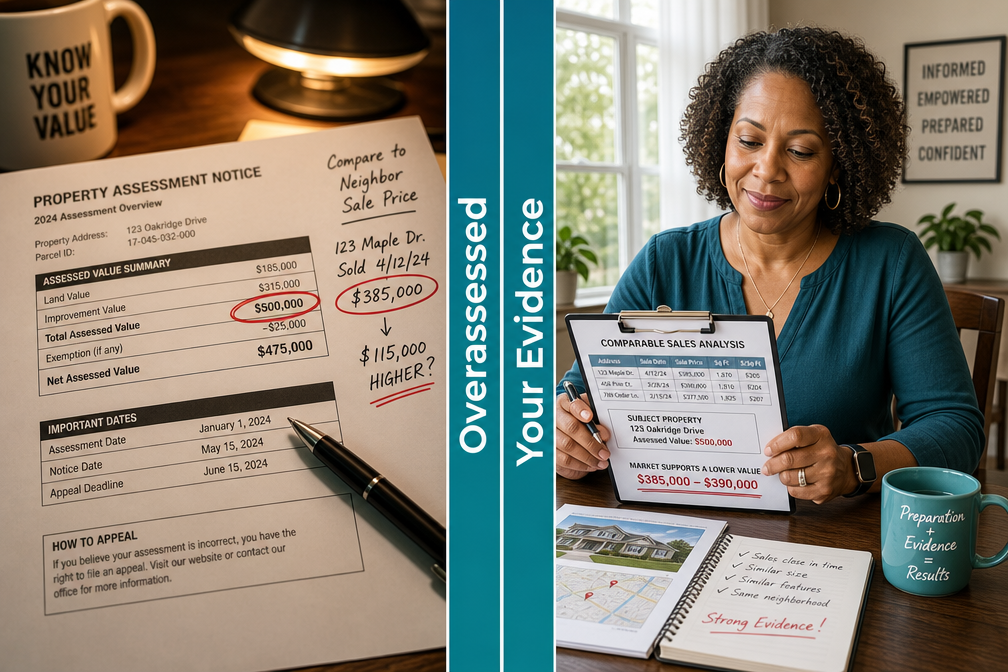
Your property is likely overassessed if the assessed value is higher than what comparable homes in your neighborhood have sold for recently. The clearest signal is a recent purchase: if you bought your home for less than the current assessed value, you have a ready-made argument.
Signs your assessment is too high:
- Your assessed value is higher than your purchase price within the last two years
- Comparable homes within one mile sold for less than your assessed value in the past 12 months
- The assessment records show incorrect square footage, bedroom count, or lot size
- Your home has significant deferred maintenance, foundation issues, or condition problems the assessor would not have seen
- Your neighborhood has seen declining values while your assessment stayed flat or rose
- You are paying more in property taxes than neighbors with similar or larger homes
Pull your assessment card from the county assessor's website. Most counties post this publicly. Check every field: square footage, number of bathrooms, finished basement status, garage type. Assessors working from permit records and aerial data make clerical errors more often than most homeowners realize. A finished basement that was never permitted, or an extra bathroom that does not exist, can inflate your assessment by tens of thousands of dollars.
Property tax reassessment after purchase is also worth watching. Some states automatically reassess at the sale price when a property changes hands. If your county did not update to reflect your purchase price and you paid less than the assessed value, that gap is your appeal in one sentence.
What Happens If You Appeal Your Property Tax Assessment?
When you appeal your property tax assessment, you are formally asking the local assessment review board to lower your property's taxable value. The process does not penalize you for asking. In the vast majority of states, filing an appeal simply opens a review.
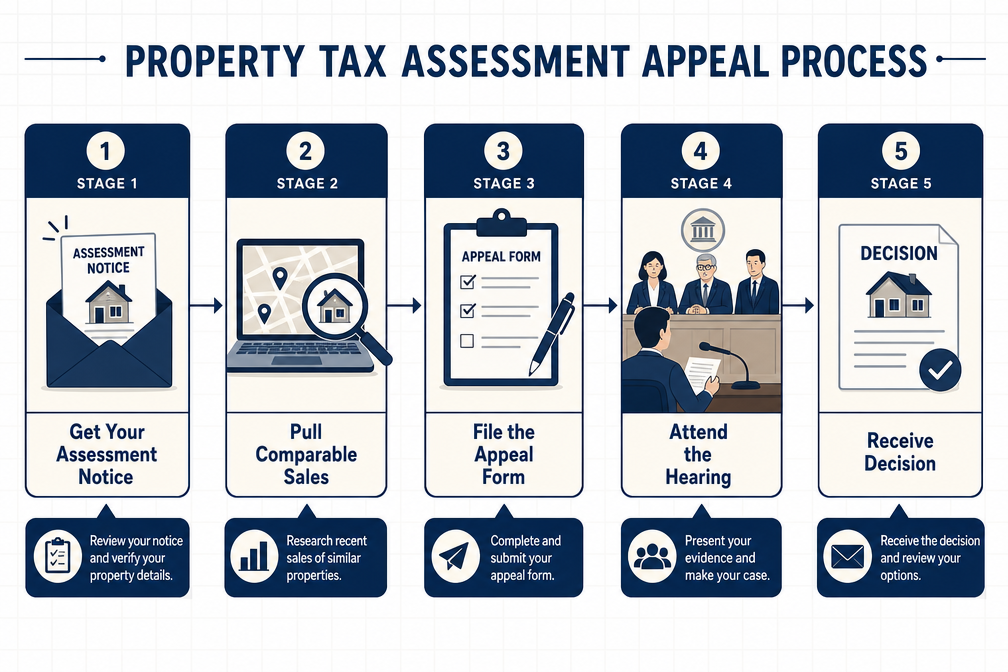
Here is the typical sequence:
- You file a written appeal form with the county board of equalization, assessment appeals board, or equivalent body before the deadline.
- The county may schedule an informal review with a staff appraiser first, which is where most cases settle.
- If the informal review does not resolve it, you attend a formal hearing before a review board, typically lasting 15 to 30 minutes.
- The board issues a written decision, usually within 30 to 90 days of the hearing.
- If you disagree with the board's decision, most states allow a further appeal to a state tax court or circuit court.
The difference between appealing and disputing property taxes is mostly terminology. An appeal is the formal administrative process. A dispute is a broader term that includes informal negotiations with the assessor's office before a formal appeal is filed. Many successful outcomes happen at the informal stage before anyone sits in front of a board.
How long does a property tax appeal take? From filing to final decision, most residential appeals resolve in 3 to 12 months. Informal reviews can settle in 4 to 8 weeks. Formal hearings add another 2 to 4 months. State court appeals can run 1 to 3 years, but those are rare for residential properties.
Can Appealing Property Taxes Increase Your Assessment?
This is the question that stops most homeowners cold, and it deserves a direct answer. In most U.S. states, filing an appeal cannot result in a higher assessment than the one you are challenging. The review board is evaluating your claim, not conducting a fresh appraisal from scratch.
The exception is real. A small number of states, including some counties in New York, allow the assessor to raise the value during the appeal process if the evidence suggests the property is underassessed. This is called a "counter-assessment" or "cross-petition." If you are in a state with this rule, does appealing property taxes hurt you? It can, if your property is actually undervalued.
Before filing, check whether your state allows counter-assessments during an appeal. Your county assessor's website or a quick call to the board of equalization will confirm the local rule. If counter-assessment is possible, pull your comparables first. If the sales data shows your home is already assessed below market value, skip the appeal and look at exemptions instead.
For the overwhelming majority of homeowners in most states, the answer to "can my assessment go up if I appeal" is no.
Who Should Appeal Their Property Tax Assessment and Who Should Not
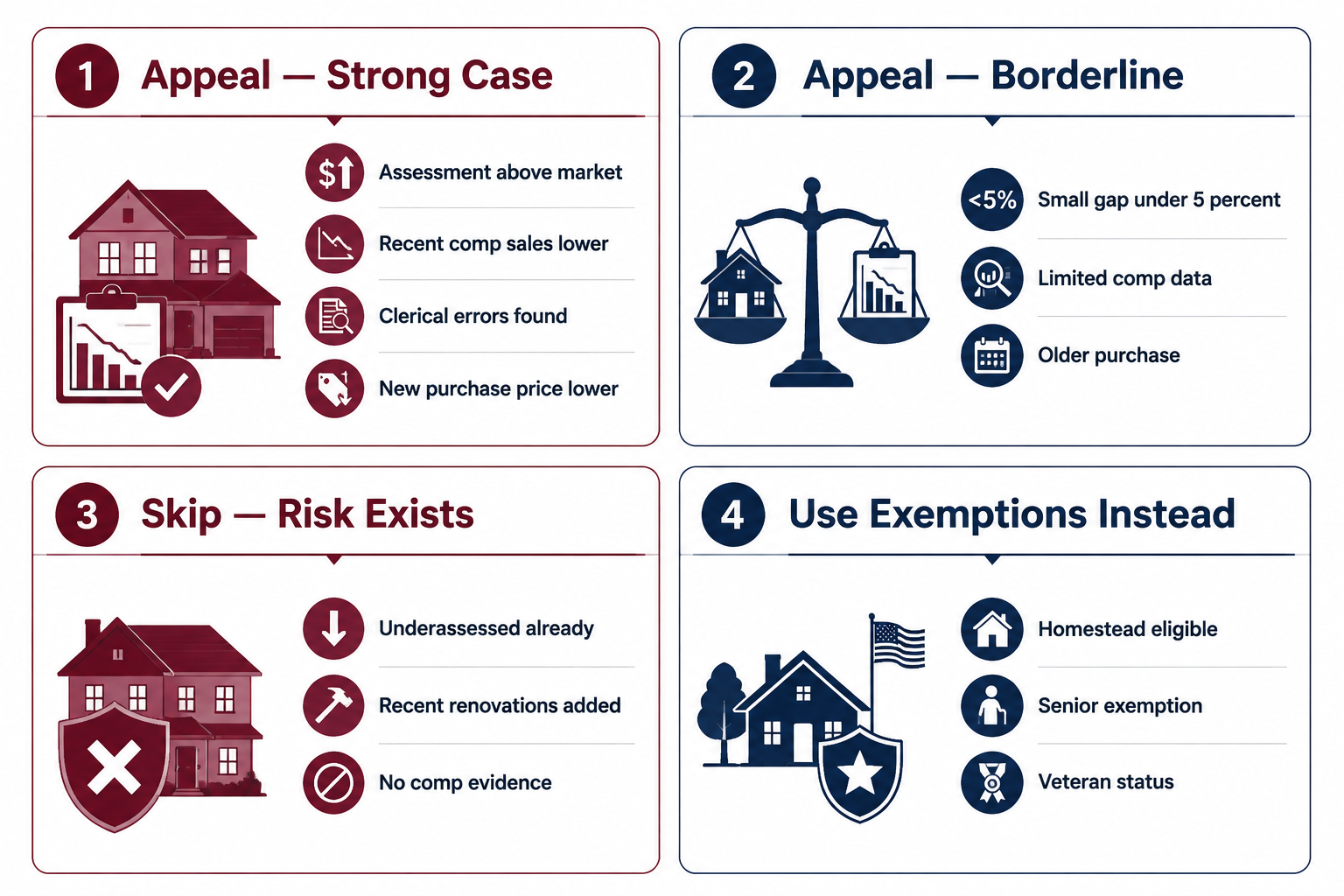
Not every homeowner has a strong case, and filing a weak appeal wastes your time and the board's. Here is a clear decision framework.
Appeal if:
- Your assessed value exceeds your recent purchase price
- Comparable sales within one mile and the past 12 months come in below your assessed value by 5% or more
- Your assessment records contain factual errors (wrong square footage, extra rooms that do not exist, incorrect lot size)
- Your property has condition issues that a mass appraisal model would miss (foundation problems, water damage, deferred maintenance)
- You recently completed a property inspection that revealed significant defects
Think twice if:
- The gap between assessed value and market value is under 5% and your annual tax bill is modest
- You have recently renovated and added square footage or amenities that the assessor has not yet captured
- Your home is already assessed below what comparable properties have sold for
Skip the appeal and check exemptions instead if:
- You qualify for a homestead exemption that has not been applied
- You are 65 or older and your county offers a senior property tax exemption
- You are a veteran eligible for a property tax exemption in your state
The homestead exemption and senior property tax exemption are separate from the appeal process entirely. They reduce your taxable value by a fixed amount or percentage regardless of whether your assessment is accurate. Check these first. They require no evidence, no hearing, and no argument. Many homeowners who qualify for a homestead exemption have never filed for it.
What Documents Do You Need to Appeal Property Taxes?
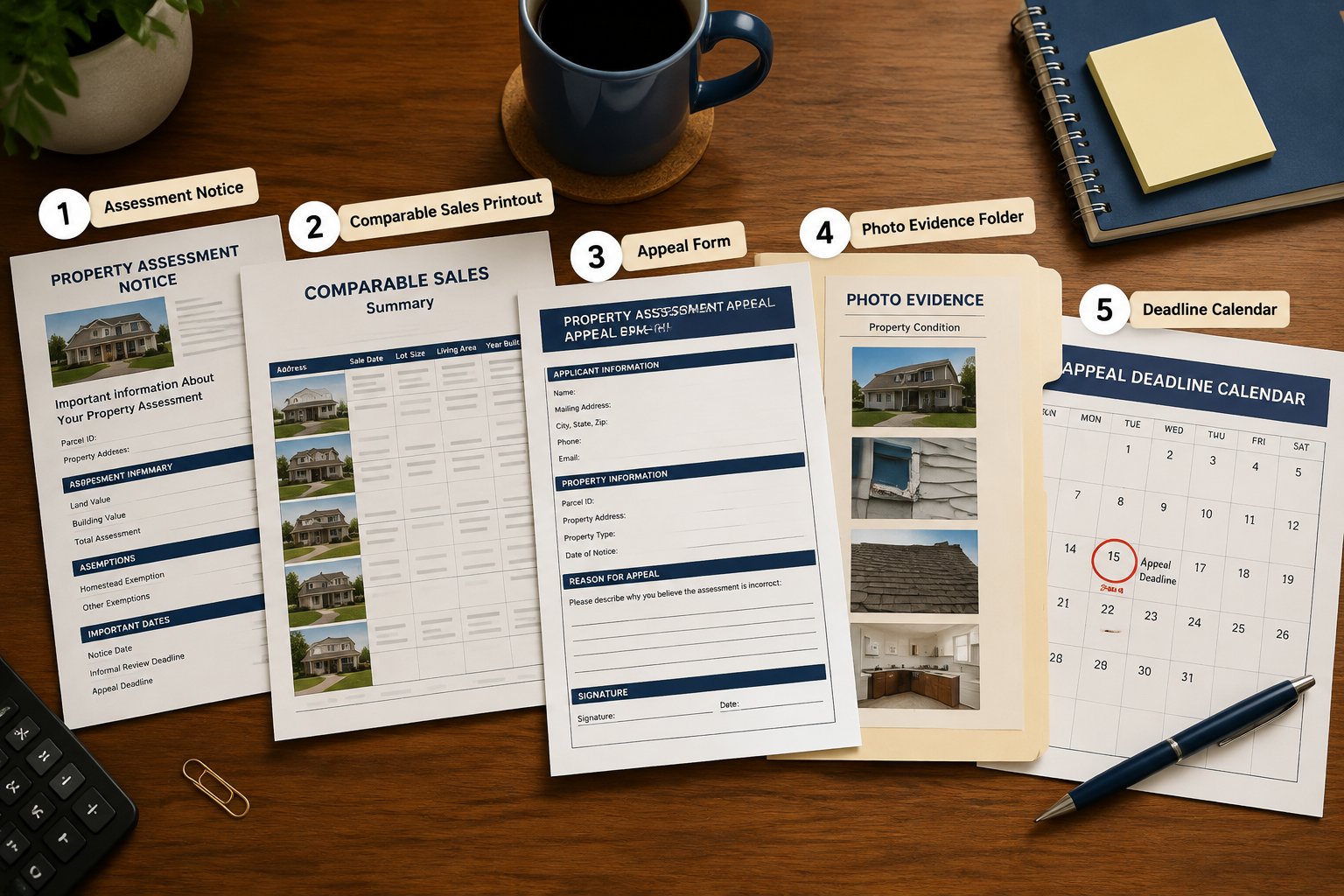
A strong property tax appeal comes down to three categories of evidence: the assessment itself, market data, and property condition.
Core documents:
- Assessment notice with your parcel number, assessed value, and the appeal deadline clearly visible
- Comparable sales (comps): at minimum three to five sales of similar homes within one mile, sold within the past 6 to 12 months, priced below your assessed value. Pull these from Zillow, Redfin, or your county recorder's public records.
- Your purchase contract or closing disclosure if you bought the home recently for less than the assessed value
- A licensed appraisal if you want the strongest possible evidence, though this costs $400 to $600 and is usually only worth it on high-value properties
- Photos of property defects that a mass appraisal would not capture: cracked foundation, aging roof, water damage, outdated systems
- Your assessment record card from the county showing the characteristics on file, so you can flag any errors
Optional but useful:
- A written market analysis from a licensed real estate agent showing current market value
- Repair estimates from licensed contractors for significant defects
- Neighbor assessment comparisons showing similar homes assessed lower
For most residential appeals, the comparable sales printout and your assessment notice are enough to open the conversation.
What Is the Deadline to Appeal a Property Tax Assessment?
Deadlines to appeal a property tax assessment are firm and vary by state and county. Missing the deadline by one day typically means waiting until the next assessment cycle.
Most counties mail assessment notices in late winter or spring. The appeal window typically opens when the notice is mailed and closes 30 to 90 days later. Some states set a fixed calendar deadline regardless of when notices go out.
How to find your deadline:
- Check the assessment notice itself. The deadline is usually printed on the front page.
- Visit your county assessor's or board of equalization's website.
- Call the assessor's office directly. Staff are required to tell you the deadline.
When to appeal property tax assessment: file as soon as you have your comparable sales pulled, not on the last day. Early filers get more scheduling flexibility and sometimes get informal settlements before the formal hearing calendar fills up.
If you missed this year's deadline, mark next year's date now. Set a calendar reminder for 30 days after the typical notice mailing date in your county.
How Much Can You Save Appealing Property Taxes?
How much you can save appealing property taxes depends on three variables: the size of the overassessment, your local effective tax rate, and whether the board grants a full or partial reduction.
A realistic range:
- A 10% reduction on a $350,000 assessed value is $35,000 off the taxable base.
- At a 1.1% effective tax rate, that saves $385 per year.
- Over a four-year reassessment cycle, that is $1,540 in savings from one filing.
On higher-value properties or in high-tax states like New Jersey, Illinois, or Connecticut, the numbers scale significantly. A homeowner in New Jersey with a $700,000 assessed value and a 2.2% effective rate who wins a 15% reduction saves over $2,300 per year.
For investors managing rental properties, the math compounds across multiple units. If you are running the numbers on a rental before you buy, our complete investor checklist for analyzing a rental property includes property tax as a line item worth scrutinizing before closing.
Is it worth appealing property taxes if the amount is small? If the annual savings would be under $200 and you are filing yourself, the time investment is still reasonable since it is a few hours of work. If you are paying a property tax appeal service a contingency fee, a small reduction may not be worth the percentage they take.
How Much Does It Cost to Appeal Your Property Tax Assessment?
For most homeowners, the property tax appeal cost is zero. Filing an appeal with the county board of equalization or assessment review board is free in nearly every U.S. jurisdiction.
Where costs come in:
- Licensed appraisal: $400 to $600 for a full residential appraisal. Worth it on high-value properties or when the assessor disputes your comparable sales.
- Property tax appeal service: Most work on contingency, taking 25% to 50% of the first year's tax savings. No upfront cost, but they take a cut of your win.
- Property tax attorney: Typically $150 to $350 per hour or a contingency arrangement. Rarely necessary for residential appeals under $1 million in assessed value.
Do you need a lawyer to appeal your property tax assessment? No. Most homeowners handle residential appeals without legal representation. The process is designed for non-lawyers. A property tax appeal service can handle the filing and hearing prep for you in exchange for a share of the savings, which makes sense if you want someone else to do the work.
For complex commercial properties, properties with unusual characteristics, or cases that escalate to state tax court, hiring a property tax attorney becomes worth the cost.
What Are the Reasons Property Tax Appeals Get Denied?
Appeals fail for predictable reasons, and most of them come down to preparation.
Common reasons for denial:
- No comparable sales evidence. Saying "my house isn't worth that much" without comps is not an argument. The board needs data.
- Comps that are too far away or too old. Sales from two years ago or three miles away carry little weight. Stay within one mile and 12 months.
- Filing after the deadline. Late appeals are dismissed without review in most jurisdictions.
- Arguing the tax rate instead of the assessed value. The board can only change the assessed value. They cannot change the tax rate. Homeowners who show up complaining about their tax bill rather than their assessed value lose immediately.
- Appealing an accurate assessment. If your home is assessed at or below market value, the board will not reduce it further without evidence.
- Ignoring the informal review. Many homeowners skip the informal settlement step and go straight to the formal hearing, missing the easiest path to a reduction.
One mistake that is startling in how often it happens: homeowners bring photos of the interior to argue the home needs updating, without bringing a single comparable sale. Photos of dated kitchens do not move boards. Numbers do.
Should I Hire a Property Tax Appeal Service?
A property tax appeal service makes sense in specific situations. They know the local board, they know what evidence wins, and they handle the paperwork. The tradeoff is a contingency fee of 25% to 50% of your first year's savings.
Hire a service if:
- You have a strong case but no time to prepare the filing
- Your property is high-value and the potential savings justify the fee
- You have already filed and lost and want professional help for the next cycle
- You own multiple investment properties and want a systematic review
File yourself if:
- Your case is straightforward (recent purchase below assessed value, clear comparable sales)
- The potential savings are modest and you do not want to share them
- You are comfortable pulling public records and filling out a form
For homeowners who also own rental properties, the property tax line item deserves the same scrutiny you would give any other operating expense. Our rental property analysis resources cover how to build accurate expense projections that hold up at the closing table.
Mistakes People Make When Appealing Property Taxes
The strongest appeals are the ones that stay focused on value, not emotion.
Mistakes that cost homeowners their cases:
- Waiting until the last week to file, then rushing the comparable sales research
- Bringing comps that support the assessed value rather than undercut it (pull all the data before you decide to file)
- Arguing that taxes are too high rather than that the assessed value is inaccurate
- Accepting the first informal offer without asking whether a lower number is possible
- Not checking for exemptions before filing an appeal (a senior property tax exemption or homestead exemption might save more with less effort)
- Skipping the property record card review and missing a factual error that would have been the easiest win
One more that is important enough to repeat: homeowners who pull their comps, see that their assessment is actually fair, and then file anyway because they are frustrated with their tax bill. That is not an appeal strategy. That is a hearing the board will dismiss in five minutes.
Give the process time before you judge the results. Property tax appeals are not instant. File early, prepare well, and give the process time to work.
FAQ
What is the property tax appeal success rate?
Homeowners who file appeals with solid comparable sales evidence win meaningful reductions in roughly 40% to 60% of cases, depending on the state and county. Success rates are higher when the gap between assessed value and market value is 10% or more.
Does appealing property taxes hurt you?
In most states, no. Filing an appeal cannot result in a higher assessment than the one you are challenging. A small number of states allow counter-assessments, so check your local rules before filing.
Can my assessment go up if I appeal?
In most states, no. In states that allow counter-assessments (parts of New York, for example), yes. Confirm your state's rules with the county assessor's office before filing.
How long does a property tax appeal take?
Most residential appeals resolve in 3 to 12 months. Informal reviews can settle in 4 to 8 weeks. Formal hearings typically add 2 to 4 more months.
What is the difference between appealing and disputing property taxes?
An appeal is the formal administrative process with a review board. A dispute is a broader term that includes informal negotiations with the assessor before a formal appeal is filed. Many successful outcomes happen at the informal stage.
Do I need a lawyer to appeal my property tax assessment?
No. Most homeowners handle residential appeals without legal help. A property tax appeal service or licensed appraiser can assist for complex cases.
Is it worth appealing property taxes if the amount is small?
If you are filing yourself, a few hours of work for even $200 in annual savings is a reasonable return. If you are using a contingency-based service, a small reduction may not be worth their fee.
What is the property tax appeal cost?
Filing is free in nearly every U.S. jurisdiction. Optional costs include a licensed appraisal ($400 to $600), a property tax appeal service (25% to 50% of first-year savings), or a property tax attorney ($150 to $350 per hour).
What is a homestead exemption and how does it differ from an appeal?
A homestead exemption reduces your taxable value by a fixed amount or percentage for your primary residence. It requires no evidence or hearing. It is separate from an appeal and should be checked first.
What is a senior property tax exemption?
A senior property tax exemption is a reduction in assessed value or tax rate available to homeowners over a certain age, typically 65, in most states. Eligibility rules and savings amounts vary by jurisdiction. Check your county assessor's website to apply.
When should I appeal my property tax assessment?
File as soon as you have pulled your comparable sales and confirmed a meaningful gap between assessed value and market value. Do not wait until the last week of the appeal window.
What if I missed the appeal deadline?
Most counties do not allow late appeals. Mark next year's deadline now and prepare your case before the next assessment notice arrives.
Conclusion
The question of should I appeal my property tax assessment has a clear answer for most homeowners: check first, then decide. Pull your assessment record, pull three to five comparable sales within a mile, and see if the numbers line up. If they do not, the appeal process is free, the hearing is short, and the property tax appeal success rate for prepared filers is genuinely strong.
Actionable next steps:
- Go to your county assessor's website and download your property record card. Check every field for accuracy.
- Pull comparable sales from Zillow, Redfin, or your county recorder for homes similar to yours sold within the past 12 months and one mile.
- Check whether you qualify for a homestead exemption, senior property tax exemption, or veteran exemption before filing an appeal. These are faster wins.
- Find your appeal deadline on your assessment notice or the county board of equalization website. Put it on your calendar today.
- If your assessed value exceeds comparable sales by 5% or more, file the appeal yourself. The form takes under an hour.
- If your case is complex or your property is high-value, consider a property tax appeal service or a licensed appraiser.
For homeowners who also own investment properties, keeping your operating expenses accurate is part of building a portfolio that actually performs. Our guide on homeowners insurance versus rental property insurance costs and coverage covers another line item that quietly overcharges property owners who never question the bill.
Fresh eyes on your tax assessment once a year is not paranoia. It is just good ownership.