
Last updated: August 23, 2026

Quick Answer: Open house tips that beat the odds most sellers face start with one uncomfortable truth: according to NAR's 2025 Profile of Home Buyers and Sellers, 62% of agents reported getting zero business from open houses. That does not mean open houses are useless. It means most sellers run them wrong. A well-prepared, well-marketed open house on the right day, priced correctly, and staged with intention still moves properties. A lazy one just burns a Sunday.
Key Takeaways
- The median home sat on the market 29 days as of July 2026 (NAR, August 2026), so every open house is a time-sensitive event, not a casual showing.
- Sundays between 1 PM and 4 PM remain the highest-traffic window for open houses in most U.S. markets.
- Staging a home before an open house costs far less than a price reduction, with NAR data showing staged homes sell faster and closer to list price.
- 81% of buyers in NAR's 2025 survey rated listing photos as "very useful," meaning your open house marketing starts online, not at the yard sign.
- Sellers who leave during their open house consistently produce better buyer feedback and higher offer rates than those who stay.
- Overpricing before an open house is the single fastest way to guarantee low attendance and no offers.
- An open house sign-in sheet is not optional. It is your lead capture system and your agent's most valuable follow-up tool.
- Pets should be removed entirely from the property, not just crated, during any open house.
- Open house refreshments do not need to be elaborate, but a clean, welcoming scent and a simple beverage station signal a well-cared-for home.
- If nobody shows up, the problem is almost always price, marketing, or timing, and each one is fixable.
What Makes an Open House Successful vs. Unsuccessful
A successful open house generates qualified buyer traffic, produces actionable feedback, and either creates offers directly or accelerates private showings. An unsuccessful one is a seller sitting in their staged living room alone for two hours.
The gap between the two almost always comes down to three variables: price, preparation, and promotion. Get all three right and the open house does its job. Miss any one of them and you are essentially hosting an expensive photo op for curious neighbors.
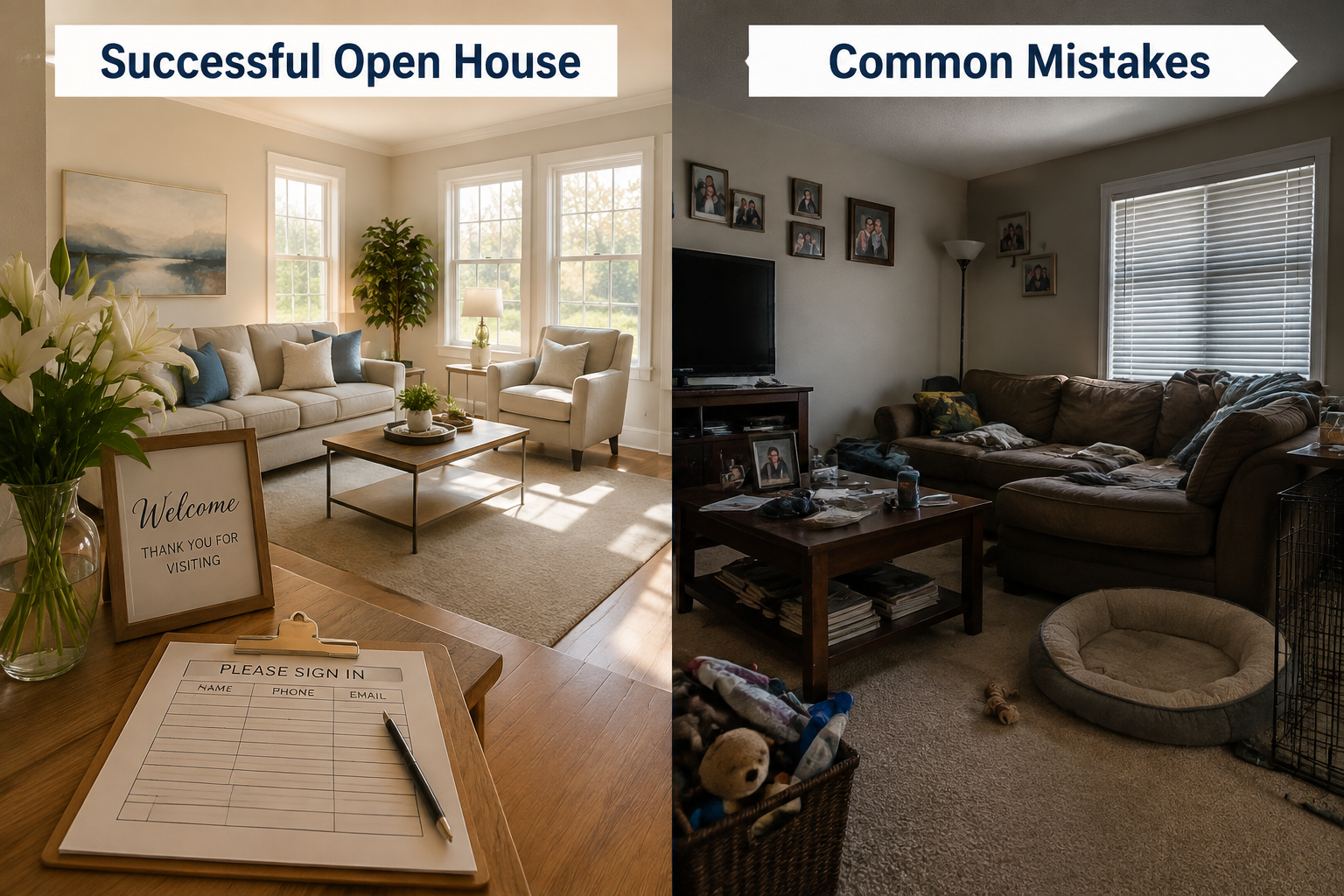
Successful open houses share a few consistent traits. The home is priced within 3% to 5% of comparable sales. It has been actively promoted across MLS, social media, and neighborhood channels for at least five to seven days beforehand. And the physical space is staged, clean, and depersonalized so buyers can mentally move in rather than mentally redecorate around someone else's life.
Unsuccessful open houses tend to share a different set of traits: overpricing, last-minute marketing, personal clutter left in place, and a seller who decided to stick around and "answer questions." We will get into why that last one is a problem shortly.
Open House Tips That Beat the Odds Most Sellers Face: How to Prepare Your Home
The most impactful open house tips for sellers are not about buying expensive furniture or renting a fog machine. They are about removing friction. Buyers need to be able to see the home, not your life inside it.
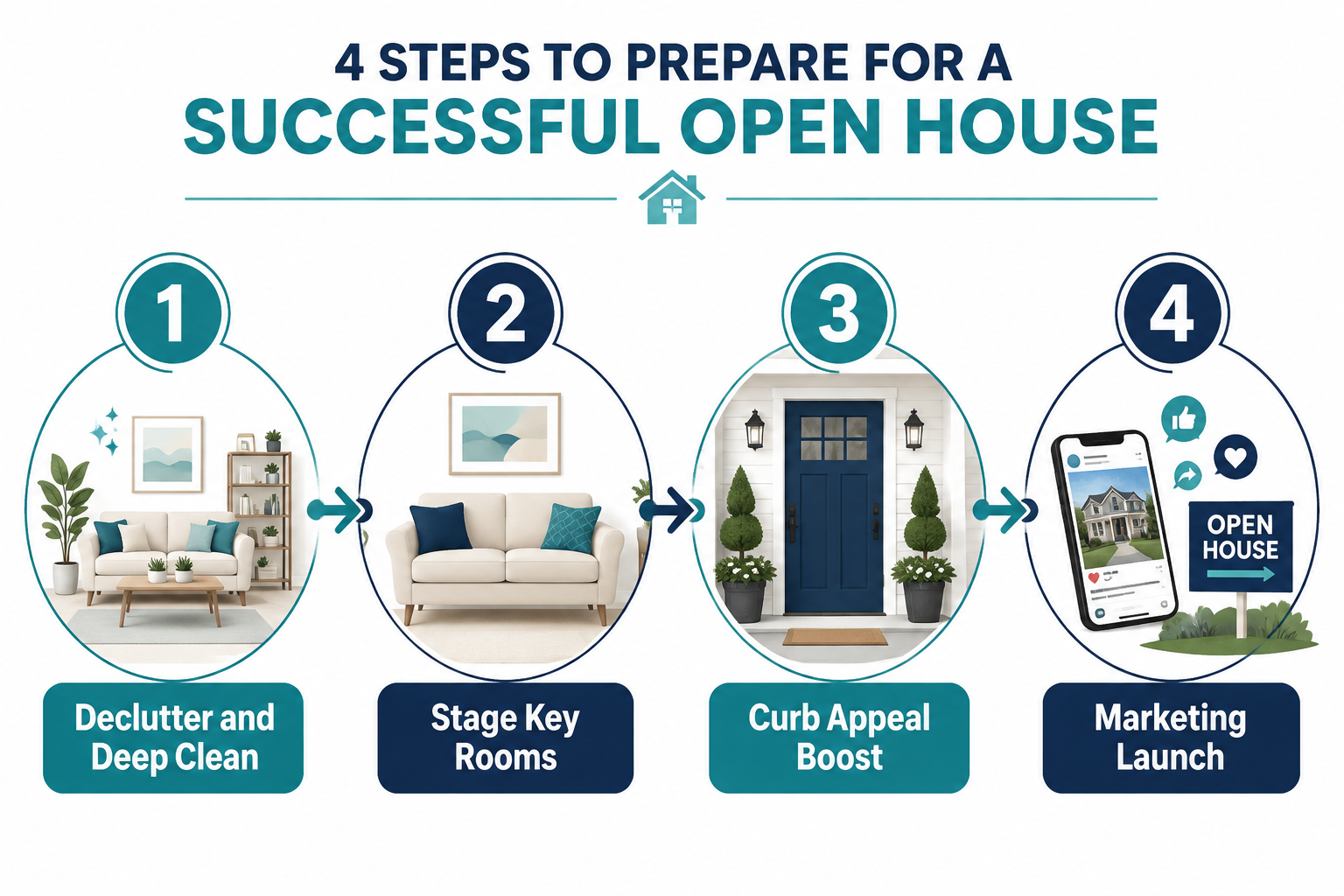
Start with decluttering before an open house. This is obvious enough that it barely needs saying, yet it remains the most skipped step. Remove at least 30% of what is currently on shelves, countertops, and in closets. Buyers open closets. A packed closet signals storage problems. A half-full closet signals space.
Staging for an open house does not require hiring a professional stager for every room, though it helps. Focus on the three rooms that sell homes: the living room, the primary bedroom, and the kitchen. Neutral bedding, fresh towels in the bathrooms, a bowl of fruit on the kitchen counter, and a few intentional throw pillows go a long way. Check out our guide to property value boosters and home renovation tips for specific upgrades worth making before you list.
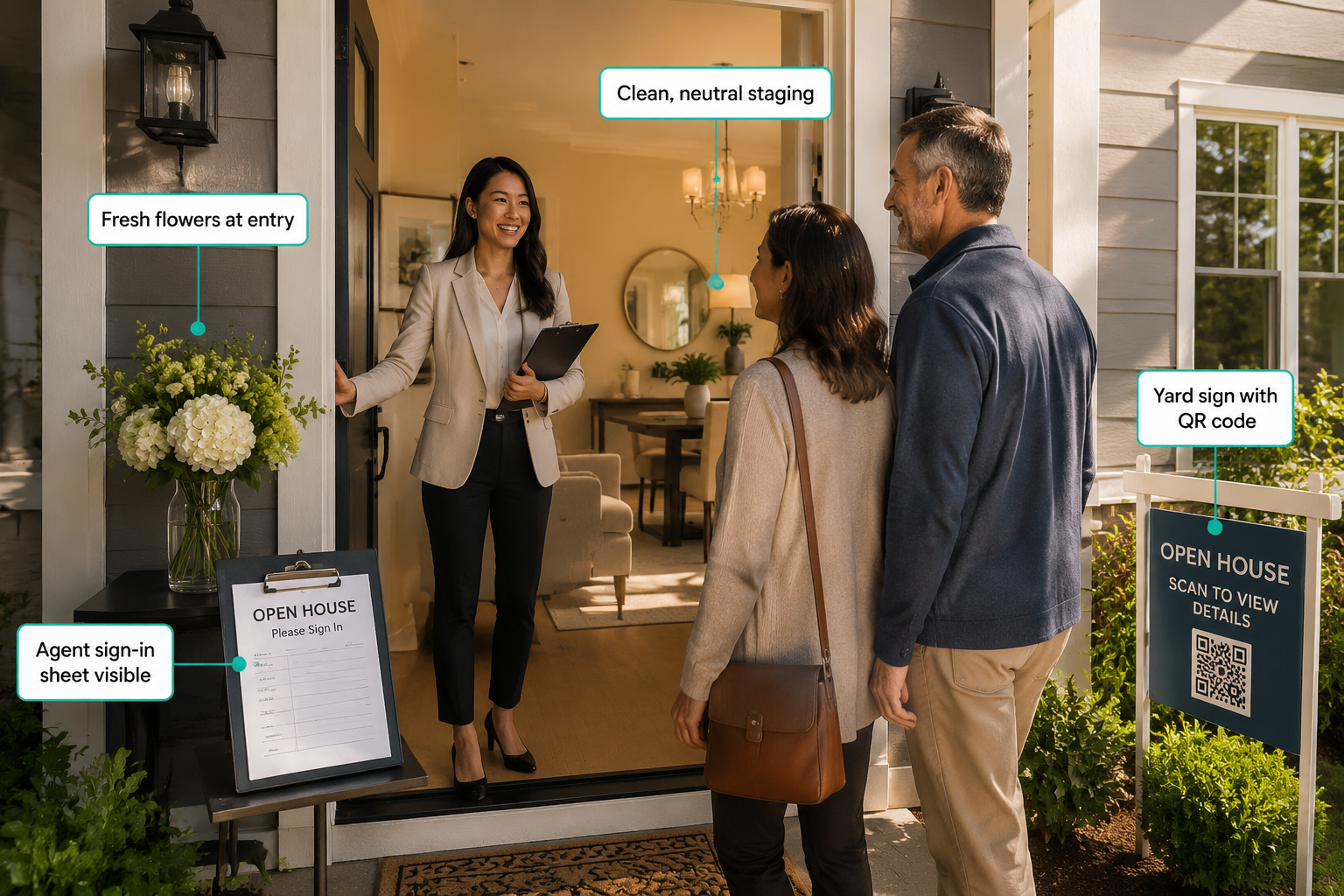
Curb appeal before an open house is your first impression and your only chance to make one. Mow the lawn, edge the walkway, pressure wash the driveway if it needs it, and put fresh mulch in the flower beds. A potted plant or two flanking the front door is a high-impact detail that costs under $40 and photographs beautifully. Fresh paint on the front door is the single highest-ROI cosmetic improvement most sellers skip.
Open house refreshments are a small but smart touch. A pitcher of water, some lemonade, and a plate of cookies near the kitchen island signals warmth and hospitality. It also keeps buyers in the home longer, which increases the chance they fall in love with it. Keep it simple. Nobody needs a charcuterie board.
What to do with pets during an open house: remove them from the property entirely. Not crated. Not in the backyard. Gone. A dog barking from a crate or a cat weaving between buyer legs is a distraction and, for buyers with allergies, a deal-breaker. Take the pet to a friend's house, a dog daycare, or a park for the duration.
Here is a quick open house checklist for sellers to run through the week before:
- Deep clean every room, including baseboards and window tracks
- Declutter all visible surfaces and closets
- Remove personal photos, religious items, and political decor
- Stage living room, primary bedroom, and kitchen
- Address curb appeal: lawn, walkway, front door
- Confirm all light bulbs work and replace any that are out
- Set the thermostat to a comfortable temperature
- Remove or secure valuables (read our full open house safety plan guide for details)
- Arrange for pets to be off-property
- Set up open house sign-in sheet at the entry
For a full 60-day prep timeline, our 60-day home selling checklist walks through every step with AI-assisted planning built in.
The Best Day and Time to Hold an Open House
Sunday between 1 PM and 4 PM is the industry standard for a reason. Buyer traffic peaks on weekends when people are not at work, and Sunday afternoons specifically give buyers time to attend church, run errands, or sleep in before heading out to tour homes. Saturday open houses work in high-demand markets but tend to attract more casual lookers than serious buyers.
How long should an open house last? Two to three hours is the sweet spot. Shorter than two hours and you cut off late arrivals who got stuck in traffic or ran an errand first. Longer than three hours and foot traffic thins, agents get tired, and the event loses its energy. A two-hour window (say, 1 PM to 3 PM) with a hard stop creates mild urgency without feeling rushed.
Avoid holiday weekends, the week between Christmas and New Year's, and any local event that will compete for attention or clog traffic. Spring and early fall are historically the highest-traffic open house seasons in most U.S. markets.
Open House vs. Private Showings: Which Is Better for Sellers
Neither format is categorically better. They serve different purposes and work best together.
Private showings attract buyers who are already serious, often pre-approved, and willing to schedule time specifically for your home. They produce more focused, higher-quality feedback. An open house casts a wider net, creates social proof (buyers seeing other buyers creates urgency), and can generate multiple offers from a single event.
The data worth knowing: NAR's 2025 survey found that 52% of buyers found their home on the internet, and 27% found it through their agent. Open houses ranked lower as a direct purchase driver. But they function as a marketing event as much as a sales event. Buyers who attend an open house and do not make an offer often come back for a private showing, or tell a friend who does.
The so-based answer is to do both. Run the open house in the first weekend on market to generate buzz and capture leads via the sign-in sheet. Then let private showings handle the serious buyers who need more time.
How Many People Typically Attend an Open House
Attendance varies widely by market, price point, and marketing effort. In a competitive market with strong online promotion, 10 to 20 visitors over a two-hour open house is a solid result. In slower markets or for higher-priced properties, five to ten is more typical.
The number of attendees matters less than the quality of the traffic. Five pre-approved buyers who spend 20 minutes each touring the home is worth more than 30 neighbors who showed up for the cookies and have no intention of buying.
Your agent should track attendance and collect contact information via the open house sign-in sheet at every event. That list is the follow-up pipeline. Without it, the open house produces no actionable data.
Should I Be Home During My Open House
No. Leave. This is one of the most consistent open house tips for sellers that agents give, and most sellers ignore it.
Buyers do not want to make comments about the home while the owner is standing in the kitchen. They will not say "this bathroom feels cramped" or "I wonder if that wall is load-bearing" with the seller three feet away. They will smile, nod, and leave without giving your agent the feedback that could lead to an offer.
Your presence also makes buyers feel like guests in your home rather than prospective owners of their future home. That psychological shift costs you money.
Take the pets, take the family, and go to lunch. Let your agent do their job. The open house safety plan covers exactly what to secure and remove before you leave.
Common Mistakes Sellers Make at Open Houses
These are the ones that show up repeatedly in agent feedback and cost sellers real money.
Overpricing the home before the open house. A home priced 8% to 10% above comparable sales will not generate offers regardless of how beautiful the staging is. Buyers in 2026 are educated. They have seen the comps on Zillow before they walk through your door. Our home sellers pricing strategies guide covers the 2026 pricing playbook in detail, and our piece on 7 pricing mistakes that trigger price cuts and lowball offers is required reading before you set a number.
Skipping the sign-in sheet. No open house sign-in sheet means no follow-up list. Your agent cannot convert open house visitors into buyers without contact information. Use a digital sign-in if possible. Several apps now capture name, email, phone, and pre-approval status in under 60 seconds. See the 7 open house apps tech-savvy agents use for the best options in 2026.
Leaving strong odors in the home. Cooking smells, pet odors, and heavy air fresheners all register negatively. A clean, neutral scent is the goal. Bake cookies an hour before if you want to get precise about it, but do not spray synthetic fragrance everywhere.
Not depersonalizing. Family photos, children's artwork, and personalized decor prevent buyers from mentally claiming the space. It is not personal. It is psychology.
Holding the open house before the listing photos are live. Your online listing drives open house attendance. If the photos are not up and the listing is not syndicated to major portals before you open the doors, you are marketing to whoever happened to drive by.
How to Price Your Home for a Successful Open House
Price is the single variable that controls everything else about your open house. Sharp staging and strong marketing cannot overcome a number that is out of step with the market.
The 2026 market context: the national median existing-home price hit $434,100 in July 2026, up 2.0% year over year, with 80% of metro areas posting price gains in Q2 2026 (NAR, August 2026). Sellers who priced within 3% to 5% of recent comparable sales saw a median sale price at 99% of list. Those who overpriced by more than 5% faced price reductions, longer days on market, and the stigma that comes with a listing that buyers assume has something wrong with it.
Price your home to create competition, not to leave room for negotiation. A home priced at $429,000 in a market where comps are at $425,000 to $435,000 will generate more open house traffic and more offers than the same home priced at $449,000 "to leave room."
Open House Staging Tips That Actually Work
Staging for an open house is about editing, not decorating. The goal is a space that photographs well, shows well, and feels aspirational without feeling unlivable.
Room-by-room priorities:
- Living room: Remove excess furniture to open up traffic flow. Two sofas and a coffee table, not four chairs and three side tables. Add one fresh floral arrangement.
- Kitchen: Clear all countertops except one small appliance and a bowl of fruit. Clean the inside of the microwave. Buyers open it.
- Primary bedroom: Neutral bedding in white or light gray. No clutter on nightstands. No laundry visible anywhere.
- Bathrooms: Fresh white towels folded neatly. No personal care products on the counter. A small plant or candle is a nice touch.
- Garage and basement: These get toured. Remove boxes, organize tools, and sweep the floor.
Natural light is your best staging tool and it costs nothing. Open every blind and curtain before buyers arrive. Replace any dim bulbs with bright daylight-spectrum LEDs.
For sellers wondering which renovations actually move the needle before listing, our kitchen upgrades to skip before selling guide is gate-keeping real money-saving information that most agents will not tell you upfront.
Open House Marketing Strategies to Get More Buyers Through the Door
The open house itself is the event. The marketing is what fills the room. Most sellers leave this entirely to their agent, which is fine, but knowing what good marketing looks like helps you hold your agent accountable.
Open house marketing ideas that produce real traffic:
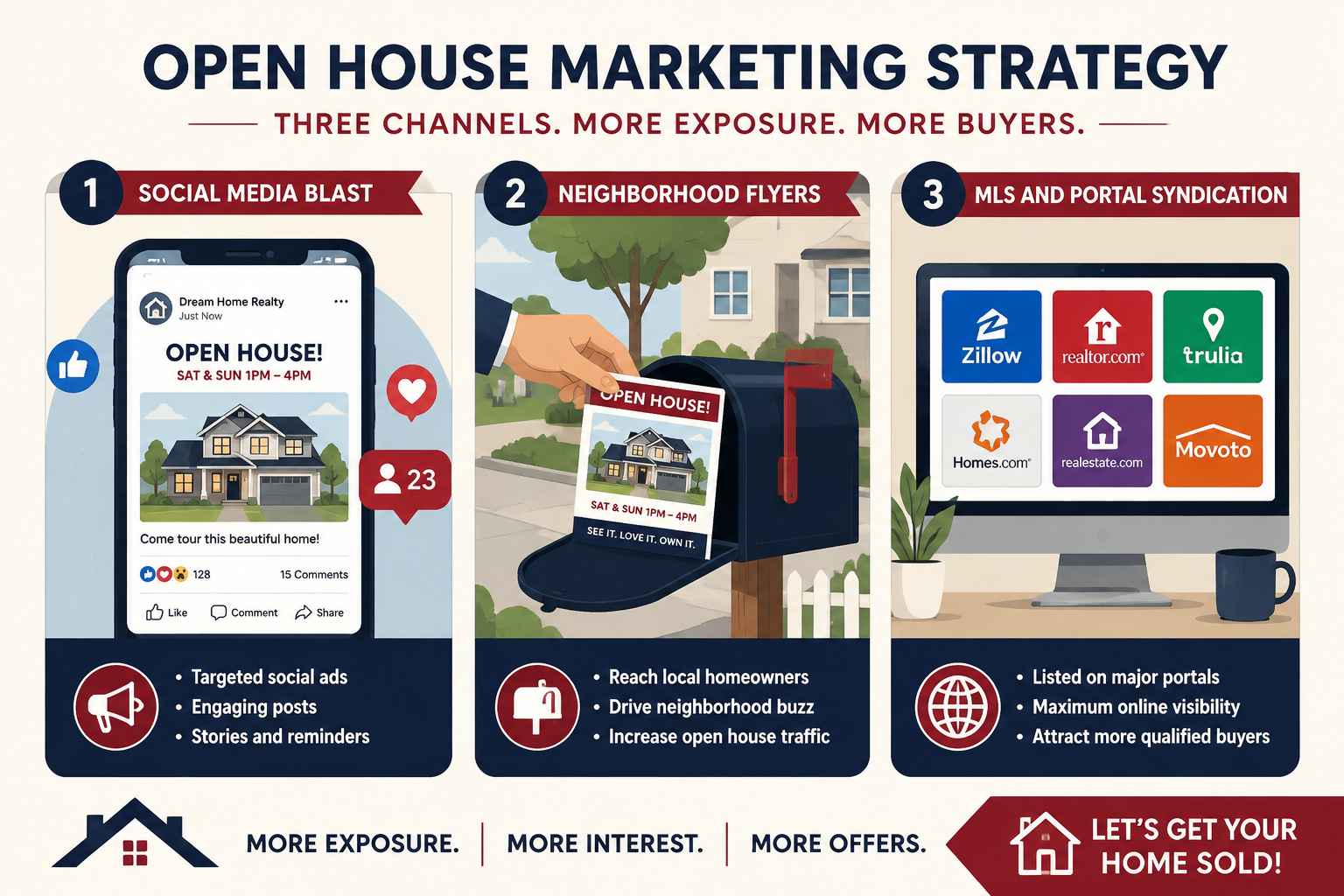
- MLS listing with open house date flagged at least five to seven days before the event. Portals like Zillow and Realtor.com surface open house listings separately, which is free additional exposure.
- Social media posts with professional photos, the address, date, and time. Facebook still reaches 76% of agents and a massive share of active buyers. Instagram Reels of a short home tour can generate hundreds of organic views in a local market.
- Neighborhood flyers dropped within a quarter-mile radius. Neighbors are your best referral network. They know people who want to live near them.
- Directional yard signs starting at least two intersections away from the property. More signs mean more foot traffic from people who were not actively looking but are now curious.
- Email blast to your agent's buyer list and sphere of influence.
- Open house QR code on the yard sign that links directly to the listing. Buyers who scan it get the full photo gallery and details before they walk in.
For a deeper look at listing marketing, our guide on home listing social media tips and marketing strategies covers what actually drives engagement in 2026.
What If Nobody Shows Up to My Open House
Zero attendance is a message, not a failure. It is telling you something specific about price, marketing, or timing.
Run through this checklist before calling the open house a waste:
- Was the listing live with photos at least five days before the event? If not, the marketing did not have time to work.
- Is the price in line with recent comps? Buyers self-select out of overpriced listings before they ever visit.
- Was the open house promoted on social media, MLS, and with directional signs? If the only marketing was a yard sign, low attendance is expected.
- Was the timing right? A holiday weekend, a major local event, or a weather event can kill attendance with no reflection on the home.
- Is the home in a location with lower buyer traffic? Rural properties and higher price points naturally attract fewer open house visitors. Private showings may be the better strategy.
If attendance is low after two well-marketed open houses, the price needs a conversation. Buyers are voting with their absence. Our piece on 8 spring home selling mistakes that cost you $40K+ covers the pricing and marketing errors that compound over time.
Is an Open House Worth It or a Waste of Time
An open house is worth it when the home is priced correctly, prepared properly, and marketed aggressively in the week leading up to it. It is a waste of time when any one of those three conditions is missing.
The 62% of agents who reported zero business from open houses in NAR's 2025 data were not necessarily running bad open houses. Many were in markets where buyer traffic was thin, or working with sellers who were not willing to prepare or price correctly. The open house itself was not the problem.
For sellers who are serious about selling, open house tips that beat the odds most sellers face all point to the same conclusion: preparation and marketing before the event matter more than anything that happens during it. Give the process time before you judge the results. A well-run open house in week one of a listing can generate the kind of early momentum that produces multiple offers and a sale above list price.
The sellers who treat the open house as a serious marketing event, price competitively, stage with intention, leave the property during the event, and follow up aggressively through their agent's sign-in sheet data consistently outperform those who treat it as a formality.
Open House Tips That Beat the Odds Most Sellers Face: FAQ
Q: How far in advance should I promote my open house?
A: Five to seven days minimum. This gives MLS portals time to syndicate the listing with the open house date flagged, and gives your agent time to run social media posts and email blasts that build anticipation.
Q: Should I offer open house refreshments?
A: Yes, but keep it simple. Water, lemonade, and a plate of cookies near the kitchen is enough. The goal is to keep buyers in the home longer and create a welcoming atmosphere, not to cater a party.
Q: How do I handle an open house sign-in sheet?
A: Place it at the entry with a pen or a tablet for digital sign-in. Collect name, phone, email, and optionally whether they are pre-approved. This list is your agent's follow-up pipeline. Without it, the open house produces no actionable leads.
Q: Do open houses actually sell homes?
A: They do, but rarely as the direct cause. More often, an open house generates leads that convert into private showings, which convert into offers. Think of it as the top of the funnel, not the close.
Q: What should I do with valuables during an open house?
A: Remove them from the property entirely. Jewelry, prescription medications, financial documents, small electronics, and spare keys should all be taken off-site or locked in a secure location before the event.
Q: Can I hold an open house without an agent?
A: Yes, but FSBO open houses carry more risk and typically produce less traffic. NAR's 2025 data shows FSBO homes sold at a median $360,000 versus $425,000 for agent-assisted sales. The commission math looks different when you factor in that $65,000 gap.
Q: What is the best time of year to hold an open house?
A: Spring (March through May) and early fall (September through October) produce the highest buyer traffic in most U.S. markets. Summer works in many markets but slows in July and August as families travel.
Q: How many open houses should I hold?
A: One well-executed open house in the first weekend on market is the standard approach. If the first one produces low traffic or no offers, a second open house after a price adjustment or additional marketing can be worthwhile.
Q: What if my home is in a flood zone or has a known issue?
A: Disclose it. Required disclosures vary by state, but withholding material information is a legal liability and a relationship-killer when buyers find out during inspection. Buyers who know about an issue upfront can price it in. Buyers who discover it later walk away or renegotiate hard.
Q: Should I do a pre-listing inspection before my open house?
A: It is worth considering. A pre-listing inspection lets you address issues before buyers find them and signals transparency. It can also reduce the chance of a deal falling apart after a buyer's inspection reveals something unexpected.
Conclusion
Running an open house that actually produces results is not about luck or a hot market. It is about doing the work before buyers walk through the door. Price the home correctly, stage the key rooms, boost the curb appeal, market aggressively for at least five days, remove the pets and yourself on the day of the event, and capture every visitor's contact information with a sign-in sheet.
The sellers who follow these open house tips for sellers consistently outperform those who wing it. And in a market where the median home sits on the market for 29 days and 80% of metros are still posting price gains, the sellers who run a strong open house in week one are the ones who close faster and closer to asking price.
Next steps:
- Run through the open house checklist for sellers above at least one week before your event
- Review your pricing against recent comps using our home sellers pricing strategies guide
- Confirm your agent has a digital sign-in system and a follow-up plan for every visitor
- Check our first-time home sellers guide if this is your first sale
- Browse the full open house tips resource hub for additional strategies