

Last updated: August 23, 2026

Quick Answer
To negotiate after home inspection, nothing is mandatory for either side. Sellers are not legally required to fix anything found in an inspection report, and buyers are not required to accept a home with problems they did not expect. The inspection period is a negotiation window, not a repair checklist the seller must complete. What happens next depends entirely on what your contract says and how willing both parties are to make a deal.
Key Takeaways
- No law forces a seller to repair items found in a home inspection. The contract governs everything.
- Buyers can request repairs, a closing cost credit, a price reduction, or a combination of all three.
- An inspection contingency is the clause that protects a buyer's right to negotiate or walk away without losing their earnest money.
- FHA loans do have required repairs, but those are lender-driven, not inspection-driven. The distinction matters.
- Safety and structural issues carry the most negotiation weight. Cosmetic items rarely do.
- A closing credit instead of repairs gives the buyer control over the quality and timing of the work.
- Sellers in a hot market have more leverage to say no. Buyers in a slow market have more leverage to push.
- If a seller refuses all requests and the inspection contingency is active, the buyer can walk away and get their earnest money back.
- Getting a second inspection before negotiating is allowed and sometimes worth the cost.
- Small repairs are often not worth the friction. Focus the request on items that affect safety, structure, or financing.
What Can You Negotiate After a Home Inspection
Buyers can negotiate almost anything after an inspection, but the most effective requests fall into three categories: repairs completed before closing, a credit at closing, or a price reduction. There is no official list of items a seller must address. The inspection report is a tool for negotiation, not a mandatory punch list.
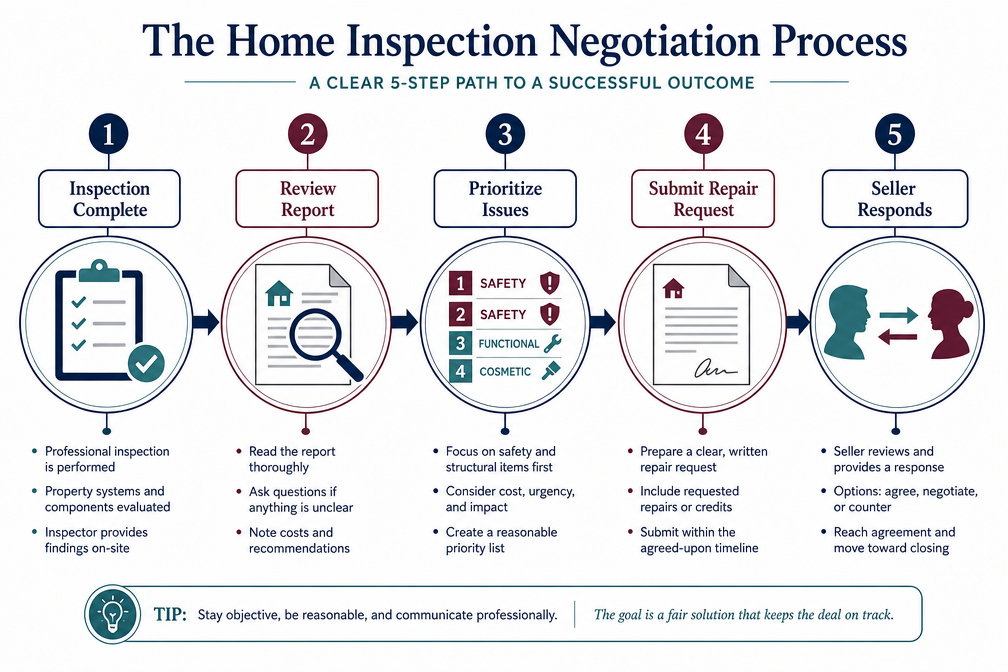
What buyers typically request:
- Roof repairs or full replacement if the inspector flagged end-of-life shingles
- HVAC servicing or replacement for systems that are failing or already dead
- Electrical panel upgrades, especially older fuse boxes or double-tapped breakers
- Plumbing repairs for active leaks, failed water heaters, or galvanized pipe issues
- Foundation cracks or structural concerns that affect the home's integrity
- Pest or termite damage found during or after the inspection
- Mold remediation in areas the inspector flagged
- Safety items like missing handrails, inoperable smoke detectors, or broken GFCI outlets
What rarely moves the needle:
- Cosmetic issues like scuffed walls, worn carpet, or dated fixtures
- Normal wear and tear on a home that was priced accordingly
- Items clearly visible before the offer was made
The home inspection negotiation is most effective when the buyer prioritizes. Sending a 40-item repair request signals inexperience and annoys sellers. Sending a focused list of five to seven legitimate concerns signals a buyer who knows what they are doing. For more on how to approach this from the buyer side, the First Time Home Buyer Tips: A Real Estate Agent's Full Guide breaks down the full process.
Negotiate After Home Inspection: Nothing Is Mandatory, and Here Is What That Actually Means
This is the part nobody explains clearly. Negotiate after home inspection, nothing is mandatory, means the contract is the only document with teeth. The inspection report itself has no legal authority to force a seller to do anything.
Most purchase contracts include an inspection contingency. That clause gives the buyer a defined window, typically 7 to 14 days depending on the state and the contract, to complete inspections and submit a repair request addendum. The seller then has a set number of days to respond. They can agree to everything, agree to some items, counter with a credit, or say no to all of it.
What happens at each response:
- Seller agrees to repairs: a repair addendum is signed, and the work must be completed before closing
- Seller offers a credit: the buyer receives cash at closing to handle the work themselves
- Seller counters: negotiations continue until both parties agree or the contingency period expires
- Seller refuses everything: the buyer decides whether to proceed as-is, renegotiate the price, or exit the contract
The inspection contingency is the buyer's protection. Without it, walking away means losing earnest money. With it active, the buyer can cancel and get that money back if the seller refuses to budge on legitimate concerns.
One thing sellers sometimes do not realize: refusing all requests is a legal right, but it is also a risk. If the buyer walks, the seller has to relist, disclose the known issues from the inspection, and start over. In a slow market, that is an expensive decision.
Do You Have to Accept Home Inspection Results
Neither side has to accept anything. Buyers do not have to accept a home with problems they find unacceptable. Sellers do not have to fix those problems. The inspection results are information, not a verdict.
What the buyer does have to accept is the timeline. The inspection contingency has a deadline. If the buyer does not submit a repair request or notice of cancellation within that window, they typically waive the contingency and lose the right to negotiate based on inspection findings. Missing that deadline is one of the most expensive mistakes buyers make.
Sellers, on the other side, have their own acceptance question. If a seller accepts an offer and the buyer's inspection turns up a major defect the seller knew about but did not disclose, that is a different situation entirely. Most states require sellers to disclose known material defects. Failing to do so can create legal exposure that goes well beyond the negotiation table.
Can Sellers Refuse to Negotiate After Inspection
Yes, sellers can refuse to negotiate. There is no law that requires a seller to respond to a repair request with anything other than a flat no. This happens more often in competitive markets where the seller knows another buyer is waiting.
That said, refusing to negotiate entirely is a calculated risk. A buyer with an active inspection contingency can cancel. The seller then faces:
- Mandatory disclosure of the known defects to future buyers
- A relisting that buyers will notice has been on the market before
- The possibility that the next buyer finds the same issues and makes the same requests
When sellers are most likely to refuse:
- Multiple offers are still active or backup offers exist
- The home is priced below market and the seller knows it
- The requested repairs are cosmetic or minor
- The seller already priced the home to reflect its condition
When sellers are more likely to negotiate:
- The home has been sitting on the market
- The inspection found legitimate safety or structural issues
- The buyer's lender requires certain repairs before funding the loan
- The seller needs to close by a specific date
How Long Do You Have to Negotiate After a Home Inspection
The negotiation window is set by the contract, not by law, and it varies by state and by how the offer was written. Most standard contracts give buyers 7 to 14 days to complete inspections and submit requests. After the buyer submits a repair request addendum, the seller typically has 3 to 5 days to respond.
The clock matters. Once the inspection contingency period expires without action, the buyer has generally waived their right to negotiate based on inspection findings. At that point, the only way to exit without losing earnest money is through another contingency, like financing or appraisal.
If both parties need more time to negotiate, they can agree in writing to extend the contingency period. This is common when a major issue is discovered and both sides want time to get contractor estimates before deciding how to handle it.
Should You Negotiate Repairs or Ask for a Credit at Closing
A closing credit instead of repairs is often the smarter move for buyers, and here is why: when a seller arranges repairs, the buyer has no control over who does the work, what materials are used, or whether the job is done correctly. A credit puts cash in the buyer's hands at closing to hire their own contractor.
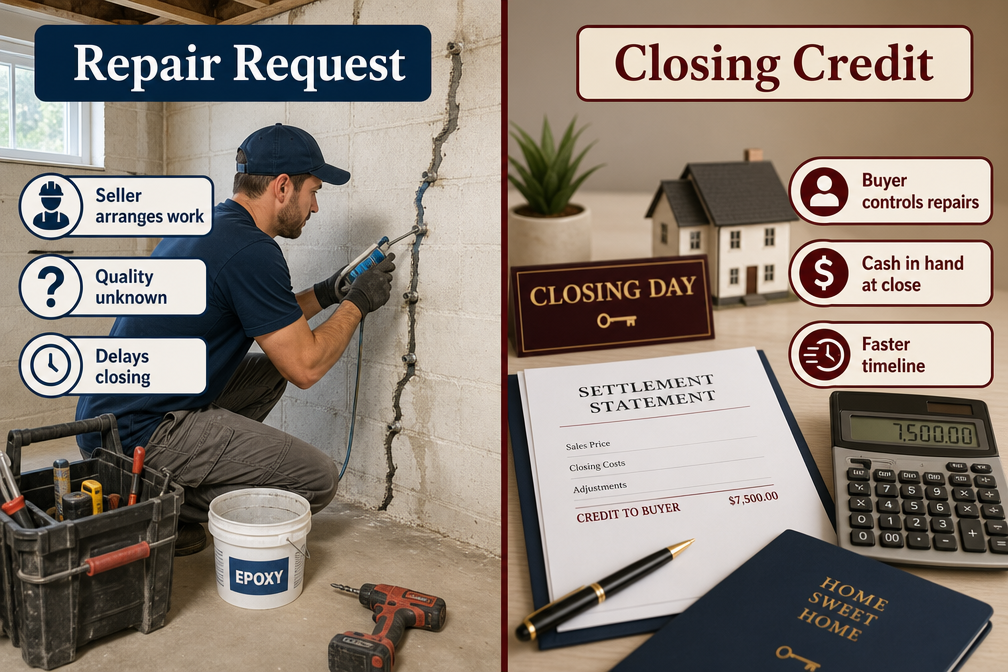
Choose a repair request if:
- The issue must be fixed before your lender will fund the loan (FHA required repairs, for example)
- The problem is a safety hazard that cannot wait, like an active gas leak or exposed electrical wiring
- You want the seller to carry the cost and risk of the work before you take ownership
Choose a closing credit if:
- You want to control the quality and timing of the repairs
- The seller is agreeable to a credit but resistant to managing contractors
- You plan to renovate anyway and can bundle the repair into a larger project
- The repair is cosmetic or non-urgent
One practical note: lenders have to approve credits. Most conventional loans cap seller credits at 3% of the purchase price for buyers putting down less than 10%, and up to 6% for buyers putting down 10% to 25%. FHA loans cap seller concessions at 6%. If the credit you are asking for exceeds those limits, the lender will not allow it and the deal structure has to change.
For more detail on how seller credits work, the Home Seller Credit Buyers Ask For Most is a useful resource on exactly this topic.
What Is a Reasonable Inspection Repair Request
A reasonable home inspection repair request focuses on safety, structural integrity, and items that affect the home's habitability or financing. Asking a seller to fix a cracked outlet cover is not reasonable. Asking them to address a roof with three years of life left on a 30-year-old house is.
Reasonable requests, ranked by weight:
- Active water intrusion or roof leaks
- Structural concerns, including foundation cracks, sagging floors, or compromised load-bearing walls
- Electrical hazards, including outdated panels, aluminum wiring in living spaces, or double-tapped breakers
- HVAC systems that are non-functional or at end of life
- Plumbing failures, including active leaks, failed water heaters, or drain backups
- Pest damage, especially if termites have compromised structural wood
- Safety code violations, including missing handrails on stairs, inoperable smoke detectors, or GFCI outlets absent near water sources
Not reasonable in most cases:
- Painting over scuffs or nail holes
- Replacing carpet that is worn but functional
- Upgrading appliances that work but are old
- Fixing anything the buyer saw during the showing and made an offer anyway
The goal of a home inspection repair request is to address items the buyer could not reasonably have known about before the offer. If it was visible during the walkthrough and the buyer offered full price anyway, asking the seller to fix it after the fact is a tough sell.
What Fails a Home Inspection and What Does Not
Nothing technically "fails" a home inspection the way a car fails an emissions test. Home inspectors report conditions, not pass-or-fail grades. The inspector's job is to describe what they found, not to tell anyone whether to buy the house.
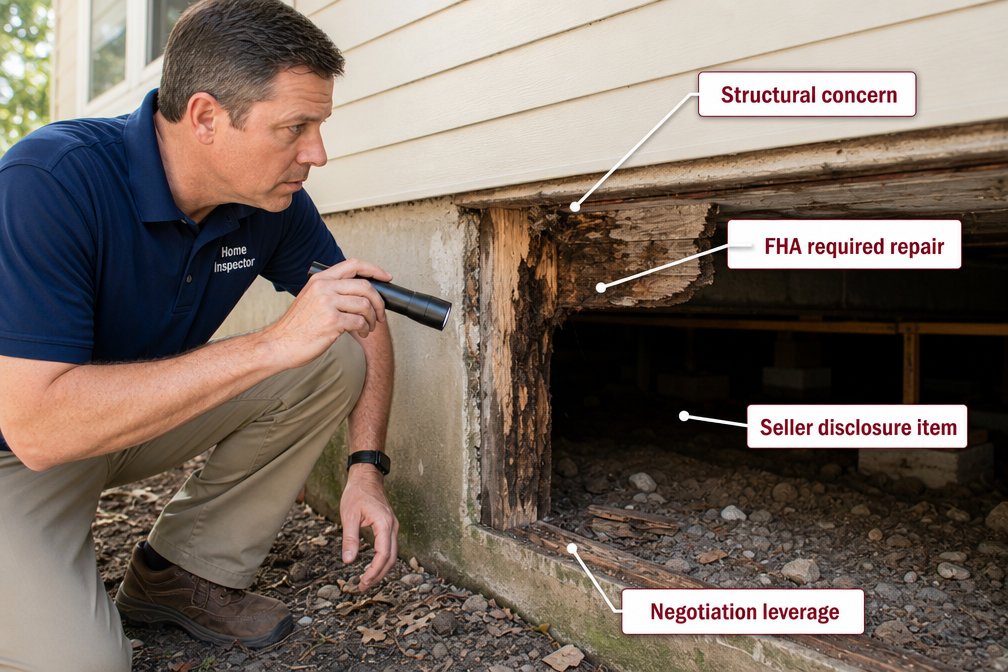
Items inspectors flag as significant concerns:
- Roof damage, missing shingles, or evidence of active leaks
- Foundation cracks, especially horizontal cracks in block foundations
- Electrical panels with known safety issues (Federal Pacific Stab-Lok, Zinsco, double-tapped breakers)
- Knob-and-tube or aluminum branch circuit wiring
- Evidence of mold or moisture intrusion in crawl spaces or basements
- Non-functional HVAC, water heater, or major appliances
- Structural wood damage from pests or rot
FHA required repairs are a separate category. FHA loans have minimum property standards, and if the appraiser or inspector flags certain items, the lender will require them fixed before funding. Common FHA required repairs include peeling paint on pre-1978 homes (lead paint concern), broken windows, missing handrails, non-functional utilities, and roof issues with less than two years of remaining life. These are not optional if the buyer is using FHA financing.
Can You Get a Second Home Inspection Before Negotiating
Yes, buyers can get a second home inspection, and in some situations it is worth every dollar. A general home inspector covers the whole house but may not be a specialist in every system. If the first inspector flagged something significant, like a foundation issue, signs of mold, or an aging electrical panel, bringing in a specialist before negotiating gives the buyer real numbers to work with.
When a second inspection makes sense:
- The first inspector flagged a possible foundation problem but could not confirm the extent
- There is evidence of past water intrusion and the buyer wants a mold test
- The roof is near end of life and the buyer wants a roofing contractor's estimate before asking for a credit
- The HVAC system is old and the buyer wants a mechanical contractor's assessment
A specialist's written estimate transforms a vague inspection finding into a dollar amount. That number becomes the basis for a specific, defensible repair request or credit ask. "The inspector noted roof concerns" is weak. "A licensed roofing contractor quoted $14,500 for a full replacement" is powerful leverage.
What Happens If the Seller Won't Fix Anything After Inspection
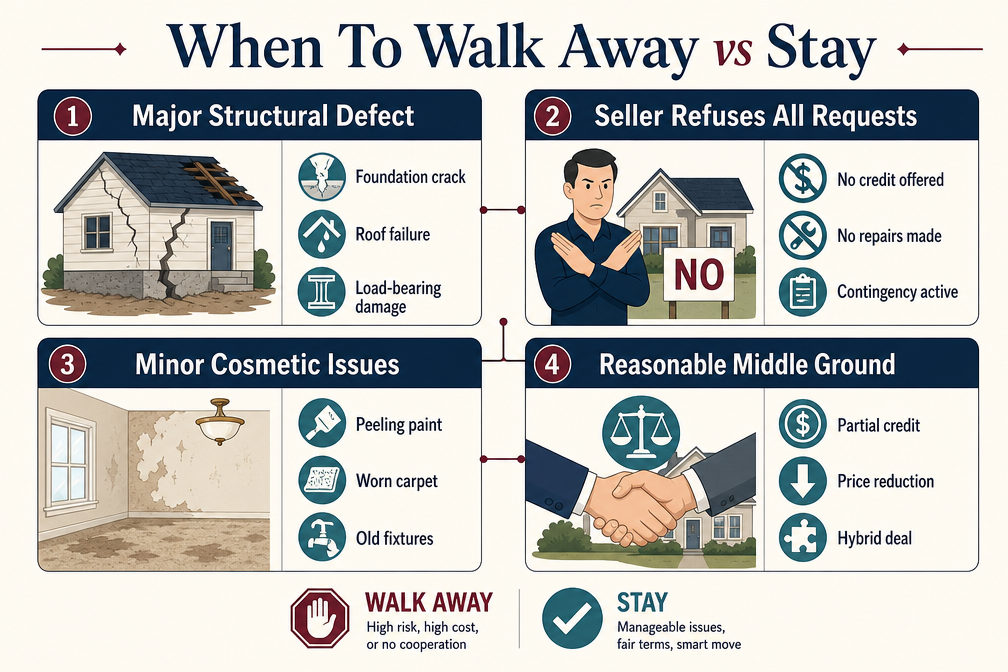
If the seller refuses all repair requests and the inspection contingency is still active, the buyer has three options: accept the home as-is, renegotiate the price instead of requesting repairs, or cancel the contract and get their earnest money back.
Option 1: Accept as-is. The buyer proceeds knowing the issues exist and plans to address them after closing. This makes sense when the issues are minor, the price already reflects the condition, or the buyer has the cash and skills to handle the work.
Option 2: Renegotiate the price. Instead of asking the seller to fix anything, the buyer asks for a price reduction equal to the estimated repair cost. Some sellers who resist making repairs will agree to a price cut because it is cleaner and faster.
Option 3: Walk away. If the inspection contingency is active and the seller refuses to negotiate at all on legitimate safety or structural concerns, canceling is a legitimate choice. The buyer gets their earnest money back and moves on. For a deeper look at when walking away is the right call, Best Home Buying Company: What They Pay and When To Walk Away covers the exit math clearly.
Can a Buyer Walk Away After Inspection
Yes, a buyer can walk away after inspection without losing their earnest money, as long as the inspection contingency is still active and the cancellation is submitted within the contract's deadline. This is one of the most important protections in a purchase contract, and it is why waiving the inspection contingency to win a bidding war is a decision that deserves serious thought.
The inspection contingency is the buyer's exit ramp. It is not unlimited. Once the contingency period expires, or once the buyer signs a waiver removing it, walking away means forfeiting earnest money unless another contingency applies.
Situations where walking away is the right call:
- The inspector found major structural damage that the seller refuses to address or credit
- The cost to repair what was found exceeds what the buyer can absorb
- The seller's disclosure did not match what the inspection revealed
- FHA required repairs exist and the seller refuses to make them, making the loan unfundable
Situations where walking away is probably overreacting:
- The inspector found normal wear and tear on a 30-year-old house
- The issues are cosmetic and the buyer simply got cold feet
- The seller offered a partial credit and the buyer rejected it without countering
Is It Worth Negotiating Small Repairs After Inspection
Negotiating small repairs after inspection is usually not worth the friction. A repair request for $200 worth of caulking or a loose doorknob can irritate a seller enough to make them less cooperative on the items that actually matter. Good negotiation strategy means picking the battles that move the needle.
The threshold question: would the cost of this repair change your decision to buy the house? If the answer is no, leave it off the list. Focus the home inspection repair request on items that affect safety, structural integrity, or the ability to get financing.
One exception: if the seller is already being difficult and the buyer is looking for a reason to exit, a long list of small items can sometimes serve as a signal that the deal is not worth saving. But that is a different conversation than genuine negotiation.
For buyers who want to understand the full picture of what sellers are thinking during this process, Preparing Your Home for Sale in 2026 This Spring gives a clear look at how sellers prepare and what they expect when the inspection comes back.
Can You Renegotiate Price After Inspection Report
Yes, renegotiating the purchase price after an inspection report is a practical and often underused strategy. Instead of asking the seller to manage repairs, the buyer asks for a price reduction equal to the estimated cost of the work. The seller does nothing. The buyer handles everything after closing.
Why sellers sometimes prefer this:
- No contractor coordination before closing
- No risk of repair work delaying the closing date
- No disputes about the quality of work done
How to make it work:
- Get a written estimate from a licensed contractor for every item you plan to include
- Add those estimates and present a total to the seller
- Request a price reduction equal to that total, or close to it
- Be prepared to negotiate down from your ask
The math example: inspection finds a roof with two years of life left. A roofing contractor quotes $16,000 for replacement. The buyer asks for a $14,000 price reduction. The seller counters at $10,000. They meet at $12,000. The buyer closes, handles the roof on their own timeline, and chooses their own contractor. That is a clean outcome for both sides.
This approach also sidesteps the lender credit cap issue. A price reduction lowers the purchase price, which affects the loan amount, but it does not run into the same percentage caps that seller concessions do.
For buyers piecing together the full negotiation picture, Negotiation Power Moves: Save Thousands on Your Next Home covers the broader strategy with the kind of broker-level detail that is genuinely useful.
How to Write a Repair Addendum That Gets Results
A repair addendum is the formal document that lists what the buyer is requesting after the inspection. It becomes part of the contract once both parties sign it. Writing one that actually gets results means being specific, reasonable, and organized.
Structure of an effective repair addendum:
- Reference the property address and the original contract date
- List each requested item clearly, one per line
- Specify whether you are requesting repair, replacement, or a credit
- For credits, state the dollar amount
- Reference the inspector's report section or page number where the item appears
- Set a deadline for completion or agreement
What to avoid in a repair addendum:
- Vague language like "fix the roof" without specifying what work is needed
- Requesting items not mentioned in the inspection report
- Including cosmetic items alongside safety concerns (it dilutes the serious requests)
- Leaving the credit amount blank and expecting the seller to fill it in
Most real estate agents have a standard repair addendum form. If the buyer is working without an agent, the state's real estate commission website typically has approved forms available. Using the right form matters because a handwritten list attached to an email does not have the same contractual weight as a properly executed addendum.
Conclusion
The home inspection is not the end of the deal. Negotiate after home inspection, nothing is mandatory, and that cuts both ways: sellers do not have to fix anything, and buyers do not have to accept a house with problems they cannot live with. The inspection contingency is the clause that makes the whole thing work, and understanding its deadline is non-negotiable.
Actionable next steps:
- Read your contract today. Find the inspection contingency clause. Write down the exact deadline for submitting a repair request. Do not miss it.
- Prioritize the inspection report. Separate safety and structural concerns from cosmetic ones. Build your request around the first category only.
- Get contractor estimates before negotiating. A written quote turns a vague concern into a specific dollar number. That number is your leverage.
- Decide between repairs and a credit. If you want control over the quality of work, ask for a closing credit. If the lender requires the repair before funding, ask for the repair.
- Know your exit. If the seller refuses everything and the issues are legitimate, the inspection contingency lets you walk away with your earnest money. Use it if you need to.
For buyers still in the early stages of the process, the U.S. Home Buyers Market Trends in 2026 gives the current market context that shapes how much leverage buyers actually have right now. And if you want to understand what sellers are thinking on the other side of the table, Home Sellers Pricing Strategies: The 2026 Playbook That Actually Moves Properties is worth reading before you make your first request.
Give the process time before you judge the results. Inspection negotiations rarely resolve in one round. Be patient, be specific, and stay focused on the items that genuinely matter.
FAQ
Q: Does the seller have to fix everything on the inspection report?
No. Sellers are not required to fix anything found in an inspection report. The contract governs what happens, and most contracts give sellers the right to refuse all repair requests. The buyer's recourse is to negotiate, accept the home as-is, or cancel using the inspection contingency.
Q: What if the seller agrees to repairs but does them poorly?
The buyer should request proof of completion, including receipts and permits where required, before closing. A final walkthrough is the time to verify repairs were done. If the work is substandard, the buyer can request it be redone or ask for a credit instead.
Q: Can I ask for a price reduction AND a credit at the same time?
Yes, but lenders will scrutinize the total. A price reduction lowers the loan amount. A seller credit is a concession subject to lender caps. Combining them is possible but requires lender approval on the credit portion.
Q: What is an inspection contingency and how long does it last?
An inspection contingency is a clause in the purchase contract that gives the buyer a set number of days to complete inspections and negotiate based on the findings. The window is typically 7 to 14 days but varies by contract and state. Once it expires without action, the buyer generally waives the right to negotiate on inspection findings.
Q: Are FHA required repairs different from regular inspection requests?
Yes. FHA loans have minimum property standards set by the lender and HUD. If an appraiser or inspector flags a condition that violates those standards, the lender will require it fixed before funding the loan. These are not optional for FHA buyers. Common FHA required repairs include peeling paint on pre-1978 homes, broken windows, missing handrails, and roof issues with less than two years of life remaining.
Q: Can I walk away from a house after the inspection without losing my earnest money?
Yes, if the inspection contingency is still active and you cancel within the deadline, you get your earnest money back. If the contingency has expired or was waived, walking away typically means forfeiting the earnest money deposit.
Q: Is it better to ask for repairs or a closing credit?
A closing credit is usually better for buyers who want control over the quality and timing of the work. A repair request is better when the lender requires the fix before funding or when the issue is a safety hazard that cannot wait until after closing.
Q: What is a reasonable amount to ask for in a closing credit?
Base the credit on actual contractor estimates, not guesses. Get at least one written quote from a licensed contractor for each item. Ask for the full estimated cost. Expect the seller to counter lower. Meeting somewhere in the middle is the most common outcome.
Q: Can the seller counter my repair request?
Yes. Sellers can accept, reject, or counter any repair request. A counter might offer a smaller credit, agree to some repairs but not others, or propose a price reduction instead. Negotiations can go back and forth until both parties agree or the contingency period expires.
Q: What happens if the inspection reveals something the seller did not disclose?
Most states require sellers to disclose known material defects. If an inspection reveals a defect the seller knew about and did not disclose, the buyer may have legal recourse beyond the standard negotiation process. Consult a real estate attorney in that situation.
Q: Should I get a home warranty instead of asking for repairs?
A home warranty covers system and appliance failures after closing, but it does not replace the value of negotiating repairs for pre-existing defects. They serve different purposes. Asking the seller to include a home warranty as part of the negotiation is reasonable, especially on older homes. See Top 5 Best U.S. Home Warranty Companies for a comparison of current options.
Q: Can I negotiate after inspection on a new construction home?
Yes. New construction homes have inspections too, and buyers should absolutely get one. Builder defects are common, and builders are not exempt from negotiation. The process is similar: submit a list of items found, request repairs or credits, and negotiate from there.